Most teams discover their AI scribe bottlenecks during the first week of go-live, not from glossy demos. Working across different tech companies, I have seen small clinics get tripped up by three technical gotchas—FHIR-based EHR data push and role mapping, on-device audio capture with voice activity detection and speaker diarization, and CPT, ICD-10, HCC suggestions that actually line up with MEAT criteria. Physician burnout makes the stakes real, and ambient documentation is now mainstream in pilots and rollouts across large systems.
Gartner forecasts healthcare and life sciences AI software spending reaching $18.9 billion by 2027, up from $11.6 billion in 2024, which explains why new scribes keep appearing. I analyzed 15 platforms in this space, then narrowed to five that align with small-practice constraints—fast setup, predictable pricing, BAAs, and EHR export or integration. In minutes, you will learn which tools fit solo and 2–10 provider clinics, what to watch for contractually, and what the credible price bands look like in 2026.
What Are AI Scribes?
AI scribes are clinical documentation tools that convert spoken or typed encounters into structured progress notes, typically in formats like SOAP, DAP, or BIRP. Depending on deployment, they can operate as real-time dictation tools or ambient systems that passively capture conversations, with varying implications for accuracy, privacy, and compliance.
Best AI Scribes in 2026
By 2026, AI scribes span a wide range—from lightweight dictation tools to full ambient documentation platforms. This list focuses on options that work for small practices, where fast setup, predictable pricing, signed BAAs, and simple EHR export matter more than enterprise customization.
1. Twofold
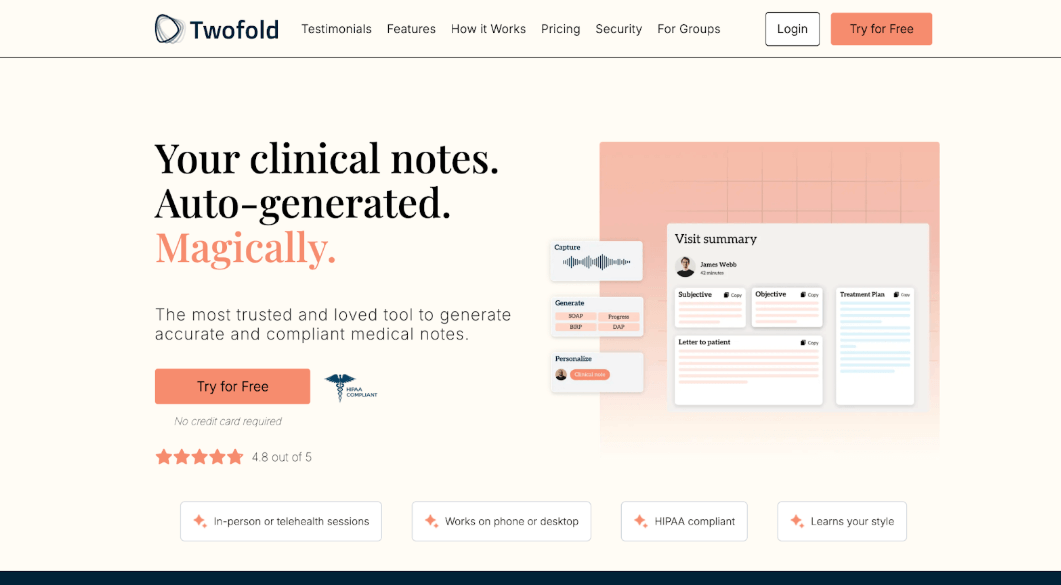
Twofold is an AI scribe focused on small practices, with real-time dictation and templated SOAP and progress notes. It includes a signed BAA, encryption, zero retention, audit logs, and EHR export.
Best for: Solo clinicians and small clinics that want fast setup, BAA by default, and simple EHR export.
Key features: HIPAA posture with BAA, real-time voice dictation, SOAP and specialty templates, audit trails, EHR export, zero retention.
Why we like it: Flat, predictable personal pricing and an iOS app make it easy to pilot without IT lift.
2. OrbDoc
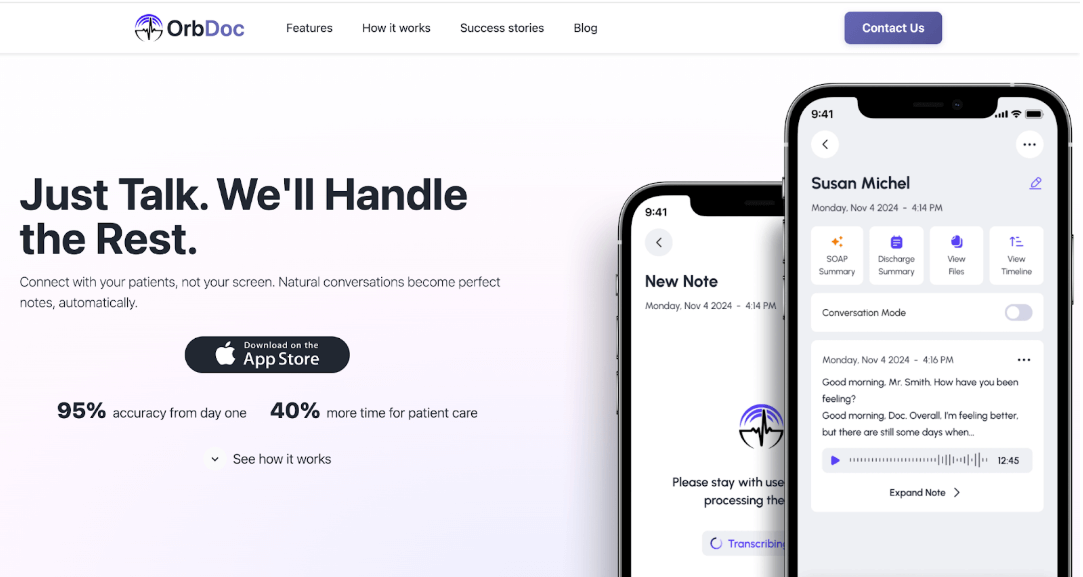
OrbDoc is built for small practices, emphasizing self-service setup and EHR integration. Its positioning centers on small-practice affordability and templates.
Best for: Small practices that want self-service onboarding with team workflows.
Key features: Real-time conversation capture, SOAP generation, team templates, EHR integration, mobile and web.
Why we like it: Clear small-practice focus, with a setup model that does not assume an IT department.
3. OmniMD Scribe AI
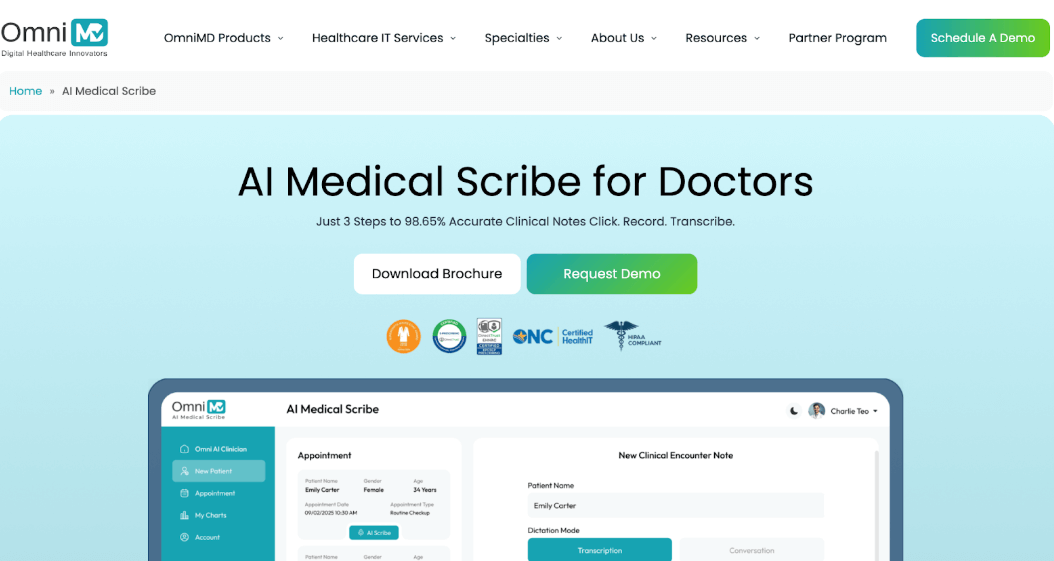
OmniMD Scribe AI is available in two configurations—integrated inside the OmniMD EHR or as a standalone scribe that works with external EHRs. It supports ambient capture with real-time speech-to-text, speaker diarization, multilingual processing, AI patient summarization, AI chart comparison, and FHIR or HL7-based interoperability.
Best for: Clinics already on OmniMD's EHR that want native scribing inside their charting workflow, or small practices seeking a standalone scribe that can post structured notes into other EHRs via SMART on FHIR or HL7.
Key features: Ambient documentation and real-time voice capture, multi-speaker diarization, multilingual support, AI-driven patient summaries, chart comparison, specialty packs, and SMART on FHIR or HL7 integration.
Why we like it: Deep native option for OmniMD EHR users plus a standalone mode for other EHRs, with explicit interoperability claims and specialty-tuned templates.
4. AI Clinical Scribe
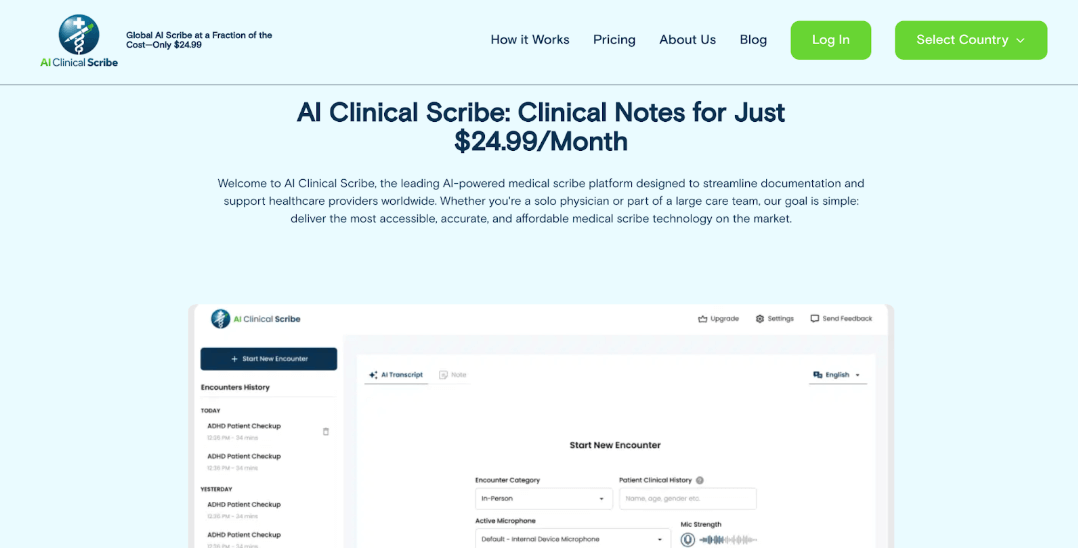
AI Clinical Scribe is a low-cost AI scribe emphasizing multilingual notes and quick EHR export. It supports nine languages and rapid note turnaround.
Best for: Cost-sensitive solo clinicians who want multilingual support.
Key features: Real-time transcription, multilingual notes, structured SOAP output, EHR export.
Why we like it: Lowest entry price observed through an independent channel, which is useful for quick solo pilots.
5. RevMaxx
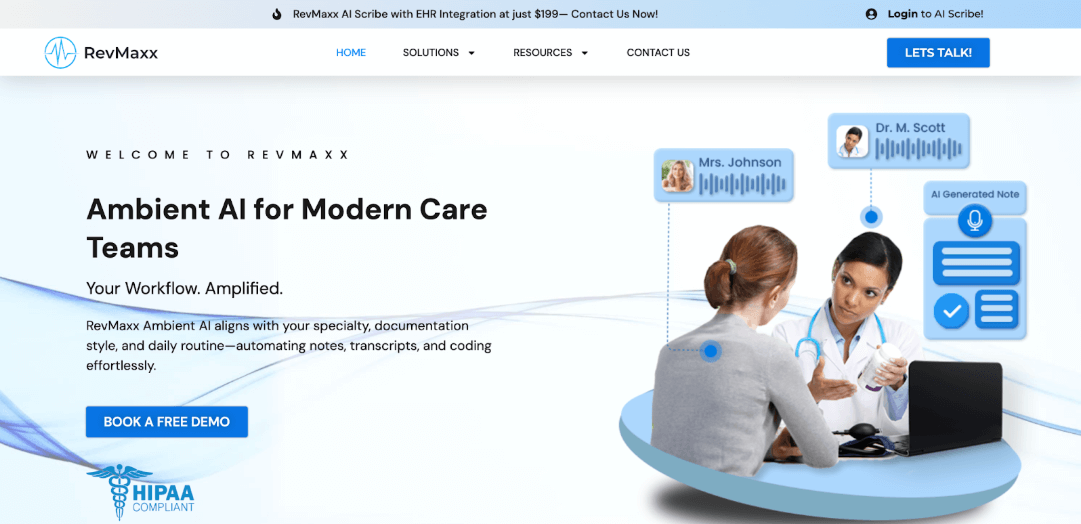
RevMaxx converts patient conversations into structured SOAP with automatic coding, and offers EHR integration and coding suggestions.
Best for: Small practices that want coding suggestions alongside the draft note.
Key features: Real-time capture, structured SOAP, ICD-10, CPT, HCC suggestions, EHR integration.
Why we like it: Emphasis on coding assistance can help small practices reduce missed revenue.
AI Scribe Tools Comparison: Quick Overview
This overview compares AI scribes across pricing transparency, free trial availability, and standout capabilities that affect pilot risk. It's designed to help small practices quickly narrow options before deeper technical or contractual review.
| Tool | Pricing Model | Free Option | Highlights |
|---|---|---|---|
| Twofold | Free option available. Personal Plan at $69/month (monthly) or $49/month (annually). Group prices are custom. | Yes | BAA included, zero retention (no audio stored), iOS app |
| OrbDoc | Not independently verified | Not independently verified | Small-practice focus, team templates, EHR integration |
| OmniMD Scribe AI | Custom quote | Not publicly posted | Integrated option inside OmniMD EHR and standalone mode for other EHRs, with SMART on FHIR or HL7, speaker diarization, multilingual, summaries |
| AI Clinical Scribe | Free Trial Multiple Languages; Individual Plan starting at $24.99/month | Yes | Multilingual support, fast note turnaround |
| RevMaxx | Third-party listing indicates $149 monthly | Vendor advertises trials, not independently verified | Structured SOAP, coding, EHR integration, pricing card on a directory |
AI Scribe Platform Comparison: Key Features at a Glance
Feature claims vary widely across AI scribe vendors, especially around BAAs, EHR integration, and real-time capture. This table highlights what is explicitly stated or verifiable, helping teams separate documented capabilities from marketing language:
| Tool | Real-Time Voice | BAA Stated | EHR Export/Integration |
|---|---|---|---|
| Twofold | Yes | Yes | Export |
| OrbDoc | Yes | Yes | Integration stated |
| OmniMD Scribe AI | Yes | Not publicly posted; confirm in contract | SMART on FHIR or HL7 integration |
| AI Clinical Scribe | Yes | Yes | Export stated |
| RevMaxx | Yes | Yes | Integration stated |
AI Scribe Deployment Options
AI scribes can be deployed through cloud apps, APIs, or EHR-embedded workflows, each with different setup effort and risk profiles. For small practices, deployment simplicity and rollback options are often more important than deep customization.
| Tool | Cloud API | On-Premise | Integration Complexity |
|---|---|---|---|
| Twofold | Yes | Not publicly verified | Low, export workflow |
| OrbDoc | Yes | Not independently verified for small practices | Moderate |
| OmniMD Scribe AI | Yes | Not publicly verified | Moderate outside OmniMD EHR; simpler inside OmniMD due to native integration |
| AI Clinical Scribe | Yes | Not publicly verified | Moderate outside OmniMD EHR; simpler inside OmniMD due to native integration |
| RevMaxx | Yes | Not publicly verified | Moderate, coding plus EHR hooks |
Common AI Scribe Challenges for Small Practices and How the Tools Help
Even well-designed AI scribes introduce practical challenges around time savings, compliance, integration, and cost control. This section connects common small-practice pain points with mitigation strategies grounded in clinical studies, vendor behavior, and federal guidance.
1. After-Hours Charting and Burnout
In multiple pilots, ambient documentation correlated with reduced burnout and time savings for many clinicians.
How each tool helps: Twofold, OrbDoc, OmniMD Scribe AI, AI Clinical Scribe, and RevMaxx all produce structured SOAP notes, so your pilot metric should be "minutes per note" and "after-hours minutes" before and after deployment.
2. HIPAA Risk, BAAs, and Data Retention
OCR guidance clarifies when BAAs are required and what counts as permissible use, and legal advisors warn about contracts that allow training on PHI without authorization.
How each tool helps: Pick a scribe that signs a BAA and commits to no PHI retention beyond processing, and that provides audit logs. Twofold and RevMaxx state BAA availability, making that a contracting requirement.
3. Integration Burden for Small Practices
ONC policy trends favor FHIR APIs and TEFCA network exchange, but many small clinics still need export and paste today.
How each tool helps: Twofold and AI Clinical Scribe support export workflows, RevMaxx and OrbDoc state EHR integration—verify with a 2-system test chart push and a rollback plan.
4. Cost Uncertainty
Independent guidance places typical ambient scribe costs in the roughly $100 to $600 per clinician monthly band, with some vendors lower and enterprise tools higher.
How each tool helps: AI Clinical Scribe and Twofold publish App Store pricing that allows small pilots with known ceilings. RevMaxx has a third-party listing with an indicative rate. For OrbDoc and ScribeAI Health, insist on a 90-day pilot clause and a month-to-month opt-out.
5. Note Quality and Safety
Studies show ambient notes can approach expert quality, but clinician review remains essential and hallucinations are a known risk.
How each tool helps: Require an approval step before the note leaves the scribe, and measure edit distance from draft to final during pilot weeks.
AI Scribe Strategic Decision Framework
Choosing an AI scribe is ultimately a risk and workflow decision, not just a feature comparison. This framework outlines the questions that most directly impact compliance exposure, real time savings, and long-term flexibility for small practices:
| Critical Question | Why It Matters | What to Evaluate | Red Flags |
|---|---|---|---|
| Does the vendor sign a BAA and restrict PHI use to TPO operations? | HIPAA requires BAAs for business associates and restricts PHI use | Contract terms on data use, model training, retention windows | No BAA, default PHI use for model training without authorization, weak breach terms |
| How will it integrate with your EHR? | Standards and policy now favor FHIR and TEFCA participation | SMART on FHIR, export, or RPA plans, mapping to USCDI v3 | Only copy-paste with no roadmap, or TEFCA only without FHIR option where APIs are requested |
| What will it actually save? | Independent data suggests real time back and burnout reduction in pilots | Baseline pajama time, target minutes per note, pilot success measures | Vague "saves hours" claims without measures |
| How do you control coding risk? | Coding hints can help, but hallucinations and over-coding are risks | Explainable code suggestions, MEAT checks, clinician review flow | Hidden edits, no audit trail |
The Bottom Line for Small Practices in 2026
Ambient documentation is no longer a novelty, and healthcare AI spending and adoption data confirm this is a durable trend, not a fad. For quick, low-risk pilots, the App Store pricing for Twofold and AI Clinical Scribe provides hard ceilings. If you need coding suggestions in the note, RevMaxx's positioning is attractive, but verify real integration in your EHR and seek third-party references. For team workflows across a small clinic, OmniMD Scribe AI and OrbDoc look promising from a feature perspective, yet both demand careful diligence due to limited independent reviews.
Anchor your decision on four checks: signed BAA and no PHI reuse, a simple EHR export or FHIR push test, time-saved metrics in week one, and an exit clause. These steps protect your time and money, and they align with current policy and clinical evidence about where ambient documentation delivers the most value.