
You think you know what "no code" means until your MVP launch week, when you are juggling auth, data modeling, and deploy pipelines. Working across different tech companies, teams often lose days on basics like Stripe webhooks, role based permissions, and staging to production sync. Most teams discover scope creep during handoff to marketing, not from sprint planning. In practical terms, the tools that save you are the ones that can scaffold CRUD over a real database, wire third party APIs like Stripe or HubSpot, and ship to the open web or mobile stores without a local setup.
The low code market is not a fad. Gartner projects low code development technologies to reach roughly 44.5 billion dollars by 2026, driven by democratized app building and hyperautomation, as summarized by InfoWorld's coverage of the forecast. This guide covers five core picks plus one rising newcomer that consistently balance speed, control, and value. You will learn where each tool fits, real pricing signals, and pitfalls that waste time or money, with third party sources throughout (InfoWorld on Gartner's forecast).
Lovable
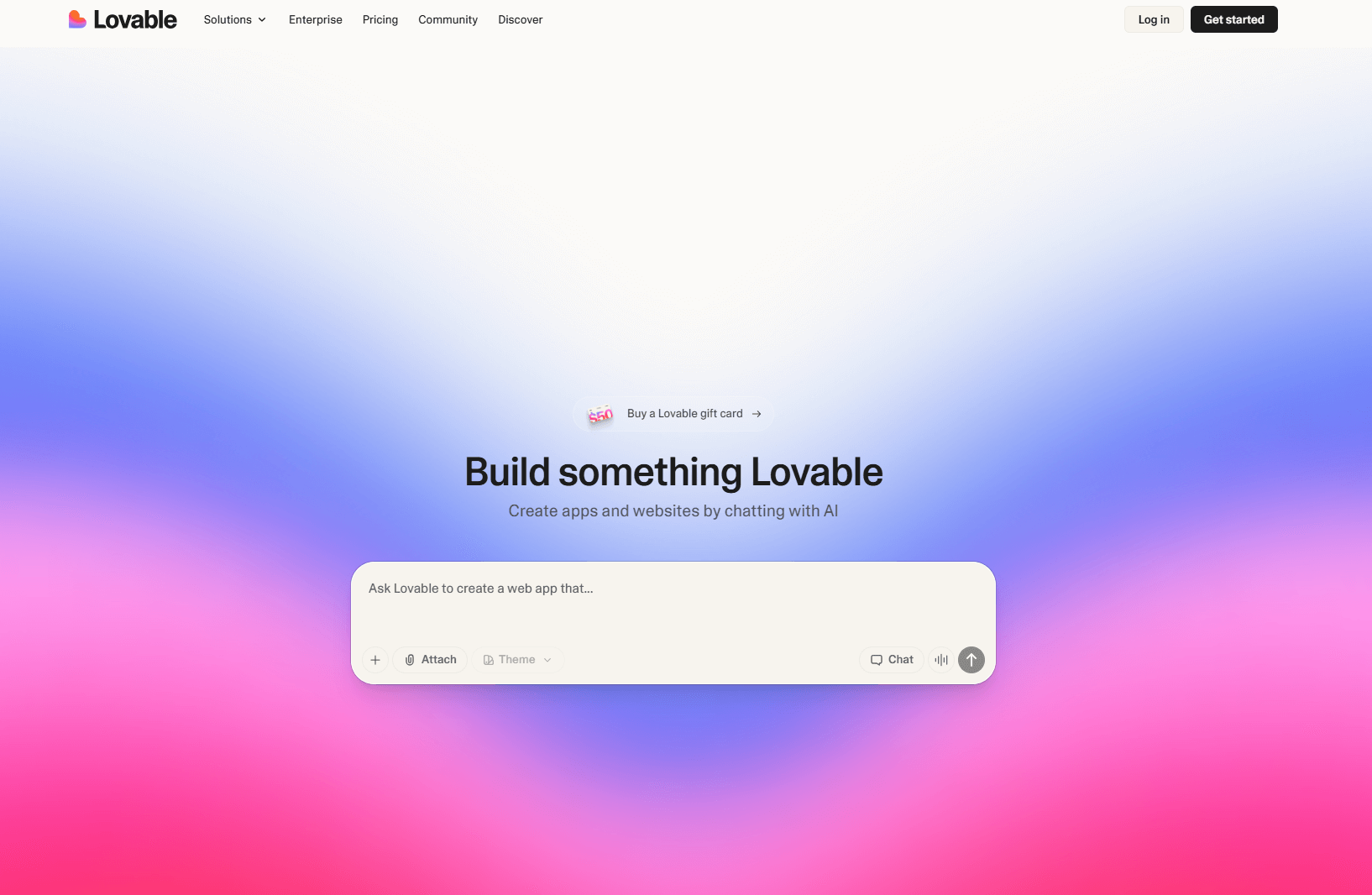
Chat based AI environment that turns prompts and screenshots into working web apps with live preview and code edits. It supports design to code workflows that many founders use for fast UI iterations.
Best for: Non technical founders and small teams who want idea to interactive prototype in hours, then export code or continue iterating with AI.
Key Features:
- Natural language to full stack code with live preview, plus GitHub export and code editing, per vendor documentation and recent coverage.
- Multi model approach that blends top AI models, noted in an interview with the CEO.
- Figma to code via Builder.io workflows has existed, though community threads report intermittent availability.
Why we like it: Time to first demo is fast, and you can keep momentum by fixing issues in the code editor without leaving the browser.
Notable Limitations:
- Recurrent complaints about credit consumption and billing clarity on Trustpilot and Reddit.
- Reports of inconsistent support responsiveness and stability during product updates from user threads.
- Platform abuse incidents, including campaigns hosting phishing on generated sites, have been documented by security press, which the company said it moved to mitigate.
Pricing: Multiple user reports list Pro at 25 dollars per month with 100 credits and Business at 50 dollars per month. Treat this as directional and confirm on the vendor's page, since independent pricing trackers do not consistently list Lovable tiers as of January 2026 (Trustpilot reviews, TechCrunch on scale and growth).
Bolt.new
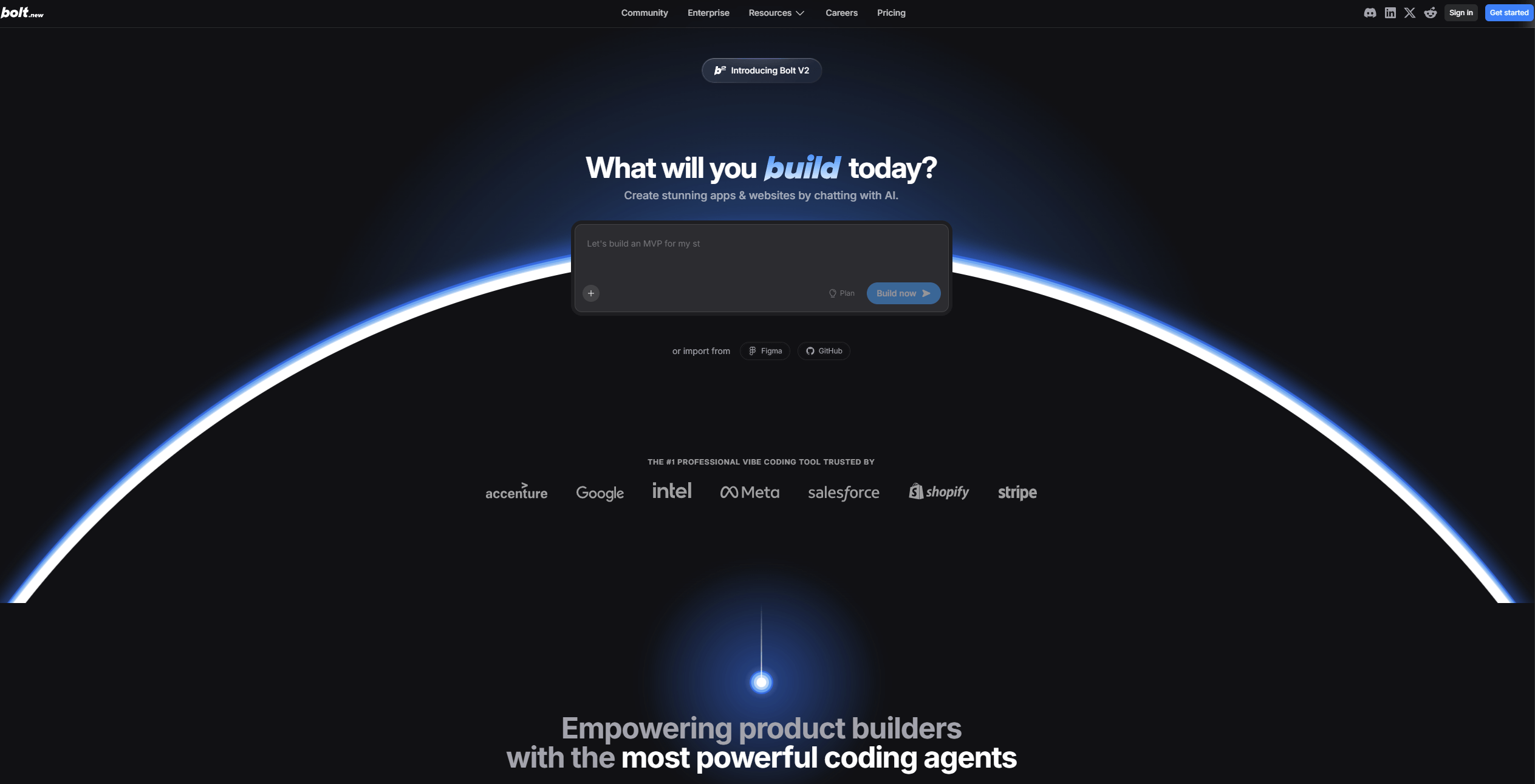
Browser based full stack app builder that generates, runs, edits, and deploys apps with WebContainers, no local setup. It evolved into an end to end stack with hosting, domains, auth, and payments.
Best for: Builders who want real code running in the browser, with GitHub export and infra baked in for web apps.
Key Features:
- WebContainers run a Node.js dev environment entirely in the browser, validated by StackBlitz technical docs and coverage.
- Shift in 2025 from "AI code only" to bundled hosting, domains, databases, serverless, auth, and Stripe powered payments.
- Rapid creation and deployment experience confirmed by hands on reporting.
Why we like it: It removes "works on my machine" friction, lets you prompt, debug, and deploy from the same tab, and exports clean repos.
Notable Limitations:
- Community reports of token management confusion and support delays across multiple threads.
- Occasional instability or build failures surfaced in user discussions.
- Pricing is token based, which can spike with heavy prompting, a pattern industry press flagged for AI coding services.
Pricing: Business media reported pricing changes in 2025, with Pro tiers ranging from 20 to 200 dollars per month based on token allowances. Independent reviews list Pro tiers at 20, 50, 100, and 200 dollars per month with rising token allowances. Confirm current tiers before committing (Business Insider on pricing shift and bundling, independent pricing summary).
Softr
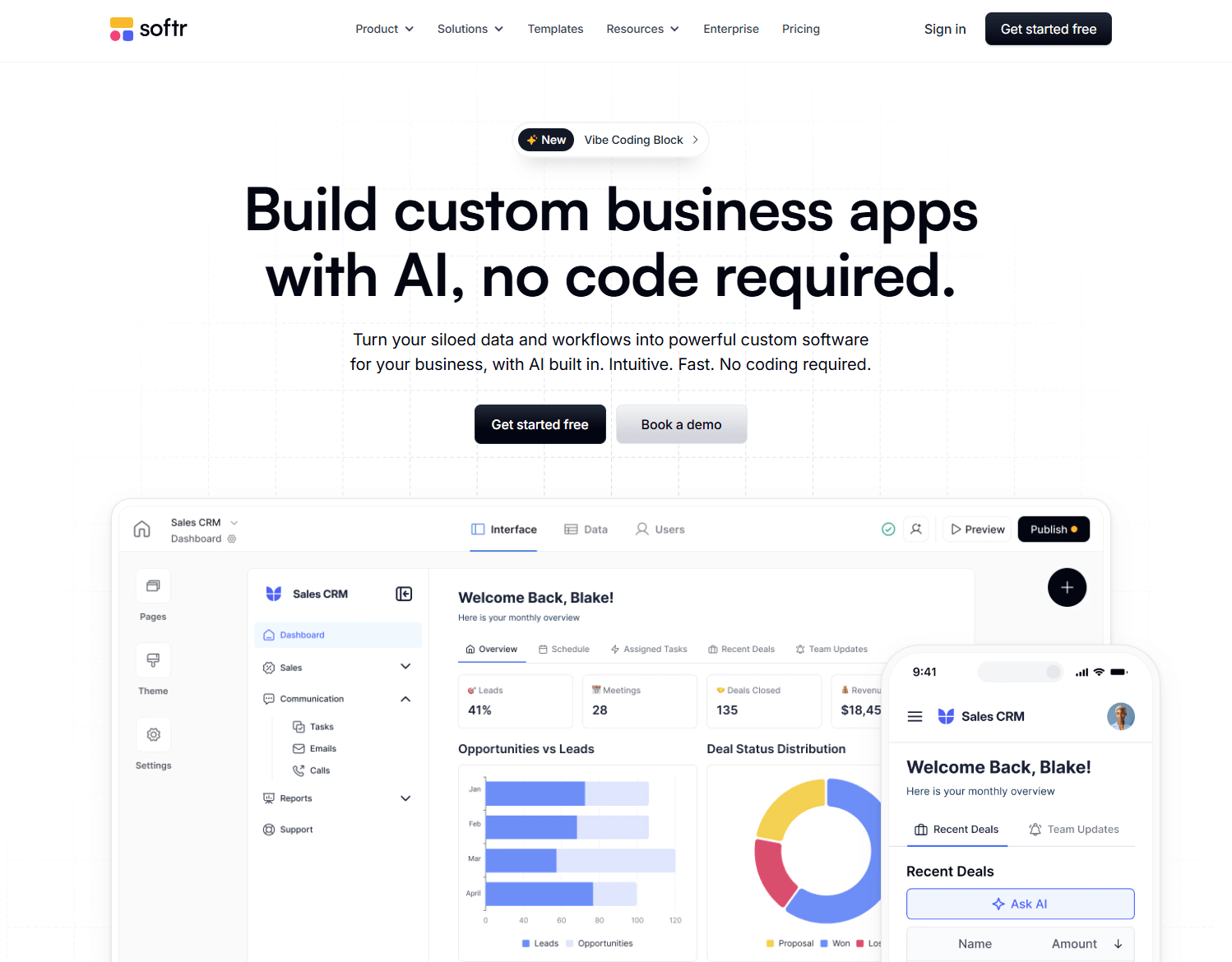
No code platform to turn data sources into portals and internal tools with drag and drop blocks and role based permissions. It now offers an AI assistant, Ask AI, that answers questions from live app data.
Best for: Operations, client services, and teams working off Airtable, Google Sheets, or SQL who need permissioned portals.
Key Features:
- Data agnostic approach beyond Airtable to Google Sheets and SQL databases, covered by TechCrunch.
- Ask AI reads live app data securely at the block level, with no API keys required, per docs.
- Templates, user groups, and granular visibility for client and staff views.
Why we like it: It is quick to stand up a real portal tied to your data with proper permissions, and the embedded AI helps non technical users query information safely.
Notable Limitations:
- Reviews cite limited design flexibility and performance dips with larger datasets.
- Plan limit changes have occurred, such as user caps on Business for new subscriptions, noted by the community.
Pricing: Third party listings show tiers such as Free, Basic at about 59 dollars per month, Professional at about 139 dollars per month, and Business at about 323 dollars per month. Check current terms and user caps before purchase (G2 pricing page, G2 reviews noting constraints).
Adalo
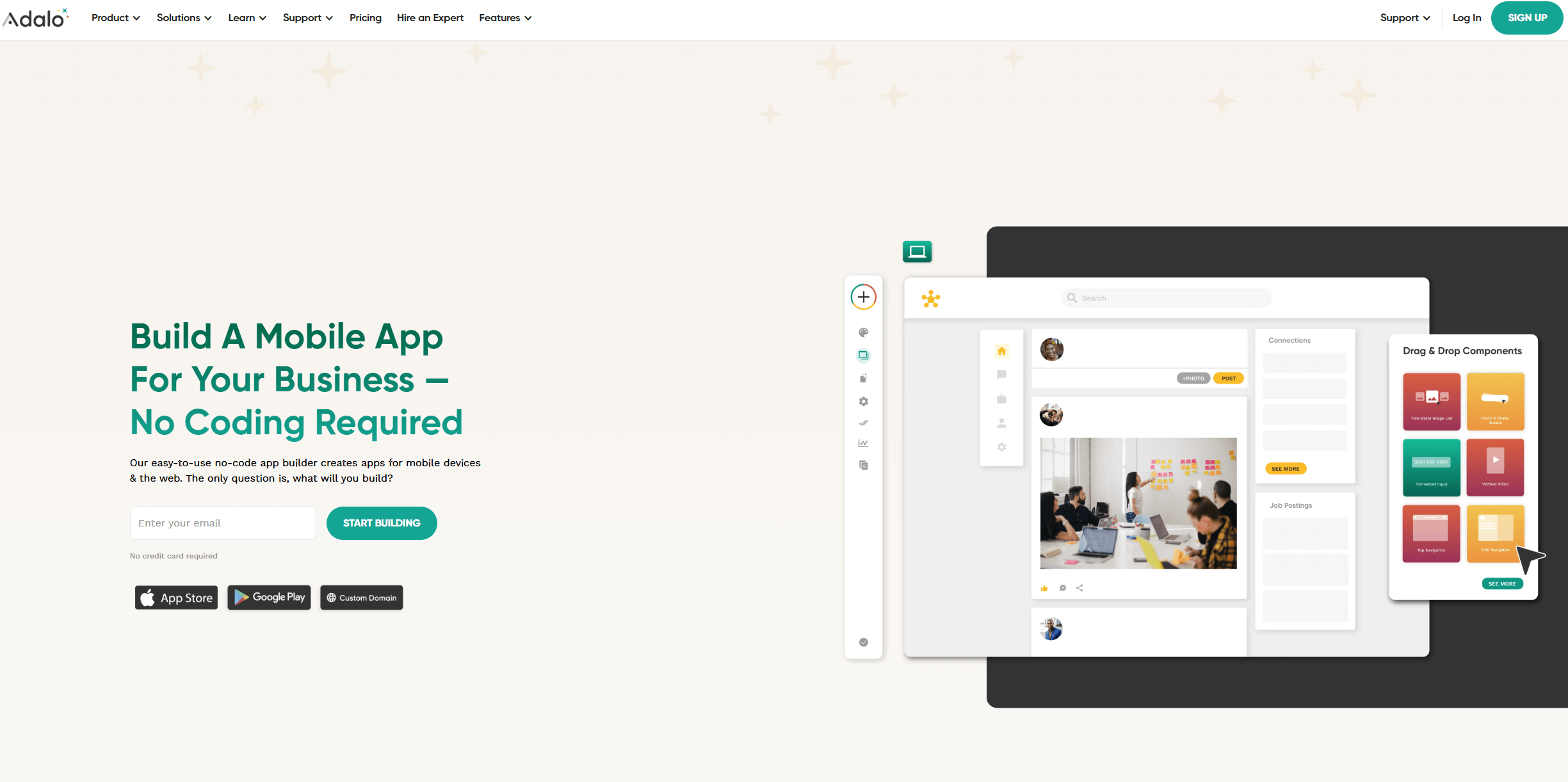
Drag and drop builder focused on mobile and web apps with a visual database, logic flows, and store publishing.
Best for: SMBs and creators who need to ship iOS, Android, and web from one project without writing native code.
Key Features:
- Visual editor with components and a built in database, widely referenced on review sites.
- Publishing to Apple App Store and Google Play via guided flows, per user reviews and platform materials.
- Integrations through marketplaces and connectors like Xano or REST APIs.
Why we like it: It remains one of the most approachable paths to a real mobile app, especially when the goal is store presence without a dev team.
Notable Limitations:
- Users report performance issues and constraints for complex apps compared with advanced competitors.
- Some dissatisfaction around past pricing changes, and design responsiveness concerns in community threads.
Pricing: Per vendor materials as of late 2025, tiers commonly shown are Free, Starter around 45 dollars per month, Professional around 65 dollars, Team around 200 dollars, and Business around 250 dollars. Verify the exact inclusions before paying, since aggregator sites can lag updates (Capterra reviews referencing features and publishing).
Appy Pie

No code app builder for mobile, web, and chatbots with AI generators for text to app and content creation.
Best for: Beginners and small businesses that need a basic app with templates and guided publishing.
Key Features:
- AI app generator offerings were announced and expanded through 2024 and 2025 press releases.
- Multi product AI suite for content, video, and design, as reported by industry newswires.
- Publishing support for both major app stores and guided submission resources.
Why we like it: The on ramps are simple, and the ecosystem covers mobile apps, chatbots, and basic content tools under one umbrella.
Notable Limitations:
- Reviews point to upsells, confusing charges, and mixed support experiences.
- Several third party reviews cite bugs and glitches that can slow down projects.
Pricing: G2 lists mobile app builder tiers like Basic at 16 dollars per app per month, Gold at 36 dollars, and Platinum at 60 dollars, with a free trial. Pricing varies across products and regions, so confirm the exact SKU and commitment before paying (G2 pricing, Capterra overview, recent PR on AI releases).
Base44
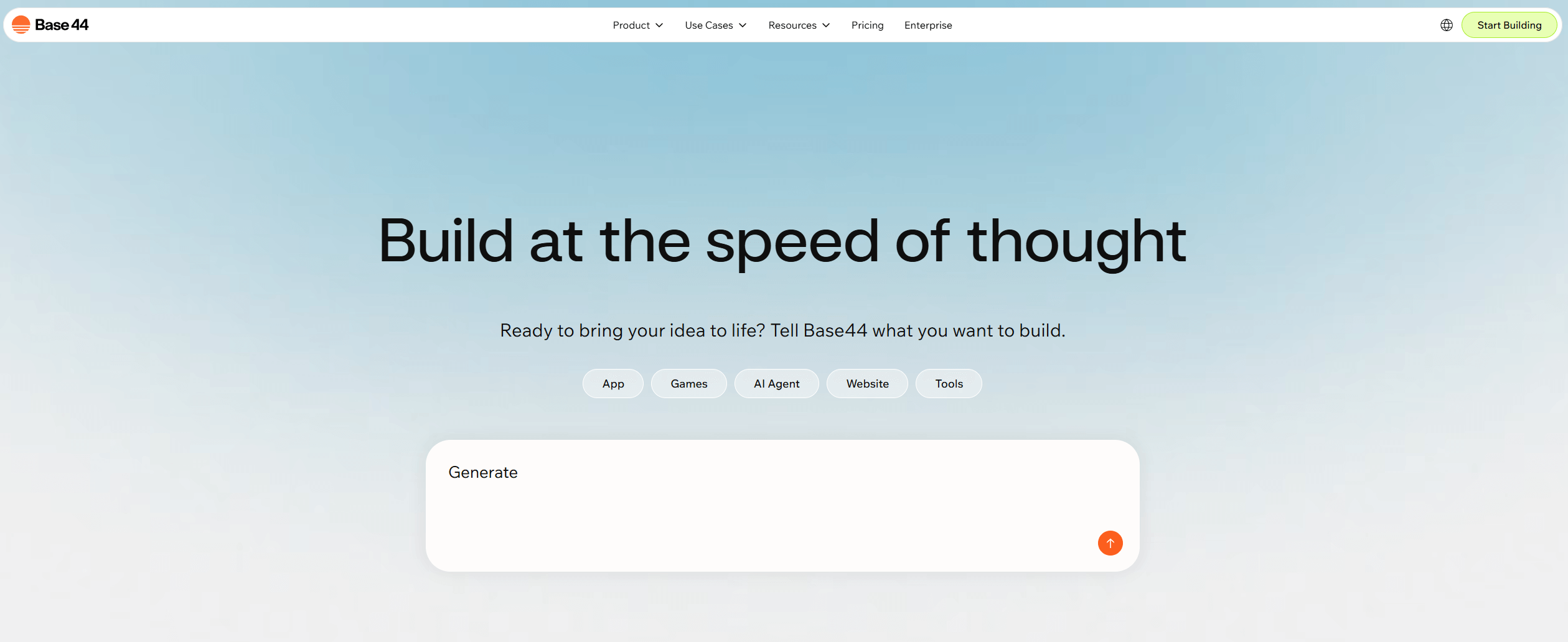
AI powered no code platform that builds functional web apps from prompts with a built in backend, auth, and deployment. In June 2025, Wix acquired Base44 for approximately 80 million dollars, providing enterprise grade infrastructure while maintaining its original platform.
Best for: Early stage founders and teams that want a credit based AI builder with integrated backend, domains, and analytics.
Key Features:
- Chat to app generation with backend functions and database, described by multiple third party reviews.
- Credit based usage with message credits for AI prompts and integration credits for API calls.
- GitHub integration and custom domains are commonly included on mid tier plans in public pricing pages.
Why we like it: It packages the backend, analytics, and hosting, so you can validate an idea without stitching services.
Notable Limitations:
- Credit ceilings can introduce variable cost and surprise overages, per independent agencies reviewing the platform.
- Platform dependency risk and reliability complaints appear in community threads.
Pricing: Independent summaries list Free, Starter around 16 to 20 dollars per month, Builder around 40 to 50, Pro around 80 to 100, and Elite around 160 to 200, often with annual discounts. Confirm quotas for message and integration credits before purchase (AI Daily overview, LowCode Agency review).
AI App Builders Tools Comparison: Quick Overview
| Tool | Best For | Pricing Model | Highlights |
|---|---|---|---|
| Lovable | Prompt to working web app for non technical founders | Credit based subscriptions | Multi model generation, code export, rapid live preview |
| Bolt.new | Browser based full stack dev with deploy | Token based plans plus bundled hosting | WebContainers run Node.js in browser, bundling hosting, domains, auth, Stripe |
| Softr | Data driven portals and internal tools | Tiered subscription | Data agnostic to Sheets and SQL, Ask AI for live data queries |
| Adalo | Mobile apps for iOS, Android, and web | Tiered subscription | Visual builder, marketplace components, store publishing flows |
| Appy Pie | Beginner friendly mobile apps and chatbots | Per app tiers | AI app generator and guided app store publishing |
| Base44 | Prompt to app with integrated backend and deployment | Credit based subscriptions | Message plus integration credits, GitHub and domain support |
AI App Builders Platform Comparison: Key Features at a Glance
| Tool | Gen from Prompts | Code Export | Built in AI Querying |
|---|---|---|---|
| Lovable | Yes | Yes, GitHub | Not stated as a separate feature |
| Bolt.new | Yes | Yes, GitHub | Not primary feature |
| Softr | Yes, AI assisted | N/A, no code platform | Ask AI over live data |
| Adalo | AI assisted scaffolding reported by vendor | N/A | Not primary feature |
| Appy Pie | Yes, AI app generator | N/A | Not primary feature |
| Base44 | Yes | GitHub on higher tiers | Not primary feature |
Sources: platform announcements and third party coverage cited above, including TechCrunch for Softr's data agnostic shift, and Business Insider for Bolt's bundled stack.
AI App Builders Deployment Options
| Tool | Cloud API | On Premise | Integration Notes |
|---|---|---|---|
| Lovable | Yes | Not publicly offered | Credits based usage and hosted deploy options, per user reports and coverage |
| Bolt.new | Yes | Enterprise options discussed in media | Uses partner infra for deploy, WebContainers for dev |
| Softr | Yes | Not publicly offered | Connects to Sheets and SQL, with role based permissions |
| Adalo | Yes | No | Publishes to iOS and Android stores per reviews |
| Appy Pie | Yes | No | Broad template ecosystem and store submission guides |
| Base44 | Yes | Enterprise custom, confirm directly | Credits apply to integrations per public overviews |
AI App Builders Strategic Decision Framework
| Critical Question | Why It Matters | What to Evaluate |
|---|---|---|
| How predictable is cost under heavy iteration? | AI builders meter prompts or tokens, which can spike costs | Credit or token math, rollover rules, overage behavior |
| Does the tool fit your data topology? | Portals and internal tools live on data integrity | Native connectors, SQL support, permission granularity |
| Can you exit with your code or data? | Reduces vendor lock in risk | GitHub export, schema portability, API coverage |
| What is the deploy story? | Time to live app and production hygiene | Domains, SSL, staging, rollbacks, observability |
AI App Builders Solutions Comparison: Pricing and Capabilities Overview
| Organization Size | Recommended Setup | Monthly Cost |
|---|---|---|
| Solo founder testing an idea | Lovable Pro or Base44 Starter for fast prompts, or Bolt.new entry tier for code export | 16 to 25 dollars typical entry pricing |
| Ops team building a portal | Softr Professional or Business, tied to Sheets or SQL | About 139 to 323 dollars plus data costs |
| SMB shipping mobile app | Adalo Professional or Team, or Appy Pie mid tier for store support | 36 to 200 dollars for respective plans |
| Startup with dev on staff | Bolt.new Pro 50 to 200 dollars tiers, or Base44 Builder to Pro | 40 to 200 dollars, usage dependent |
Problems & Solutions
-
Problem: "We must launch a customer portal on top of spreadsheets in one week."
- Softr: Drag in list, table, and form blocks, connect Google Sheets or SQL, set user groups and visibility, then toggle Ask AI so managers can query live data. This workflow and Softr's data agnostic expansion were covered in 2025 reporting, and Ask AI's security model is described in help docs (TechCrunch on Softr's shift, Ask AI docs).
- Value tip: Start with a single permissions model and a minimal set of blocks to avoid performance dips noted in user reviews.
-
Problem: "We need a demoable web app by Monday, no local dev setup allowed."
- Bolt.new: Prompt the stack, run and debug inside WebContainers, then deploy with bundled hosting and connect Stripe. The bundling and pricing structure are reported by business media, and hands on tests have shown same day shipping possible.
- Value tip: Keep prompts tight to reduce token burn, a common complaint in community threads.
-
Problem: "Give me an MVP with polished UI from design, not dev."
- Lovable: Convert screenshots and, when available, Figma via Builder.io workflows into working code, then iterate with AI. Growth and direction are covered by tech press, and Figma workflow discussions are visible in user threads. Caveat that the integration has been intermittent per community reports.
- Value tip: Budget credits for refactors, and consider exporting to GitHub if you expect heavier custom code.
-
Problem: "We must be in both app stores with minimal engineering."
- Adalo and Appy Pie: Both are commonly used for iOS and Android publishing flows. Reviews and third party pages confirm store oriented features and guided submission. Be alert to reports of upsells and billing complexity on Appy Pie, and performance or feature constraints on Adalo for complex apps.
- Value tip: Factor Apple's 99 dollars per year and Google's one time 25 dollars developer fees into your budget, and keep templates simple for first approval.
-
Problem: "We want a built in backend and credit based scale during ideation."
- Base44: Use prompt to app with integrated auth, database, analytics, and domains, then watch message and integration credit consumption. Independent reviews outline the plan structure and credit concepts, and community threads warn about billing experiences to vet before scale up.
Bottom Line: Pick Speed, Control, or Predictability - not all three
If you value raw speed from prompt to product, Lovable and Bolt.new can be game changing, with the tradeoff of credits or tokens and occasional instability reflected in community posts and press tests. If you need predictable portals and permissions tied to business data, Softr's data agnostic direction and built in Ask AI make it a pragmatic pick for 2026. For store presence without engineers, Adalo and Appy Pie remain viable starting points, though reviews advise caution on performance and billing. The broader market momentum is clear, with low code spending tracking toward 44.5 billion dollars by 2026, so expect faster AI assisted scaffolding across all these tools over the next year.
Always trial on the free tier, read recent third party reviews, and run a cost test under realistic prompt volume before committing to annual plans.
