
If you are a healthcare professional overwhelmed by documentation, you are far from alone. By 2026, clinical workloads have only intensified, yet documentation requirements continue to expand. Many clinicians still spend a substantial portion of their day charting, reviewing notes, and correcting records instead of engaging with patients. Traditional note taking methods and basic digital tools struggle to keep pace with modern care delivery while meeting strict privacy and security expectations.
The impact is felt everywhere. Notes are rushed between appointments, evenings are spent catching up on charts, and patient interactions are shortened to keep schedules moving. At the same time, the stakes around data protection have never been higher. Compliance failures and privacy violations can carry serious consequences for both providers and organizations. Clinicians need tools that reduce documentation burden without introducing new risk.
AI powered, HIPAA compliant note taking tools are increasingly filling that gap. These systems listen during clinical encounters, generate structured notes, and integrate directly into existing workflows while keeping patient data protected. This guide focuses on the tools healthcare teams are actually using in 2026 to save time, improve documentation quality, and restore focus on patient care.
Summary Comparison Table
| Tool | Best For | Key Features | Deployment Time |
|---|---|---|---|
| Twofold Health | AI Medical Scribing | Real-time clinical note generation, EHR integration, voice-to-text | Quick |
| DeepScribe | Ambient AI Documentation | Real-time conversation capture, 98.8/100 KLAS rating, eliminates after-hours charting | Quick |
| Suki AI | Voice-Enabled Clinical Assistant | Natural language processing, Epic/Cerner integration, voice commands | Quick |
| AssemblyAI | Developer API Integration | Speech-to-text API with diarization, 99+ language support, developer-focused | Moderate |
| NexHealth | Patient Engagement Platform | EHR integration, patient communication, practice management | Quick |
| Abridge | Clinical Conversation AI | Clinician-reviewed content, SOC2 Type 2 certified, bias minimization | Quick |
| Heidi Health | Global Clinical Documentation | Multi-specialty support, 50+ countries, free tier available | Quick |
| Carepatron | Practice Management Suite | All-in-one platform, scheduling, billing, note-taking integration | Moderate |
Twofold Health — AI Medical Scribe Excellence
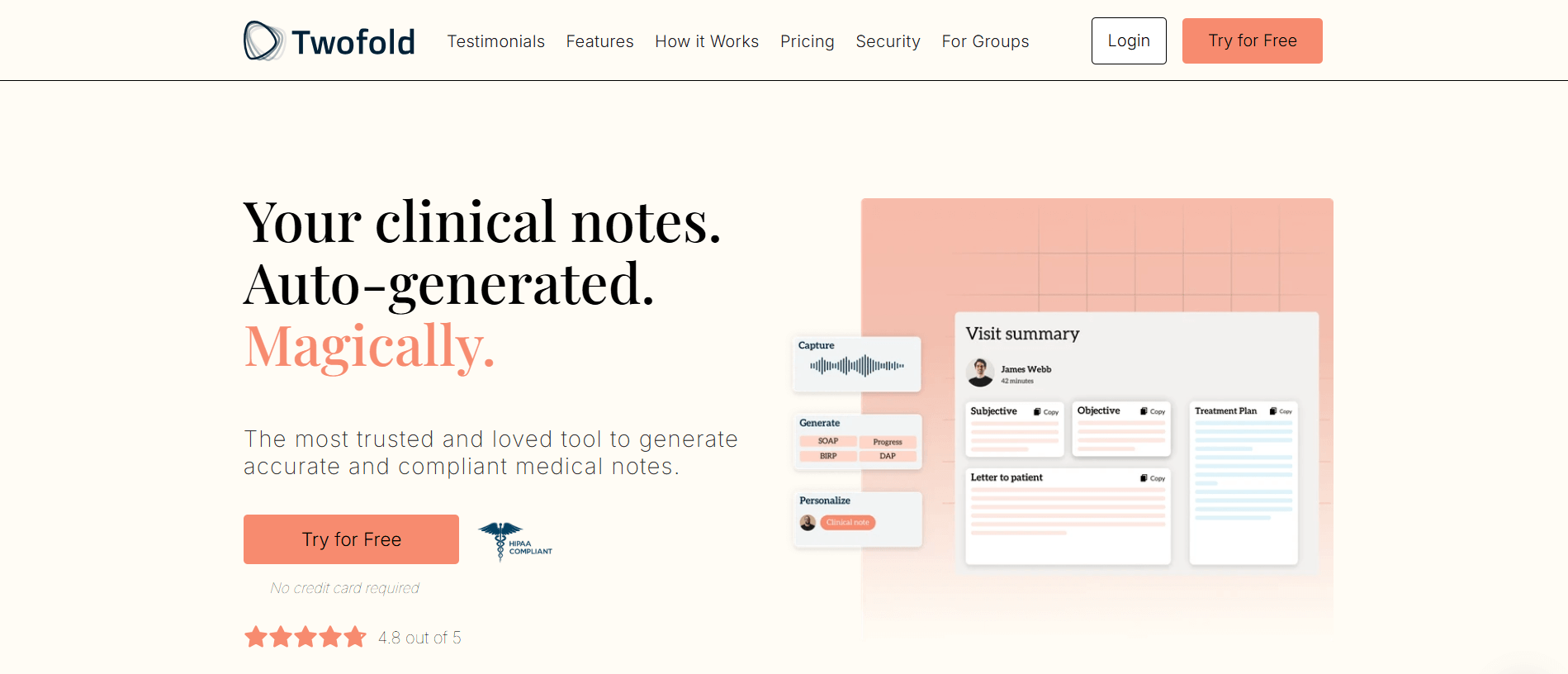
Best for: Clinicians seeking accurate, fast clinical note generation
Twofold Health's top-rated AI medical scribe generates accurate clinical notes in seconds — HIPAA-compliant, trusted by thousands of clinicians daily. Unlike generic note-taking apps, Twofold is specifically designed for healthcare settings, focusing on medical terminology accuracy and clinical workflow integration.
Key Strengths:
- Generates clinical notes in seconds
- Trusted by thousands of clinicians
- Medical-grade accuracy for healthcare terminology
- Seamless EHR integration capabilities
Deployment: Quick setup with healthcare-focused interface requiring minimal training time.
Considerations: Primarily designed for medical settings, may not suit general business applications.
DeepScribe — Ambient AI Platform Leader
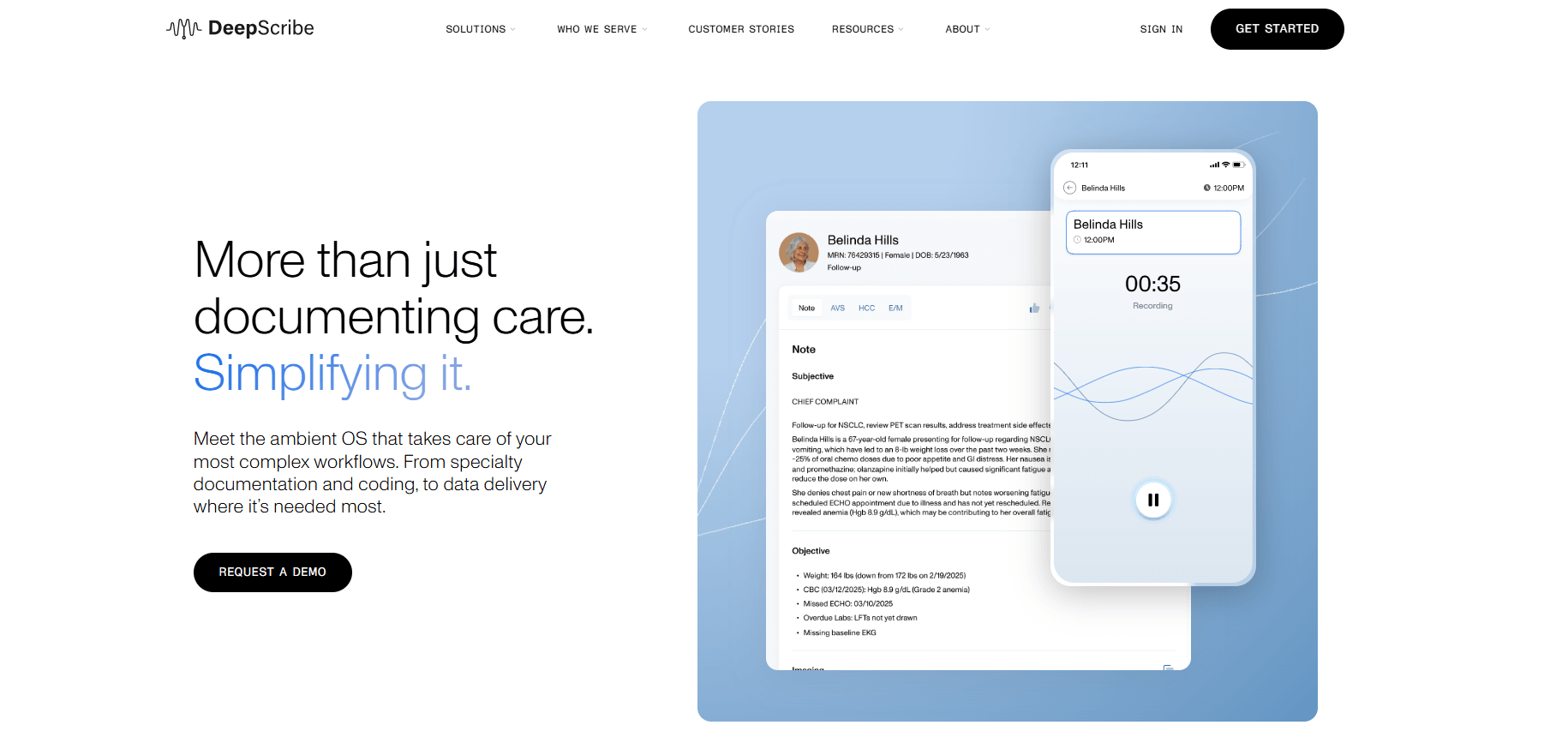
Best for: Healthcare providers wanting comprehensive ambient documentation
Transform patient conversations into clinical notes with DeepScribe's ambient AI platform - rated 98.8/100 by KLAS Research. Eliminate after-hours documentation and reclaim your time. DeepScribe stands out for its exceptional accuracy and ability to capture natural conversations during patient visits.
Key Strengths:
- Industry-leading 98.8/100 KLAS Research rating
- Eliminates after-hours documentation burden
- Ambient listening technology
- Real-time note generation during patient visits
Deployment: Quick implementation with intuitive ambient recording setup.
Considerations: Premium pricing may be challenging for smaller practices.
Suki AI — Voice-Powered Clinical Assistant
Best for: Voice-first clinical documentation and EHR navigation
Suki AI is a voice-enabled medical scribe that helps physicians create clinical notes using natural language processing (NLP). It supports dictation, generates structured notes, and integrates with major EHRs like Epic and Cerner. Suki revolutionizes clinical workflows by enabling hands-free documentation and EHR interaction.
Key Strengths:
- Advanced natural language processing
- Epic and Cerner EHR integration
- Voice-driven workflow optimization
- Reduces documentation time significantly
Deployment: Quick setup with voice training for optimal accuracy.
Considerations: Voice recognition may require adaptation for different accents and speaking styles.
AssemblyAI — Developer-Focused Speech API
Best for: Healthcare technology developers building custom solutions
Yes - we will comply with applicable laws and HIPAA is grounded in law. If you have concerns about HIPAA compliance while using our service, please get in touch with our Sales team. AssemblyAI provides robust speech-to-text capabilities with healthcare-grade compliance for development teams.
Key Strengths:
- Support to transcribe over 99+ languages and counting, including Global English (English and all of its accents)
- Advanced Speech AI models, providing industry-leading speech-to-text accuracy
- Speaker diarization for multi-participant conversations
- Comprehensive developer documentation
Deployment: Moderate setup time requiring technical integration expertise.
Considerations: Requires development resources for implementation and customization.
NexHealth — Patient Engagement Platform
Best for: Healthcare providers seeking comprehensive patient engagement
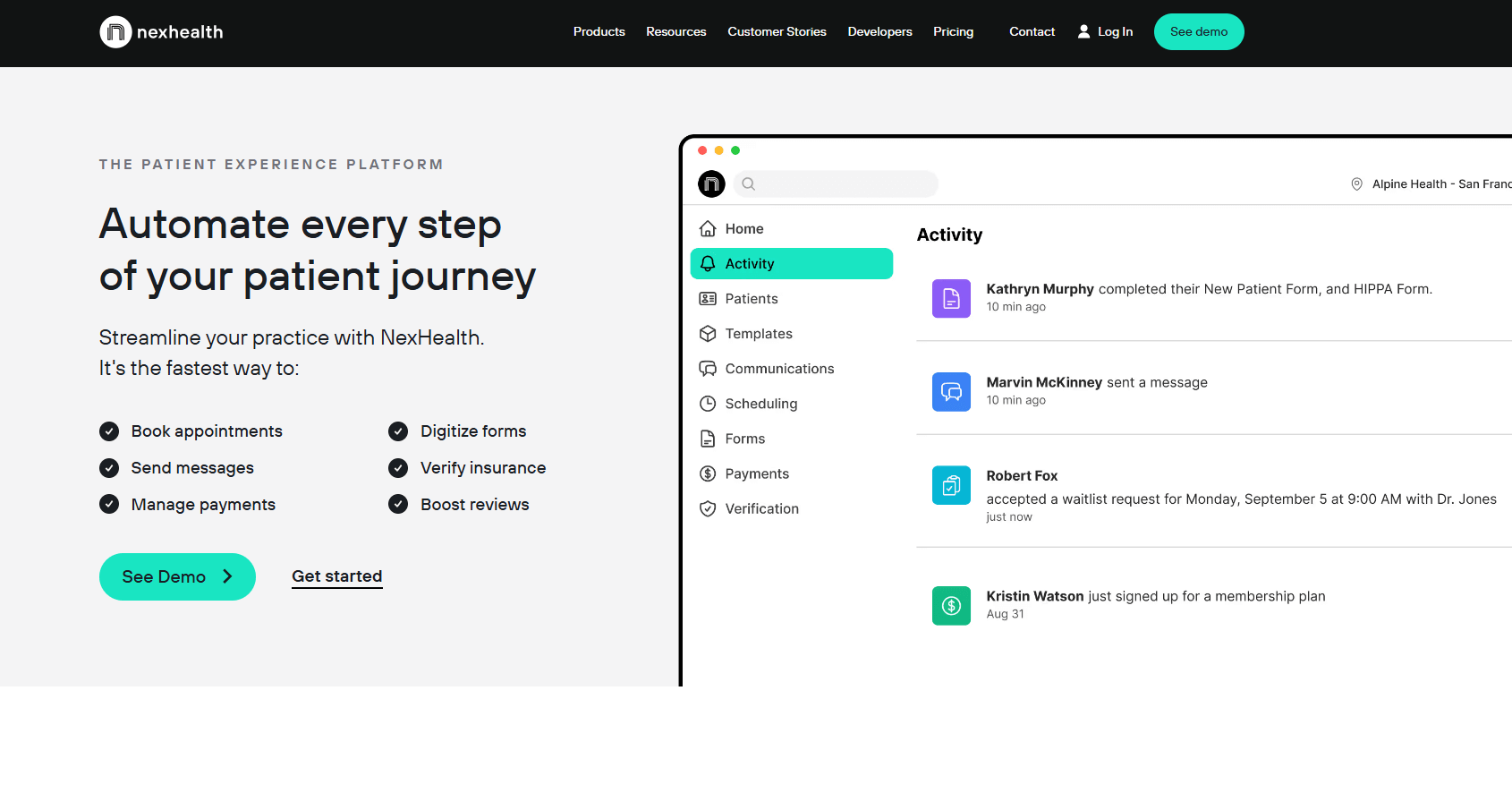
NexHealth offers a patient engagement platform that includes AI-driven note-taking capabilities alongside appointment scheduling, patient communication, and practice management features.
Key Strengths:
- Comprehensive patient engagement features
- EHR integration capabilities
- Multi-channel patient communication
- Practice management integration
Deployment: Quick setup with user-friendly interface and EHR connectivity.
Considerations: May offer more features than necessary for practices focused solely on documentation.
Abridge — Clinician-Reviewed AI Documentation
Best for: Healthcare organizations prioritizing accuracy and compliance
Designed to minimize the risk of hallucinations and bias, the company is SOC2 Type 2 certified and HIPAA compliant and claims to ensure all content is clinician-reviewed before being sent to the EHR.
Key Strengths:
- Clinician-reviewed content for accuracy
- SOC2 Type 2 certification
- Bias and hallucination minimization
- Enterprise-grade security features
Deployment: Quick implementation with robust security protocols.
Considerations: May have higher costs due to premium security and review features.
Heidi Health — Global Clinical Documentation
Best for: International healthcare providers and multi-specialty practices
Heidi Health is the best AI medical scribe that transcribes visits & generates notes to save time & focus on care. Trusted in 50+ countries – try for free today!
Key Strengths:
- Trusted across 50+ countries
- Multi-specialty support
- Free tier available for trial
- Global compliance standards
Deployment: Quick setup with international localization support.
Considerations: May require customization for specific regional healthcare requirements.
Carepatron — Comprehensive Practice Management
Best for: Small to medium healthcare practices seeking all-in-one solutions
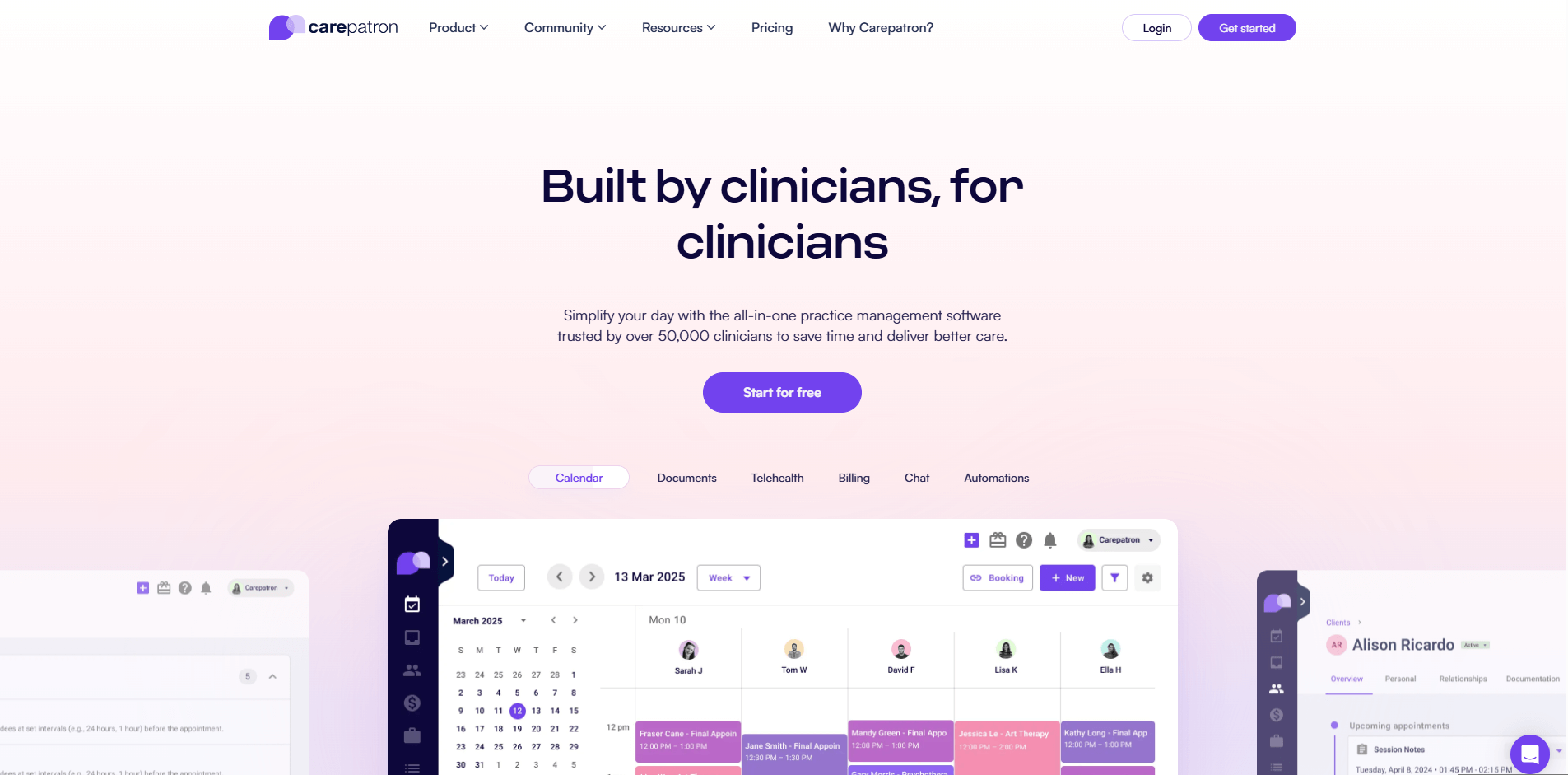
Carepatron integrates HIPAA-compliant note-taking within a broader practice management platform, offering scheduling, billing, and patient management alongside documentation features.
Key Strengths:
- All-in-one practice management
- Integrated billing and scheduling
- Patient portal functionality
- Comprehensive workflow management
Deployment: Moderate setup time due to comprehensive feature set.
Considerations: May be overwhelming for practices only seeking documentation solutions.
Pro Tips for Implementation
- Start with a pilot program: Test your chosen tool with a small group of providers before full deployment
- Verify EHR compatibility: Ensure seamless integration with your existing electronic health record system
- Train on medical terminology: Test accuracy with your specialty's specific vocabulary and common phrases
- Establish backup protocols: Always have contingency plans for system downtime or technical issues
- Monitor compliance regularly: Conduct periodic audits to ensure ongoing HIPAA compliance
How to Choose the Right HIPAA-Compliant AI Note-Taking Tool
| Key Decision Factor | Why It Matters | What to Look For | Best Tool Examples |
|---|---|---|---|
| Clinical Accuracy | Reduces editing time and ensures quality documentation | Medical terminology recognition, specialty-specific training | Twofold Health, DeepScribe |
| EHR Integration | Eliminates double data entry and streamlines workflow | Direct integration with your EHR system | Suki AI, NexHealth |
| Real-time Processing | Enables documentation during patient visits | Live transcription and note generation | DeepScribe, Abridge |
| HIPAA Compliance | Protects patient data and avoids regulatory penalties | BAA availability, encryption, audit trails | All listed tools |
Final Thoughts
AI driven clinical documentation is no longer experimental. In 2026, it is becoming a practical necessity for healthcare providers trying to balance quality care, regulatory requirements, and sustainable workloads. The real value of these tools is not just speed, but consistency, accuracy, and reduced cognitive load for clinicians.
There is no single best solution for every practice. Solo providers may prioritize simplicity and low cost. Large systems need proven accuracy, deep EHR integration, and strong governance. Development teams require flexible APIs, while multi specialty or international organizations need adaptability across workflows and regions. The right choice depends on how you practice, where documentation slows you down, and how tightly the tool fits into your daily routine.
Successful adoption starts with a focused pilot, clear expectations, and clinician feedback. When implemented thoughtfully, AI note taking tools can return hours to clinicians each week, improve record quality, and strengthen patient relationships. The goal is not to replace clinical judgment, but to remove the administrative friction that gets in the way of delivering care.
