
Most teams discover their hiring bottlenecks during quarterly headcount scrums, not from vendor demos. Working across different tech companies, we have seen talent teams struggle with skills taxonomies, entity resolution across ATS and CRM records, and evaluation drift that creeps into screening rubrics. You think you know your pipeline until hiring managers ask for a shortlist by Friday and your stack cannot reconcile skills synonyms, normalize profiles, or surface silver medalists. According to Gartner, HR technology remains the top investment priority and AI is reshaping recruiting workflows into 2026, which matches what we see on the ground. Expect real time market data, AI matching, and bias audits to move from nice to have to required features (Gartner newsroom).
The broader HR technology market was valued at $37.66B in 2023 and is forecast to reach $81.84B by 2032, a 9.2 percent CAGR, which sets the context for talent intelligence buyers evaluating long term partners (Fortune Business Insights).
SeekOut
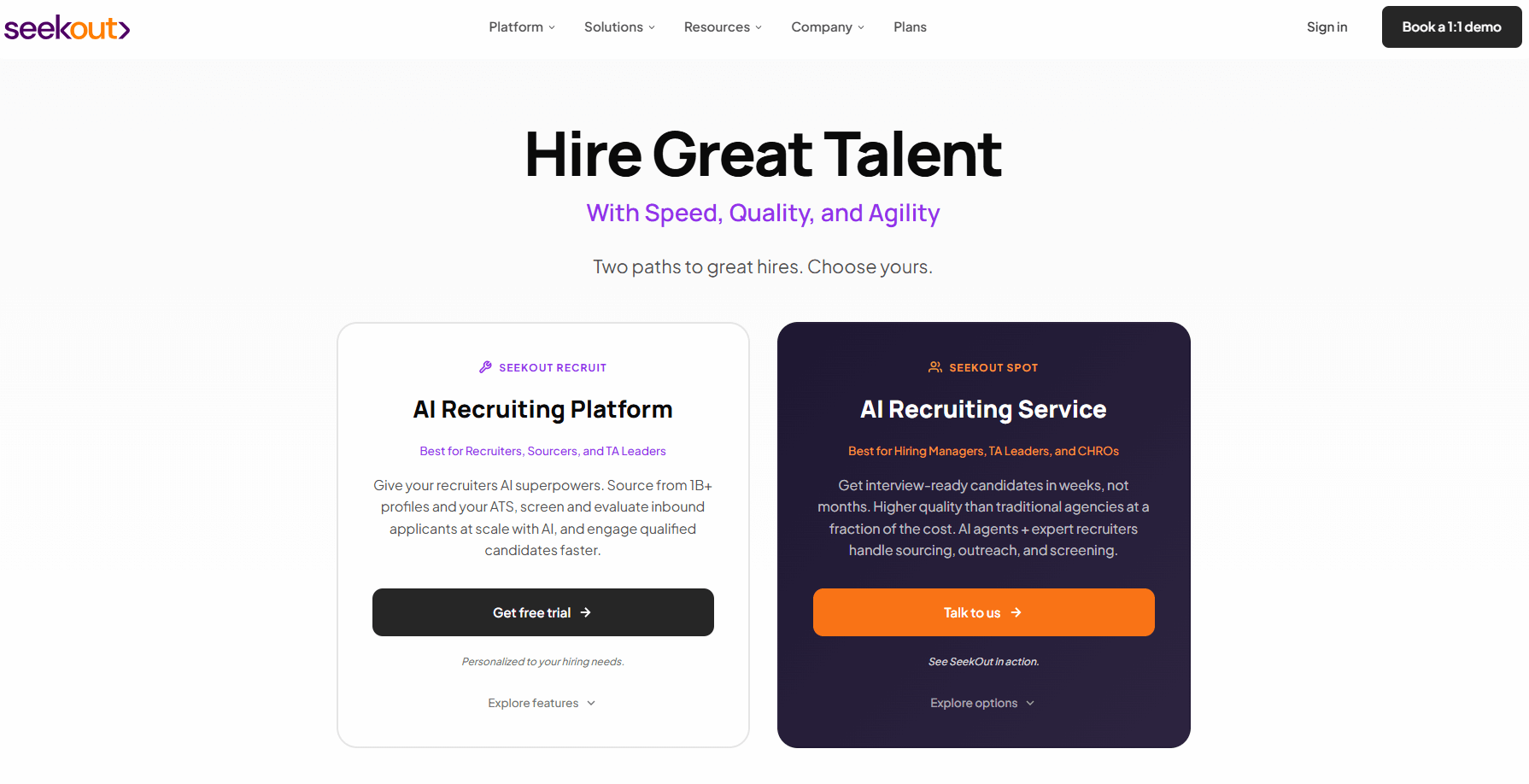
AI recruiting and talent intelligence platform focused on sourcing, screening, outreach, and labor market insights. Generative AI features, such as conversational search, shorten time from job description to shortlist.
Best for: Talent acquisition teams that need deep sourcing across public profiles, diversity filters, and quick labor market analytics.
Key Features:
- AI assisted sourcing with conversational search that turns plain language prompts into candidate queries (GlobeNewswire product announcement).
- Diverse pipeline filters and large external people graph, per analyst and media coverage (TechCrunch profile).
- Talent pool and location insights to guide market strategy, validated in user reviews (G2 reviews summary).
Why we like it: From our experience in the startup ecosystem, SeekOut is fast to pilot and gives sourcers immediate wins on hard to find talent, especially when hiring managers need evidence - for example a map of where specific skills clusters exist - to unblock req approvals.
Notable Limitations:
- Contact data quality can be inconsistent, and some profiles lack usable emails, per multiple buyer reviews.
- Recent downsizing raised questions about execution focus in 2024, though the company remains active (TechCrunch layoffs report; GeekWire coverage).
Pricing: Pricing not publicly available. Contact SeekOut for a custom quote. Third party listings show no public price and categorize perceived cost at the high end, with median time to implement at one month (Capterra pricing page).
Eightfold AI
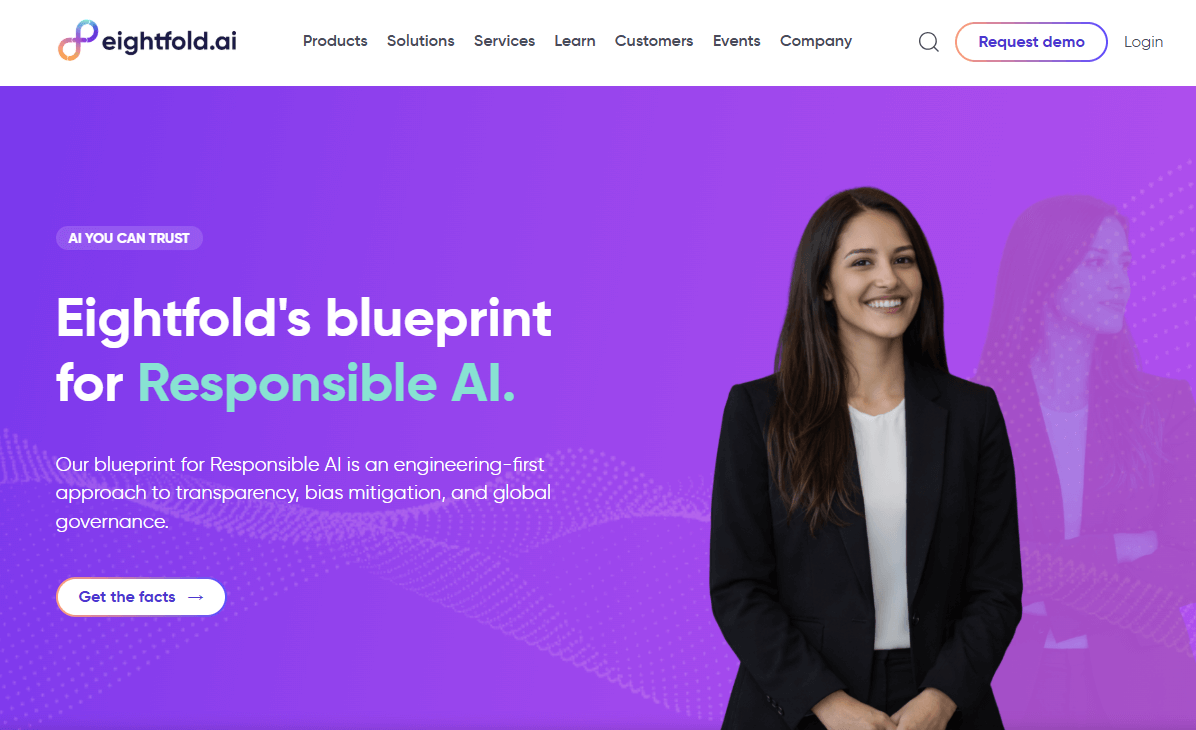
AI native talent intelligence platform for recruiting, internal mobility, upskilling, and workforce planning with agent based automation. New capabilities include AI Interviewer for first round screening and recruiter agents for high volume roles.
Best for: Enterprises building a skills based strategy that spans external hiring and internal career paths, with governance and certifications.
Key Features:
- Skills driven matching, internal mobility and career hub, validated by large enterprise partnerships such as S&P Global's skills based initiative (PR Newswire partnership note).
- Agentic AI features for autonomous scheduling and first round interviews, launched in 2025 (GlobeNewswire product launch).
- Enterprise certifications including ISO 27001 and FedRAMP Moderate cited in product communications, relevant for regulated buyers.
Why we like it: After helping startups scale, the strength of Eightfold is in unifying external profiles, employee data, and learning signals into a single skills graph, which is critical when you must show internal mobility outcomes and not just sourcing volume.
Notable Limitations:
- Ongoing class action in California alleges FCRA related issues over applicant scoring and data sources, which Eightfold disputes. Legal outcomes may impact compliance processes for buyers that use the tool in candidate screening (Fortune coverage; SFGATE report; Insurance Journal).
- Some users cite a learning curve, UI complexity, and variable data accuracy in reviews (G2 reviews summary; Capterra reviews).
Pricing: Pricing not publicly available. Contact Eightfold AI for a custom quote. Third party listings do not publish standard tiers and note average implementations around five months (Capterra profile).
iMocha
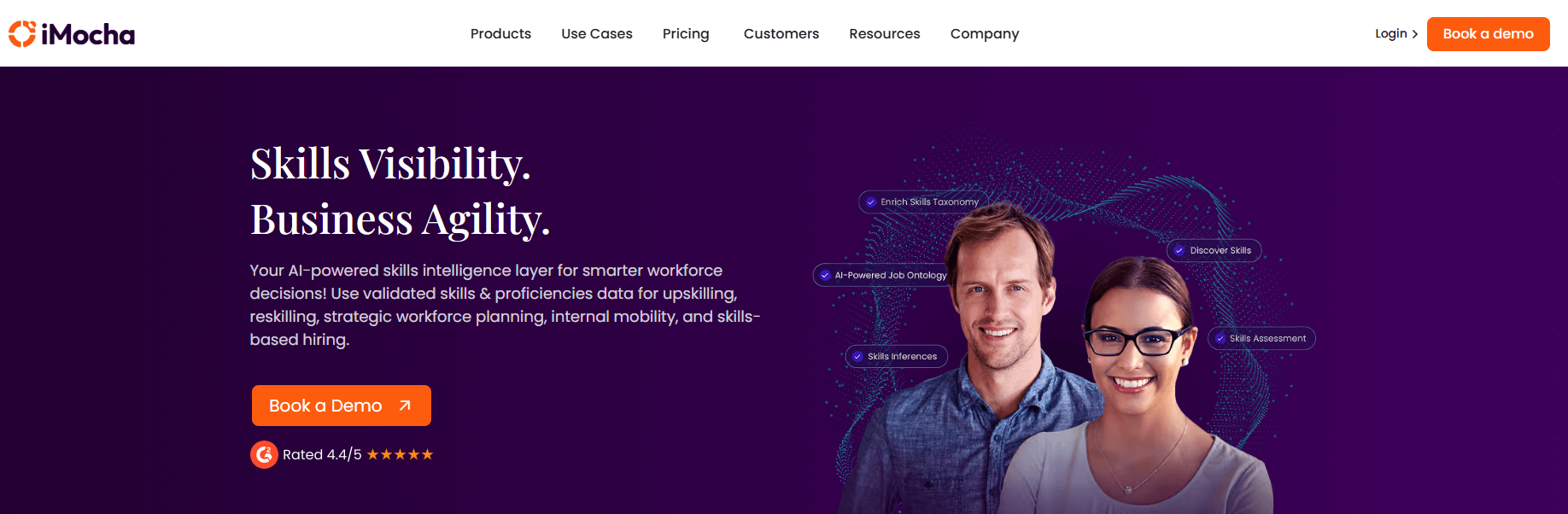
Skills intelligence and assessments platform for building a validated skills inventory, screening candidates, and guiding upskilling and internal mobility. Frequently positioned as a partner for skills ecosystems.
Best for: HR and TA teams that need validated assessments and skills analytics tied to learning and internal movement.
Key Features:
- Large library of technical and functional skills assessments with advanced proctoring, frequently noted by users (G2 reviews summary).
- Integrates with SAP SuccessFactors Talent Intelligence Hub as an initial partner, supporting unified skills profiles and career paths (SAP News, SuccessConnect 2024).
- Skills mapping and analytics used to inform workforce planning and mobility, seen in partner ecosystem announcements (SAP 2H 2024 release note).
Why we like it: According to vendor documentation and what buyers report, iMocha is pragmatic when you must prove skills objectively, reduce false positives, and connect results to learning plans, which saves teams time and reduces rework in later interview stages.
Notable Limitations:
- Some reviewers call out reporting depth and admin setup as areas to improve for new users.
- Pricing clarity varies by edition on third party sites, so expect a sales assisted quote for enterprise features.
Pricing: Third party listings show a Basic plan at $400 per month, billed annually, plus enterprise plans by quote. Verify current pricing with the seller before budgeting (Capterra pricing page).
Talent Intelligence Tools Comparison: Quick Overview
| Tool | Best For | Pricing Model | Highlights |
|---|---|---|---|
| SeekOut | External sourcing and labor market insights | Custom quote, annual license | Conversational AI search, strong diversity filters, quick time to value per reviews |
| Eightfold AI | Enterprise scale skills matching and internal mobility | Custom quote | Agent based automation, certifications for regulated buyers, large enterprise references |
| iMocha | Validated skills assessments and skills analytics | Basic plan public, enterprise by quote | Deep assessment catalog, SAP SuccessFactors TIH integration for skills profiles |
Talent Intelligence Platform Comparison: Key Features at a Glance
| Tool | AI Matching | Internal Mobility | Skills Assessments |
|---|---|---|---|
| SeekOut | Yes, prompt based search and matching | Light, focused on rediscovery and outreach (per reviews) | Limited native testing, often pairs with third party tools |
| Eightfold AI | Yes, skills based matching across lifecycle | Strong, Career Hub and mobility workflows | Basic screening automation, not a dedicated assessment catalog |
| iMocha | Skills inference supports matching context | Supports mobility through validated skills profiles | Yes, large catalog with proctoring |
Talent Intelligence Deployment Options
| Tool | Cloud API | Integration Complexity | Key Notes |
|---|---|---|---|
| SeekOut | Yes, SaaS with ATS connectors mentioned in reviews | Works with leading ATS per buyer reports | Expect standard SSO and webhook style integrations |
| Eightfold AI | Yes, enterprise SaaS, references to FedRAMP Moderate in product communications | Integrates with Workday, SAP SuccessFactors, Greenhouse, iCIMS per listings | On-premise not publicly documented |
| iMocha | Yes, SaaS | SAP SuccessFactors TIH partner | Used to consolidate skills profiles |
Talent Intelligence Strategic Decision Framework
| Critical Question | Why It Matters | What to Evaluate | Red Flags |
|---|---|---|---|
| Do we need validated skills data or is inference enough? | Gartner found only 8 percent of orgs have reliable skills data, weak data undermines matching and mobility decisions (Gartner newsroom). | Depth of assessment catalog, validation methods, how inferred skills are labeled and governed. | "Black box" scores with no audit trails or explanation. |
| What is our legal posture on AI screening? | Lawsuits argue AI scores may be consumer reports under FCRA, exposing employers to compliance risk. | Pre adverse action workflows, candidate notices, model documentation, human in the loop checkpoints. | No clear policy or tooling for notices, dispute rights, or explainability. |
| Are we buying for external recruiting, internal mobility, or both? | Many suites claim end to end but excel in one domain, buying the wrong fit adds cost and change fatigue (Gartner Recruiting Tech Guide). | Roadmap alignment, reference customers with similar scope, adoption metrics by role. | One size fits all claims without proof points or references. |
Talent Intelligence Solutions Comparison: Pricing & Capabilities Overview
| Organization Size | Recommended Setup | Annual Investment | Notes |
|---|---|---|---|
| < 1,000 employees | SeekOut for sourcing, iMocha for skills tests, HCM native mobility if available | Varies by seats and volumes, iMocha from $4,800 per year | Custom quotes for SeekOut |
| 1,000 to 10,000 | SeekOut plus iMocha, or Eightfold AI if mobility is a priority | Custom quotes | Budget for implementation services per vendor and SI |
| > 10,000 or regulated | Eightfold AI for integrated matching and mobility, augment with assessments, selective use of SeekOut for niche sourcing | Custom quotes | Include change management and compliance review |
Problems & Solutions
-
Problem: Hiring managers request a shortlist of niche engineers in a new market and your team cannot prove talent supply or set expectations.
Solution: Use SeekOut's market insights to visualize talent pools by location and skill cluster, then run conversational search to produce an initial slate and show evidence to stakeholders. This workflow is echoed in user feedback about SeekOut's analytics and sourcing depth. -
Problem: Your CEO commits to skills based internal mobility, but managers lack visibility into transferable skills and career paths.
Solution: Deploy Eightfold AI's skills based matching with mobility experiences, combining employee profiles and learning to surface adjacent roles, as seen in S&P Global's program announcement. Set goals for internal fill rate and time to redeploy. -
Problem: Screening volume creates interview waste and false positives for technical roles.
Solution: Introduce iMocha assessments early, capture validated skills, and sync results to your HCM to drive learning and mobility decisions. iMocha's SAP SuccessFactors Talent Intelligence Hub partnership shows how skills data can unify across systems. Reviews often cite strong proctoring and test variety to cut manual effort.
The Bottom Line on Talent Intelligence in 2026
If you need immediate pipeline and market evidence, start with SeekOut and pair it with clear KPIs for slate quality and outreach response. If your mandate includes internal mobility and skills strategy, Eightfold AI's end to end approach is compelling, but legal and governance reviews are essential given active litigation around AI scoring. For teams that must prove skills objectively and link hiring to development, iMocha offers validated assessments and an ecosystem path through SAP's Talent Intelligence Hub. Whatever you choose, remember Gartner's warning: most organizations lack reliable skills data, so invest first in data quality, explainability, and change management.
