

You think you know how to keep therapy notes efficient until a 25-session week collides with Friday audits and payer-specific templates. From my experience in the startup ecosystem, the biggest wins come from practical details like EHR autofill into TherapyNotes or SimplePractice, reliable speaker diarization when recording sessions, and PDQI-9 style quality checks to keep notes usable for billing. Early adopters learned quickly that adoption rises or falls on integration and governance, not hype, which tracks with what large systems report about ambient documentation tools in practice.
A verified signal of momentum, nearly two-thirds of U.S. hospitals using Epic had adopted ambient AI tools by June 2025, and ambient scribes were on track to be among the fastest-adopted technologies in healthcare, although financial impact remained unclear. You will learn where each tool shines, what to watch for, and how to avoid costly missteps that stall adoption.
Why AI Tools for Therapy Notes Are Essential in 2026
Therapy documentation is no longer just a compliance task - it directly impacts clinician workload, burnout, and reimbursement accuracy. With increasing session volumes and stricter payer requirements, manual note-taking is becoming unsustainable for many practices. AI tools help therapists reduce documentation time, improve consistency, and maintain high-quality notes without sacrificing clinical focus.
5 Best AI Tools for Therapy Notes
The tools below represent the most practical AI solutions for therapy notes in 2026, selected based on real-world workflow fit, documentation quality, and ease of adoption. Each platform takes a different approach - from live session recording to post-session dictation - so the right choice depends on how you prefer to document and how your EHR workflow is set up.
1. Twofold
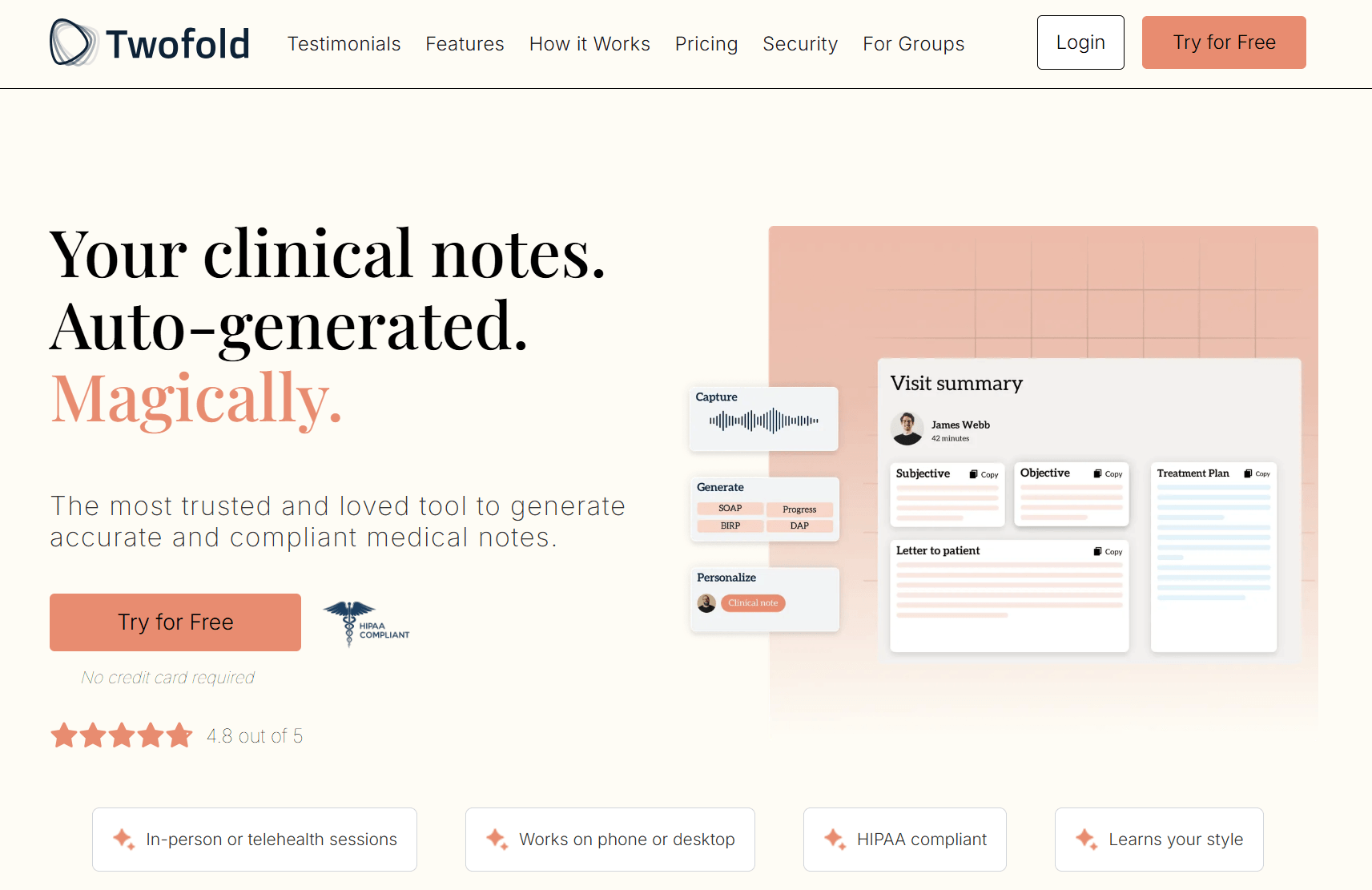
Twofold is an AI medical scribe for therapists and clinicians that records sessions, drafts structured notes, and learns your writing style. It runs in the browser and works alongside most EHRs via copy and paste.
Best for: Solo therapists and small groups that want fast drafts and style adaptation without heavy IT work.
Pro: Low setup and style learning can reduce edits once the system adapts to your documentation patterns.
Con: You may still need occasional formatting cleanup when pasting into certain EHRs.
Pricing: Free plan available. Paid plans start at $19 for the first month on monthly billing (discounted from $69), then standard pricing applies. Annual plans are listed at $44/month (discounted from $49). Group pricing is custom.
2. Supanote
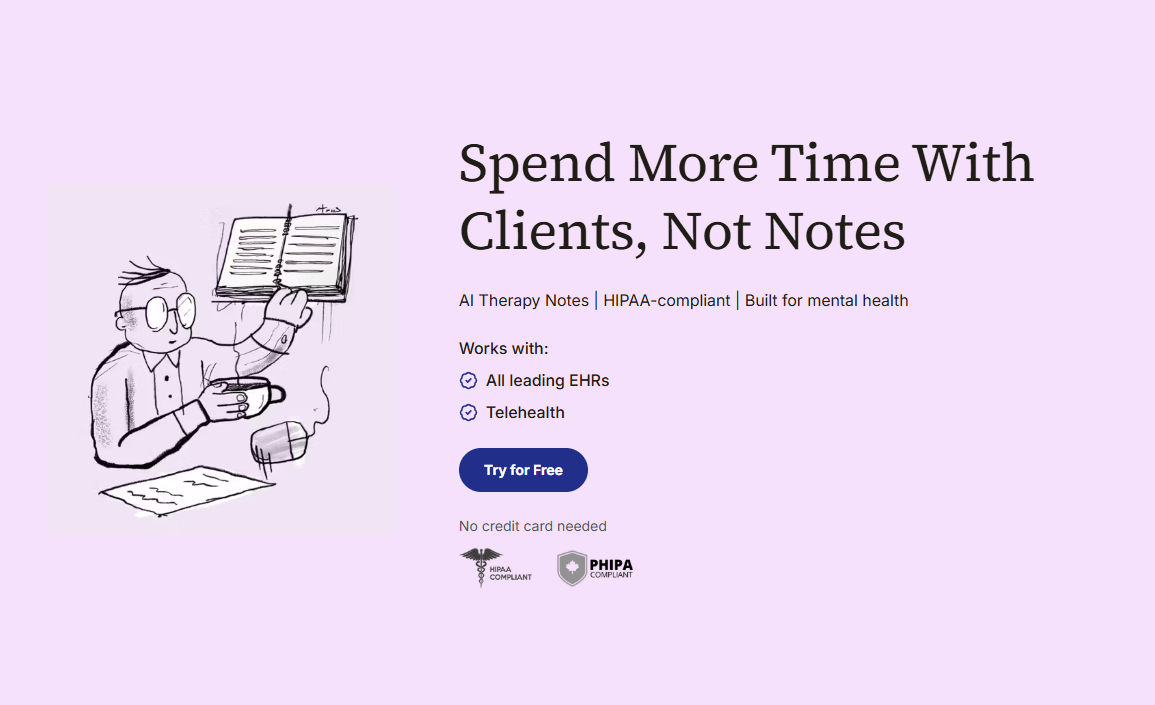
Supanote is therapy-focused AI that turns recorded, dictated, or uploaded audio into HIPAA-oriented progress notes and supports multiple note formats. It offers a Chrome extension that can fill EHR forms directly for supported systems.
Best for: Therapists who want time savings from browser-based EHR autofill instead of manual copy and paste.
Pro: Chrome EHR Autofill reduces manual entry for supported EHRs.
Con: Autofill works only with the EHRs listed for the extension, so others require copy and paste.
Pricing: Starter starts at $29.99 per month, Pro at $49.99 per month, and Master at $89.99 per month, with a 7-day free trial.
3. TheraPro
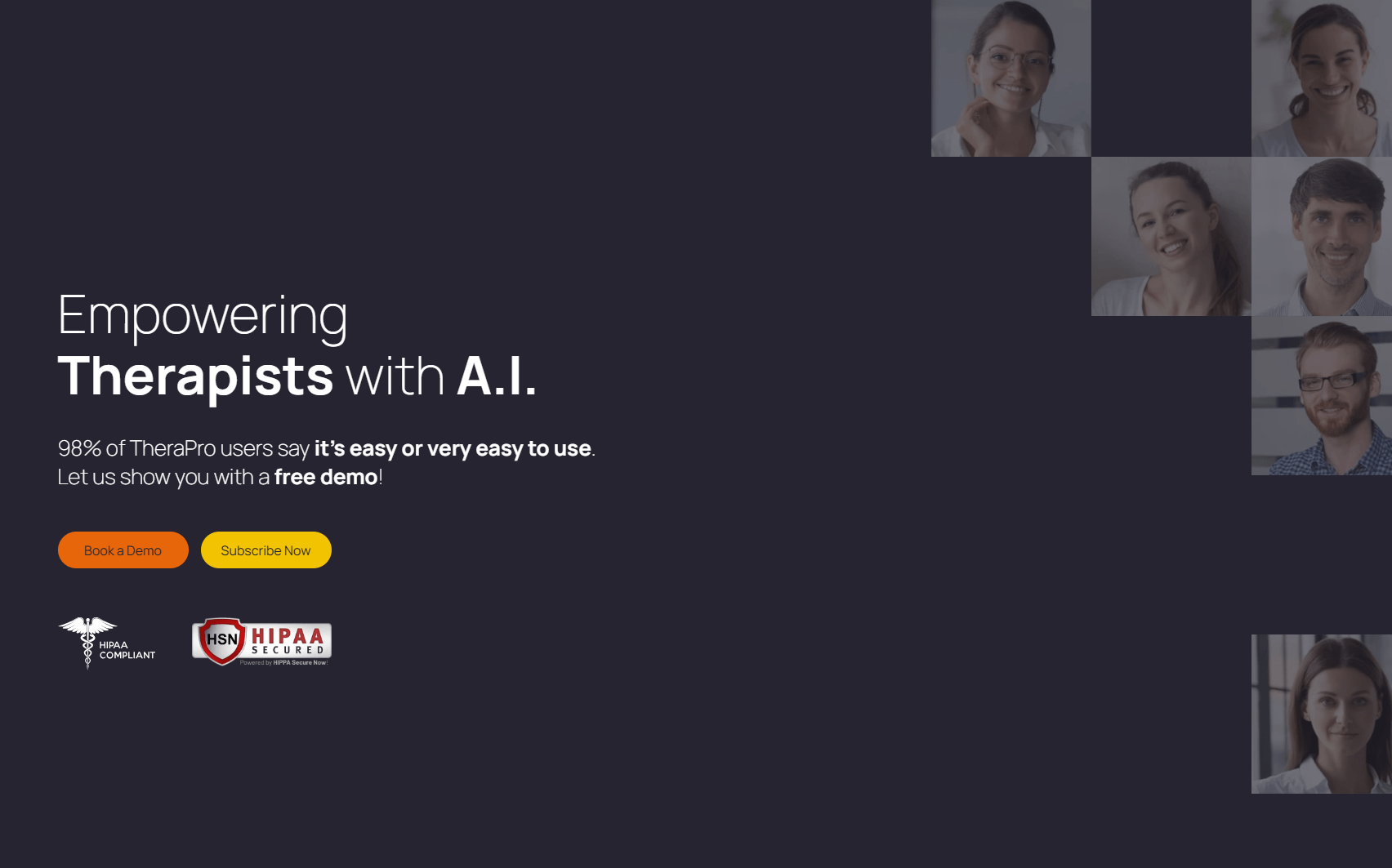
TheraPro is a HIPAA-compatible AI that summarizes therapy sessions into progress notes and emphasizes privacy controls. Notes can be copied into any EHR, and the site highlights immediate audio deletion after processing.
Best for: Clinicians who want a straightforward session-to-summary flow with minimal configuration.
Pro: Multiple tiers, including a free plan, make it easy to try, and the product centers on privacy messaging.
Con: Fewer independent reviews than large enterprise vendors; confirm consent, retention, and BAA terms during evaluation.
Pricing: Free plan at $0 with 3 full sessions per week; paid tiers Basic at $19 per month, Plus at $39 per month, Pro at $59 per month, and Multi-Therapist at $39 per user per month.
4. Apollo Notes
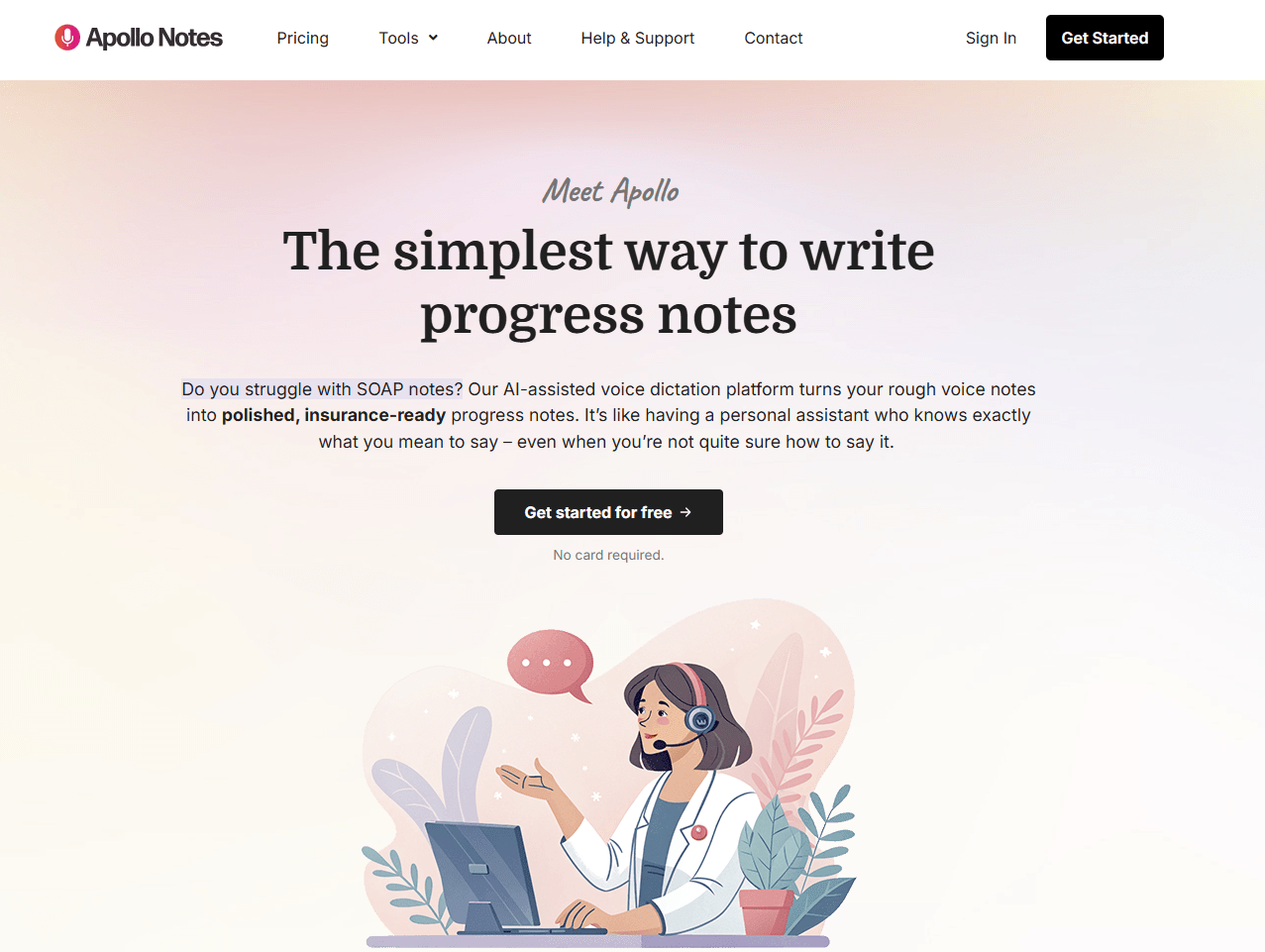
Apollo Notes is a voice-dictation platform that converts post-session dictation into polished, insurance-ready progress notes and correspondence. It is designed to be used after a session rather than for in-room recording.
Best for: Solo practitioners who prefer dictating notes after sessions instead of recording live.
Pro: Clear quotas and low-cost tiers make budgeting simple for individuals.
Con: No live ambient capture, so benefits hinge on your comfort with structured dictation.
Pricing: Free at $0 for 10 notes per month; Essential at $24 per month for 150 notes; Advanced at $37 per month for 350 notes, per the official pricing page.
5. Pablo
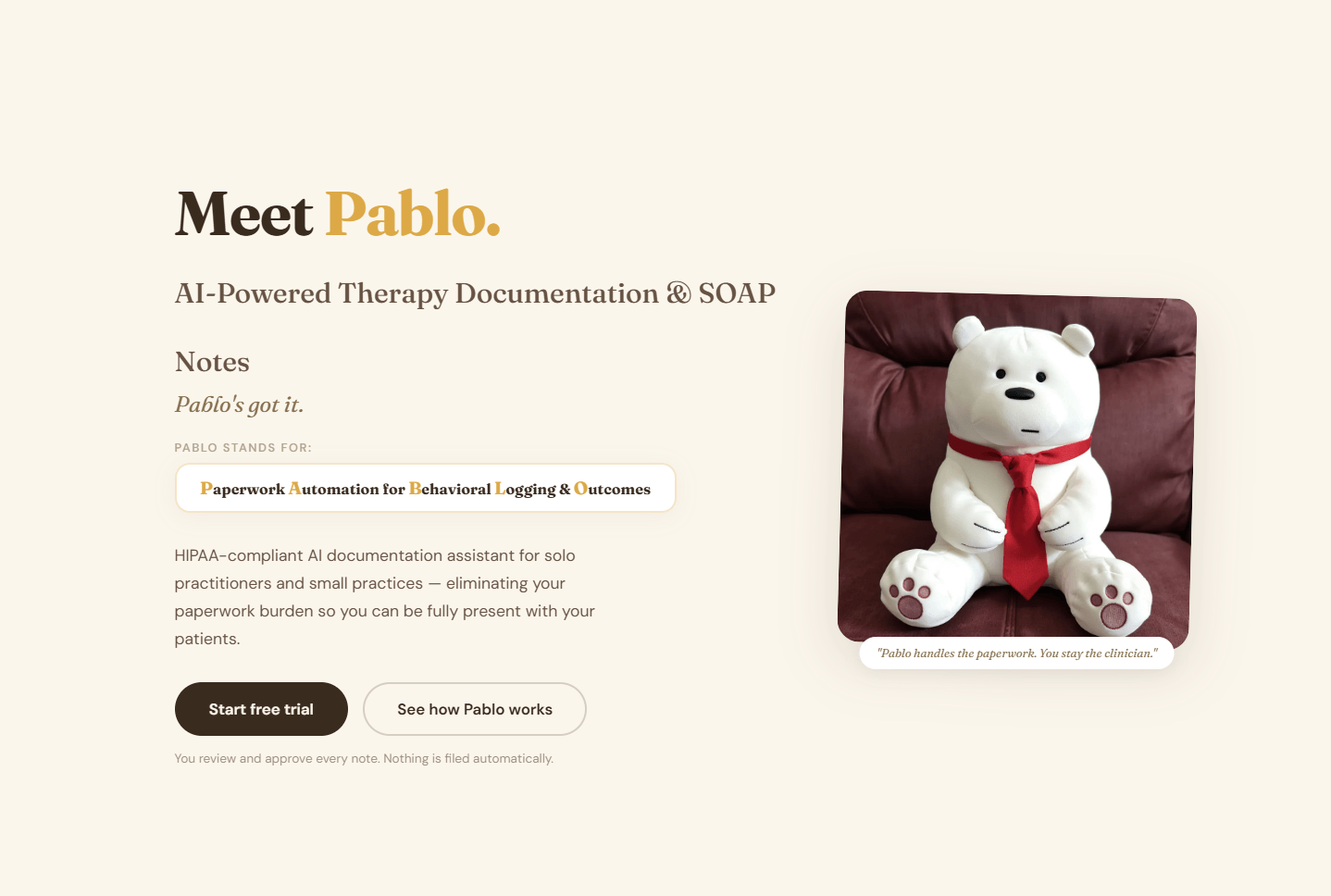
Pablo is a HIPAA-focused AI assistant for therapy that records sessions, drafts SOAP or custom notes, and adds a verification layer that checks generated statements against the transcript. It also offers an open-source self-hosting option for full data sovereignty.
Best for: Clinicians who want extra verification and the option to self-host.
Pro: Claim verification and confidence scoring can speed safe review before sign-off.
Con: Rapidly evolving product; confirm feature maturity and EHR fit for your workflow.
Pricing: Pablo Solo is $14 per month or $140 per year with 15 free sessions to start; Pablo Practice is $39 per month for early adopters; Pablo Solo is fully open source for self-hosting.
Therapy Note Tools Comparison: Quick Overview
This table summarizes who each tool fits best, what pricing approach they use, and whether a free option exists. Use it to narrow candidates before you evaluate workflow fit and governance needs. Pricing and highlights may change, so confirm during your trial or pilot.
| Tool | Best For | Free Option | Highlights |
|---|---|---|---|
| Twofold | Fast drafts with minimal IT overhead | Free for the first week, then $19 for the first month | Adapts to clinician style, browser-based setup |
| Supanote | EHR autofill into SimplePractice or TherapyNotes | 7-day trial as per vendor page | Chrome EHR Autofill for select systems |
| TheraPro | Simple session-to-summary flow | Free trial available as per vendor page | Privacy messaging and minute-by-minute processing, community cautions on ToS carve-outs |
| Apollo Notes | Post-session dictation and structured notes | Free trial available as per vendor page | ICD-10 suggestions and letters, copy-to-EHR workflow |
| Pablo | Notes with verification and confidence scoring | Free trial available as per vendor page | Verification layer flags unsupported claims before sign-off |
Therapy Note Platform Comparison: Key Features at a Glance
This quick matrix shows capture modes, how notes move into your EHR, and common formats. Treat it as a starting point to match tools to your day-to-day workflow:
| Tool | Live Recording | Dictation After Session | Templates/Formats |
|---|---|---|---|
| Twofold | Yes | Yes | SOAP, DAP, BIRP, MSE, custom |
| Supanote | Yes | Yes | SOAP, DAP, BIRP |
| TheraPro | Yes | Yes | SOAP, DAP, BIRP |
| Apollo Notes | Dictation focused | Yes | SOAP, DAP, BIRP, treatment plans, letters |
| Pablo | Yes | Yes | SOAP and custom with verification |
Therapy Note Strategic Decision Framework
Use these questions to stress-test fit before you commit to a budget. Answer them with data from your own time-motion baselines and a short pilot. If any red flags appear, pause and adjust the rollout plan first.
| Critical Question | Why It Matters | What to Evaluate | Red Flags |
|---|---|---|---|
| Will this cut EHR time per clinician by at least 10 to 15 minutes daily? | A JAMA analysis found that ambient scribes modestly reduced EHR and documentation time across five centers | Pilot data from your team, time-motion baselines, target specialties. | Vendor refuses pilot or cannot produce similar outcomes in your setting. |
| Do you have governance and consent for recording? | PHTI notes clinician burnout benefits but unclear financial ROI, stressing policy and consent | BAA, consent scripts, client opt-out, retention policies. | Vague ToS, unclear audio retention, or model-training rights. |
| How will you audit AI note quality? | Academic groups show AI notes can underperform human notes on quality metrics | Internal PDQI-style scoring, random audits, payer feedback. | No workflow for QA or corrections before sign-off. |
| Does it fit your EHR workflow? | KLAS found EHR integration drives purchasing decisions in ambient speech | Autofill or copy reliability, formatting fidelity, note template mapping. | Frequent paste errors, loss of structure, missing mandatory fields. |
Common Challenges in AI Therapy Notes and How to Solve Them
Adopting AI for therapy notes often runs into a predictable set of challenges: time savings that don't materialize, inconsistent note quality, privacy concerns, and friction with EHR workflows. This section breaks down the most common issues backed by research and pairs them with practical ways different tools address them:
Problem 1: Documentation time drives burnout and pajama time.
What research says: Ambient scribes are rapidly adopted and can reduce EHR time, but the financial impact is still uncertain.
How tools help:
Twofold reduces edits after it learns your style, which clinicians report in community threads, speeding end-of-day wrap-up.
Supanote removes copy and paste through EHR Autofill for supported systems, which shortens the last mile of documentation.
Apollo Notes turns quick dictations into payer-ready language, a lighter lift for clinicians who do not want live recording, per the founder's description.
Problem 2: Note quality and safety.
What research says: New evaluations have found AI scribe notes can be lower quality than clinician notes on thoroughness and organization, which calls for careful review before signing.
How tools help:
Pablo adds a verification layer that flags unsupported statements before sign-off, per product materials.
Twofold and Supanote both require clinician review, which aligns with governance best practice recommended by health systems and PHTI's emphasis on careful evaluation.
Problem 3: Privacy, consent, and retention.
What research says: Governance and EHR integration are decisive for adoption, and unclear policies undermine trust.
How tools help:
TheraPro markets immediate audio deletion, but community reviewers highlight ToS carve-outs, so teams should confirm BAAs and retention in writing before rollout.
Supanote and Twofold provide HIPAA-oriented workflows with clinician review, but you still need documented patient consent and an audit trail, as emphasized by large-system rollouts.
Problem 4: EHR workflow friction.
What research says: Integration and copy fidelity drive decisions and satisfaction in ambient documentation projects.
How tools help:
Supanote's Autofill supports SimplePractice and TherapyNotes to reduce formatting issues.
Twofold, Apollo Notes, and Pablo use copy-to-EHR flows, which reduce IT lift but require quick formatting checks.
Therapy Note Solutions Comparison: Pricing and Capabilities Overview
The following ranges provide a practical starting point for mapping tools to different practice sizes and workflows. Use them to estimate budgets and shortlist options before running a pilot or negotiating pricing. Since plans and features evolve quickly, it's best to confirm current pricing and capabilities directly with each vendor.
| Organization Size | Recommended Setup | Annual Investment |
|---|---|---|
| Solo therapist on SimplePractice or TherapyNotes | Supanote with Chrome Autofill or Twofold for style learning | Estimate 12 times the monthly figure per clinician |
| 2 to 10 clinicians mixed EHRs | Twofold or Apollo Notes to standardize dictation plus shared templates | Varies by uptake, confirm during pilot |
| 10 plus clinicians behavioral health clinic | Pilot Supanote for supported EHRs, evaluate TheraPro privacy terms and Pablo verification for high-risk notes | Request quotes, budget for training and QA |
Bottom Line
Ambient documentation is moving fast in hospitals, and even outpatient therapy is feeling the pull. Adoption is high, but studies show time savings and quality vary, and governance makes or breaks results. For most therapists, start with a low-friction pilot. If you want EHR autofill in SimplePractice or TherapyNotes, try Supanote. If you prefer fast drafts with minimal IT lift, Twofold is a strong fit. If verification matters most, Pablo's review layer is compelling. Keep consent, retention, and QA front and center, and you will avoid the costliest mistakes.