The first SOC 2 usually survives on a spreadsheet, a shared drive of screenshots and one person who remembers which control answers which auditor requests. That setup breaks the year a second framework arrives: ISO 27001 asks for the same access review in a different shape, a healthcare customer wants HIPAA or HITRUST, and the auditor on round two asks why March's screenshots don't match the user list exported in June. From that point, the expensive part of compliance isn't the audit fee but the engineering weeks spent recollecting evidence that already exists.
The rulebooks are also changing faster than an annual spreadsheet refresh can follow. FedRAMP's Consolidated Rules for 2026 become mandatory on January 1, 2027, and new Rev5 certifications stop in June 2027. In July 2026, the Department of War suspended CMMC Phase II, leaving defense contractors on self-assessments while a reform task force prepares recommendations. A compliance platform pays for itself when a rule change means remapping controls you already run, not rebuilding the program from a fresh template.
Below are seven platforms that handle that remapping well, from tools that leave the audit to your firm to ones that perform it in-house.
Compliance Management Platforms at a Glance
| Platform | Best for | Pricing model | Standout |
|---|---|---|---|
| Hyperproof | Mid-market and enterprise teams running several frameworks with their own auditor | Quote only | 160+ pre-built frameworks crosswalked to one control set |
| Thoropass | Teams that want the software and the audit from one vendor | Quote; AWS Marketplace from $8,700/yr for the platform plus $5,800/yr for a SOC 2 audit | In-house licensed CPA auditors work inside the platform |
| Anecdotes | Enterprise GRC teams running risk and compliance across several entities | Quote; all frameworks, integrations and modules included | 230+ native integrations and FedRAMP 20x Class C certification |
| Scrut Automation | Cost-conscious teams growing from a first SOC 2 to multi-entity GRC | Quote; AWS Marketplace lists $15,000/yr for up to 20 employees | Scrut Teammates AI agents plus guided onboarding |
| Strike Graph | NIST 800-171 and CMMC programs, and teams adding frameworks | Free Launch tier; Scale from $21,500/yr | Atlas AI adviser and Verify AI evidence checks |
| LogicGate Risk Cloud | Enterprises folding compliance into IT, enterprise and vendor risk | Quote; Applications plus Power User licenses | 30+ no-code Applications with A-LIGN audit mapping |
| Comp AI | Startups and developer teams that want an open-source core | Quote on a 20-minute call; self-hosting is free | AGPLv3 open core with 580+ integrations advertised |
How We Evaluated These Tools
We compared each platform against its own product pages, pricing pages, documentation and official marketplace listings, checked in October 2026, using five criteria:
- Multi-framework mapping: whether one control and one piece of evidence can answer several frameworks, or each new framework arrives as a fresh template.
- Evidence quality: how much evidence is pulled from live systems with timestamps and source data, versus uploaded by hand.
- Audit path: who performs the audit, whether your current firm can work inside the platform, and what happens to evidence if you switch.
- Pricing transparency: published prices or marketplace listings, plus the add-ons that change the year-two bill.
- Reach beyond compliance: risk registers, vendor risk, multi-entity reporting and readiness for federal or defense work.
The 7 Best Compliance Management Platforms
1. Hyperproof
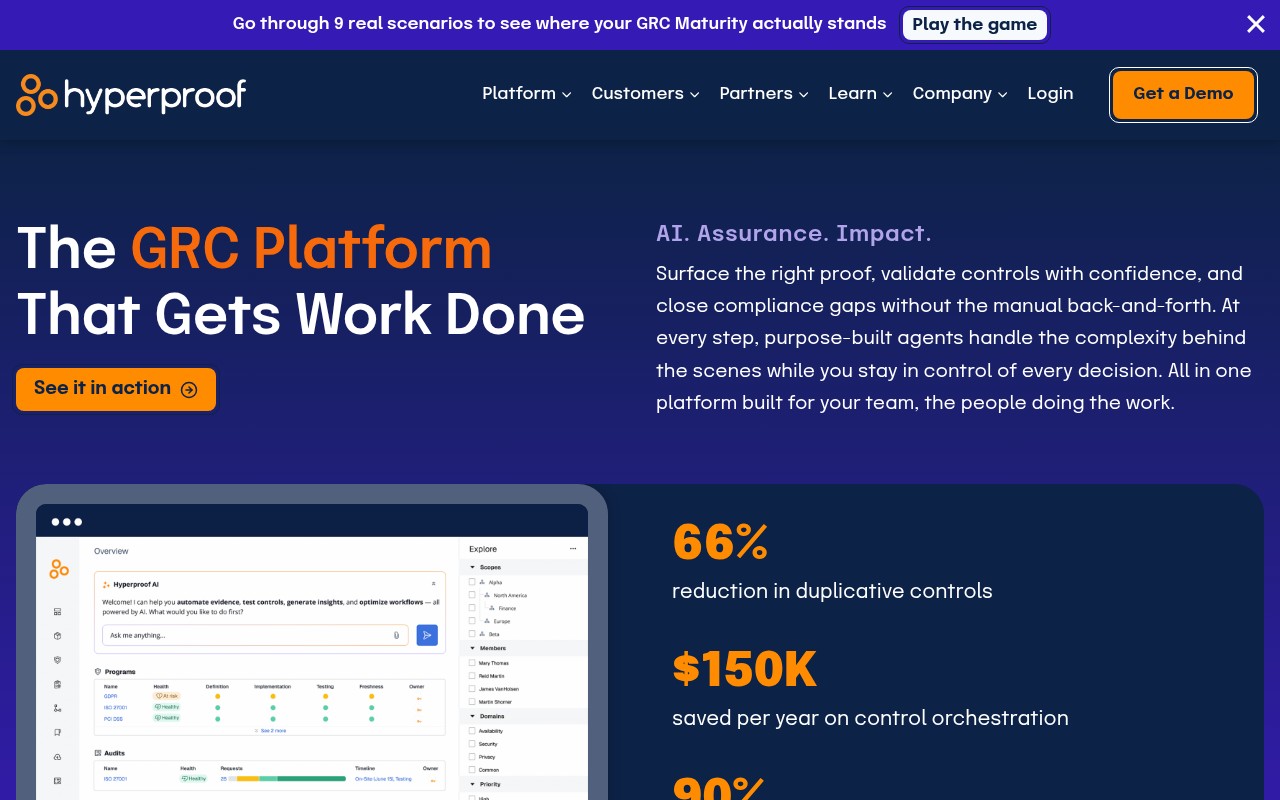
Hyperproof is a compliance operations platform for teams that already carry several frameworks and want one common control set behind all of them. Its library lists more than 160 pre-built frameworks, including SOC 2, ISO 27001, NIST 800-53, CMMC, DORA, NIS2, FedRAMP and HITRUST, and crosswalks let a single access-review control answer every framework that asks for it. Compliance, risk, audit, third-party risk and policy management run on the same control data, and a separate Hyperproof Gov environment serves teams that need FedRAMP-certified hosting.
Best for: Mid-market and enterprise security and compliance teams running three or more frameworks with an audit firm they already trust.
Key features:
- 160+ pre-built frameworks crosswalked to a common control set, plus custom frameworks
- 200+ integrations for automated evidence collection from cloud, identity and ticketing tools
- AI Guided Experiences, launched at RSAC 2026, starting with an agent that suggests links between controls, policies, risks and evidence
- Hyperproof Gov, a FedRAMP Certified Class C environment first announced in March 2026
Why we like it: Hyperproof ties controls directly to the risk register, so a failing evidence sync shows up as a change in risk posture instead of waiting for the next audit walkthrough.
Notable limitations:
- No public pricing or free tier, so expect a sales-led scoping cycle before you see a number
- Hyperproof does not issue audit reports; the audit comes from your firm or one of its partner firms
- Hyperproof Gov runs separately from the commercial app, so federal work is scoped and priced as its own deployment
Pricing: Quote only, with no plan prices published (checked October 2026). If federal buyers are in your pipeline, ask for Hyperproof Gov as a separate line item.
2. Thoropass
Thoropass sells the readiness platform and the audit together. Its audits are delivered by Thoropass Assurance, a licensed CPA firm registered with the AICPA, whose auditors work inside the same platform where you collect evidence, so requests, samples and findings never move to email or a second portal. Audit leadership includes alumni of KPMG, EY and Coalfire, and the published framework list covers SOC 1, SOC 2, ISO 27001, PCI DSS, HIPAA, HITRUST e1, i1 and r2, CMMC Level 1, NIST CSF 2.0, Cyber Essentials and GDPR.
Best for: Startups and healthcare or fintech SaaS teams that want one vendor accountable from readiness to the signed report.
Key features:
- In-house auditors working in the platform from kickoff to final report
- Multi-framework audits that reuse evidence across SOC 2, ISO 27001, HIPAA and HITRUST
- CREST-accredited penetration testing, PCI ASV scans and vulnerability scanning from the same vendor
- Option to run audits alongside an existing third-party GRC platform
Why we like it: Thoropass puts auditor requests next to the evidence they need, which removes the duplicate-upload loop that slows most second-year audits.
Notable limitations:
- On the federal side, the public framework list stops at CMMC Level 1 and NIST CSF 2.0, with no FedRAMP
- The audit firm is affiliated with the software company; Thoropass publishes an independence policy, but confirm that your customers and audit committee accept the structure
- No price list on its own site, where quotes depend on frameworks, audit scope and company size
Pricing: On AWS Marketplace, the Compliance Platform starts at $8,700 per 12 months with the first framework included, and the SOC 2 Audit Subscription starts at $5,800 per 12 months. Direct quotes vary by frameworks, audit scope, company size and services.
3. Anecdotes
Anecdotes is enterprise GRC built on a data layer. More than 230 native integrations feed a normalized evidence store that records a timestamp and source system for every data point, and Data Studio collects artifacts from systems without a prebuilt plugin. Compliance, risk, governance and third-party risk run as applications on that data, with 60+ pre-mapped frameworks and requirement-level cross-mapping, so one evidence set can satisfy NIST, ISO 27001 and HIPAA at once. Multi-entity management gives each subsidiary, business unit or region its own register that rolls up to an enterprise view, and the platform has been FedRAMP 20x Class C (Moderate) certified since June 2026.
Best for: Enterprise GRC teams running compliance, enterprise risk and vendor risk across several entities from one evidence base.
Key features:
- 230+ native integrations plus Data Studio for custom evidence pipelines
- Agentic control monitoring, enterprise risk and third-party risk applications, with Agent Studio for no-code custom agents
- ChatGRC and an MCP connection that expose program data to your AI assistant
- Multi-entity registers that roll up to enterprise reporting
Why we like it: In Anecdotes, risk levels recalculate automatically when a mitigating control changes status, so board reporting reflects this week's control failures rather than last quarter's workshop estimates.
Notable limitations:
- HITRUST does not appear in the public framework library, and CMMC is covered only through NIST 800-171
- Positioned and packaged as enterprise GRC, which is more platform than a single first SOC 2 needs
- The audit comes from your firm or one of Anecdotes' audit partners
Pricing: Quote only. Anecdotes sells one platform price that includes unlimited frameworks, all 230+ plugins, every GRC module, AI features and custom agents, with no per-framework or per-module fees (checked October 2026).
4. Scrut Automation
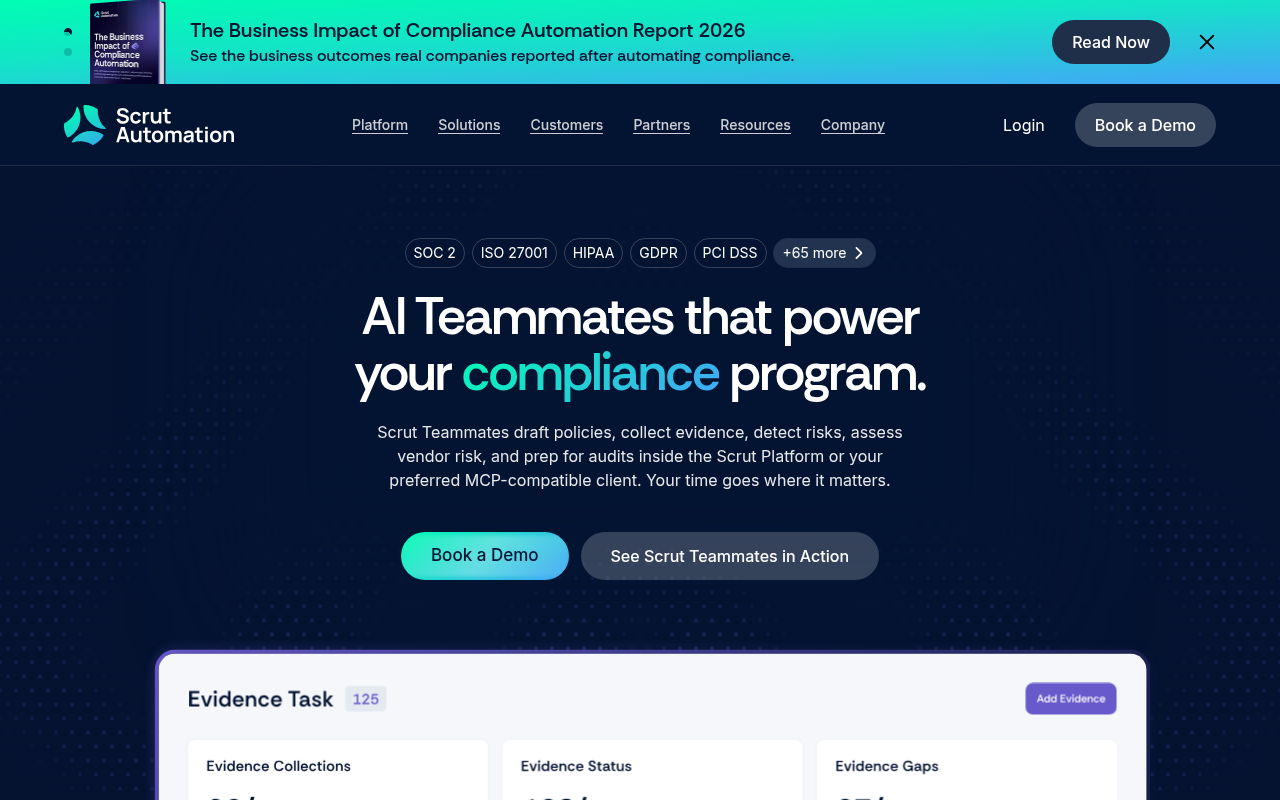
Scrut Automation starts from risk and keeps the entry bill modest. It supports 70+ frameworks out of the box, including SOC 2, ISO 27001, PCI DSS 4.0, HIPAA, GDPR, DORA, NIS2, NIST 800-53, NIST 800-171, CMMC 2.0 Levels 1 and 2 and ISO 42001, and connects to 150+ tools. A live risk register sits on a common data layer, so a cloud misconfiguration surfaces in the register next to the control it affects. Onboarding includes implementation managers and dedicated InfoSec managers who help draft policies and interpret frameworks, which matters when nobody in-house has run an audit before.
Best for: Startups and mid-market teams that want risk-first compliance and guided onboarding, with room to grow into multi-entity GRC.
Key features:
- 70+ frameworks on a unified control framework, plus custom frameworks
- 150+ integrations with continuous automated tests and drift detection
- Scrut Teammates, AI agents that draft policies, collect evidence, run readiness assessments and pre-fill security questionnaires
- Scrut MCP Server for querying controls and filing evidence from Claude, Cursor or other MCP clients
Why we like it: Scrut Automation routes a cloud-config gap into one prioritized fix linked to the affected control and risk, instead of separate alerts in separate modules.
Notable limitations:
- HITRUST and FedRAMP are not on Scrut's published framework list (checked October 2026)
- No pricing page; the only public number is an AWS Marketplace listing for small teams
- Scrut's Audit Center hosts your external auditor, but the audit itself is contracted and paid separately
Pricing: Quote-based. AWS Marketplace lists the Compliance Automation module at $15,000 for a 12-month contract covering organizations of up to 20 employees.
5. Strike Graph
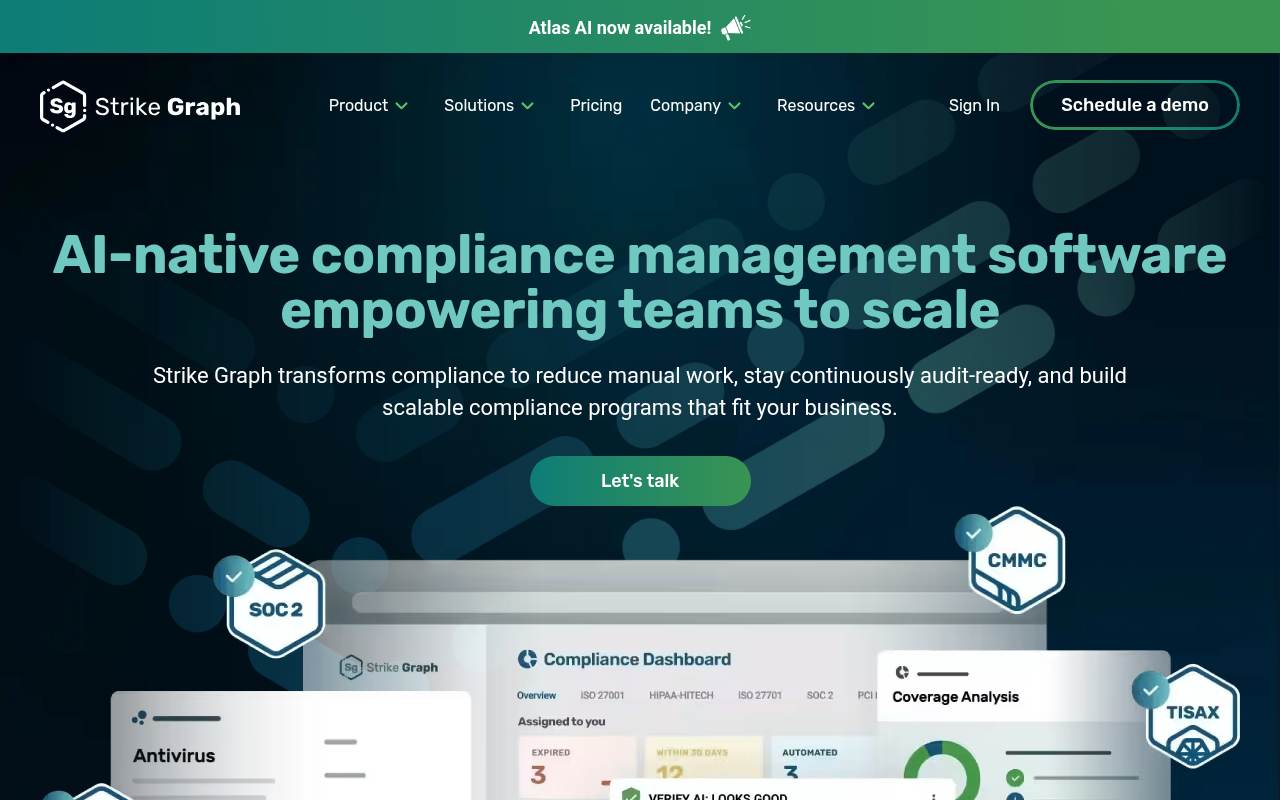
Strike Graph is AI-native compliance aimed at the months between audits. Verify AI checks collected evidence before the auditor sees it, the AI Security Assistant drafts questionnaire answers and integration scripts, and Atlas, launched in August 2026, analyzes posture across controls, evidence and ownership, then proposes a prioritized remediation plan that runs only after a human approves it. Frameworks come in three price tiers covering close to 30 standards, from SOC 2 and HIPAA in Tier 1 to ISO 27001 and PCI DSS in Tier 2 and CMMC Level 2, HITRUST, NIST 800-53 for FedRAMP, DORA and NIS2 in Tier 3.
Defense contractors get the most specific value here. The July 2026 suspension of CMMC Phase II left Phase 1 self-assessments and the underlying DFARS 252.204-7012 obligations in place, so contractors handling CUI still need a current System Security Plan and POA&Ms, and Strike Graph's Scale plan includes tooling for both.
Best for: Defense contractors maintaining NIST 800-171 documentation, and SaaS teams adding frameworks who want AI to keep evidence current between audits.
Key features:
- Atlas posture adviser with human approval on every recommended action
- Verify AI evidence validation and an AI Security Assistant
- Action Items for POA&Ms, a System Security Plan builder and SBOM monitoring on the Scale plan
- New frameworks map automatically onto existing controls
Why we like it: Strike Graph flags weak evidence while there is still time to fix it, which turns the pre-audit scramble into a short list of items with owners.
Notable limitations:
- The Certify tier has no printed price, and the step from the free Launch tier to Scale at $21,500 a year is steep
- Each extra framework adds $2,000 to $8,000 a year depending on tier and plan, so a fourth or fifth framework changes the renewal
- SOC 2 reports come from independent auditors in its partner network; Strike Graph's own audit services cover approved certifications and ISO 27001 internal audits
Pricing: Launch is free. Scale starts at $21,500 a year and Enterprise at $35,000 a year. Strike Graph also sells consumption-based AI credit packs from $4,250 a year, a penetration test starts at $10,000, and general users carry no per-seat fee.
6. LogicGate Risk Cloud
LogicGate Risk Cloud is a no-code GRC platform where compliance is one Application among more than 30. You buy the Applications you need, such as Controls Compliance, Enterprise Risk, Third-Party Risk, Cyber Risk and AI Governance, and adjust their workflows without code on a shared graph database, so the compliance program shares records and reporting with the rest of the risk function. The Controls Compliance Application shares evidence across unlimited frameworks, and through a partnership with A-LIGN, more than 230 auditor-vetted evidence requirements from A-LIGN's request lists for SOC 2, ISO, HITRUST and PCI come mapped into it.
Best for: Enterprises that want compliance, IT risk and third-party risk inside one configurable program, with an admin team to build it.
Key features:
- 30+ no-code Applications on one graph database
- Controls Compliance with evidence shared across unlimited frameworks and A-LIGN's auditor-vetted requirements
- GRC Agents, live since LogicGate's Summer 2026 release, plus automated control testing
- Risk Cloud Quantify for financial risk modeling, sold as an add-on
Why we like it: Because every workflow in LogicGate Risk Cloud is configurable, a failed control can trigger the same remediation and reporting path as an enterprise risk, with nothing exported to a spreadsheet.
Notable limitations:
- Flexibility needs builders: licensing centers on Power Users who build and manage Applications, so plan for at least one owner of the configuration
- Implementation, integration services, professional services and Quantify are priced separately from the Applications
- A-LIGN auditors can collaborate inside Risk Cloud, but the audit is a separate engagement with A-LIGN or your own firm
Pricing: Quote-based. You pay for the Applications you run plus Power User licenses, and Standard and External users are included at no extra cost.
7. Comp AI
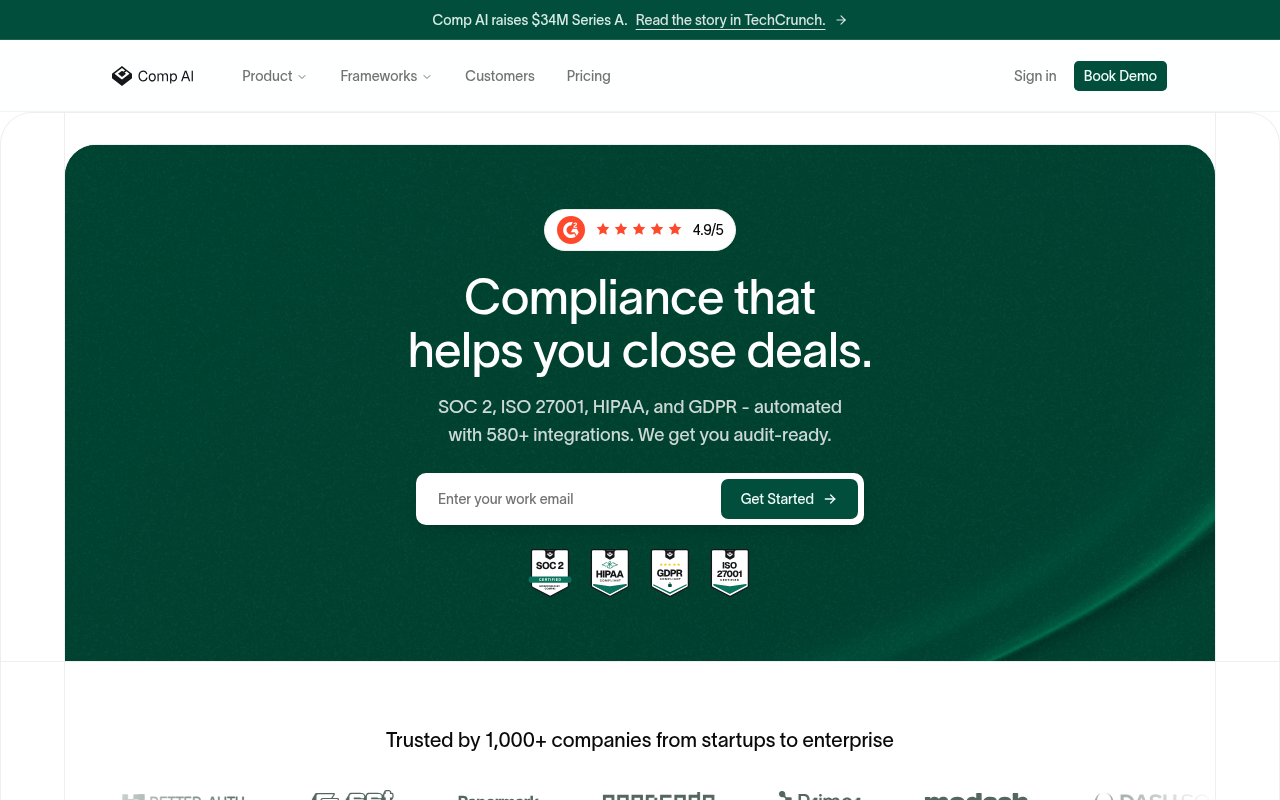
Comp AI is the pick for teams that want to read or run the code. Its core is open source under AGPLv3, with a small Enterprise Edition directory under a commercial license, and the repository includes a self-hosting guide built on Node.js, Bun and PostgreSQL. The managed product adds AI agents that gather evidence, draft policies from your stack and processes, monitor controls and run vendor reviews, plus an open-source device agent and a live trust center that removes a control the moment it fails. Comp AI raised a $34 million Series A in September 2026 and says more than 1,000 companies use it.
Best for: Startups and developer-led teams chasing SOC 2 or ISO 27001 that want to inspect or self-host the compliance platform.
Key features:
- AGPLv3 open core on GitHub with a self-hosting guide
- AI agents for evidence collection, policy drafting, control monitoring and vendor reviews
- Open-source device agent that checks disk encryption, firewall and screen-lock settings on employee machines
- 580+ integrations advertised, with daily cloud scans
Why we like it: With Comp AI, you can read the code behind every check that marks a control as passing, which makes it easier to answer an auditor who asks how an evidence result was produced.
Notable limitations:
- Self-hosting means you own the database, upgrades and integration credentials, and the README still lists Docker and Vercel deployment steps as coming soon
- AGPLv3 obligations apply if you modify the code and serve it to users, so have counsel review the license before you fork
- HITRUST and CMMC are not among the frameworks named on its pricing page, and the company was founded in 2025
Pricing: No price list. Comp AI quotes on a 20-minute call based on frameworks, headcount, timeline and whether the audit, penetration testing or a trust center is included. The open-source code is free to self-host.
Frameworks and Audit Path Compared
Read the middle column first if you sell to healthcare, federal agencies or the defense sector, then check who performs the audit.
| Platform | SOC 2 and ISO 27001 | HITRUST, FedRAMP and CMMC | Who performs the audit |
|---|---|---|---|
| Hyperproof | Yes, crosswalked across 160+ frameworks | All three in the library; Hyperproof Gov runs in a FedRAMP Class C environment | Your firm or a partner firm |
| Thoropass | Yes, audited in-house | HITRUST e1, i1 and r2; CMMC Level 1; FedRAMP not listed | Thoropass Assurance, its affiliated CPA firm |
| Anecdotes | Yes, with requirement-level cross-mapping | FedRAMP yes; CMMC via NIST 800-171; HITRUST not listed | Your firm or an Anecdotes audit partner |
| Scrut Automation | Yes | CMMC 2.0 Levels 1 and 2; HITRUST and FedRAMP not listed | Your firm, working in Scrut's Audit Center |
| Strike Graph | Yes, with ISO 27001 as a Tier 2 framework | HITRUST, NIST 800-53 for FedRAMP, CMMC Levels 1 and 2 | Partner-network auditors, with internal audits in-house |
| LogicGate Risk Cloud | Yes, with crosswalks | HITRUST via A-LIGN requirement mapping; confirm FedRAMP and CMMC content | A-LIGN or your own firm |
| Comp AI | Yes, as core frameworks | FedRAMP quoted; HITRUST and CMMC not named | Can be scoped into the quote; confirm the firm |
Automation and Deployment Compared
Integration counts are each vendor's own figure, so the AI column says more about whether evidence stays fresh between audits.
| Platform | Integrations | AI and monitoring | Deployment |
|---|---|---|---|
| Hyperproof | 200+ | AI Guided Experiences and continuous controls monitoring | SaaS, plus a separate FedRAMP Class C environment |
| Thoropass | Cloud, identity, HR and ticketing connectors, with no count published | Real-time monitoring and alerts, plus an AI-assisted audit workflow | SaaS |
| Anecdotes | 230+ native, plus Data Studio | Agent Studio, Agent Library, ChatGRC and MCP | SaaS, FedRAMP 20x Class C certified |
| Scrut Automation | 150+ | Scrut Teammates agents, an MCP server and continuous tests | SaaS |
| Strike Graph | 50+ cloud integrations from the Certify tier up | Atlas, Verify AI and the Security Assistant, with MCP on Scale | SaaS |
| LogicGate Risk Cloud | Native connectors plus integration services | GRC Agents and automated control testing | SaaS |
| Comp AI | 580+ advertised | AI agents, daily cloud scans and a device agent | Managed cloud or self-hosted open core |
Strategic Decision Framework
| Critical question | Why it matters | What to evaluate | Red flags |
|---|---|---|---|
| Does one control really answer several frameworks? | Cross-mapping is where the second and third audits get cheaper, and a library count doesn't prove the mapping exists | Ask the vendor to show one access-review control mapped to SOC 2, ISO 27001 and your next framework, with one piece of evidence attached | Each new framework arrives as a fresh template with no shared controls |
| Who performs the audit, and can you change firms? | The audit relationship usually outlasts the software contract | Whether your current firm can work in the platform, which audit partners are supported, and what happens to evidence if you leave | Leaving the platform also means leaving your audit firm and rebuilding the evidence trail |
| Is the evidence live data or uploaded screenshots? | Auditors test populations and dates, and screenshots go stale the week after you take them | Which controls collect evidence through integrations with timestamps and source data, and which rely on manual uploads | A dashboard that turns green as soon as a file exists in a folder |
| What does year two cost with one more framework? | Most buyers add a framework within a year or two, and the first quote rarely shows that line | Price per added framework, entity and admin seat, plus renewal caps | Per-framework add-ons with no renewal cap |
| Is federal or defense work on the horizon? | FedRAMP's 2026 rules turn mandatory in January 2027, and CMMC self-assessments still apply during the Phase II pause | POA&M tracking, an SSP builder, NIST 800-171 and 800-53 depth, and whether the vendor itself holds a FedRAMP certification | A framework template with no POA&M or SSP workflow behind it |
Problems & Solutions
- Problem: You bought enterprise GRC for a first SOC 2, and the implementation project is still running when the customer deadline arrives. Solution: For a first attestation, start with Scrut Automation, Strike Graph, Comp AI or Thoropass, and move to Anecdotes or LogicGate Risk Cloud when a risk committee and several entities need one register.
- Problem: A startup tool now has to cover subsidiaries, regions and a board risk report, and the gaps are filled with exports. Solution: Look for multi-entity registers that roll up to one view, which Anecdotes offers natively and Scrut Automation offers at its enterprise stage, and migrate the control set rather than just the documents.
- Problem: A defense deal appears, and the platform only has a framework template. Solution: Strike Graph's POA&M Action Items and SSP builder cover the paperwork CUI contracts require, and Hyperproof adds a FedRAMP-hosted environment if the program will hold federal data.
- Problem: Your audit firm won't work on the vendor's platform, so evidence gets exported twice. Solution: Confirm auditor access before signing; if you want one accountable party, Thoropass includes the auditor, and LogicGate Risk Cloud lets A-LIGN auditors work inside the platform.
- Problem: Security or legal won't let compliance data leave your own infrastructure. Solution: Comp AI's AGPLv3 core can be self-hosted, as long as your team accepts ownership of upgrades and the license terms.
The Bottom Line
If you already carry several frameworks and trust your audit firm, start with Hyperproof, and scope Hyperproof Gov separately if federal buyers are in the pipeline. If you want one vendor from readiness to the signed report, Thoropass is the cleanest bundle, provided your customers accept an affiliated audit firm.
If cost matters and you want risk built in from the first SOC 2, Scrut Automation offers the most guided path at a publicly listed entry price. If defense documentation or evidence freshness between audits is the pressure, Strike Graph's Atlas, Verify AI and POA&M tooling fit best. If compliance data must stay in your own infrastructure, Comp AI is the only platform here with an open-source core.
If compliance is one part of an enterprise risk program across subsidiaries, quote Anecdotes for its all-inclusive data layer and LogicGate Risk Cloud for its configurable Applications, and expect an implementation project with either.