Most teams discover data chaos during a board drill on AI readiness, not from an internal audit. Working across different tech companies, I have learned that the biggest Enterprise Data Management mistakes happen when schema drift hits production, cost spikes go unnoticed, and no one can trace column-level lineage to the dashboard that broke. From my experience in the startup ecosystem, three fixes save real money fast, enforce CI checks on data branches before merges, add SLOs around ingestion and transformation jobs, and tag PII for policy-driven masking. The average breach hit $4.88M in 2024, which is why reliability and governance belong in the same plan, per IBM's Cost of a Data Breach Report.
IDC reports public cloud services revenue reached $669.2B in 2023, which explains why data platforms and governance tools are converging in the cloud era, per IDC's tracker summary. In minutes, you will learn which tools fit your size, how to avoid lock-in and cost traps, and where to start for fastest value.
lakeFS
lakeFS is a Git-like version control for data lakes that brings branching, commits, and atomic merges to object storage. It lets teams create isolated test branches, run data quality checks, then roll back safely.
Best for: Teams on S3, ADLS, GCS, or S3-compatible storage that want code-style workflows for data with instant rollback.
Key Features:
- Branching and merging over object storage, with zero-copy branches and atomic commits, per vendor documentation.
- Pre-merge hooks to block bad schemas or failed validations, per vendor documentation.
- Point-in-time time travel and revert for rapid recovery, per vendor documentation.
Why we like it: It gives you Git-like guardrails on a lake without re-platforming, so experiments stop breaking production while storage costs stay flat due to zero-copy branching. The open-source foundation and Apache 2.0 license mean no vendor lock-in, and you can self-host or use the enterprise option. For teams that need rapid rollback and safe data experimentation, lakeFS provides the best combination of control, flexibility, and cost efficiency.
Notable Limitations:
- Requires operational maturity in versioning workflows, based on community reports that cite learning curve and perceived stability concerns in early deployments, see this r/dataengineering discussion.
- Ecosystem awareness is improving but community size is smaller than warehouse-native stacks, inferred from coverage volume vs peers on review hubs like G2's category pages.
Pricing: Open source under Apache 2.0 with a free community path, per Wikipedia's lakeFS entry. Enterprise support and hosted options exist, pricing not publicly available via neutral sources. Contact the vendor for a custom quote.
Acceldata

An AI-assisted control plane that unifies data observability, governance signals, and cost optimization, with agents that detect and remediate anomalies.
Best for: Data leaders who need autonomous monitoring across Snowflake, Databricks, Hadoop, and hybrid estates, plus FinOps guardrails.
Key Features:
- Agentic anomaly detection and multi-dimensional drift checks across data and pipelines, as announced in this April 2025 release.
- Cross-platform policy and lineage context for AI and analytics workloads, per the platform debut at Autonomous 25.
- Marketplace availability and hybrid deployment options, see Google Cloud Marketplace news.
Why we like it: The platform goes beyond dashboards to recommended actions and spend guardrails, which shortens MTTR and curbs runaway compute.
Notable Limitations:
- UI can feel busy and setup can be complex in large estates, per verified G2 reviewer feedback.
- Some out-of-the-box alerts may need tuning to avoid noise, noted in an AWS Marketplace customer review.
Pricing: Public listings show contract-based pricing on AWS Marketplace, for example $5,000 per year for a Data Reliability dimension and $100,000 per year for Spend Intelligence, plus other options, per AWS Marketplace. A separate offer lists a $10,000 annual platform entry. Confirm scope and terms with the seller.
K2View
An entity-centric platform that builds real-time data products and stores each entity's data in its own Micro-Database for low-latency access.
Best for: Enterprises needing operational 360s, tokenization, and API-ready entity data for apps and AI with strict SLAs.
Key Features:
- Micro-Databases that unify each entity's data and keep it fresh in real time, per third-party coverage of the launch on PR Newswire.
- Flexible architectures, deploy as data fabric, mesh, or hub, per the same announcement on PR Newswire.
- Built-in cataloging and monitoring around data products, per the media announcement above.
Why we like it: The entity-first approach fits high-throughput operational cases where a customer or device record must be current and queryable within milliseconds.
Notable Limitations:
- Steeper learning curve and documentation gaps noted by users, per G2 reviews.
- Some reviewers mention cost and initial complexity, also on G2.
Pricing: Pricing not publicly available. G2 lists pricing as "TBD," so you should contact K2View for a custom quote, per G2 product page.
Collibra
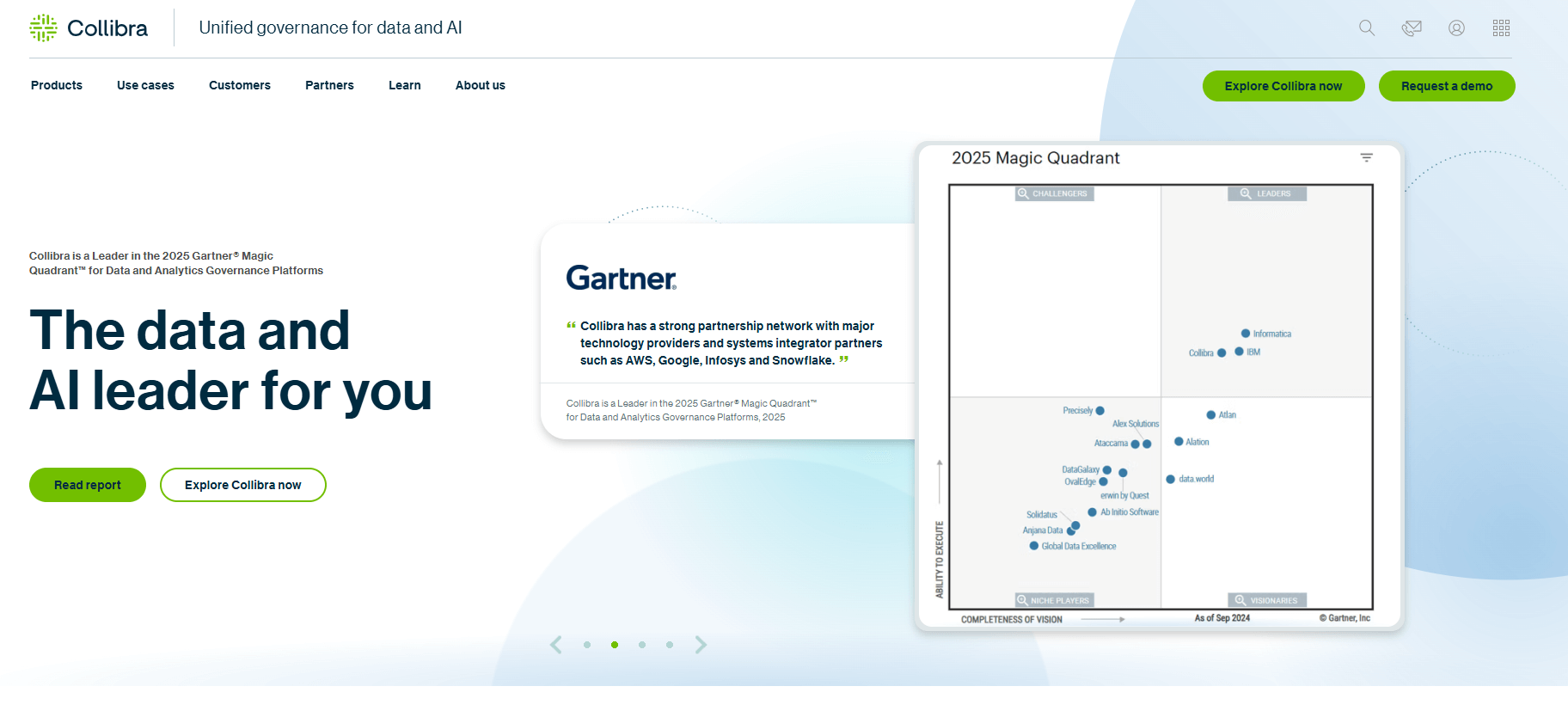
A cloud-native governance, catalog, lineage, privacy, and data quality platform with policy workflows and multi-persona experiences.
Best for: Organizations standardizing governance and catalog across multi-cloud and BI ecosystems with audit-ready lineage.
Key Features:
- End-to-end catalog with automated technical and business lineage, per marketplace listing on AWS Marketplace.
- Data quality and privacy workflows tied to access requests and marketplace patterns, per AWS Marketplace.
- Independent validation as a Leader in data and analytics governance and data intelligence, referenced by IDC MarketScape coverage in PR Newswire and Gartner's new MQ leadership acknowledgment cited in Collibra's press notice carried on PR Newswire.
Why we like it: Strong governance plus wide ecosystem connectors give large teams a single language for data definitions, policies, and access.
Notable Limitations:
- Steep onboarding curve and UI complexity reported by users, per G2 reviews.
- Pricing and connectors can add up in large estates, and access automation gaps are noted by customers, per PeerSpot reviews and pros-cons.
Pricing: Available via marketplaces and enterprise contracts. An AWS Marketplace listing shows $170,000 for a 12-month subscription to Collibra Data Intelligence Cloud. Confirm seat types, modules, and term discounts with the seller.
Snowflake
A scalable data platform for warehousing, secure data sharing, and AI-ready analytics with consumption-based pricing.
Best for: Teams that want elastic compute and storage separation, governed sharing, and wide partner ecosystem for BI and AI.
Key Features:
- Credit-based compute with per-second billing and capacity options, explained by independent analysts at Twing Data.
- Secure data sharing and marketplace with subscription and usage pricing for listings, covered by third-party docs like Select's pricing guide.
- Time Travel for point-in-time recovery and cloning that supports rollback patterns, discussed widely in public analyses like Twing Data.
Why we like it: Mature elasticity, rich connectors, and data sharing reduce heavy lifting and speed up delivery of analytics and AI products.
Notable Limitations:
- Cost management and forecastability require discipline, frequently cited by users in G2 reviews.
- Small-file ingestion and advanced features can need extra engineering, also reflected in user feedback on G2.
Pricing: Usage based. A neutral pricing snapshot lists $2, $3, and $4 per compute hour for Standard, Enterprise, and Business Critical in many US regions, respectively, per G2 pricing page. Independent analysts outline per-credit ranges by region and edition, per Twing Data.
Enterprise Data Management Tools Comparison: Quick Overview
| Tool | Best For | Pricing Model | Free Option |
|---|---|---|---|
| lakeFS | Data lake teams needing Git-like branching and rollback | Open source plus commercial support | Yes, Apache 2.0 |
| Acceldata Agentic Data Management | Hybrid estates that need observability, governance signals, and FinOps | Contract pricing, listings on marketplaces | No public free plan |
| K2View Data Product Platform | Real-time entity 360s and operational APIs | Enterprise contract | Not public |
| Collibra Data Intelligence Platform | Unified governance, catalog, lineage at enterprise scale | Subscription, marketplace offers | Not public |
| Snowflake Data Cloud | Elastic analytics and data sharing across teams | Consumption pricing by credits | Trial offers vary by channel |
Highlights:
- lakeFS: Zero-copy branches, fast revert, CI hooks
- Acceldata: Agentic anomaly detection, cross-platform policies
- K2View: Micro-Databases per entity, fabric or mesh
- Collibra: Multi-persona governance and lineage
- Snowflake: Storage-compute separation, data marketplace
Enterprise Data Management Platform Comparison: Key Features at a Glance
| Tool | Versioning or Lineage Guardrails | Data Quality Controls | Cost Governance Signals |
|---|---|---|---|
| lakeFS | Branching, commits, revert before merge | Pre-merge hooks for checks | Indirect storage savings with zero-copy branches |
| Acceldata | End-to-end lineage context | Anomaly, schema, and drift checks | Spend analytics, guardrails, anomaly detection |
| K2View | Entity graph and data product catalog | Tokenization and quality within Micro-Databases | Efficiency via entity-scoped compute and caching |
| Collibra | Automated technical and business lineage | Policy workflows and data quality monitoring | License governance via catalog and policies |
| Snowflake | Access history and data sharing lineage | Native features and partner tools | Resource monitors and capacity options |
Enterprise Data Management Deployment Options
| Tool | Cloud API | On-Premise | Air-Gapped | Integration Complexity |
|---|---|---|---|---|
| lakeFS | Yes | Yes | Possible via self-host | Moderate, depends on object store and hooks |
| Acceldata | Yes | Yes | Possible for regulated environments | Moderate to High across multi-platform |
| K2View | Yes | Yes | Possible for regulated environments | Moderate to High, entity modeling required |
| Collibra | Yes | Yes, incl. gov listings | Possible in restricted networks | Moderate, wide connector set |
| Snowflake | Yes | No traditional on-prem | Not applicable | Low to Moderate with strong ecosystem |
Enterprise Data Management Strategic Decision Framework
| Critical Question | Why It Matters | What to Evaluate | Red Flags |
|---|---|---|---|
| Can we roll back bad data quickly without reprocessing everything? | Shortens outages and avoids revenue loss | Time travel, branching, atomic merges | Heavy copies for "dev" lakes, slow rollback |
| Will the platform give actionable cost and reliability signals? | Uncontrolled spend and hidden failures hurt trust | Spend dashboards, anomaly detection, guardrails | "Monitor only" views, no policies or automation |
| How will governance scale to AI and self-service? | AI needs high-quality, well-governed data | Catalog coverage, policy workflows, access requests | Manual approvals, lineage gaps, PII tagging gaps |
| Do we avoid lock-in while meeting SLAs? | Hybrid stacks are the norm | Open standards, marketplace options, migration paths | Proprietary formats only, limited egress paths |
Enterprise Data Management Solutions Comparison: Pricing & Capabilities Overview
| Organization Size | Recommended Setup | Monthly Cost | Annual Investment |
|---|---|---|---|
| 100-500 employees | Snowflake Standard plus lakeFS for lake versioning | Varies by usage | Varies by usage |
| 500-5,000 employees | Snowflake Enterprise, Collibra catalog and policies, Acceldata for reliability and spend | Varies, consumption and contract mix | Confirm via marketplace quotes and usage data |
| 5,000+ employees | Snowflake Business Critical, Collibra enterprise subscription, Acceldata agentic observability, K2View for real-time 360s | Contract plus consumption | Use RFP plus pilot usage baselines |
Note, pricing is highly variable. For verified reference points, see Collibra's $170,000 12-month listing on AWS Marketplace, Snowflake's G2 compute-hour entries at $2 to $4 per hour, and Acceldata listings on AWS Marketplace.
Problems & Solutions
-
Problem: Cost and risk from poor data quality
Why it matters, Gartner estimates poor data quality costs organizations $12.9M a year on average, which compounds across AI and analytics programs, per Gartner analysis.
How tools help, Acceldata adds anomaly and drift checks and can tie reliability to cost signals, which users confirm while noting UI and setup tradeoffs. Collibra operationalizes policies and quality monitoring with audit-ready lineage, validated in marketplace listings and user reviews. -
Problem: Breach impact and recovery delays
Why it matters, the average breach reached $4.88M in 2024, and multi-environment breaches were costlier and slower to contain.
How tools help, lakeFS enables fast rollback to a known good commit to limit blast radius, with community scenarios describing revert patterns, see this technical doc excerpt and general open-source confirmation via Wikipedia. Collibra centralizes lineage and data ownership to speed breach investigation paths, as reflected in customer usage comments on AWS Marketplace reviews. -
Problem: Sudden cloud spend spikes during scale up
Why it matters, rapid growth in public cloud services signals more variable consumption risk.
How tools help, Acceldata's Spend Intelligence and anomaly guardrails highlight long-running or spiky queries. Snowflake provides resource monitors, capacity contracts, and per-credit transparency discussed by independent analysts, per Twing Data's pricing explainer and pricing snapshots on G2. -
Problem: Real-time operational views for entity 360 and AI prompts
Why it matters, analytics platforms do not always meet millisecond operational needs.
How tools help, K2View's Micro-Databases serve entity-scoped, fresh data for APIs and apps, as described in the launch coverage on PR Newswire. Users cite value and learning curve on G2.
The bottom line for 2026
Enterprise data failures rarely come from missing tools - they come from missing guardrails. If you want the fastest path to reliability and cost control, start with lakeFS to put CI style controls, rollback, and isolation around your data lake without re-platforming. Pair it with agentic observability like Acceldata to surface drift, reliability issues, and spend anomalies before they hit executives or customers. When governance and audit pressure rise, Collibra provides the system of record for lineage, policies, and ownership. Keep analytics elastic with Snowflake, but treat credits and capacity like financial instruments, not background infrastructure.
At a market level, rising breach costs, accelerating cloud spend, and AI driven data demand mean reliability, governance, and cost management now converge into a single discipline. The teams that succeed in 2026 measure time to rollback, incident MTTR, and dollars saved per policy, not just query speed. Start with one domain, enforce controls early, and scale only what proves it can protect both data and budget.