Most teams discover spare parts waste during an audit after a line stoppage, not from monthly dashboards. Working across different tech companies, I have seen the biggest savings come from three technical moves: safety stock tuning by asset criticality, duplicate part normalization across ERPs, and forecast models that blend usage with supplier lead time risk. Aviation and industrial MRO are back in growth mode, with Oliver Wyman’s analysis showing maintenance demand trending near 3% annually through 2035, as summarized by the Aeronautical Repair Station Association’s market assessment.
This guide contains four tools that consistently cut inventory, shrink stockouts, or reduce turnaround time. You will learn where each tool pays back fastest, the tradeoffs reviewers call out, and what to check during pilot scoping.
The Importance of MRO Cost Reduction Tools
MRO costs are rarely driven by one issue alone. They build up through excess stock, duplicate parts, weak sourcing visibility, and manual planning that hides where cash and time are being lost. The right tools help teams make those inefficiencies visible early, so they can reduce working capital without increasing service risk.
4 Best MRO Cost Reduction Tools in 2026
No single MRO cost reduction tool solves every problem equally well. Some platforms are strongest at spare parts data quality and sourcing visibility, while others are better suited to inventory optimization or aviation-specific maintenance workflows. The shortlist below focuses on tools that can materially improve cost, availability, or turnaround time in real operating environments.
1. SPARETECH
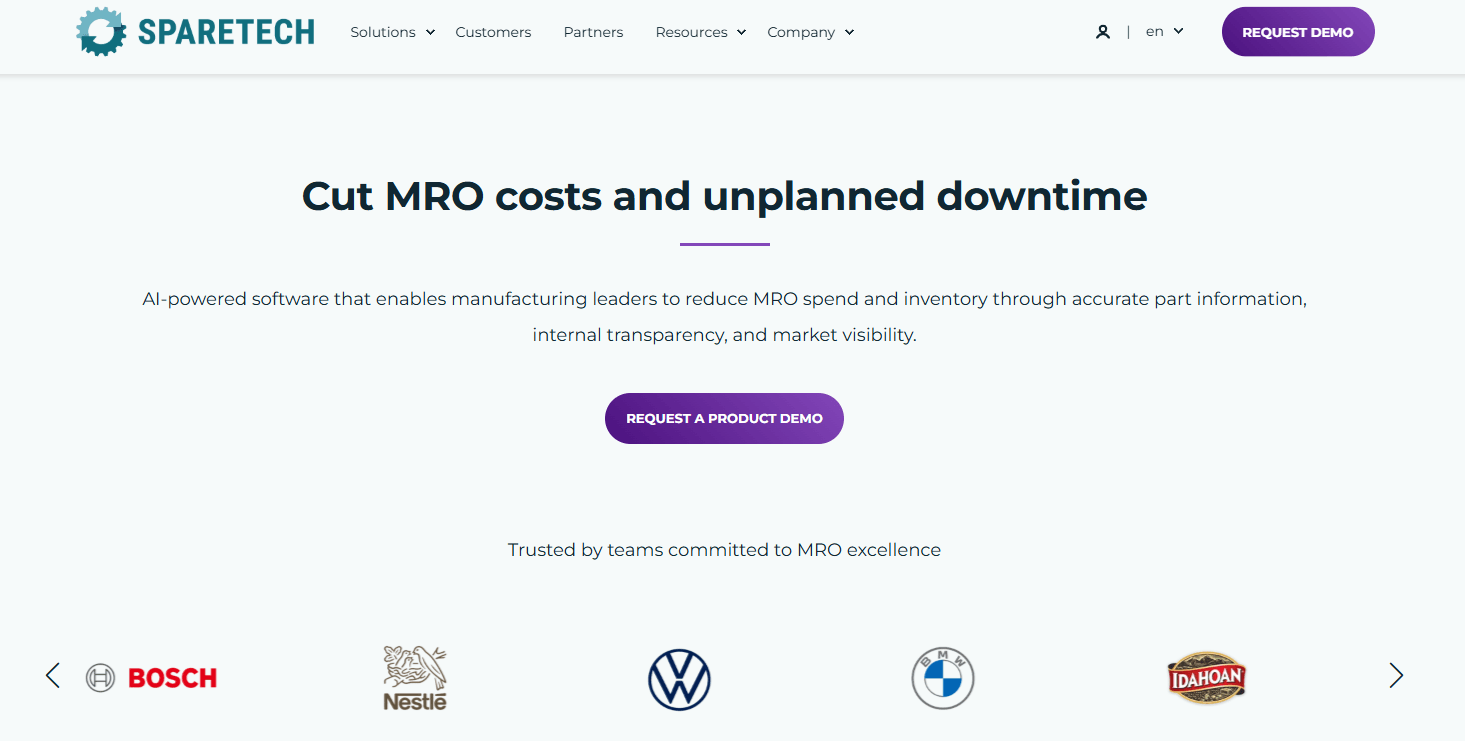
SPARETECH is an AI-powered spare parts intelligence platform for manufacturers, focused on clean material masters, duplicate reduction, and better sourcing decisions through accurate part information, internal transparency, and market visibility. It combines global spare parts search, BOM checks, and data lifecycle management to help standardize ERP records with original manufacturer information and reduce duplicate stocks.
Best for: Enterprise manufacturers with multi-site spare parts operations, fragmented material master data, and teams looking to reduce inventory, improve sourcing, and standardize spare parts data across plants.
Pros:
- Rapid savings from duplicate removal and price transparency across suppliers, as per user reviews.
- Global spare parts search and original manufacturer information improve data quality and standardization.
- Strong search that speeds part identification and substitution checks.
- Automated new material creation reduces bad data entering the ERP.
- Fits multi-site manufacturing environments that want to release working capital through better spare parts data, duplicate reduction, and sourcing visibility.
Cons:
- Potential data usage fees according to reviewers on G2.
- Variability in depth and standardization of manufacturer information across parts data per reviews.
- Limited public pricing and few independent case studies relative to older EAM suites.
- Requires ERP integration and data sync effort typical of master data projects, as per user feedback trends.
2. IBM Maximo Inventory Optimization
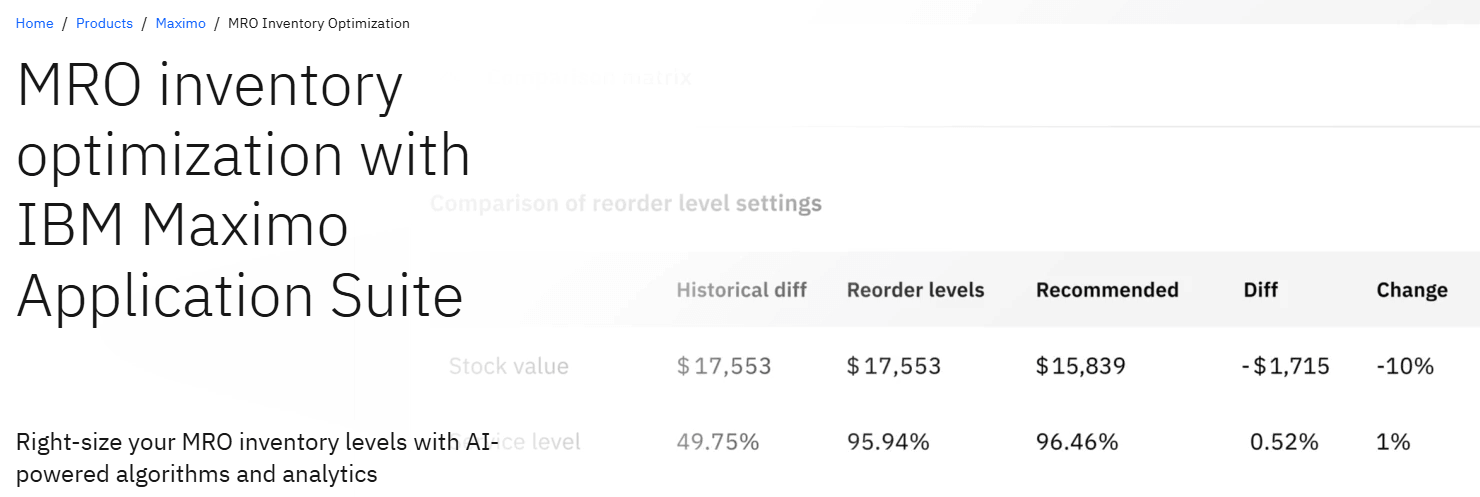
IBM Maximo Inventory Optimization is an AI-driven, cloud-based MRO inventory optimization solution within the IBM Maximo portfolio. It uses forecasting, prescriptive analytics, and optimization to improve stock levels, reorder points, and critical spares availability.
Best for: Asset-intensive industries such as utilities, oil and gas, mining, and transportation seeking inventory right-sizing tied to work management and failure data.
Pros:
- Forecasting and policy optimization that align stock to service targets.
- Uses historical demand and lead time to quantify stockout risk.
- Native integration with Maximo’s asset and work data improves the relevance of stocking decisions.
- Strong fit when maintenance history and failure behavior drive stocking policies.
Cons:
- A steep learning curve and complex UI can slow adoption.
- Requires careful data modeling and admin support for large enterprises, per reviews.
- IBM publicly lists an Essentials edition starting at USD 3,094 per month, while broader pricing depends on inventory size, environments, and capability tier.
- Higher integration effort due to Maximo data model alignment in complex environments.
3. MaintainRO

MaintainRO is a 4th-generation MRO software platform for aviation, rotorcraft, and naval operations, with a focus on scheduling, compliance, secure workflows, and AI-powered maintenance visibility.
Best for: Flight departments, rotorcraft operators, and defense or paramilitary fleets that want modern planning and compliance features in a focused system.
Pros:
- Aviation-focused workflows with compliance checkpoints suitable for regulated environments.
- Mobile and offline capture support line and hangar operations.
- AI-powered diagnostics, asset health insights, and real-time dashboards support maintenance planning and operational visibility.
- Emphasis on secure compliance, tamper-proof audits, and workcard-based maintenance workflows for regulated environments.
Cons:
- Scarce independent reviews on major directories as of March 2026, raising diligence needs.
- Fewer public references than long-standing aviation suites such as AMOS or Veryon.
- Pricing not published, requiring custom quotes and pilot scoping.
- Stability and support should be validated through references and a structured pilot.
4. SOMA MRO Software
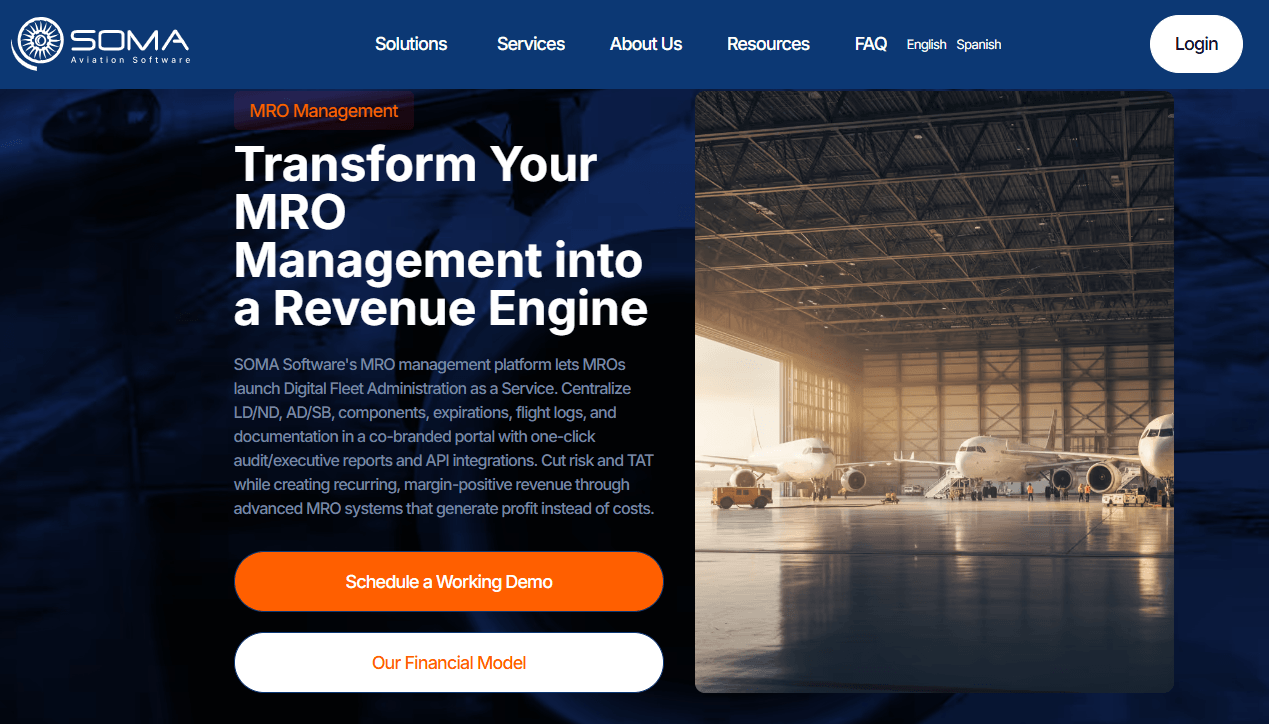
SOMA MRO Software is an aviation MRO platform covering real-time task tracking, component lifecycle management, purchasing and inventory, compliance automation, and maintenance reporting.
Best for: Regional airlines, charter operators, and independent MROs that want an aviation-focused suite with component life tracking and compliance.
Pros:
- Aviation-specific suite with real-time task, inventory, and component life tracking.
- Positive user feedback on ease of use and support.
- Supports automated AD tracking, compliance dashboards, and component lifecycle visibility suitable for operators that need stronger maintenance control and audit readiness.
- Inventory management, purchasing controls, and centralized maintenance data improve operational visibility and support compliance workflows.
Cons:
- Some reviewers cite response delays and desire better task grouping and filters.
- Smaller ecosystem and fewer published enterprise references than legacy leaders.
- Data migration and setup can take time, according to review commentary.
MRO Cost Reduction Tools Comparison: Quick Overview
At a high level, these tools differ in where they create value fastest. Some reduce costs through cleaner data and better buying decisions, while others optimize stock policies or tighten maintenance execution. This quick overview helps narrow the field before you look deeper at features, pricing, and deployment fit.
| Tool | Pricing Model | Free Option | Highlights |
|---|---|---|---|
| SPARETECH | Custom quote | No public free plan | Strong spare parts search, duplicate reduction, and sourcing visibility for faster MRO savings |
| IBM Maximo Inventory Optimization | Suite subscription, private offers via AWS Marketplace | Not indicated on the marketplace | Policy-based stocking, forecasts, and service level targets within Maximo |
| MaintainRO | Custom quote | Not indicated | Focused aviation workflows, scheduling and compliance features |
| SOMA MRO Software | Custom quote | Contact vendor | Real-time task, inventory and component tracking with positive user feedback |
MRO Cost Reduction Platform Comparison: Key Features at a Glance
Feature lists can look similar until you compare what each platform is actually built to improve. This table highlights the functional areas that matter most for cost reduction, from spare parts normalization and forecasting to compliance tracking and component lifecycle control. It is designed to help buyers separate broad platforms from purpose-built tools.
| Tool | Feature 1 | Feature 2 | Feature 3 |
|---|---|---|---|
| SPARETECH | Global spare parts search | Duplicate detection and material master standardization | Cost deviation visibility across supplier and market data |
| IBM Maximo Inventory Optimization | Forecasting and safety stock policy optimization | Stockout risk insights by part and site | Native integration with Maximo work and asset data |
| MaintainRO | Job cards, scheduling and compliance checkpoints | Mobile and offline capture | Analytics supporting predictive maintenance |
| SOMA MRO Software | Maintenance scheduling and inspections | PO management and storeroom controls | Component life and airworthiness tracking |
Where MRO Costs Build Up and Which Tools Help Most
MRO cost pressure usually shows up in a few repeatable patterns: rising maintenance volume, too much time spent searching for information, and too much capital tied up in slow-moving stock. This section maps those problems to the kinds of tool capabilities that actually help, so buyers can connect platform choice to operational outcomes rather than feature lists alone.
1. Aviation and industrial MRO spend continues to grow with fleets and regulatory demands, which pressures working capital and parts availability.
- SPARETECH: Helps reduce working capital by removing duplicates, improving spare parts visibility across sites, and surfacing cost deviations and sourcing options so procurement teams can buy more strategically.
- IBM Maximo Inventory Optimization: Sets policy-based stocking with forecasts and service targets, reducing excess stock and stockouts within Maximo workflows.
- MaintainRO and SOMA: Cut turnaround time by standardizing job cards, task sequencing, and component control, which helps fleets absorb a higher workload without proportional headcount.
2. Technicians can spend large portions of time searching manuals and records, slowing execution.
- SPARETECH: Centralizes spare parts data and reduces ambiguity, speeding part identification, duplicate detection, and spare parts list processing across sites.
- IBM Maximo Inventory Optimization: Works within the Maximo data model, so planners can align spares to actual failure and work history rather than digging across systems.
- MaintainRO and SOMA: Provide structured task, inspection, and component records that reduce manual lookups and improve audit trails, based on aviation user feedback on directories.
3. Carrying spare parts is expensive, and many inventories contain a high share of slow movers.
- SPARETECH: Highlights duplicate SKUs, internal stock visibility, and supplier cost differences to reduce unnecessary spend and excess inventory more quickly.
- IBM Maximo Inventory Optimization: Tunes safety stock and reorder points to service targets, an established way to cut inventory without risking availability.
- MaintainRO and SOMA: Help avoid over-ordering by tightening component life tracking, inspections, and planned maintenance visibility that keeps parts aligned to upcoming tasks.
MRO Cost Reduction Strategic Decision Framework
Tool selection matters, but the bigger driver of results is how clearly you define the operating problem first. This framework helps teams pressure-test their assumptions around data quality, service levels, supplier signals, and pilot scope before they commit budget or time, making evaluation more disciplined and outcomes more measurable.
| Critical Question | Why It Matters | What to Evaluate | Red Flags |
|---|---|---|---|
| How clean is our part master and vendor list today? | Dirty data hides duplicates, inflates stock and spend | Sample 200 high-value SKUs for duplicates, obsolete alternates, and wrong lead times | No governance on new material creation, free text descriptions, missing manufacturers |
| What service levels do we truly need by asset criticality? | Overprotecting non-critical parts ties up cash | Map parts to asset criticality and downtime cost, set differentiated targets | One size fits all 98% service targets across all parts |
| Can we connect maintenance history to spares? | Real failure patterns drive smart stocking | Link work orders, MTBF, and spares usage in optimization | Optimizing in isolation from maintenance and outage data |
| Do we have credible supplier lead time and price signals? | Lead time variance and price dispersion drive cost | Use marketplace or review signals and contract data to refresh parameters quarterly | Static lead times older than 12 months, no visibility of cross-supplier price differences |
| Will the pilot reach scale in 90 days? | Savings depend on scope and adoption | Pick two sites, 3 critical asset families, and measure stockouts, inventory, and buy price | Open-ended pilots with no baseline, no exit criteria, or no adoption plan |
The Bottom Line
MRO cost reduction usually comes down to three levers: cleaner spare parts data, better inventory policies, and stronger execution inside maintenance workflows. The right platform should help you improve at least one of those quickly, while creating a realistic path to broader gains in availability, working capital, and sourcing control. Instead of starting with vendor claims, start with the bottleneck that is costing you the most today, define what success looks like in 90 days, and choose the tool that is best matched to that problem.