
You think you know where growth leaks happen until a single release tanks activation and your dashboards tell you the "what," not the "why." From our experience in the startup ecosystem, the biggest wins come from pairing event analytics with experimentation and qualitative context. Three examples that move the needle fast: instrumenting feature-level retention by persona, running holdout tests on onboarding flows, and tracing "time to value" from first-run to PQL creation. Recent analyst coverage confirms product analytics is now table stakes for digital products, not a nice to have. Gartner's Market Guide stresses that teams without product analytics cannot fully understand user behaviors or optimize experiences at scale. (gartner.com)
IDC reports enterprise applications revenue reached 356 billion dollars in 2023 and is forecast to surpass 600 billion dollars by 2028, a signal that analytics-driven software is drawing sustained budget. In minutes, you will know which platform fits your data model, experiment cadence, and team skill mix, plus what limitations to plan around. (businesswire.com)
Amplitude
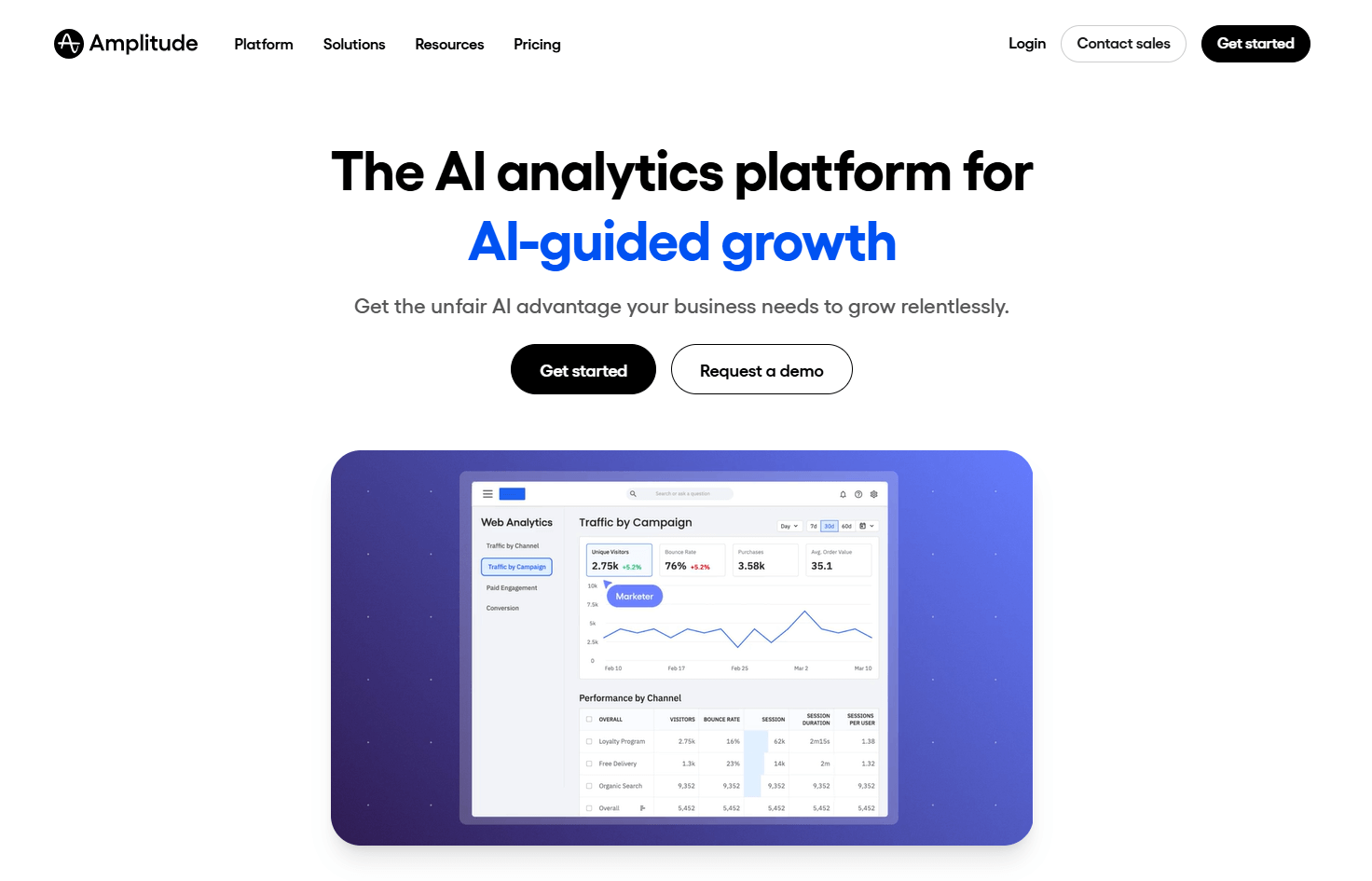
Unified product analytics and experimentation with funnels, retention, and behavioral cohorts. Now augmented with native session replay and self-serve web experimentation to connect the "what" and the "why."
Best for: Teams that want one stack for analytics, A/B testing, and replay, with strong cohorting and growth experiments.
Key Features:
- Behavioral analytics with funnels and retention, plus native Session Replay to see friction in context. (businesswire.com)
- Web Experimentation to A/B test and personalize without heavy engineering lift. (investors.amplitude.com)
- Visual tagging and event management improvements that cut instrumentation overhead.
Why we like it: It compresses the loop from insight to experiment to decision, so growth, product, and engineering can ship confidently from one data backbone.
Notable Limitations:
- Steeper learning curve for advanced analysis and governance, according to buyer reviews. (g2.com)
- Costs can ramp with scale and advanced features, which SMB buyers call out frequently. (selecthub.com)
Pricing: Starter free tier plus paid tiers via quote. Public tiering is listed on third-party sites, but exact rates vary by MTUs and add-ons. See G2's pricing overview for current structure. Pricing may change - confirm with sales. (g2.com)
Mixpanel
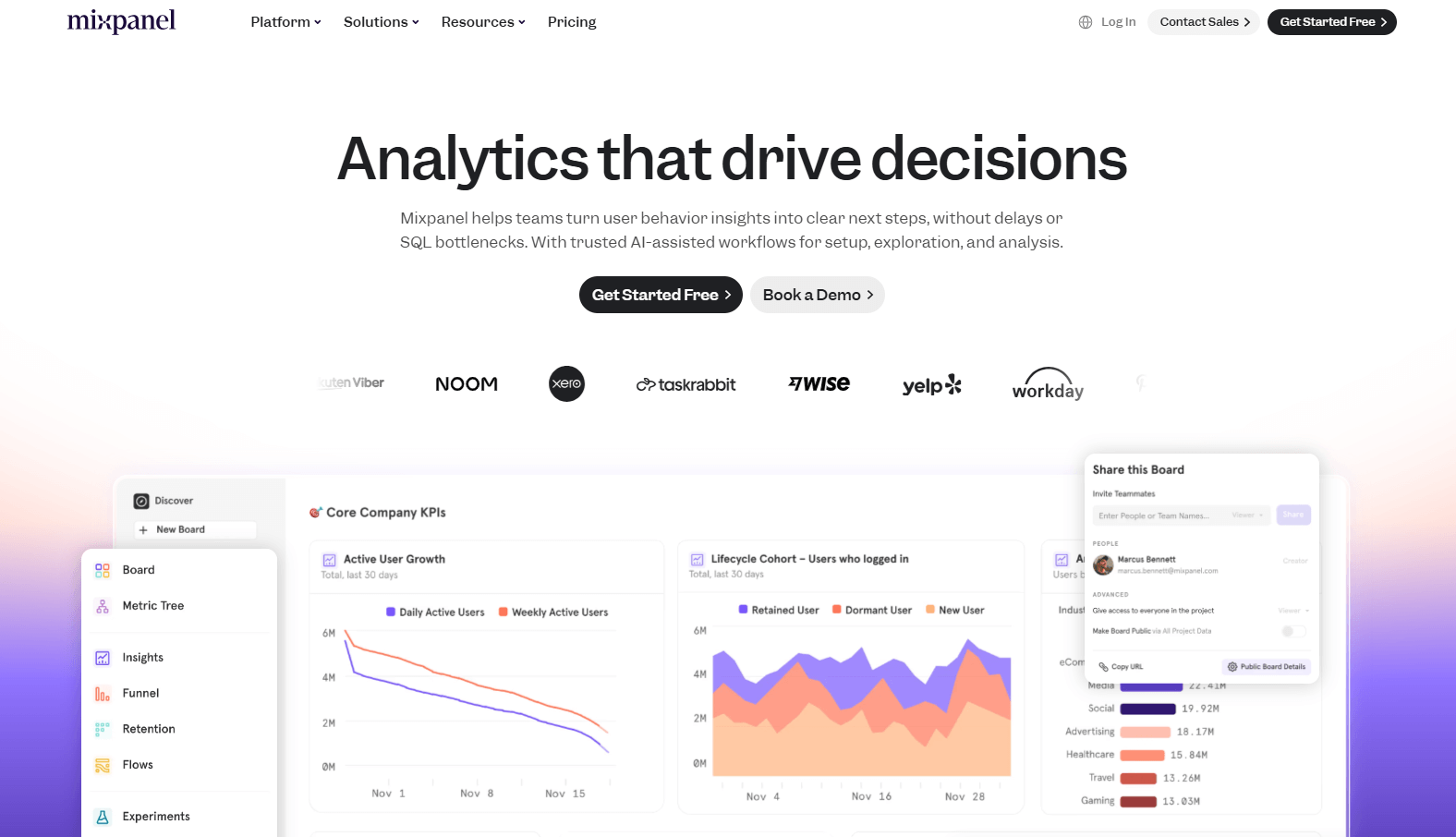
Event-based product analytics focused on self-serve funnels, retention, and segmentation, now with session replay, heatmaps, and AI-assisted querying.
Best for: PLG teams that want fast, flexible event analysis and strong funnel workflows with optional replay.
Key Features:
- Core analytics for events, funnels, retention, and flows, long a Mixpanel strength. (g2.com)
- Session Replay and heatmaps integrated with reports to jump from trend to visual evidence. (businesswire.com)
- Generative AI query builder to "chat with data" for faster exploration. (prnewswire.com)
Why we like it: The event model stays snappy at scale, and replay closes the loop for diagnosing friction without tool switching.
Notable Limitations:
- Event-based pricing can spike with volume, and reviewers note a learning curve for complex setups. (g2.com)
- A late 2025 incident at a major customer spotlighted vendor risk around third-party analytics data. Evaluate security posture and data sharing settings. (businessinsider.com)
Pricing: Free tier available. Growth shows first 1M monthly events free with usage-based overages on several third-party listings, though terms vary by plan and region - confirm with sales. See G2 and Capterra summaries for current structures.
Heap
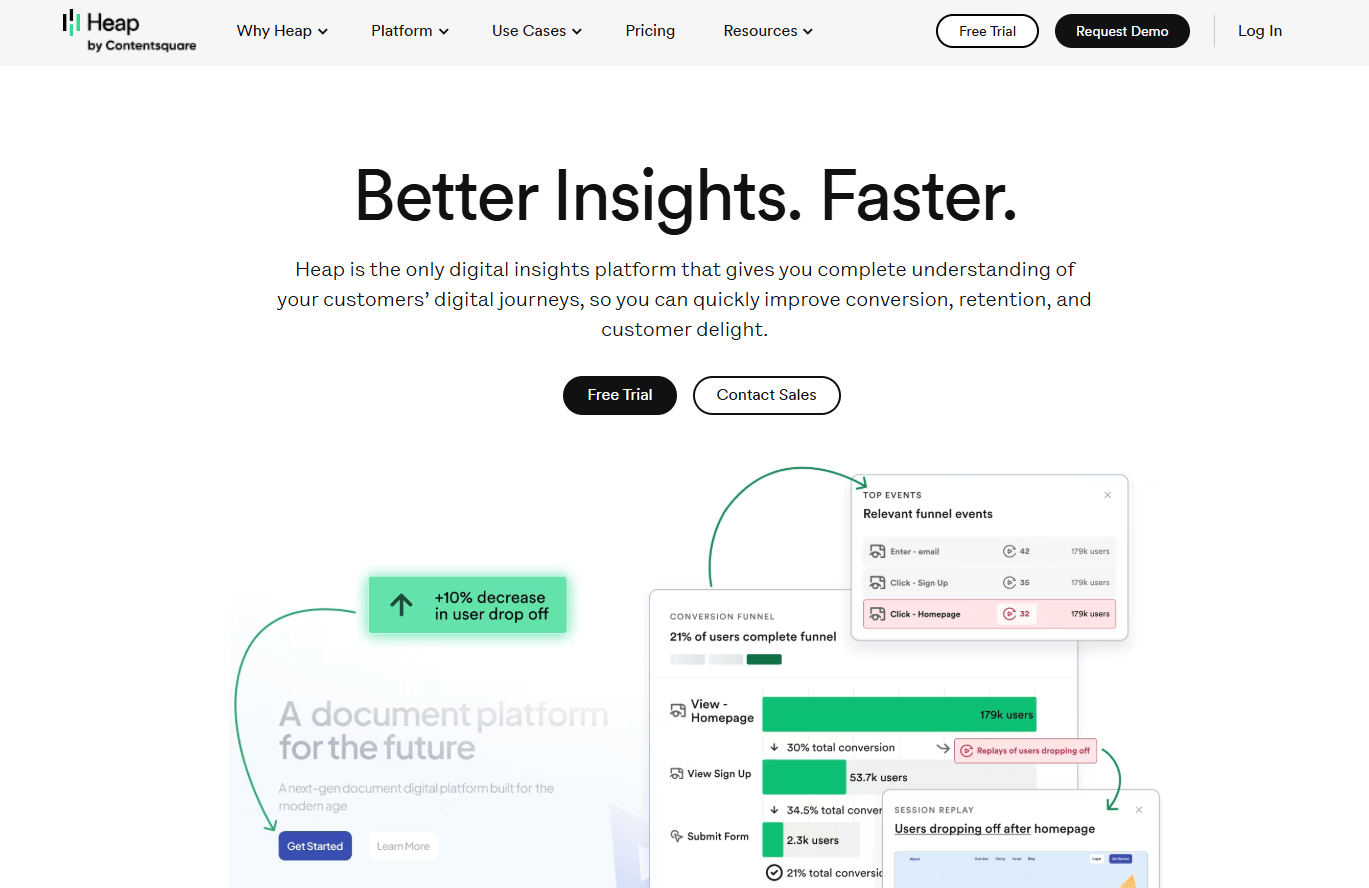
Autocapture product analytics with retroactive analysis to answer questions you did not plan for, plus optional session replay.
Best for: Teams that want to instrument less up front, then analyze retroactively when questions change.
Key Features:
- Autocapture of user interactions and retroactive reporting, so you can define events after the fact. (g2.com)
- Integrated session replay capabilities added through the Auryc acquisition. (businesswire.com)
- Broad dashboarding and segmentation praised by reviewers for speed to insight. (solutions.trustradius.com)
Why we like it: Autocapture and retrospective analysis reduce planning risk, which is ideal when your roadmap shifts weekly.
Notable Limitations:
- Data sprawl from autocapture can create noise without disciplined taxonomy, per user reviews. (capterra.com)
- Pricing and support tiers vary, and some features like Session Replay may be add-ons depending on plan.
Pricing: Free plan with 10k monthly sessions, Growth starting near 3,600 dollars per year on third-party listings. Higher tiers are quote-based. Verify current terms on G2.
Note: Heap has been part of Contentsquare since December 7, 2023; capabilities continue under the combined portfolio. (cooley.com)
Pendo
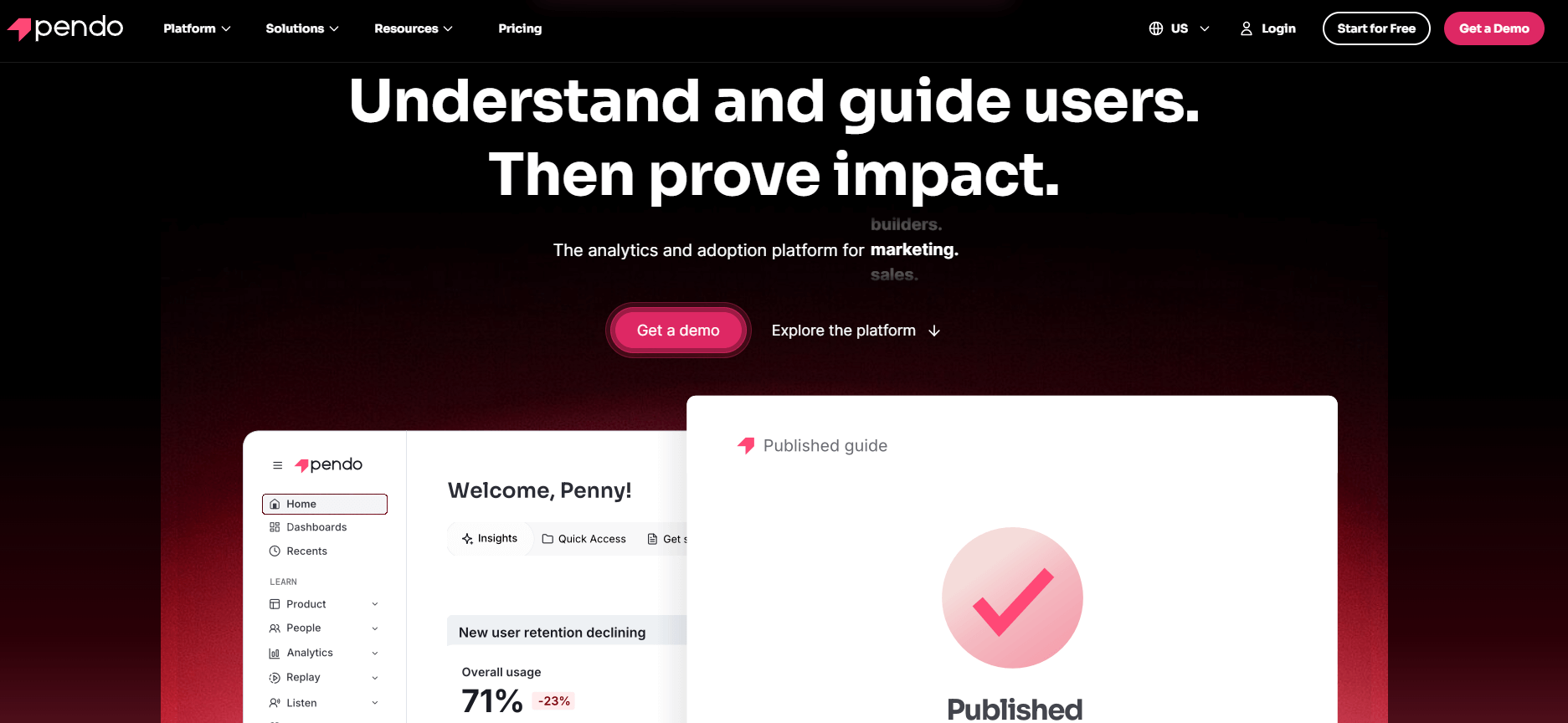
All-in-one product platform that combines analytics, in-app guides, and feedback to drive onboarding and activation.
Best for: Teams that want analytics plus in-app guidance and surveys in a single workflow.
Key Features:
- Product analytics with in-app guides for onboarding and announcements. (g2.com)
- Feedback collection and discovery workflows to connect qualitative input with usage. (trustradius.com)
- Session replay available on Core and above, per current plan descriptions on review sites.
Why we like it: For PLG motions that depend on in-app nudges and surveys, Pendo consolidates two jobs - understand and act - in one place.
Notable Limitations:
- Opaque, MAU-based pricing and steeper learning curve are common buyer concerns.
- Free tier caps at 500 MAUs, so growing teams hit paywalls quickly.
Pricing: Free plan up to 500 MAUs. Paid tiers - Base, Core, Pulse, and Ultimate - are quote only on review sites. Multiple third-party sources report typical annual contracts in the five-figure range - confirm with sales.
PLG Tools Comparison: Quick Overview
| Tool | Best For | Pricing Model | Highlights |
|---|---|---|---|
| Amplitude | Unified analytics, replay, and experiments | Tiered, volume-based | Strong cohorts, native web experimentation, session replay |
| Mixpanel | Event-based funnels and retention with replay | Usage-based events | Fast self-serve funnels, AI query builder, heatmaps |
| Heap | Autocapture and retroactive analysis | Tiered by sessions and features | Minimal upfront tagging, retroactive questions, optional replay |
| Pendo | Analytics plus in-app guides and feedback | MAU-based tiers | Onboarding and analytics in one platform, session replay on higher tiers |
PLG Platform Comparison: Key Features at a Glance
| Tool | Behavioral Analytics | Session Replay | Experimentation |
|---|---|---|---|
| Amplitude | Yes | Yes | Yes, native web experimentation |
| Mixpanel | Yes | Yes | Yes, with constraints by plan |
| Heap | Yes | Yes | Limited, focus on analysis |
| Pendo | Yes | Yes, on Core+ | Limited A/B, strong in-app guides |
PLG Deployment Options
| Tool | Cloud API | On-Premise / Air-Gapped | Integration Complexity |
|---|---|---|---|
| Amplitude | Yes | Not publicly offered | Medium, typical SDKs and data pipelines |
| Mixpanel | Yes | Not publicly offered | Medium, event schema planning needed |
| Heap | Yes | Not publicly offered | Medium, requires taxonomy governance post autocapture |
| Pendo | Yes | Not publicly offered | Medium, adds guide instrumentation to analytics |
PLG Strategic Decision Framework
| Critical Question | Why It Matters | What to Evaluate | Red Flags |
|---|---|---|---|
| Do we need retroactive analysis or can we define events up front | Reduces risk when requirements shift | Autocapture depth, retroactive querying | High services dependency to clean noisy data |
| How will pricing scale with our usage | Avoids surprise overages | MTU or event model, included replay, data retention | Event volume penalties that force under-tracking |
| Do we want analytics and experimentation in one | Speeds the insight-to-action loop | Native testing, governance, statistical methods | Disconnected tools and data joins for A/B reads |
| Do we need in-app guidance and feedback | Drives activation and PQLs | Guide targeting, NPS, roadmap feedback | Guide builders that require CSS or slow to deploy |
PLG Solutions Comparison: Pricing and Capabilities Overview
| Organization Size | Recommended Setup | Typical Annual Budget Range | Notes |
|---|---|---|---|
| Pre-seed to Seed | Mixpanel Free or Amplitude Starter to validate PMF, keep event taxonomies lean | 0 to low four figures if usage stays within free thresholds | Event overages or added replay can change costs quickly on usage-based plans. |
| Series A to B | Amplitude Plus or Mixpanel Growth with replay, or Heap Growth for retroactive depth | Low to mid five figures depending on MTUs, events, and add-ons | Heap Growth lists from 3,600 dollars per year on G2, others are quote-based. |
| Mid-market | Amplitude Growth with Experimentation, or Mixpanel Growth plus replay, or Pendo Core for analytics plus guides | Mid five figures, varies by data volume and MAUs | Pendo contracts are commonly five figures annually on third-party reports - confirm with vendor. (userpilot.com) |
| Enterprise | Amplitude Enterprise, Mixpanel Enterprise, or Pendo Ultimate depending on governance needs | High five to six figures for multi-product footprints | Align security, data residency, and pipeline strategy with procurement and risk teams. |
Problems and Solutions
-
Problem: Conversion drops after a checkout redesign, but dashboards only show the cliff.
- Amplitude: Use funnels to isolate the step, then watch Session Replay for impacted cohorts and launch a targeted A/B test on copy or form fields with Web Experimentation.
- Mixpanel: Compare pre- and post-funnels, then jump into built-in replays and heatmaps for the affected step to see confusion points.
- Heap: Retroactively define the new form events and segment by traffic source without redeploying code, then review replays to confirm the hypothesis.
- Pendo: Pair analytics with an in-app guide to test inline help or nudge users through the changed step, then monitor uplift.
-
Problem: Data debt from years of ad hoc tracking makes analysis slow and brittle.
- Amplitude: Use improved tagging and governance to rationalize events, then cohort analysis to validate the refactor.
- Mixpanel: Leverage AI-assisted query building to audit key metrics, then rebuild funnels against a cleaned event set.
- Heap: Lean on autocapture and retroactive definitions to answer emergent questions while you migrate old schemas.
- Pendo: Keep stakeholders informed with targeted in-app announcements during measurement changes to reduce confusion.
-
Problem: Early PLG traction needs activation and feedback to unlock PQLs.
- Amplitude: Map "time to value" by cohort and test shorter onboarding paths with experiments.
- Mixpanel: Build PQL cohorts from event combinations and track progression across lifecycle dashboards.
- Heap: Use retroactive looks to discover the few behaviors that correlate with retention, then prioritize features accordingly.
- Pendo: Launch in-app guides and NPS, then segment analytics by respondents to connect sentiment with behavior.
The Bottom Line
The product analytics stack you choose should mirror how your team ships. If you want one platform that closes the loop from insight to test with visual evidence, Amplitude and Mixpanel now both pair analytics with session replay, and Amplitude adds native web experimentation. If you need retroactive answers with minimal upfront tagging, Heap's autocapture is compelling, especially for fast-changing roadmaps. If your PLG playbook hinges on in-app nudges and surveys, Pendo combines analytics with guidance and feedback, though pricing transparency is limited on paid tiers. Analyst trends suggest analytics budgets will keep growing through 2028 and beyond, so pick a model that scales with your usage, not against it.