

Most teams discover their building data is fragmented during a retrofit or lease renegotiation, not from their building automation vendor. Working across different tech companies, we have seen "smart" fall apart when BACnet/IP data is siloed, MQTT topics are inconsistent, and occupancy sensors never make it into the CMMS. The result is wasted energy and underused space, even though buildings account for roughly 30 percent of global final energy demand, per the International Energy Agency's latest outlook on buildings. That scale makes small integration wins add up fast, especially when you can close the loop from sensor to work order to outcome (IEA Buildings, 2025).
The market is big and getting bigger. Frost and Sullivan estimates the smart city market at about 2.4 trillion dollars in 2025, with nearly half of spend concentrated in smart energy, infrastructure, and building segments, a proxy for where smart spaces budgets flow (Frost and Sullivan smart cities insight). In this guide you will learn where each platform fits, what to watch for in deployments, and how to avoid cost and time traps.
SpaceIntel

AI driven virtual facilities management focused on remote oversight of assets and spaces. Emphasis on virtual inspections, 3D context, and predictive insights for multi site portfolios.
Best for: Facilities leaders who need remote condition visibility across many locations and want to triage issues without rolling trucks.
Key Features:
- Virtual FM with 3D or panoramic context for assets and spaces, per SpaceIntel documentation
- Remote inspections and issue annotation that tie back to maintenance tasks
- Predictive analytics on asset condition and risk scoring for prioritization
Why we like it: It shortens the time from "what is happening" to "what should we do," which is exactly where FM teams lose hours and travel costs.
Notable Limitations:
- Limited third party reviews in 2025 to 2026, so proof of value should hinge on a pilot with quantified KPIs; SpaceIntel's existence and positioning are corroborated by independent profiles like Crunchbase (SpaceIntel company profile).
- Unknown breadth of native integrations with BAS or desk booking tools compared with older IWMS suites, so budget time for API mapping.
- Enterprise references are not widely published on neutral marketplaces, so request customer contacts early.
Pricing: Pricing not publicly available. Contact SpaceIntel for a custom quote.
Spacewell
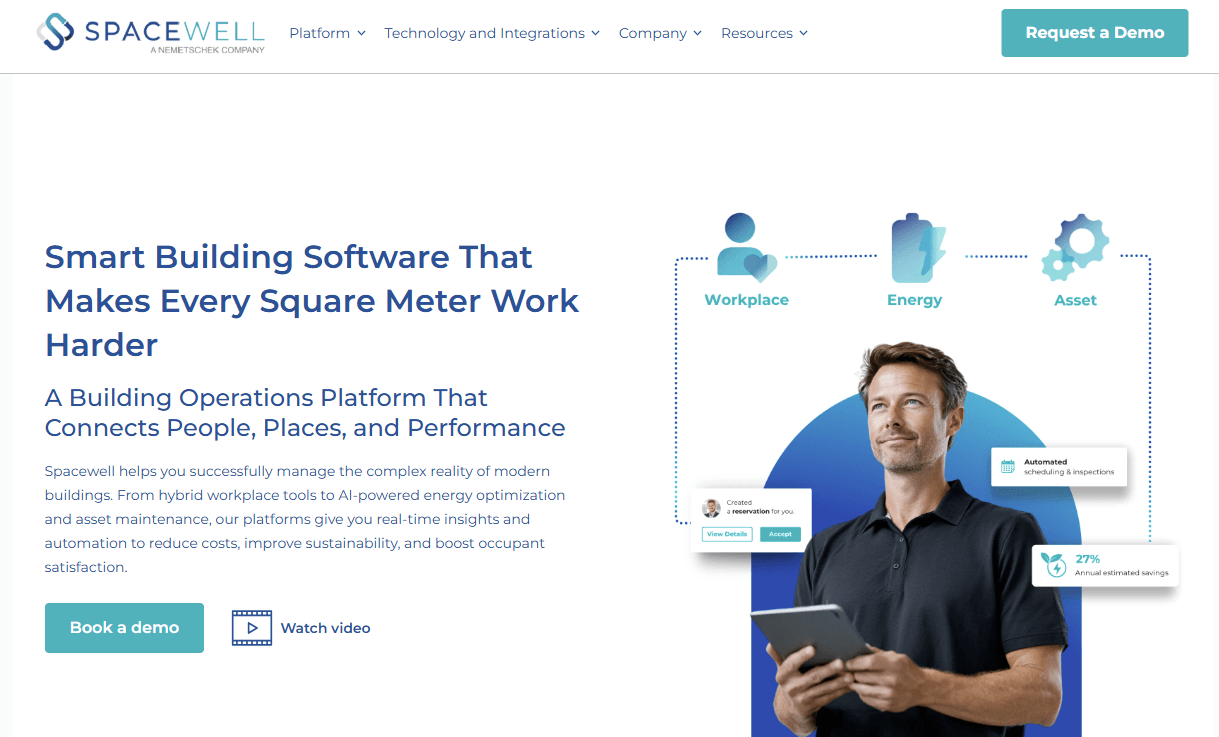
Smart building operations and workplace platform spanning space, maintenance, and energy analytics, with an energy module from its DEXMA acquisition.
Best for: Enterprises seeking an IWMS style core with modern energy analytics and workplace tools in one vendor family.
Key Features:
- Workplace and space management with booking, occupancy analytics, and portfolio views, per Spacewell documentation
- Asset maintenance and FM workflows with dashboards and mobile apps
- Energy optimization through Spacewell Energy, formerly DEXMA, for monitoring, anomaly detection, and savings tracking
Why we like it: The combination of IWMS depth plus a mature energy analytics module gives real levers to reduce opex while improving space experience.
Notable Limitations:
- Users report a learning curve and time consuming configuration for advanced reporting and workflows (Capterra Spacewell reviews).
- Energy users note occasional UI friction for non technical roles and slow performance on large time spans (G2 Spacewell Energy reviews).
- Some reviewers mention that complex setups may require specialist support and bespoke work, which can extend timelines.
Pricing: Spacewell Energy has published public sector pricing in the UK G Cloud listing that indicates per admin annual charges, though enterprise bundles vary by scope (UK G Cloud pricing document). Contact Spacewell for a custom quote.
DigiSpace
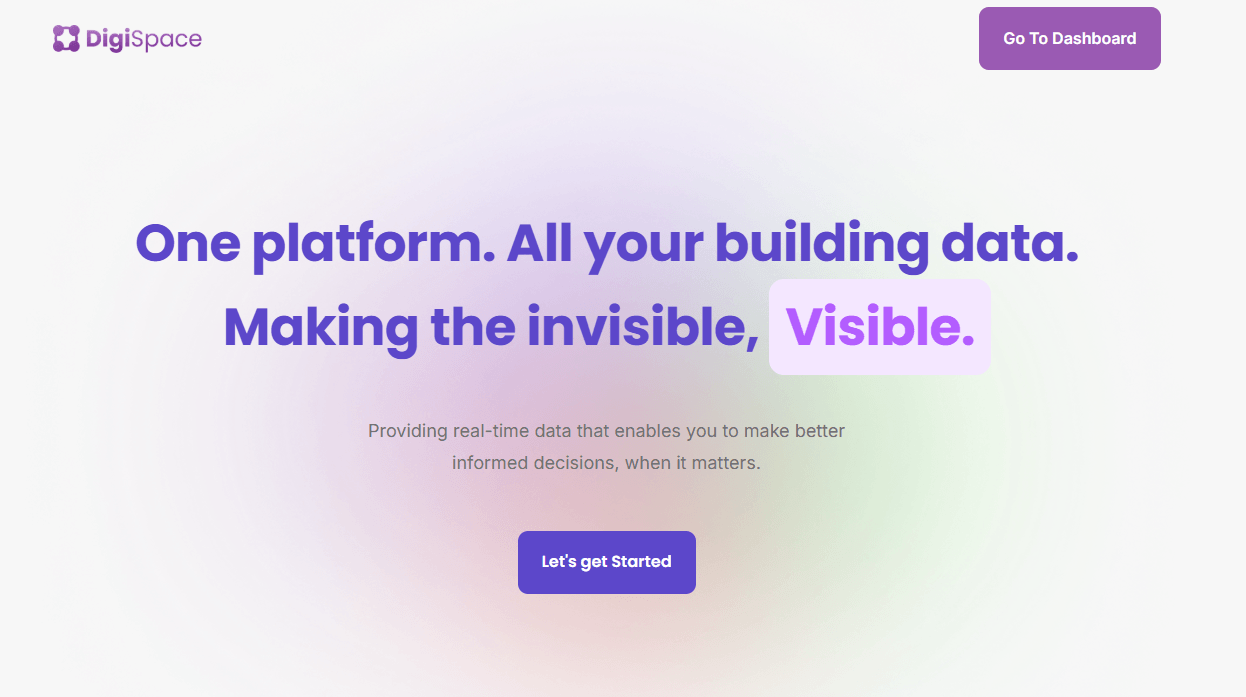
Web based smart building dashboard that aggregates data from building systems, IoT sensors, and external sources into a unified view.
Best for: Teams that need a lightweight, hardware agnostic dashboard to centralize building, sensor, and external data feeds without a full IWMS rollout.
Key Features:
- Unified dashboard, hardware and software agnostic, for BAS, IoT sensors, and third party data, per DigiSpace documentation
- Progressive Web App for easy access without thick client installs
- Data aggregation from multiple sources to support KPIs and simple alerts
Why we like it: For organizations starting the smart journey, a simple, vendor neutral dashboard can align stakeholders quickly and spotlight quick wins.
Notable Limitations:
- As of early 2026, there are few neutral marketplace reviews, so validation should include security review and a sandbox with your live data.
- Advanced automation, work order depth, and deep analytics are not documented at the level of bigger suites, so pair with existing CMMS and analytics stacks.
- Complex integrations may still require integrator time, consistent with practitioner feedback on building dashboards in general (r/BuildingAutomation practitioner thread).
Pricing: Pricing not publicly available. Contact DigiSpace for a custom quote.
Smart Spaces Tools Comparison: Quick Overview
| Tool | Best For | Pricing Model | Highlights |
|---|---|---|---|
| SpaceIntel | Remote multi site FM oversight | Custom enterprise licensing | Virtual inspections, 3D context, predictive triage |
| Spacewell | Unified IWMS plus energy analytics | Enterprise licensing, modules | Workplace, maintenance, energy optimization in one suite |
| DigiSpace | Lightweight, vendor neutral dashboarding | Custom, project based | Aggregates BAS and IoT data into one view |
Smart Spaces Platform Comparison: Key Features at a Glance
| Tool | Feature 1 | Feature 2 | Feature 3 |
|---|---|---|---|
| SpaceIntel | Remote inspections | 3D or panoramic asset context | Predictive asset risk scoring |
| Spacewell | Space and workplace tools | Maintenance workflows | Energy analytics and savings tracking |
| DigiSpace | Hardware agnostic dashboard | Multi source data aggregation | PWA access for broad teams |
Smart Spaces Deployment Options
Note: API availability is derived from user reviews and public listings where available.
| Tool | Cloud Deployment | Integration Complexity | Notes |
|---|---|---|---|
| SpaceIntel | Not publicly documented | Project dependent | On-premise and air-gapped options not publicly documented |
| Spacewell | Available per user reviews | Project dependent | On-premise and air-gapped options not publicly documented |
| DigiSpace | Not publicly documented | Project dependent | On-premise and air-gapped options not publicly documented |
Smart Spaces Strategic Decision Framework
| Critical Question | Why It Matters | What to Evaluate | Red Flags |
|---|---|---|---|
| Do we have reliable occupancy data by zone and day of week? | Most cost savings come from space right sizing, which depends on accurate occupancy, and many US markets still average only about 50 to 60 percent office use on weekdays (Axios on Kastle data, Kastle barometer update). | Badge swipe data, sensor coverage, data freshness, privacy posture. | Static floor plans with no sensor coverage, or conflicting badge and sensor counts. |
| How will the platform surface energy anomalies we can act on? | Buildings drive around 30 percent of global energy demand, so anomaly detection and M&V are core to ROI. | Meter hierarchy, normalization, baselining, alert tuning, M&V reports. | Dashboards without baselines, no weather normalization, or no export for audits. |
| Can work orders be auto created from rules? | Closing the loop from insight to action reduces backlogs and labor waste. Federal facilities show mounting deferred maintenance, underscoring the need for automation (GAO 2025 high risk update). | Native CMMS depth or reliable connectors to your CMMS, API triggers, SLA tracking. | Manual re entry between systems, or one way integrations. |
| What is our integration plan for BAS and IoT? | Data quality drives everything, from comfort to decarb. | Supported protocols, API limits, data retention, partner ecosystem. | Custom scripts with no support or rate limited APIs that throttle analytics. |
Smart Spaces Solutions Comparison: Pricing and Capabilities Overview
| Organization Size | Recommended Setup | Procurement Route | Notes |
|---|---|---|---|
| 1 to 5 buildings | DigiSpace as a central dashboard, pair with existing CMMS | Direct contract | Start with occupancy and energy KPIs to validate ROI in 90 days. |
| 5 to 50 buildings | SpaceIntel pilot for remote inspections plus DigiSpace for dashboards | Direct or RFP | Quantify avoided truck rolls and faster triage. |
| 50+ buildings or multi region | Spacewell core for workplace and maintenance, add Spacewell Energy for analytics | RFP or marketplace frameworks | Consider staged rollout by portfolio to manage change. Public sector can reference listings like G Cloud for modules and terms. |
Problems & Solutions
Problem 1: Hybrid work leaves space underused. U.S. office occupancy has hovered around the mid 50 percent range since 2024 based on badge data, with wide weekday variation, so portfolios carry excess space and operating costs (Kastle barometer methodology).
- SpaceIntel: Use remote walkthroughs and 3D context to validate which zones can be mothballed or consolidated, then generate targeted punch lists for moves.
- Spacewell: Combine booking and occupancy analytics to identify floors for consolidation, then push changes through maintenance and move workflows in the same system. User reviews highlight strong reporting but a learning curve on complex configuration, so plan time for dashboards and reports.
- DigiSpace: Aggregate sensor, BAS, and booking feeds into a single view to expose low utilization zones quickly. Practitioners emphasize specifying dashboard requirements clearly to avoid rework.
Problem 2: Rising energy costs and decarbonization targets demand better analytics. Buildings represent about 30 percent of global final energy demand, so anomaly detection and measurement and verification matter for cost and emissions.
- SpaceIntel: Prioritize assets with predicted failure risk that drive energy waste, then route corrective work to local teams.
- Spacewell: Spacewell Energy users report actionable monitoring, alerts, and M&V, alongside occasional UI or performance friction at large time spans, which is manageable with data scoping and training.
- DigiSpace: Start with a simple meter and submeter dashboard to surface baseload anomalies and schedule syncs with FM to close issues in the CMMS.
Problem 3: Maintenance backlogs keep growing. The U.S. federal deferred maintenance and repair backlog more than doubled between fiscal 2017 and 2024, reaching about 370 billion dollars, a reminder that manual processes will not catch up without automation.
- SpaceIntel: Remote inspections reduce site visits, help triage by risk, and give supervisors evidence to prioritize work orders.
- Spacewell: Link insights to work orders, SLAs, and mobile workflows to track time to close and backlog burn down.
- DigiSpace: Provide a universal "single source of truth" for issue discovery, then trigger downstream tickets through your existing CMMS integrations or simple exports.
The Bottom Line
Smart spaces budgets are consolidating around platforms that turn data into decisions, which tracks with broader smart city spending where buildings, energy, and infrastructure take nearly half the pie. If you want a quick win, stand up a lightweight dashboard and validate two or three occupancy and energy use cases. If you need scale, pair a remote FM layer or a full IWMS core with energy analytics. Keep one rule front and center, the ROI only shows up when insights trigger work orders and verified outcomes.