
Business Intelligence tools have become foundational systems for organizations operating in an increasingly data intensive environment. In 2026, businesses generate and consume more data than ever before across cloud platforms, applications, and customer touchpoints. BI tools collect, integrate, and analyze this data, transforming it into clear visual formats such as dashboards, charts, and reports that support faster and more accurate decision making.
As data volumes continue to grow, information overload has become a major barrier to effective strategy. Modern BI platforms help organizations cut through noise by surfacing relevant insights, tracking performance in real time, and identifying trends that directly impact growth and efficiency.
Today’s BI tools place strong emphasis on self service analytics, AI assisted insights, predictive modeling, and automated data narratives. These capabilities expand data access beyond technical teams, enabling leaders, analysts, and operators to make informed decisions, optimize operations, and strengthen long term competitive positioning.
1. Pyramid Analytics
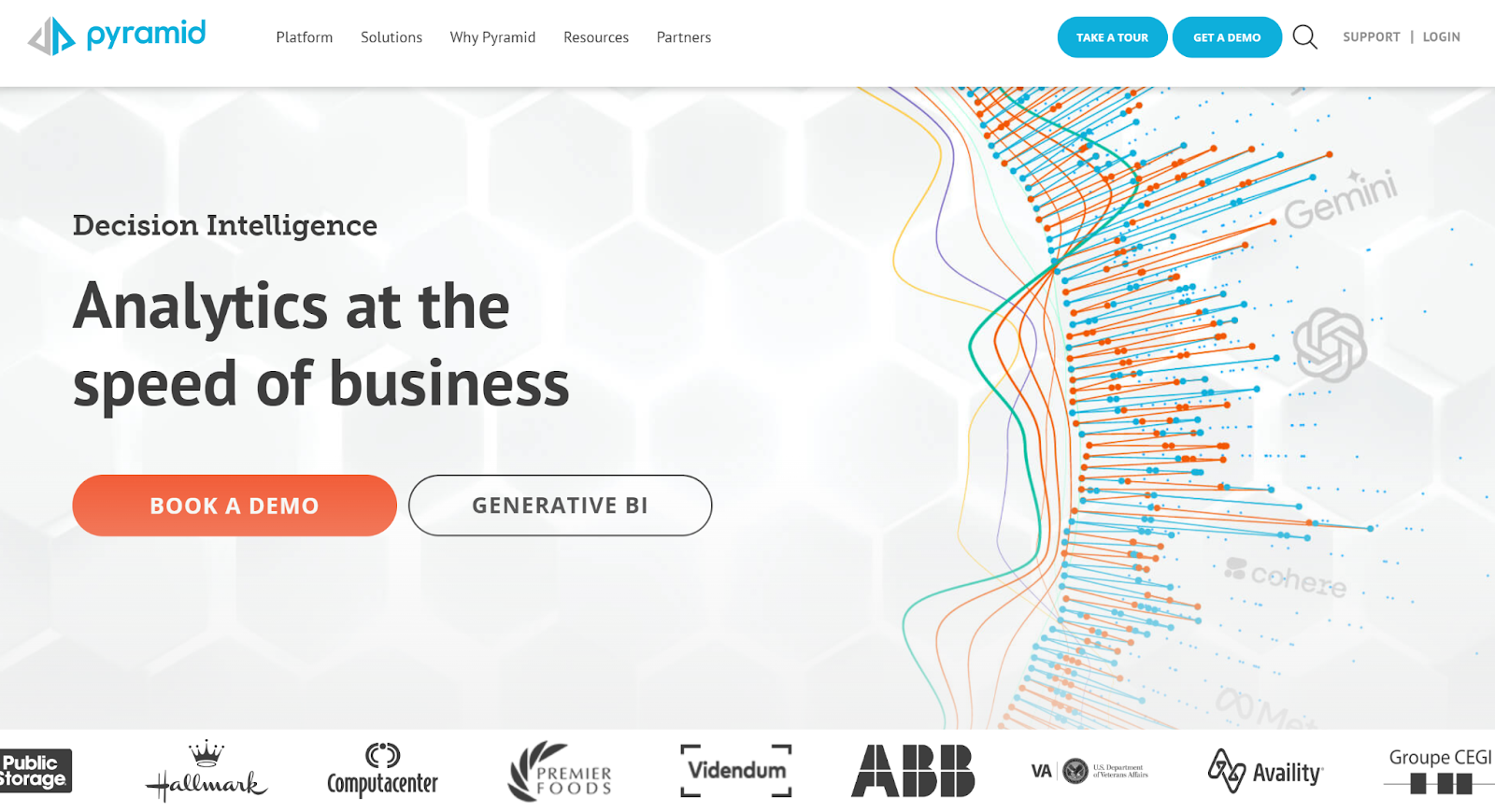
Pyramid Analytics offers a robust Decision Intelligence Platform designed to elevate business analytics through a seamless, no-code, AI-driven interface. The platform integrates data preparation, data science, and business analytics, enabling users to make informed, data-driven decisions swiftly. Pyramid Analytics stands out for its ability to connect directly to multiple data sources, on-premise or in the cloud, offering super-fast performance via its PYRANA query engine and facilitating complex analyses with ease.
Pyramid Analytics has been recognized as a visionary in the 2024 Gartner Magic Quadrant and lauded for its advanced AI and machine learning capabilities. It empowers novices and pros alike with tools to build interactive analyses, visualize data, and derive actionable insights, all while maintaining data integrity and security.
Key Features:
- Integrated Data Prep: No-code data preparation with point-and-click capabilities that maintain data at the source, enhancing the analytical experience.
- AI and Machine Learning: Out-of-the-box ML libraries and AI-guided workflows to spot trends, build scenarios, and visualize data.
- PYRANA Engine: Direct query engine offering lightning-fast performance across multiple data sources.
- Self-Service Analytics: User-friendly interfaces for creating dashboards, reports, and visualizations, enabling non-technical users to harness the power of BI.
2. Databox
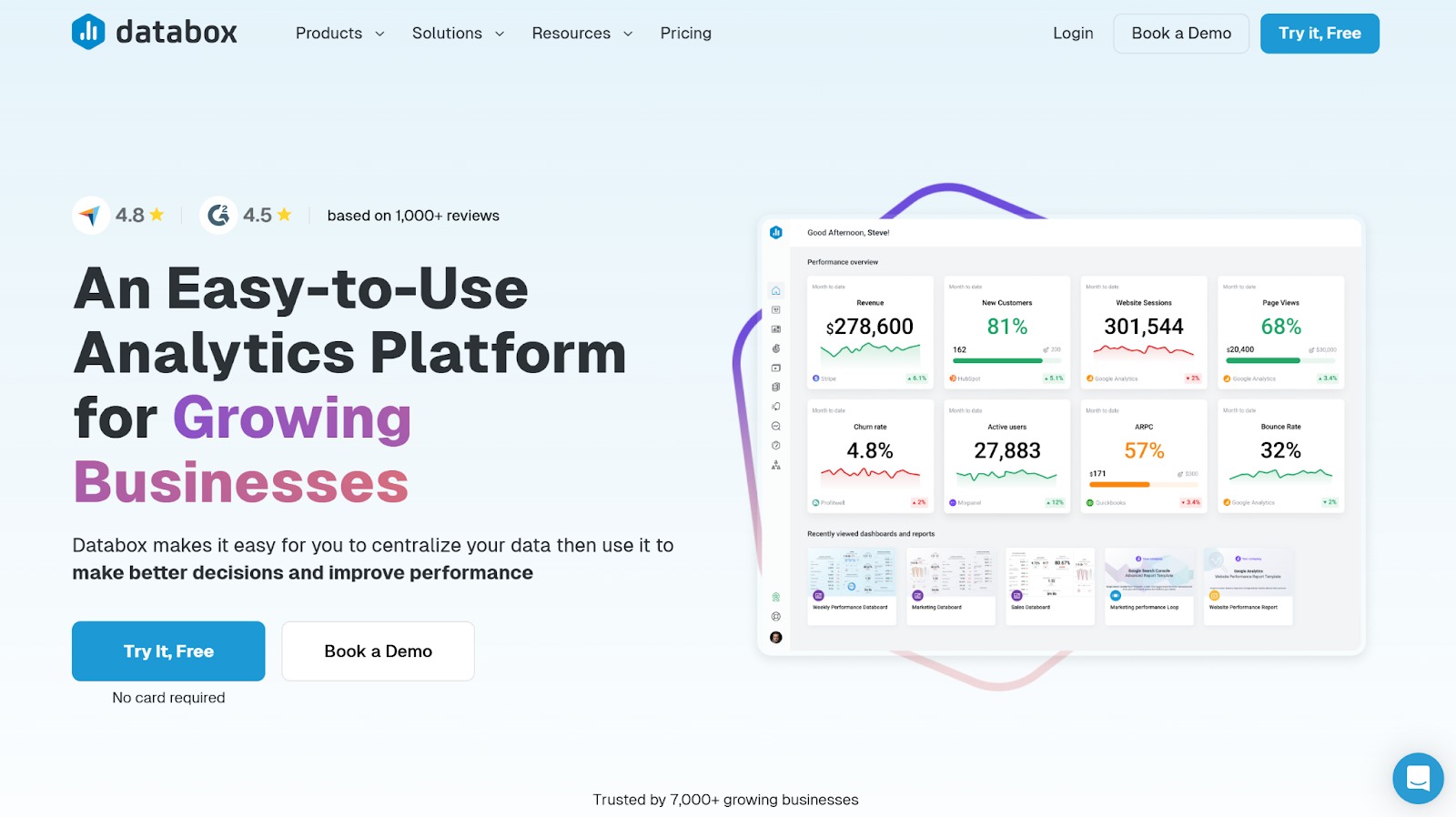
Databox is an easy-to-use analytics platform designed for growing businesses, offering a centralized solution to track, visualize, and analyze data. Trusted by over 7,000 companies, including industry giants like eBay and PWC, Databox allows users to bring all their data into one secure location, eliminating the need for juggling multiple tools and browser tabs. This platform is particularly beneficial for teams that need to make data-driven decisions quickly and efficiently, whether it's for marketing spend, hiring, or improving overall performance.
Databox stands out with its user-friendly interface that requires no coding knowledge, making it accessible to both technical and non-technical users. It offers pre-built templates, drag-and-drop dashboard builders, and automated reporting, enabling businesses to focus more on strategy rather than manual data compilation. The platform also supports hundreds of integrations with popular SaaS applications, databases, and APIs, ensuring that all relevant data is easily accessible and actionable.
Key Features:
-
Centralized Data Source: Aggregate data from various sources including SaaS applications, databases, and spreadsheets into one platform.
-
Customizable Dashboards: Create and customize beautiful dashboards with a drag-and-drop builder, perfect for uncovering new insights.
-
Automated Reporting: Generate and share custom reports automatically, complete with your branding and performance summaries.
-
Goal Tracking and Forecasting: Set and monitor goals, receive alerts when off-track, and use predictive analytics to plan for the future.
3. Xplenty BI tool
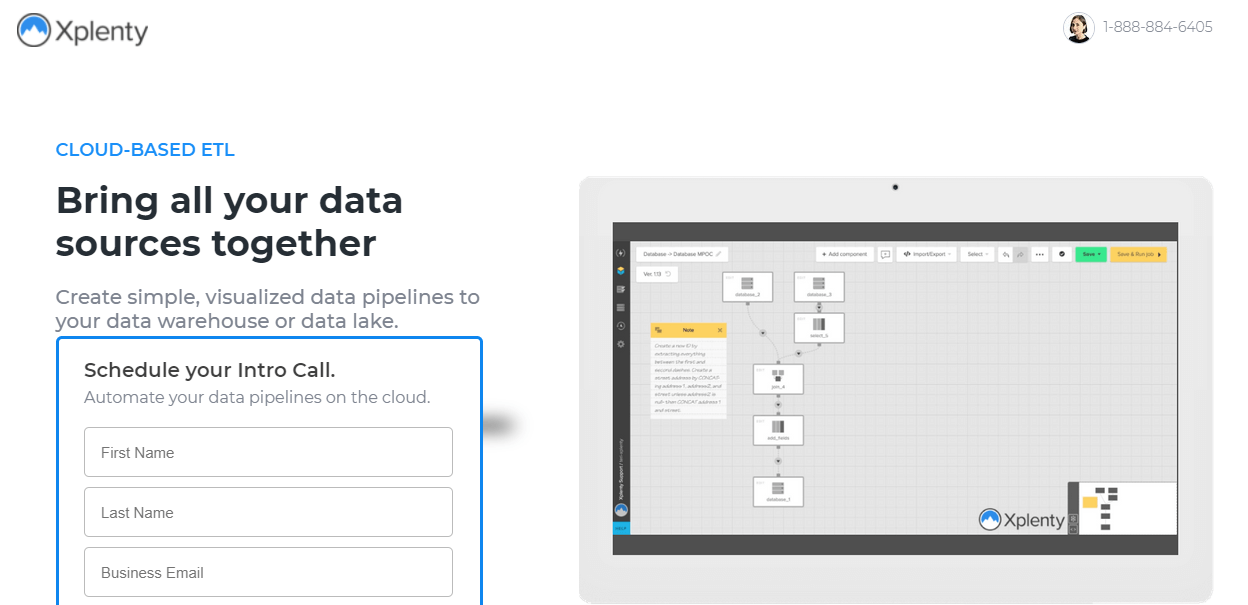
Xplenty is a data integration platform. It is a cloud-based solution that integrates all your data sources.
Xplenty offers feature-rich data-rich marketing solutions. Xplenty will integrate its data enrichment tools.
Key Features:
-
It provides omnichannel marketing and data-driven insights.
-
Xplenty has customer support analytics solutions
-
It will help you keep up to date with marketing automation.
-
Xplenty will make your marketing campaign effective.
-
It will help you create a complete sales analysis solution.
4. ThoughtSpot BI tool
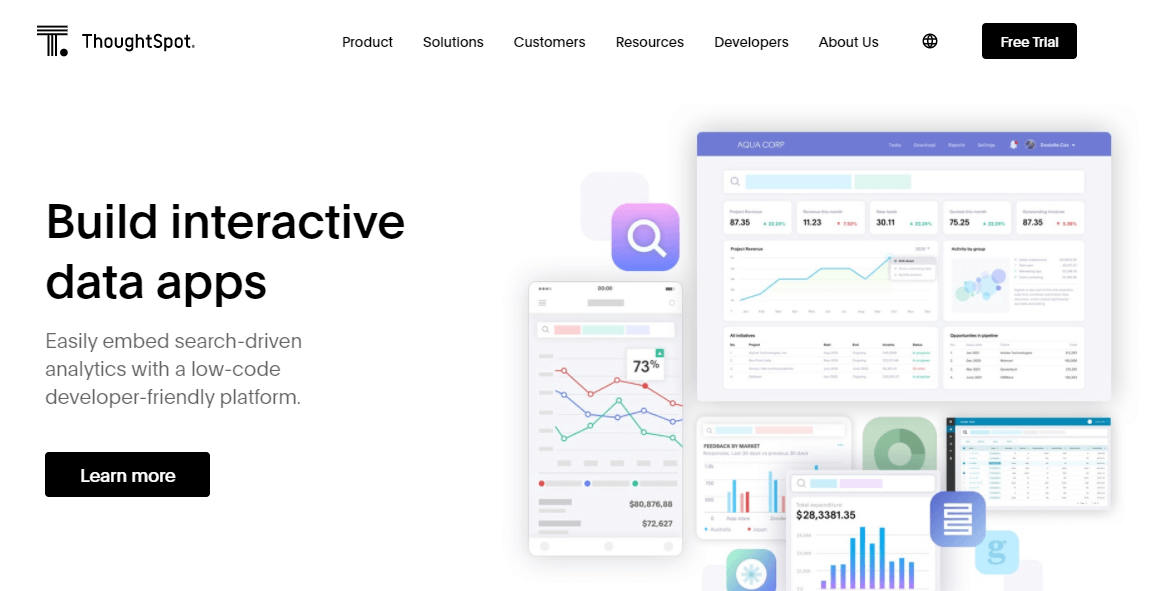
ThoughtSpot is the next-generation analysis platform based on search and artificial intelligence. Using this software, users can enter questions in the search box just like using Google or Bing, and get accurate answers immediately.
The analysis platform provides the best visualization, so users can easily analyze data, create reports, and create dashboards without relying on IT.
It connects to popular cloud data warehouses such as Amazon Redshift and cloud data platform Snowflake, enabling enterprise users to discover insights from all cloud data through search and artificial intelligence.
Data points and retrieve dozens of insights in seconds. Provides information for non-technical business users through anomaly detection, trend analysis, benchmarking, etc.
Key Features:
-
Easy to use for everyone. Use search to create your in charts. and dashboards in seconds, without the need for experts or advanced training, even for the most complex queries.
-
100% Accuracy and Trust.
-
Instant response time.
5. AtScale Analytics BI tool:
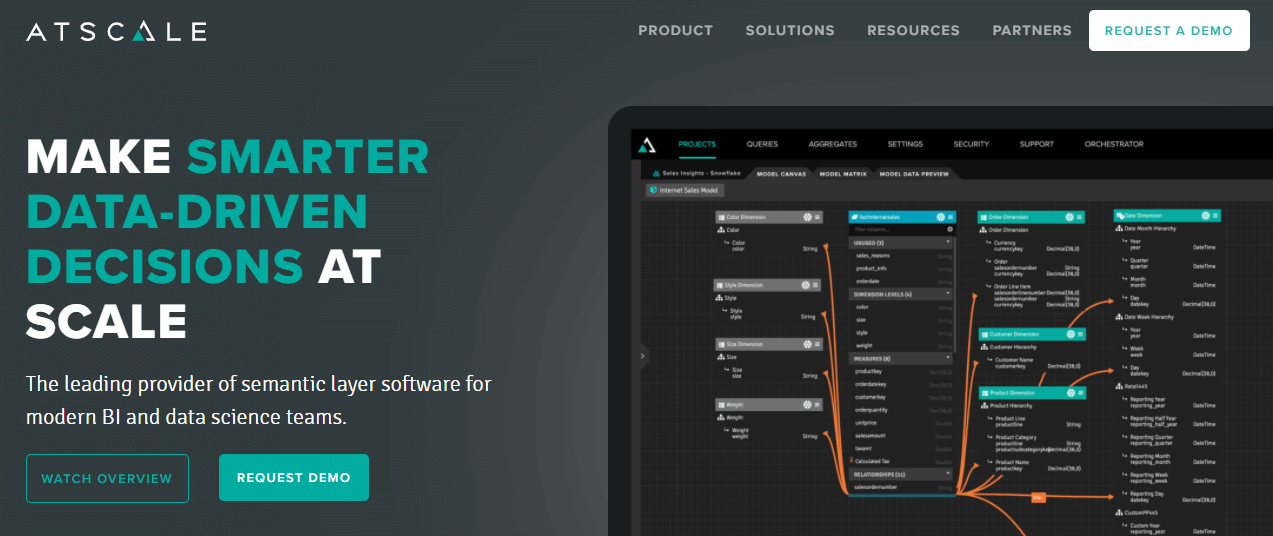
AtScale-based San Mateo uses their known tools (from Microsoft Excel to Tableau Software to QlikView) to provide business users with multi-dimensional and interactive analysis capabilities at full speed directly in Hadoop.
Key Features:
-
Visualization Analysis Reportings.
-
Data Processing Modelings.
-
Data Storage Encryption.
-
Queries governance
6. Metric Insights
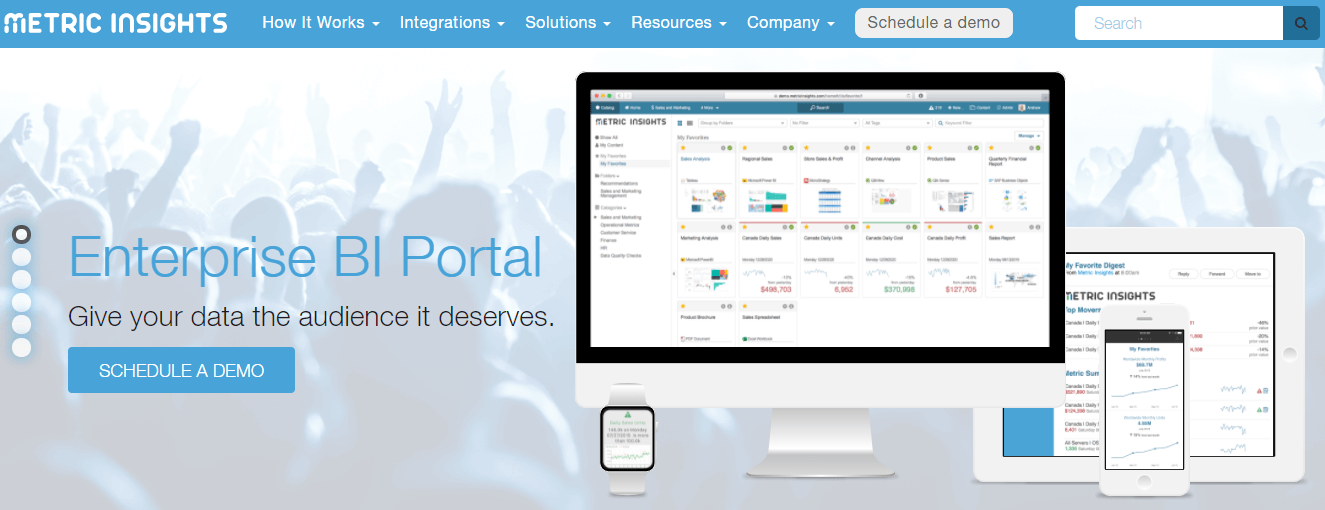
With Metric Insights, you can provide a single interactive portal that connects to all your data sources and provides a single source of truth for publishing, promoting, and accessing all your BI content.
The portal enables the BI team to centrally monitor, certify, and promote content for users throughout the organization.
Key Features:
-
Helps in collecting all the data sources in a single place
-
The efficiency of marketing activities
-
Secure Platform
-
Data Visualization and Warehousing
-
Offers data integrity
-
The efficiency of marketing spending.
7. FICO Analytics BI
The FICO Big Data Analytics end-to-end analysis tool provides an easy way to extract and navigate data.
Allow users to better understand the system and provide additional information on how to use the data to get more business/income. Provide business information and show future models.
Key Features:
-
Improves internal/operational efficiency
-
Promotes innovation
-
Improves decision making
-
Reduces time to market
-
Improves customer relationships/services
8. Microsoft Power BI
With Microsoft’s BI suite, you can quickly connect your data prep modeling and visualization. Then, securely look after your insights and even embed them into your project applications and websites.
It was launched in the year 2011 and supports users with its cloud-based BI services, also known as Power BI Services.
Key Features:
-
View reports on the go.
-
Provide real-time information
-
Offer Quick Insights facility to the users
-
Data Security and Integrity
-
REST APIs are available to create apps that are integrated with Power BI
-
Control access and refresh rates to on-premise data
-
Cloud-based SaaS development
9. Oracle BI tool
Oracle BI is a proprietary, open business intelligence tool that can provide reporting, temporary query analysis, online analysis, and processing, etc.
Users can access information and collaborative workplaces and applications in a variety of ways with Oracle BI. It's because this tool helps manage the balance between business and IT collaboration.
Moreover, it provides quick access to traditional data analytics and non-traditional data. Also, it maintains current business investment, reduces time-consuming, and helps make accurate business decisions.
Key Features:
-
Interactive dashboards
-
Actionable intelligence
-
Enterprise reporting
-
Location and value frameworks
-
Secure platform
-
Manageability and middleware integration.
10. IBM Cognos BI tool

Cognos BI tool by IBM is a web-based reporting and analysis tool. It is used for data aggregation and easy-to-use detailed reports.
Additionally, you can also schedule the report to run in the background during a specific period. The commenting also saves time when viewing the daily report because you don’t need to run the report every time.
The IBM Cognos offerings meet the small scale and large scale calculative functions for project applications and websites. Thus, it provides a flexible reporting infrastructure too and can be used by large and medium-sized enterprises. It meets the needs of advanced users, analysts, business managers, and business executives.
Key Features:
-
Customized UI (User Interface).
-
Dynamic cubes hardware sizing wizard.
-
Secure platform.
-
Ability to create reports faster with templates.
11. ZOHO Analytics

Indian multinational technology company Zoho launched its BI suite Zoho Analytics in 2009.
Self-service BI and analytics solutions are used for business dashboards and reporting. It allows users to create intuitive dashboards and visually analyze any data.
With over 500 integrations for your business applications, over 10,000 clients worldwide, and a 4.3-star rating from Capterra, this is one of the business intelligence reporting tools worth considering.
Key Features:
-
IP Restriction and Access Restriction
-
White label solutions for embedded analytics and BI/analytics portals.
-
more security and enable you to control and manage access to your account.
-
The commenting section in sharing options
-
data visualizations and insightful dashboards
-
Can be deployed on AWS, Microsoft Azure, and Google Cloud.
-
It is a cloud-based intelligence solution that offers several applications within its suite
-
Spreadsheet-like interface for deep analytics
-
100+ readymade connectors for popular business apps, cloud drives, and databases.
12. Oracle Hyperion BI tool
Oracle Hyperion BI tool was launched in 2007. Many of its products target the business intelligence (BI) as well as enterprise performance management (EPM) markets. Also, they have been developed and sold as Oracle Hyperion products since 2013.
Oracle Hyperion provides a comprehensive set of integrated applications with common Web and MS Office interfaces, reporting tools, mobile information delivery, and management.
Whether deployed on-premises, in the cloud, or in a hybrid environment, Oracle's Hyperion platform provides enterprises with seamless and secure integration, enabling their customers to plan for growth, report confidently, and accelerate the realization of business value.
Key Features:
-
It comprises several useful Data Warehouses.
-
It supports Unix OS
-
Interactive Data Visualization
-
Is more secure and enables you to control and manage access to your account.
-
It allows users to plan the data execution efficiently.
-
Ad-Hoc reporting and analysis.
-
Also comes with features like user management, administration and provides access
13. YellowFin Analytics tool

Yellowfin BI is a proprietary BI tool that can be used with collaborative BI mapping, data discovery, data visualization, and dashboard Functions similar to mobile BI allow users to access and monitor business-related data from anywhere.
Additionally, the Yellowfin BI suite combines 5 main products to connect, transform and understand your company data: Yellowfin signals, stories, dashboards, data discovery, and data prep.
Yellowfin is known as the agile and responsive reporting solution process that supports business decision-making
Key Features:
-
Provide smart, trigger-based tasks. If the KPI is lower than the standard, these tasks will be automatically sent to the relevant personnel. This allows everyone in the company to take the right action at the right time.
-
Yellowfin Stories allows users to combine data with written narratives, videos, and images to create reliable human-centric data reports.
-
Thanks to the Yellowfin signal based on a powerful AI control algorithm, it can automatically detect trends and anomalies in the data, and provide instant and personalized notifications directly to your smartphone.
14. DataPine BI

Datapine connects data from multiple sources for analysis to generate standard or custom reports, or merge smart alerts to receive notifications of anomalies and goals.
Moreover, this tool is a powerful solution for companies of all sizes because datapine can be deployed for a variety of industries, functions, and platforms, regardless of size.
The SQL mode in DataPine allows analysts to create their queries, while on the other hand, its enduring interface ensures that you intuitively enter your values and create powerful charts and dashboards, using only effective visual analysis.
Key Features:
-
If business anomalies occur or generate multiple types of information, including growth, trends, value drivers, hypothetical scenarios, etc., please remind users.
-
Use advanced dashboard software features (such as drill-down, chart zoom, widget links, hierarchical filters, etc.) to drill down into every part of the dashboard to ensure a detailed data discovery process.
-
Just drag your KPIs onto the interface and watch your charts and graphs turn into professional dashboards without any IT involvement or advanced coding.
-
Take advantage of BI reporting tools and create standard or customized reports by sharing via URL, enabling viewer access, or sending an automated email report which you can automate at specific time intervals. Additionally, you can embed datapine into your application.
15. SAP BI
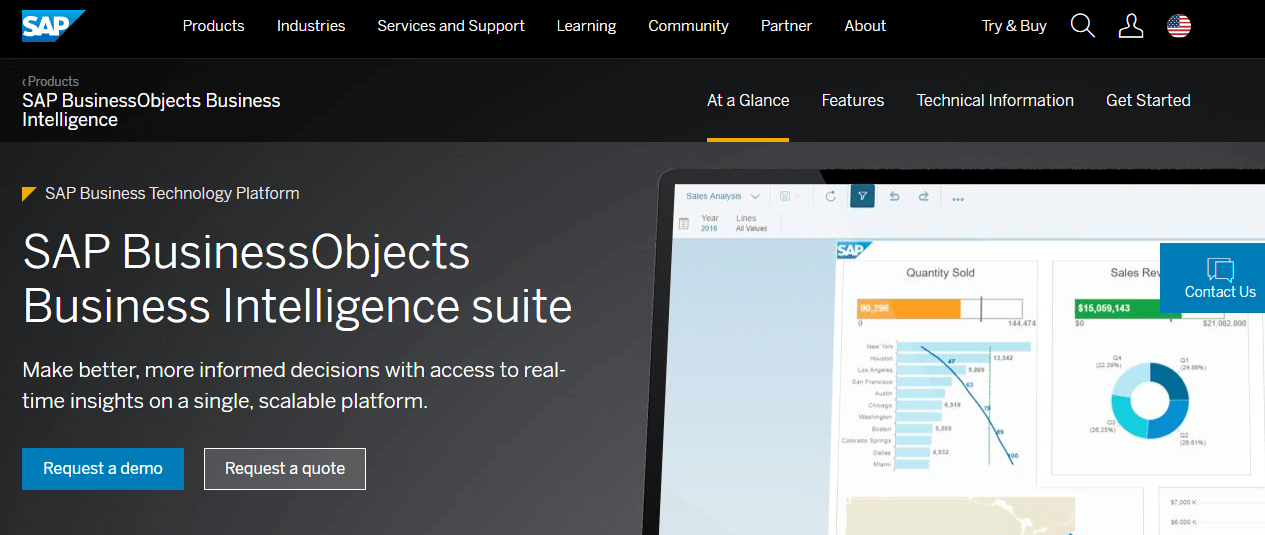
SAP BI supported by SAP SE is the ultimate popular InMemory computing platform for transforming relational databases.
Key Features:
-
Able to analyze multi-dimensional data sources, flexible dashboards, mobility, and flexible and scalable BI platform in Web and MS office environments.
-
Mobile BI for end-users on the go
-
All information can be accessed at a single point through BI. You can access data from multiple sources in one place (ie, BI).
-
SAP BI provides easy to use GUI and better formatting
-
Its excellent query performance and requires little management.
16. SAS BI

SAS is a well-known proprietary tool that can provide the right information to the right people at the right time.
Moreover, SAS Business Intelligence is a software solution that provides many products and technologies for data scientists, text analysts, data engineers, predictive analysts, econometricians, and optimization modelers.
This BI tool provides automated analysis supported by machine learning built into interactive visualizations to answer business questions.
Key Features:
-
Text analytics allows you to obtain information from text data (such as social media and location analytics) that combines data from a geographic environment.
-
SAS provides a variety of BI products and technologies, focusing on visual data exploration and simple analysis, interactive reports and dashboards, collaboration, and mobile applications.
-
It provides a high-quality connection between various data sources and end-users.
-
It provides real-time analysis and allows users to perform self-service reporting.
Official Link: SAS
17. Sisense BI

Sisense Bi was developed by Jim Goodnight and John Shall at the University of North Carolina in 1970. Initially, Sisense was a proprietary end-to-end BI tool designed for users who were not accustomed to BI. The solution comes with mobile and Web-based.
Sisense uses ElastiCube as its analysis database. Based on chip technology, it also supports cloud platform Ad hoc analysis, ad hoc query, and ad hoc reporting. Also, data visualization is the main function of Sisense.
Key Features:
-
Easily access raw data files and data from external databases. Read and write almost any data format!
-
Use data entry, editing, retrieval, formatting, and conversion tools to manage data.
-
Advanced analytics can help you make changes and improvements to your data. business. practices.
-
Comprehensive graphing and reporting
-
Operational research and project management
-
Data update and modification
-
Powerful data processing language
-
Excellent data cleansing feature
-
Multi-host system interaction
18. MicroStrategy BI tool

Microstrategy provides a series of solutions to offer scalable, secure, flexible, and scalable cloud solutions that can meet the needs of IT and business departments.
Additionally, MicroStrategy is an enterprise analytics and mobile platform that focuses on superintelligence, conjoint analytics, and cloud solutions.
Capterra users gave a reliable rating of 4.2 *, making this one of our business intelligence tools with a significant benchmark in the BI market.
With the support of natural language processing and machine learning, you can also integrate voice technology and chatbots, such as the Alexa or Google home page.
Key Features:
-
MicroStrategy is a free, proprietary tool that provides timely data-driven for every business problem.
-
Supports data mining and visualization for web-based deployment
-
Contains the features and functions of multiple applications and converts information into reports.
-
Enhance business productivity and profitability, and promote cloud support services via Amazon Web
-
The desktop version of this tool is free, but the enterprise version is priced for cloud-based deployments
19. HubSpot BI

HubSpot was founded in 2006 by Dharmesh Shah and Brian halligan.
It is the BI tool that can easily create custom reports by connecting all CRM business, contacts, and business data, as well as marketing, sales, and service data.
Companies can use custom objects to import data into HubSpot and integrate their applications through the HubSpot App Marketplace.
It is an all-in-one inbound marketing software that helps attract visitors through blogs, social media, and advertising. Moreover, it also helps customers convert through landing pages, email, marketing automation, and ABM.
In addition, HubSpot enables ROI tracking through revenue attribution reports. Their list of customers includes VMware, Trello, and SurveyMonkey.
Key Features:
-
HubSpot is inbound marketing, sales, and service software.
-
Provides CRM software which is completely free. It will help you organize, track and build better relationships with potential customers and customers.
-
Powerful and flexible content management software useful for marketers and developers.
-
Marketing software that helps in running complete inbound marketing campaigns on a large scale.
20. Oracle NetSuite BI
Oracle NetSuite enables organizations of all sizes to handle plans and budgets. It is business management software and provides solutions for small and large companies.
This solution is designed to handle financial, sales, contract, and operational planning issues through comprehensive planning, budgeting, and forecasting.
Moreover, the solution is designed to help quickly simulate financial and operational changes using financial assumptions.
Key Features:
-
It provides easy-to-use, scalable, and agile business solutions that include ERP, CRM, e-commerce, and PSA functions.
-
It helps in cutting IT costs in half, reducing financial settlement time by 20% to 50%, and reducing quote-to-cash cycle time by 50%.
-
Oracle NetSuite can help global enterprises meet their complex functional, industry, regulatory, and tax requirements.
21. Google Data Studio BI Analytics
Google Data Studio from Google Analytics enables companies to transform data into reports and informational dashboards. It was launched in 2016 as part of the Google Analytics 360 suite. It comes with multiple built-in marketing templates.
Key Features:
-
Google Data Studio provides easy-to-use features, including converting data into charts and graphs for more meaningful information
-
Provides fine-tune existing reports to provide custom solutions and Data visualization
-
It democratizes data by enabling sharing and collaboration.
-
Measure macro events that contribute to your business. For instance, measuring the number of brochure downloads
-
Standard reports in Google Analytics are adequate for a typical SMB website
-
Advanced reports can be configured which will allow you to see needles in the haystack.
22. Intercom Analytics BI

Intercom Analytics BI tool for professionals was founded in 2011 by Eoghan McCabe, Des Traynor, Ciaran Lee, and David Berrett. It enables marketing teams to segment attributes and send specific applications or emails to generate new leads.
Intercom helps businesses by segmenting users based on location, revenue, industry, etc., and helps businesses through outbound messages, autoresponder, and account-based marketing.
This tool also provides intelligent robots to enhance the customer experience and provides dialogue support for businesses of all sizes in the financial, e-commerce, education, and healthcare fields.
Key Features:
-
It is a proprietary business tool that provides the right information to the right users
-
It provides powerful solutions that are easy to manage and compile
-
Deliver data to businesses, customers, and managers.
-
Advanced-Data Integration and Click Analysis
23. Tableau BI tool

The Tableau analytics BI tool provides a dashboard for the enterprise to put all marketing data together in one place and provides useful insights on social media, customer journeys, website performance, and spendings.
The different kinds of products include Tableau preparation, screen desktop, screen server, and network Tableau and mobile Tableau.
The Tableau desktop provides data exploration through an intuitive interface. It also uses a statistical model driven by AI.
Key Features:
-
Users can access data from multiple sources, or add their data
-
Tableau is a free and easy-to-use BI system
-
Supports data exploration and visualization with an ancient architecture
24. Adaptive Insights BI
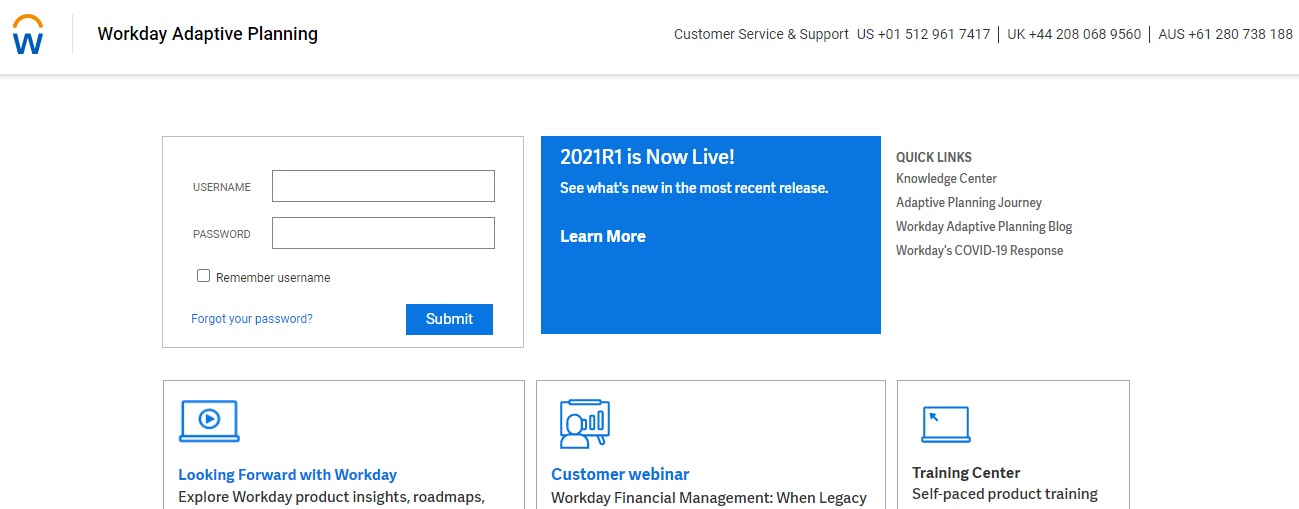
Adaptive Insights provides a powerful yet intuitive “cloud-up” planning, integration, analytics and integrated business intelligence (BI) and enterprise performance management (CPM)
This BI tool is a leader in cloud business and financial analytics solutions for businesses and nonprofits of all sizes.
The Software-as-a-Service (SaaS) platform enables finance and management teams to work together to plan, monitor, report, and analyze financial performance and operational performance.
Key Features:
-
Powerful modeling for businesses of all sizes, easy for people to use in all areas of the business
-
RealTime Financial Consolidation
-
Sharing insights and facilitating collaboration across the organization
-
Self-service interactive dashboards and data visualizations
-
Offers data integrity, warehousing, and security
25. GOOD DATA Analytics BI
GoodData is business analytics software that provides tools for data ingestion, storage, analysis and querying, visualization, and application integration.
You can integrate your analysis on your website, desktop, or mobile app, or create dashboards and reports for your daily activities without having to earn a Ph.D., as described on their website. GoodData is also one of the youngest software solutions on our list.
Founded in 2007, GoodData has received a stable 4.3-star rating from Capterra. GoodData is a competitive reporting and analysis tool on the market.
The manual has been greatly simplified to allow new users to create reports through visualization. You can access the Zendesk field, which is a very impressive feature. The support is also great as it can help solve time-critical technical issues.
Key Features:
-
Product features and performance
-
Service breadth
-
Improve business process results
-
Self-service interactive dashboards and data visualizations
-
Data integrity, warehousing, and security
26. BITNAMI BI

Bitnami makes it easy for you to install and run your favorite open source software on all platforms, including laptops, Kubernetes, and major clouds.
The BITNAMI data analysis platform focuses on the rapid development and guided analysis of applications and dashboards. It is built on the correlation engine and can realize data discovery without query-based tools, thereby eliminating the risk of data loss and inaccurate results.
Capterra has received 4.3 stars and users are very satisfied with the product and its features, making it one of the best BI tools on our list.
Key Features:
-
Improve business process results
-
Majorly used by IT organizations
-
Easy to use and handle
-
Self-service interactive dashboards and data visualizations
-
Data Integrity, warehousing, and security
27. PENTAHO BI
Pentaho is an open-source business tool that focuses on making accurate and data-driven business decisions. The tool is also cloud-compatible and provides interactive analysis.
Pentaho is a business intelligence tool that can provide customers with various business intelligence solutions. Report data analysis, data integration, data mining, etc. Pentaho provides a complete set of BI functions that can improve business performance and efficiency.
The platform includes big data integration, data mining, and predictive data analysis. Pentaho enables users to collect and manage data from multiple dynamic sources and helps turn big data into insights
Key Features:
-
It provides a seamless experience on smartphones and tablets.
-
Pentaho relies on powerful visualizations that allow users to interact with data to magnify and view important statistics.
-
This tool is specifically designed to blend with mobile platforms.
-
Improve business process results
-
Majorly used by IT organizations
-
Easy to use and handle
-
Self-service interactive dashboards and data visualizations
28. DOMO Analytics

Domo, Inc. is a cloud-based platform designed to provide company-wide decision-makers with direct, simplified, real-time access to business data with minimal IT intervention?
It is a SaaS (Software as a service) venture. But it doesn't end here. Domo connects directly to the location of your data to provide real-time information on important metrics, allowing you to make faster and more accurate decisions.
Key Features:
-
It helps in the management of projects.
-
Sharing and Collaboration
-
It also helps in sharing socially.
-
Easy to use and handle
-
Self-service interactive dashboards and data visualizations
-
Offers data security
29. QlikSense

QlikSense is a Business Intelligence (BI) tool that provides powerful data analytics to help you make better business decisions. QlikSense allows you to quickly and easily create custom dashboards, reports, and visualizations that display the data you need. QlikSense also lets you analyze and visualize large amounts of data from multiple sources, including spreadsheets and databases. This makes it easy for you to gain actionable insights into your business.
QlikSense has been specifically designed to meet the needs of business users who want to gain real-time insights into what's happening in their businesses. It can be used by anyone with basic knowledge of Microsoft Word or Excel and a basic understanding of SQL Server. The tool comes with a number of prebuilt reports and dashboards, but it also allows users to create their own reports and dashboards, as well as integrate them with other applications.
Key features
-
Create multiple types of reports using just one query.
-
Connect data sources such as databases and other applications to your QlikView environment so that your users can access that information easily.
-
Filter your data by multiple criteria at once in one click or drag-and-drop action.
-
Get a bird’s eye view of all your data by displaying it in a single dashboard view with insights on top
-
You can load your data into Qlik Sense without having to go through each record one by one.
Cost
$30/month
30. Clear Analytics BI

Clear Analytics BI tool allows you to drag and drop the data into Excel and helps users integrate data from the internal system. It works with Microsoft Power BI to clean and model different data sets using Power Query and Power Pivot.
Capterra has a user rating of 4.5 stars, which makes this tool one of the most prominent tools on our list.
Key Features:
-
It enables you to understand the source of the data, the filters applied, who ran the report, and when the data was extracted.
-
It provides ad hoc, self-service reports directly to Power BI, allowing non-technical users to explore the data stored in the database using a drag-and-drop interface and a dynamic query designer.
-
Users can also share their knowledge with mobile devices, including iWatch.
Conclusion
In 2026, business intelligence is no longer a supporting function but a core driver of organizational performance. BI tools enable companies to turn growing volumes of data into reliable insights that guide planning, execution, and measurement across every department.
By adopting the right BI platform, organizations can improve data consistency, accelerate decision cycles, and respond more confidently to market changes. Strong BI capabilities lead to better visibility, improved operational efficiency, and more predictable outcomes. Selecting a BI tool that aligns with your data strategy and business goals is essential for building a resilient and insight driven organization.
FAQs
1. What are Business Intelligence (BI) tools?
Business Intelligence (BI) tools are software applications designed to convert raw data into actionable insights. These tools offer features such as data visualization, interactive dashboards, and advanced analytics, enabling businesses to make informed decisions based on comprehensive data analysis.
2. What are the different stages of Business Intelligence?
The stages of Business Intelligence typically include data collections, integration, analysis, visualization, and decision-making.
3. What are the most important functions of every BI tool?
Every BI tool should provide the following functionalities:
-
Data Visualization: The ability to create and share interactive charts, graphs, and dashboards.
-
Predictive Analytics: Tools for forecasting future trends based on historical data.
-
ETL (Extract, Transform, Load): Processes that prepare data for analysis.
-
Self-Service Analytics: Empowering users to explore data and generate reports without IT assistance.
-
Data Integration: The ability to connect with various data sources and integrate them into a unified view.
