

Choosing a claims tool is usually one of three jobs. A hospital already on Epic, Oracle Health, or MEDITECH needs claim-to-cash on top of the chart it already has. An independent practice needs billing, eligibility, and remittance posting without a health-system revenue-cycle contract. A third path is a single layer: a pre-submit scrub or a clearinghouse that moves the file. Mixing those requests is how you buy a clearinghouse and still own the denial.
A claims tool is not an EMR. It is the work after the visit: eligibility, charge capture, claim scrub, 837 submit, 835 / electronic remittance advice (ERA) post, denial follow-up, patient statement. A clearinghouse moves the 837 and brings back the 835. A scrub tries to stop the bad 837. Revenue cycle management (RCM) is the people-plus-software operation that works denials and patient balances. Those are not the same purchase.
If denials are a department, start with Waystar. If the claim is dying before it is submitted, Experian Health is the pre-submit scrub. If the practice still says Kareo, Tebra Billing Starter is the current brand. If the same login has to be the chart and the claims desk, AdvancedMD lists a per-provider starting price. Small billing shops that want a listed monthly user rate can start with EZClaim. At Epic’s Users Group Meeting (17–20 Aug 2026) four health systems went live on real-time prior-auth checks via the Coverage Requirements Discovery (CRD) API, with a CMS payer deadline of 1 Jan 2027. If denials are “auth not obtained,” a second scrub will not catch an authorization the chart never asked for. Ask whether the EHR is on CRD before you buy another edit layer. The method is on How we review tools.
What usually goes wrong when choosing a claims tool
Most bad fits start with treating health-system revenue cycle and independent-practice billing as the same product.
| Problem | Solution |
|---|---|
| A practice tool is sold into a health-system shop | Write whether you need health-system revenue cycle or independent-practice billing |
| You bought eligibility when you needed claim-to-cash | Write whether the purchase is the full cycle or one step |
| The listed price is a clearinghouse ping | Use the claims-product price, not a reseller start-at |
| Health-system and independent-practice quotes are mixed | Match the setting where the claim actually originates |
How we evaluated healthcare claims tools
Four checks: whether the product is built for health-system revenue cycle or independent-practice billing, whether you are buying claim-to-cash or one layer, whether any price is public, and how you are billed (transaction, prescribing provider, user, or percent of collections). First-pass marketing percentages did not move a ranking. Neighbor products sit under Other healthcare claims tools worth considering.
TL;DR: The 8 Compared
| Tool | Best for | What to check |
|---|---|---|
| Waystar | Hospitals and health systems that need claim-to-cash on top of the chart they already have |
ProductClearinghouse plus denial recovery, posting, and patient billing. Connectors for Epic, Oracle Health, MEDITECH, eClinicalWorks
PriceQuote-only. Platform plus per-transaction clearinghouse fees
Watch-outRecoupment Manager may sit on a second line. The 99% first-pass figure is theirs
|
| Experian Health | Revenue-cycle teams whose first-pass problem is dirty claims leaving the EHR |
ProductPre-submit scrub. Line-level edits before the 837 is built
PriceQuote-only. Enterprise module. No public per-claim rate
Watch-outIt will not replace a denial workqueue or a patient-statement shop
|
| Tebra | Independent US practices that want cloud billing without a hospital RCM contract |
ProductBilling Starter is claims. Practice Essentials adds the EHR. Kareo is the old name
PriceQuote-only per prescribing provider. EPCS about $75 one-time. PDMP $500 per facility
Watch-outBilling Starter has no listed package dollar. Statements and terminals are extras
|
| AdvancedMD | Small and mid-size practices that want claims, scheduling, and the chart in one cloud suite |
ProductPractice management plus optional RCM as a percent of collections. Same login for PM and EHR
PriceMedical specialties from $429 / provider / month. RCM 4–8% of collections
Watch-outOther specialties and billing-services sit above the medical-specialty floor. EHR+PM is above the PM floor
|
| Quadax Xpeditor | Health systems that want Xpeditor edits plus a provider clearinghouse, especially on Epic Resolute |
ProductXpeditor edits plus provider clearinghouse, eligibility, remits, denials
PriceQuote-only
Watch-outYou still originate claims from an EHR or practice-management system
|
| Cognizant TriZetto Provider Solutions | Provider groups that need a high-connectivity clearinghouse, not a payer adjudicator |
ProductProvider clearinghouse and claims management. Optional RCM services
PriceQuote-only. Not Facets
Watch-outPayer TriZetto suites are a different product
|
| EZClaim | Small billing shops that want listed monthly pricing for claim entry and submit |
ProductBilling software. Claim entry, electronic submit, secondary / MSP
PriceFirst user $199 / month. Extra users $149
Watch-outClearinghouse fees are extra. Claims transmit through TriZetto
|
| MedEvolve Effective Intelligence | Provider RCM teams that already bill and need touch-level workflow, not another clearinghouse |
ProductFinancial clearance, insurance A/R, and patient A/R workflow. Not rails
PriceQuote-only
Watch-outNot a clearinghouse. Claims still need a payer connection elsewhere
|
Waystar
Waystar is the hospital and health-system claims stack: financial clearance, claim management, denial recovery, payment posting, and patient billing on one platform. The company is public (NASDAQ: WAY). The product most buyers mean when they say “Waystar claims” is Claim Management plus the AltitudeAI layer that now sits on top of it.
Waystar cites a first-pass / clean-claim figure of about 99% on the current platform. CEO Matt Hawkins has used that figure in public remarks, including around JPM. Treat the percentage as Waystar’s number until a proof of concept runs it against your payer mix. AltitudeAI is the 2026 denial and appeal layer: documentation and coding checks before the 837 goes out, suggested corrections from historical denial patterns, and faster appeal-package assembly. Silent-denial / payer-takeback detection is the newer motion. Recoupment Manager is sold as its own product. Confirm whether silent-denial sits inside the Claim Management quote or is a new line.
Best for: Health systems that need claim-to-cash on top of the chart they already have.
What you get:
- Claim lifecycle: edits, submit, status, attachments, and denial workqueues, with nightly refresh on the operational dashboards.
- AltitudeAI for denial prevention and appeal packaging, plus the newer recoupment / silent-denial pass.
- Patient Financial Care for estimates, statements, and online pay.
- EHR connectors for the major hospital and ambulatory charts. The integration is the implementation.
Why we like it: This is the one on the list built for a health-system revenue-cycle shop. If the problem is “our denials are a department,” start here.
Limits:
- Quote-only. No public per-claim or per-provider list. Third-party write-ups invent annual floors and a percent of collections; those are not Waystar’s list price.
- Implementation is a project. If the billing team is two people and a clearinghouse login, this is the wrong purchase.
- The 99% first-pass figure is Waystar’s platform number. Ask for it on your top ten payers before you put it in a board deck.
Price: Quote-only. Typically a platform subscription plus per-transaction clearinghouse fees (270/271 eligibility, 837 claims, 276/277 status, 835 remits). Confirm whether Recoupment Manager sits inside Claim Management or on a separate line.
Experian Health
Experian Health Claim Management is the pre-submit scrub. The product’s job is to catch the code, demographic, or medical-necessity problem while the encounter is still on the billing desk. That is a different hole than Waystar’s end-to-end RCM.
Line-level review happens before billing, with automatic flags on bad codes and a reject reason you can act on. Experian sells this into hospitals and large groups that already have a clearinghouse and want fewer 277s. It will not catch a missing auth the chart never asked for. If denials are “auth not obtained,” the CRD conversation belongs in the EHR before you buy a second scrub.
Best for: Revenue-cycle teams whose first-pass problem is dirty claims leaving the EHR.
What you get:
- Pre-bill claim edits on each line of the encounter, before the 837 is built.
- Payer-rule and coding flags in the existing billing workflow rather than a second desktop.
- Rejection feedback that names the fix, so the same claim does not bounce twice.
- Sits next to Experian’s eligibility and patient-access products if you already buy those. Do not assume you have to.
Why we like it: Most “claims platforms” on old listicles are really EHRs with a submit button. Experian is one of the few that is actually the scrub. If your clean-claim rate is the KPI, this is the product.
Limits:
- It will not replace a denial workqueue, a patient-statement shop, or an EHR. Buying only the scrub and hoping A/R days fall is how this proof of concept fails.
- Quote-only. No public per-claim rate.
- Value tracks how current the payer-rule pack is. Ask for the last time your top payers were updated, in writing.
Price: Quote-only. Budget as an enterprise module on top of whatever you already pay Experian Health, or as a standalone claims-edit contract. Do not use a reseller’s “starts at” figure.
Tebra
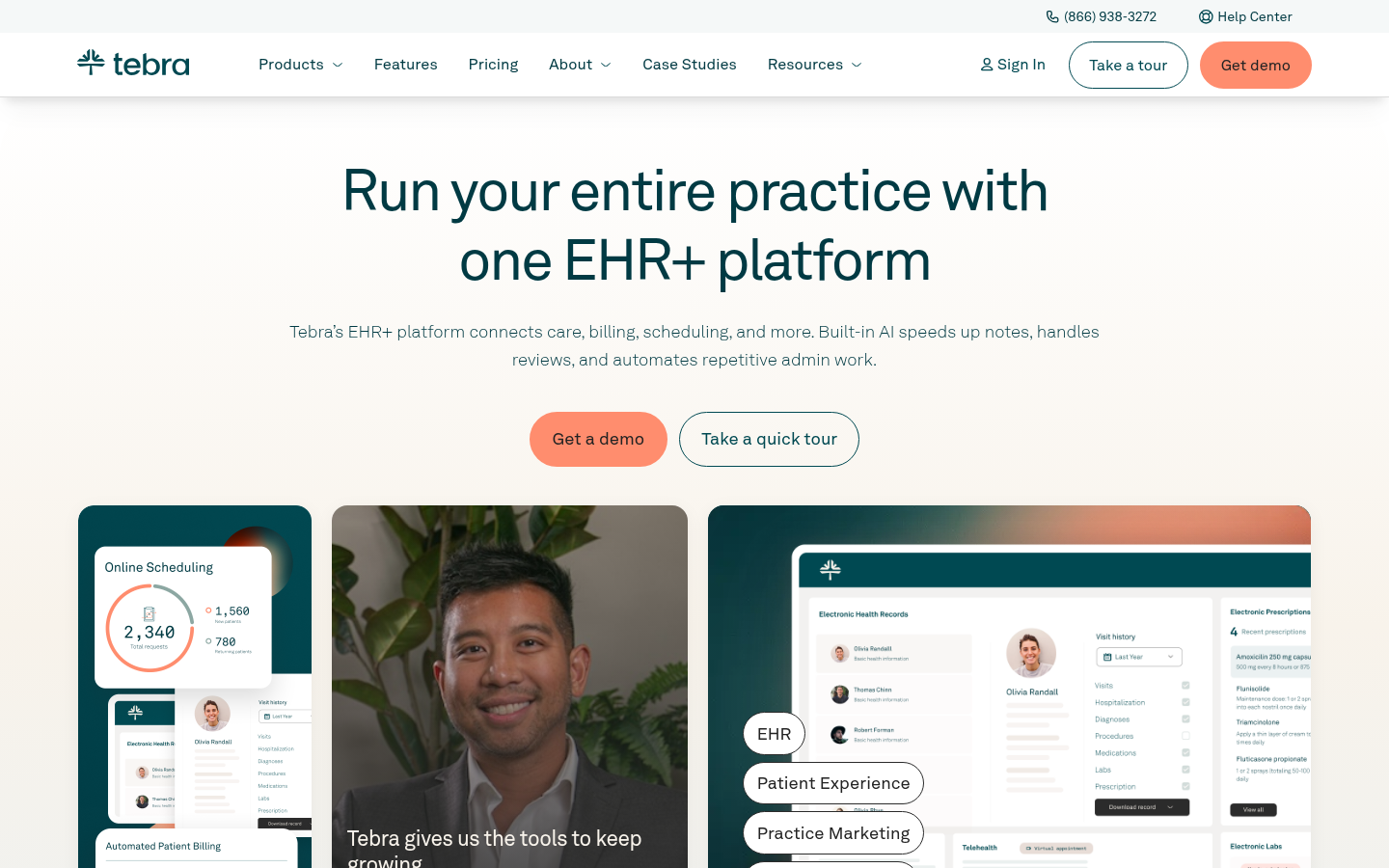
Tebra is what Kareo Billing became. Kareo (billing) and PatientPop (patient growth) merged; the live brand, packages, and pricing are Tebra. If a 2025 request still says Kareo, you are buying this.
The claims product is Tebra Billing: eligibility, charge capture, insurance enrollment, e-claims (submissions, rejections, denials), fee schedules, auto payment posting, and patient statements. Billing Starter is the claims-only package. Practice Essentials adds clinical EHR and telehealth. Practice Automation adds the patient-experience layer. Pricing is per prescribing provider. Front desk, MAs, and billers are included. Providers who bill 100 claims or fewer a month get a lower tier. On a Tebra quote you will also see pass-through compliance line items, including electronic prescribing of controlled substances (EPCS) setup and prescription drug monitoring program (PDMP) access (Appriss, not a Tebra markup on the page).
Best for: Independent US practices that want cloud billing without a hospital RCM contract.
What you get:
- E-claims, eligibility, ERA auto-post, and denial handling in Billing Starter, without buying the full EHR.
- One provider license covers unlimited non-clinical staff. That is the cost model.
- Low-volume tier at 100 claims a month or under, aimed at part-time and locum panels.
- AI Note Assist is an EHR add-on. Do not let a demo wander there if you came for denials.
Why we like it: If the practice still says Kareo, this is the current billing product. You get e-claims without a health-system RCM contract, on a quote billed per prescribing provider.
Limits:
- No public dollar tiers for Billing Starter. Community per-provider figures are not a Tebra list price. Get the quote for Billing Starter versus Practice Automation as two different lines.
- This is independent-practice billing. If you are a 200-bed facility, you are in the Waystar conversation.
- Statements, card terminals, and some reminders are starred as extra on the package grid. PDMP is about $50 per user per year on top of the facility fee. Read the asterisks.
Price: Custom quote on tebra.com/pricing. Billed per prescribing provider. Named extras: EPCS about $75 per provider one-time, and PDMP $500 per facility.
AdvancedMD
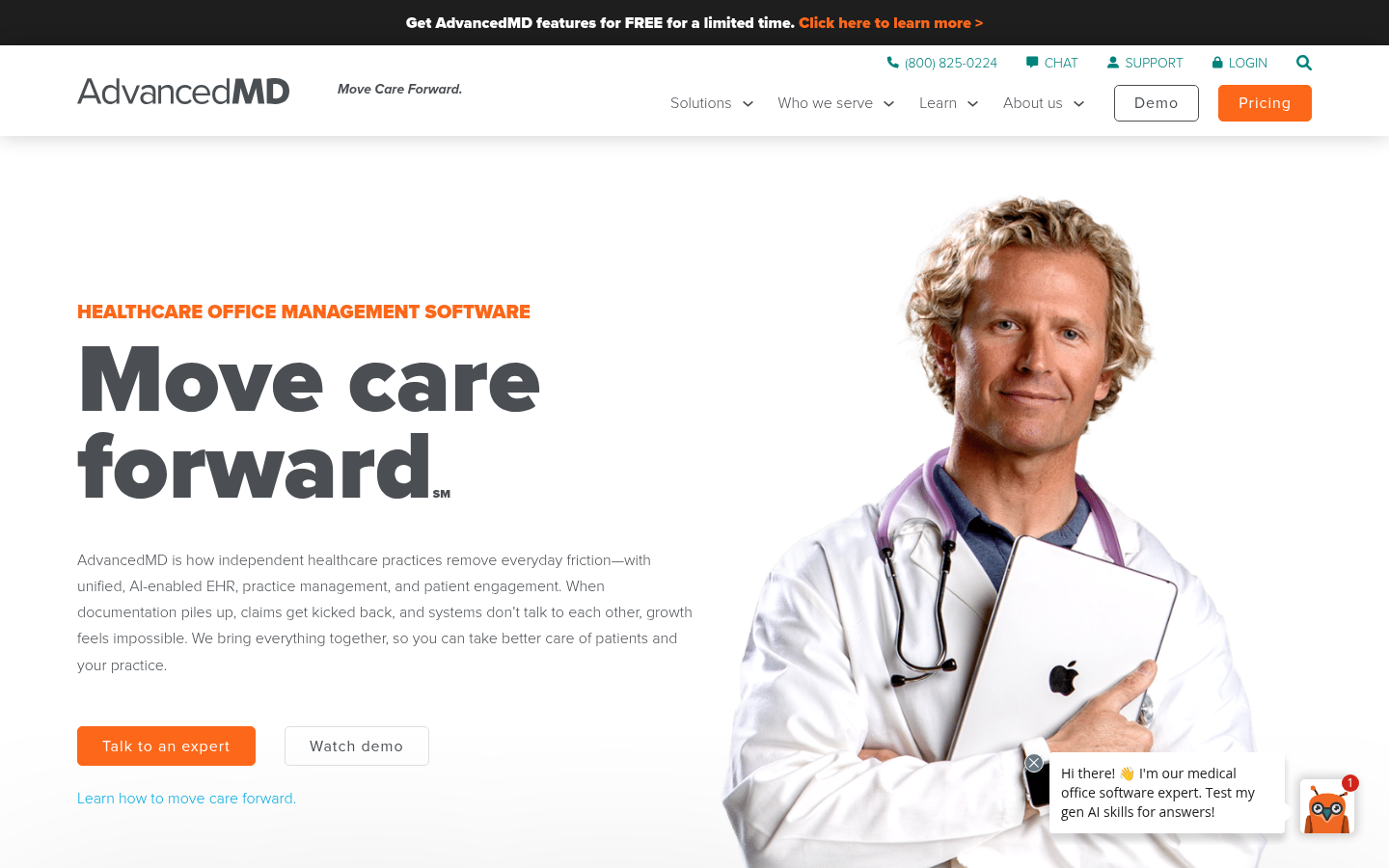
AdvancedMD is the ambulatory suite where practice management, billing, and the EHR share a login. The claims desk is not a bolt-on: worklists, claim status across providers and locations, and the billing company program (AdvancedBiller) all sit on the same cloud practice-management system.
Pricing is per provider per month, by specialty. A provider, on that page, is a mid-level clinician or higher. RCM services are a percent of collections. Billing-services subscriptions are a separate per-provider line. EZClaim also lists a monthly user rate; AdvancedMD is the one that can keep the chart on the same login.
Best for: Small and mid-size practices that want claims, scheduling, and the chart in one suite.
What you get:
- Claim worklists and status across providers and locations, with the practice-management system and EHR on the same credentials.
- Clearinghouse, eligibility, ERA, and patient billing inside practice management.
- Specialty editions (mental health, physical medicine, MedSpa) with their own price bands on the public page.
- Optional RCM as a percent of collections when the practice does not want to staff the billing desk.
Why we like it: You can put a per-provider month in a spreadsheet before the demo, and keep the chart on the same login. EZClaim lists a user rate too, but it does not include the chart. The hospital stacks make you wait for sales.
Limits:
- The medical-specialty floor is practice-management / billing. Integrated EHR plus practice-management quotes come in higher on the same builder. Do not budget the floor and then add the chart for free.
- RCM as a percent of collections is a different contract than the software subscription. Mixing them in one line item blows up the first-year number.
- Implementation, e-prescribe, eligibility, and card processing show up as extras. Get them on the quote.
Price: Medical specialties start at $429 per provider per month. RCM is 4–8% of collections. Other specialties and billing-services sit above that medical-specialty floor.
Quadax Xpeditor
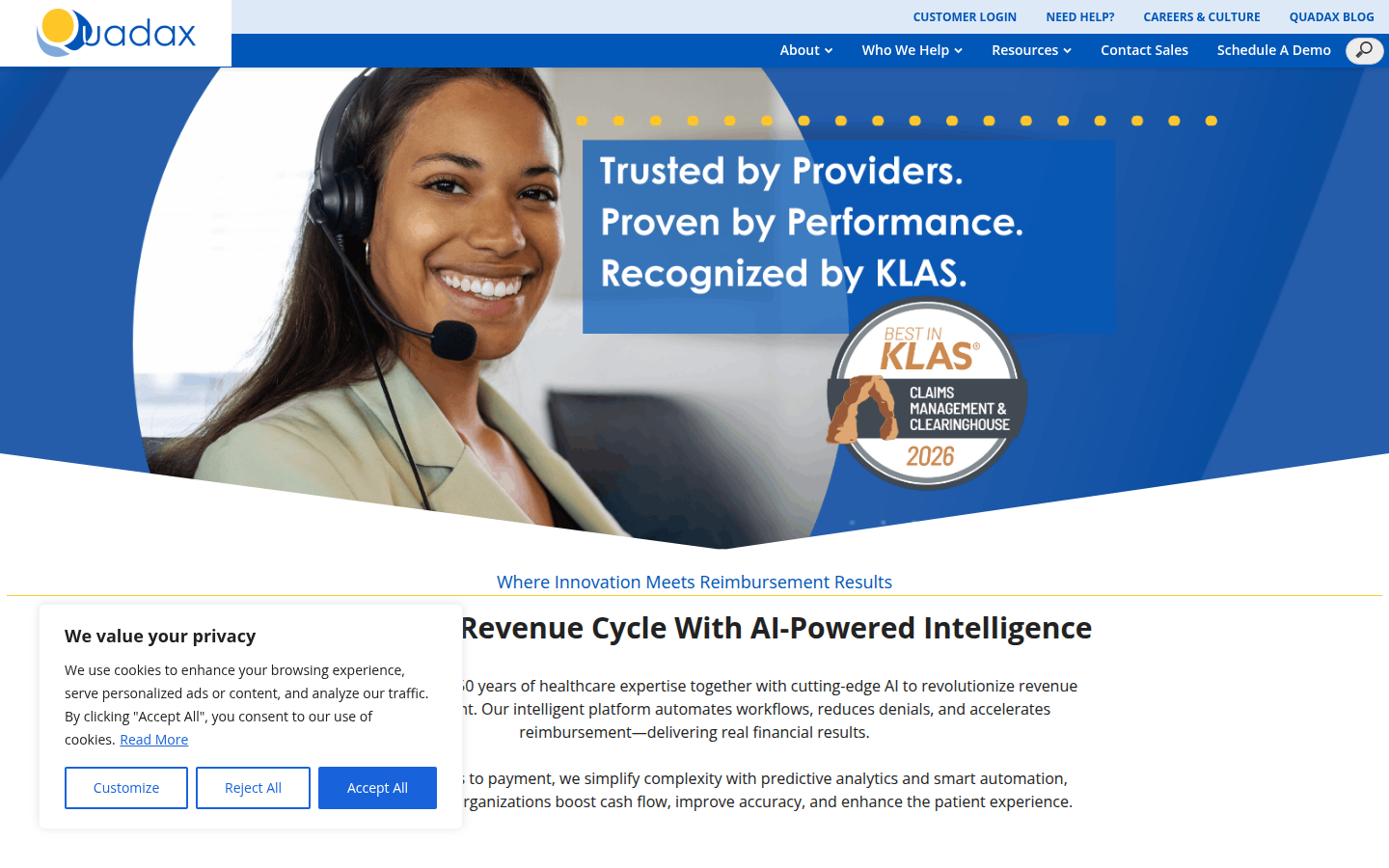
Quadax Xpeditor is the other hospital and group claim-to-cash layer on this page: Xpeditor edits, a provider clearinghouse, eligibility, remits, and denials. Waystar is the broader health-system RCM platform. Quadax is the one built around Xpeditor’s edit workflow, with Epic Resolute as a common integration.
It was named 2026 Best in KLAS Claims Management & Clearinghouse (5 Feb 2026 release). AskQ AI guidance sits inside Xpeditor. Pricing is quote-only. You still originate claims from an EHR or practice-management system.
Best for: Health systems that want Xpeditor edits plus a provider clearinghouse, especially on Epic Resolute.
What you get:
- Xpeditor claims management: rules and edits (bi-weekly updates), biller workflow, audit trail, coordination of benefits, and dashboards.
- Provider clearinghouse plus eligibility, claim status, remits, and denials.
- Epic Resolute integration that returns edits quickly.
- AskQ AI guidance inside Xpeditor.
Why we like it: If you already run Epic Resolute and want edits plus a provider clearinghouse from one vendor, this is the health-system alternative to Waystar. You will take a quote.
Limits:
- Quote-only. No public per-claim or per-provider list.
- You still originate claims from an EHR or practice-management system. Quadax is the claim-to-cash layer on top.
- Built for hospitals, labs, and physician groups, not payer adjudication.
Price: Quote-only.
Cognizant TriZetto Provider Solutions
Cognizant TriZetto Provider Solutions is the provider clearinghouse and claims-management brand. Waystar and Quadax sell a fuller hospital claim-to-cash stack. This is the high-connectivity clearinghouse: 650-plus practice-management / EHR integrations and 11,000-plus payer connections. Do not confuse it with Cognizant TriZetto payer suites (Facets).
Optional RCM services sit next to the clearinghouse. Fast-track enrollment is the pitch if a clearinghouse dies. Pricing is quote-only.
Best for: Provider groups that need a high-connectivity clearinghouse, not a payer adjudicator.
What you get:
- Provider clearinghouse and claims management, including rejection and denial handling.
- Patient engagement, credentialing, and analytics on the same family.
- Optional outsourced RCM services.
- SOC 2, EHNAC, and HITRUST language you can take to compliance.
Why we like it: If the gap is payer connectivity rather than a full hospital RCM platform, this is the provider clearinghouse to shortlist. Keep payer Facets off the same quote.
Limits:
- Quote-only. Enterprise sales motion.
- Wrong product if someone pastes Facets. Provider Solutions is the claims brand on this page.
- A clearinghouse will not staff your denial desk unless you buy the optional RCM services as their own line.
Price: Quote-only.
EZClaim

EZClaim is small-practice medical billing software: claim entry, electronic submit, secondary and Medicare Secondary Payer (MSP) claims, and reports. Tebra and AdvancedMD are the other independent-practice options here. EZClaim is the one with a listed monthly user rate, and claims transmit through TriZetto rather than through EZClaim-owned rails.
Cloud monthly pricing is month-to-month, with no contract. Extra company files, extra storage, and the patient portal are add-ons. You can trial the TriZetto clearinghouse without buying EZClaim. This is billing software, not an EHR.
Best for: Small billing shops that want listed monthly pricing for claim entry and submit.
What you get:
- Claim entry, electronic submit, secondary / MSP, 40-plus reports, and CPT / HCPCS and ICD libraries.
- Cloud on Mac and PC, with an onboarding coach or self-serve setup, daily backup, and branded statements.
- Direct submit to TriZetto from the app. Clearinghouse reports land back in EZClaim.
- Month-to-month access. Extra company files and storage are add-ons.
Why we like it: You can put a monthly number in a spreadsheet before a sales call. That is rare on this claims list. The catch is you still pay clearinghouse fees on top.
Limits:
- Clearinghouse fees are extra. Claims transmit through TriZetto, not through EZClaim-owned rails.
- Not an EHR and not payer adjudication. One license is not multi-office.
- Annual billing is slightly lower than month-to-month. Get the term you actually want on the quote.
Price: First user $199 per month. Extra users $149.
MedEvolve Effective Intelligence
MedEvolve Effective Intelligence is the provider RCM operations layer: financial clearance, insurance A/R, and patient A/R automation that measures staff touches. Waystar and Quadax sell rails plus workflow. This sits on your current EHR or practice-management system, or on MedEvolve Practice Management, and is not a clearinghouse.
Worklists, remote-workforce visibility, and generative AI on touch data are the product. Pricing is quote-only. Third-party $500-per-user figures are not a list price.
Best for: Provider RCM teams that already bill and need touch-level workflow, not another clearinghouse.
What you get:
- Ei Suite worklists on financial clearance, insurance A/R, and patient A/R, with every staff touch measured.
- Runs on your current EHR or practice-management system, or on MedEvolve Practice Management.
- Remote workforce visibility and generative AI on touch data.
- Quote-only access. No published per-user list.
Why we like it: If the billing rails already work and the problem is how many times staff touch a claim, this is the operations layer. It will not replace a clearinghouse.
Limits:
- Not a clearinghouse. Claims still need a payer connection elsewhere.
- No public list price. Ignore third-party $500-per-user figures.
- If you still need edits and submit, you wanted Waystar, Quadax, or a practice billing suite, not this layer alone.
Price: Quote-only.
If the next comparison is the chart rather than the claims desk, start with EMR tools.
Health-system RCM or independent practice, and are you buying the full cycle?
This grid plots two questions. Across is the buyer: health-system RCM on the left, independent practice on the right. Up is the layer: end-to-end claim-to-cash at the top, one layer (scrub, billing, or workflow) at the bottom.
 Health-system RCM
 Practice billing
 Billing or workflow
Placement is health-system revenue cycle versus independent practice, and full claim-to-cash versus one layer. Billing-only packages sit on the one-layer side even when the same vendor also sells a chart. Placement only, not review scores.
How you are billed
| Tool | Listed price | What the quote still hides |
|---|---|---|
| Waystar | Quote-only. No public per-claim or per-provider list | Platform fee plus 270/271, 837, 276/277, 835. Recoupment Manager may be a second line. The 99% first-pass figure is theirs |
| Experian Health | Quote-only. No public per-claim rate | Payer-rule freshness on your top payers. A reseller “starts at” is not a list price |
| Tebra | Custom quote per prescribing provider. EPCS about $75 one-time. PDMP $500 / facility + about $50 / user / year | Billing Starter has no listed package dollar. Statements and terminals are starred extras |
| AdvancedMD | Medical specialties from $429 / provider / month. Mental health $130–$399. MedSpa $278. RCM 4–8% of collections. Billing services $229–$1,070 | EHR+PM is above the practice-management floor. RCM percent and software subscription are different contracts. Physical medicine and addiction medicine $399 |
| Quadax Xpeditor | Quote-only | Provider claim-to-cash, not payer adjudication |
| Cognizant TriZetto Provider Solutions | Quote-only | Provider Solutions only. Not payer Facets |
| EZClaim | First user $199 / month. Extra $149. Annual $189 / $144 | TriZetto clearinghouse fees are extra |
| MedEvolve Effective Intelligence | Quote-only | Not a clearinghouse. Third-party $500-per-user figures are not a list price |
Other healthcare claims tools worth considering
These are real products next door. Someone would want them. They are not provider claim-to-cash in the sense this page compares.
- PLEXIS and DataGenix ClaimScape - Payer / TPA adjudication, not provider claim-to-cash.
- NextGen and RXNT - EHR-plus-billing suites. They belong on an EMR shortlist first.
- FileTrac, TeamDesk, Pega claims, SimplePractice, Insta, OSP, Speedy Claims, QuickCap, Bisok - P&C, generic databases, FNOL, wellness OS, hospital admin, custom-dev, CMS-1500 utilities, capitation, or document processing. Not this purchase.
Questions before you sign a claims contract
If setting, cycle, and billing stay fuzzy, you are still buying a submit button.
- Which setting is this? A health-system RCM contract and an independent-practice seat are not interchangeable. If the billing team is two people, a hospital stack is the wrong contract.
- Are you buying the full cycle or one layer? A clearinghouse, a scrub, and a denial shop are three jobs. Buying two of the same layer is a duplicate purchase.
- What number can you put in the spreadsheet? Quote-only stays quote-only. Listed starting points here are AdvancedMD from $429 per provider per month (RCM 4–8% of collections) and EZClaim at $199 / $149. Tebra’s named extras are EPCS about $75 and PDMP $500 per facility. A reseller Waystar “starts at” is not a list price.
Which claims tool should you pick
Dirty claims leaving the EHR: Experian. Health-system denials and cash: Waystar. Independent practice that still says Kareo: Tebra Billing Starter, unless you need the full Automation bundle. Same login for chart and claims: AdvancedMD, and budget the EHR band above the $429 medical floor if you need the chart. Hospital edits plus clearinghouse: Quadax Xpeditor, quote. Provider clearinghouse at scale: TriZetto Provider Solutions, quote. Small-practice listed monthly rate: EZClaim, first user $199 per month, clearinghouse fees extra. Touch-level RCM operations: MedEvolve, quote, not a clearinghouse. Treat every first-pass percentage you have not seen on your own payers as marketing.
Frequently asked questions
Do I need a claims tool if I already have an EHR?
Only if the EHR’s submit button is the thing failing. Plenty of practices run eClinicalWorks or AdvancedMD and never buy Waystar. The claims tool earns its keep when eligibility, scrub, denial ownership, or patient-pay is the gap the chart does not close.
What is the difference between a clearinghouse, a scrub, and RCM?
A clearinghouse moves the 837 and brings back the 835. A scrub tries to stop the bad 837. RCM is the people-plus-software operation that works denials and patient balances. Waystar sells all three. Experian sells the scrub. Tebra and AdvancedMD sell practice billing that includes a clearinghouse. EZClaim is billing software; the clearinghouse is extra.
Which claims tools list a public price?
AdvancedMD and EZClaim. AdvancedMD: medical specialties start at $429 per provider per month; RCM is 4–8% of collections; other specialties sit above that floor. EZClaim: first user $199 per month, extra users $149; clearinghouse fees extra. Tebra is quote-only per prescribing provider, with named extras (EPCS about $75, PDMP $500 per facility). Waystar, Experian Health, Quadax Xpeditor, TriZetto Provider Solutions, and MedEvolve are quote-only. If a reseller quotes a Waystar “starting at” figure, that is not a list price.