
Lovable ships a running web app from a prompt. You leave when the credit pool also pays for hosting you wanted to own, or when the job is native mobile, or when you already have a repo and someone who can review diffs.
Lovable in 2026 still does the founder job: describe an app, get a running web product with a frontend, backend, database, authentication, and a publish URL. Workspaces share one plan and one credit pool. GitHub and GitLab sync sit on every plan. A zip of the code is paid-only, so a free experiment stays inside Lovable Cloud. That is why the credit pool also paying for hosting, a native mobile brief, or a repo that already needs a reviewer are leave reasons, not a second prompt.
A Hacker News thread on the architecture behind Lovable and Bolt put the useful job in one line: use these tools for the software you would never have written at all.
The hosted prompt-to-app tools come first. A Flutter canvas and an IDE sit after those, plus one self-host builder if you want the workspace on a box you operate.


You are on Lovable


v0

v0 by Vercel turns a prompt into real code and a full-stack web app on the Next.js stack Vercel already hosts. The default UI kit is shadcn, a set of copy-paste React components, plus Tailwind. You deploy in one click or open a pull request.
Best for: Teams already on Vercel, Next.js, and shadcn who want a prompt that lands as a deploy or a PR.
Key features:
- An AI agent that writes real code and full-stack apps, with a connect-to-backend path.
- One-click deploy on Vercel, or a pull request back to the repo.
- Next.js, Tailwind, and shadcn as the default path.
- Business opts out of training by default.
Why we like it: If the company already ships on Vercel, the preview and the production host are the same vendor. You're not learning a second cloud to publish.
Notable limitations:
- Plus and Business are per user. A four-person team multiplies the seat before extra credits. Lovable Pro can add those people on one shared pool.
- The stack is Vercel and Next. If you wanted somewhere else, this is the wrong lane.
Pricing:
- Free is $0, with $5 of monthly credits and 7 messages a day.
- Plus is $30 per user per month, with $30 of credits per user plus a $2 daily login credit.
- Business is $100 per user per month, same credits, training opt-out by default.
- Enterprise is custom.
Bolt.new
Bolt.new is StackBlitz's chat-to-app window in the browser. You prompt an app, a site, or a prototype, import from Figma or GitHub, and iterate against a file tree and a terminal. Bolt Cloud adds hosting, databases, auth, and custom domains.
Best for: Founders who want the files in front of them while they chat, and who will spend tokens on a growing project.
Key features:
- Chat an app in the browser with a file tree and a terminal.
- Figma or GitHub import.
- Bolt Cloud for hosting, databases, auth, and custom domains.
- Token rollover on Pro. Teams seats each keep their own token pot.
Why we like it: You can see the files, which is closer to a real project than a preview that hides the tree.
Notable limitations:
- Most token usage is syncing the project file system to the AI. A larger project costs more per message. Tokens die on the tenth fix.
- Teams tokens are not shared. Unlike Lovable's one pool, each Bolt seat burns its own pot.
Pricing:
- Free is $0, with 1M tokens a month, a 300K daily cap, Bolt branding, and 10MB uploads.
- Pro is $25 a month, with 10M tokens, no daily cap, no branding, a custom domain, and token rollover.
- Teams is $30 per member per month.
- Enterprise is custom. Yearly billing saves up to 28%.
Replit Agent

Replit Agent turns a plain-language brief into an app inside one hosted workspace. The agent writes, tests, and publishes. Auth, databases, hosting, and monitoring are platform services. The same login also covers mobile, slides, design, and games.
Best for: Founders who want one hosted workspace that can publish without leaving, and who might also need mobile or slides from the same product.
Key features:
- Agent writes the code, the infrastructure, and the databases from a plain-language brief.
- Auth, database, hosting, and monitoring as platform services.
- Lite, Economy, and Power modes. Turbo (up to 2.5x speed and 6x cost) sits on Pro and Enterprise.
- Mobile, slides, design, and games on the same platform.
Why we like it: This is the closest job match to Lovable: you describe the product and the workspace publishes it.
Notable limitations:
- Core is a credit floor. Turbo speed is gated to Pro and Enterprise, and it multiplies cost.
- Starter can publish one project. A second live app means a paid plan.
Pricing:
- Starter is Free, with daily Agent credits and one published project.
- Core is $20 a month billed annually, or $25 billed monthly. You get $25 of monthly credits, 5 collaborators, and 2 parallel agents.
- Pro is $95 a month billed annually ($100 before annual), with $100 of credits, 15 collaborators, and 10 parallel agents.
- Enterprise is custom.
Base44
Base44 is the Wix-backed builder that takes a plain-language brief and returns a frontend, backend, database, auth, and payments. Apps run on production infrastructure. The same product also covers websites and Superagents, Base44's agent layer.
Best for: Founders who want vibe coding with payments and auth already wired, and who will pay once the app has to stay private.
Key features:
- Describe the product. Base44 builds the frontend, backend, database, auth, and payments.
- Apps run on production infrastructure.
- Websites and Superagents sit in the same product.
- Private apps are a paid feature from 6 February 2026. Free users keep older private apps but can't flip a public app to private without upgrading.
Why we like it: Payments and auth arrive with the first build. You're not wiring a second vendor the night before a demo.
Notable limitations:
- A non-public MVP requires pay. Free is fine for a public experiment and a hard stop for a private one.
- Canceling drops you to Free at period end, with a 5-app cap. Apps stay live, though paid features may drop.
Pricing: Yearly rates are public. A monthly toggle exists.
- Free is $0, with 25 message credits a month, 100 integration credits a month, and up to 5 apps.
- Starter is $16 a month billed annually.
- Builder is $40 a month billed annually.
- Pro is $80 a month billed annually.
- Elite is $160 a month billed annually.
- Enterprise is custom.
Softgen
Softgen plans, builds, previews, and deploys a full-stack web app from a description. The switch pitch is ownership of the repo and the host. Every project lives in a GitHub repo you own, deploys to your Vercel, and can connect your own Supabase, a hosted database and auth service.
Best for: Founders who want the Lovable-style chat, then a repo and a host that still work if Softgen goes away.
Key features:
- Describe a full-stack web app. Softgen plans, builds, previews, and deploys.
- Every project lives in a GitHub repo you own.
- Deploy to your Vercel. Connect your own Supabase.
- Model choice is part of the positioning against Lovable, Bolt, and v0.
Why we like it: The lock-in pitch is the point: the app can keep running after you cancel.
Notable limitations:
- The live bill is a yearly license plus a pay-as-you-go wallet. Usage is a second bill you have to watch.
- You operate GitHub, Vercel, and Supabase, which is the point and also the work.
Pricing: The live bill is a $33-a-year license plus a pay-as-you-go wallet. A $3 minimum starts a 3-day trial. Unused credits stay if you cancel.
Anything

Anything is the product at Create.xyz. You turn words into mobile apps, sites, tools, and products, built with code. The feature grid includes web plus mobile, 40+ integrations, and App Store submit.
Best for: Founders who need a web app and a mobile app from the same prompt, and who will pay before the first build.
Key features:
- Prompt to mobile apps, sites, tools, and products, built with code.
- Web plus mobile, with 40+ integrations and App Store submit on the feature grid.
- Private projects, branding removal, and custom domains on Pro.
- Credits spend on builder messages and on AI integrations inside the published app.
Why we like it: Web and mobile sit in one prompt. Lovable's publish path is a web URL.
Notable limitations:
- Building an app requires a paid plan. The free surface won't ship a real project.
- Credits pay for chat and for AI features inside the live app, the same unified-balance trap as Lovable. Unused monthly credits expire at cycle end. Top-offs never expire.
Pricing:
- Pro 20k is $19 a month billed annually, or $24 billed monthly, for 20k credits, private projects, branding removal, and custom domains.
- Max 200k is $199 a month billed annually, or $239 billed monthly, for 220k credits.
- Teams is custom. Top-offs are $12 per 10k credits and never expire.
The hosted prompt-to-app options end here. The next two are a different job: a visual Flutter canvas, then an IDE.
FlutterFlow
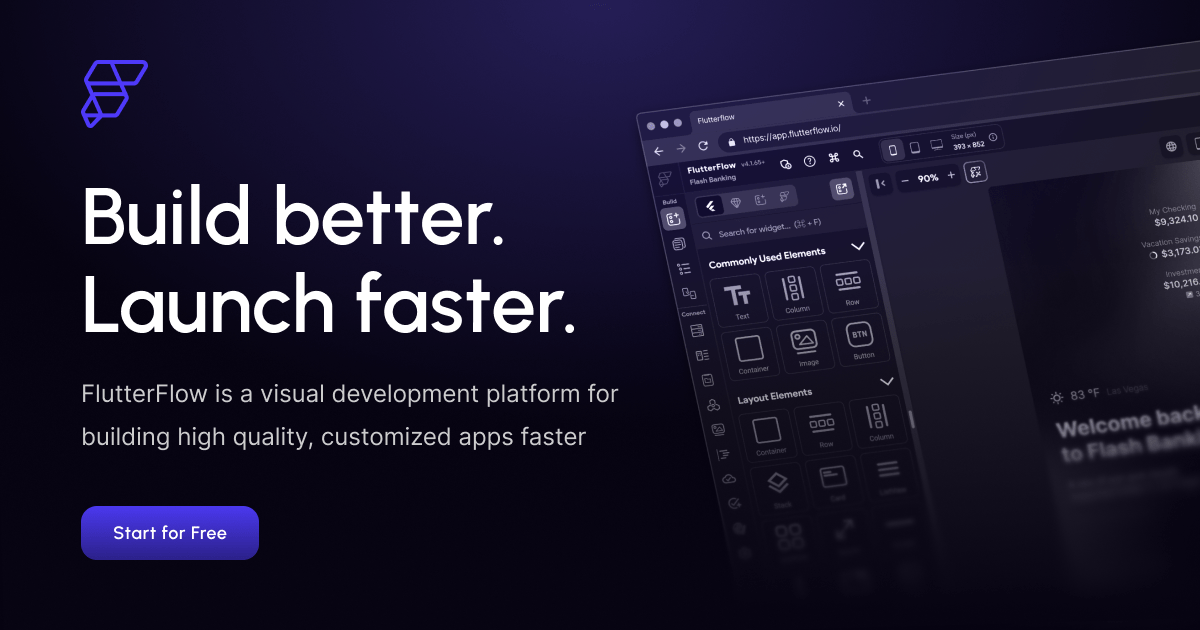
FlutterFlow is a visual builder for Flutter, Google's toolkit for iOS and Android apps. You click a canvas, use AI Generation and AI Agents, export the code, and one-click deploy to the stores. The job versus Lovable is native mobile and desktop, on a canvas you drive.
Best for: Teams that need iOS and Android store builds and want a visual Flutter canvas more than a hosted React URL.
Key features:
- Visual Flutter builder with AI Generation and AI Agents on a counted quota.
- Code and Android package (APK) download, plus store deploy, from Basic.
- GitHub push and collaboration from Growth.
- Desktop targets sit on the same Flutter path.
Why we like it: Store deploy and a repo you can own are official paths. Lovable ships a web app.
Notable limitations:
- AI Generation is a counted request quota, not an open-ended chat agent.
- Code download starts at Basic. GitHub push starts at Growth. App Store plus repo ownership is a higher floor than Lovable's web publish.
Pricing:
- Free is $0, with 2 projects, 5 AI Generation requests for the lifetime of the account, and 0 AI Agents.
- Basic is $39 a month, with unlimited projects, code and APK download, store deploy, 50 AI requests a month, and 1 AI Agent.
- Growth is $80 for the first seat and $55 for the second, with GitHub, collaboration, 200 AI requests a month, and unlimited Agents.
- Business is $150 for the first seat and $85 for seats 2 through 5, with 500 AI requests a month.
- Enterprise is custom.
Cursor

Cursor is an IDE for a repo you already have, not a prompt-to-running-app publisher. The product is a coding agent for ambitious software. Agents work in a repo, a terminal, Slack, and GitHub pull requests. The trusted-by list is NVIDIA, Stripe, and Fortune 500 engineering.
Best for: People who already have a repository and can review a diff. Wrong next click if you can't open a repo.
Key features:
- A coding agent that works in the repo, the terminal, Slack, and GitHub pull requests.
- Hobby is free. Individual, Teams, and Enterprise sit above it.
- Lovable's docs list Cursor as a client that can drive Lovable from the editor. The useful sequence is Lovable, Bolt, or v0 first, then Cursor.
Why we like it: Once the app is a real repo, this is the editor that keeps shipping. It doesn't pretend to be the publisher.
Notable limitations:
- It won't publish a running product from a prompt for a non-dev.
- If nobody on the team can read a diff, stay on a hosted builder.
Pricing:
- Hobby is Free.
- Individual is $20 a month, covering Pro, with Pro+ and Ultra on the same page.
- Teams is $40 per user per month.
- Enterprise is custom.
One self-host pick if you want the builder on hardware you operate.
Tinykit
GitHub gem MIT self-host
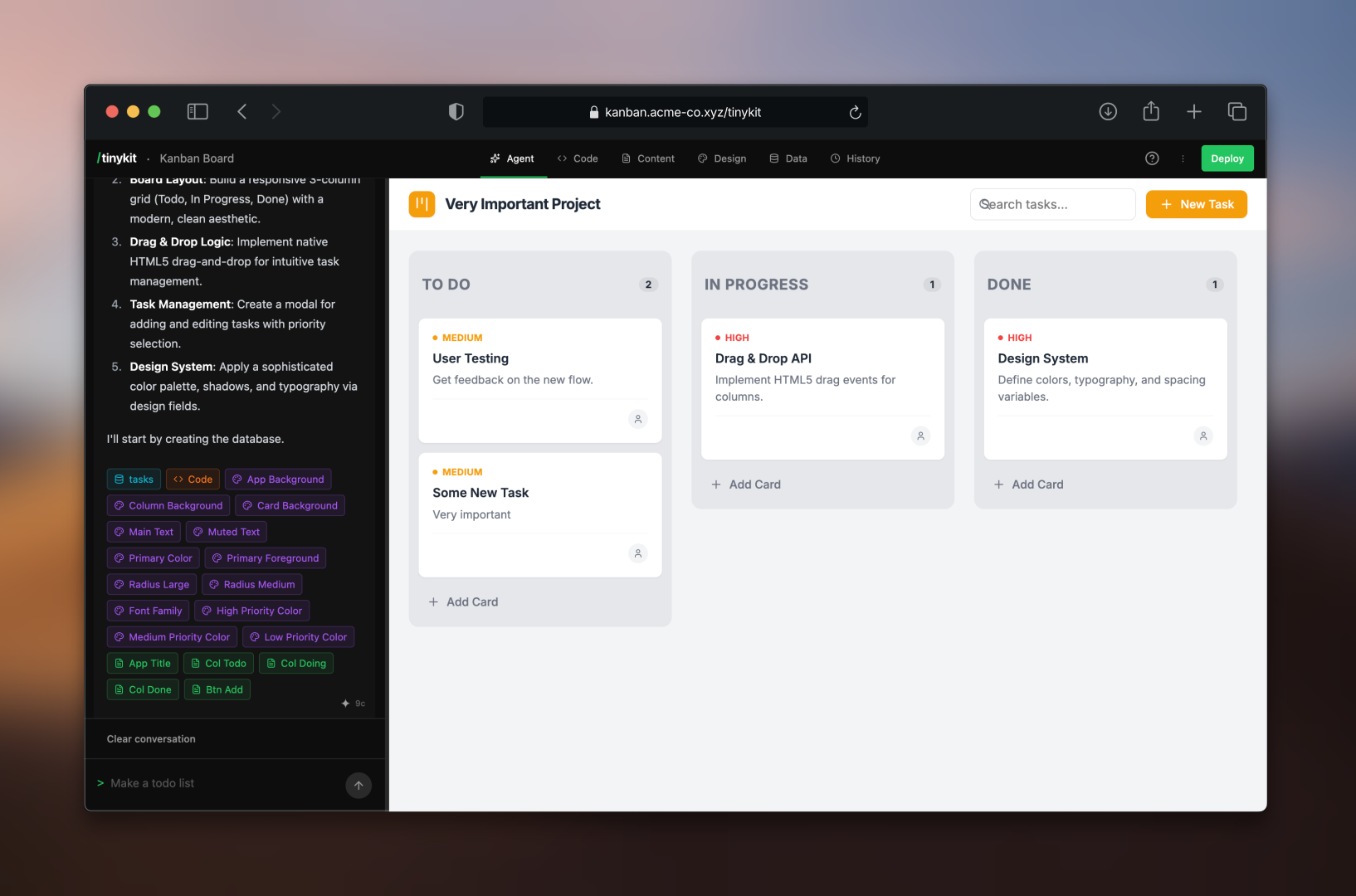
Tinykit is an open-source platform for building and deploying web apps with AI. Think Lovable, Replit, or v0, but self-hostable and self-contained. It manages code, database, content, and deployment under the hood. It is early alpha, best suited for personal utility tools, small business apps that store records, and internal tools.
Best for: A founder who wants to run the builder on a box they operate, for personal tools and internal apps.
Key features:
- Self-hostable builder that manages code, database, content, and deployment.
- Positioned against hosted prompt-to-app tools, on hardware you run.
- MIT license. The MIT repo is what you install.
Why we like it: You keep the prompt-to-app habit and you keep the builder, a real third path if hosted credits are the thing you hate.
Notable limitations:
- Early alpha. Auth is still listed as coming soon.
- A weak replacement for a public Lovable app. Treat it as personal tools and internal apps that store records.
Pricing: Self-host is Free under MIT. You pay the box it runs on.
Stay on Lovable or pick a lane
| If you need | Use |
|---|---|
| Chat to a published web app, with auth, a database, and unlimited collaborators on one bill | Stay Lovable |
| Already on Vercel, Next.js, and shadcn | v0 |
| A browser terminal and file tree, and tokens you expect to burn | Bolt.new |
| One hosted workspace that can also emit mobile or slides | Replit Agent |
| Built-in payments and auth, and you will pay for a private app | Base44 |
| The app on your GitHub, Supabase, and Vercel if you cancel | Softgen |
| Web and mobile from one prompt, and you will pay before building | Anything |
| iOS and Android stores on a visual Flutter canvas | FlutterFlow |
| A repo and a person who can review diffs | Cursor |
| The builder on a box you operate, for an internal tool | Tinykit |
Leave Lovable when you need the repo on a host you control, native store builds, or an IDE. Stay when the job is chat to a published web app and one shared credit pool for the whole workspace. Pro is $25 a month (100 credits) or $250 a year. Business is $50 a month or $500 a year, and it is the tier that stays out of model training by default. Free is 5 daily build credits, capped at 30 a month, with no custom domain and no code download. From 9 September 2026, Free and Pro customer data may be used for training unless you opt out.
Frequently asked questions
Does the credit pool also pay for hosting?
Yes. That is why a team that wants the repo on their own GitHub, Supabase, and Vercel treats a zip or a git sync as the exit test, not a nicer prompt.
Can I get a store build from the same chat window?
Not as a first-class Lovable job. Native iOS and Android need a mobile canvas or a hosted workspace that emits those targets. Stay if the product is a published web app.
Is the Vercel-native builder the same purchase?
Only if you already ship Next.js there. It is a component-and-app flow on that host, not an all-in-one credit pool with unlimited collaborators on one bill.
When do I move to an IDE?
When you have a repo and someone who can review diffs. The prompt tool got you software you would not have written. It is not a substitute for a reviewer.
 Written by StartupStash
Editorial team
StartupStash is an editorial team. Each Top Tools shortlist is researched by a writer who works in that category, then checked against first-party product pages and public prices before it goes live.
 Reviewed by Manaal
Content Manager, Startup Stash
Reads the shortlist, the priced claims, and the sourcing before a piece goes live.
How this page is checked
We read first-party product pages, dated changelogs, and AWS Marketplace when a listing exists. Catalog counts stay vendor claims.
