
Remote support tools look similar until you try to license a help desk. Some products are meant for employees connecting to their own computers. Others are designed for technicians connecting to someone else’s device, with session codes, elevation, recording, and audit logs. Attended support ends when the customer closes the lid. Unattended access stays on the device. Mixing an employee remote-work plan with a technician license is how a desk pays for the wrong product.
The billing unit is the other trap. Some vendors charge concurrent technicians. Others charge named users, channels, or simultaneous connections. Unattended computers are often a second pool. Privileged-access sessions (approvals, recording, an on-prem appliance) are usually a different product from everyday help desk remote. Before you compare prices, write down how many technicians need to be connected at the same time, how many unattended devices you support, and whether the session needs those controls. The method is on How we review tools.
If the brand is already on the user’s PC, start with TeamViewer: technicians are licensed users and channels, and Tensor is the enterprise quote. If sessions need approvals, recording, and an on-prem appliance, BeyondTrust Remote Support is that path. If you want a public concurrent-technician price this afternoon, Splashtop is the usual shortlist. If latency is why you are switching and you will count connections rather than technicians, AnyDesk lists annual prices.
What usually goes wrong when licensing remote support
Most bad fits start with buying an employee laptop plan for a help desk, or counting headcount when the vendor bills concurrent sessions.
| Problem | Solution |
|---|---|
| The license unit is not the one in your model | Write concurrent technician, named user, channel, or connection |
| Unattended computers are billed separately | Ask whether unattended access is included in the technician license |
| A privileged-access session is a different product | Confirm whether you need approval, recording, and an on-prem appliance |
| The public price is a different remote-access plan | Read the help desk plan, not the employee laptop plan |
How we evaluated remote support tools
Four checks: the license unit (concurrent technician, named user, channel, or connection), whether unattended computers are a second pool, whether any price is public, and whether the session can run with privileged-access controls or an appliance. Marketing “fastest remote desktop” claims did not move a ranking. Neighbor products sit under Other remote support tools worth considering.
TL;DR: The 10 Compared
| Tool | Best for | What to check |
|---|---|---|
| TeamViewer | The familiar brand, if you will pay annual channels or open a Tensor quote |
How pricing worksLicensed users and channels. Only the expert needs a license. Remote Access is self-access
PriceRemote Access from $24.90 / month billed annually. Business, Premium, and Corporate sit above it. Tensor is quote-only
Watch-outRemote Access is self-access. Do not buy it for a help desk
|
| BeyondTrust | Sessions that need privileged-access controls: concurrent reps, audit, on-prem appliance |
How pricing worksConcurrent representatives, not endpoints. Extended availability can consume a second license
PriceQuote-only. Cloud, B-Series appliance, or virtual appliance
Watch-outThird-party per-rep-year figures are not a list price. Do not budget a per-endpoint rate
|
| Splashtop | Help desks that want a public concurrent-technician price for attended plus unattended |
How pricing worksConcurrent technician. Attended via code is unlimited. Unattended is 10 or 300 computers per license
Price$259 a year (10 unattended) or $399 (300)
Watch-outA $6 remote-work plan exists. Do not budget it for a help desk
|
| AnyDesk | A fast session and a public annual table, if you will count connections before seats |
How pricing worksAnnual connections. Solo is one user, one outgoing connection. Standard starts at one connection
PriceSolo $28.90, Standard $49.90, Advanced $111.90 per month billed annually
Watch-outThe monthly-equivalent price is due as a year in full. Standard is one connection
|
| ConnectWise ScreenConnect | Help desks that want a public concurrent-technician price and already live in ConnectWise |
How pricing worksConcurrent technician. One / Standard / Premium
PriceOne $30, Standard $45, Premium $55 / month billed annually per concurrent tech
Watch-outPrivileged Access is a separate add-on. One is a single-session plan
|
| Zoho Assist | A solo admin who wants a named free plan, or a shop already on Zoho |
How pricing worksNamed user. Free cap is 1 tech / 5 unattended
PriceFree plan listed. Paid: check at checkout
Watch-outThe free plan is one technician. A multi-tech desk needs a paid plan
|
| LogMeIn Rescue | Desks that already run Rescue and need pin-code technician support |
How pricing worksTechnician seat. Quote-only
PriceQuote-only
Watch-outNot a public concurrent-technician price
|
| RustDesk | Teams that will host their own relay and want a listed Pro console price |
How pricing worksSelf-hosted client. Optional Pro console
PricePro from $11.88 / month billed annually
Watch-outYou still run the relay
|
| ISL Online | Desks that want self-hosted or EU-hosted concurrent sessions and will take a quote |
How pricing worksConcurrent sessions. Cloud or self-hosted
PriceQuote-only
Watch-outSelf-hosted is a different commercial path than cloud
|
| Chrome Remote Desktop | A single admin who will accept a Google account and a PIN |
How pricing worksGoogle account. No help desk plan
PriceFree. No commercial license
Watch-outNot a concurrent-technician product
|
TeamViewer
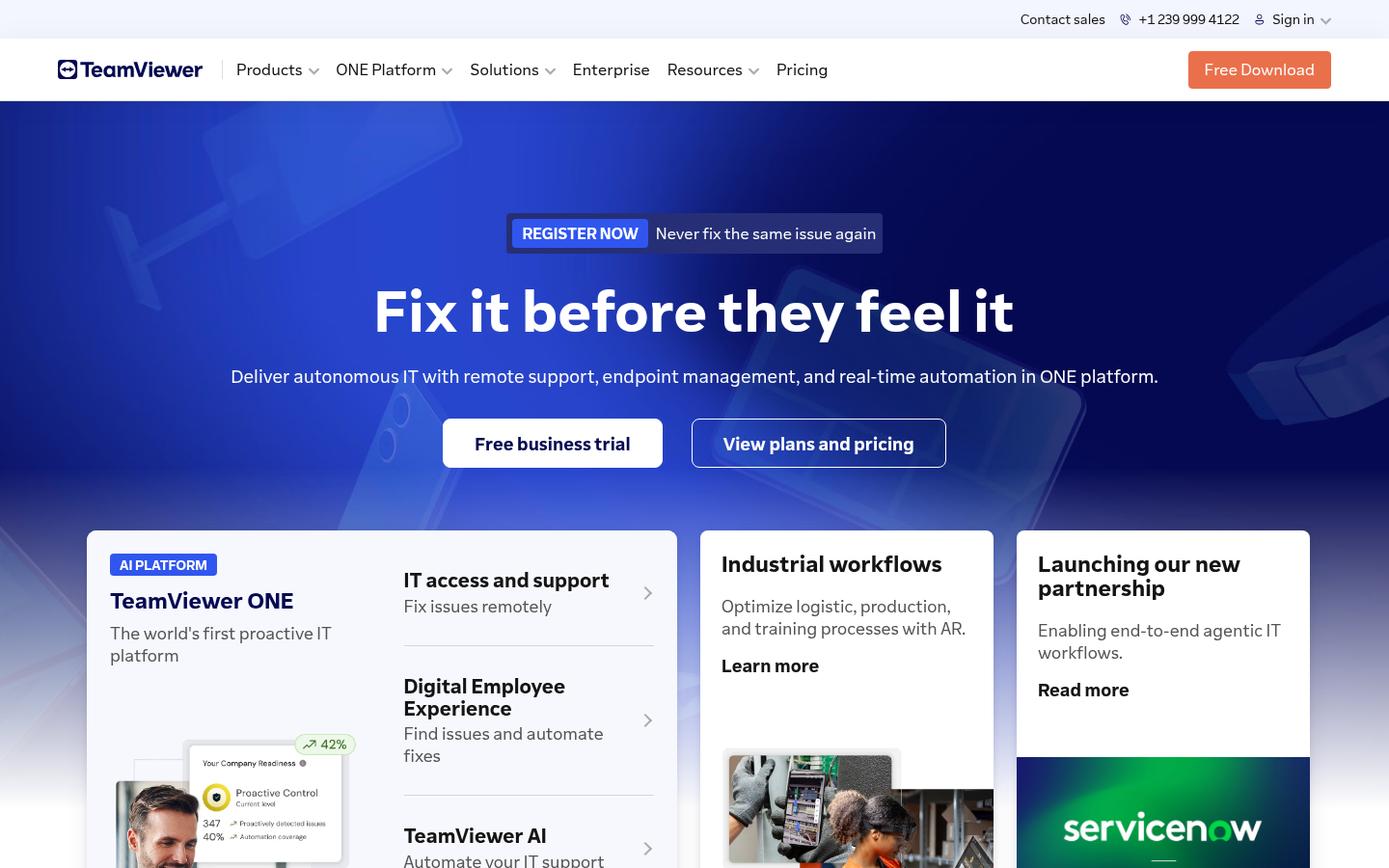
TeamViewer is still the name a user already has installed. You buy licensed users and channels, billed annually. Only the expert needs a license. Remote Access, Business, Premium, and Corporate are the self-serve ladder. Tensor is the enterprise cloud: single sign-on, an audit API, conditional access, US-restricted regions, and agentless SSH, VNC, and RDP. Remote Access is self-access. It is the laptop plan, not a twenty-person help desk.
If ServiceNow is already the ticket system, you do not need to switch vendors just to get a ticket-system button. Add-ons (asset management, endpoint protection, monitoring, mobile device management) stack on the base license, so the sticker is not the bill. Tensor is quote-only. Annual subscriptions auto-renew; cancel in writing with 28 days’ notice, and budget the year.
Best for: Help desks that already use it and will pay for channels or a Tensor quote.
What you get:
- Attended and unattended access across Windows, macOS, Linux, mobile, and a long IoT/OT tail on Tensor.
- AI troubleshooting and session summaries, plus a device-experience add-on on Remote and Tensor.
- Tensor: single sign-on, conditional access, agentless access, US regional lock-in, Intune unattended.
- A public Remote ladder you can start on, then a Tensor quote if the desk outgrows it.
Why we like it: You can start on the public Remote ladder and grow into Tensor without switching vendors. Other tools on this page are either a self-serve help desk plan or a quote-only privileged-access platform, not both. The catch is buying Remote Access for a help desk. That is the laptop license.
Limits:
- Add-ons stack on the base license. The sticker is not the bill.
- Tensor is quote-only.
- Annual auto-renew, 28-day written cancel. Budget the year.
- Remote Access is self-access. Buying it for a 20-person help desk is the wrong plan.
Price: Remote Access is $24.90 per month billed annually and is self-access. Business, Premium, and Corporate sit above it. Tensor is quote-only.
BeyondTrust
BeyondTrust Remote Support is the Bomgar line: a representative console, a session that can punch through a customer firewall, and a license that counts concurrent reps, not endpoints. Cloud, B-Series appliance, or virtual appliance. Extended availability mode consumes a second license if you leave a rep “available” while they are not in the console.
Choose it when remote support is a privileged path. Session recordings, approvals, vaulted credentials, and the rest of the BeyondTrust privileged-access family are in the same vendor group. There is no public list price. Third-party per-rep-year figures are not a vendor list price.
Best for: Support sessions that need approvals, recording, and an on-prem appliance.
What you get:
- Concurrent-representative licensing. Create as many accounts as you want; the cap is who is logged into the console at once.
- Cloud or on-prem (B-Series / virtual appliance). Chat-only license packs exist on subscription appliances.
- Attended, unattended, and mobile. Jump through customer networks you do not control.
- Same vendor family as Privileged Remote Access and Password Safe, if that is the next purchase.
Why we like it: Security teams treat this as an access product, not a remote-desktop download. If the RFP says session recording, approval, and no standing admin, start here rather than stretching a public concurrent-technician plan.
Limits:
- Quote-only. There is no list rate you can put in a mid-market budget.
- Extended availability burns licenses. Count that before you copy last year’s rep number.
- Overkill if the work is a five-person MSP fixing a home printer.
- Implementation is a project. The console is not a self-serve download.
Price: Quote-only. Custom, concurrent representatives. Do not budget a per-endpoint rate; that is not how Remote Support is sold.
Splashtop
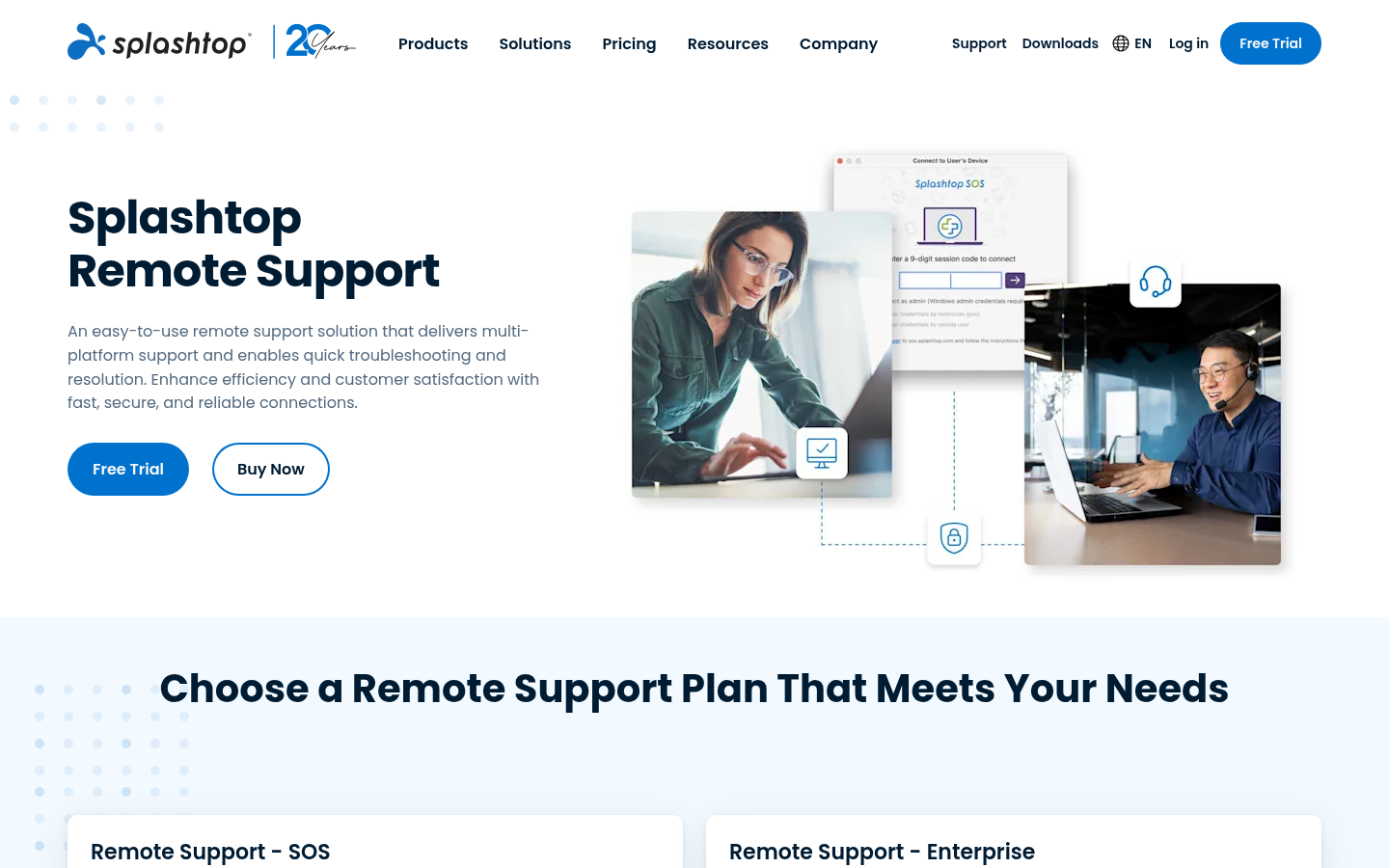
Splashtop Remote Support (SOS) is the help desk plan you can price without a sales call. You buy concurrent technicians. Attended sessions via a code are unlimited. Unattended computers are a second limit: 10 or 300 per license, stacking to 1,200. A $6 remote-work plan exists. It is not this product.
Enterprise is quote: single sign-on, IP allow lists, SIEM, APIs, unattended Android, more than 1,200 devices. Endpoint management, AR, and Connector (agentless RDP/SSH) are add-ons. A ten-person desk with four simultaneous sessions buys four licenses.
Best for: Help desks that want a public concurrent-technician price for attended plus unattended.
What you get:
- Concurrent tech licenses. A ten-person desk with four simultaneous sessions buys four licenses.
- Session code for attended. Persistent unattended on the 10 or 300 pool.
- Reboot-and-reconnect, elevate past Windows prompts, file transfer, session recording, up to three techs in one session.
- Enterprise adds SSO, granular ACL, cloud recording, service desk, APIs.
Why we like it: You can put a concurrent-technician price in a budget without a sales call, and the 10-computer rung versus the 300-computer rung is a real fork. That is the practical split versus quote-only privileged-access tools on this page.
Limits:
- SOS does not include Tensor-class or BeyondTrust-class controls. SSO and SIEM are Enterprise.
- 1,200 managed-computer ceiling on SOS. Past that, you are on the quote.
- Remote Access (Solo / Pro / Performance) is a different product. Do not buy it for help desk work.
- Confirm the live SOS amount at checkout.
Price: Concurrent-technician SOS starts at $259 a year (10 unattended) or $399 (300). Enterprise is quote. Do not budget the $6 remote-work plan for a help desk.
AnyDesk
AnyDesk sells speed and a small client. You buy annual connections, not technician seats. Solo, Standard, Advanced, and Ultimate. All commercial plans are billed annually; the site shows monthly equivalents. Standard starts with one connection. Advanced starts with two. Ultimate is quote, including on-prem.
Standard is 20 users and 500 unattended devices. Advanced is 100 users, 1,000 devices, Windows installer, command line, Group Policy, and live phone support. Solo is one user, one outgoing connection. That is not a help desk plan. Extra connections on Standard and Advanced bill annually.
Best for: Teams that care about session speed and will count connections, not seats.
What you get:
- Cross-platform remote desktop. Custom-branded client on Standard and up.
- Unattended device pools: 100 / 500 / 1,000 by tier.
- Connection add-ons billed annually, so a three-tech desk can count them before it pays.
- Advanced: mass deploy, Group Policy, phone support.
Why we like it: You can count outgoing connections before you pay, and the small client is why teams switch when latency is the complaint. Splashtop and ScreenConnect count technicians; AnyDesk counts outgoing connections.
Limits:
- Annual prepaid. The monthly-equivalent price is due as a year in full.
- Standard starts with one concurrent connection. A three-tech desk that works at the same time is already buying add-ons.
- Ultimate on-prem is a different conversation. Do not assume Standard can go on-prem.
Price: Solo $28.90, Standard $49.90, Advanced $111.90 per month billed annually. Ultimate is quote. Taxes extra.
ConnectWise ScreenConnect

ConnectWise ScreenConnect is a concurrent-technician remote support product for help desks. One is a single-session plan with 10 unattended agents. Standard and Premium bill per concurrent technician, with three sessions and unlimited unattended. If ConnectWise is already the ticket system, this is the help desk remote tool that sits next to it.
Privileged Access is a separate add-on, so the base plan is everyday support, not an appliance. Standard and Premium include Backstage, session recording, and PSA integrations. On-prem is a different quote. One is not a multi-tech help desk license.
Best for: Help desks that want a public concurrent-technician price and already live in ConnectWise.
What you get:
- Concurrent-technician licenses with a public One / Standard / Premium table.
- Unattended agents: 10 on One, unlimited on Standard and Premium.
- Backstage, session recording, and ConnectWise ticket integrations on Standard and Premium.
- Privileged Access as a separate add-on, not inside the base help desk plan.
Why we like it: You get a public concurrent-technician price and a ConnectWise PSA fit in the same product. Splashtop also lists concurrent-technician prices; ScreenConnect is the one that already lives next to ConnectWise tickets.
Limits:
- Privileged Access is an add-on, not the base help desk plan.
- On-prem is a different quote.
- One is a single-session plan with 10 unattended agents. Do not treat it as a multi-tech help desk license.
Price: One is $30 per month billed annually. Standard is $45 per concurrent technician. Premium is $55.
Zoho Assist

Zoho Assist is Zoho’s remote support and unattended-access product. There is a free plan for one technician, five unattended computers, and one concurrent session. Paid Standard, Professional, and Enterprise seats exist; the amount shows at checkout.
Licensing is named-user. The free cap is one technician, so a multi-tech desk will be on a paid plan. It is not a privileged-access appliance. For a solo admin, or a shop already in Zoho, the named free plan is a real starting point.
Best for: A solo admin who wants a named free plan, or a shop already on Zoho.
What you get:
- Remote support plus unattended access on the same product.
- Free plan: 1 technician, 5 unattended computers, 1 concurrent session.
- Paid Standard / Professional / Enterprise seats at checkout.
- Named-user licensing, not a public concurrent-technician table.
Why we like it: The named free plan lets a solo admin start without a quote. That is the practical split versus Splashtop’s concurrent-technician floor and versus Chrome Remote Desktop, which is free but is not a help desk product.
Limits:
- Paid amounts show at checkout. Read the live price before you budget a paid seat.
- Not a privileged-access appliance.
- The free plan is one technician. It will not cover a multi-tech desk.
Price: Free for 1 technician, 5 unattended computers, and 1 session. Paid seats: check Standard / Professional / Enterprise at checkout.
LogMeIn Rescue

LogMeIn Rescue is a high-touch remote support product: a technician console, mobile support, and a pin-code session. Pricing is quote-only. Do not treat a third-party technician amount as a list rate.
Mobile and unattended paths are on the product. Rescue bills a technician seat, not a public concurrent-technician table. It is the path for desks that already run pin-code sessions here and need to stay, not the starting point if you need a public price this afternoon.
Best for: Desks that already run Rescue and need pin-code technician support.
What you get:
- Technician-led remote support with a pin-code session.
- Mobile and unattended paths on the product.
- A technician seat sold on a quote, with no list rate.
- A high-touch console aimed at support orgs that already live in Rescue.
Why we like it: Pin-code, technician-led sessions are the workflow desks already on Rescue actually run. If that is your queue, switching to a public concurrent-technician plan just to see a number is usually more expensive than the quote.
Limits:
- No list rate.
- Wrong as a first comparison if you need a public concurrent-technician price.
Price: Quote-only.
RustDesk

RustDesk is the open-source remote desktop you can self-host. The client is free and does not require an account for basic use. RustDesk Server Pro is the commercial console, from $11.88 per month when billed annually.
You still run the relay. That is the trade versus a hosted help desk. Pro is a console, not a BeyondTrust appliance. Choose it when you want the session path on infrastructure you control, and you will operate that host.
Best for: Teams that will host their own relay and want a listed Pro console price.
What you get:
- An open-source client you can self-host, with no account required for the basic client.
- An optional RustDesk Server Pro console.
- A listed Pro price from $11.88 / month when billed annually.
- Self-hosted relay operation as part of the deployment, not a hosted SaaS session path.
Why we like it: You can self-host the relay and still buy a listed Pro console, instead of sending every session through a vendor cloud. That is the split versus Splashtop or ScreenConnect, and it is not a substitute for BeyondTrust’s appliance and audit model.
Limits:
- Self-hosting is the work. You still run the relay.
- Pro is a console, not a BeyondTrust appliance.
- Confirm the live Pro amount at checkout.
Price: Client is free. Server Pro from $11.88 / month billed annually.
ISL Online

ISL Online is a concurrent-session remote support product with cloud and self-hosted options, including EU hosting. Commercial pricing is a quote.
It is everyday help desk remote, not a privileged-access appliance. Self-hosted and cloud are different commercial paths. Choose it when you need concurrent sessions on a host you control or in the EU, and you will take a quote.
Best for: Desks that want self-hosted or EU-hosted concurrent sessions and will take a quote.
What you get:
- Concurrent remote support sessions.
- Cloud or self-hosted deployment, including an EU-hosted path.
- A quote-led commercial path rather than a public concurrent-technician table.
- Everyday help desk remote, not a privileged-access appliance.
Why we like it: You can run concurrent sessions in the cloud or self-hosted, including in the EU, without buying a privileged-access platform. RustDesk is the open-source self-host path; ISL Online is the concurrent-session product sold for that same hosting question.
Limits:
- No list rate you can treat as a checkout price.
- Not a privileged-access appliance.
- Self-hosted is a different commercial path than cloud. Get that on the quote.
Price: Quote-only.
Chrome Remote Desktop

Chrome Remote Desktop is Google’s free remote-access client in Chrome. You sign in with a Google account and a PIN. There is no commercial help desk license, no concurrent-technician plan, and no unattended MSP product.
It is free remote access, not a help desk platform. There is no audit pack or named technician license. Use it when a single admin will accept a Google account and a PIN. If you need session codes, elevation logs, and concurrent technician billing, pick one of the licensed tools above.
Best for: A single admin who will accept a Google account and a PIN.
What you get:
- Free remote access in Chrome.
- A Google account plus a PIN.
- No commercial concurrent-technician plan, audit pack, or unattended MSP license.
- A personal remote-access path, not a help desk product.
Why we like it: It is free Google-account remote access when that is actually the need. Zoho Assist’s free plan is the help desk-shaped $0 option; Chrome Remote Desktop is the Google PIN option, and it is not a substitute for TeamViewer or Splashtop.
Limits:
- No help desk license, audit pack, or concurrent-technician billing.
- Wrong if you need a named technician plan.
Price: Free. No commercial license.
If the same desk also owns the on-call queue, start with incident management tools.
Do sessions need privileged-access controls, and is technician pricing public?
This grid plots two questions. Across is whether technician or connection pricing is public: a public price on the left, a quote or appliance on the right. Up is the session: privileged-access controls at the top, everyday help desk at the bottom.


 Concurrent tech or connections
 Tensor is contact us
Placement is privileged-access versus everyday help desk, and a public technician price versus a quote. TeamViewer sits on the quote side because Remote Access at $24.90 is self-access, and Tensor is contact-us. Placement only, not review scores.
How you are billed, side by side
| Tool | How pricing works | Wrong product |
|---|---|---|
| TeamViewer | Licensed users and channels, billed annually. Remote Access $24.90 / month billed annually | Remote Access is self-access. A help desk that buys it for twenty people bought a laptop license |
| BeyondTrust | Concurrent representatives. Quote-only | A per-endpoint rate. That is not how Remote Support is sold |
| Splashtop | Concurrent tech, billed annually at $259 (10 computers) or $399 (300) | Remote Work Solo from $6. That plan is not SOS |
| AnyDesk | Solo $28.90, Standard $49.90, Advanced $111.90 per month billed annually. Extra connections $29.90 | Solo is one outgoing connection. It is not a three-tech desk |
| ConnectWise ScreenConnect | One $30, Standard $45, Premium $55 / month billed annually per concurrent tech. Month-to-month Standard $59, Premium $69 | Do not treat One as a multi-tech help desk plan |
| Zoho Assist | Free plan is listed. Paid plans: check at checkout | Do not take a paid seat from a reseller blog |
| LogMeIn Rescue | Quote-only | Do not paste a third-party technician dollar |
| RustDesk | Pro from $11.88 / month billed annually | Client is free. Hosting is yours |
| ISL Online | Quote-only | Self-hosted is a different commercial path |
| Chrome Remote Desktop | Free. No commercial license | It is not a help desk license |
Other remote support tools worth considering
Help desk neighbors that belong in a different comparison: an AR overlay, a stack-specific remote, a quote-led product with no public concurrent-tech price to compare, or lab VNC.
- Electric, ShowMyPC, and the AR-only tools (Help Lightning, SightCall, XMReality) - A different product. Remote support here is a session you can elevate and close, not an AR overlay or a consumer share link.
- Dameware / SolarWinds Remote Support - Right if you already live in that stack. This page focuses on products with a public concurrent-technician price or a privileged-access path.
- GoTo Resolve - A help desk remote product sold on a quote. It is not on this comparison because there is no public concurrent-tech price to compare.
- TightVNC and MeshCentral - Open-source remote access. Fine in a lab. Not a licensed help desk product.
Questions before you sign a remote-support contract
If the billing unit is not in writing, you are still buying a laptop license.
- Is this remote support or remote access? Remote access is you on your own PC. Remote support is you on someone else’s, with a session code, elevate, and a log. Mixing them is how a help desk buys a self-access plan.
- How are you billed? Concurrent technicians, concurrent representatives, licensed users and channels, and annual connections are different units. Count simultaneous sessions, then read the price.
- Do sessions need privileged-access controls? Recorded approval, a customer network you do not own, and an appliance are a quote. A public concurrent-technician price is everyday help desk remote.
Which remote support tool should you pick
The familiar brand, knowing Remote Access is the laptop plan and Tensor is the quote: TeamViewer. Privileged path, concurrent reps, appliance: BeyondTrust. A number you can put in a budget this afternoon: Splashtop. Latency and a public connection table: AnyDesk, and count outgoing connections before you call Solo a help desk plan. ConnectWise already in the building: ScreenConnect. Solo admin: Zoho Assist free, or Chrome Remote Desktop if a PIN is enough. Self-hosted open source: RustDesk. Incumbent high-touch: LogMeIn Rescue, quote. EU-hosted or self-hosted concurrent sessions: ISL Online, quote. Then count how many sessions you run at 10 a.m.
Frequently asked questions
Is remote support the same purchase as remote access?
No. Remote access is you on your own PC. Remote support is you on someone else’s machine, with a session code, elevate, and a log. TeamViewer Remote Access and Splashtop Solo are the first. SOS, Tensor, BeyondTrust Remote Support, and ScreenConnect Support are the second. Attended ends when the customer closes the lid. Unattended is the plan that stays.
Do I need BeyondTrust if Splashtop already lists $259 or $399?
Only if the session is a privileged path: customer networks you do not own, recorded approval, an appliance, a privileged-access story. A 12-person internal desk with 80 laptops is a public concurrent-technician purchase. BeyondTrust stays quote-only and bills concurrent representatives, not endpoints.
How does AnyDesk bill, and is Standard enough for three technicians?
AnyDesk bills annually, and Standard starts with one outgoing connection, so a three-tech desk working at once is already buying add-ons. The published rates sit in AnyDesk’s Price section. The monthly-equivalent number is due as a year in full.