Most teams discover their agent infrastructure is not production ready during a messy rollout to the first business unit, not from a neat internal proof of concept. From our experience in the startup ecosystem, the biggest pitfalls show up around three nuts-and-bolts details: policy-enforced tool access via MCP, end-to-end audit trails across agents and tools, and multi-tenant cost controls with request tracing. You think you know your stack until the first red-team run exposes prompt injection on a third-party MCP server and no one can prove who did what. Agent infrastructure is now a board topic as adoption accelerates, with Gartner forecasting that 40% of enterprise apps will ship with task-specific agents by 2026, up from less than 5% in 2025 (Gartner press release).
For market context, IDC projects AI infrastructure spending to reach $758 billion by 2029, with over 84% in cloud environments (IDC Worldwide AI Infrastructure Tracker). In this guide you will learn where these platforms differ on MCP governance, auditability, deployment models including air-gapped options, and what to budget, based on verified third-party sources.
TrueFoundry AI Gateway
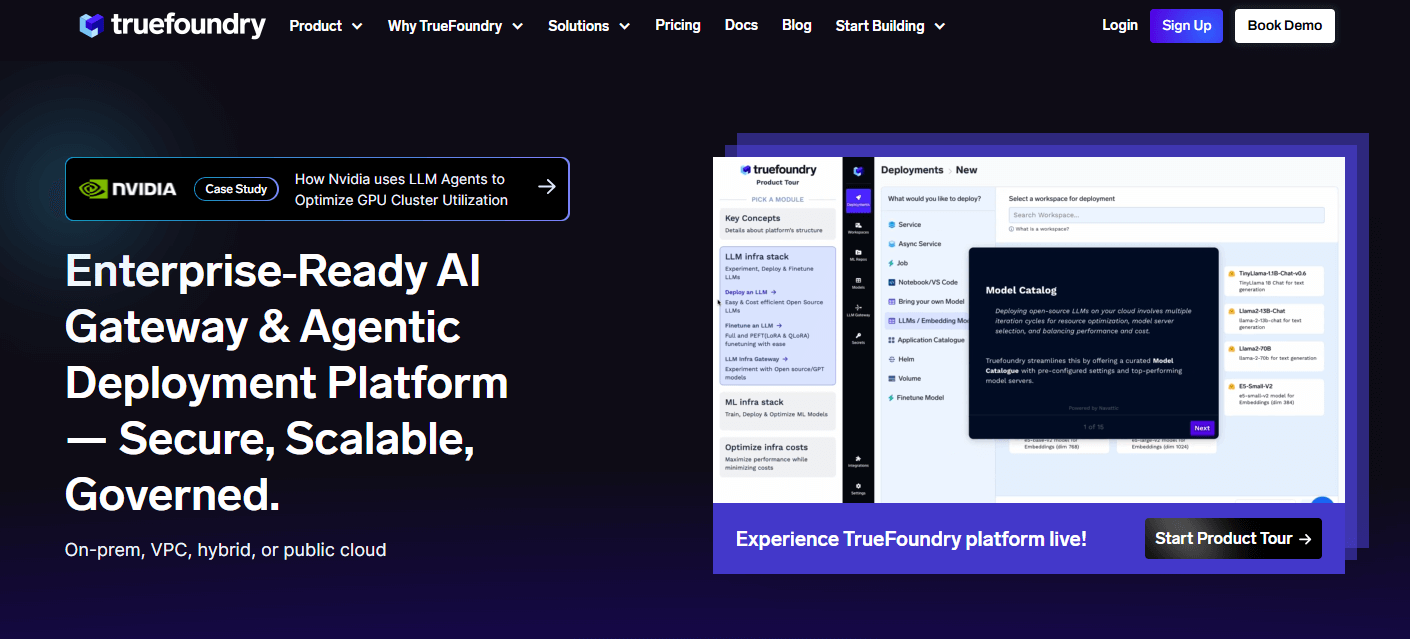
A unified control plane for LLM and agent traffic with native MCP support. Focused on governance, observability, and policy controls for enterprise agent workloads.
Best for: Platform teams that need centralized routing, RBAC, and audit across models, tools, and MCP servers.
Key Features:
- Unified LLM and MCP gateway with central auth and RBAC, per vendor documentation
- Request tracing, latency and error metrics, plus log inspection for debugging, per vendor documentation
- Guardrail hooks and budget controls, per vendor documentation
- SaaS, VPC, and on-prem deployment options, per vendor documentation
- Kubernetes-native operations for enterprise fit, as noted in a funding profile by TechCrunch
Why we like it: The gateway pattern reduces one-off integrations and centralizes risk controls. In practice it helps platform teams move faster on model trials while keeping finance and security in the loop.
Notable Limitations:
- Some users cite a learning curve on advanced features and concerns about pricing for smaller teams, based on summaries on G2.
- Initial setup can be complex for certain environments, also reflected on G2.
Pricing:
- Public SaaS tiers listed on G2 show Developer Free, Pro at $499 per month for 10 users, and Pro Plus at $2,999 per month for 25 users.
- An Enterprise private offer on AWS Marketplace lists $100,000 for 12 months for up to 10 developers.
- Contact TrueFoundry for a custom quote for VPC or on-prem deployments.
Trinity by Ability.ai
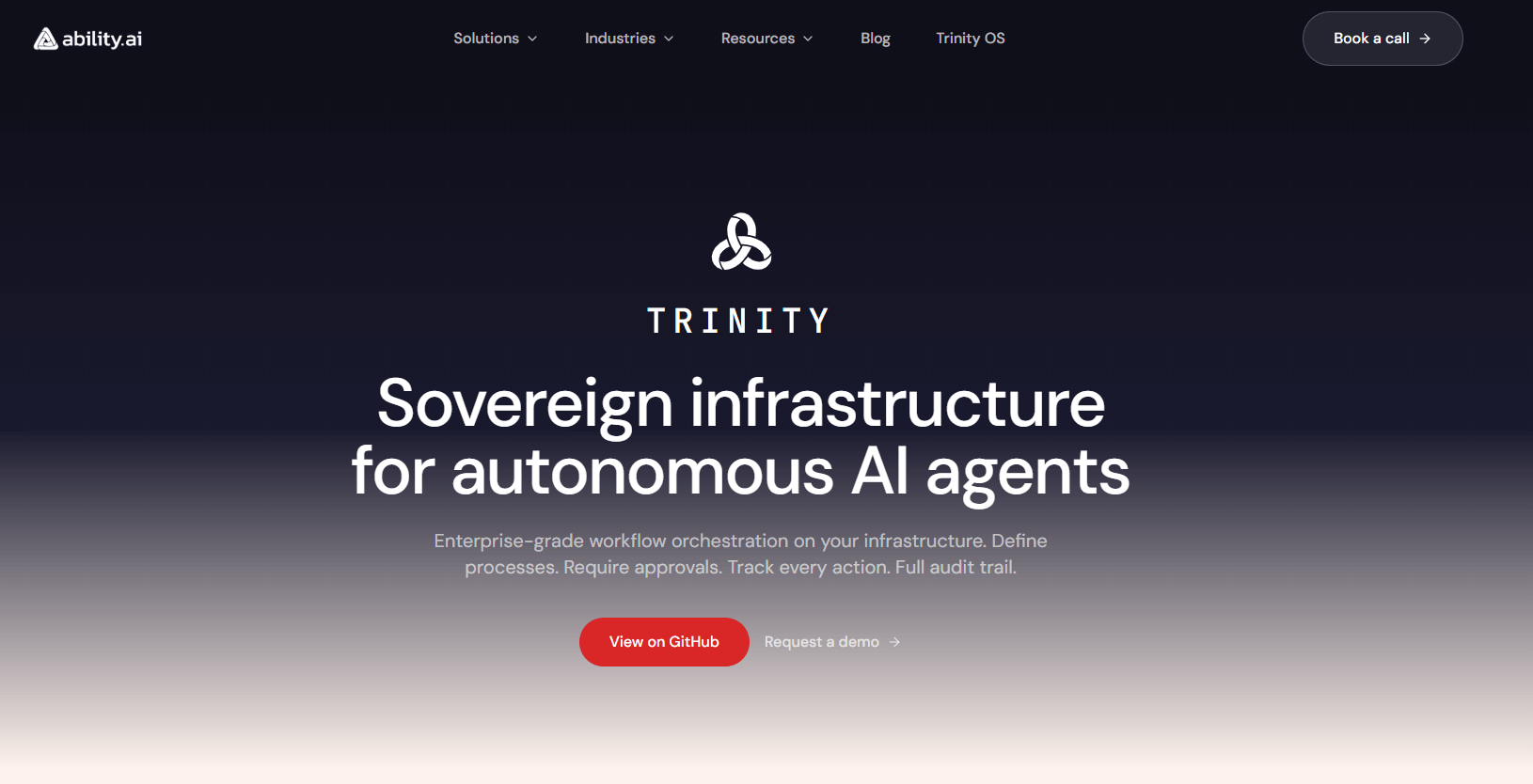
A sovereign, on-your-infrastructure platform for autonomous agents with approvals, audit trails, and multi-agent orchestration.
Best for: Security-sensitive organizations that want visual orchestration, approval gates, and full auditability inside their perimeter.
Key Features:
- Multi-agent orchestration graph with real-time status, per vendor documentation
- Declarative workflow editor with approvals, retries, and branching, per vendor documentation
- Timeline and replay for investigations, per vendor documentation
- Built-in agent terminal for live sessions, per vendor documentation
- Full action audit trail, per vendor documentation
Why we like it: Trinity leans into process and approvals, which matches how regulated teams move agents from pilot to production without losing control.
Notable Limitations:
- Limited third-party reviews or analyst coverage as of early 2026.
- Open-source core plus enterprise features may require in-house engineering capacity to operate at scale, based on available public information.
Pricing: Pricing not publicly available. Contact Ability.ai for a custom quote.
Agentfield Control Plane
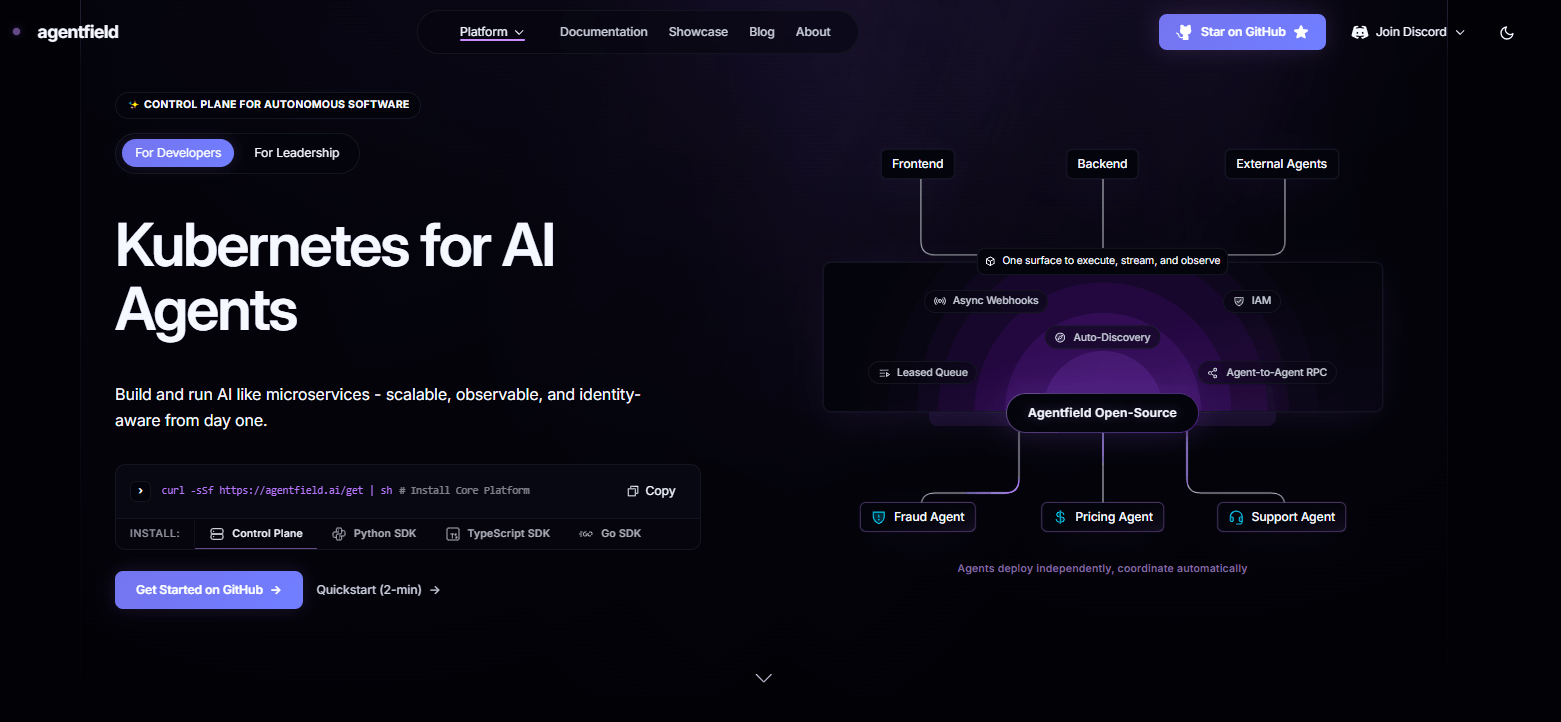
A control plane that treats agents like microservices, adding cryptographic identity and verifiable credentials to every execution for tamper-proof audit.
Best for: Engineering teams that want agents deployed as APIs with built-in identity, audit, and secure agent-to-agent communication.
Key Features:
- Agents as microservices with autogenerated endpoints and OpenAPI, per vendor documentation
- Cryptographic DIDs for each agent and verifiable credentials per execution, per vendor documentation
- Secure agent-to-agent calls with identity checks and signed records, per vendor documentation
- Event-driven coordination and shared memory, per vendor documentation
Why we like it: The focus on cryptographic proof addresses a common gap - logs are not enough once agents make consequential decisions.
Notable Limitations:
- Early-stage ecosystem with few public customer references and no major third-party review listings as of early 2026.
- Operating model may require deeper platform engineering compared to managed offerings, based on available public information.
Pricing: Pricing not publicly available. Contact Agentfield for a custom quote or support plan.
Ciroos AI SRE Teammate

A multi-agent AI platform aimed at SRE and ITOps teams to investigate, triage, and remediate incidents faster.
Best for: SRE, DevOps, and ITOps groups that need cross-domain investigations with human in the loop and strong collaboration patterns.
Key Features:
- Multi-agent investigations across telemetry sources, per company descriptions in Business Insider
- Focus on cross-domain correlation and anomaly detection for faster root cause, per Constellation Research coverage
- Analyst recognition on the 2025 Constellation ShortList for Observability, per Constellation Research
Why we like it: It addresses SRE toil with opinionated workflows, which is where many general-purpose agent platforms struggle.
Notable Limitations:
- Young product category with limited independent customer reviews as of early 2026.
- Scope is SRE-centric, so broader enterprise automation may require complementary tooling, based on available public information.
Pricing: Pricing not publicly available. The company announced a $21 million seed round to scale enterprise deployments, per GlobeNewswire. Contact Ciroos for a custom quote.
Agent Infrastructure Tools Comparison: Quick Overview
| Tool | Best For | Pricing Model | Highlights |
|---|---|---|---|
| TrueFoundry AI Gateway | Platform teams needing centralized policy, routing, and audit | SaaS tiers (includes free Developer tier per G2), enterprise contracts | Unified LLM and MCP gateway, strong observability, enterprise deployments |
| Trinity by Ability.ai | Regulated or security-sensitive teams wanting sovereign deployments | Custom enterprise support (open-source core per vendor) | Visual orchestration, approvals, replay, audit trails |
| Agentfield Control Plane | Engineering orgs standardizing agents as microservices with cryptographic audit | Custom, not public | DIDs and verifiable credentials, secure agent-to-agent calls |
| Ciroos AI SRE Teammate | SRE, ITOps, DevOps teams focused on incident response | Custom enterprise | Multi-agent SRE investigations, analyst recognition |
Agent Infrastructure Platform Comparison: Key Features at a Glance
| Tool | Governance & RBAC | Observability & Replay | MCP Focus |
|---|---|---|---|
| TrueFoundry AI Gateway | Centralized RBAC and policy controls, per vendor documentation | Metrics, logs, tracing, request inspection, per vendor documentation | Native MCP gateway and registry, per vendor documentation |
| Trinity by Ability.ai | Approval gates, full audit trail, per vendor documentation | Timeline, replay of executions, per vendor documentation | Designed to run agent ecosystems, per vendor documentation |
| Agentfield Control Plane | Cryptographic identity and signed credentials, per vendor documentation | Tamper-proof audit artifacts, per vendor documentation | Oriented to secure agent-to-agent calls, per vendor documentation |
| Ciroos AI SRE Teammate | Human-in-the-loop workflows, per analyst coverage | SRE-grade investigation timelines, per analyst coverage | Integrates agents for investigations, per analyst coverage |
Agent Infrastructure Deployment Options
| Tool | Cloud / On-Prem | Air-Gapped | Integration Complexity |
|---|---|---|---|
| TrueFoundry AI Gateway | SaaS + on-prem available | Available in enterprise per vendor documentation | Moderate - central gateway pattern reduces app changes |
| Trinity by Ability.ai | On your infrastructure per vendor documentation | Vendor indicates support for perimeter-only deployments | Moderate - YAML workflows and visual editor help adoption |
| Agentfield Control Plane | Self-hosted first, on-prem supported | Likely feasible - vendor positions for sovereign setups | Higher - favors platform-engineering ownership |
| Ciroos AI SRE Teammate | Enterprise deployment | Not publicly specified | Moderate - depends on telemetry and ITSM integrations |
Agent Infrastructure Strategic Decision Framework
| Critical Question | Why It Matters | What to Evaluate | Red Flags |
|---|---|---|---|
| Do you need strict MCP governance today or in 12 months | MCP is becoming a de facto connector layer, adoption by major vendors is rising, which increases risk exposure (Forbes overview, The Verge coverage) | Central registry, auth models, approvals, tool allowlists, audit depth | No centralized MCP control, only ad hoc connectors |
| What audit standard satisfies your risk team | Logs alone are insufficient if agents make consequential decisions | Cryptographic proofs, replay, signed artifacts, retention policies | Only log exports, no signed records or replay |
| Where must agents run | Sovereign and air-gapped demand is growing, especially in public sector and regulated industries (ITPro citing Gartner) | On-prem and VPC options, migration paths, hardware footprint | SaaS only with no roadmap for private deployments |
| Who operates the platform | Teams underestimate the run cost of agent infra | Ops model, SRE toolchain fit, upgrade policy, SLAs | DIY cluster with no support, unclear SLAs |
Agent Infrastructure Solutions Comparison: Pricing & Capabilities Overview
| Organization Size | Recommended Setup | Monthly Cost | Annual Investment |
|---|---|---|---|
| Startup or small team | TrueFoundry Pro for gateway and policy baseline, or Trinity OSS for sovereign pilots | TrueFoundry Pro listed at $499 per month for 10 users on G2 | ~$6,000, excludes model and cloud costs |
| Mid-market with platform team | TrueFoundry Enterprise contract via AWS Marketplace or Trinity with enterprise support | Varies by contract | AWS Marketplace lists $100,000 for 12 months for up to 10 developers |
| Large enterprise, regulated | Combine TrueFoundry for gateway and Ciroos for SRE incident tooling, consider Agentfield for cryptographic audit pilots | Pricing not publicly available for Trinity, Agentfield, Ciroos | Contact vendors for custom quotes and deployment scopes |
Problems & Solutions
-
Problem: Tool sprawl and MCP security risks create compliance gaps
Why it matters: MCP is gaining broad adoption, but research highlights protocol-level and implementation risks, including prompt injection and cryptographic misuse (TechRadar security write-up, arXiv analysis Jan 2026, arXiv study Dec 2025).
How each tool helps:- TrueFoundry AI Gateway centralizes MCP servers behind RBAC and approvals, then logs tool calls for audit, per vendor documentation.
- Trinity adds approval gates and full action timelines, helping security teams verify sensitive operations, per vendor documentation.
- Agentfield generates signed verifiable credentials for every agent execution so audits do not rely only on logs, per vendor documentation.
- Ciroos focuses on controlled investigations with multi-agent collaboration, fitting security review workflows in operations, per analyst coverage.
-
Problem: High cost of incidents and slow mean time to resolution
Why it matters: The median cost of a high-impact outage reached about $2 million per hour in 2025, and organizations with stronger observability reduce that impact (Help Net Security citing New Relic's 2025 Observability Forecast).
How each tool helps:- TrueFoundry provides tracing and request-level logs across models and tools, which speeds detection and rollback discussions, per G2 overview and vendor documentation.
- Trinity's replay and timeline views compress post-incident analysis by making agent actions reviewable in order, per vendor documentation.
- Agentfield's tamper-proof credentials create admissible audit artifacts for incident reviews and regulator questions, per vendor documentation.
- Ciroos targets MTTR directly with multi-agent SRE investigations and cross-domain correlation.
-
Problem: Data locality, air-gapped or sovereign requirements
Why it matters: Sovereign infrastructure spending is set to triple in Europe by 2027, reflecting rising data location and control requirements.
How each tool helps:- TrueFoundry offers VPC and on-prem options and is sold through enterprise channels including AWS Marketplace.
- Trinity is built to run on your infrastructure with approvals and audits, per vendor documentation.
- Agentfield is self-hosted with cryptographic identity built in, which suits sovereign setups, per vendor documentation.
- Ciroos positions for enterprise deployments and SRE tool integration, per analyst and press coverage.
Choosing Your Control Plane for Agents
Bottom line, agent adoption is rising quickly in mainstream software, and the control layer you choose will set your security and operations posture for years. Gartner expects 40% of enterprise apps to include task-specific agents by the end of 2026, which raises the stakes on governance and audit from day one. At the same time, AI infrastructure investment continues to surge, which favors platforms that run cleanly in cloud and private deployments. If you need a mature gateway with third-party pricing signals, start with TrueFoundry. If sovereign control and approvals are the priority, shortlist Trinity. If you want cryptographic proof for every agent action, evaluate Agentfield. If your pain is MTTR and incident fatigue, bring Ciroos into a pilot with your observability stack. Pick one primary platform, write your audit requirements first, and only then scale agents across the enterprise.