
Every security operations team in 2026 is fighting the same losing math: analysts face well over 100,000 alerts a day, and only 1% to 5% of them are real threats, which means most of a SOC's time is spent ruling out noise rather than stopping attacks. That gap is exactly what agentic SOC platforms are built to close.
Unlike traditional SOAR tools, which run static, rule-based playbooks an analyst has to design and maintain, agentic platforms use LLM reasoning and autonomous agents to investigate alerts with little or no human input, generate response steps on the fly, and adapt to context, reducing analyst toil by an estimated 60% to 95%.
The shift is moving from pilot to production fast. Gartner has projected that multiagent AI in threat detection and incident response will climb from roughly 5% to 70% of AI implementations, primarily to augment rather than replace staff.
From our work across cybersecurity and MSP-focused accounts, the platforms pulling ahead share three traits: autonomous triage and investigation at machine speed, transparent reasoning analysts can audit, and human oversight on high-risk actions. Selection was guided by verified funding and enterprise adoption, founding pedigree and analyst coverage, demonstrated agentic capability across the SOC lifecycle, and how well each platform fits real, multi-tool environments. The guide covers which platform fits which environment, what to expect on pricing and deployment, and where the real tradeoffs sit between platform-native agents and vendor-agnostic overlays.
Mate
Mate is an AI SOC platform built on a Security Context Graph, a living model of your organization that Mate's agents use to build detections and run triage, investigation, and response as one continuous, self-improving cycle, tailored to your environment and your tools.
Mate emerged from stealth in November 2025 with $15.5 million in seed funding led by Team8 and Insight Partners. Founded in early 2025 and based in Tel Aviv, the company builds an AI SOC that uses LLMs, reasoning models, and AI agents to investigate and resolve incidents, automatically closing routine alerts and escalating complex ones with full context so the SOC operates as a continuously learning defense system.
Its founding team are alumni of Wiz and Microsoft, including the former head of product for Microsoft Defender XDR and Security Copilot. Mate is SOC 2, HIPAA, and ISO compliant, and reports design-partner deployments with financial services and critical infrastructure organizations across the US, Europe, and Israel, with named CISOs at Bridgewater Associates, AlphaSense, Lead Bank, Discount Bank, and Merlin Entertainments featured on its site.
Best for:
SOC and MSSP teams in complex, multi-tool environments that want an autonomous, context-aware analyst that onboards in hours and works across any stack rather than one vendor's ecosystem.
Key Features:
- A Security Context Graph that Mate builds within 24 hours by mining an organization's data, architecture, SOPs, ownerships, and past investigations into a living institutional memory its agents draw on (Mate Security).
- Continuous Detection / Continuous Response (CD/CR), a closed-loop model where investigations compress into new detections and detections feed the next investigation, keeping both current as context changes (Mate Security).
- Autonomous triage and investigation against the context graph with full reasoning transparency, plus supervised response actions aligned to your SOPs with a human in the loop (Mate Security).
- Vendor-agnostic integration across SIEM, EDR, email security, custom apps, and scripts, with analysts able to use Mate inside familiar tools or as a standalone investigation console (Mate Security, SecurityWeek Mate funding).
Why we like it:
Mate stands out because it attacks the root problem most AI SOC tools skip: context. Instead of relearning the environment on every alert, Mate builds an organizational brain in a day and compounds it with every investigation, which is why design partners report covering 100% of their alert queue and sharp drops in mean time to respond. Founded by the team that built Microsoft Defender XDR and Security Copilot, it pairs that pedigree with a vendor-agnostic design that fits the messy, multi-tool reality of real SOCs.
Notable Limitations:
- Mate is the newest and earliest-stage platform here, emerging from stealth in late 2025 on a seed round, so its install base and long-term track record are far smaller than the incumbents.
- Headline outcomes such as near-total alert coverage and large MTTR reductions come from early design-partner deployments and the company's own reporting, so they warrant validation in your own environment during a pilot.
Pricing:
Custom, based on environment and scope. Contact Mate for a demo and quote.
CrowdStrike Charlotte AI
An agentic security analyst embedded directly in the CrowdStrike Falcon platform that independently analyzes data, draws conclusions, and takes authorized action with bounded autonomy across detection, investigation, and response.
CrowdStrike (NASDAQ: CRWD) positions Charlotte AI as going beyond copilots: rather than waiting for prompts, it autonomously triages alerts, reasons over first-party and third-party data, and acts within limits set by security teams, trained on millions of real-world SOC decisions from Falcon Complete Next-Gen MDR.
At RSA 2026 the company introduced the Charlotte AI AgentWorks ecosystem for no-code agent building, integrated with models from Anthropic, NVIDIA, and OpenAI and backed by partners including Accenture, Deloitte, Kroll, and Salesforce. Charlotte Agentic SOAR serves as the orchestration layer that coordinates native, custom, and third-party agents under analyst command.
Best for:
Enterprises already standardized on the CrowdStrike Falcon platform that want agentic triage, investigation, and response native to their existing telemetry and tooling.
Key Features:
- Charlotte AI Detection Triage that autonomously classifies alerts, including identity-based attacks, with bounded autonomy under analyst-defined limits (CrowdStrike agentic AI announcement).
- A mission-ready agentic workforce of purpose-built agents for triage, investigation, threat hunting, malware analysis, and vulnerability prioritization, all sharing Falcon's unified telemetry (Futurum CrowdStrike analysis).
- Charlotte AI AgentWorks for no-code, natural-language agent building integrated with multiple frontier AI models (Futurum CrowdStrike analysis).
- Charlotte Agentic SOAR orchestration that coordinates agent-to-agent and analyst-to-agent collaboration across the security lifecycle (CrowdStrike Agentic SOAR).
Why we like it:
Charlotte AI's edge is data and feedback: trained on years of real Falcon Complete analyst decisions and grounded in one of the industry's richest telemetry layers, it reasons with context that standalone overlays cannot match, while bounded autonomy keeps actions inside guardrails security teams define.
Notable Limitations:
- Value is realized inside the Falcon ecosystem, so organizations not standardized on CrowdStrike see far less benefit, and capabilities are tied to the platform's data layer and module licensing.
- Outcomes depend on adopting multiple Falcon modules, which means cost and complexity scale with the breadth of the deployment (Futurum CrowdStrike analysis).
Pricing:
Module-based within the Falcon platform, licensed by the modules and capabilities deployed. Contact CrowdStrike for a quote.
Torq
An autonomous, vendor-agnostic AI SOC platform that fuses agentic AI with hyperautomation to automate Tier-1 through Tier-3 analyst work across any existing SIEM, XDR, and security stack, built for enterprise and public-sector scale.
Torq, founded in 2020 by an Israeli team and headquartered in New York, reached unicorn status in January 2026 with a $140 million Series D at a $1.2 billion valuation, led by Merlin Ventures and bringing total funding to $332 million.
The company reports its AI agents are embedded in Fortune 500 SOCs including Marriott, PepsiCo, Procter & Gamble, Siemens, Uber, and Virgin Atlantic, running millions of agentic actions daily, and it was named a Leader in every KuppingerCole AI SOC category. Torq holds 151 reviews on G2 and has been described by Forbes as the de facto AI SOC leader.
Best for:
Large enterprises and government SOCs that want a vendor-agnostic platform to automate the full triage-to-response lifecycle on top of an existing security stack without proprietary lock-in.
Key Features:
- Torq Socrates, a 24/7 AI SOC analyst for autonomous Tier-1 alert investigation and triage, paired with a multi-agent system where specialized agents collaborate on sub-tasks (UnderDefense agentic SOC comparison).
- HyperSOC with multi-agent reasoning that cuts investigation time by up to 90% and lets teams handle far more alerts without adding headcount (Torq Series D announcement).
- A self-service agentic builder for intent-based, natural-language workflow creation, so teams build their own agents with minimal effort (Torq Series D announcement).
- A vendor-agnostic architecture that works on top of Splunk, Elastic, Microsoft Sentinel, and other tools with full data portability (UnderDefense agentic SOC comparison).
Why we like it:
Torq is the best-funded pure-play in the category and one of the most platform-neutral: rather than tying a SOC to one vendor's telemetry, it layers agentic AI and hyperautomation over whatever stack a team already runs, which is why its agents have spread bottom-up across Fortune 500 SOCs.
Notable Limitations:
- Enterprise positioning and custom pricing make it heavier to evaluate and deploy than a lightweight analyst agent, and it is built for larger SOCs rather than small teams.
- The depth of its hyperautomation and multi-agent tooling carries a learning curve for teams new to automation-first operations.
Pricing:
Enterprise custom pricing based on scale, alert volume, and deployment. Contact Torq for a quote.
Dropzone AI
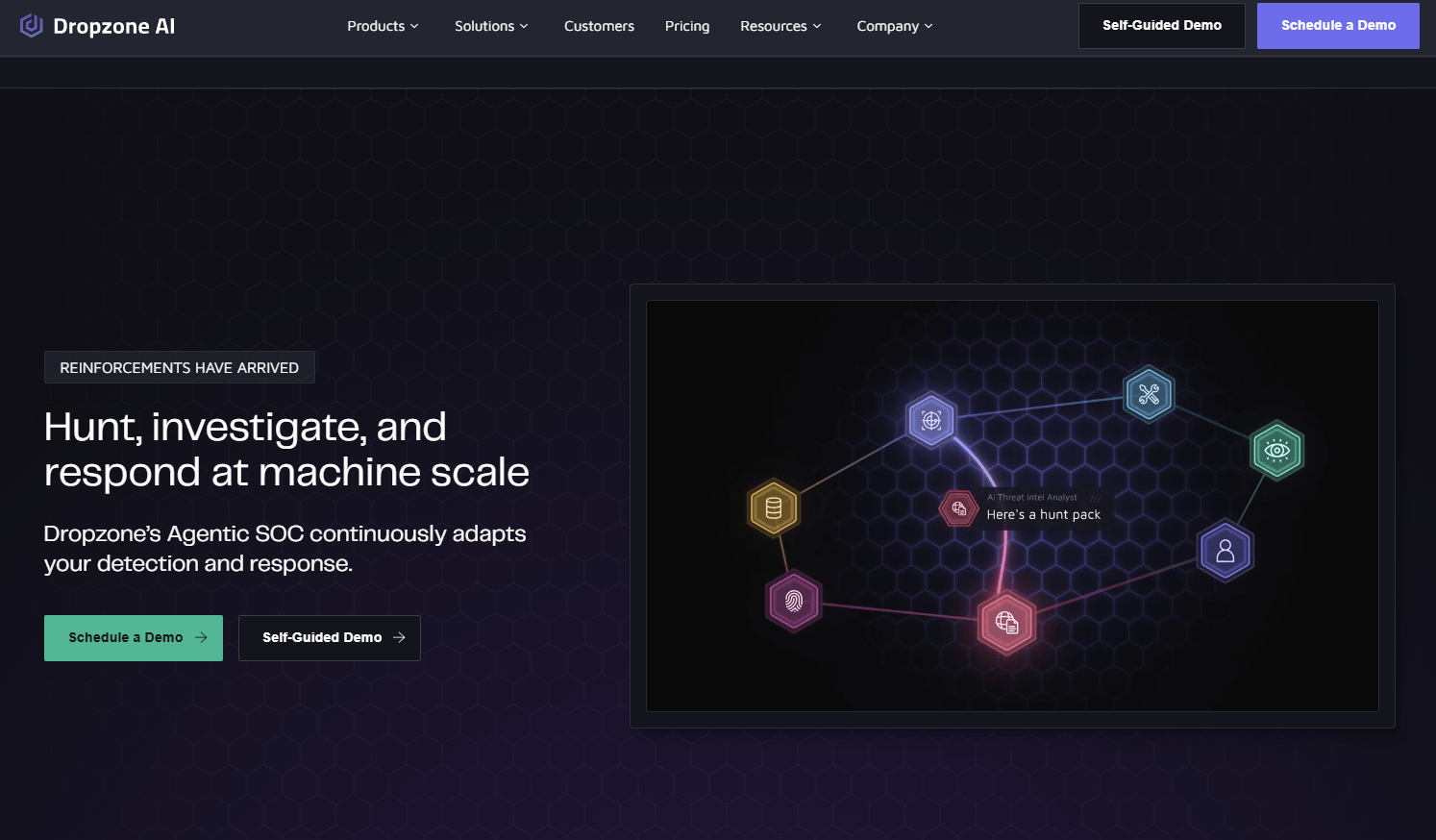
An AI-native SOC analyst that autonomously investigates and resolves alerts across phishing, endpoint, network, cloud, identity, and insider threats, designed to replicate the techniques of elite analysts without adding headcount.
Dropzone AI, based in Seattle, raised a $37 million Series B in 2025 led by Theory Ventures, with Madrona, Decibel Ventures, Pioneer Square Labs, and IQT, bringing total funding to more than $57 million.
The company reports its AI SOC Analyst clears 90% of Tier-1 tickets and cuts triage time from 25 minutes to under 10. Dropzone closed 2025 with 11x ARR growth and Fortune Cyber 60 recognition, and says it is trusted by more than 300 organizations including UiPath, Zapier, Pipe, and Mysten Labs.
Best for:
Lean security teams and enterprises that want an autonomous Tier-1 analyst to absorb alert triage and investigation across a vendor-agnostic tool stack.
Key Features:
- An AI SOC Analyst that autonomously investigates alerts across phishing, endpoint, network, cloud, identity, and insider threats with human-level reasoning (SecurityWeek Dropzone funding).
- AI Threat Hunting that proactively and continuously hunts for threats as part of the agentic SOC platform (Dropzone 2025 momentum).
- Decision-ready investigation outcomes that follow evidence trails and reduce Tier-1 toil, clearing the majority of routine tickets automatically (MSSP Alert Dropzone).
- Vendor-agnostic integrations across existing security tools, so agents plug into a team's current stack (MSSP Alert Dropzone).
Why we like it:
Dropzone is a focused, production-proven autonomous analyst rather than a broad platform, and its measurable Tier-1 results, clearing 90% of tickets and cutting triage time by more than half, make it a clean fit for teams whose first problem is simply keeping up with alert volume.
Notable Limitations:
- As a Series B company, it is far smaller than the platform incumbents, and long-term viability is less proven than CrowdStrike.
- Auditability of autonomous agent decisions can be a consideration in heavily regulated industries such as healthcare and finance, where every verdict must be defensible.
Pricing:
Custom, typically tiered by alert or investigation volume. Contact Dropzone AI for a quote.
Prophet Security
An agentic AI SOC platform built from day one as an autonomous analyst, spanning alert triage, proactive threat hunting, and detection tuning, designed to augment an existing stack rather than replace it.
Prophet Security raised a $30 million Series A in 2025 and reports that its Prophet AI SOC Analyst has performed over 1 million investigations, saving roughly 360,000 hours of investigation toil while delivering 10x faster response and 96% fewer false positives for enterprises across high tech, manufacturing, financial services, and healthcare.
The platform pairs three agents - SOC Analyst, Threat Hunter, and Detection Advisor - with detection recommendations aligned to the MITRE ATT&CK framework, and positions itself as a vendor-agnostic layer that augments existing tools rather than requiring their replacement.
Best for:
Security teams that want an autonomous analyst plus threat hunting and detection-tuning agents layered over their current SIEM and XDR without ripping out existing investments.
Key Features:
- Prophet AI SOC Analyst that autonomously triages, investigates, and responds to alerts at machine speed to cut noise (Prophet Security Series A).
- Prophet AI Threat Hunter that generates hypotheses, identifies leads, and runs investigations proactively across environments (Prophet Security Series A).
- Prophet AI Detection Advisor that analyzes telemetry, uncovers detection gaps, and recommends fixes aligned to MITRE ATT&CK (Prophet Security Series A).
- A vendor-agnostic design that augments the existing stack with autonomy rather than demanding a platform replacement (Prophet Security AI SOC guide).
Why we like it:
Prophet covers more of the lifecycle than a triage-only agent, bundling investigation, proactive hunting, and detection engineering, and its day-one autonomous design plus MITRE-aligned tuning make it a strong overlay for teams that want to improve detections, not just clear alerts.
Notable Limitations:
- At a $30 million Series A, it is an early-stage vendor with a smaller install base and a less-proven long-term track record than the incumbents.
- Headline metrics such as the 96% false-positive reduction and 10x speed are vendor-reported, so they warrant validation against your own environment during a pilot.
Pricing:
Custom, based on scope and alert volume. Contact Prophet Security for a quote.
Agentic SOC Platforms: Quick Overview
| Tool | Best For | Pricing Model | Highlights |
|---|---|---|---|
| Mate | Complex, multi-tool SOC and MSSP teams | Custom | $15.5M seed from Team8 and Insight, 24-hour context graph, founders behind Microsoft Defender XDR. |
| CrowdStrike Charlotte AI | Falcon-standardized enterprises | Module-based within Falcon | Bounded-autonomy agents, AgentWorks, trained on millions of SOC decisions. |
| Torq | Large, vendor-agnostic enterprise SOCs | Enterprise custom | $332M raised, $1.2B unicorn, multi-agent hyperautomation across any stack. |
| Dropzone AI | Lean teams needing a Tier-1 analyst | Custom, volume-tiered | $57M+ raised, clears 90% of Tier-1 tickets, Fortune Cyber 60. |
| Prophet Security | Teams wanting analyst plus hunting and tuning | Custom | 1M+ investigations, three agents, MITRE-aligned detection tuning. |
Agentic SOC Platform Comparison: Key Features at a Glance
| Tool | Feature 1 | Feature 2 | Feature 3 |
|---|---|---|---|
| Mate | Security Context Graph built in 24 hours | Continuous Detection / Continuous Response loop | Vendor-agnostic triage with supervised, SOP-aligned response |
| CrowdStrike Charlotte AI | Autonomous detection triage with bounded autonomy | Mission-ready agentic workforce in Falcon | AgentWorks no-code agents plus Agentic SOAR orchestration |
| Torq | Torq Socrates 24/7 AI analyst and multi-agent system | HyperSOC cutting investigation time up to 90% | Vendor-agnostic builder over Splunk, Elastic, Sentinel |
| Dropzone AI | Autonomous AI SOC Analyst across six alert domains | Continuous AI Threat Hunting | Decision-ready outcomes clearing 90% of Tier-1 tickets |
| Prophet Security | Autonomous SOC Analyst for triage and response | Threat Hunter generating and chasing hypotheses | Detection Advisor tuning detections to MITRE ATT&CK |
Agentic SOC Deployment Options
| Tool | Free or Trial Option | Deployment Model | Best-Fit Environment |
|---|---|---|---|
| Mate | Demo-based | Vendor-agnostic overlay, 24-hour onboarding | Complex multi-tool SOCs and MSSPs |
| CrowdStrike Charlotte AI | No, licensed by module | Native to Falcon platform | Existing CrowdStrike Falcon customers |
| Torq | Demo-based | Vendor-agnostic overlay on any stack | Large enterprise and public-sector SOCs |
| Dropzone AI | Demo-based | Vendor-agnostic analyst overlay | Lean teams on mixed tool stacks |
| Prophet Security | Demo-based | Vendor-agnostic overlay augmenting existing tools | Teams keeping current SIEM and XDR investments |
Agentic SOC Strategic Decision Framework
| Critical Question | Why It Matters | What to Evaluate | Red Flags |
|---|---|---|---|
| Are we platform-native or vendor-agnostic? | Native agents reason on richer first-party data; overlays avoid lock-in across mixed stacks | Telemetry coverage, integration breadth, data portability | A platform-native agent when most of your telemetry lives elsewhere |
| How fast can the agent learn our environment? | Agents that rebuild context per incident cap accuracy; pre-built context drives faster, sharper verdicts | Onboarding time, organizational context modeling, retention of analyst knowledge | Tools that need weeks of tuning or relearn the environment on every alert |
| Can we audit and govern autonomous actions? | Regulated industries need every agent verdict to be defensible and logged | Transparent reasoning, action guardrails, identity scoping, full logging | Black-box decisions with no rationale or activity trail |
| Are the headline metrics independently supported? | Vendor-reported coverage and time savings vary widely and are rarely audited | Analyst coverage, named customers, design-partner results, pilot outcomes in your own environment | Bold percentages with no customer evidence or third-party validation |
Agentic SOC Solutions: Pricing and Capabilities Overview
| Organization Type | Recommended Setup | Pricing Model | Key Consideration |
|---|---|---|---|
| Complex multi-tool SOC or MSSP | Mate for context-graph autonomous SOC | Custom | Fast onboarding and stack-agnostic; newest vendor, validate in a pilot |
| Enterprise standardized on CrowdStrike | Charlotte AI native in Falcon | Module-based within Falcon | Deepest data context, but value is tied to the Falcon ecosystem |
| Large, multi-vendor enterprise SOC | Torq for vendor-agnostic hyperautomation | Enterprise custom | Broadest automation and neutrality, with enterprise scope and pricing |
| Lean team drowning in Tier-1 alerts | Dropzone AI as an autonomous analyst | Custom, volume-tiered | Fast, focused triage relief; smaller vendor than the incumbents |
| Team wanting hunting and detection tuning | Prophet Security as a lifecycle overlay | Custom | Broader agent coverage; early-stage vendor, validate metrics in a pilot |
Problems & Solutions
-
Problem: Most AI SOC agents start blank and try to learn the environment in real time during an incident, like asking an analyst to relearn the network on every investigation, which caps both accuracy and trust.
Solution: Mate builds a Security Context Graph of your organization within 24 hours and has its agents investigate against it, covering the full alert queue and compressing closed investigations into new detections through its Continuous Detection / Continuous Response loop. -
Problem: Enterprises with sprawling, multi-vendor stacks cannot get one consistent layer of automation across SIEM, XDR, and dozens of point tools without ripping and replacing.
Solution: Torq layers agentic AI and hyperautomation over any existing stack, including Splunk, Elastic, and Microsoft Sentinel, with a multi-agent system that cuts investigation time up to 90% and full data portability (Torq Series D announcement). -
Problem: Lean security teams cannot hire their way out of Tier-1 triage as alert volume and attack frequency climb, and analyst burnout compounds the staffing shortage.
Solution: Dropzone AI's autonomous SOC Analyst investigates alerts across six threat domains and clears 90% of Tier-1 tickets, cutting triage from 25 minutes to under 10 without adding headcount. -
Problem: Clearing alerts is not enough when weak or noisy detections keep generating false positives and miss real threats in the first place.
Solution: Prophet Security pairs an autonomous analyst with a Threat Hunter and a Detection Advisor that tunes detections to the MITRE ATT&CK framework, reporting 96% fewer false positives across more than 1 million investigations (Prophet Security Series A).
Final Take
Agentic SOC in 2026 comes down to one question before features: where does your context live, and how fast can an agent learn it. Mate is built around exactly that - a Security Context Graph that models your organization in 24 hours and powers a continuous detection-and-response loop across any stack, backed by a founding team that previously built Microsoft Defender XDR and Security Copilot.
For enterprises standardized on a single platform, CrowdStrike's Charlotte AI reasons on years of Falcon Complete analyst decisions and acts with bounded autonomy native to the Falcon stack. Among the vendor-agnostic pure-plays, Torq's $332 million in funding and $1.2 billion valuation back the deepest multi-agent hyperautomation, Dropzone AI delivers a focused, production-proven Tier-1 analyst for lean teams, and Prophet Security extends agentic coverage into proactive hunting and MITRE-aligned detection tuning.
Start with where your telemetry lives and what your first bottleneck is - context, multi-tool sprawl, alert volume, or weak detections - then pilot the platform whose model matches your environment, and validate every vendor-reported metric against your own data before you commit. For teams that want an autonomous analyst tailored to their environment from day one, Mate is a strong fit.
