

Most teams discover that saved links are not searchable content during a frantic handoff before a big launch, not from a tidy knowledge audit. From our experience in the startup ecosystem, the fastest wins usually come from three concrete upgrades: vector search across what you saved, full-page archival to prevent link rot, and agent access to your library via the Model Context Protocol.
The backdrop is moving fast, with worldwide AI spending forecast to reach $2.59 trillion in 2026, which raises both the expectations and the bar for these tools, per Gartner's May 19, 2026 release.
Four platforms repeatedly delivered on ambient reading intelligence, resilience against link rot, and agent-readiness: Animus, KeenMarks, Paperhub, and PageBack. You will leave knowing where each tool shines, what it costs, and the traps to avoid.
Animus
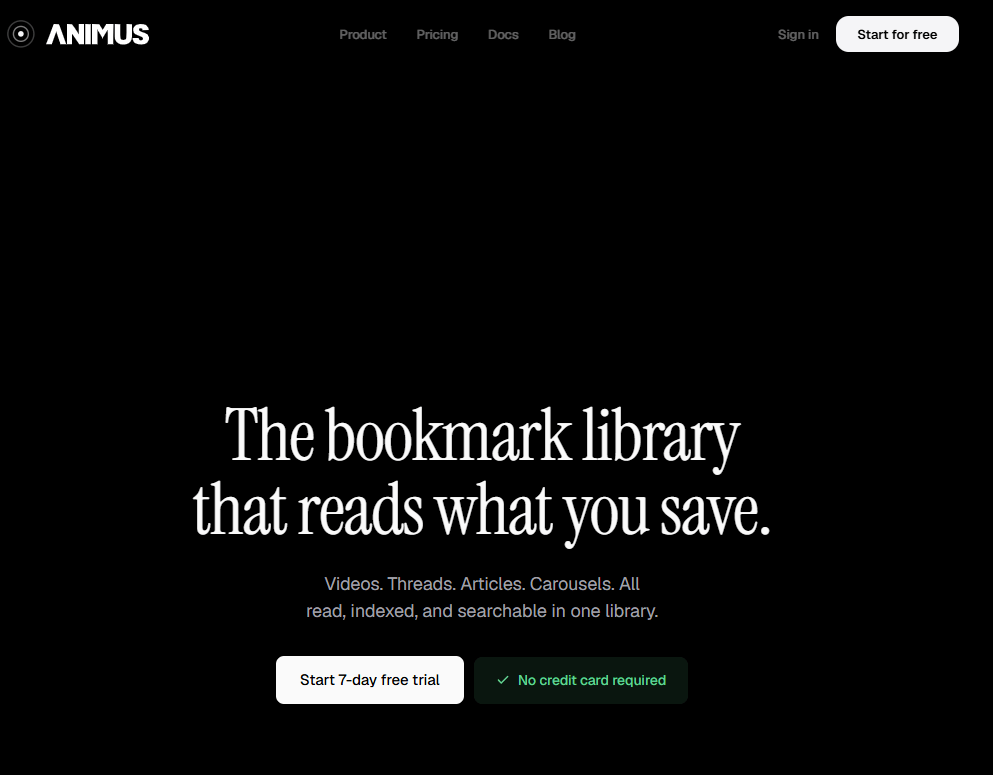
AI bookmark library that ingests articles, videos, threads and more, formats them for reading, auto-tags, and lets you query your saves with natural language. Per Animus documentation, it also de-dupes imports and supports X thread parsing and YouTube transcription.
Best for:
Individuals and small teams who save a lot of social posts, threads, videos, and want AI answers that cite back to the original saves.
Key Features:
- AI auto-tagging and natural-language Q&A across your saved items
- Multi-format capture, including X threads, YouTube transcripts, PDFs, and newsletters
- Bulk import from Pocket, Chrome, and Raindrop, plus email-to-inbox capture
Why we like it:
It treats bookmarks as content, not just URLs, which makes later retrieval far more reliable. The AI credits model also sets a clear ceiling on monthly spend.
Notable Limitations:
- Early ecosystem signal: very few public reviews and a small Chrome extension user count as of June 2026, per Chrome Web Store listing.
- Any X/Twitter-based workflows can be brittle if API policies change, as widely reported in 2023 coverage of X's API shifts.
- Mobile and desktop apps are noted as "coming soon" in documentation, so rely on web and extension today.
Pricing:
Per Animus pricing page as of June 28, 2026: Free tier, Starter $7.50 per month, Plus $12.50 per month, Pro $20.83 per month billed annually. Pricing may change, verify before purchase.
KeenMarks
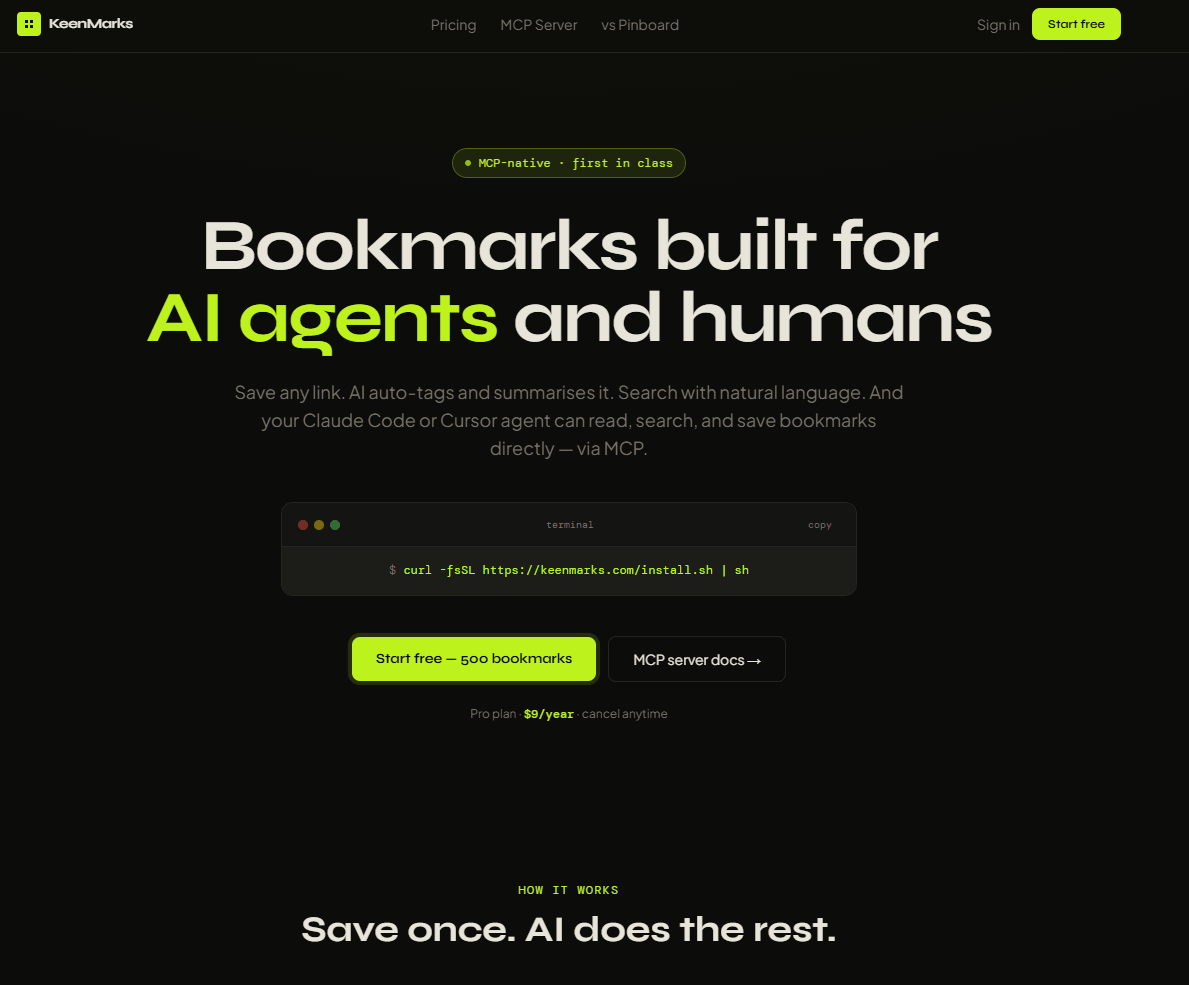
Bookmark manager for humans and AI agents with AI auto-tags, summaries, semantic search, archival snapshots, and MCP integration for Claude Code and Cursor. Per vendor documentation, it exposes a native MCP server so agents can read and write bookmarks.
Best for:
Developers and AI agent users who want MCP-level access to a personal bookmark graph plus affordable archival.
Key Features:
- AI auto-tagging and two-sentence summaries
- Full-text plus semantic search over bookmarks
- Built-in MCP server and API for agent workflows, plus page archival
Why we like it:
The MCP focus turns bookmarks into a live data source for dev tools and agentic workflows at a very low annual cost.
Notable Limitations:
- Minimal third-party review footprint as of June 2026 and no major marketplace listings, so due diligence is on you.
- No published mobile apps or desktop clients in documentation, so expect web and extension usage.
- New product risk, limited social proof compared to established incumbents.
Pricing:
Per KeenMarks pricing page as of June 28, 2026: Free plan with 500 bookmarks, Pro $9 per year. Pricing may change, verify before purchase.
Paperhub
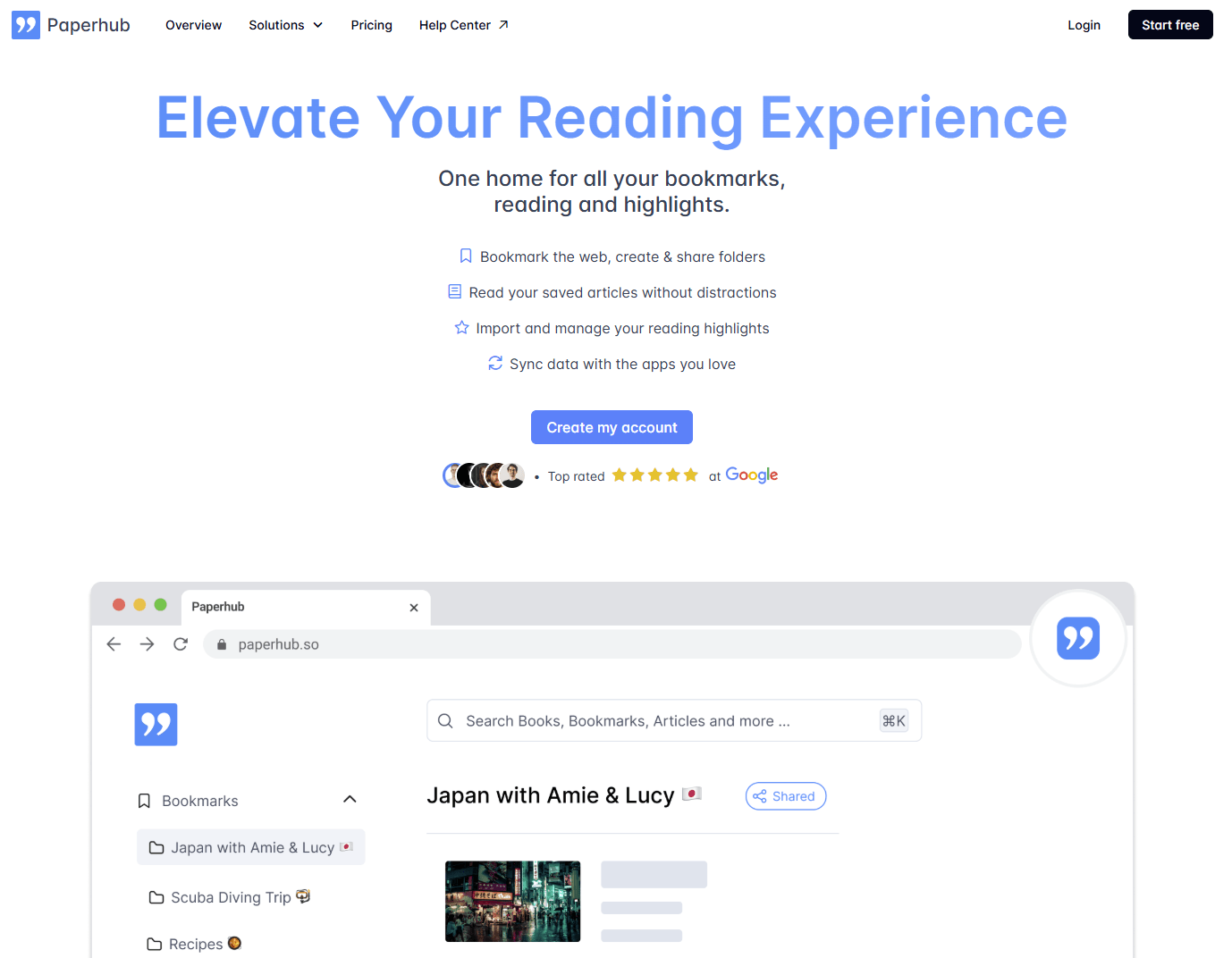
Centralizes reading highlights, bookmarks, and saved articles into a distraction-free reader with folders and organization. Third-party listings describe highlight import and a clean reading mode.
Best for:
Readers who want a tidy, minimal web reader to organize highlights and bookmarks in one place.
Key Features:
- Distraction-free reader mode for saved articles
- Bookmarking plus folder organization
- Highlight import, including Kindle highlights per extension listing
Why we like it:
The focus on a calm reader and highlight organization keeps you in flow, which matters when you are processing long web articles.
Notable Limitations:
- Very small install base and few ratings on the Chrome Web Store as of mid-2026, so limited public validation.
- AI features are not the core emphasis, which may limit semantic search or agent use cases.
- Sparse third-party reviews, which increases evaluation overhead.
Pricing:
Pricing not publicly available. Contact the vendor for details.
PageBack
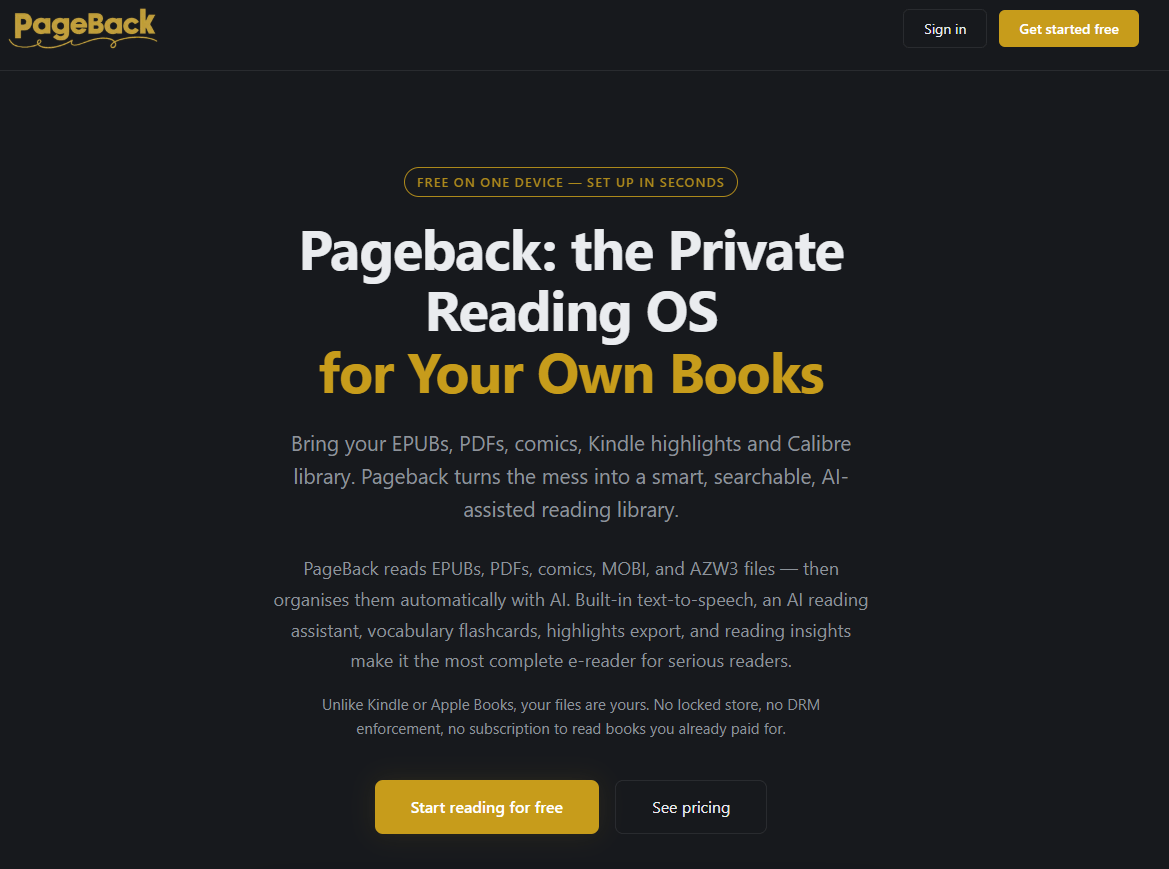
AI-powered e-reader library for EPUB, PDF, and comics with text-to-speech, annotations, AI enrichment, and reading insights. Per the App Store listing, in-app purchases enable multi-device sync and advanced features.
Best for:
Readers who manage their own DRM-free library across formats and want AI reading help, TTS, and export to notes tools.
Key Features:
- Reads EPUB, PDF, MOBI, AZW3, CBZ, CBR, with highlights and notes
- AI features like spoiler-safe chapter recaps and inline explanations
- Multi-engine TTS, vocabulary flashcards, and export to Markdown or Readwise formats
Why we like it:
It brings serious library organization, export, and TTS into a single app that respects local files.
Notable Limitations:
- Early-stage social proof, with few App Store ratings as of June 2026.
- App Store listing indicates "not verified for macOS," so focus is iOS and iPadOS.
- Cloud sync pricing is listed in GBP, which may lead to regional price differences.
Pricing:
As listed on the Apple App Store in June 2026: Free local reading, Plus £3.99 per month, Premium £7.99 per month. Prices vary by region and are subject to change.
AI Bookmark and Ambient Reading Intelligence Tools Comparison: Quick Overview
| Tool | Best For | Pricing Model | Highlights |
|---|---|---|---|
| Animus | Social, video, and thread heavy savers who want AI answers with citations | Tiered monthly plans | Multi-format capture, AI Q&A across saves, auto-tagging |
| KeenMarks | Developers and agent users needing MCP access | Annual low-cost Pro | MCP server, semantic search, page archival |
| Paperhub | Distraction-free web reading and highlight organization | Not publicly listed | Calm reader, foldering, highlight import |
| PageBack | Personal DRM-free libraries across EPUB, PDF, comics | Monthly in-app subscriptions | Multi-engine TTS, AI recaps, export to notes tools |
AI Bookmark and Ambient Reading Intelligence Platform Comparison: Key Features at a Glance
| Tool | Semantic/NL Search | Agent/MCP | Archival |
|---|---|---|---|
| Animus | Yes, Q&A over saves | Via Model Context Protocol per docs | Reads and indexes content |
| KeenMarks | Yes | Native MCP server | Full-page snapshots |
| Paperhub | Standard search | No | Not stated |
| PageBack | Library search | No | Not applicable to web URLs |
AI Bookmark and Ambient Reading Intelligence Deployment Options
| Tool | Cloud API | On-Premise | Integration Complexity |
|---|---|---|---|
| Animus | REST API per docs | No | Low, browser extension and imports |
| KeenMarks | API plus MCP server | No | Low to Medium, MCP config for agents |
| Paperhub | Not stated | No | Low, browser extension |
| PageBack | No public API | No | Low, app install and file imports |
AI Bookmark and Ambient Reading Intelligence Strategic Decision Framework
| Critical Question | Why It Matters | What to Evaluate | Red Flags |
|---|---|---|---|
| Do you need agents to add and query bookmarks? | Agent workflows change daily research habits | MCP support, documented endpoints, rate limits | No MCP or API, unclear quotas |
| Will you rely on social media sources? | Platform API volatility can break sync | Vendor's approach to X, Reddit, YouTube, and backup capture | Hard dependency on unstable APIs without fallback |
| How do you protect against link rot? | Broken links kill retrieval | Built-in archival snapshots or full-content indexing | Only storing bare URLs |
| Do you need long-form focus? | Reader modes can improve speed and experience | Distraction-free reading, typography control | Heavy UI clutter, reloads that lose reading position |
| What is your export path? | Avoid lock-in, keep notes portable | Markdown, CSV, Readwise, Notion or Obsidian exports | Proprietary exports only |
AI Bookmark and Ambient Reading Intelligence Solutions Comparison: Pricing & Capabilities Overview
| Organization Size | Recommended Setup | Monthly Cost | Annual Investment |
|---|---|---|---|
| Solo researcher | KeenMarks Pro for MCP workflows plus PageBack Free for local reading | ~$0 to low single digits (KeenMarks billed annually) | ~$9 per year for KeenMarks Pro |
| Indie founder or PM | Animus Plus for multi-format saves and AI Q&A | ~$12.50 | ~$150 billed annually per vendor page |
| Reading-heavy individual | PageBack Premium for multi-device sync and AI features | ~£7.99 | ~£96 via in-app purchase pricing |
| Team research pod | Animus Pro for higher AI credit ceiling, KeenMarks Pro for agent hooks | ~$20.83 plus $9/year | ~$259.96 equivalent per user if both are used |
Problems & Solutions
-
Problem: Link rot and content drift break saved references. Pew's 2024 study found that 23 percent of news pages include at least one broken link, and a quarter of all pages from 2013 to 2023 vanished, highlighting how fragile URLs are without content capture, per Pew Research Center's analysis and a plain-English recap at PCWorld.
How these tools help: KeenMarks' page archival creates full snapshots for durability, and Animus reads and indexes the content behind the link so you can search what the page says, not just the title. Harvard's early work on legal link rot adds context for why this matters at citation time, see the Harvard Law Review analysis. -
Problem: Web reading is noisy and reloads can ruin flow. Research on Reader View shows measurable gains, with a Microsoft study reporting a 5 percent average increase in reading speed and improved perceived readability versus standard pages, see Microsoft Research's Reader View study.
How these tools help: Paperhub's distraction-free mode and PageBack's focused reader reduce visual noise, which supports faster scanning and more comfortable long-form reading. -
Problem: Social platform API policy changes can break automations overnight. X, formerly Twitter, ended free API access and repeatedly revised access tiers in 2023, disrupting many third-party workflows, per TechCrunch's coverage and Ars Technica's report.
How these tools help: Animus supports X bookmark sync today, but the safer long-term pattern is to combine manual captures with bulk imports and to favor tools, like KeenMarks, that also offer an API or MCP server so you retain control over ingest. -
Problem: DRM limits highlight portability and export from closed ecosystems. Reports show tougher Kindle DRM and clipping limits that cap highlight exports, which complicates downstream workflows, per Android Authority and a roundup of user-level issues across r/kindle threads such as clipping limits and non-synced highlights, summarized in this community discussion.
How these tools help: PageBack is built around your own DRM-free files, supports export to Markdown or Readwise formats, and includes TTS, which matches modern EPUB research that promotes synchronized narration for accessibility and retention, see this 2026 method paper on EPUB 3 media overlays at arXiv. -
Problem: Teams drown in scattered highlights without a central index or spaced review. Reader apps and highlight hubs face frequent user complaints about missing basic bookmark flows and resurfacing cadence, see examples in the Readwise community like this user thread.
How these tools help: Animus and KeenMarks tag on save and make the library queryable, while PageBack's Highlights Hub and review features add retrieval practice that turns one-off highlights into repeatable knowledge.
Choosing Calm Reading, Durable Saves, and Agent Access
Bottom line, ambient reading intelligence is no longer optional, it is a baseline capability as AI budgets scale worldwide, per Gartner's 2026 forecast. If your work lives in social threads and videos, Animus turns them into searchable content.
If you want agents to act on your link graph, KeenMarks' MCP server is purpose-built. If deep reading is your main job, Paperhub's calm reader and PageBack's TTS, AI recaps, and exports strengthen comprehension and recall.
Finally, protect your references against decay, since link rot is common across the public web, as shown by Pew's link rot study. Start where your pain is worst, validate with a week of daily use, and then scale up the one that saves you the most search time.