You think you know where your content comes from until a takedown request lands and you cannot prove who shot the photo, who edited it, or whether AI touched it. From our experience in the startup ecosystem, the biggest mistakes happen when teams stitch together ad hoc checks instead of building provenance into the pipeline. Three technical moves change the game fast: signing C2PA manifests at ingest, preserving credentials through crops and resizes, and adding AI text screening inside Docs and LMS workflows. Public concern is real, with 59 percent of people worried about false online news and over half of U.S. respondents uncomfortable with AI in newsrooms, per the 2024 Digital News Report by the Reuters Institute and Oxford, summarized by Reuters.
The publishers market does not yet have a stand-alone "content provenance" segment in major analyst taxonomies, so your best bet is to combine proven building blocks. Expect a clear path to deploy C2PA content credentials, where AI detection helps rather than harms, and where you learn exactly when to trust stylometry and when to treat it as a hint, not a verdict. You will also see the tradeoffs, including bias and evasion risks that academic studies have documented.
Cloudinary (C2PA Content Credentials)

Image and video management with cryptographically signed provenance for images and, where supported, video. Embeds and preserves C2PA Content Credentials so assets carry a tamper-evident history end to end.
- Best for: Newsrooms and publishers that need cryptographic provenance at scale inside a DAM and delivery CDN.
- Key Features:
- C2PA Content Credentials signing and preservation, confirmed in a July 2024 release on Business Wire.
- Provenance that survives common transformations, aligned with the C2PA approach covered by The Verge.
- DAM capabilities recognized by analyst coverage, including Gartner Magic Quadrant mentions reported via Business Wire.
- Why we like it: C2PA signing where your media already lives. It reduces "did we label this" Slack threads because provenance gets attached at ingest and stays attached on delivery.
- Notable Limitations:
- Per public documentation, some content provenance features have been labeled beta, which means APIs and parameters can change before GA. Treat rollouts with change control in mind, and verify on a staging property.
- Content credentials are opt in across the ecosystem, so provenance travels best when downstream platforms preserve metadata, a challenge noted in ecosystem coverage by The Verge.
- Pricing: Pricing not publicly available. Contact Cloudinary for a custom quote.
Copyleaks
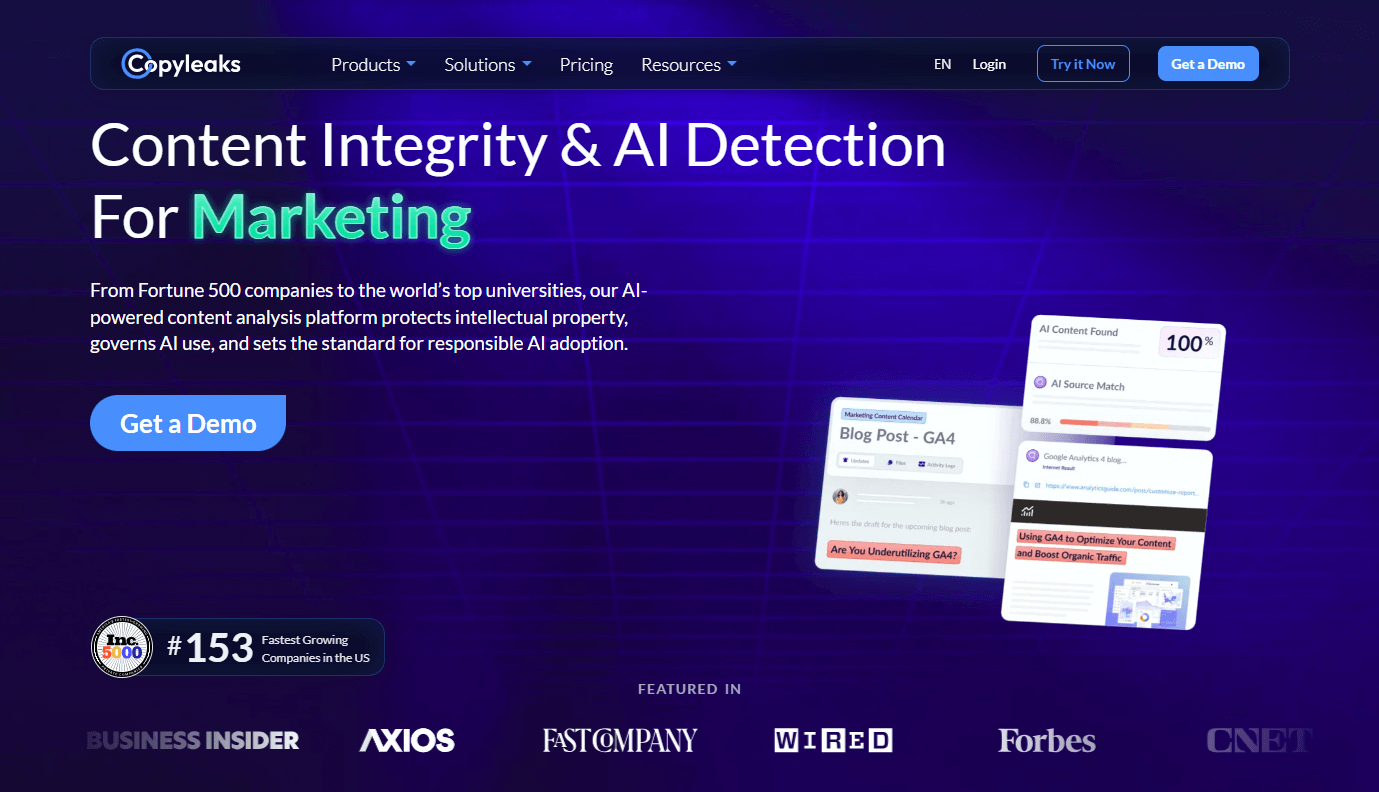
AI content and plagiarism detection with add-ons for Google Docs, LMS integrations, and a browser extension for in-context checks.
- Best for: Editors and standards desks that need fast AI and plagiarism checks in Docs or an LMS, with API options for batch.
- Key Features:
- Google Docs add-on listed in the Google Workspace Marketplace for AI and plagiarism checks inside Docs, launched June 2025 (Google Workspace Marketplace).
- Browser extension with significant install base and recent updates documented by third-party extension trackers (BrowserPowers).
- LMS integrations publicly described and widely used in education, with ongoing rollout updates covered by third-party newswires like GlobeNewswire.
- Why we like it: Practical placements where editors write and grade, so checks happen before publish, not after.
- Notable Limitations:
- Independent studies show AI detectors can be biased against non-native writers and are vulnerable to prompt, paraphrase, and translation attacks, so treat scores as signals, not verdicts. See peer-reviewed and academic work from Stanford affiliates and others in Patterns via ScienceDirect summary, the arXiv preprint by Liang et al (arXiv), and robustness tests showing drops under attack (arXiv, arXiv).
- Community reports occasionally cite inconsistent scores across tools, which aligns with the broader literature on detector variance (Reddit thread example).
- Pricing: G2 lists several starter editions, including AI Detector starting at $7.99 per month, Plagiarism Checker at $8.99 per month, and AI + Plagiarism Detection at $13.99 per month, with enterprise and LMS tiers by quote (G2 pricing).
JustDone AI
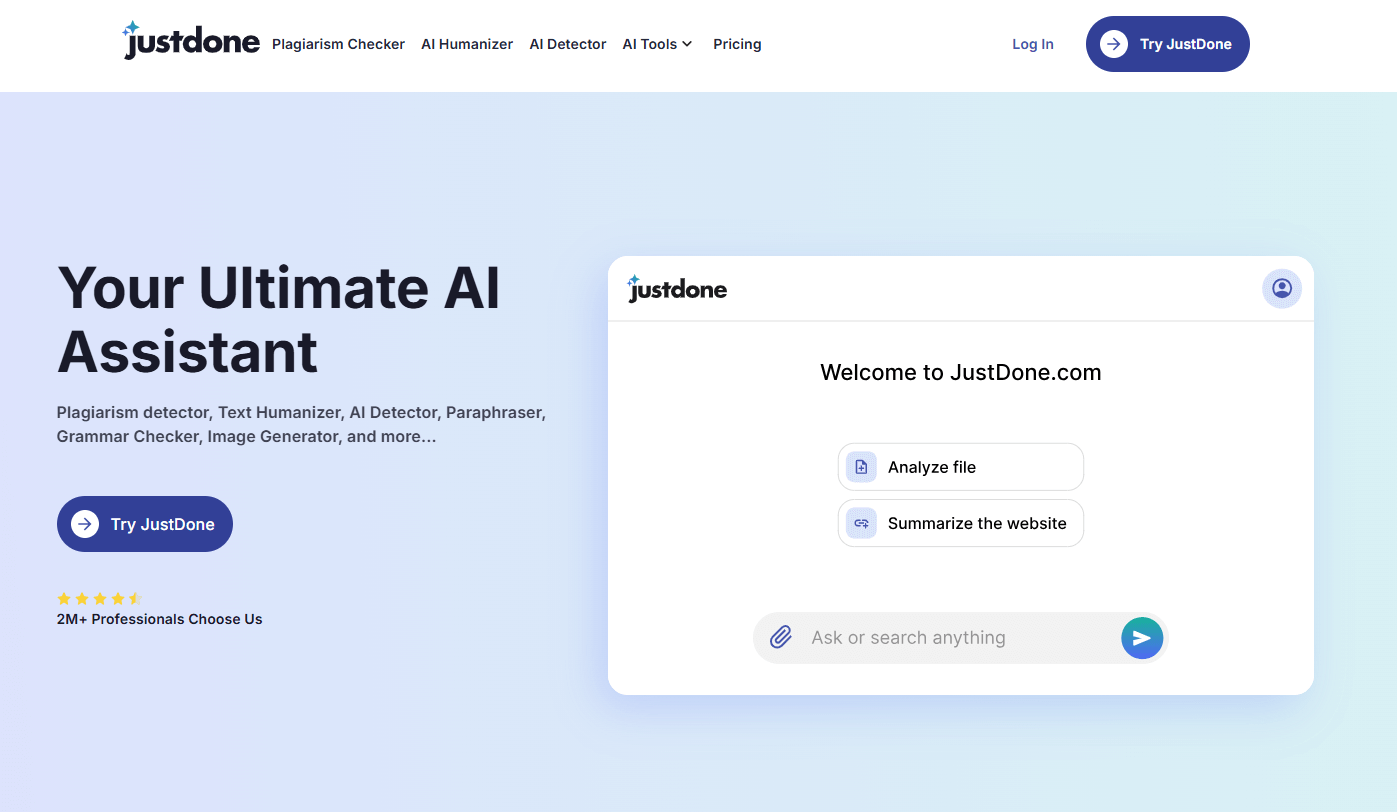
Web platform bundling AI writing, AI detection, plagiarism checks, an AI "humanizer," and research helpers in one interface.
- Best for: Small teams testing an all-in-one workspace for drafting, checking, and light paraphrasing.
- Key Features:
- Per vendor materials, includes AI generation, detection, plagiarism checking, and an AI "humanizer." Public reviews frequently mention these modules in day-to-day use, both positively and critically, on Trustpilot.
- Rapid, browser-based workflow with no installation, reflected in public review narratives on Trustpilot.
- Mixed user feedback across independent forums regarding accuracy and billing practices, see examples on Reddit and aggregated on an external review site (RealReviews.io).
- Why we like it: One tab to draft and triage is convenient for quick edits and student newsroom experiments.
- Notable Limitations:
- Multiple internet reviews and forum threads report inconsistent AI detection results and disputed charges, so teams should trial with a burner card, compartmentalize usage, and avoid treating outputs as authoritative (Trustpilot, Reddit).
- "Humanizer" features raise governance and ethics risks, and, per academic research, simple paraphrase and translation can both trigger false positives and also defeat detectors, which undermines newsroom trust (arXiv).
- Pricing: Pricing not publicly verified on independent marketplaces as of December 7, 2025. Treat any pricing claims as provisional, and confirm terms during a short pilot.
PlagiarismCheck.org

Originality checking with AI detection, grammar and citation tools, and an authorship fingerprinting module for stylistic comparison across submissions.
- Best for: Academic publishers and education partners seeking plagiarism checks plus authorship-style signals tied to LMS workflows.
- Key Features:
- LMS and CMS oriented features and reporting are reflected in third-party product pages and reviews on G2.
- Authorship fingerprinting is presented as a stylometry-based signal, not determinative proof. Treat as advisory, consistent with broader stylometry literature that urges caution in high-stakes use (MIT Press, Computational Linguistics).
- AI detection and grammar with document-friendly reporting are frequently mentioned in G2 reviews.
- Why we like it: Simple packaging for plagiarism plus "does this match prior style" signals, useful in editorial QA backlogs.
- Notable Limitations:
- Stylometry has documented limits for detecting machine-generated misinformation and can be evaded or confounded, so avoid using it as sole evidence (Computational Linguistics, 2020 and 2024 updates).
- Smaller public reviewer base than category leaders, which means less third-party validation to benchmark accuracy trends.
- Pricing: G2 lists Pay-As-You-Go options and shows Educational Institution pricing starting at about $1 per user per year, with details varying by seat count and term length (G2 pricing). For enterprise plans, contact the vendor.
AI Content Provenance for Publishers Tools Comparison: Quick Overview
| Tool | Best For | Pricing Model | Highlights |
|---|---|---|---|
| Cloudinary | Cryptographic media provenance at scale | Custom enterprise | C2PA signing and preservation tied to DAM and delivery |
| Copyleaks | Editorial and academic AI plus plagiarism checks | Tiered subscriptions, enterprise by quote | Google Docs add-on and LMS integrations |
| JustDone AI | All-in-one writing and checking in browser | Not independently verified | Mixed public reviews on accuracy and billing |
| PlagiarismCheck.org | Plagiarism checks plus authorship signals | Pay-As-You-Go and institutional tiers | Authorship fingerprinting with caution per stylometry limits |
AI Content Provenance for Publishers Platform Comparison: Key Features at a Glance
| Tool | C2PA Credentials | AI Text Detection | Plagiarism Check |
|---|---|---|---|
| Cloudinary | Yes, per July 2024 newswire coverage | N/A | N/A |
| Copyleaks | N/A | Yes | Yes |
| JustDone AI | N/A | Yes, per public descriptions in reviews | Yes, per public reviews |
| PlagiarismCheck.org | N/A | Yes (reviews mention AI checks) | Yes |
AI Content Provenance for Publishers Deployment Options
| Tool | Cloud API | On-Premise | Integration Notes |
|---|---|---|---|
| Cloudinary | Yes | No public on-prem offers | Delivered as SaaS with DAM and delivery, provenance aligns with C2PA |
| Copyleaks | Yes | No public on-prem offers | Add-ons for Docs and LMS |
| JustDone AI | Yes | No public on-prem offers | Web app noted in public reviews |
| PlagiarismCheck.org | Yes | No public on-prem offers | LMS oriented per G2 |
AI Content Provenance for Publishers Strategic Decision Framework
| Critical Question | Why It Matters | What to Evaluate |
|---|---|---|
| Do you need cryptographic provenance on images and video, or only text screening? | C2PA credentials prove history and edits, while text detectors only estimate authorship. | C2PA support, credential preservation through transforms, CDN behavior, inspector tooling. |
| How will you mitigate detector bias and evasion? | Detectors can mislabel non-native writers and are easy to evade with paraphrase or translation. | Detector transparency, threshold controls, human review policy, appeals workflow. |
| Do you need authorship signals, and at what risk level? | Stylometry can surface style shifts but cannot prove truth or intent. | Use stylometry for triage only, pair with source-based review. |
| Where do checks live in your workflow? | In-editor checks prevent late surprises. | Docs add-ons, LMS and CMS integrations, API batch jobs. |
AI Content Provenance for Publishers Solutions Comparison: Pricing & Capabilities Overview
| Organization Size | Recommended Setup | Monthly Cost | Annual Investment |
|---|---|---|---|
| Small newsroom or local publisher | Copyleaks starter tier for text checks plus basic C2PA via platform partners where possible | From $7.99 to $13.99 for Copyleaks per G2 listings, Cloudinary varies | ~$96 to ~$168 for Copyleaks starter, provenance cost depends on vendor quote |
| Mid-size digital magazine | Copyleaks team plan, Cloudinary for C2PA in DAM and delivery | Mixed, Copyleaks listed tiers plus custom Cloudinary | Custom, depends on volume and seats |
| Enterprise or national newsroom | Cloudinary for credentialed media supply chain, Copyleaks enterprise or LMS integration, stylometry as triage only | Enterprise quotes | Enterprise quotes |
Problems & Solutions
-
Problem: An election photo is cropped and republished across partners, then challenged for manipulation.
Solution: Adopt C2PA signing in the DAM and preserve credentials at the edge so every derived image carries a tamper-evident history. Cloudinary's C2PA implementation addresses signing and preservation, while broader ecosystem support for Content Credentials is growing, with large networks such as Cloudflare adding one-click preservation for images. -
Problem: A freelance submission reads "AI-ish," and the editor needs a quick, in-doc check without breaking flow.
Solution: Run Copyleaks from the Google Docs sidebar and log a snapshot in the editorial ticket. The official marketplace listing confirms AI and plagiarism checks inside Docs. -
Problem: A student-run section wants to catch ghostwriting patterns across repeat contributors.
Solution: Use PlagiarismCheck.org's authorship fingerprinting for triage only, then escalate for source-based review. Stylometry can surface style shifts, but peer-reviewed work shows limits when the goal is detecting machine-generated misinformation, so keep it advisory and not punitive. -
Problem: A contributor proposes "humanizing" copy to beat detectors before submission.
Solution: Decline and document a policy against AI trace removal. Research shows AI detectors are both evadable and biased, which means "humanizers" only add risk to your newsroom and erode trust. Public forum reports also describe inconsistent detection from all-in-one tools that advertise humanizers, which should be treated as a governance red flag.
Bottom Line for Publishers
Most teams discover provenance gaps during a crisis, not during planning. The fastest path to resilience is a two-track stack: cryptographic media provenance through C2PA credentials attached at ingest and preserved at delivery, and careful AI plus plagiarism screening in the editor with transparent thresholds and human review. Public skepticism is rising, with global audiences increasingly worried about AI in news production, per the 2024 Reuters Institute survey. Use Cloudinary for C2PA where media lives, Copyleaks for in-workflow text checks, PlagiarismCheck.org for stylometry as triage only, and treat all "humanizer" claims as a governance risk. This combination saves painful retractions and legal spend by making authenticity verifiable, understandable, and reviewable.