You think you know how long grading takes until a stack of 200 handwritten exams lands on your desk on a Friday afternoon. From our experience in the startup ecosystem, the biggest wins come from concrete workflow fixes, not hype. Three examples that actually cut hours: multilingual OCR for messy scripts, rubric mapping to state standards, and CSV gradebook export to your LMS. Adoption is real too, with education leading all industries as 86 percent of organizations reported using generative AI in 2024, according to an IDC InfoBrief. You will learn where each platform excels, what to watch for, and the fastest way to pilot without surprises.
GradingPal
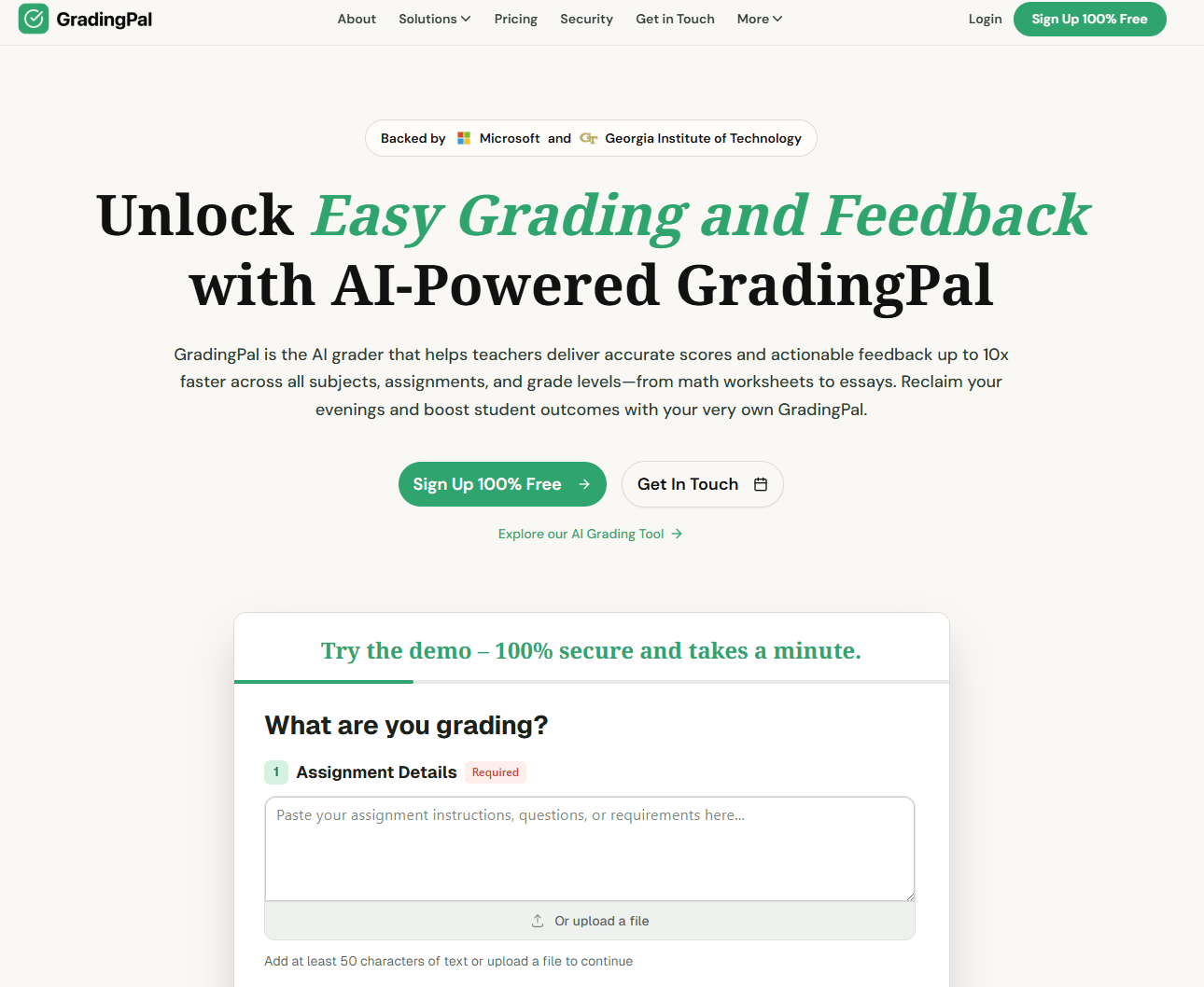
AI grading for K-12 and higher-ed instructors focused on fast, rubric-aligned scoring, detailed feedback, and class-wide insights. Built for everyday assignments, from worksheets to essays, with Google Classroom sync and standards mapping.
- Best for: K-12 teachers and lecturers who want quick rubric-based grading, feedback that sounds like the teacher, and simple Google Classroom workflows.
- Key Features: Rubric-anchored scoring, handwritten support, Common Core or NGSS standards alignment, class-wide analytics, Google Classroom sync.
- Why we like it: Working across different tech companies, we have seen adoption hinge on teacher control. GradingPal keeps the human in the loop with fast drafts, then easy override, and the analytics surface where a reteach yields the biggest gain.
- Notable Limitations:
- Canvas or Schoology integrations are reserved for institutional plans, so solo teachers typically rely on Google Classroom or exports.
- District approval and a DPA may be required before student work can flow to any third-party tool, a recurring theme in educator discussions about FERPA and online services (US ED privacy guidance overview, plus practitioner concerns echoed in teacher forums).
- Pricing: Free Basic plan, Lite at $19 per month billed annually, Pro at $39 per month billed annually, and School or District custom quotes. Pricing reflects the vendor's published page as of April 2026, subject to change.
GradeLab

Enterprise-grade AI grading that targets large handwritten exam workflows with analytics, moderation, and teacher override. Offers on-premise deployment for institutions that need offline or air-gapped operation.
- Best for: Universities, exam boards, or government bodies running high-volume handwritten exams or requiring on-premise, offline processing.
- Key Features: Handwriting recognition across 30 plus languages, rubric and stepwise marking, AI moderation with audit trail, item analytics and LaTeX reports, offline on-premise option.
- Why we like it: After helping startups scale in regulated settings, we look for air-gapped options and override controls. GradeLab's on-premise mode and teacher moderation meet real procurement and security asks.
- Notable Limitations:
- Pricing transparency is limited, and many advanced capabilities are listed as paid add ons, which can complicate budgeting at scale.
- Public third-party reviews are sparse, so buyers should insist on pilots with representative samples before rollout, a best practice echoed by higher-ed communities trialing new grading tools (example educator thread on trialing AI graders).
- Pricing: Pay-as-you-go per paper and Enterprise custom quotes. Pricing not publicly itemized; contact GradeLab for a custom quote.
Paideon
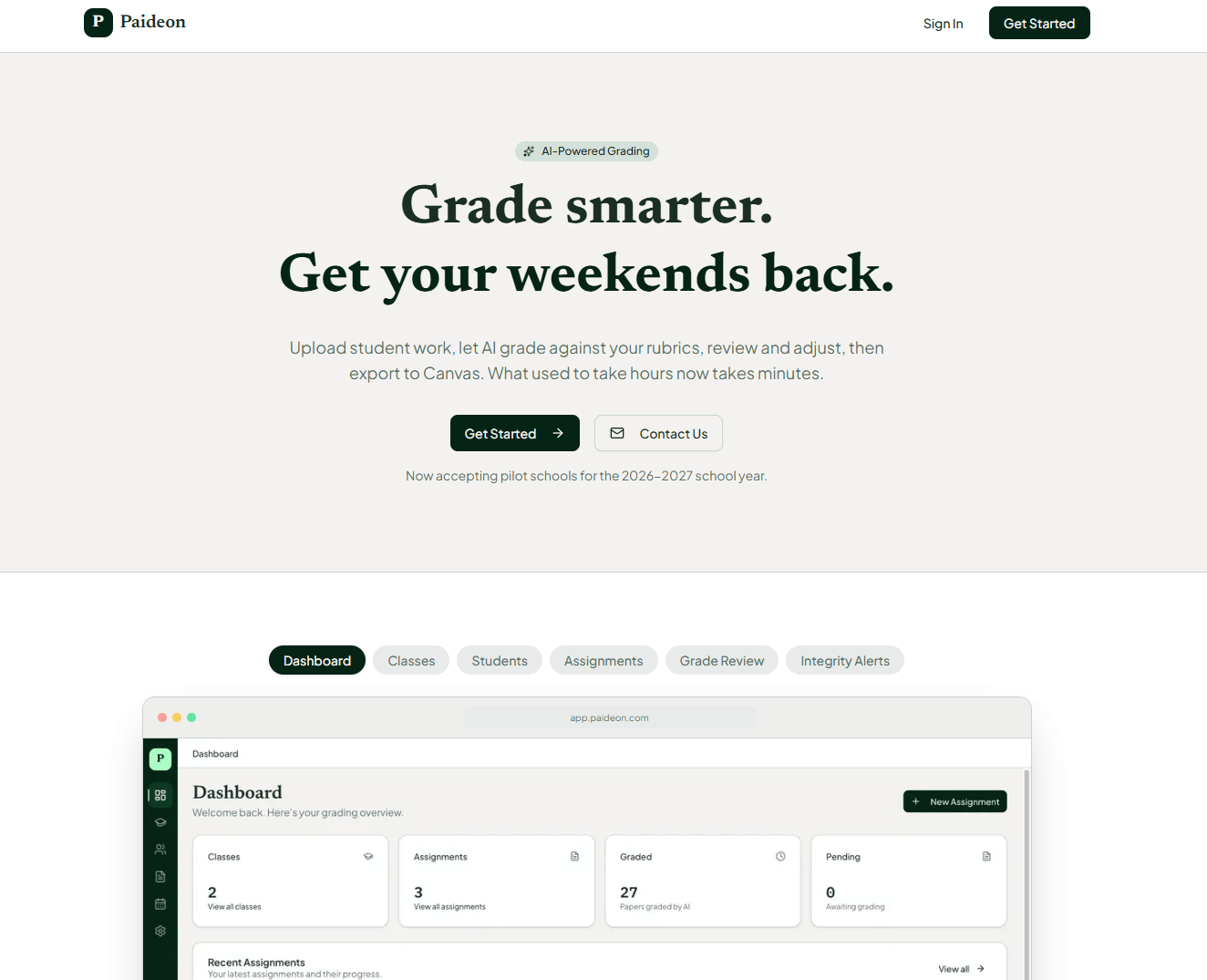
AI-powered, rubric-based grading for essays, projects, and uploads, with similarity detection and Canvas-ready exports. Built with privacy defaults like stripping student identifiers before AI processing.
- Best for: Schools that want rubric-anchored grading and Canvas-ready gradebook exports, plus basic integrity checks, in a pilot-friendly setup.
- Key Features: Batch rubric grading, three-panel human review, similarity detection and AI writing flags, Canvas-ready CSV export, per-seat school licensing.
- Why we like it: From our experience in the startup ecosystem, tools that make CSV flows boring and reliable get adopted faster. Paideon's focus on rubric transparency and quick exports keeps rollout friction low.
- Notable Limitations:
- Pricing is not public, and the product is recruiting pilot schools for 2026 to 2027, so it is earlier stage.
- Direct LMS integrations beyond Canvas-ready CSV are not highlighted, so districts relying on other LMSs may need extra steps.
- Pricing: Pricing not publicly available. Contact Paideon for a custom quote and pilot details.
ExamAi
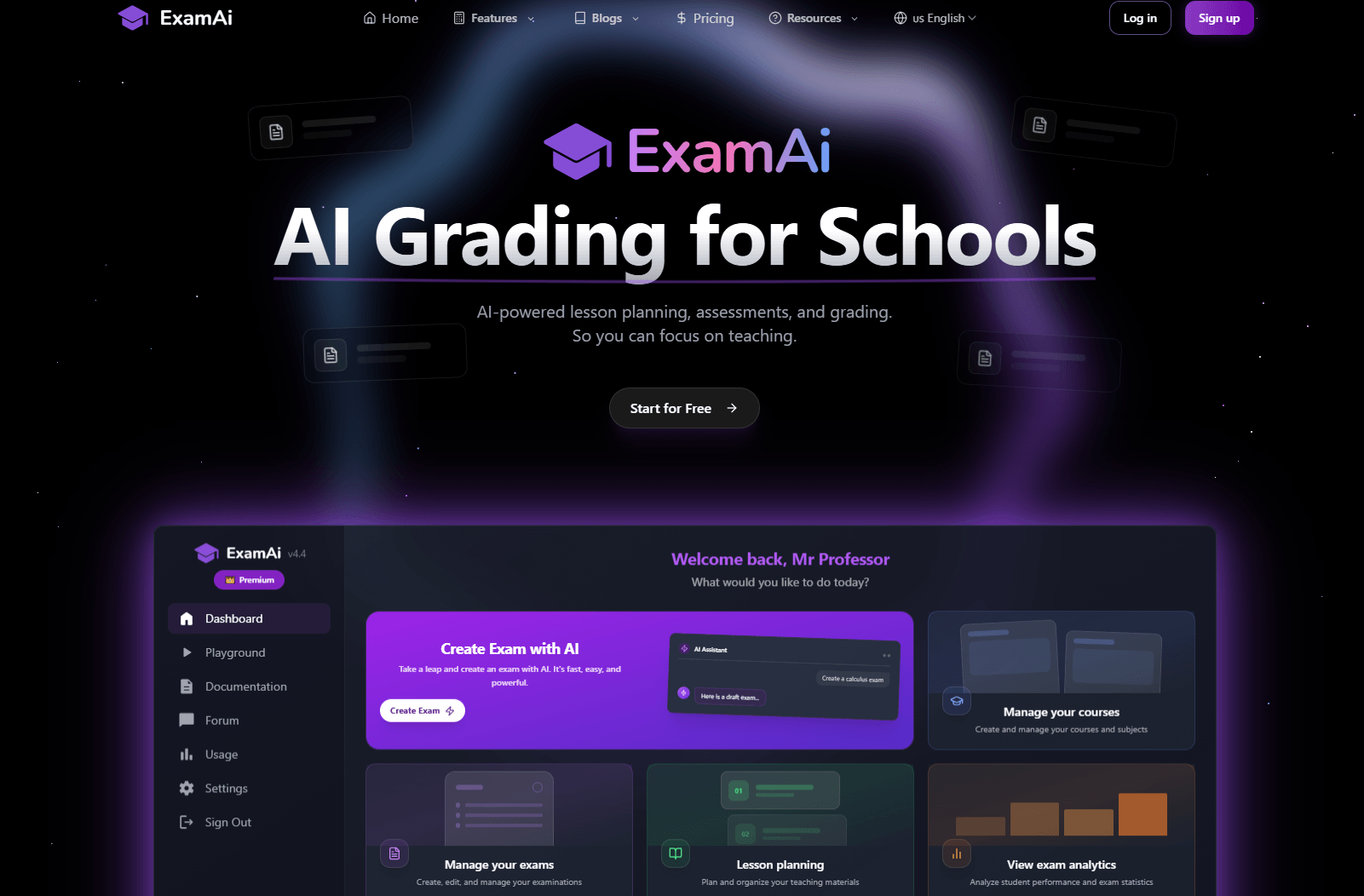
An AI platform for lesson planning, exam creation, and grading, including support for handwriting ingestion and exam analytics. Offers QR code workflows for identity matching on scanned booklets.
- Best for: Teachers who want a single tool for creating exams, grading at volume, and pushing results to Canvas via roster and gradebook workflows.
- Key Features: AI exam generation, rubric-driven grading with teacher override, handwriting ingestion for large scan batches, Canvas roster import and grade export, analytics dashboards.
- Why we like it: The bundle of creation plus grading speeds tight iteration, especially when you need to regenerate questions and re-grade quickly to close a learning gap.
- Notable Limitations:
- Canvas workflows rely on CSV import or export steps, which some departments prefer to replace with native LMS integrations.
- As with any AI grader, alignment to human rubrics can vary on subjective tasks, a risk highlighted in independent studies of AI essay scoring reliability and bias (SAGE study on proportional bias).
- Pricing: Free tier with monthly usage limits and a Premium plan at $19 per month, plus Enterprise quotes. Pricing reflects public FAQs as of April 2026, subject to change.
AI Grading Tools Comparison: Quick Overview
| Tool | Best For | Pricing Model | Highlights |
|---|---|---|---|
| GradingPal | K-12 teachers and lecturers | Tiered plans, free Basic, school quotes | Rubric-based grading, standards mapping, Google Classroom sync |
| GradeLab | Universities, exam boards, public sector | Pay per paper, enterprise quotes | Handwriting grading at scale, audit trails, on-premise or offline |
| Paideon | Schools using Canvas exports | Custom licensing, pilots open | Batch rubric grading, similarity flags, Canvas-ready CSV |
| ExamAi | Teachers combining exam creation and grading | Free plus $19/mo, enterprise quotes | AI exam generation, rubric override, handwriting ingestion |
AI Grading Platform Comparison: Key Features at a Glance
| Tool | Feature 1 | Feature 2 | Feature 3 |
|---|---|---|---|
| GradingPal | Rubric-anchored scoring | Standards alignment | Class-wide analytics |
| GradeLab | Multilingual handwriting OCR | AI moderation and audit trail | On-premise deployment |
| Paideon | Batch rubric grading with human review | Similarity and AI-writing flags | Canvas-ready CSV export |
| ExamAi | AI exam creation and planning | Handwriting ingestion for large batches | Canvas roster and gradebook workflows |
AI Grading Deployment Options
| Tool | Cloud API | On-Premise / Air-Gapped | Integration Complexity |
|---|---|---|---|
| GradingPal | Not stated | No | Low for Google Classroom, higher for district rollouts |
| GradeLab | Available | Yes, offline air-gapped mode | Moderate to high, institutional integrations and add ons |
| Paideon | Cloud app | No | Low to moderate, CSV to Canvas |
| ExamAi | Cloud app | No | Low to moderate, CSV roster and grade exports |
AI Grading Strategic Decision Framework
| Critical Question | Why It Matters | What to Evaluate | Red Flags |
|---|---|---|---|
| Do we need offline or air-gapped grading? | Some exams and agencies prohibit cloud data flows | On-prem options, local encryption, no external calls | Cloud-only promises for sensitive exams |
| How will we meet FERPA and state privacy rules? | Third-party tools need contracts and direct control clauses | DPA templates, data maps, retention, audit logs | No FERPA posture, weak deletion or audit trails |
| Can teachers easily override and explain grades? | AI must support human authority and transparency | Rubric anchoring, rationale visibility, override logs | Black-box scores, no rationale or version history |
| Will it fit our LMS today? | CSV bridges can add friction and errors | Native or CSV workflows, group sync, standards mapping | Manual reentry, brittle exports, missing standards |
AI Grading Solutions Comparison: Pricing & Capabilities Overview
| Organization Size | Recommended Setup | Monthly Cost | Annual Investment |
|---|---|---|---|
| Individual teacher | GradingPal Lite or ExamAi Premium for rubric grading and quick feedback | $19 to $39 per user | $228 to $468 per user |
| Department pilot, mixed subjects | GradingPal Pro for analytics, or ExamAi Premium across a small cohort | Varies by seats | Varies by seats |
| University, handwritten exams | GradeLab on-premise or enterprise plan with moderation and audit trails | Contact vendor | Custom quote |
| District rollout with Canvas | Paideon school licensing with Canvas-ready exports, or GradingPal School plan | Contact vendor | Custom quote |
Problems & Solutions
-
Problem: Grading load crowds out instruction. Teachers report heavy weekly time on grading, with one U.S. survey putting it at 9.9 hours per week, which aligns with broader time-use findings on assessment load (BusinessWire summary of Learnosity research, supported by a 2025 TNTP review of teacher time use showing median hours still high for grading and feedback in many contexts in the U.S. (TNTP literature review)).
- How tools help: GradingPal and ExamAi generate rubric-based drafts with edit and approve steps, cutting turnarounds while preserving teacher judgment. GradeLab batches entire exam sets, then surfaces question-level analytics so reteach plans are immediate.
-
Problem: Handwritten exams slow everything, especially in STEM or mixed-format responses. Many institutions digitize scripts but still need accurate interpretation for diagrams and math (University of Guelph guidance on digitized handwritten exams).
- How tools help: GradeLab focuses on multilingual OCR for handwriting and diagrams with moderation and audit logs. GradingPal and ExamAi support scans for handwriting, then map grades back to a class list so feedback returns quickly.
-
Problem: Alignment and fairness on subjective writing tasks. Independent studies show AI graders can diverge from human scores, sometimes lenient at low performance and stricter at high performance, indicating proportional bias risks. Other research finds human-AI agreement can vary and depends on rubrics, genre, and scale selection (MDPI education study on stability and fairness, plus evidence that scale design affects human-AI agreement in judge settings (arXiv analysis)).
- How tools help: All four tools keep teacher override in the loop. For higher-stakes courses, run a small concordance study, compare AI drafts against double-marked human samples, and lock in rubric prompts that perform best on your subjects.
-
Problem: Privacy and policy compliance. Schools must treat third-party providers as school officials under FERPA with direct control, data maps, and vendor contracts. The U.S. Department of Education's PTAC guidance sets clear expectations for online educational services, including vendor agreements and data handling practices, with a CRS explainer of the school official exception and vendor control requirements (Congressional Research Service brief).
- How tools help: GradeLab's on-premise option fits institutions that cannot send data to the cloud. GradingPal, Paideon, and ExamAi each describe teacher-in-control workflows with exports that align to district approval paths and audit trails, which simplifies DPIA and DPA reviews.
Bottom Line: Pick the Fastest Safe Win, Then Scale
AI grading is no longer theoretical in schools, and education has been the fastest adopter among major sectors. For quick classroom gains, GradingPal and ExamAi reduce the time to first draft and keep teachers in charge. For exam bodies and universities that need handwriting at scale, GradeLab's moderation and on-premise options fit institutional guardrails. If you want a Canvas-centric pilot with similarity flags and simple CSV flows, Paideon is a clean start. Before any rollout, require a small concordance study on your rubrics and confirm vendor privacy terms align with FERPA's school official framework, which regulators explain in practical terms for districts and vendors alike (ED PTAC resources).