You think you know your GPU plan until your first 2 a.m. incident when spot evictions spike, pods get unschedulable, and your fine-tuning run stalls for hours. After helping startups scale, the fastest fixes combine topology-aware placement, preemption policies tuned for mixed spot and on-demand, and real-time GPU slicing to raise utilization without hurting latency. Most teams discover these gaps during live launches, not from vendor decks. Gartner projects end-user spending on AI-optimized IaaS to reach $37.5 billion in 2026, confirming why orchestration choices matter now, not later (Gartner newsroom).
IDC expects AI infrastructure spending to reach about $223 billion by 2028, with cloud-deployed servers taking roughly three quarters of spend, a signal that cross-cloud control planes will keep compounding value (IDC via Business Wire). Below, you will learn when each platform wins, the limits to watch, and where pricing is transparent.
dstack
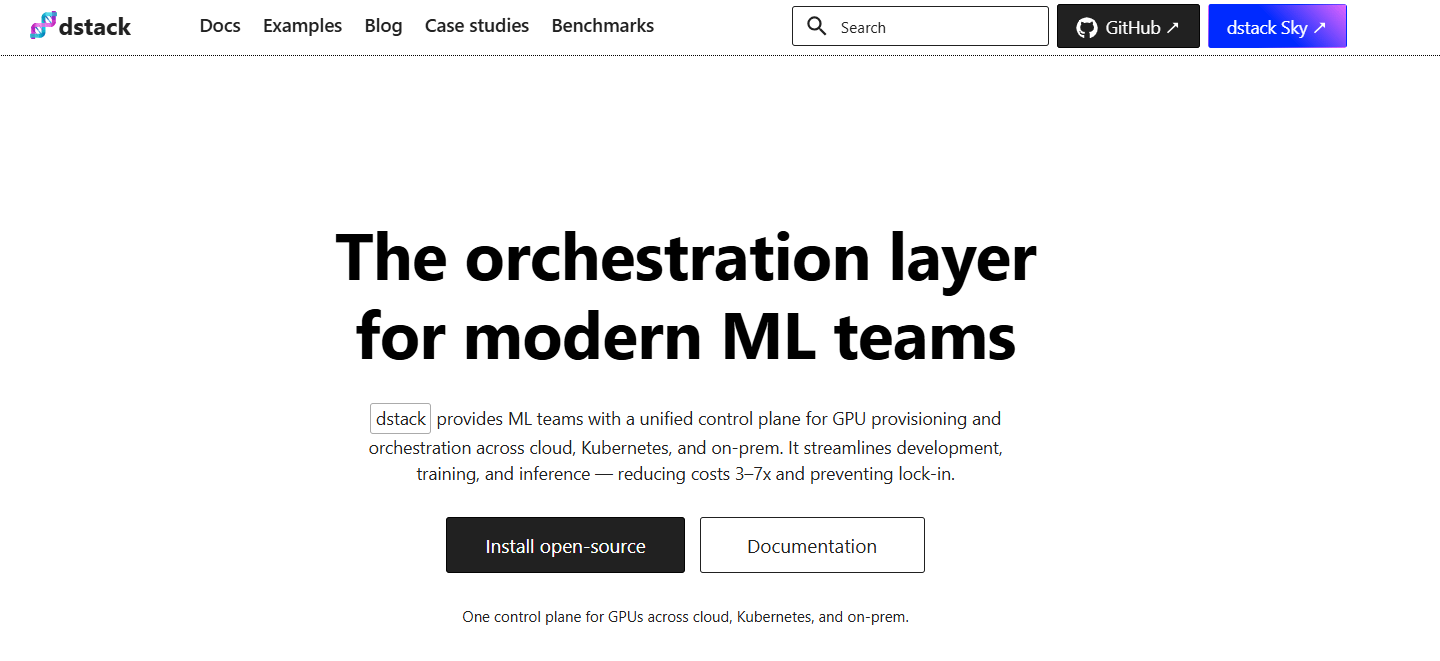
Open orchestration platform that gives ML teams a unified control plane for GPU provisioning and workload execution across clouds, Kubernetes, and on-prem. Built to simplify dev environments, training, and inference with ML-centric primitives instead of general-purpose schedulers.
According to vendor documentation.
Best for: ML teams that want one control plane for cloud plus on-prem, and a lighter alternative to Kubernetes or Slurm when they do not need the full K8s stack.
Key Features:
- Unified control of GPUs across multi-cloud, Kubernetes, and SSH-managed on-prem clusters, per vendor documentation.
- Dev environments that bridge desktop IDEs with remote GPUs for fast iteration, per vendor documentation.
- Single-node and distributed training orchestration with simple YAML configs, per vendor documentation.
- OpenAI-compatible inference endpoints with autoscaling, per vendor documentation.
Why we like it: From our experience in the startup ecosystem, dstack's ML-native objects reduce time spent on cluster plumbing when teams bounce between cloud GPUs and a few on-prem boxes. A third-party partnership note also confirms its open-source orientation and multi-cloud intent, which aligns with cost shopping across providers (Vultr blog announcement).
Notable Limitations:
- Kubernetes backend requires pre-provisioned nodes and does not yet offer full managed autoscaling, per vendor documentation.
- Limited independent reviews, so due diligence and a pilot are recommended as of February 2026.
- Enterprise security attestations and large-scale benchmarks are not broadly published by third parties.
Pricing: Pricing not publicly available. dstack has an AWS Marketplace listing that validates packaging for AWS environments, but the listing does not expose a paid price (AWS Marketplace listing).
GPUFleet AI
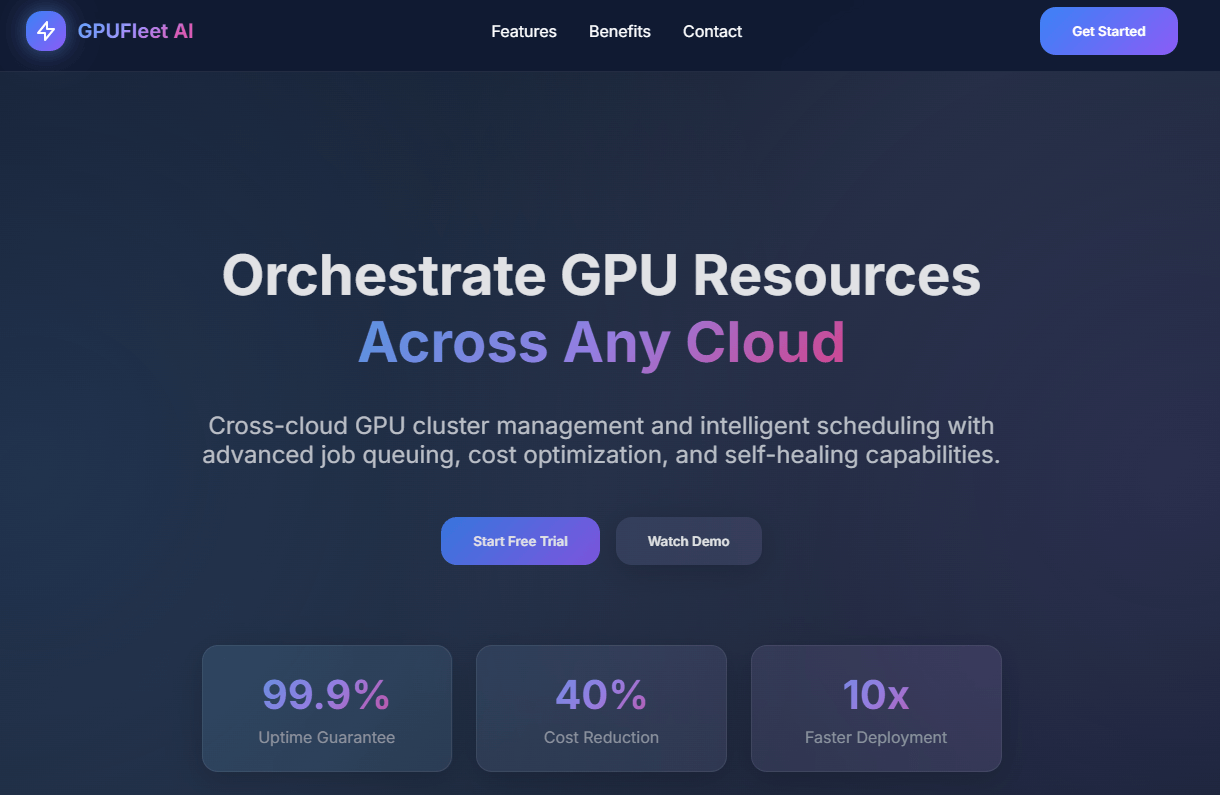
GPU orchestration platform focused on cross-cloud cluster management, intelligent job queuing, and real-time analytics. Positioning emphasizes cost optimization, self-healing, and autoscaling across multiple providers.
According to vendor documentation.
Best for: Teams that want a single pane for multi-cloud GPU scheduling and are exploring cost controls on mixed fleets.
Key Features:
- Intelligent job queue and cross-cloud scheduling with automatic load balancing, per vendor documentation.
- Cost optimization with real-time analysis and autoscaling, per vendor documentation.
- Self-healing with automated failure detection and recovery, plus real-time dashboards, per vendor documentation.
Why we like it: Working across different tech companies, we have seen value in simple job queues that hide provider quirks and cut idle time when GPUs are fragmented across regions or vendors.
Notable Limitations:
- No independent third-party reviews, benchmarks, or verification available as of February 2026. Exercise caution and conduct thorough due diligence.
- No verified marketplace listing at the time of research, which may slow enterprise procurement.
- Security certifications and audit artifacts are not publicly documented by third parties.
Pricing: Pricing not publicly available. The vendor advertises a trial, but pricing or terms could not be verified on neutral marketplaces. Contact the vendor for a custom quote.
Exostellar AIM
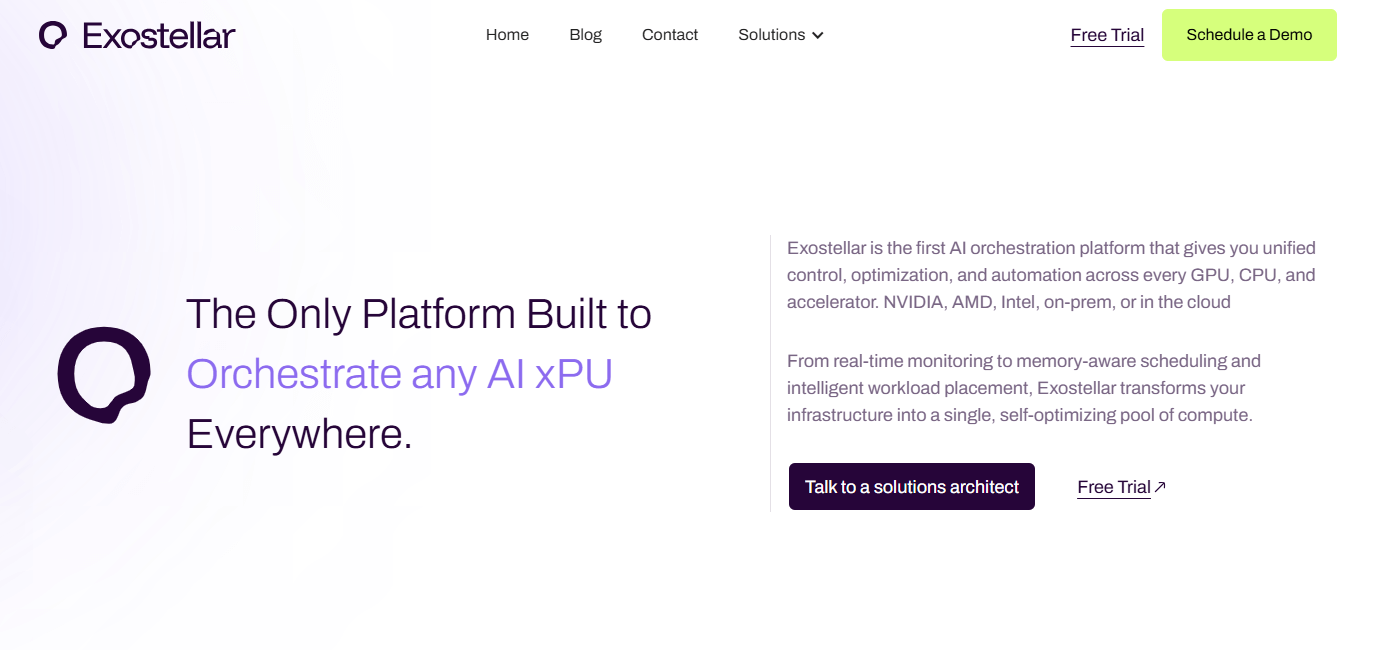
Unified AI infrastructure management for heterogeneous accelerators and multi-cluster GPU environments. Announced capabilities include topology-aware scheduling, hierarchical quotas, and real-time observability across NVIDIA, AMD, and other accelerators.
Backed by third-party press and marketplace listings.
Best for: Enterprises running mixed accelerators across several Kubernetes clusters, who need federation, quota management, and policy-driven scheduling.
Key Features:
- Multi-cluster federation, cross-cluster scheduling, and hierarchical quota management (Business Wire GA announcement).
- Vendor-agnostic GPU slicing and dynamic right-sizing beyond fixed partitions, built on Kubernetes device resource allocation primitives (Business Wire SDG announcement).
- Kubernetes-native integration and real-time utilization with observability for reclamation and rebalancing.
Why we like it: After helping startups scale, we value policy-driven quota sharing across teams and topology-aware placement. Exostellar's focus on heterogeneous GPUs plus marketplace artifacts lowers procurement friction for pilots.
Notable Limitations:
- Newer platform in rapid development, so feature depth may vary by accelerator. Independent reviews remain limited.
- Real-world results depend on cluster topology and model mix. Validate slicing and preemption settings in a pilot.
- Some components are free listings while enterprise support and full features are contract based.
Pricing: AWS Marketplace lists the Exostellar Controller and Worker AMIs as free listings, with underlying AWS costs billed separately. Enterprise platform pricing is not publicly available, so contact Exostellar for a custom quote (AWS Marketplace, Controller, AWS Marketplace, Worker).
AI Infrastructure & GPU Orchestration Tools Comparison: Quick Overview
| Tool | Best For | Pricing Model | Highlights |
|---|---|---|---|
| dstack | Unified control across cloud, K8s, on-prem | Not publicly available (OSS core) | ML-native dev envs, distributed jobs, simple configs |
| GPUFleet AI | Cross-cloud job scheduling and cost controls | Not publicly available | Intelligent queue, autoscaling, real-time analytics |
| Exostellar AIM | Multi-cluster, heterogeneous GPU orchestration | Enterprise contracts | Federation, hierarchical quotas, GPU slicing |
AI Infrastructure & GPU Orchestration Platform Comparison: Key Features at a Glance
| Tool | Multi-Cluster Federation | Heterogeneous GPU Support | Quota Management |
|---|---|---|---|
| dstack | Partial, per vendor docs via fleets and backends | NVIDIA, AMD, TPU per vendor docs | Project level controls, per vendor docs |
| GPUFleet AI | Claimed cross-cloud cluster mgmt | Claimed multi-provider support | Not publicly documented |
| Exostellar AIM | Yes, per Business Wire GA coverage | Yes, NVIDIA, AMD, others per GA coverage | Yes, hierarchical quota per GA coverage |
AI Infrastructure & GPU Orchestration Deployment Options
| Tool | Cloud API | On-Premise | Integration Complexity |
|---|---|---|---|
| dstack | Yes, plus AWS Marketplace packaging | Yes, SSH fleets and K8s backend per vendor docs | Moderate, ML-centric configs |
| GPUFleet AI | Claimed multi-cloud APIs | Claimed support | Unknown, limited third-party detail |
| Exostellar AIM | Yes, AWS Marketplace artifacts | Yes, K8s-native | Moderate to high, depends on cluster topology |
AI Infrastructure & GPU Orchestration Strategic Decision Framework
| Critical Question | Why It Matters | What to Evaluate |
|---|---|---|
| Do we need multi-cluster federation now or within 12 months | Avoids stranded GPUs across projects and regions | Cross-cluster scheduling, preemption, quota sharing |
| How do we handle spot evictions without SLO hits | Spot saves money but hurts reliability | Preemption policies, checkpointing, right-sizing |
| Can the platform schedule across heterogeneous accelerators | Supply and price volatility push you to non-NVIDIA too | Vendor-agnostic scheduling, slicing, topology awareness |
| Is Kubernetes required for day one | K8s adds power and complexity | K8s-native vs ML-native control planes |
AI Infrastructure & GPU Orchestration Solutions Comparison: Pricing & Capabilities Overview
| Organization Size | Recommended Setup | Monthly Cost |
|---|---|---|
| Seed to Series A | dstack pilot on a small mixed cloud and on-prem fleet | Varies by cloud GPU rates, platform pricing not public |
| Growth stage | Exostellar AIM pilot across two K8s clusters, add quotas | AWS infra plus enterprise contract, see Marketplace notes |
| Enterprise | RFP including Exostellar AIM and a K8s baseline alternative | Enterprise contracts, internal ops included |
Problems & Solutions
-
Problem: GPU cost and availability vary widely by region and provider, and hyperscalers are accelerating capex to chase demand, which can push enterprises into price spikes and long queues. TrendForce expects eight major CSPs to surpass $600 billion in capex by 2026, driven by GPU procurement and rack-scale systems, which signals persistent volatility for buyers (TrendForce press). IDC also forecasts AI infrastructure spending to reach about $223 billion by 2028, with most AI servers deployed in cloud environments, which raises the bar for cross-cloud capacity management. As a reference point for budgeting, Google lists L4, A100, H100, and H200 hourly prices on public pages, illustrating the spread buyers must navigate (Vertex AI pricing).
-
How dstack helps: A unified control plane simplifies moving workloads across cloud GPUs and on-prem nodes, with ML-centric configs that reduce ops time, per vendor documentation. This is useful when you need to chase better pricing or different GPU SKUs across providers. A third-party partnership note also highlights its open-source approach, helpful for keeping options open during cost shopping.
-
How GPUFleet AI helps: For teams prioritizing cross-cloud queues and quick scaling, the product's claimed intelligent scheduling and real-time analytics can reduce idle time and speed failover, per vendor documentation. Given the limited third-party validation, run a time-boxed pilot to measure queue wait times and target utilization.
-
How Exostellar AIM helps: Multi-cluster federation, hierarchical quotas, and topology-aware scheduling address stranded capacity and long queues. Its vendor-agnostic slicing aims to raise density during inference, which is valuable when H100 and H200 supply is tight or costly. If you run on GKE, review Google's GPU scheduling behaviors to align expectations on node provisioning and taints before testing advanced orchestration features (GKE GPU allocation guide).
-
What To Do Next
If you are choosing between these, start with a 30 day bakeoff that measures three things:
- Queue wait time to first token for inference and to first epoch for training, across two distinct GPU SKUs.
- Achieved GPU utilization and cost per 1k tokens or per training step, with and without spot.
- Admin overhead, including time to isolate a noisy neighbor and time to grant GPU access to a new team.
Gartner's latest outlook on AI-optimized IaaS confirms spending is surging into the specific infrastructure these platforms target, so even small utilization gains pay back quickly in 2026 budgets. IDC's forecast underscores that the shift to cloud-deployed AI servers will keep multi-cloud orchestration relevant for years, which is why we prioritized federation, quota control, and heterogeneous support in the picks above.