

Most teams discover that “automated” campaigns stall at integrations or approvals during the first real launch, not from a sales demo. From our experience in the startup ecosystem, the biggest wins come from nailing technical building blocks like event-level attribution mapping, CRM and ESP permission scopes, and human-in-the-loop review queues. You think you know your stack until an agent must post to four ad networks, push UTM-clean data to analytics, and log versions for legal sign-off. The upside is real, with generative AI already reshaping marketing workflows according to McKinsey’s analysis, and we will focus on where these agents actually save time and budget.
McKinsey estimated in 2023 that generative AI could add up to $4.4 trillion in annual value globally, with marketing and sales among the highest exposure functions, and 2024 survey data shows marketing as one of the top departments adopting gen AI, both points that reinforce why these tools matter now (McKinsey report). In the next sections you will learn exactly who each tool is best for, the verified feature set, pricing transparency where available, and the tradeoffs that real buyers should consider, with third-party evidence from analysts and review research.
TurboAgents
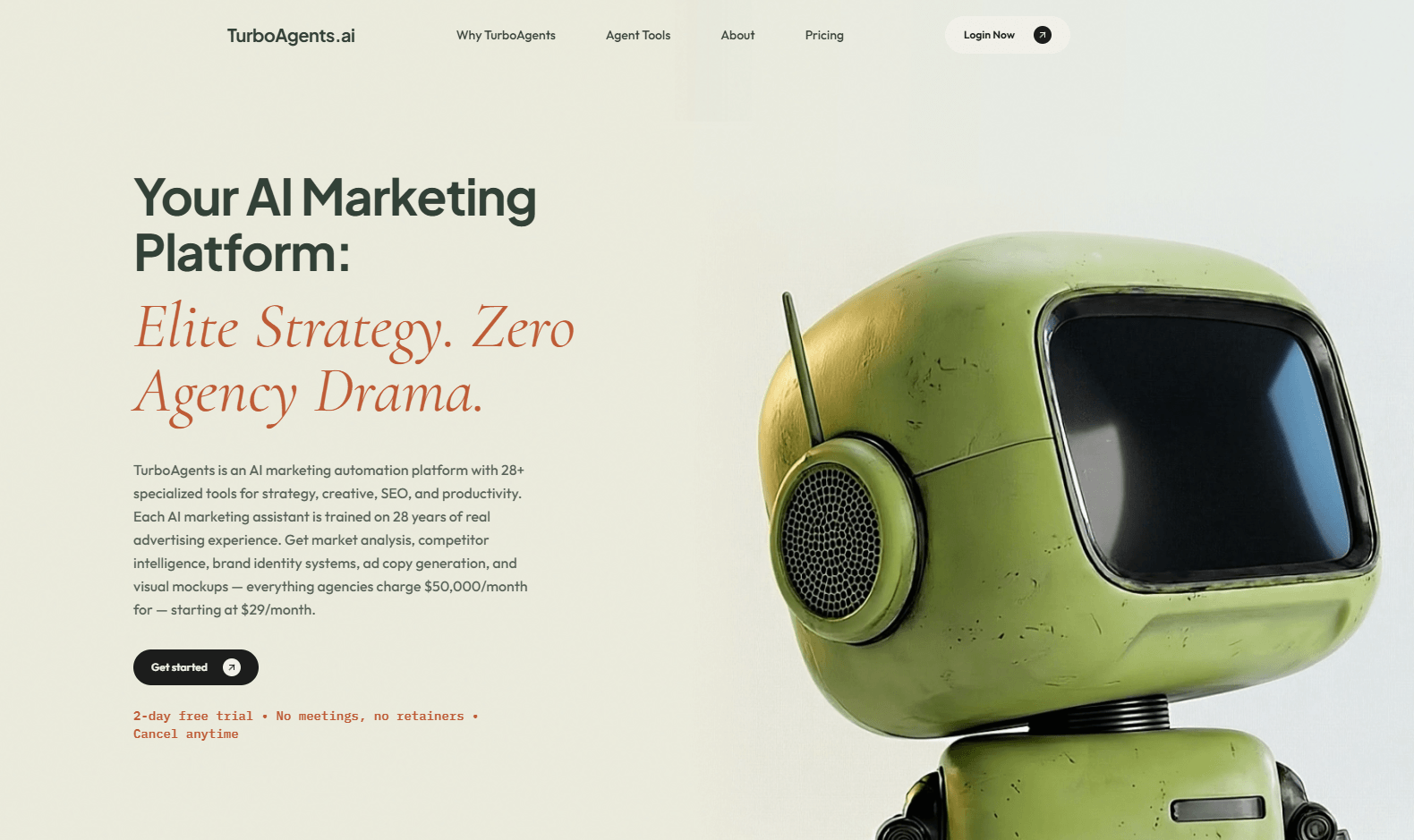
A marketing automation suite with 28 plus specialized AI tools spanning strategy, creative, SEO, and productivity. Built to output production files like briefs, mockups, and documents rather than prompts or suggestions, per TurboAgents documentation.
- Best for: Solo marketers, creators, and small agencies that want breadth, not a point tool.
- Key Features: Per TurboAgents documentation, 28 plus task-specific tools across strategy, creative, SEO, and productivity, professional file outputs, token metering with plan caps, and new tools added on a rolling basis.
- Why we like it: The task-specific model means less prompt wrangling. In practice, it can replace multiple single-purpose apps for competitor analysis, positioning, ad copy, and SEO content.
- Notable Limitations:
- Independent third-party reviews are limited as of June 2026, so public feedback is scarce, a known issue in this category per multiple discussions about review reliability on major directories (Reddit thread).
- Like many AI marketing tools, users may encounter generic outputs without strong inputs and review loops, a pattern flagged in G2’s research on agent builders and AI tools (G2 insights).
- Integration breadth is not the focus, and buyers often cite workflow and connector friction when agents touch real systems, a risk area highlighted across buyer feedback studies (G2 agent builders report).
- Pricing: Per TurboAgents documentation, plans list from approximately $29 per month for Basic, $99 per month for Pro, and $199 per month for Agency. Pricing not independently verified on a marketplace. Contact the vendor for a custom quote if you need higher limits.
ServoAgent
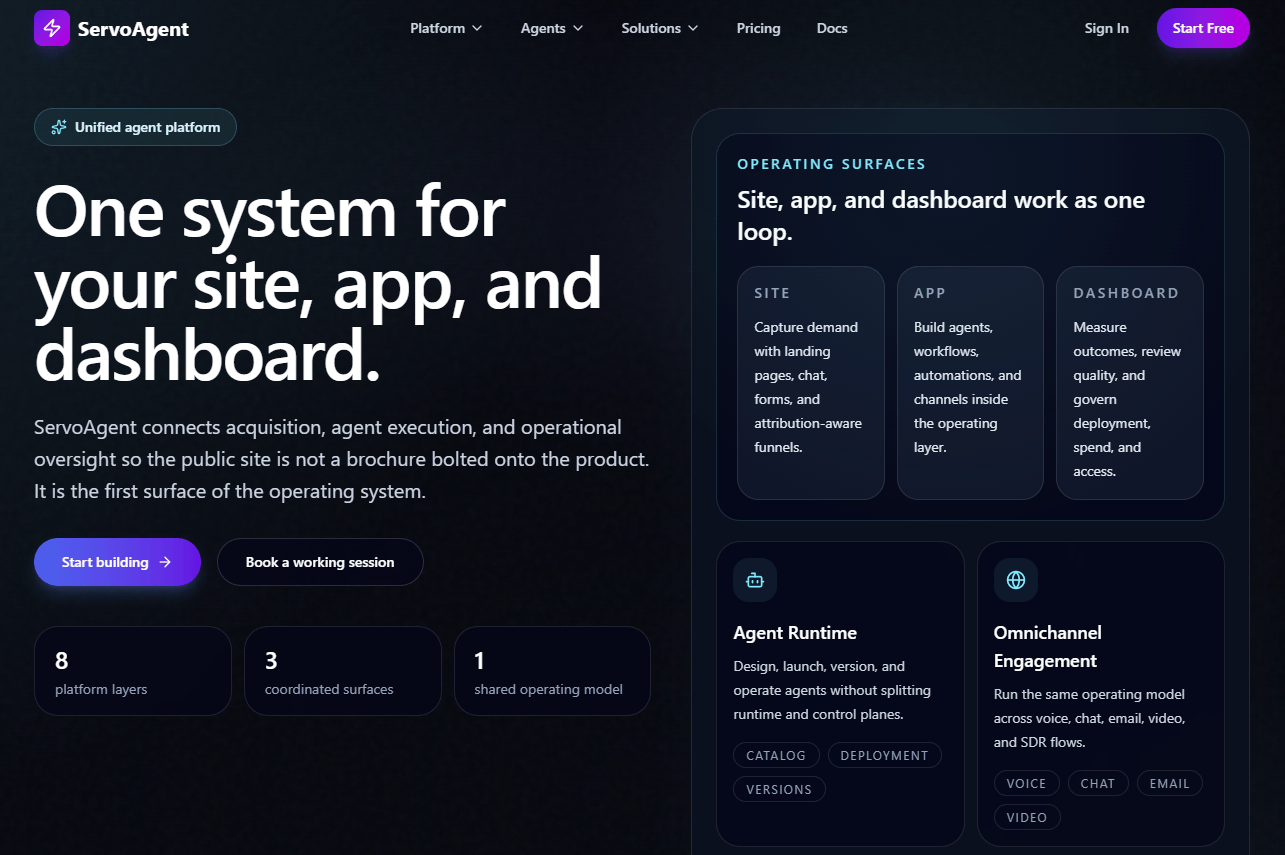
A platform to deploy and govern AI agents across voice, chat, email, video, and SDR, with a shared operating model for acquisition, execution, and oversight, per ServoAgent documentation. Includes free tier with metered interactions on entry.
- Best for: Teams that need one stack for omnichannel agents plus governance, reporting, and versioning.
- Key Features: Per ServoAgent documentation, omnichannel agents for voice, chat, email, video, and SDR, analytics and observability, approvals and budget controls, connectors and workflow orchestration, and multi-workspace agency operations.
- Why we like it: It treats agents, channels, and governance as one loop. That matters when sales wants outreach, marketing wants content, and ops needs auditability.
- Notable Limitations:
- The breadth of channels can raise integration complexity, which is the most cited failure point for agent workflows in third-party analyses (G2 insights).
- Fully autonomous outreach can create compliance and brand risks without strong guardrails, a governance need called out by Forrester for agent programs (Forrester analysis).
- Public, independent user review volume is still emerging in this category, so proof often comes from pilots or references rather than large benchmarks (G2 enterprise agents outlook).
- Pricing: Per ServoAgent documentation, Starter is approximately $49 per month, Professional $149 per month, Agency $399 per month, and Enterprise is custom. A free tier with limited interactions is advertised. For enterprise, contact ServoAgent for a custom quote.
AiMOS
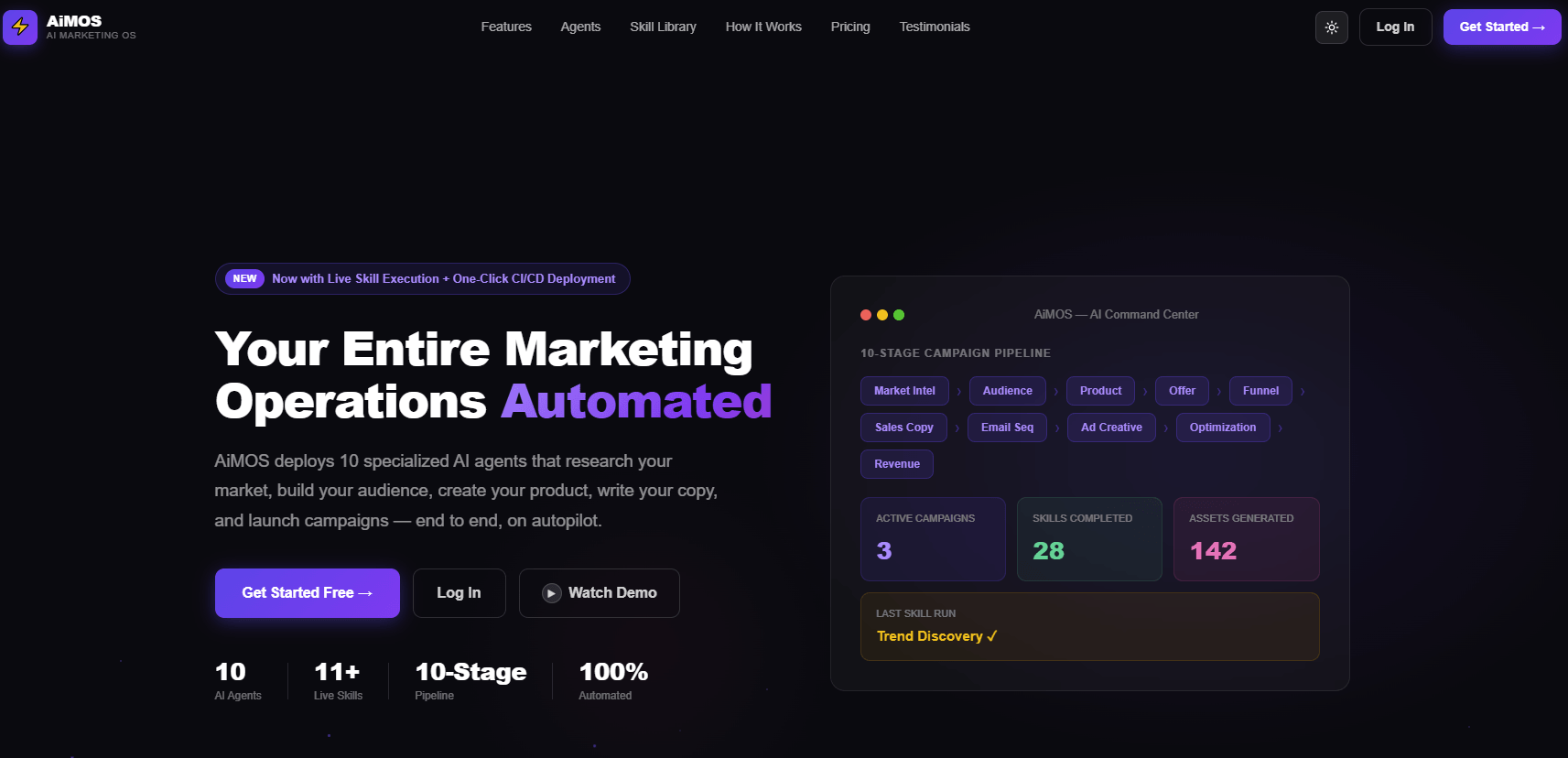
An AI Marketing OS with 10 specialized agents that run a 10-stage pipeline from market research through campaign launch, with live skills and an orchestration layer, per AiMOS documentation. Oriented toward end-to-end campaign generation at speed.
- Best for: Solo founders, creators, and small teams launching direct-response or content-led campaigns quickly.
- Key Features: Per AiMOS documentation, 10 specialized marketing agents, a 10-stage campaign pipeline, live skills execution, a “revenue flywheel” scoring model, and campaign autopilot with alerts.
- Why we like it: It compresses a typical launch motion into one orchestrated flow, handy for resource-constrained teams who need drafts, assets, and messaging prepared the same day.
- Notable Limitations:
- End-to-end automation can drift in tone or quality without human review, a pattern frequently raised by practitioners testing agent autopilot in marketing contexts (Reddit practitioner recap).
- Independent third-party reviews remain thin in this niche, which requires extra diligence on pilots and KPIs before committing (G2 agent builders report).
- Integrations appear narrower than enterprise stacks, so teams with complex CRMs, CDPs, or data warehouses may need workarounds, a common source of friction noted across AI agent deployments (G2 insights).
- Pricing: Per AiMOS documentation, Starter is approximately $27 per month, Pro $97 per month, and Enterprise $297 per month, with a short free trial. Pricing not independently verified on a marketplace. Contact the vendor for a custom quote if your needs exceed listed tiers.
OpenAnalyst
Full-stack marketing agents that emphasize review gates, auditability, and deployment paths for enterprise teams, per OpenAnalyst documentation. Includes agents for paid media, lifecycle, content ops, lead routing, reporting, and governance.
- Best for: Enterprise marketing and RevOps teams that need agent workflows with explicit approvals, identity controls, and hosting choices.
- Key Features: Per OpenAnalyst documentation, review and approval paths, SSO and RBAC expectations, audit and observability, custom hosting options, and scoped deployments aligned to enterprise requirements.
- Why we like it: It starts with governance and deployment, not just content. That maps to how enterprises actually introduce agent workflows into production environments.
- Notable Limitations:
- Custom deployments require time and internal alignment, which mirrors analyst guidance to treat each agent as a governed identity with lifecycle controls (Forrester guidance).
- Pricing is call-driven and may start with a paid consultation, which raises the bar versus self-serve options.
- Independent user reviews are limited, so proof of value typically comes from scoped pilots and internal scorecards rather than broad public benchmarks (G2 enterprise agents outlook).
- Pricing: Pricing not publicly available. Per OpenAnalyst documentation, enterprise consultations start at approximately $3,000 to scope requirements. Contact OpenAnalyst for a custom quote.
AI Marketing Agents Tools Comparison: Quick Overview
| Tool | Best For | Pricing Model | Highlights |
|---|---|---|---|
| TurboAgents | Solo marketers and small agencies | Tiered subscription, short trial listed | 28 plus task-specific tools across strategy, creative, SEO |
| ServoAgent | Teams deploying omnichannel agents | Tiered subscription and enterprise custom, free metered tier | Unified runtime, governance, analytics across voice, chat, email, video, SDR |
| AiMOS | Fast direct-response and content launches | Tiered subscription, short trial listed | 10-stage pipeline, live skills, campaign autopilot |
| OpenAnalyst | Enterprise marketing and RevOps | Call-driven, enterprise deployment, no free tier advertised | Review gates, audit trails, SSO and hosting options mapped to IT requirements |
AI Marketing Agents Platform Comparison: Key Features at a Glance
| Tool | Planning and Research | Creative and Content | Analytics and Audit |
|---|---|---|---|
| TurboAgents | Market and competitor intelligence, positioning | Ad copy, brand kits, SEO content | Basic outputs and files for reporting |
| ServoAgent | Pipeline capture, SDR, lead flows | Multichannel outreach, content at channel level | Analytics, evaluations, governance and approvals |
| AiMOS | Trend discovery, personas, offer design | Sales pages, email sequences, ad creative | Flywheel scoring, alerts, campaign autopilot |
| OpenAnalyst | Campaign and lifecycle analysis | Content briefs and workflow approvals | Audit logs, review states, identity and source controls |
AI Marketing Agents Deployment Options
| Tool | Cloud API | On-Premise | Integration Complexity |
|---|---|---|---|
| TurboAgents | Not emphasized | Not advertised | Low to medium, oriented to output and content |
| ServoAgent | Yes | Enterprise option listed | Medium to high given channels and connectors |
| AiMOS | Not emphasized | Not advertised | Medium for small stacks, higher for complex CRMs |
| OpenAnalyst | Yes | Customer infrastructure option | High, but governed with approvals and RBAC |
AI Marketing Agents Strategic Decision Framework
| Critical Question | Why It Matters | What to Evaluate | Red Flags |
|---|---|---|---|
| Where will human review sit in the loop? | Human-in-the-loop improves quality and trust, tied to adoption findings in enterprise agent programs (G2 enterprise report). | Draft, review, approve, publish states, named owners. | Agents that “auto-publish” without logs or approvals. |
| Which integrations are must-have on day one? | Integration friction is the top failure point in agent workflows (G2 insights). | CRM, ESP, ad networks, data warehouse, analytics. | Connectors missing or unstable, manual CSV hops. |
| What governance and identity controls are required? | Analysts advise treating every agent as a governed identity (Forrester analysis). | SSO, RBAC, audit logs, budget controls, evidence checks. | No auditability, no approval gates, unclear source rules. |
| How will success be measured? | Gen AI value requires measurable KPI lift, not demos (McKinsey perspective). | Baselines, agent scorecards, eval rubrics, A/B plans. | Vague ROI claims, no experiment design. |
AI Marketing Agents Solutions Comparison: Pricing and Capabilities Overview
| Organization Size | Recommended Setup | Monthly Cost | Annual Investment |
|---|---|---|---|
| Solo creator or SMB | TurboAgents or AiMOS for planning and content, light review queue | Roughly $27 to $99, per vendor documentation | $324 to $1,188, excluding add-ons |
| Growth team with outbound | ServoAgent Professional for multichannel agents, add review gates | Roughly $149, per vendor documentation | $1,788 plus pilot time |
| Enterprise marketing ops | OpenAnalyst scoped deployment with approvals and SSO | Pricing not publicly listed | Starts with a paid consultation per vendor documentation, then custom |
Problems & Solutions
-
Problem: “Our agent created content fast, but publishing stalled because legal and brand teams need approvals.”
Solution: Choose platforms that make review states and audit trails first class. OpenAnalyst centers approvals, RBAC, and auditability, which aligns with analyst guidance to govern agents as explicit identities with lifecycle controls (Forrester analysis). -
Problem: “The agent demo looked great, then integrations broke when we connected CRM, ads, and email.”
Solution: ServoAgent positions acquisition, execution, and governance on one stack, which directly tackles the integration friction that buyers repeatedly flag across agent deployments (G2 insights). Start with a single, high-value workflow before scaling. -
Problem: “We cannot keep up with research, briefs, and first drafts for every channel.”
Solution: TurboAgents and AiMOS compress planning and creative into orchestrated runs so teams can review instead of write from scratch. This is where gen AI shows early productivity impact in marketing, as documented in industry research (McKinsey perspective). -
Problem: “Autonomous outreach went off brand, we need results without reputational risk.”
Solution: Keep human-in-the-loop for anything customer-facing. Programs with human oversight show stronger, more durable outcomes in third-party reviews research (G2 enterprise agents outlook). Use ServoAgent’s approvals or OpenAnalyst’s guardrails before messages are sent. -
Problem: “Leadership wants proof beyond anecdotes.”
Solution: Build scorecards and A/B plans into the workflow. Industry surveys show momentum, but ROI depends on measurement design, not hype (McKinsey 2024 AI survey). Start with one KPI, one channel, and a defined review cadence.
The Bottom Line on AI Marketing Agents
Agent platforms are moving from demos to deployment, helped by growing enterprise investment and even acquisitions in the agent ecosystem, like recent coverage of agentic platforms in mainstream tech media (TechCrunch on an agent-builder acquisition and Axios on Meta’s agent network deal). The gains are real when teams pair planning and content agents with governance and measurement. The risks are real too, particularly when autonomy outruns controls, a point Forrester underscored in its B2B predictions about ungoverned gen AI risk in go-to-market teams (Forrester predictions release). If you pilot with tight scopes, define review gates, and measure outcomes, the four tools above can cut days of manual work into hours while protecting brand and budget.