You think you know your stack is "automated" until one off request floods your support queue and your brittle Zaps, scripts, and webhooks start failing. From my experience in the startup ecosystem, the biggest wins come from AI-native automation that can reason about tasks, not just pass data. Real examples that pay off fast include AI triage that routes emails to Jira with SLO checks, lead enrichment that posts scored accounts to Slack for approval, and invoice capture that posts to NetSuite with variance flags. TechCrunch's reporting on AI-first orchestration and agent builders confirms that the space has matured well beyond simple triggers and actions, making this a good moment to upgrade your approach to automation (TechCrunch coverage).
Industry analysts project strong growth in hyperautomation software, with demand driven by talent shortages and digital transformation initiatives. I analyzed several platforms across iPaaS, low code suites, and agent builders, then narrowed to five that consistently combine reasoning, orchestration, and governance. In a few minutes you will know which tools fit your size, data posture, and budget, where they break, and how to avoid common deployment traps.
n8n

Source available low code automations that you can self host or run in the cloud. Recent releases add an AI workflow builder that generates flows from natural language, then lets you refine them.
Best for: Technical teams that want a self hosted option with deep control and prompt based workflow generation.
Key Features:
- AI workflow builder that creates and edits flows from natural language, per vendor documentation and media interviews.
- Large node library, plus community nodes now available in cloud and self hosted editions, based on community release notes (r/n8n thread summarizing node availability).
- Self hosting via Docker or VPS is common for teams needing data residency or cost control (community how-tos).
Why we like it: Self hosting keeps data in your environment, execution based pricing is predictable, and prompt based building cuts setup time for common flows.
Notable Limitations:
- Steeper learning curve and UI complexity at large flow sizes, per user reviews (G2 reviews page).
- Some AI builder capabilities roll out to cloud first and may lag on self hosted, per recent community updates (community discussion).
Pricing: Cloud Starter and Pro plans are listed at roughly €20 and €50 per month respectively on third party listings, with self hosted Community Edition free, and Enterprise by quote (G2 pricing snapshot). Always confirm current pricing with the vendor.
Zapier
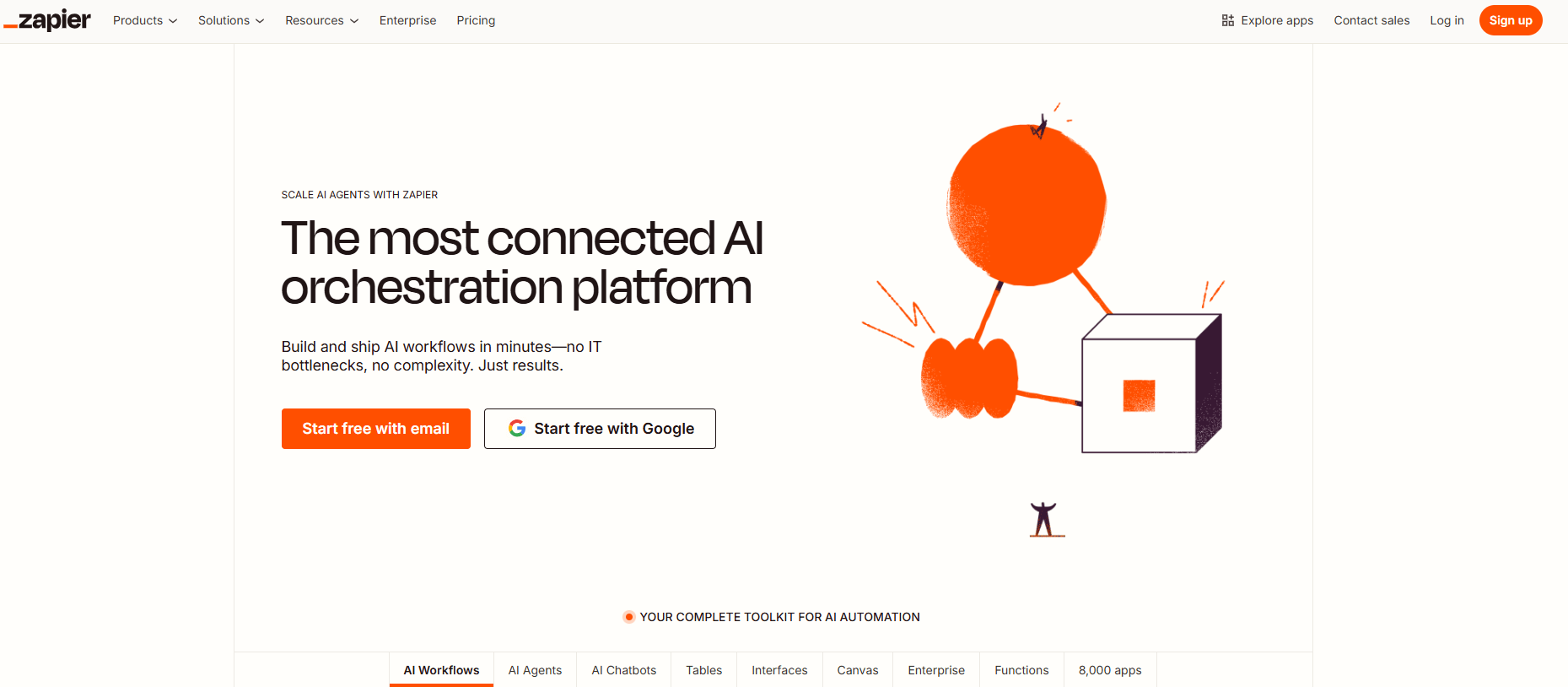
Cloud based automation across thousands of apps with AI agents that can operate independently and work in pods. Recent updates emphasize orchestration and governance at scale.
Best for: Business teams that need fast wins across many SaaS tools, plus AI agents for repetitive tasks.
Key Features:
- Zapier Central evolved into Zapier Agents, enabling AI bots that act across 7,000 plus apps, according to a public launch announcement (PR Newswire summary).
- Agents now focus on automation over chat and can be grouped in pods for monitoring, per product update notes.
- New governance and assistant capabilities announced in 2025 add MCP connectivity and enterprise controls (Yahoo Finance press release reprint).
Why we like it: The app ecosystem is unmatched for SMB and mid market, and the agents model reduces "chatbot sprawl" by pushing toward outcome oriented automation.
Notable Limitations:
- Costs scale with task volume, which can surprise teams as usage grows, per third party pricing guides and user commentary (Capterra pricing guide).
- Complex data transforms and versioned governance remain lighter than enterprise iPaaS standards, per analyst and buyer comparisons.
Pricing: Free, Professional, Team, and Enterprise tiers with usage based task allowances, for example $29.99 per month for Professional when billed monthly, per third party listings. Pricing for Agents is in flux during beta, verify directly with the vendor.
Workato
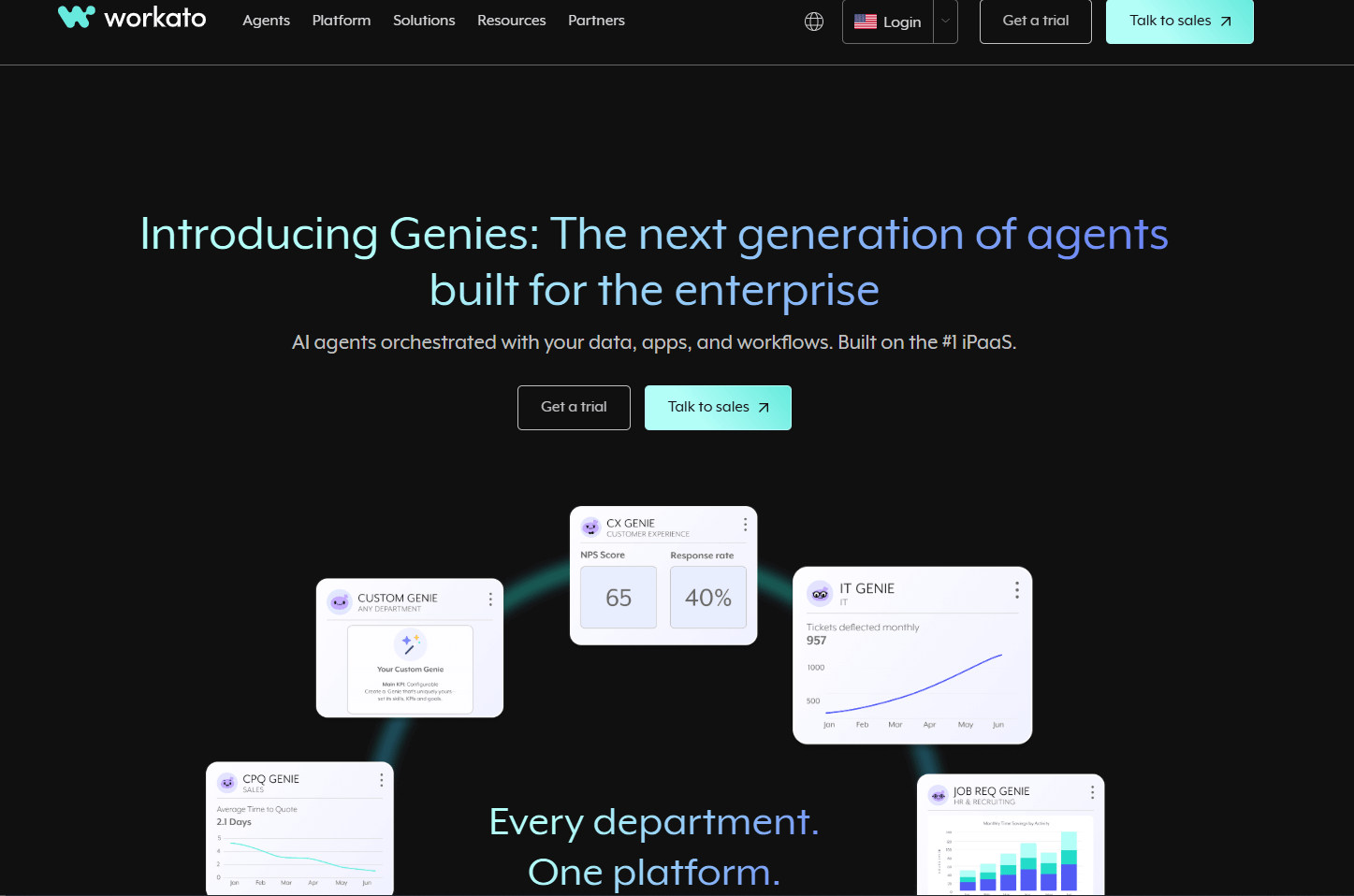
Enterprise orchestration platform with agent centric features and strong governance. Recent "Workato One" release unifies agent building, MCP connectors, and operations in one console.
Best for: Enterprises that need end to end process orchestration, data context, and policy controls across departments.
Key Features:
- Workato One introduces Agent Studio, Agent Hub, Agent Trust, and orchestration across CRM, ERP, HR, and ITSM, as announced in March 2025.
- Enterprise Model Context Protocol offering to connect agents like ChatGPT and Claude to governed enterprise skills and data, now available per the company's newsroom and independent coverage (Business Wire MCP announcement, Axios coverage).
- Recognized on industry lists and analyst reports for iPaaS leadership, which indicates broad connector depth and scale (Business Wire note on Gartner MQ and Cloud 100).
Why we like it: Mature governance, on prem agents for data behind firewalls, and a clear path to production scale agents make it fit for high stakes processes.
Notable Limitations:
- Buyers frequently cite higher cost compared to SMB tools, per third party reviews (G2 pricing overview).
- Requires upfront design and change management to realize value at enterprise scale, per buyer feedback on analyst and review sites.
Pricing: Pricing not publicly available. Contact Workato for a custom quote. Third party listings confirm "contact vendor" and usage based pricing models (G2 pricing overview, Workato pricing docs summary).
Pegasystems Pega Infinity
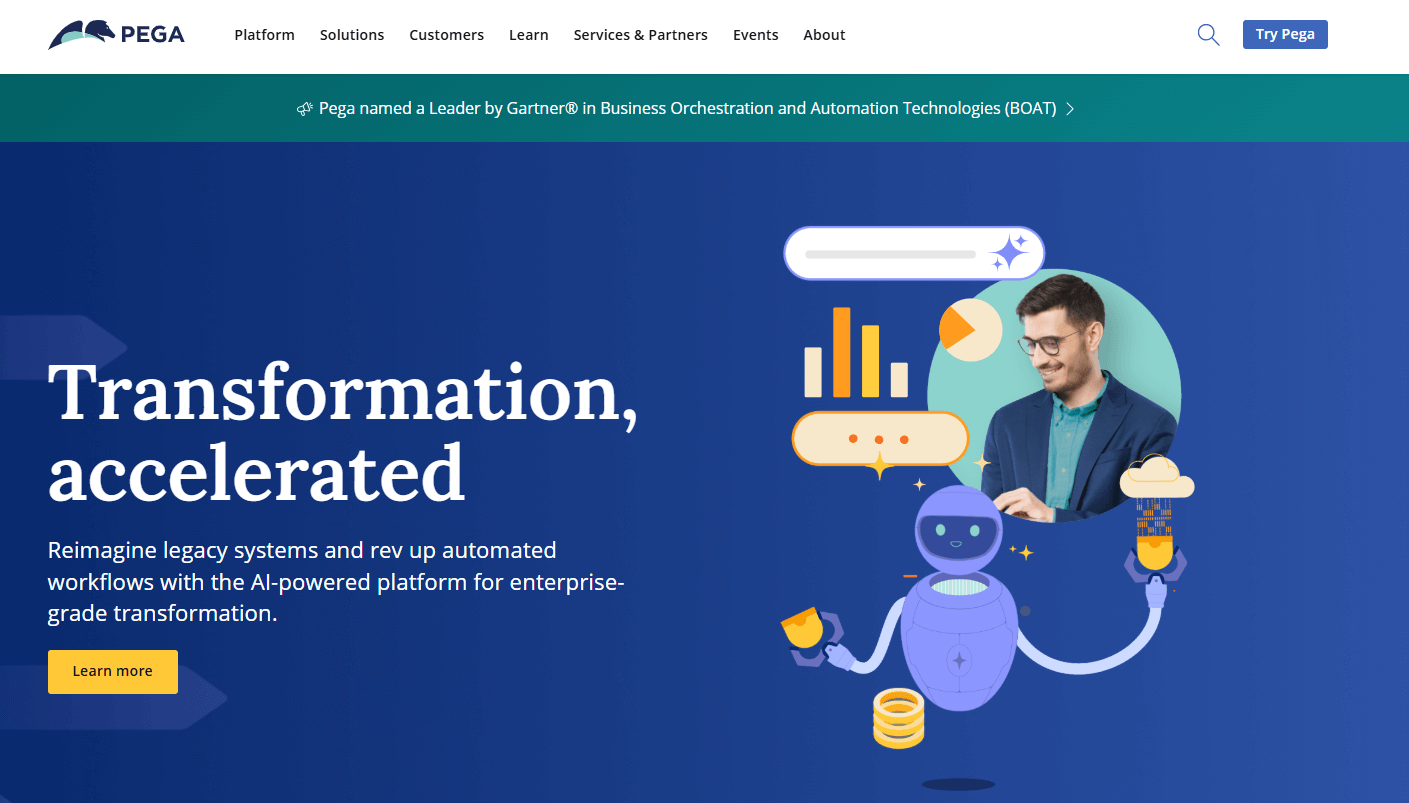
Enterprise low code workflow and decisioning suite. The 2025 release positions Pega Infinity as an agentic transformation platform with a fabric that orchestrates AI agents and systems.
Best for: Regulated enterprises that need generative design time, predictable run time automation, and centralized governance.
Key Features:
- Pega Infinity '25 introduces an agentic platform that combines reasoning at design time with dependable execution at run time, per release notes carried by wire services (Business Wire GA announcement).
- Agentic Process Fabric orchestrates agents and systems across the enterprise, announced at PegaWorld 2025 and covered by multiple outlets.
- Collaboration and embedded experiences, for example Microsoft Teams integration and multi experience chat widgets, added in the '25 cycle.
Why we like it: Strong decisioning heritage with centralized control and the new fabric pattern can help large orgs avoid fragmented "agent islands."
Notable Limitations:
- Longer implementation times and higher cost are common buyer themes, with a 7 month median time to implement and 26 months to ROI on review aggregators (G2 Pega Platform page).
- Steep learning curve and talent availability concerns appear in peer reviews and marketplaces (G2 buyer commentary, AWS Marketplace insights).
Pricing: Pricing not publicly available. Contact Pegasystems for a custom quote. Third party sites benchmark relative cost but do not provide list pricing (G2 pricing insights).
Lindy.ai
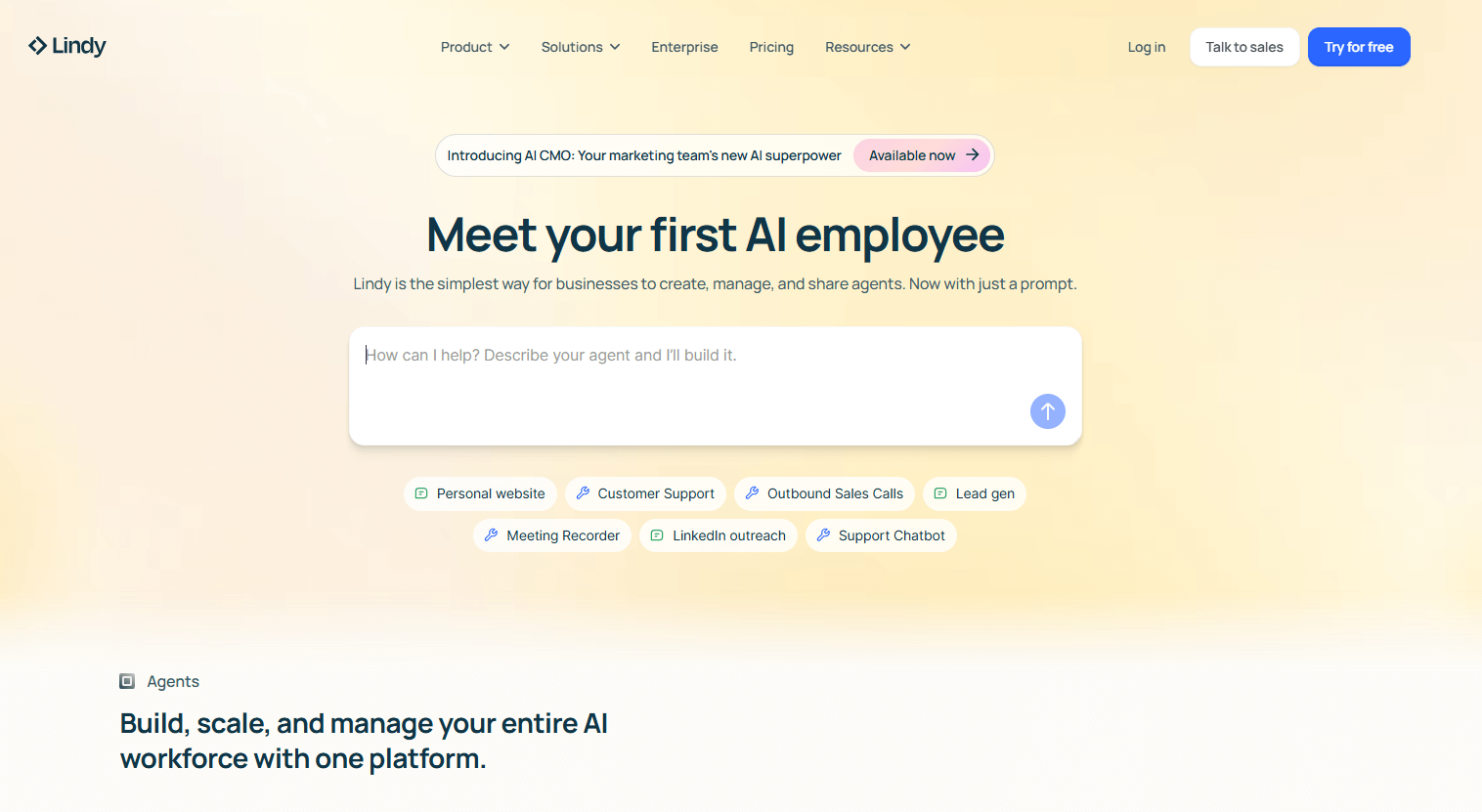
No code agent builder that creates "AI employees" which can read knowledge, act across tools, and even place calls. Focused on sales, customer support, and admin workflows.
Best for: Teams that want natural language agent creation with templates for sales ops, support, and scheduling.
Key Features:
- Natural language agent creation with multi agent coordination and a growing template library, per third party reviews and guides (CreativeAdvisor review, G2 reviews).
- Voice agent features and phone call capabilities reported in independent roundups, useful for reception and scheduling scenarios (SaaSworthy pricing and features page).
- Broad connector coverage through native apps and partner ecosystems, as described by reviewers.
Why we like it: Fast to test agentic workflows without code, handy for teams that want to pilot voice or inbox style assistants before investing in heavier platforms.
Notable Limitations:
- Credit based usage can pause agents when limits are hit, and enterprise controls are still maturing, per independent reviews.
- Users note reliability hiccups and a learning curve despite the "no code" pitch, per community and review feedback.
Pricing: Third party trackers list a free tier and paid plans starting around $49.99 per month, with higher tiers for voice and usage, subject to change. Verify current pricing with the vendor.
AI-Native Workflow Automation Tools Comparison: Quick Overview
| Tool | Best For | Pricing Model | Free Option |
|---|---|---|---|
| n8n | Self hosted AI workflows with control | Execution based cloud or free self hosted | Yes, self hosted CE |
| Zapier | SMB to mid market cross app automation | Usage based tasks | Yes |
| Workato | Enterprise orchestration and agent governance | Custom quote, usage based | No public free plan |
| Pega Infinity | Regulated, complex workflows and decisioning | Custom quote | No public free plan |
AI-Native Workflow Automation Platform Comparison: Key Features at a Glance
| Tool | Feature 1 | Feature 2 | Feature 3 |
|---|---|---|---|
| n8n | Prompt based workflow generation | Self hosted or cloud | Large node and community ecosystem |
| Zapier | AI Agents with pods | 7,000 plus integrations | Governance updates and MCP support |
| Workato | Agent Studio and Agent Hub | Enterprise MCP connectors | Strong governance and on prem agent |
| Pega Infinity | Agentic Process Fabric | Design time reasoning, run time predictability | Embedded collaboration widgets |
AI-Native Workflow Automation Deployment Options
| Tool | Cloud API | On-Premise | Air-Gapped | Integration Complexity |
|---|---|---|---|---|
| n8n | Yes | Yes, self hosted | Possible via self hosted networks, verify controls | Moderate for large flows, per user reviews |
| Zapier | Yes | No | No | Low to moderate, scales in task cost |
| Workato | Yes | Yes via on prem agent | Not fully air gapped, agent phones out | Moderate to high, enterprise setup |
| Pega Infinity | Yes via Pega Cloud | Yes | Case by case, verify with vendor | High, typical enterprise rollout |
AI-Native Workflow Automation Strategic Decision Framework
| Critical Question | Why It Matters | What to Evaluate | Red Flags |
|---|---|---|---|
| Where can agents act with least friction today | Early wins build stakeholder buy in | App coverage, auth model, data access | Vendor does not support your core apps |
| Do you need self hosting or data residency | Impacts compliance and cost | Self hosted option, on prem connectors | Cloud only when policies require on prem |
| How will you govern prompts, skills, and changes | Prevents agent drift and outages | Versioning, audit trails, policy controls | No change control or environment isolation |
| What is your cost driver | Avoids surprise overages | Tasks, activities, executions, credits | Metering tied to volume without caps |
AI-Native Workflow Automation Solutions Comparison: Pricing & Capabilities Overview
| Organization Size | Recommended Setup | Monthly Cost | Annual Investment |
|---|---|---|---|
| Startup to SMB | Zapier Team for app automation, add Lindy for voice or inbox agents | Team from about $103.50 per month, Lindy Pro about $49.99 per month | ~$1,800 to $2,000 plus overages |
| Technical SMB or data sensitive | n8n self hosted CE on a VPS | Server costs only, often tens of dollars per month | Few hundred dollars plus ops time, per community norms |
| Mid market | Zapier Team or Workato starter by quote, add n8n for bespoke self hosted flows | Mixed, depends on usage | Varies, confirm with vendor and consider ROI |
| Enterprise | Workato One or Pega Infinity with governed agents | Custom quote | Custom, expect multi quarter rollouts with governance |
Problems & Solutions
-
Problem: Lead routing takes hours, SDRs chase stale prospects.
How tools solve it: Zapier's AI Agents, evolved from Zapier Central, let teams build bots that pull from CRM, enrich profiles, and trigger outreach across thousands of apps, reducing manual triage. Recent updates add pods and dashboards so ops can monitor and tune agents as volume grows. -
Problem: Departments run separate automations, no central control or context.
How tools solve it: Workato One combines Agent Studio for building, Agent Hub for operations, and Agent Trust for governance, plus an enterprise MCP layer so AI agents can safely act on business systems with context. -
Problem: Legacy systems slow down AI adoption and process changes.
How tools solve it: Pega Infinity '25 uses design time reasoning for modernization via Blueprint and run time predictability for execution, while Agentic Process Fabric coordinates agents and workflows across old and new systems. -
Problem: Builders spend days stitching nodes, prompts, and APIs to prototype AI flows.
How tools solve it: n8n's AI workflow builder generates flows from natural language and lets you refine them in a visual editor, speeding up iteration for technical teams that prefer self hosting. -
Problem: You need a receptionist or scheduling assistant that actually makes calls.
How tools solve it: Lindy's plans and reviews highlight phone agent capabilities and credit based tiers, which fit voice scheduling and customer intake pilots, with the caveat of usage caps.
The Bottom Line
Automation breaks down when it can not reason, recover, or explain itself. In 2026, the dividing line is no longer low code versus code, but whether your automation stack supports governed agents that can plan tasks, act across systems, and be observed and controlled in production.
If you need fast cross-app wins with minimal setup, Zapier’s agent model is still the quickest way to replace brittle Zaps with outcome driven workflows. If data residency, customization, or cost predictability matter, n8n gives technical teams AI native automation with ownership and version control. At enterprise scale, where failures carry real operational and regulatory risk, Workato One and Pega Infinity ’25 represent the emerging standard for agent governance, policy enforcement, and change management. Tools like Lindy are best treated as edge accelerators for voice and inbox workflows, not core orchestration.
The market signal is clear. AI first orchestration has moved beyond experimentation into production software, driven by labor constraints and digital transformation pressure highlighted by analysts and confirmed by recent funding and platform consolidation. The teams that win treat agents like production services, with budgets, SLOs, audit trails, and rollback. Start with one workflow tied to revenue or support load, measure time saved and error reduction, then expand only where agents prove they can act safely and predictably.