

Most teams discover their retrieval stack is the real bottleneck during the first enterprise pilot, not from the first demo. From our experience in the startup ecosystem, the biggest wins come from very specific engineering choices like cross-encoder reranking, hybrid BM25 plus vector search, and summary indexes over long PDFs. In a market where generative AI spend is exploding - Gartner forecasts worldwide AI spending will total $2.52 trillion in 2026, a 44 percent increase year-over-year - the bar keeps rising for robust search and retrieval under real production load (Gartner press release). Working across different tech companies, we have seen retrieval quality determine product success far more than model choice.
After reviewing features, deployment models, security posture, and pricing transparency across the AI search and retrieval landscape, we selected four platforms that consistently delivered developer speed, relevance, and deployment control. You will learn where each tool is strongest, how to curb latency and cost without sacrificing relevance, and how to pick a platform that fits your VPC and compliance needs. For context, Forrester's coverage of cognitive search shows the category's breadth and why evaluation depth matters (Forrester Wave overview, landscape brief).
Enscrive
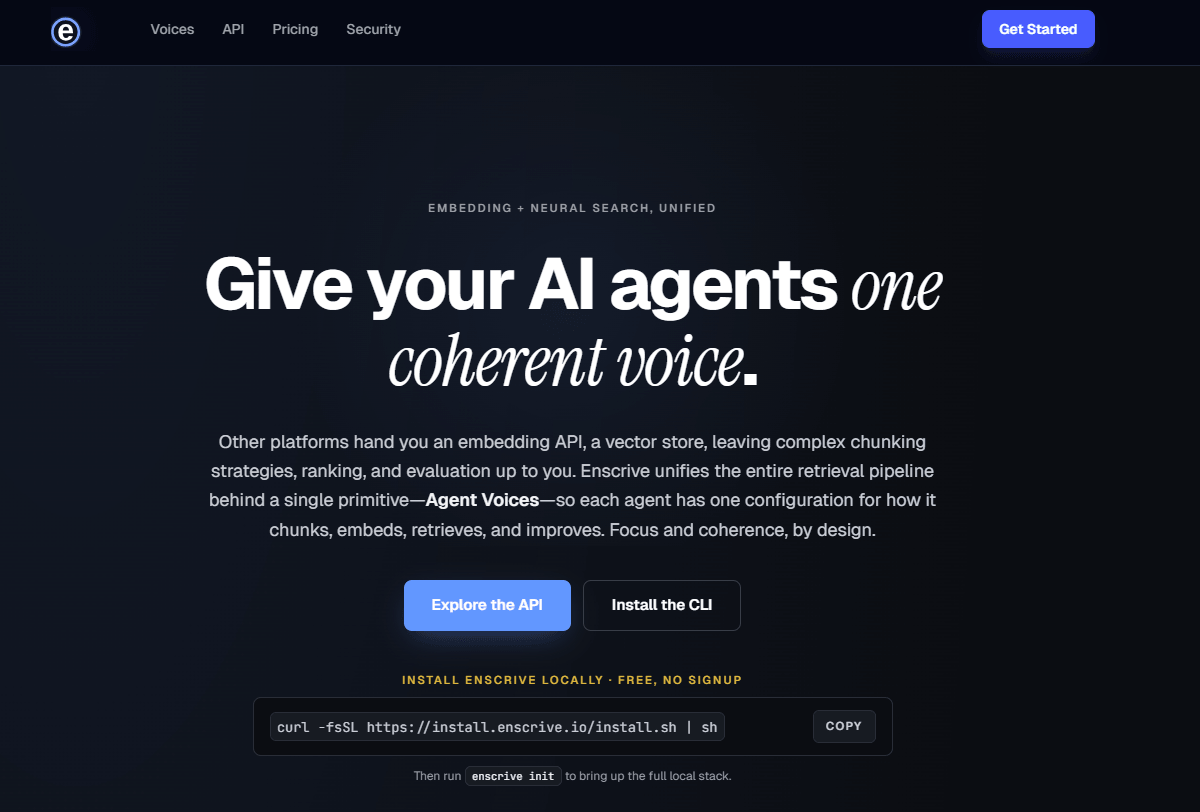
Memory infrastructure for AI agents that unifies embeddings, neural search, and retrieval with tunable "agent voices." Built for sub-200 ms search with evaluation gates and multi-environment promotion, per vendor documentation.
- Best for: Teams building agent workflows that need opinionated chunking, hybrid search, and an evaluation workflow baked in.
- Key Features: Agent Voices with configurable chunking and retrieval, hybrid vector plus BM25 search, multi-model embeddings, evaluation campaigns with NDCG and precision metrics, multi-environment dev or staging or prod controls, per vendor documentation.
- Why we like it: The "voice" abstraction saves engineering time by coupling chunking, embeddings, and ranking into one reproducible profile you can measure and promote.
- Notable Limitations: Pricing is quote based, limited independent reviews or analyst coverage publicly available, and few third-party benchmarks outside vendor materials.
- Pricing: Pricing not publicly available. Contact Enscrive for a custom quote.
Moorcheh
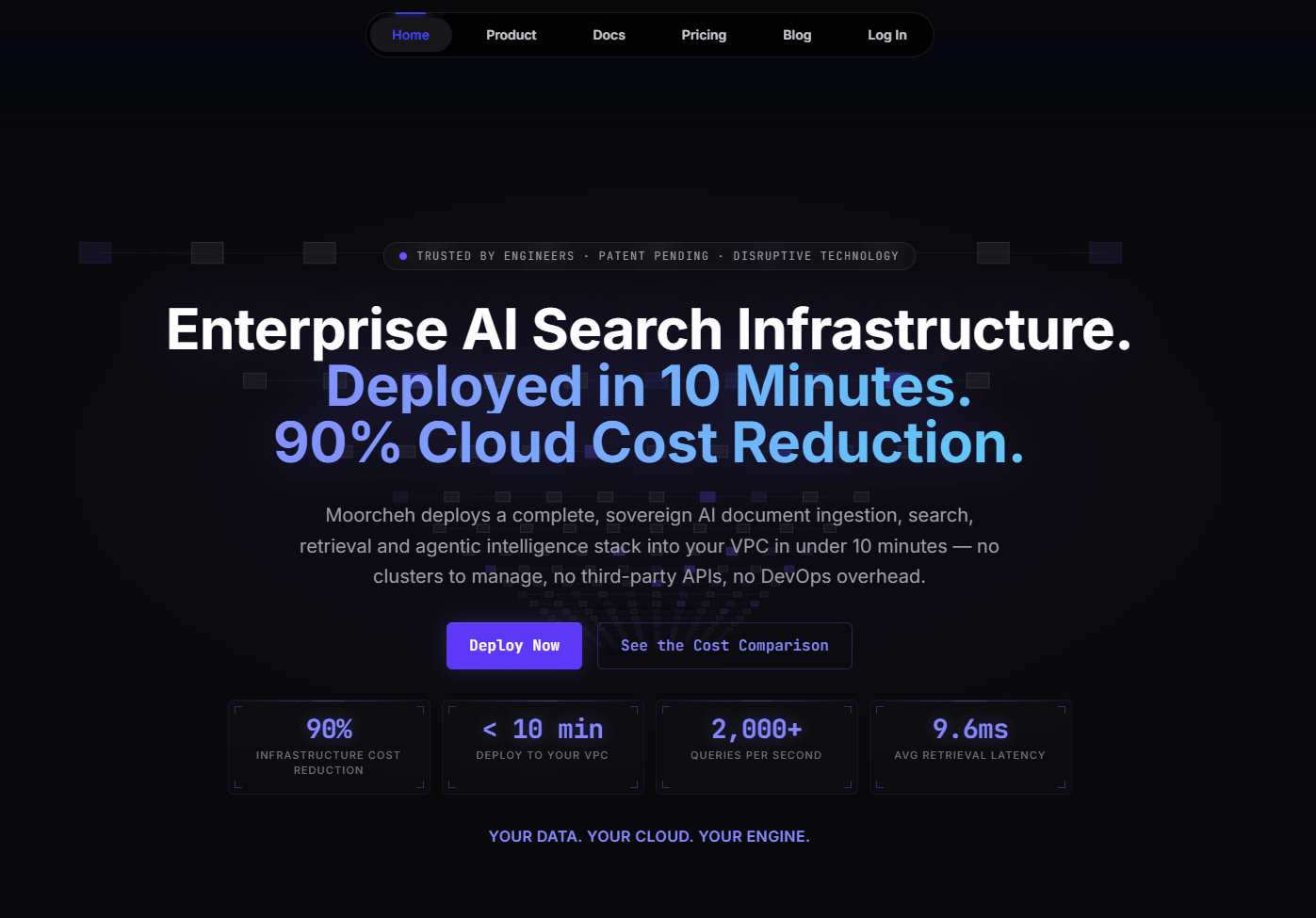
Enterprise AI search stack that can deploy into your VPC in minutes with multimodal ingestion and hybrid retrieval. Vendor materials emphasize index-free retrieval and serverless scaling.
- Best for: Regulated enterprises that prefer a sovereign VPC deployment with air-gapped options and infrastructure as code.
- Key Features: Multimodal file ingestion, hybrid retrieval with keyword constraints, serverless architecture that scales to zero, namespace isolation for multi-tenant SaaS, observability across ingestion and search, per vendor documentation.
- Why we like it: For teams that want private, in-VPC deployment without stitching together vector DBs and rerankers, the single API and IaC approach shortens time to production.
- Notable Limitations: Independent third-party benchmarks are limited, aggressive cost reduction claims are vendor published, and initial VPC deployment assumes comfort with AWS or Azure or GCP infrastructure as code.
- Pricing: Per vendor page as of May 2026: Builder free, Production usage-based, Sovereign custom. Verify on the vendor site for the latest details.
Ragie
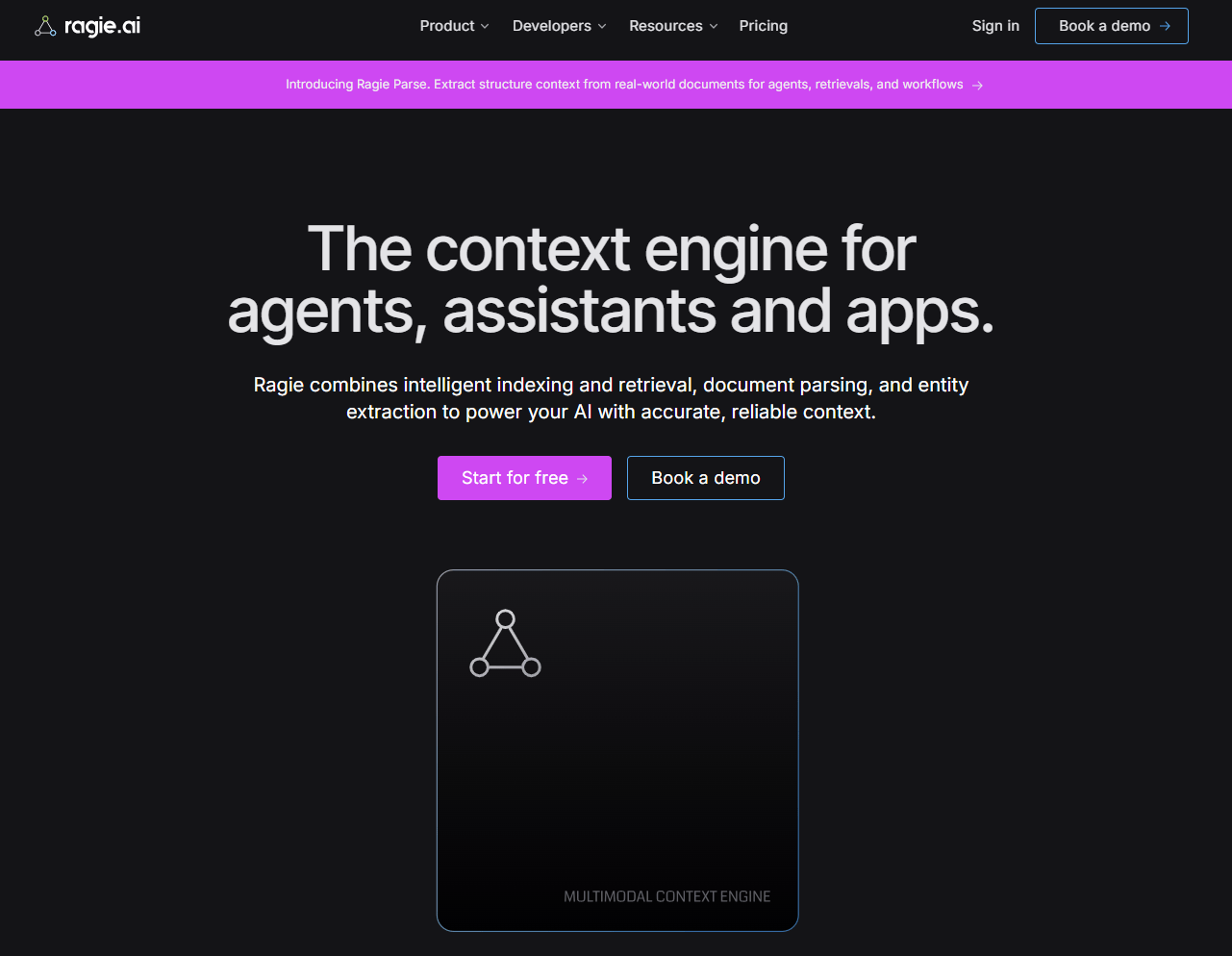
Context engine that builds vector, keyword, and summary indexes with entity extraction and reranking for agent-ready retrieval. Public materials highlight multimodal support and connectors.
- Best for: Product teams that want a managed RAG pipeline, including parsing, indexing, hybrid search, reranking, and entity extraction.
- Key Features: Vector plus keyword plus summary indexes, multimodal OCR and media processing, hybrid search with rerank, partitions for tenant isolation, connectors for Google Drive or Notion or Slack, per vendor documentation.
- Why we like it: The combination of three index types with built-in entity extraction reduces custom glue code and speeds up accurate context delivery for agents.
- Notable Limitations: Storage and processing fees can add up at scale, as noted by developer discussions comparing managed RAG platforms; independent reviews are still sparse; connectors beyond the first may carry per-connector fees per public pricing pages.
- Pricing: As of May 2026, Developer free, Starter $100 per month, Pro $500 per month, Enterprise custom. Confirm current pricing on the vendor site.
ZeroEntropy
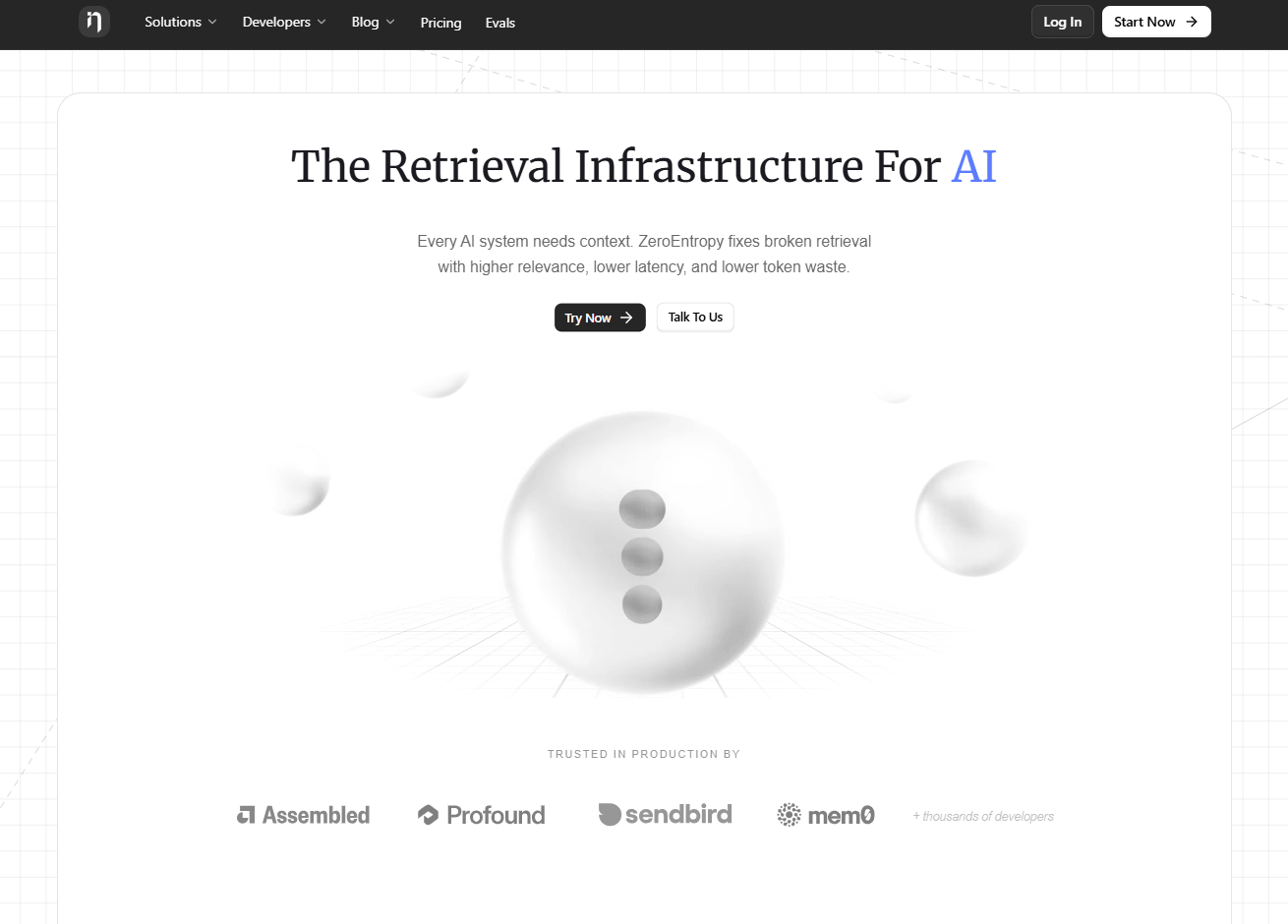
Managed retrieval infrastructure with first-party embedding and reranker models and a search API that handles ingestion, OCR, and reranking. Available through major marketplaces.
- Best for: Teams that want strong reranking and embeddings out of the box and are open to usage-based APIs or marketplace deployment.
- Key Features: zembed-1 embedding model, zerank-2 reranker, end-to-end search API with OCR and chunking, on-prem options, and compliance claims such as SOC 2 or HIPAA per documentation; listings available on Microsoft and AWS commercial marketplaces.
- Why we like it: High-quality reranking and embeddings are the lowest-effort way to lift answer quality without tearing apart your architecture.
- Notable Limitations: Many performance claims are vendor published and discussed in community threads, and adding a reranker can introduce latency that must be measured in your workload.
- Pricing: Model pricing is published by the vendor, for example per-million-token pricing for rerankers and embeddings, and usage-based pricing for the Search API. Marketplace listings exist, but enterprise pricing is by quote.
AI Search & Retrieval Infrastructure Tools Comparison: Quick Overview
| Tool | Best For | Pricing Model | Highlights |
|---|---|---|---|
| Enscrive | Agent memory with eval gates and hybrid search | Quote based | Agent Voices profiles, evaluation workflows |
| Moorcheh | Sovereign VPC deployments with air-gapped options | Tiered plus usage (free tier available) | Serverless architecture, index-free retrieval angle |
| Ragie | Managed context engine for apps and agents | Tiered plus usage (free tier available) | Vector, keyword, and summary indexes with entity extraction |
| ZeroEntropy | Strong reranking and embeddings via API or marketplace | Usage based, enterprise quotes | Reranker plus embed models, end-to-end search API |
AI Search & Retrieval Platform Comparison: Key Features at a Glance
| Tool | Hybrid Search | Reranking | Multimodal Ingestion |
|---|---|---|---|
| Enscrive | Yes | Yes | Yes |
| Moorcheh | Yes, with keyword constraints | Yes | Yes |
| Ragie | Yes | Yes | Yes |
| ZeroEntropy | Yes | Yes | Yes, via pipeline |
AI Search & Retrieval Deployment Options
| Tool | Cloud API | On-Premise or VPC | Integration Complexity |
|---|---|---|---|
| Enscrive | Yes | Private networking options per vendor | Low, REST API with evaluation tooling |
| Moorcheh | Yes and VPC deploy | Yes, VPC with air-gapped option | Medium, requires IaC in your cloud |
| Ragie | Yes | Not stated | Low, managed pipeline with connectors |
| ZeroEntropy | Yes, plus marketplaces | Yes, on-prem model licensing available | Low to medium, API plus model endpoints |
AI Search & Retrieval Strategic Decision Framework
| Critical Question | Why It Matters | What to Evaluate | Red Flags |
|---|---|---|---|
| Do you need hybrid search plus reranking on day one | Relevance gaps drive hallucinations and weak answers | Support for BM25 plus vectors, cross-encoder rerankers, quality metrics like NDCG | Vendor claims without eval metrics or guidance |
| Will you deploy in a sovereign VPC | Data and compliance requirements often block SaaS | IaC templates, private networking, air-gapped options | Only multi-tenant SaaS, no residency controls |
| How will you control latency and cost at scale | Reranking and big indexes can spike cost or p95 | Token accounting, summary indexes, caching, batch ops | Pricing opaque, no guidance on cost controls |
| Do you need multimodal parsing | PDFs, scans, and media are common in enterprises | OCR quality, timestamped media retrieval, table or form parsing | Text-only pipelines marketed as multimodal |
AI Search & Retrieval Solutions Comparison: Pricing & Capabilities Overview
| Organization Size | Recommended Setup | Monthly Cost | Annual Investment |
|---|---|---|---|
| Startup, single product team | Managed pipeline with hybrid search and rerank enabled | Varies by usage and storage, measure per 10k queries plus ingestion | Depends on document volume and reranker usage |
| Mid-market SaaS | Managed context engine plus partitions for tenancy | Tiered plan plus overage for pages or media | Tie spend to onboarded tenants |
| Regulated enterprise | VPC deploy with air-gapped options and IaC | Platform subscription plus cloud infra | Multi-year contract with governance add-ons |
Problems & Solutions
-
Problem: Top-k semantic recall is fine in dev, then answers drift in production. What changed is ranking. Microsoft documents that a semantic reranker scores and reorders candidates to lift relevance, which is exactly what reduces noisy answers in RAG or search pipelines (Microsoft Learn on semantic reranking).
Solution: ZeroEntropy's focus on reranking and embeddings gives you a fast path to measurable gains. If you prefer a managed retrieval pipeline, Ragie's hybrid search plus rerank approach targets the same issue while also handling parsing and indexing, which VentureBeat highlighted when it covered the company's launch of managed RAG services (VentureBeat coverage). -
Problem: You need a sovereign or air-gapped deployment quickly for compliance reviews. Forrester notes that cognitive search is being reshaped by gen AI and governance expectations, which raises deployment and data control requirements beyond traditional search rollouts (Forrester brief).
Solution: Moorcheh positions a VPC-native stack that deploys in minutes and scales to zero when idle. This pattern aligns with the broader industry push to bring gen-AI building blocks closer to enterprise data and controls, a trend also underlined by IDC's AI spending research that calls out governance packages becoming standard with platforms (IDC FutureScape summary). -
Problem: Latency and cost creep as you ingest large volumes or add reranking. AWS guidance shows embedding and indexing choices are a large part of total cost, and that batching and careful pipeline design matter for RAG economics (AWS re:Invent session slides on RAG cost).
Solution: Enscrive's "voice" profiles and evaluation gates help you test chunking and hybrid settings before promotion. If you need managed cost levers, Ragie exposes page-based processing and storage pricing so you can project unit economics, though community discussions also flag that storage or processing add-ons should be watched closely in any managed RAG stack (developer discussion on cost drivers). -
Problem: Proving vendor claims with independent signals. Early-stage platforms often publish their own benchmarks. Buyers should seek market validation. ZeroEntropy's reranker appears on Microsoft's commercial marketplace, and the company's seed round led by Initialized Capital was covered by TechCrunch, both useful third-party signals even if you still need to run your own evals (Microsoft Marketplace listing, TechCrunch funding article). For Ragie, VentureBeat's coverage provides external context on scope and positioning of its managed RAG service.
-
Problem: Will adding a reranker slow our app. Practitioners often ask if the extra hop is worth it. Community threads outline the latency tradeoffs and when reranking pays off most, especially once initial recall is solid (discussion on reranker latency tradeoffs).
Solution: ZeroEntropy and Ragie both expose reranking as a distinct step, so you can A or B test on your eval set and turn it on only where ROI is clear.
Conclusion: How to Pick the Right Retrieval Core
Start with workload truths, not vendor slogans. If you need sovereign control today, a VPC-native platform is the fastest path to unblock security reviews. If your answers are inconsistent, prioritize hybrid search plus reranking and measure with NDCG before debating model swaps. The category is moving fast, and broader AI spend is surging - Gartner forecasts worldwide AI spending will total $2.52 trillion in 2026 - which raises expectations for reliability and governance in search and retrieval stacks. Use the decision framework above, run a focused eval on your data, and pick the platform that minimizes glue work while giving you the deployment model your organization needs.
Notes on verification:
- Market landscape and category context referenced from Forrester research pages.
- Reranking concept and value documented by Microsoft.
- Cost drivers for RAG pipelines discussed in AWS materials.
- ZeroEntropy third-party signals from marketplace and funding news.
- Ragie launch and positioning covered by VentureBeat.
- Community perspective on reranker latency tradeoffs included for buyer diligence.