

Most teams discover AI sprawl during a security incident, not from their CMDB. Working across different tech companies, we have seen how an AI Bill of Materials, or AI-BOM, changes the post-incident playbook by making model lineage, datasets, and provider dependencies visible.
Three examples that save real time and money: mapping model calls to inference providers, surfacing license obligations on model weights and datasets, and tracking drift between model versions in CI. With EU AI Act timelines landing in 2026, inventories and documentation are fast becoming table stakes, a reality underscored by the NIST AI RMF baseline for risk controls and CycloneDX's AI/ML-BOM guidance.
In 2026, Gartner forecasts worldwide AI spending to reach 2.59 trillion dollars, which magnifies the cost of blind spots in AI supply chains. In this guide you will learn where each platform fits, how they map to EU AI Act and ISO/IEC 42001 programs, and what trade-offs to expect.
AISBOM
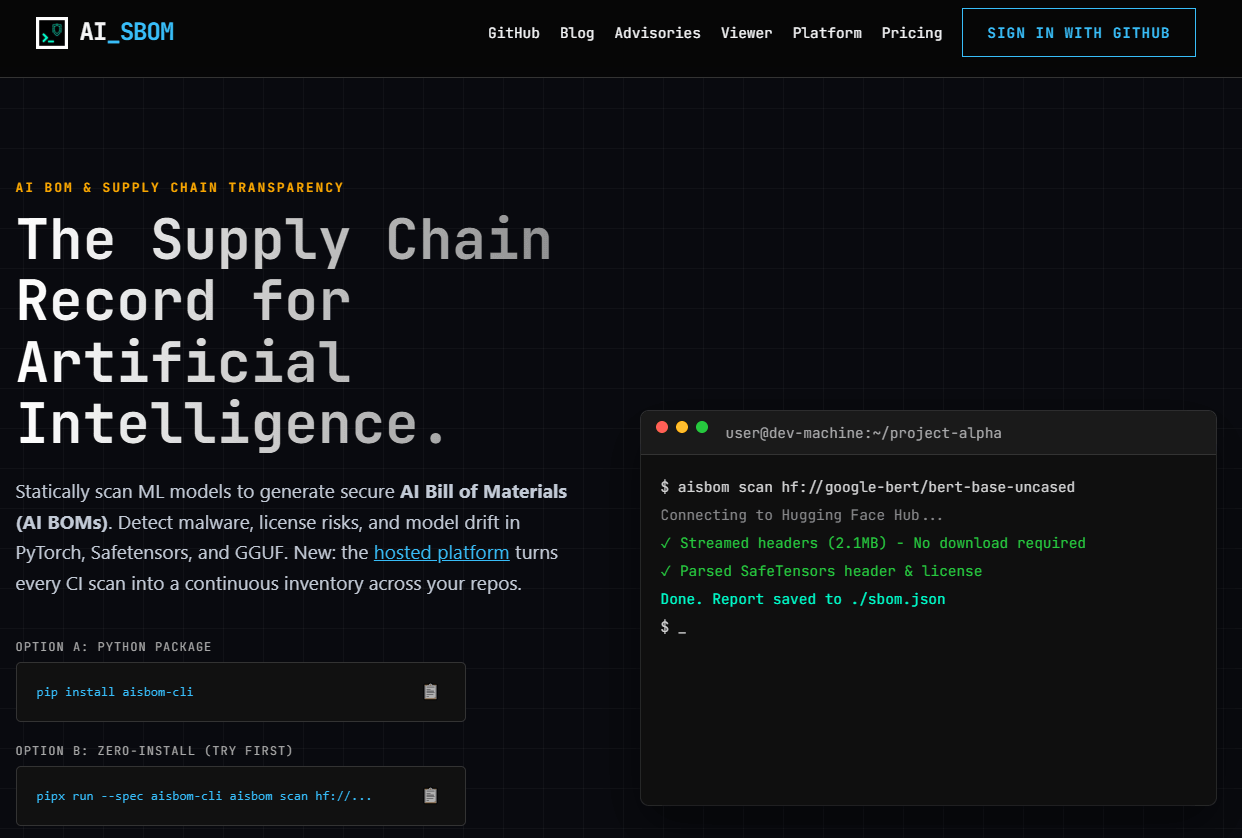
Automated scanner that builds a structured AI-BOM from repositories and model artifacts, then tracks drift across builds. Focus on malware detection, license risk, and CI integration per vendor documentation.
- Best for: Security and platform teams that want CI-driven AI-BOMs across many repos without heavy setup.
- Key Features: Model and dataset inventory, CycloneDX and SPDX export, license and security findings, drift tracking with PR history, CI integration.
- Why we like it: The CI-first approach catches drift early, and machine-readable exports slot into existing SBOM workflows.
- Notable Limitations: Public third-party reviews are scarce as of June 2026, so buyers should validate deployment at scale and on-prem, self-hosted options during trials. Limited analyst coverage makes long-term roadmap harder to benchmark.
- Pricing: A free, open-source CLI and standalone binary are available, with malware, license, and drift scanning included. Contact AISBOM for hosted or enterprise options.
Mend AI, AI-BOM
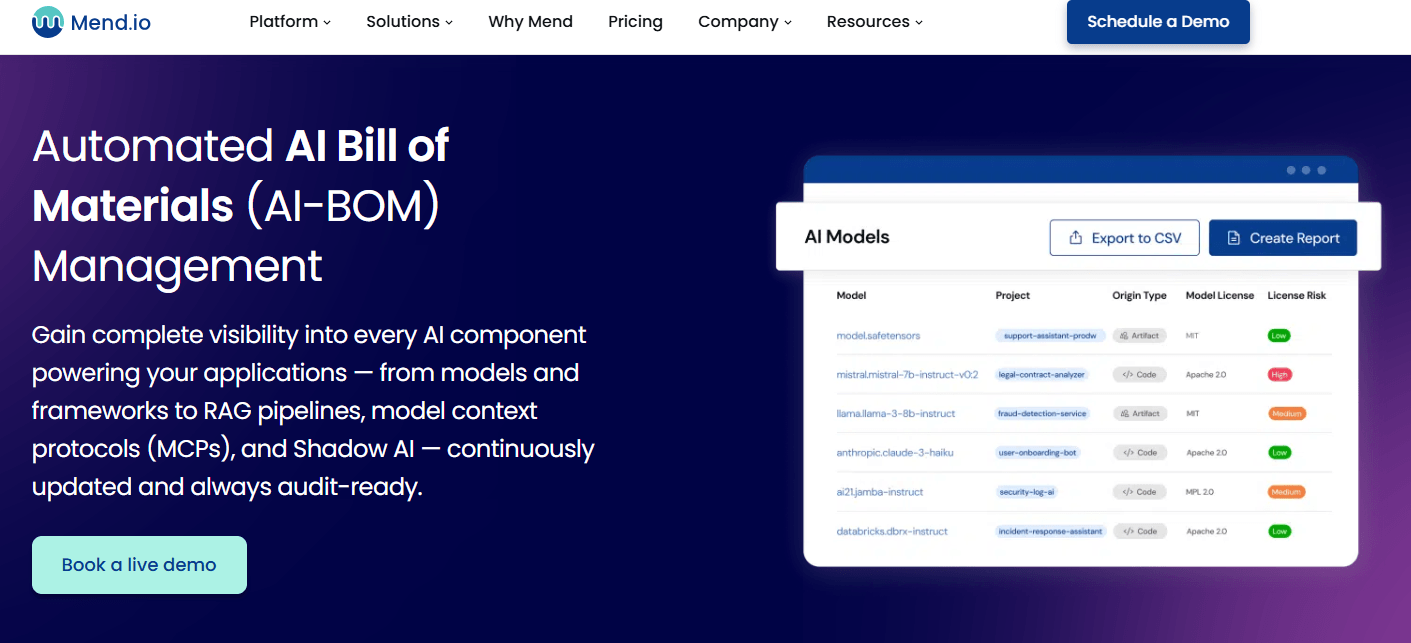
Enterprise AI security add-on inside Mend AppSec that discovers AI components, generates an AI-BOM, and adds testing and runtime guardrails. According to vendor documentation, it also detects Shadow AI.
- Best for: Enterprises standardizing on one platform for SCA, SAST, and AI-layer inventory and controls.
- Key Features: AI-BOM and Shadow AI discovery, automated red teaming and prompt testing, runtime guardrails, policy driven governance, reports aligned to risk frameworks.
- Why we like it: AI inventory sits next to code and dependency risk, which shortens handoffs between AppSec, platform, and GRC.
- Notable Limitations: Some AI capabilities have rolled out in staged releases and betas, so confirm general availability and support commitments; certain AI features require specific Mend AI subscriptions; pricing benchmarks tend to be enterprise-level, plan budget early using independent references.
- Pricing: AWS Marketplace lists "Mend Application Security Platform for 20 contributing developers" at 20,000 dollars, which reflects a per-developer model, per the AWS Marketplace listing. G2's pricing page shows Mend AppSec up to 1,000 dollars per developer per year and Mend AI up to 300 dollars per developer per year, which indicates tiered packaging and that pricing is subject to change, per G2's Mend pricing.
AIBOM Studio
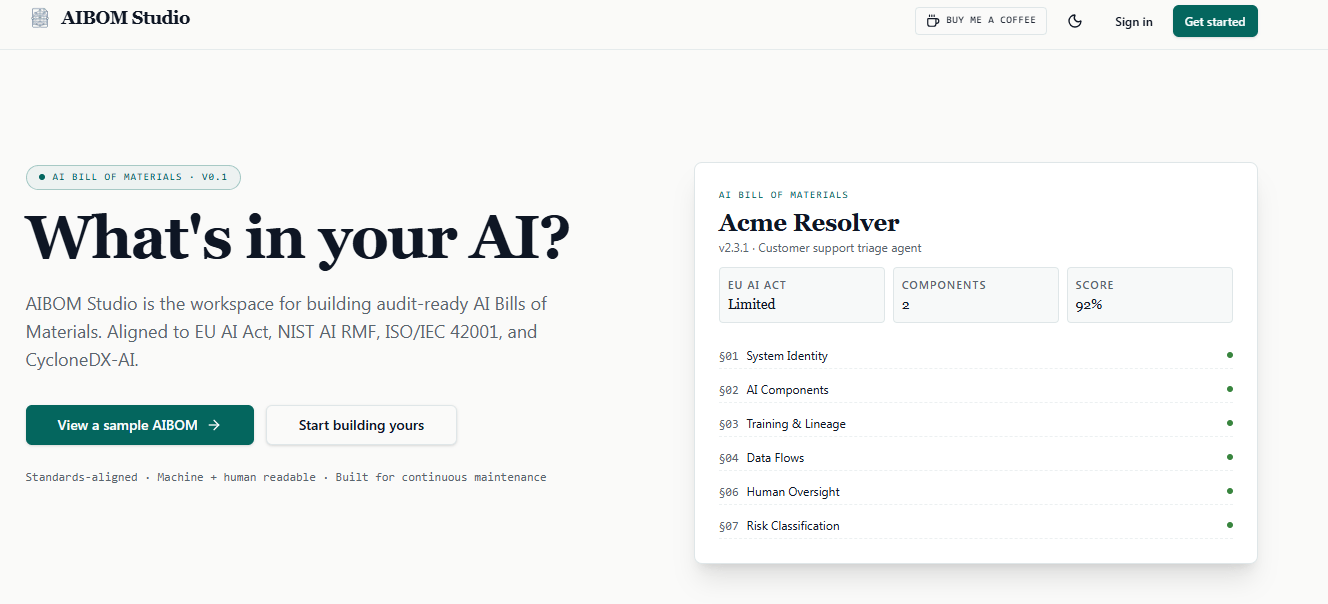
Workspace for building audit-ready AI-BOMs that align with EU AI Act, NIST AI RMF, ISO/IEC 42001, and CycloneDX-AI per vendor documentation. Geared to governance, documentation, and conformance files.
- Best for: GRC and legal teams that need standardized AI inventories and documentation mapped to regulatory controls.
- Key Features: Structured AI-BOM authoring, templates mapped to EU AI Act, NIST AI RMF, ISO/IEC 42001, CycloneDX-AI export.
- Why we like it: Strong emphasis on audit-ready structure, which helps close documentation gaps before conformity assessments.
- Notable Limitations: Public third-party reviews are limited; functionality leans toward documentation rather than automated discovery, so technical teams may need a scanner alongside it.
- Pricing: Pricing not publicly available. Contact AIBOM Studio for a custom quote.
Trusera AI-BOM
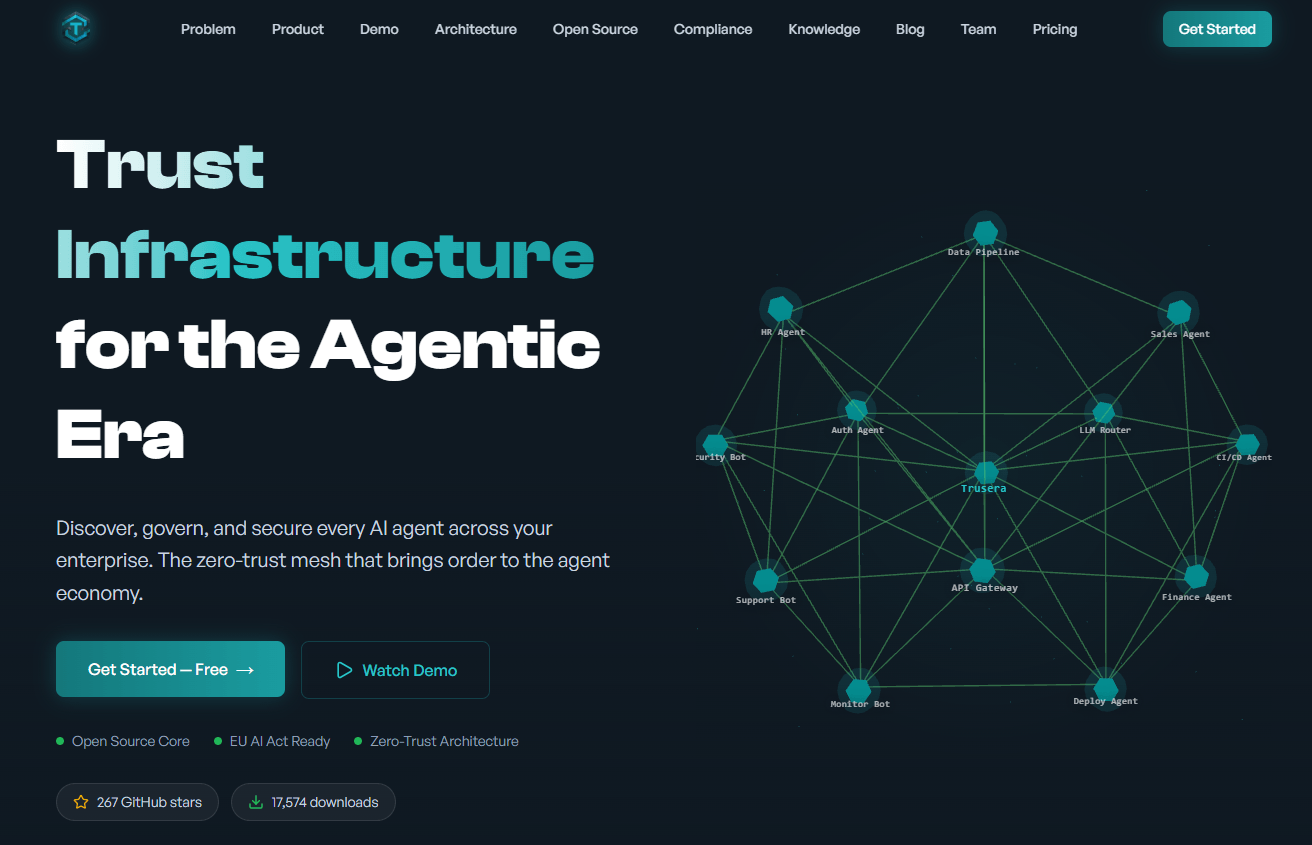
Discovery platform that catalogs AI agents, models, and pipelines, then generates AI-BOMs mapped to regulatory frameworks per vendor documentation. Designed for real-time inventory.
- Best for: Teams experimenting with agent frameworks that need continuous discovery and a single catalog of AI components.
- Key Features: Auto-discovery of models, agents, pipelines; real-time catalog; AI-BOM generation; framework mapping for compliance reporting.
- Why we like it: Discovery focus fits fast-moving agent stacks where components change weekly.
- Notable Limitations: Few independent reviews as of June 2026; validate ecosystem coverage, especially for lesser-used agent frameworks and self-hosted models.
- Pricing: A free, open-source CLI and runtime SDKs are available and run without a Trusera account, with hosted cataloging and monitoring offered separately. Contact Trusera for a custom quote.
AI Bill of Materials Tools Comparison: Quick Overview
| Tool | Best For | Pricing Model | Free Option |
|---|---|---|---|
| AISBOM | CI driven AI-BOM for code and model artifacts | Open-source CLI plus paid hosted or enterprise | Yes, open-source CLI |
| Mend AI, AI-BOM | Enterprises consolidating AppSec and AI inventory | Per developer, marketplace SKU available | No public free tier |
| AIBOM Studio | Governance teams producing audit-ready inventories | Custom quote | Not stated |
| Trusera AI-BOM | Agent heavy teams needing discovery and cataloging | Open-source CLI plus paid hosted | Yes, open-source CLI |
AI Bill of Materials Platform Comparison: Key Features at a Glance
| Tool | Discovery Automation | Standards Support | Risk Insights |
|---|---|---|---|
| AISBOM | Repo and artifact scanning in CI | CycloneDX AI, SPDX | License and security flags, model drift |
| Mend AI, AI-BOM | Codebase discovery, Shadow AI detection | Reports mapped to risk frameworks | Red teaming, prompt testing, guardrails |
| AIBOM Studio | Manual, template driven | EU AI Act, NIST AI RMF, ISO/IEC 42001, CycloneDX-AI | Documentation checks and mappings |
| Trusera AI-BOM | Real-time discovery of agents and pipelines | Regulatory mappings | Catalog health and change history |
AI Bill of Materials Deployment Options
| Tool | Cloud API | On-Premise | Integration Complexity |
|---|---|---|---|
| AISBOM | Yes | Yes, self-hosted CLI runs locally | Low, CI integration focus |
| Mend AI, AI-BOM | Yes | Enterprise options available | Medium, platform wide rollout |
| AIBOM Studio | Cloud workspace | Validate with vendor | Low, documentation first |
| Trusera AI-BOM | Yes | Yes, CLI and SDKs run locally | Medium, discovery across agents |
AI Bill of Materials Strategic Decision Framework
| Critical Question | Why It Matters | What to Evaluate | Red Flags |
|---|---|---|---|
| Do we need automated discovery or documentation first | Discovery finds Shadow AI, documentation closes audit gaps | Breadth of model, agent, provider coverage vs. template depth | Manual spreadsheets, no API export |
| Which standards are mandatory for us | EU AI Act, NIST AI RMF, ISO/IEC 42001 drive evidence requirements | CycloneDX AI/ML-BOM support and control mappings | Proprietary formats only |
| How will we prove provenance and lineage | Regulators and customers will ask for sources and changes | Dataset lineage, versioning, signed artifacts | No traceability across model versions |
| Can we operationalize findings in CI/CD | Early catches are cheaper | CI actions, policy gates, machine-readable output | Reports that cannot fail builds |
| What does pricing scale with | Predictability matters for adoption | Per developer or per asset, marketplace SKUs | Opaque quotes, surprise overages |
AI Bill of Materials Solutions Comparison: Pricing and Capabilities Overview
| Organization Size | Recommended Setup | Monthly Cost | Annual Investment |
|---|---|---|---|
| 1-50 developers | AISBOM or Trusera for discovery, AIBOM Studio for documentation | Custom quote | Custom quote |
| 51-300 developers | Mend AI with AI-BOM plus discovery scanner if needed | See marketplace SKU for Mend AppSec 20 CDs | Pricing varies by seats and bundles |
| 300+ developers | Mend AI platform rollout, keep AIBOM Studio for documentation packs | Custom quote | Custom quote with multi-year negotiation potential |
Problems and Solutions
Problem: Shadow AI and inventory gaps slow risk decisions. Independent coverage notes that many organizations' AI adoption is outpacing governance, leaving gaps in ownership and documentation, as reported in ITPro's write-up of an IBM leadership survey.
Solution: Mend AI's AI-BOM plus Shadow AI discovery centralizes model and provider visibility; AISBOM's CI scanning builds inventories directly from code and model artifacts.
Problem: Documentation for the EU AI Act is due in defined phases, with high-risk technical documentation under Article 11 and Annex IV taking effect August 2, 2026 under current law, and a proposed Digital Omnibus that could push some high-risk deadlines to December 2027, so teams need predictable, standard-aligned evidence. See the European Commission's regulatory framework overview and the Council's press note on simplification.
Solution: AIBOM Studio produces structured AI-BOMs and documentation mapped to EU AI Act articles, NIST AI RMF functions, and ISO/IEC 42001 clauses. Trusera's mapping helps turn discovery into regulator-readable reports.
Problem: Buyers and regulators expect machine-readable inventories, similar to SBOM requirements driven by Executive Order 14028 and NTIA's minimum elements, which set the template for AI-BOM formats. See NTIA's SBOM minimum elements and the CISA SBOM resource library.
Solution: AISBOM and AIBOM Studio support CycloneDX AI/ML-BOM export, which aligns with emerging practice for AI supply chain transparency, as detailed in the CycloneDX AI/ML-BOM guide.
Problem: Breach costs remain high, which raises the penalty for incomplete inventories and undocumented dependencies. IBM's 2025 Cost of a Data Breach report put the global average at 4.44 million dollars, down 9 percent year over year, with shadow AI adding an average 670,000 dollars where AI use went ungoverned. See IBM's Cost of a Data Breach 2025.
Solution: Mend AI's runtime guardrails and automated testing, paired with AISBOM's CI driven drift detection, help teams catch issues earlier, when fixes are cheaper.
Bottom Line
AI-BOM is moving from a nice-to-have to an operational control as AI spend and regulatory pressure climb. The four platforms here cover two buyer patterns, automated discovery for engineering teams and audit-ready documentation for governance.
Start by deciding which evidence you must produce for the EU AI Act and ISO/IEC 42001, then back into the discovery and CI hooks required to keep that evidence fresh. Use machine-readable formats like CycloneDX AI/ML-BOM to avoid lock-in, and budget with neutral references such as marketplace SKUs where available, including the Gartner AI spending forecast and the AWS Marketplace listing for Mend.