
Most teams discover chemicals management gaps during Tier II season, not from internal audits. Working across different tech companies, I have seen procurement bring in a "small" solvent, then EHS scrambles to find the SDS, print a GHS label, and map storage before reporting cuts off, a pattern regulators anticipated with HazCom's standardized SDS and labels requirements. That scramble is why software that centralizes SDS libraries, container level inventory, and label generation matters, especially under OSHA's revised Hazard Communication Standard aligned with GHS and its 16 section SDS format, signal words, pictograms, and hazard statements. See the rule text for the label and SDS elements that drive many software workflows in the first place, per the federal register record for OSHA 1910.1200. (OSHA Hazard Communication final rule)
According to new analyst research, EHS software spend reached about 1.9 billion dollars in 2023 and is projected to grow to 4.5 billion dollars by 2029, a 14.6 percent CAGR, and that spend is heavily concentrated in high risk industries like chemicals. You will learn which tools fit by site size and regulation profile, how they compare on approvals, labeling, and reporting, and what traps to avoid with deployment and change management. (Verdantix market size and forecast 2025)
VelocityEHS
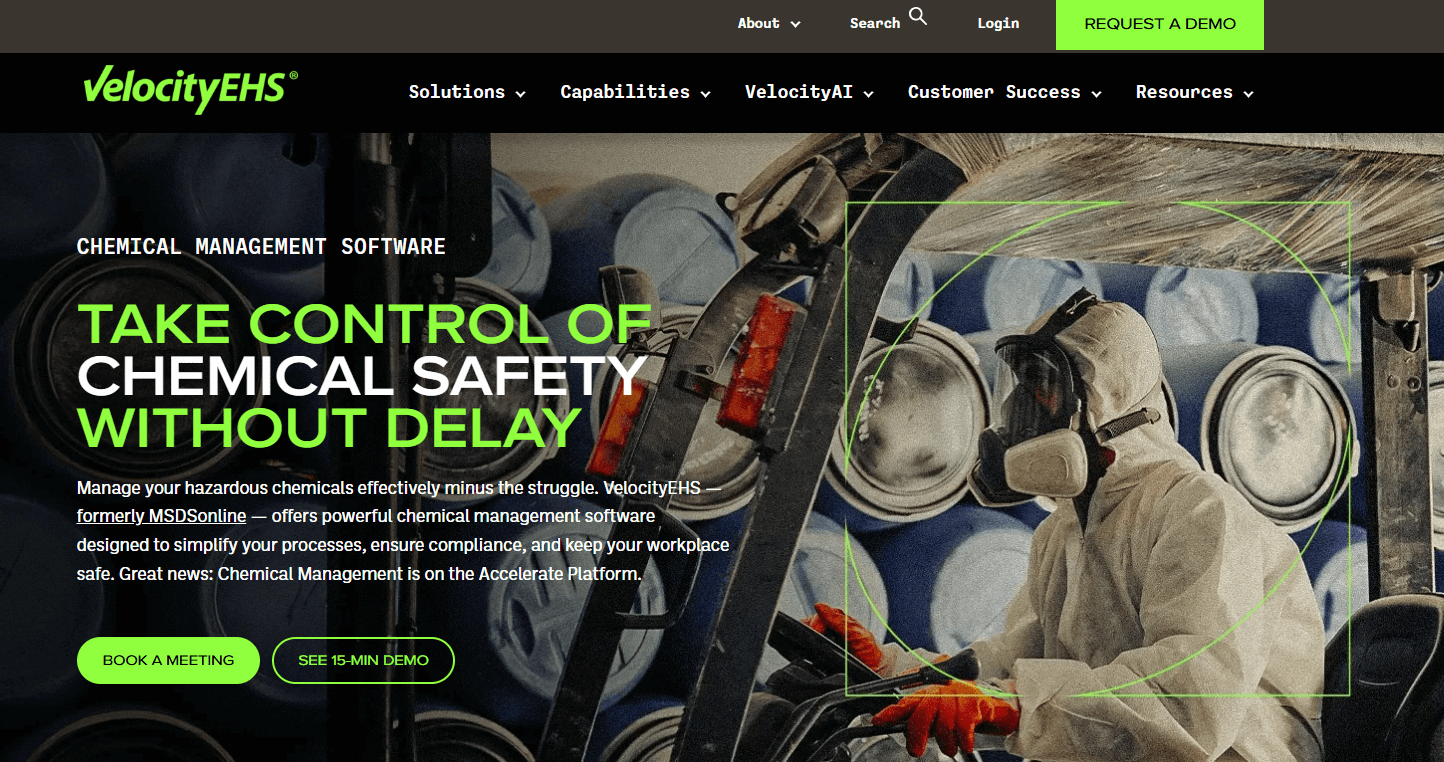
Cloud based SDS and chemical inventory with labeling and regulatory reporting that grew out of MSDSonline. Mobile app supports offline SDS access and container lookups for field teams.
Per vendor documentation, it includes SDS management, inventory tracking, label generation, and first responder sharing via Plan1.
- Best for: Multi site North American organizations that need large SDS libraries, GHS label printing, and Tier II support with basic first responder sharing.
- Key Features: SDS library and eBinders, container level inventory, GHS label printing, emergency response sharing, mobile app for offline SDS.
- Why we like it: Strong SDS search at scale and practical touches like Plan1 for first responder access reduce scramble during incidents and pre planning.
- Notable Limitations: Reviews cite slow support at times and reporting performance lags, and some users report mobile scanning issues.
- Pricing: Pricing not publicly available. Contact VelocityEHS for a custom quote.
Context from independent sources: user reviews frequently praise SDS search and labeling, while calling out support response times and reporting latency. See recent user feedback on leading review sites and the official mobile app listing for offline capability and QR login. (Capterra VelocityEHS reviews, G2 VelocityEHS Accelerate reviews, Apple App Store, SDS Chemical Management, ISHN coverage of Plan1 for first responders)
ERA Chemical Management Software
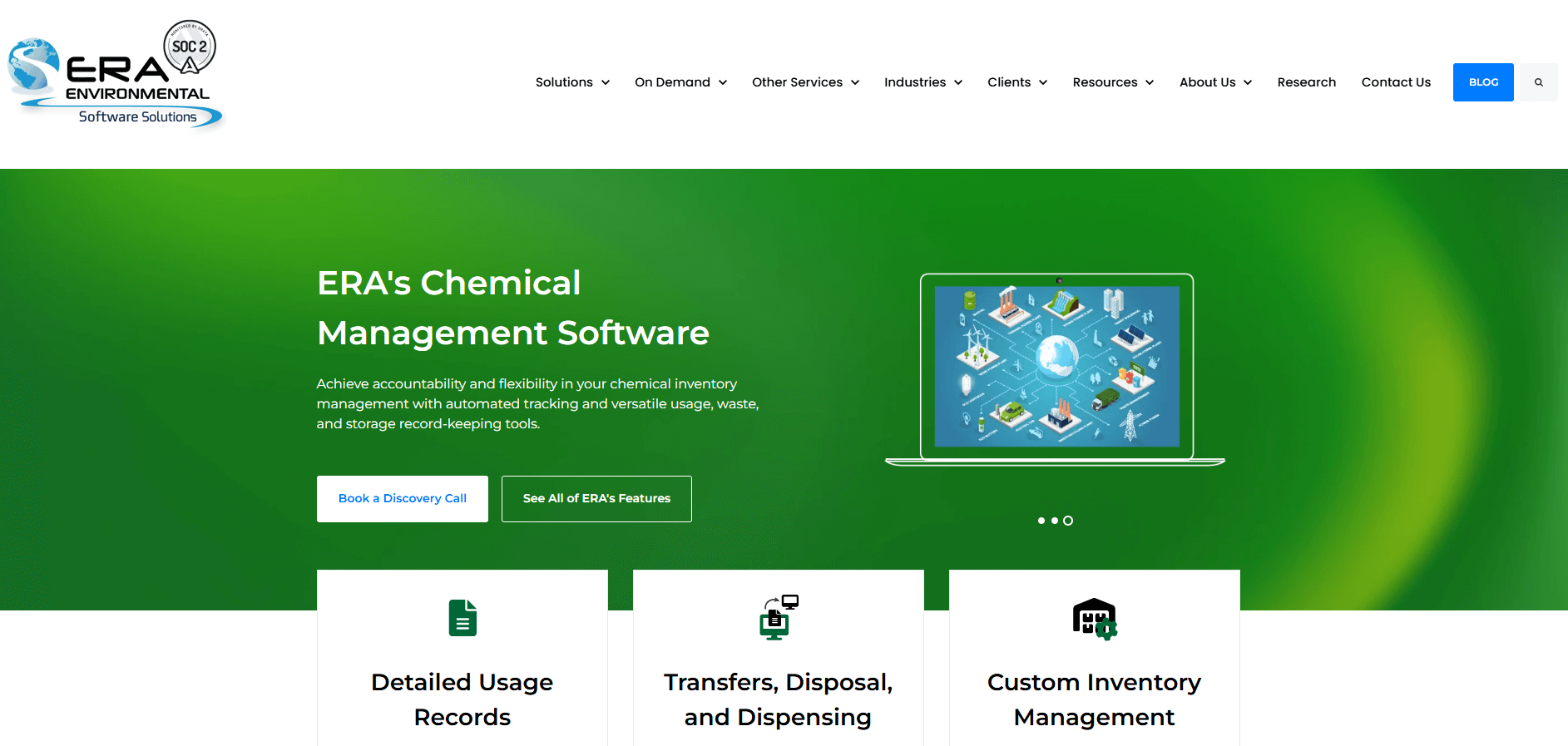
Compliance focused EHS platform with deep regulatory and emissions calculation capabilities, backed by a large Master Chemical List for automated reporting.
Per vendor documentation, modules cover chemical inventory, emissions calculations, TRI and Tier II reporting, SDS and label authoring, and configurable workflows.
- Best for: Manufacturers that need auditable calculations across air, waste, TRI, and chemical inventory with one data backbone.
- Key Features: Master Chemical List powered calculations, automated environmental reports, chemical inventory and usage tracking, SDS and label authoring services, role based dashboards.
- Why we like it: Strong regulatory math and audit trails reduce spreadsheet risk and rework during agency audits.
- Notable Limitations: No public pricing and a learning curve for broader modules are frequently mentioned.
- Pricing: Pricing not publicly available. Contact ERA for a custom quote.
Independent references: coverage highlights the Master Chemical List scale, automation of reporting workloads, and recent SOC 2 Type II certification, while noting the adoption curve and lack of transparent pricing. (Research.com ERA platform review, EIN Presswire SOC 2 Type II announcement)
Chemscape CHAMP, Chemical Risk Management

SDS management plus a structured chemical approval and risk assessment workflow, including substitution suggestions and exposure control plans.
Per vendor documentation, CHAMP adds configurable approvals, control banding, storage compatibility, substitution comparisons, and exposure control planning on top of SDS management.
- Best for: Teams that want a formalized chemical approval workflow before a product reaches the floor, with industrial hygiene guardrails.
- Key Features: Chemical approvals, task based risk assessment, control recommendations aligned to the hierarchy of controls, safer substitution tool, exposure control plans and labels.
- Why we like it: The approval centric approach helps catch hazards early, standardizes decisions, and provides a defensible record for auditors.
- Notable Limitations: Users report that adding new chemicals could be easier and that Excel exports can complicate filtering across binders.
- Pricing: Pricing not publicly available. Contact Chemscape for a custom quote.
Independent references: reviewers mention Smart Charts, exposure control plans, and approvals as differentiators, with feedback on data export pain points. (G2 Chemscape reviews)
Conformics Intrims RIMS
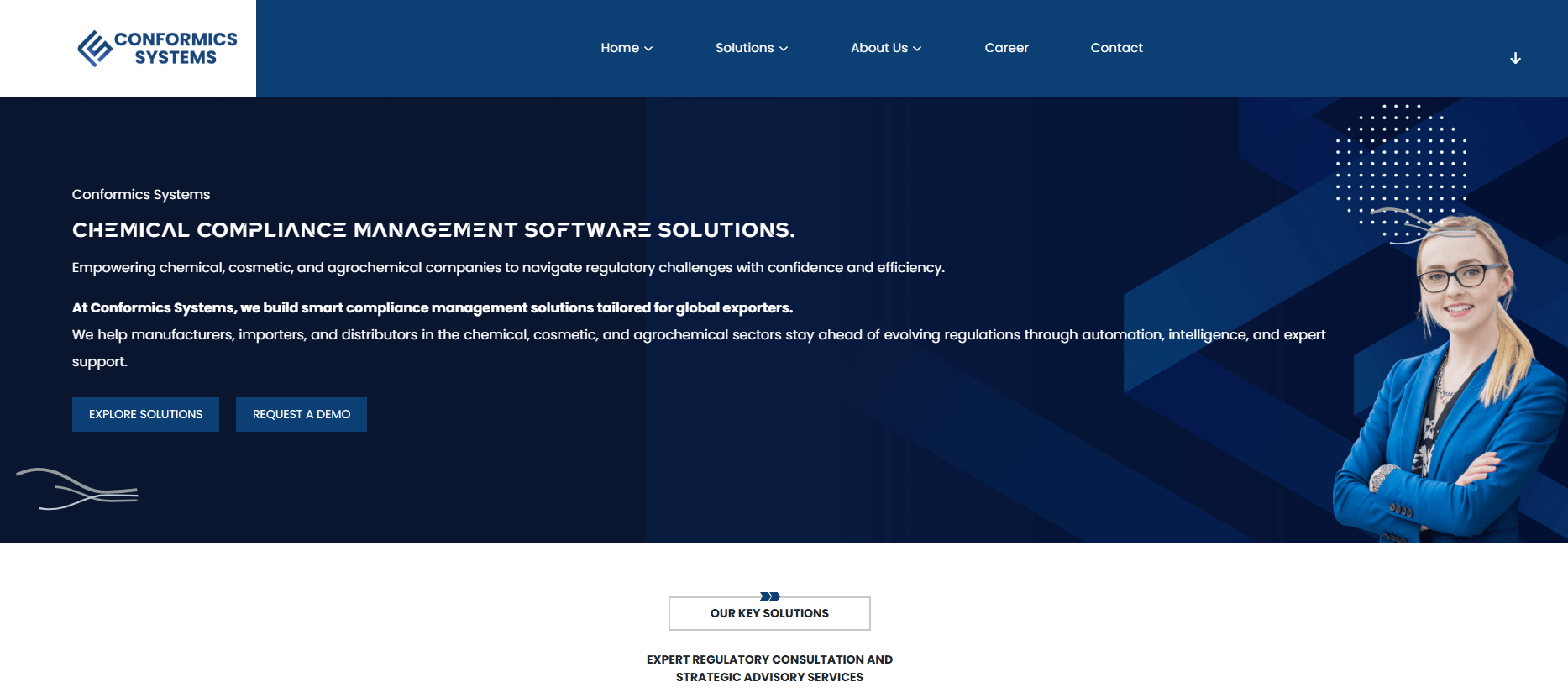
Regulatory Information Management System that centralizes compliance dashboards, multi region tracking, and automated reports for chemical regulations.
Per vendor documentation, Intrims offers regional compliance management, supplier and buyer management, compliance status tracking, and reporting, with an entry level free tier and paid plans.
- Best for: Exporters and distributors that need light weight global regulatory tracking with dashboards and basic reporting.
- Key Features: Centralized compliance dashboard, multi region coverage, automated reporting and tracking, supplier and buyer management, compliance status and alerts.
- Why we like it: Clear framing as a regulatory information hub makes it a potential fit for teams that primarily need to track obligations across jurisdictions.
- Notable Limitations: Limited independent reviews as of November 2025 and new platform maturity mean buyers should pilot and validate coverage depth.
- Pricing: Vendor publicly lists a Free plan and paid tiers starting at 420 euros per year, as of November 4, 2025. Independent verification not available, confirm directly.
Independent context: given sparse third party coverage, plan for a proof of concept and data validation prior to broad rollout. If you rely on TRI, Tier II, or REACH workflows, confirm report formats against regulatory guidance. For US requirements, see the EPA's Tier II program overview to match data fields. (EPA hazardous chemical inventory reporting)
Chemicals Management Tools Comparison: Quick Overview
| Tool | Best For | Pricing Model | Highlights |
|---|---|---|---|
| VelocityEHS Chemical Management | Multi site SDS, labeling, Tier II support | Custom quote | Deep SDS library, GHS labels, first responder sharing noted in industry coverage |
| ERA Chemical Management Software | Regulated manufacturing with emissions reporting | Custom quote | Master Chemical List, automated reports, SOC 2 Type II reference |
| Chemscape CHAMP | Approval first risk management | Custom quote | Approvals, control banding, substitution, exposure plans from user reviews |
| Conformics Intrims RIMS | Global regulatory tracking for exporters | Public tiers per vendor page | Compliance dashboards, multi region tracking, supplier and buyer management |
References for highlights come from analyst and review sources rather than vendor marketing. For example, Verdantix tracks EHS spend growth, EPA details Tier II reporting scope and thresholds, and G2 or Capterra capture user level strengths and pain points. (EPA Tier I and Tier II overview)
Chemicals Management Platform Comparison: Key Features at a Glance
| Tool | SDS Management | Inventory and Labels | Approvals and Risk |
|---|---|---|---|
| VelocityEHS Chemical Management | Yes | Container tracking, GHS label printing cited by users | Basic product requests |
| ERA Chemical Management Software | Yes | Inventory and usage tracking | Configurable workflows |
| Chemscape CHAMP | Yes | Labels and storage compatibility | Formal approvals, risk banding, substitution |
| Conformics Intrims RIMS | Document tracking focus | Inventory scope varies by plan | Compliance status and alerts |
User reviews and analyst notes are the basis for this roll up, not vendor claims. Validate against your regulatory scope, for example OSHA HazCom requires GHS elements on labels and a 16 section SDS, which drives needed capabilities. (OSHA HCS labeling and SDS format)
Chemicals Management Deployment Options
| Tool | Cloud API | On Premise | Integration Complexity |
|---|---|---|---|
| VelocityEHS Chemical Management | Cloud first | Not publicly documented | Moderate, reviews mention reporting configuration efforts |
| ERA Chemical Management Software | Cloud first | Not publicly documented | Moderate to High, reviews cite training and onboarding needs |
| Chemscape CHAMP | Cloud | Not publicly documented | Low to Moderate, user comments note admin tools but some import and export friction |
| Conformics Intrims RIMS | Cloud | Not publicly documented | Low to Moderate, depends on data migration and region coverage |
Where deployment details are not independently documented, request architecture and security whitepapers during evaluation. If you need offline SDS in the field, confirm mobile capabilities and device support, for example the Apple App Store listing describes offline SDS for VelocityEHS.
Chemicals Management Strategic Decision Framework
| Critical Question | Why It Matters | What to Evaluate |
|---|---|---|
| Does it operationalize HazCom and GHS labeling correctly? | OSHA specifies standardized label elements and SDS formats | Label templates with signal words, hazard and precautionary statements, pictograms |
| Can it produce data needed for EPCRA Tier II by March 1? | Facilities with SDS obligations and threshold quantities must report inventories annually | Container level quantities, locations, hazard categories, exportable Tier II fields |
| How are chemical approvals and substitutions governed? | Early hazard and substitution reviews reduce incidents and rework | Configurable approval workflows, risk banding, defensible records |
| Are emissions and TRI calculations auditable? | Industrial sites face frequent audits and inspections | Transparent calculation methods, versioned factors, traceable inputs |
Source requirements and dates are set by regulators, for example OSHA's HCS defines label elements and SDS content, and EPA's EPCRA program describes covered facilities and thresholds that drive Tier II inventories. (EPA Tier II program scope and thresholds)
Chemicals Management Solutions Comparison: Pricing and Capabilities Overview
| Organization Size | Recommended Setup | Monthly Cost |
|---|---|---|
| Small, single site | Chemscape CHAMP or Intrims pilot for approvals or compliance dashboards, verify against Tier II needs | Not publicly available or varies by plan |
| Mid market, multi site | VelocityEHS Chemical Management or ERA with core chemical modules, pilot labeling and reporting | Custom quote |
| Large, regulated manufacturing | ERA with emissions and chemical inventory, or VelocityEHS plus emissions add ons, consider a staged rollout | Custom quote |
Pricing is often quote based, and public price lists are rare in this category. When a vendor advertises tiers, treat the figures as starting points and confirm entitlements and limits. If pricing cannot be independently verified, perform a paid pilot or a limited scope contract to reduce risk.
Problems and Solutions
-
Problem: We miss the March 1 Tier II deadline because location and quantity data are scattered, and first responders do not have pre incident access.
Solution: A system that pairs container level inventory with mapped locations and pre configured Tier II data fields reduces the annual scramble. VelocityEHS is frequently cited by users for labeling and SDS access, and industry coverage describes its first responder sharing concept, while EPA's Tier II page clarifies the thresholds and scope to configure forms correctly. (Capterra VelocityEHS reviews, ISHN Plan1 overview) -
Problem: We get inconsistent chemical approvals, then discover late that a product triggers restricted lists.
Solution: A workflow that forces approvals before procurement, calculates risk, and checks regulatory lists creates a defensible record. Reviewers call out CHAMP's approvals, risk banding, and exposure plans, which map to best practices for pre use review. -
Problem: Environmental reports involve black box spreadsheets, leading to audit anxiety.
Solution: Systems with traceable calculations, a master chemical database, and versioned factors reduce time under audit. Independent coverage of ERA highlights automated reporting and a large chemical list, with recent SOC 2 Type II certification referenced for security minded buyers. (Research.com ERA platform review) -
Problem: Field teams rely on paper binders and cannot reach SDS during an incident or maintenance window.
Solution: Mobile apps with offline SDS and quick search cut response time. The Apple App Store details offline SDS and QR login for the VelocityEHS app, and user reviews point to inventory and labeling strengths that help day to day. -
Problem: Regulatory pressure and cost are rising, especially in the EU, and we need central visibility of obligations by region.
Solution: A RIMS that tracks multi region obligations and status can cut research time and missed updates. Recent reporting shows rising compliance costs in the EU chemicals sector, a signal to invest in centralized tracking, dashboards, and alerts. (Reuters analysis of EU regulatory costs)
The Bottom Line on Chemicals Management Platforms
By 2026, chemicals management software is no longer justified as a compliance convenience. It is operational infrastructure. OSHA HazCom enforcement, Tier II scrutiny, and rising EU and state level chemical controls mean gaps surface in real time, not during audits. Teams that still rely on shared drives, binders, or spreadsheets feel the pain first during reporting deadlines and incidents.
The tools that win now do three things reliably. They make SDS access and GHS labeling automatic at the container level. They enforce approvals and substitutions before chemicals reach the floor. And they produce audit ready Tier II, TRI, and emissions data without manual reconciliation.
If your priority is scale and readiness across many sites, VelocityEHS remains strong for SDS access, labeling, and responder visibility. If regulatory math and defensible reporting are your biggest risks, ERA’s calculation backbone is built for audits, not demos. If you want to stop bad chemical decisions before they start, Chemscape’s approval first workflow creates discipline procurement alone cannot enforce. If your challenge is tracking obligations across regions with limited internal staff, Intrims can serve as a lightweight regulatory control tower, provided you validate depth early.
The mistake in 2026 is buying software that stores documents but does not change behavior. Start with the deliverable regulators care about most in your operation, usually Tier II accuracy, labeling compliance, or approval traceability. Run a proof of concept against that outcome, verify outputs directly against OSHA and EPA guidance, and expand only after the tool removes manual steps and produces evidence you can stand behind. Compliance risk is now operational risk, and the right platform should make that visible and manageable every day, not once a year.