

Most teams discover their conversational agent breaks on edge cases during a high-traffic incident, not from a vendor demo. From experience in the startup ecosystem, the biggest wins come from three technical moves: grounding answers with retrieval augmented generation, enforcing policy with function calling and role-based permissions, and clean human handoff that preserves full context. Adoption is rising fast, with customer service leaders having rushed to pilots and early deployments through 2025 and into 2026, according to a recent Gartner survey. The analysis claim tested in this guide is simple: the best agents are the ones that reduce time to value in production rather than in a sandbox.
Market urgency is real - Gartner projects agentic AI will autonomously resolve 80% of common customer service issues without human intervention by 2029, driving a 30% reduction in operational costs for CX teams (Gartner prediction). From a broader field of platforms reviewed, we narrowed to three featured tools that consistently deliver in their domains: customer service, internal enterprise support, and healthcare triage. Below you will learn where each tool fits, verified capabilities, realistic limitations from reviews, and how to budget with transparent or clearly disclosed pricing.
Fin (Intercom)
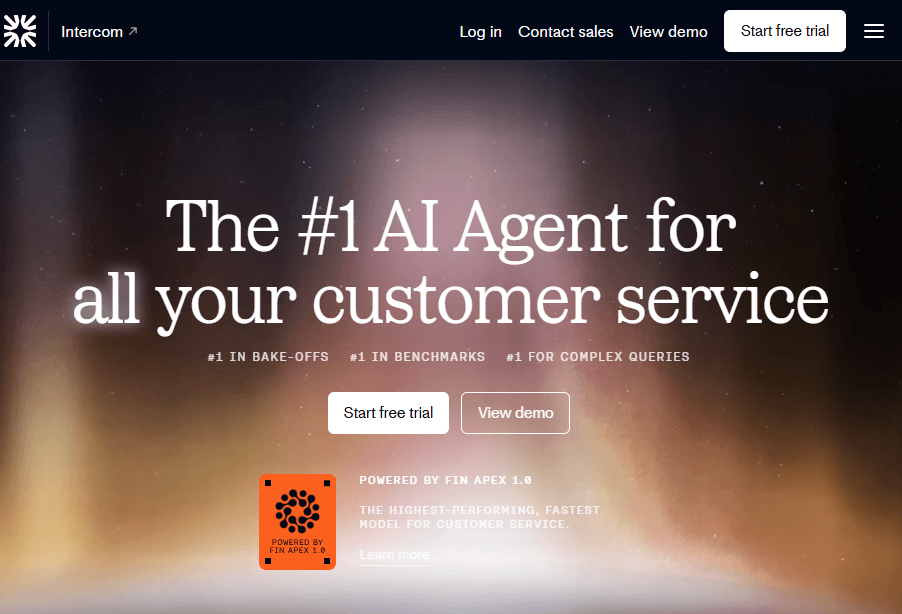
A customer service AI agent that handles common questions end to end, then hands off complex cases with full transcript and context to human agents. Built for chat first and now expanding to email, social, and voice, per vendor documentation.
- Best for: Digital-first support teams that want measurable deflection with outcome pricing instead of per-seat AI add-ons.
- Key Features: Outcome priced per resolution, omnichannel coverage including chat, email, social, and voice, automated fallback and handoff with conversation history, configurable guardrails and tone, analytics to improve answer quality.
- Why we like it: Outcome pricing aligns spend to resolved conversations, which makes ROI reviews straightforward if you model monthly resolution volumes, as described in a Stripe customer story about Fin's value-based pricing model (Stripe case study).
- Notable Limitations:
- Usage-based spend can be unpredictable if you cannot forecast volumes - a common budgeting concern echoed in third-party breakdowns and community analyses of resolution-based pricing.
- Performance depends on the quality of your help center and policies, a theme that appears in aggregated user feedback on review sites like G2's Intercom page.
- Some users report edge cases and multi-step workflows need tuning or human review loops before scale, based on field feedback threads (customer support practitioners' discussion).
- Pricing: Outcome based at $0.99 per resolved conversation, with a minimum of 50 resolutions per month when running Fin standalone (outside of Intercom's helpdesk). When used inside Intercom, at least one paid seat is required, ranging from $29 to $139 per seat per month depending on plan. There are no volume discounts or pricing caps, so model your expected resolution volumes carefully before committing. For the most current details see Intercom's pricing page.
Moveworks
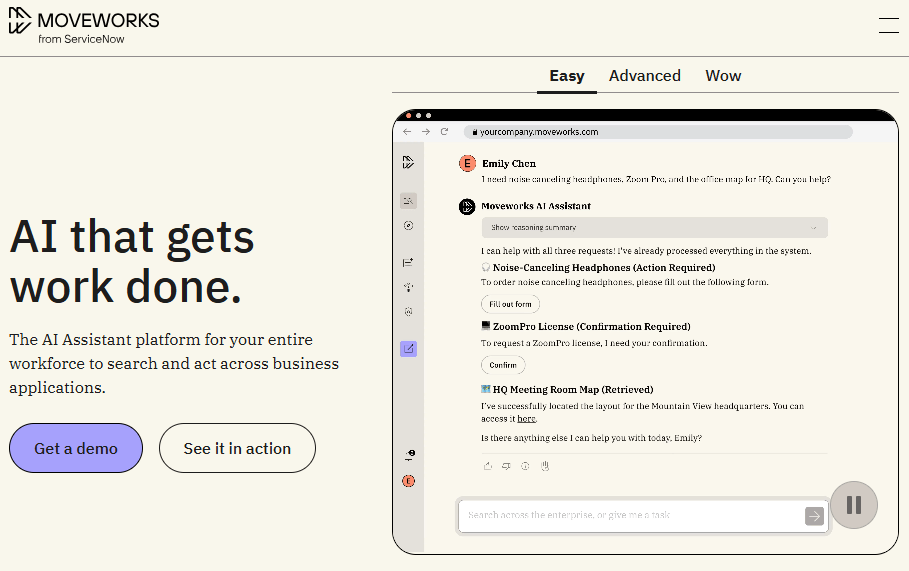
An agentic AI platform for internal support that understands employee requests, searches across systems, and takes action across IT, HR, and other workflows. Strong fit for large enterprises standardizing on Teams or Slack with ServiceNow or similar back ends. Note: ServiceNow completed its acquisition of Moveworks on December 15, 2025, so product packaging and roadmap continue to evolve under the new ownership.
- Best for: Enterprises that need end-to-end automation across ITSM, HR, and facilities inside Slack or Teams.
- Key Features: Deep integrations with systems of record like ServiceNow and Microsoft 365, autonomous task completion with policy controls, enterprise search and knowledge synthesis, analytics for ticket deflection and time to resolution.
- Why we like it: When an organization already runs ServiceNow, Moveworks' orchestration plus search can shorten cycle times for requests and standard changes - a pattern reinforced by analyst and news coverage of enterprise deployments and the completed acquisition (ServiceNow acquisition announcement).
- Notable Limitations:
- Best results require significant setup and ongoing stewardship, a consistent theme in enterprise user reviews on G2.
- Pricing is enterprise-oriented, and several midmarket teams report cost as a barrier, as reflected in buyer discussions and forums (practitioner feedback).
- Post-acquisition integration into ServiceNow's Now Assist portfolio means product packaging and roadmap may continue to shift through 2026 (acquisition completion coverage).
- Pricing: Pricing not publicly available. Contact Moveworks/ServiceNow for a custom quote. For peer feedback on value and implementation scope, consult third-party review hubs like G2.
Ada
A clinical-grade conversational agent for symptom assessment and care navigation that guides users to the right point of care and can integrate into health system digital front doors. Designed with clinician-reviewed content and triage logic.
- Best for: Health systems, payers, and digital health programs that need medically governed triage and care routing.
- Key Features: Structured symptom assessment and triage, clinician-reviewed medical knowledge base, care navigation with configurable endpoints, reporting for safety and appropriateness, integrations into patient portals or mobile apps.
- Why we like it: Independent studies show Ada's triage and diagnostic performance is competitive among symptom checkers and improves care appropriateness in real-world settings, including peer-reviewed and clinical evaluations in emergency departments and health networks (JMIR ED study via PMC, comparative analysis via PMC, ESSENCE study preprint).
- Notable Limitations:
- Symptom checker performance varies across conditions, and systematic reviews caution that diagnostic accuracy ranges widely across tools and scenarios (systematic review, PMC).
- Deployment must account for clinical safety, equity, and regulatory oversight, which adds governance overhead compared with generic chatbots (scholarly review on ethical and legal considerations).
- Not a replacement for clinicians, and organizations still need clear escalation and liability frameworks, reinforced by multiple academic evaluations (comparative analysis via PMC).
- Pricing: Pricing not publicly available. Health systems should request an enterprise proposal that includes implementation, validation, and governance costs. For evidence review, start with peer-reviewed studies such as the emergency department evaluations on PMC.
Conversational Interface Agents Tools Comparison: Quick Overview
| Tool | Best For | Pricing Model | Highlights |
|---|---|---|---|
| Fin (Intercom) | Customer service deflection with measurable ROI | $0.99 per resolved conversation for the AI agent, platform seats billed separately | Outcome pricing ties spend to value, growing omnichannel reach including voice |
| Moveworks | Internal IT, HR, and enterprise support at scale | Custom enterprise pricing (now under ServiceNow) | Deep ServiceNow and collaboration stack integrations, strong enterprise search and orchestration |
| Ada | Healthcare symptom assessment and care navigation | Custom enterprise pricing | Peer-reviewed triage performance and real-world ED evaluations |
Conversational Interface Agents Platform Comparison: Key Features at a Glance
| Tool | Feature 1 | Feature 2 | Feature 3 |
|---|---|---|---|
| Fin (Intercom) | Outcome priced AI agent with analytics | Omnichannel support expanding to voice | Automated fallback and agent handoff with full transcript |
| Moveworks | Conversational front door in Slack or Teams | Orchestrates actions in ServiceNow and other systems | Enterprise search across knowledge sources |
| Ada | Structured triage and care routing | Clinician-reviewed medical knowledge base | Evidence from ED and health system studies |
Conversational Interface Agents Deployment Options
| Tool | Cloud API | Integration Complexity | Notes |
|---|---|---|---|
| Fin (Intercom) | Yes | Low to medium | Fastest when knowledge lives in the help center, per user reviews |
| Moveworks | Yes | Medium to high | Depends on ITSM and identity landscape; now part of ServiceNow portfolio |
| Ada | Yes | Medium | Requires clinical validation and governance tied to care pathways |
Conversational Interface Agents Strategic Decision Framework
| Critical Question | Why It Matters | What to Evaluate | Red Flags |
|---|---|---|---|
| Can we reliably forecast conversation volumes and resolution rates? | Pricing models vary; outcome or usage can swing spend | Historic ticket data, seasonality, bot containment, safe-handoff rate | No baseline modeling for outcome pricing |
| Do we have clean knowledge and policies to ground answers? | Accuracy and safety depend on content quality | Coverage of top intents, update workflow, audit trails | "We will populate the KB later," weak content ownership, review gaps |
| Which systems must the agent act in, not just search? | True ROI comes from action: resets, access, provisioning | Catalog of native integrations, security model, approvals | Manual swivel chair steps remain after bot response |
| What are the clinical or regulatory boundaries? | In healthcare, safety and appropriateness trump speed | Evidence base, escalation rules, clinical governance | Treating a symptom checker as medical diagnosis without oversight |
Conversational Interface Agents Solutions Comparison: Pricing & Capabilities Overview
| Organization Size | Recommended Setup | Estimated Monthly Cost | Notes |
|---|---|---|---|
| Startup to Mid-Market CX | Fin for AI resolution plus human inbox. Model 5,000 AI resolutions per month. | ~$4,950 for AI resolutions at $0.99 each, plus platform seats per your plan. | Model with seasonality and planned content expansions. Minimum 50 resolutions/month applies for standalone use. |
| Large Enterprise IT/HR | Moveworks integrated with ServiceNow or similar, Slack or Teams front end. | Pricing not publicly available. | Request a custom quote; reference peer benchmarks from G2. |
| Health System | Ada embedded in portal or app with governance and clinical validation. | Pricing not publicly available. | Align budget to validation studies and integration scope, guided by peer-reviewed evidence. |
Problems & Solutions
-
Problem: Post-launch support spikes overwhelm chat and email queues.
- Fin (Intercom): Outcome pricing and analytics make it straightforward to measure deflection and budget impact when volumes surge, as described by Intercom's value-based pricing implementation with Stripe Billing (Stripe case study). Independent coverage also shows Fin expanding to voice, which helps absorb channel spillover during peaks (feature coverage).
-
Problem: Employees wait days for common IT tasks like access requests or password resets.
- Moveworks: Acts in collaboration tools and executes actions in systems like ServiceNow, reducing handoffs and cycle time - now reinforced further by full integration into the ServiceNow agentic AI portfolio following the December 2025 acquisition close (acquisition completion). Peer reviews highlight faster resolution for common IT and HR tasks when implemented with adequate ownership and data plumbing (G2 overview).
-
Problem: Health systems struggle with inappropriate ED utilization and patient uncertainty.
- Ada: Peer-reviewed emergency department studies show structured assessments with Ada can deliver competitive triage performance and improve care navigation, which health systems can operationalize in front-door flows (JMIR ED study via PMC, comparative analysis via PMC). A real-world quality improvement study in a large network reported shifts toward more appropriate care, providing an implementation playbook for digital front doors (ESSENCE preprint).
A practical path forward
The biggest mistakes happen when teams roll out agents without modeling price and governance. The data shows adoption has accelerated through 2025 and into 2026, with customer service leaders having executed aggressive pilots for conversational AI (Gartner survey). For fast wins, pair Fin with a content sprint and resolution forecasting, bring Moveworks in where you already have strong ITSM and identity foundations, and treat Ada as a clinical program with validation and oversight based on peer-reviewed evidence (PMC studies). Finally, watch vendor developments closely - Moveworks' acquisition by ServiceNow closed in December 2025, meaning packaging and capabilities are actively evolving through 2026 (acquisition completion).