Most teams discover their cryptography is scattered and brittle during an outage or compliance audit, not from a planned assessment. Working across different tech companies, I have seen crypto-agility fail at three very specific points: mass TLS rotation across Kubernetes ingress controllers, inconsistent ACME enrollments across multi-cloud, and slow swaps from RSA or ECDSA to NIST's new ML-KEM or ML-DSA in code paths. The urgency is real, with finalized post-quantum standards arriving on August 13, 2024 and named ML-KEM, ML-DSA, and SLH-DSA by NIST, which reset many roadmaps (NIST announcement). Pair that with breaches averaging $4.88M in 2024 and budgets shift fast (IBM's Cost of a Data Breach Report).
You will learn where each one fits, how they handle cryptographic discovery and rotation, and what to expect on pricing and deployment, backed by third-party sources like NIST, AWS Marketplace, Business Wire, and G2.
Keyfactor Crypto-Agility Platform
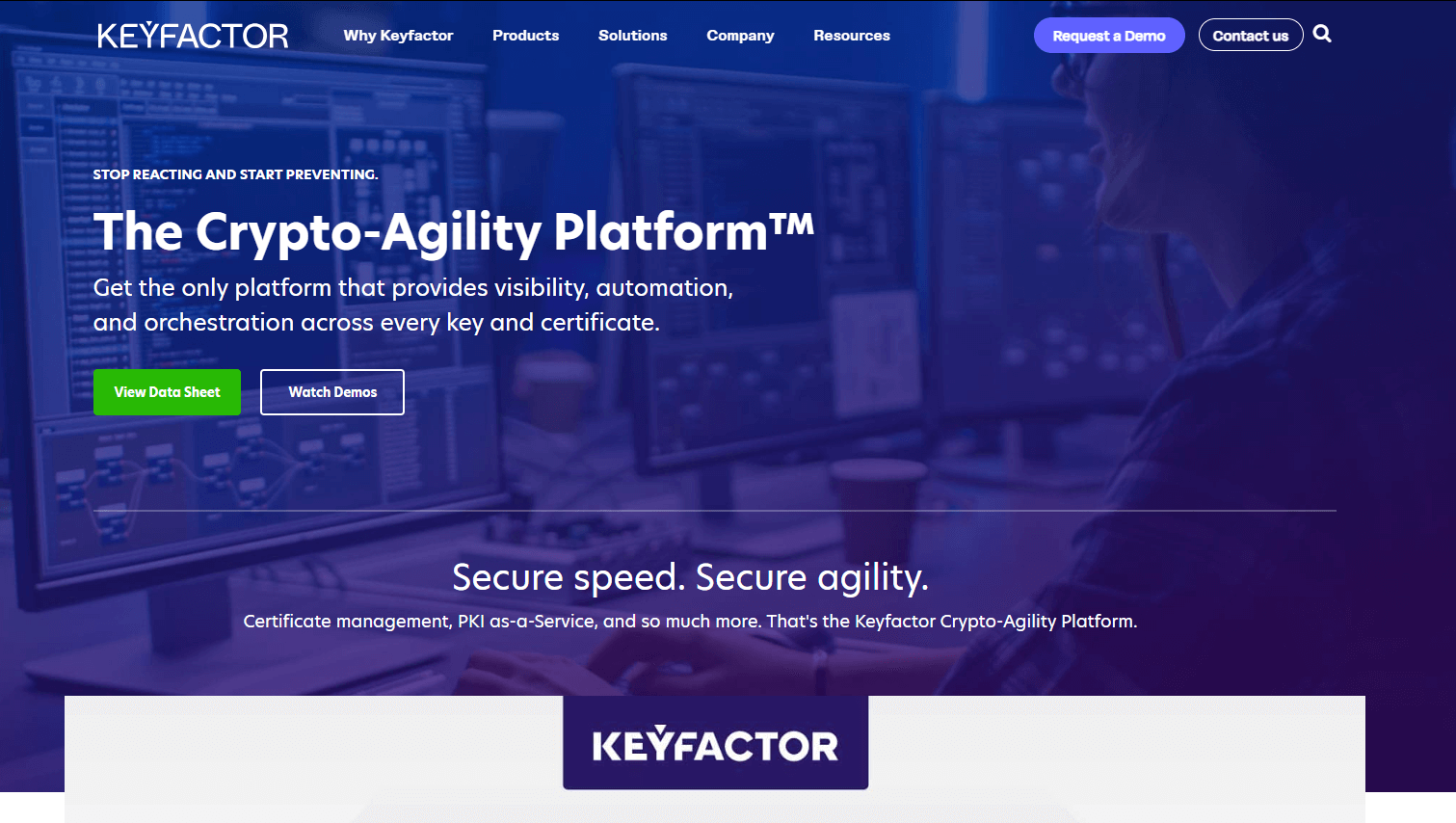
Enterprise platform for PKI, certificate lifecycle automation, and cryptographic discovery, with options spanning SaaS, cloud marketplace images, and on-prem. The company expanded into cryptographic posture management via acquisitions and reports nine-figure ARR growth.
Best for: Large enterprises that need unified PKI issuance, certificate lifecycle automation, and cryptographic discovery across hybrid and regulated environments.
Key Features:
- Enterprise PKI with EJBCA, REST APIs and protocol support like ACME, SCEP, CMP, EST, plus HSM integrations, per vendor documentation.
- Certificate lifecycle management with discovery and automation, per vendor documentation.
- Cryptographic discovery and posture management after the 2025 acquisitions of InfoSec Global and CipherInsights, validated in the press (Business Wire coverage).
- Cloud marketplace options, including EJBCA Enterprise AMIs with free trials and per-hour pricing (AWS Marketplace listing).
- ARR milestone reported publicly in 2024, indicating scale and stability (Business Wire report).
Why we like it: The breadth is hard to match, especially when a team wants issuance and lifecycle in the same house, then needs crypto discovery for PQC planning without stitching multiple vendors.
Notable Limitations:
- Several G2 reviewers cite initial deployment complexity and a learning curve for workflows and troubleshooting content (G2 Keyfactor Command reviews).
- Some manual steps for endpoint inventory can slow early rollouts, per recent user feedback on G2.
Pricing:
- EJBCA Enterprise Cloud software fee from roughly $2.67 per hour on select instance types, 30-day free trial available.
- EJBCA SaaS public pricing examples on the UK G-Cloud start around £62,065 per year for certain packages, details vary by scope (UK Digital Marketplace).
- Command SaaS Lite availability confirmed via Azure Marketplace announcement, pricing not publicly listed in that release, contact vendor or channel for a quote (Business Wire).
AppViewX AVX ONE CLM
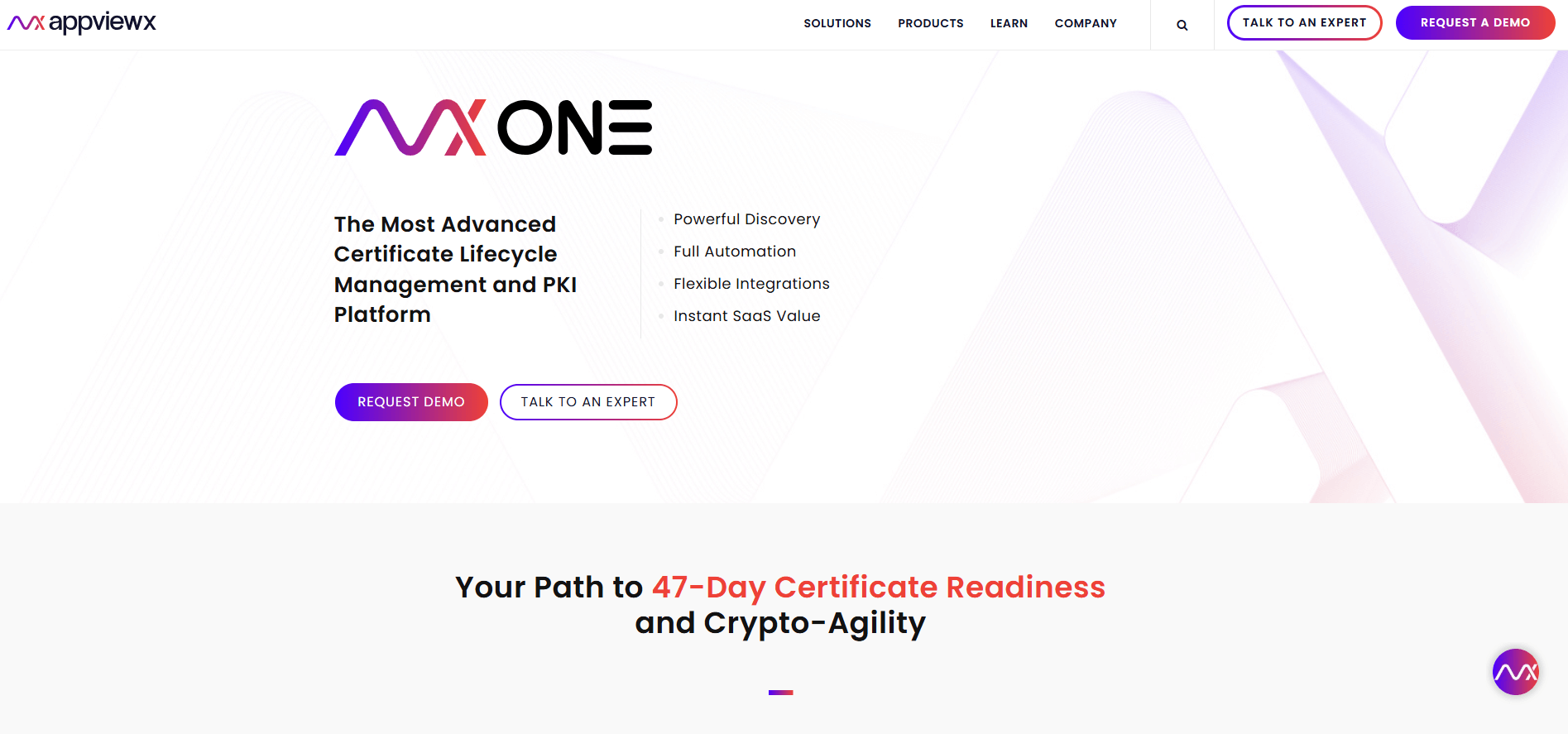
Cloud-first certificate lifecycle management and PKI platform with strong discovery, policy, and workflow automation. Available via SaaS, private cloud, and on-prem with marketplace SKUs.
Best for: Enterprises that want prescriptive CLM automation, SaaS speed, and clear pricing tiers for server certificate volumes.
Key Features:
- Smart Discovery and automation workflows for renewal, provisioning, revocation, and binding across hybrid environments, highlighted by analyst coverage and show launches (Business Wire RSA launch).
- Multi-tenant SaaS, plus on-prem and dedicated cloud options, per independent launch coverage.
- Kubernetes and container integrations, including an EKS add-on in AWS Marketplace (AWS Marketplace EKS add-on).
- Recognized with industry awards and shortlists in 2024 and 2025, indicating market momentum (Business Wire awards roundup).
Why we like it: The discovery and workflow depth help teams stop outages quickly, then scale consistent policy. It fits well where teams want SaaS speed yet keep on-prem options.
Notable Limitations:
- Some users report bugs when adopting newer versions and a modest learning curve while tuning workflows (G2 AppViewX CERT+ reviews).
- Limited number of public peer reviews compared to longer-tenured incumbents, which can make benchmarking harder (Gartner Peer Insights vendor page).
Pricing:
- AVX ONE CLM on AWS Marketplace lists monthly contract tiers, for example $2,100 for 100 server certs and $4,200 for 250, plus a 30-day free option for 500 certs (AWS Marketplace listing).
- PKIaaS packages are also listed in the marketplace with contract pricing, contact for private offers (AWS Marketplace PKIaaS).
QuSecure platform

Platform focused on discovery, orchestration, and migration to post-quantum cryptography with crypto-agility, including modules for cryptographic inventory and hybrid deployments.
Best for: Public sector and regulated enterprises planning PQC pilots or production rollouts, especially where SBIR or government channel access matters.
Key Features:
- PQC orchestration with modules for cryptographic inventory and live encryption management, as described in independent coverage of deployments and awards (Business Wire company launch).
- Government traction through SBIR awards with U.S. Army and U.S. Air Force, signaling fit for defense use cases (Business Wire Army contract, Business Wire Air Force follow-on).
- Distribution via AWS Marketplace private offers and public sector channels like Carahsoft, improving procurement paths (Carahsoft announcement).
Why we like it: If crypto-agility planning is driven by NIST's 2024 PQC standards and government timelines, the product depth plus federal channels can reduce friction from pilot to production.
Notable Limitations:
- Few public peer reviews, which can make third-party validation and benchmarking harder for buyers outside defense (G2 QuSecure seller page).
- As a younger category, long-tail integration references are comparatively limited in open sources, which can lengthen proof phases, supported by wider industry reporting on PQC adoption maturity timelines (Barron's on PQC adoption urgency).
Pricing:
- Pricing not publicly available. Available via AWS Marketplace private offers and public sector resellers, contact channel partners for a custom quote.
pqAgility (from pqpki)
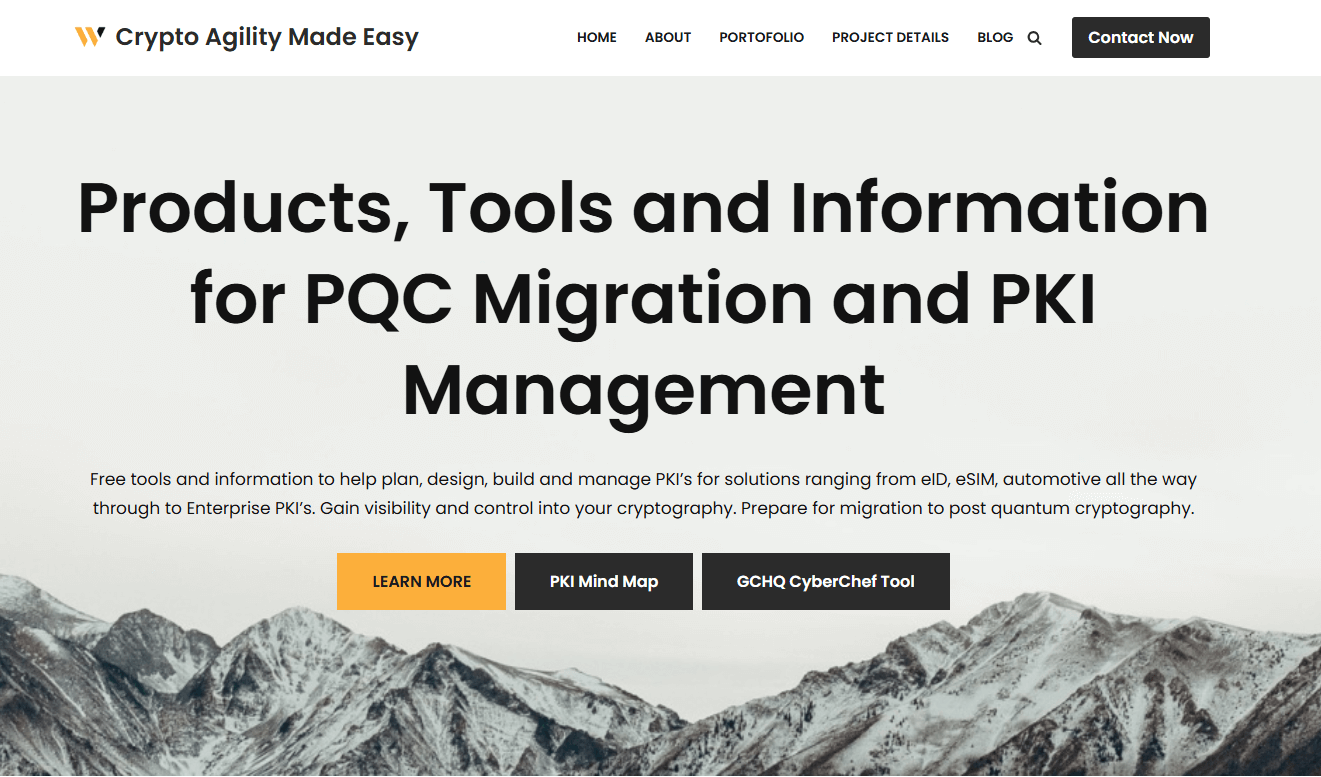
Open-source crypto-agility platform focused on cryptographic inventories, PKI management, and PQC migration planning. It targets teams that prefer to stand up and customize their own stack.
Best for: Security engineers who want an open stack for PKI and crypto inventory with the flexibility to customize components.
Key Features:
- Certificate Authority, Registration Authority, basic certificate lifecycle, and discovery with REST APIs, per vendor documentation.
- Emphasis on inventories and PQC migration planning workflows, per vendor documentation.
- Sample PKI utilities and planning aids for building policies, per vendor documentation.
Why we like it: For hands-on teams, an open platform can cut license costs and enable deeper customization while experimenting with PQC migrations alongside standard PKI.
Notable Limitations:
- Independent code hosting and sustained community activity are not well documented in third-party sources, which can impact support expectations at scale.
- Limited third-party reviews and benchmarks available publicly as of November 19, 2025, so due diligence should include a proof of concept and code review.
Pricing:
- Open-source, pricing not publicly documented for any commercial support. Treat as free software with potential services costs. If you need commercial SLAs, verify availability directly and request references.
Crypto-Agility Tools Comparison: Quick Overview
| Tool | Best For | Pricing Model | Highlights |
|---|---|---|---|
| Keyfactor Crypto-Agility Platform | Large enterprises needing issuance plus lifecycle and crypto discovery | Per-hour AMI fees or annual SaaS, channel quotes | Deep PKI, lifecycle automation, cryptographic discovery after 2025 acquisitions |
| AppViewX AVX ONE CLM | Enterprises seeking fast CLM automation with SaaS | Published monthly tiers on AWS Marketplace | Smart Discovery, multi-cloud coverage, Kubernetes add-on |
| QuSecure platform | Public sector and regulated industries planning PQC rollouts | Private offers via channels | PQC orchestration, SBIR traction, Carahsoft distribution |
| pqAgility | Hands-on teams wanting open-source PKI and crypto inventory | Open-source, services optional | DIY flexibility for inventories and PQC planning, per vendor documentation |
Crypto-Agility Platform Comparison: Key Features at a Glance
| Tool | Cryptographic Discovery | PKI Issuance | PQC Planning Support |
|---|---|---|---|
| Keyfactor | Yes, strengthened via 2025 acquisitions | Yes, EJBCA and SaaS options | Yes, roadmap aligned to NIST PQC standards |
| AppViewX AVX ONE CLM | Yes, Smart Discovery | PKIaaS options available | PQC-forward positioning in launch coverage |
| QuSecure | Yes, Recon module per public descriptions | Focus on orchestration and crypto-agility | Yes, aligned to NIST PQC transition milestones, with federal pilots |
| pqAgility | Yes, per vendor documentation | Yes, per vendor documentation | Yes, per vendor documentation |
Crypto-Agility Deployment Options
| Tool | Cloud API | On-Premise | Air-Gapped |
|---|---|---|---|
| Keyfactor | Yes, marketplace images and SaaS | Yes | Yes for PKI components like offline roots in SaaS descriptions |
| AppViewX AVX ONE CLM | Yes, SaaS and Kubernetes add-on | Yes | Not publicly documented |
| QuSecure | Yes, via AWS Marketplace private offers and public sector channels | Yes | Not publicly documented |
| pqAgility | Yes, self-hosted APIs per vendor documentation | Yes | Possible, depends on deployment choices, not independently documented |
Crypto-Agility Strategic Decision Framework
| Critical Question | Why It Matters | What to Evaluate | Red Flags |
|---|---|---|---|
| Can we inventory cryptography across all estates, including legacy and containers | PQC timelines and "store now, decrypt later" make visibility mandatory | Discovery depth across endpoints, code, TLS, SSH, and hardware | Discovery limited to a single CA or only TLS scanning |
| How fast can we rotate from RSA or ECDSA to ML-KEM or ML-DSA in live systems | NIST finalized PQC standards in 2024, agencies and vendors face deadlines through 2035 | Policy controls, automation, change windows, fallbacks, hybrid ciphers | Manual cutovers, service restarts that disrupt SLOs |
| Do we have a procurement path that matches our sector | Federal and regulated buyers need approved channels | Marketplace SKUs, SEWP, Carahsoft, private offers | Only direct purchase, no approved channels |
| What is the real TCO over 3 years | Breach cost pressure is rising, outages and rework are expensive | License, infrastructure, services, downtime risk | Hidden fees, opaque capacity limits |
Crypto-Agility Solutions Comparison: Pricing & Capabilities Overview
| Organization Size | Recommended Setup | Monthly Cost | Annual Investment |
|---|---|---|---|
| Mid-market with hybrid cloud | AppViewX AVX ONE CLM SaaS tier for 250 certs | $4,200, plus infra where applicable | ~$50,400 |
| Enterprise with internal PKI and HSMs | Keyfactor EJBCA Enterprise Cloud AMI, 24x7 | From ~$1,986 per month using $2.67 per-hour software fee estimate, plus AWS and services | From ~$23,800, plus infra and services |
| Public sector pilot for PQC | QuSecure via AWS private offer or Carahsoft | Pricing not publicly available | Contact channel for quotes |
| Engineering-led PoC with customization | pqAgility open-source stack | Software free, infra and labor apply | Services optional, verify scope |
Problems & Solutions
-
Problem: Crypto inventory is incomplete, and agencies or critical infrastructure must catalog vulnerable algorithms due to federal directives.
How each tool helps:- Keyfactor adds cryptographic discovery to CLM and PKI, aligning with inventory requirements seen in federal guidance and NIST's PQC standards timeline.
- AppViewX Smart Discovery gathers more certificates across hybrid estates, reducing blind spots before rotation windows.
- QuSecure Recon focuses on cryptographic asset inventory as a first step toward PQC migration, noted in federal contracting momentum.
- pqAgility positions inventory and PKI components for a self-hosted approach, per vendor documentation.
Why it matters: Federal memoranda and NSA CNSA 2.0 timelines are pushing inventories and migrations across this decade (White House NSM-10 summary, NSA CNSA 2.0 advisory).
-
Problem: Short maintenance windows make mass rotation risky, and outages are expensive.
How each tool helps:- Keyfactor and AppViewX automate renewal and binding, and surface expiring certs before SLO impact, supported by user and launch reports.
- QuSecure emphasizes crypto-agile orchestration to change algorithms and keys without ripping out existing stacks, mirrored in award and contract coverage.
- pqAgility offers DIY control paths for staged cutovers, per vendor documentation.
Why it matters: Breach and outage costs are rising, making automation pay back fast.
-
Problem: Preparing for PQC with real standards and deadlines, while still running today's systems.
How each tool helps:- Keyfactor and AppViewX now market PQC-forward controls, while running classical PKI and CLM at scale, with cloud marketplace routes for faster start.
- QuSecure focuses on orchestrated PQC transitions and has public sector channels that match government schedules.
- pqAgility supports planning and pilots for hybrid or PQC-ready PKI in a lab or controlled environment, per vendor documentation.
Why it matters: NIST finalized PQC standards in 2024, and guidance points toward adoption milestones through 2035 (NIST PQC standards, NIST PQC program page).
The Bottom Line on Crypto-Agility
Crypto-agility does not start with ML-KEM in production. It starts with knowing where cryptography lives, automating rotation, and only then planning algorithm transitions so you can move fast without breaking SLOs.
In 2026, the practical path is:
Inventory first - build a cryptographic bill of materials across certs, TLS endpoints, code paths, and Kubernetes ingress, because you cannot migrate what you cannot see. This aligns with federal migration guidance like OMB M-23-02 and CISA’s push toward automated PQC discovery and inventory.
Automate lifecycle and binding - mass TLS rotation, ACME consistency, and renewal workflows are where outages happen, so CLM and policy-driven automation pay back immediately.
Stage PQC upgrades with real standards - NIST’s finalized standards approved as FIPS 203, 204, and 205 (ML-KEM, ML-DSA, SLH-DSA) reset roadmaps, and NIST has also published transition guidance to help map quantum-vulnerable standards to PQC successors.
Vendor-wise, if you want one stack spanning issuance, lifecycle, and discovery, Keyfactor is the most complete. If you want fast CLM wins with transparent marketplace tiers, AppViewX is hard to ignore. If your program is PQC-driven with public sector channels and orchestration, QuSecure matches that motion. If you need a DIY lab-to-pilot path, pqAgility can work, but assume you own integration, operations, and support.
Finally, this is not academic risk management. With breach costs averaging $4.88M in 2024, teams that can rotate and standardize crypto quickly are reducing real financial exposure, not just ticking a compliance box.