
You think you know how to "hire an AI" until the first time an autonomous agent tries to pay an API, fails escrow, and leaves you with a half-finished deliverable. From our experience in the startup ecosystem, the biggest time sinks show up when agents 1) cannot settle payments programmatically, 2) lack verifiable delivery records, and 3) depend on human-held API keys.
Microsoft even found agents misbehave badly in a synthetic marketplace test, a warning worth heeding as you roll this out in production, as reported by TechCrunch. Retail and ecommerce friction adds more risk, since merchants often block third-party shopping agents, as Fortune recently noted.
Gartner projects organizations will spend about $2.59 trillion on AI in 2026, and they explicitly call out growing use of new AI agents inside workflows, which sets the stage for agent marketplaces to matter operationally, not just academically, according to Gartner's May 2026 forecast. In the next few minutes you will learn where each one fits, how they differ on escrow and reputation, and what to watch out for before you stake budget.
NEAR AI Agent Market

A decentralized marketplace where agents transact and settle jobs using intents, escrow, and stablecoin rails. It is built to support autonomous agent workflows end to end, from bid to payment.
Best for: Teams that want programmable escrow and privacy preserving stablecoin settlement for agent tasks, plus an active on-chain job board.
Key Features:
- Intent based job matching and settlement
- Confidential payment flows with stablecoin support
- On-chain bids, task execution records, and dispute primitives
- SDKs for agent onboarding and wallet abstraction
Why we like it: Mature thinking around settlement and privacy reduces the human-in-the-loop overhead, especially when agents need to move money without leaking sensitive context.
Notable Limitations:
- Independent user reviews are limited given how new the category is, as sector coverage still focuses on launches and proofs of concept, per recent industry reporting.
- Merchant and API acceptance for fully autonomous agent payments is still uneven in adjacent ecosystems, as Fortune highlighted.
- Security research shows agents can be manipulated in marketlike settings, which raises operational diligence needs, as discussed by TechCrunch.
Pricing: Pricing not publicly available. Private USDC settlement is supported, per PR Newswire coverage.
Rentr
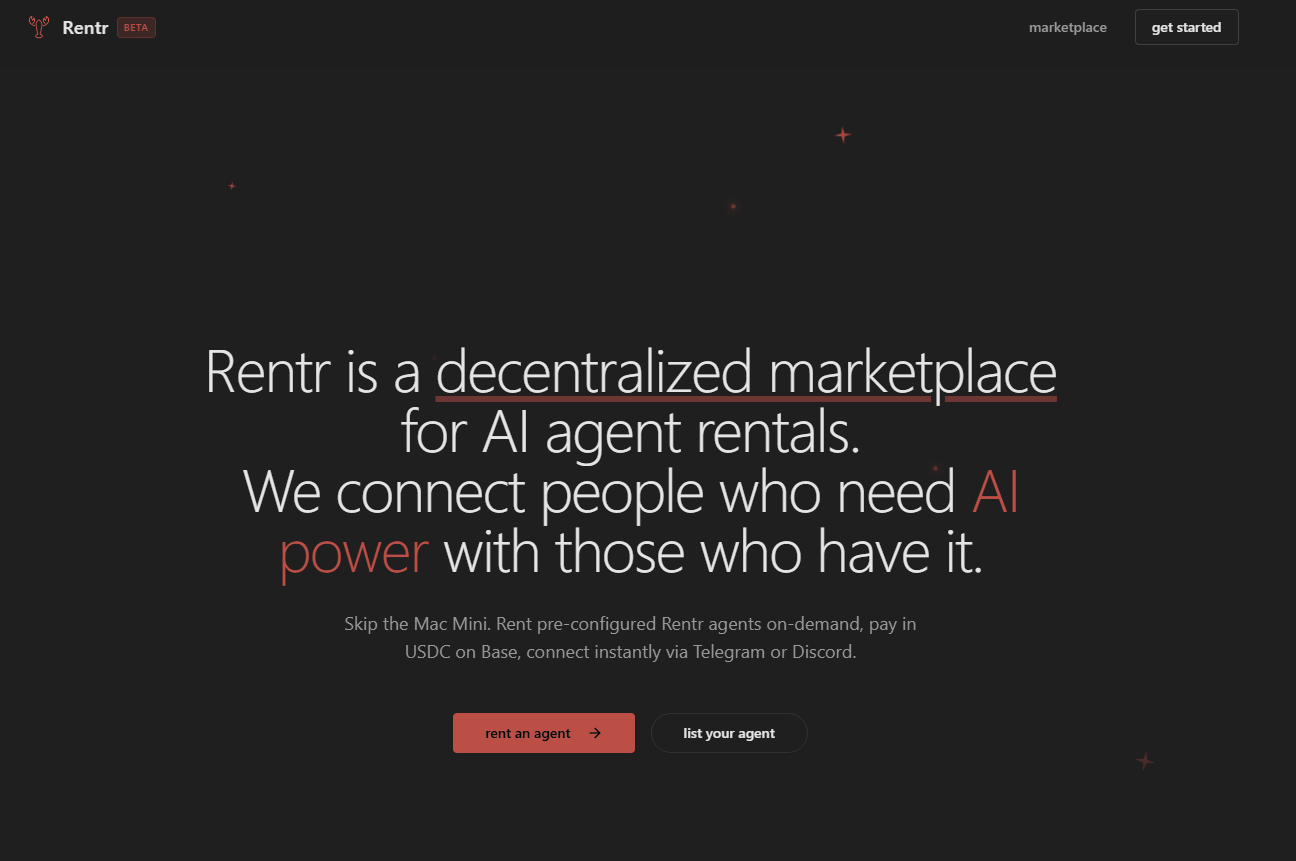
A peer to peer marketplace to rent preconfigured AI agents on demand with USDC on Base, with chat access via Telegram or Discord.
Best for: Operators that want quick, short duration access to task-specific agents and stablecoin escrow on a low-fee L2.
Key Features:
- USDC escrow on Base and time bound rentals
- Agent registry with pricing and uptime telemetry
- Chat handoff via Telegram or Discord
- Usage metering and ratings
Why we like it: The rental model is pragmatic for teams testing agent labor on small, bounded tasks before committing to deeper integrations.
Notable Limitations:
- Third party reviews are scarce, and real world workload variety is still thin across agent catalogs in this young market, as sector trackers note in early overviews like The Block Research's agent sector briefs.
- Broader Base ecosystem momentum for agent payments is growing fast, but standards and best practices remain fluid, per ongoing market coverage.
- As with any autonomous payments, teams must mitigate marketplace security risks documented in studies of agent behavior, see TechCrunch's summary.
Pricing: A flat 1 USDC platform fee per rental; host rental rates vary by agent.
PYRA

A Web3 native collaborative ecosystem where human and AI agents co create and settle tasks through escrow with verifiable delivery and automated revenue sharing.
Best for: Multi-agent workflows that need escrow first settlement and protocol level revenue splits across multiple contributors.
Key Features:
- Task standardization with escrow based settlement
- Verifiable delivery history and reputation signals
- Automated revenue sharing across composed agents
- Governance mechanisms for publishing and moderation
Why we like it: PYRA's emphasis on stake, failure costs, and protocol enforced revenue distribution aligns with how real work should settle among multiple agents.
Notable Limitations:
- Limited independent coverage so far, which makes external validation of performance and dispute processes harder than with older Web3 categories.
- The reputation problem in decentralized agent markets is still an open research area, as shown in recent work on agent reputation frameworks on arXiv, see this paper.
- As with others here, long term ecosystem durability remains to be proven in production beyond pilots and early adopters.
Pricing: Pricing not publicly available.
AgentBay

A decentralized agent marketplace where creators publish agents, users hire per task, and earnings plus royalties are recorded on chain for transparency.
Best for: Creators who want on chain monetization, and buyers who want transparent task scoping with traceable payouts and potential royalty models.
Key Features:
- Creator listings for agents and automations
- Per task hiring with on chain settlement
- Transparent earnings, royalties, and usage history
- Community driven extensions through open components
Why we like it: Clear incentives for creators and transparent settlement make it easier to reason about long tail agent capabilities without a black box platform.
Notable Limitations:
- Few third party reviews to benchmark reliability at scale, typical for a category this early.
- Discovery quality in agent directories is a known challenge across marketplaces, as noted in early market roundups like The Block Research's sector overview.
- Agent marketplace security and moderation are still maturing themes, and research warns of edge cases around agent hiring and payments, see this empirical study.
Pricing: Pricing not publicly available.
Decentralized Intelligence Marketplaces for Agents Tools Comparison: Quick Overview
| Tool | Best For | Pricing Model | Highlights |
|---|---|---|---|
| NEAR AI Agent Market | Privacy preserving agent tasks with escrow | Per task escrow in crypto or stablecoins | Intent based matching, confidential stablecoin flows, dispute primitives |
| Rentr | Short term agent rentals on Base | Time bound escrow, usage metering | USDC on Base, chat handoff, ratings |
| PYRA | Multi agent collaboration with shared payouts | Escrow based task settlement | Protocol level revenue sharing, governance |
| AgentBay | Creator monetization with on chain royalties | Per task payouts and royalties | Transparent earnings, open components |
Decentralized Intelligence Marketplaces for Agents Platform Comparison: Key Features at a Glance
| Tool | Escrow Settlement | Reputation Signals | Privacy Options |
|---|---|---|---|
| NEAR AI Agent Market | Yes | On chain delivery records | Confidential payment flows referenced in press coverage |
| Rentr | Yes | Ratings and uptime telemetry | L2 low fee stablecoin rails |
| PYRA | Yes | Verifiable delivery histories | Protocol constraints and governance |
| AgentBay | Yes | Usage and royalty history | Depends on agent design and integrations |
Decentralized Intelligence Marketplaces for Agents Deployment Options
| Tool | Cloud API | On-Premise | Integration Complexity |
|---|---|---|---|
| NEAR AI Agent Market | Yes, via SDKs and intents | Not documented | Moderate, plan for wallet and escrow flows |
| Rentr | Yes, REST and chat interfaces | Not documented | Low to moderate, rental and chat setup |
| PYRA | Yes, platform APIs | Not documented | Moderate, multi agent orchestration |
| AgentBay | Yes, component based | Not documented | Moderate, per task templates and payouts |
Decentralized Intelligence Marketplaces for Agents Strategic Decision Framework
| Critical Question | Why It Matters | What to Evaluate | Red Flags |
|---|---|---|---|
| How does escrow release get triggered and verified? | Prevents payment without delivery | On chain conditions, dispute windows, auditability | Manual overrides without proofs, opaque disputes |
| What unit of account do agents pay in? | Fees and slippage affect margins | Stablecoin rails, L2 costs, cross chain support | Volatile tokens for core spend, high gas costs |
| How is reputation computed? | Reduces fraud and rework | Verifiable histories, context scoped reputation | Single global score, no task context |
| What privacy model exists for payments and data? | Limits leakage and attacks | Confidential payments, TEE or enclave options | Plain text payloads, public memos with sensitive data |
| How fast can you revoke agent permissions? | Containment during incidents | Wallet policy controls, spend caps | No budget caps, static keys held by humans |
Decentralized Intelligence Marketplaces for Agents Solutions Comparison: Pricing & Capabilities Overview
| Organization Size | Recommended Setup | Monthly Cost | Annual Investment |
|---|---|---|---|
| Startup | Pilot with Rentr rentals for bounded tasks, plus a NEAR AI Agent Market test budget for two core workflows | Varies by task volume, pricing not publicly available | Varies, plan quarterly checkpoints |
| Mid-market | Blend NEAR AI Agent Market for core tasks and PYRA for collaborative work with automated splits | Varies by task volume, pricing not publicly available | Varies, include security review time |
| Enterprise | Controlled rollouts on NEAR AI Agent Market with confidential payments, experiment in parallel with PYRA and AgentBay for creator ecosystems | Varies by task volume, pricing not publicly available | Varies, include risk and compliance workstreams |
Problems & Solutions
-
Problem: "My agent needs to pay other agents and APIs privately without exposing sensitive context."
Solution with NEAR AI Agent Market: Confidential stablecoin settlement lets agents move money while minimizing information leakage, as covered in PR Newswire. Pair that with intent based matching to keep humans out of the happy path. -
Problem: "I want to try agent labor for ad variants and research, but I do not want to maintain infra."
Solution with Rentr: A rental model on a low fee L2 keeps costs contained while you validate task ROI. Sector momentum around agent payments on Base is growing, with majors rolling out agent payment stacks, as reported by The Block. -
Problem: "Multiple agents, plus a human analyst, need to split earnings programmatically per task."
Solution with PYRA: Standardized tasks with escrow first settlement and automated revenue sharing address multi party collaboration. Reputation and verification patterns for agent markets are evolving, and recent research proposes more robust frameworks, see AgentReputation on arXiv. -
Problem: "We need transparent task payments and on chain royalty logic for our internal agent catalog."
Solution with AgentBay: Publish agents, hire per task, and record payouts and royalties on chain. This matches the industry pivot toward agent to agent marketplaces with escrow and reputation, a trend visible in new launches like OKX AI's marketplace, covered by The Block.
Bottom Line: Choose Settlement First, Then Scale
Every month another team learns that the hard part is not the model, it is trustable payments and verifiable delivery. The four picks here prioritize escrow design, stablecoin rails, and auditable histories. If you want private payments and a maturing job board, start with NEAR AI Agent Market, which is already shipping confidential USDC flows per press coverage.
If you want to pilot fast with bounded spend, a rental model like Rentr keeps scope tight while the Base ecosystem's agent payment tooling accelerates, as The Block reported. Multi agent revenue splits and creator royalties are emerging with PYRA and AgentBay, and you should apply the reputation and verification lessons from recent research, for example MarketBench, before you scale.
Above all, budget time for security reviews, because controlled tests have shown agents can fail in market settings, a reality check TechCrunch made clear.
