
Picture this. You are scrolling through social media when a video of a public figure making a shocking statement stops you cold. Something feels wrong, but the footage looks completely real. In 2026, that moment of doubt is increasingly common. Deepfakes and synthetic media now spread faster than fact checks, and the quality has reached a point where even trained professionals struggle to tell real from fake at first glance. What began as an experimental novelty has matured into a large scale risk used for fraud, disinformation, extortion, and reputation attacks. Traditional verification methods no longer hold up. Visual inspection fails, metadata can be spoofed, and real time manipulation removes the safety net of delayed analysis. The result is an arms race where choosing the wrong detection tool can mean missing a critical threat or falsely accusing legitimate content.
This guide focuses on the deepfake detection tools that hold up under real pressure. It is written for teams that need practical answers, not hype, and want to understand which tools fit their risk profile, operational capacity, and budget.
Quick Reference Comparison
| Tool | Best Use Case | Accuracy Level | Pricing Model |
|---|---|---|---|
| Sensity AI | Enterprise security & law enforcement | High (90%+ detection rate) | Custom pricing |
| Deepware Scanner | Quick web-based video verification | Moderate (probability-based) | Free with limitations |
| Reality Defender | Business media integrity protection | High (multi-modal detection) | Subscription-based |
| Resemble AI Detect | Audio deepfake detection | Very High (90% audio detection) | Freemium model |
Detailed Tool Analysis
Sensity AI — Enterprise-Grade Deepfake Defense

Best for: Large organizations, law enforcement, media companies
Sensity employs advanced deep neural networks (DNNs) for detecting and analyzing deepfake audio and video, trained on extensive datasets comprising genuine and manipulated content. Their platform offers comprehensive detection capabilities covering both visual and audio manipulation.
Key Strengths:
- Multi-modal detection (video, audio, images)
- Real-time monitoring capabilities
- Forensic-grade reporting
- API integration for enterprise workflows
Deployment Considerations: Sensity provides custom pricing and requires significant technical integration. Best suited for organizations with dedicated security teams.
Limitations: No free tier available; requires custom implementation.
Deepware Scanner — Accessible Web Detection
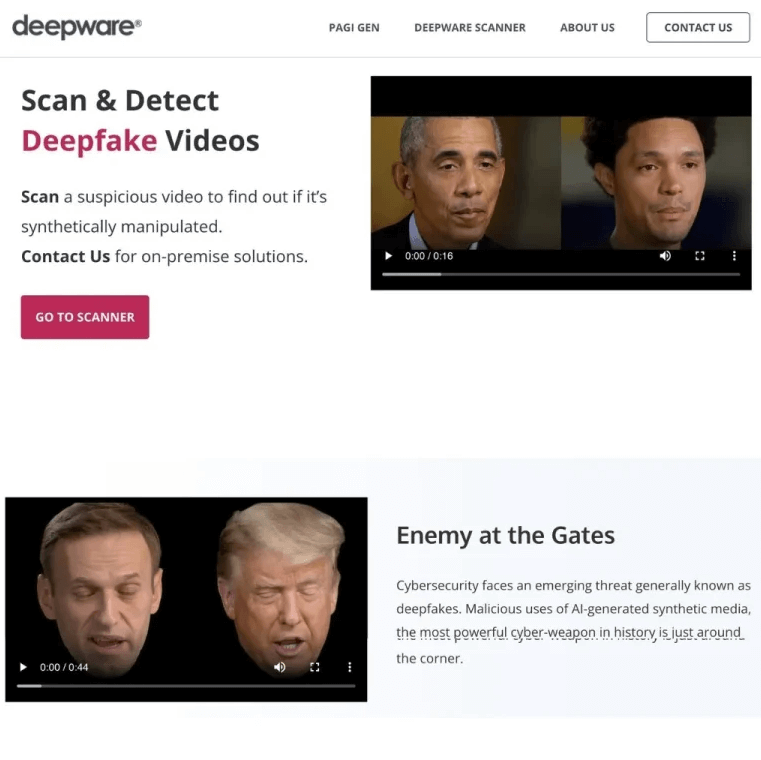
Best for: Journalists, content creators, general users
The tool is relatively easy to use: users simply upload the URL of the video they want to scan to the Deepware Scanner's user-friendly web interface. Deepware Scanner focuses on deepfake manipulation that uses a real video of a person and modifies or swaps their face.
Key Strengths:
- Free web-based access
- Simple URL-based scanning
- Visual feedback with bounding boxes
- No registration required
Deployment Considerations: Instant access through web browser, no installation needed.
Limitations: Results state the chances of a specific video being deepfake or not rather than definitive answers. Limited to face-swap detection.
Reality Defender — Business Media Protection
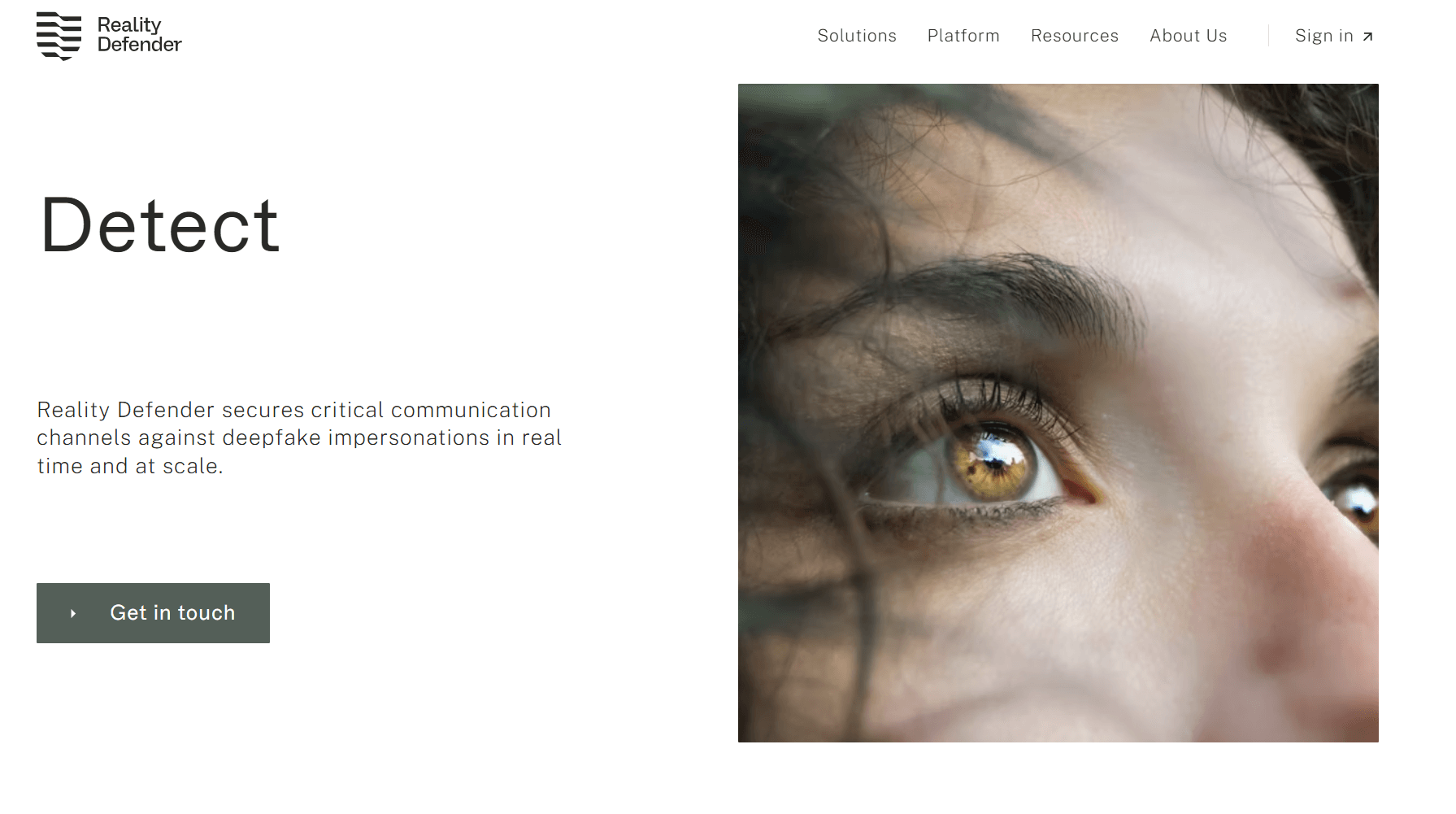
Best for: Marketing teams, PR agencies, brand protection
Reality Defender offers a comprehensive suite for detecting various forms of synthetic media. The platform is designed for businesses that need to verify content authenticity before publication or distribution.
Key Strengths:
- Multi-format support (video, audio, images, text)
- Business-friendly dashboard
- Batch processing capabilities
- Integration with content management systems
Deployment Considerations: Moderate setup time with business-focused pricing tiers.
Limitations: May be cost-prohibitive for smaller organizations.
Resemble AI Detect — Audio Deepfake Specialist
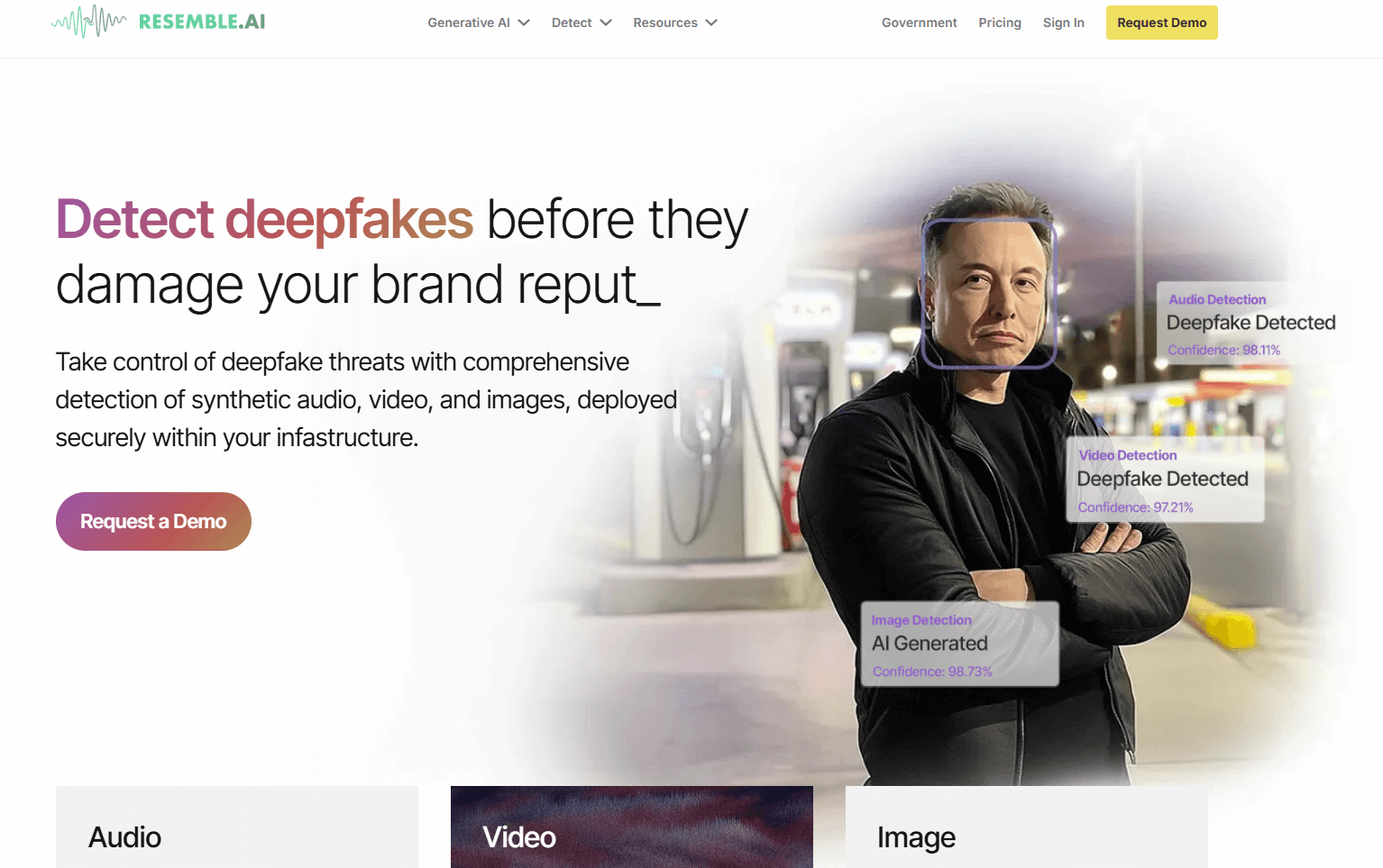
Best for: Voice authentication, call centers, audio content verification
Their AI Detect model captures 90% of audio deepfakes out of the box, working against all Generative AI vendors and open source models including Microsoft and Google Wavenet.
Key Strengths:
- Specialized audio focus
- High accuracy rate (90%)
- API-first approach
- Works against major AI voice generators
Deployment Considerations: Quick integration with existing audio workflows.
Limitations: Audio-only detection; doesn't handle visual deepfakes.
Choosing Your Detection Strategy
| Your Primary Need | Recommended Approach | Best Tool Match | Budget Consideration |
|---|---|---|---|
| Enterprise security | Multi-layered detection with forensic reporting | Sensity AI + Reality Defender | High ($10K+ annually) |
| Content verification | Quick, accessible scanning for decision-making | Deepware Scanner + backup verification | Low (Free to $100/month) |
| Audio-first protection | Specialized voice authentication and call verification | Resemble AI Detect | Medium ($500-2K/month) |
| Brand protection | Comprehensive media monitoring and analysis | Reality Defender | Medium-High ($2-10K/month) |
Implementation Best Practices
Start with Free Tools: Begin your deepfake detection journey with Deepware Scanner to understand baseline capabilities and false positive rates.
Layer Your Defenses: No single tool catches everything. Successful organizations combine automated detection with human review for high-stakes content.
Test Before You Trust: Run known deepfakes through your chosen tools to establish confidence levels and identify blind spots.
Plan for Scale: Consider API integration capabilities if you're processing large volumes of media regularly.
Critical Gaps in Current Tools
Despite marketing claims, current deepfake detection faces significant challenges:
- Evolving Techniques: New deepfake methods often outpace detection updates
- False Positives: Legitimate compressed or low-quality content may trigger false alarms
- Processing Limitations: Real-time detection remains computationally expensive
- Format Dependencies: Many tools work well on specific file types but struggle with others
Making the Right Choice
There is no silver bullet for deepfake detection, and any vendor claiming perfect accuracy should raise immediate skepticism. In 2026, the most effective defense against synthetic media combines automated detection, layered verification, and human judgment for high impact decisions. Enterprise teams handling legal, financial, or public trust risk need forensic depth, auditability, and integration into existing workflows. Journalists and creators need fast screening tools that flag suspicious content without slowing down reporting. Audio focused environments like call centers and identity verification benefit from specialized voice detection rather than general purpose platforms.
The right choice depends on what is at stake, how fast you need answers, and how much uncertainty you can tolerate. Treat deepfake detectors as decision support, not arbiters of truth. Test them against known examples, understand their blind spots, and assume adversaries will adapt. In a landscape where synthetic media evolves monthly, resilience comes from layered defenses and disciplined verification, not blind trust in any single tool.