
You think you know how detectable AI content is until a crisis review finds your watermark collapses under JPEG recompression, social re-encoding, or a light diffusion re-edit. Working across different tech companies, teams have shipped with only metadata labels, skipped spread-spectrum embedding for speed, and forgotten adversarial "regeneration" attacks that can strip pixel-level marks. Gartner has been warning that authenticity signals like watermarking will matter more as generative content floods discovery channels, a shift already changing search and content policies, according to a recent Gartner prediction. From our experience in the startup ecosystem, the right pick balances robustness, workflow fit, and organizational risk.
The global digital watermarking market was an estimated 1.60 billion dollars in 2025 and is projected to reach 3.80 billion dollars by 2033, per Grand View Research. Below you will learn where each tool excels, where it struggles, and how to match a platform to your security, compliance, and creative workflows without overspending.
SynthID
Google DeepMind's watermarking tech that embeds signals into images, audio, video, and text, with a Detector portal to verify whether content was made with Google's tools. Independent coverage confirms multi-modal scope and the public detector rollout to early testers.
- Best for: Orgs already producing AI media with Google models, or teams needing a verifier for Google-made outputs.
- Key Features:
- Imperceptible watermarking across images, audio, video, and text, verified via a browser portal, as covered at Google I/O 2025 by TechCrunch and The Verge.
- Detection highlights portions most likely to contain the watermark, per Ars Technica's report.
- Integrated with Google's media models like Veo and Lyria, as summarized in public coverage of Veo's releases on Wikipedia's Veo entry.
- Why we like it: Fastest path to at-scale watermarking if your stack already runs on Vertex AI, plus a simple verifier for comms, policy, and newsroom teams.
- Notable Limitations:
- Detector identifies SynthID, not third-party marks.
- All invisible marks face regeneration attacks that can remove pixel-level signals, as shown by a NeurIPS 2024 paper on watermark removal (NeurIPS proceedings).
- Pricing: Pricing not publicly available. Public reports indicate staged access via waitlist for the Detector portal.
Steg.AI
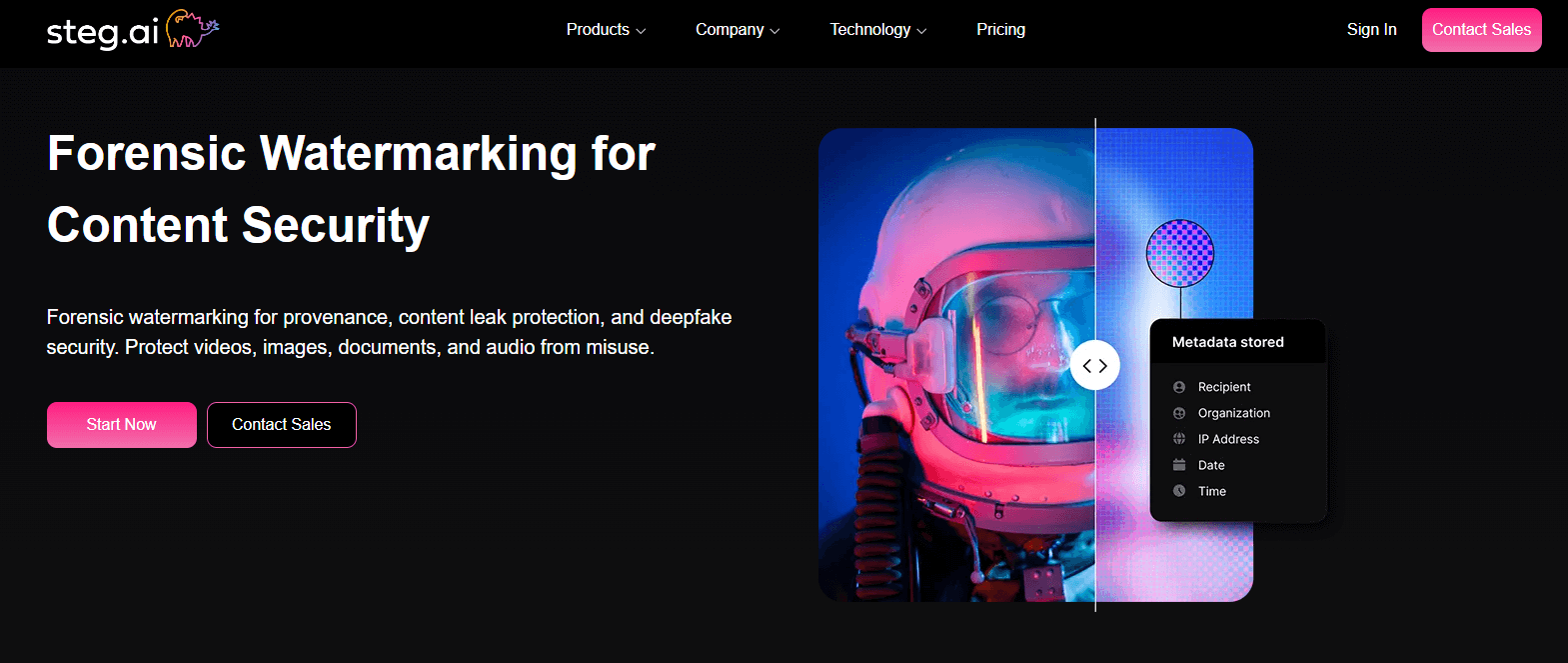
Enterprise watermarking with visible and forensic options for images, video, and documents via API or web app, built by a team with published steganography research and backed by institutional investors.
- Best for: Brands and media teams needing leak tracing on pre-release assets and C2PA-friendly provenance signals.
- Key Features:
- Forensic watermarking that survives common edits and complements C2PA content credentials, as described in third-party investor and industry write-ups (Paladin Capital news).
- API and browser-based workflows for rapid rollout without custom pipelines.
- Support for layered creative formats in recent product updates, covered in company news picked up by the trade press.
- Why we like it: Practical leak-tracing on early cuts, deck comps, and product shots, plus alignment with content provenance standards used across platforms.
- Notable Limitations:
- Public, independent benchmarks are limited, and, like other pixel-space approaches, theory and practice show vulnerability to regeneration attacks.
- Few third-party user reviews at scale, which can slow procurement due diligence on larger teams.
- Pricing: Pricing not publicly available on independent marketplaces. Contact vendor for a custom quote.
Verance Authentication (Verance)
Broadcast-grade watermarking with broad device adoption in living room hardware. Its audio watermarking underpins NextGen TV interactivity and has long been mandated in Blu-ray players.
- Best for: Broadcasters, studios, and distributors needing device-level watermark detection across cable, satellite, and OTA environments.
- Key Features:
- NextGen TV watermark detection shipped on major TV lines like LG and Hisense, enabling interactive apps over any distribution path, per the standards body's news hub (ATSC news).
- Adopted by major broadcaster groups to expand reach of ATSC 3.0 applications, according to industry coverage.
- Heritage in Cinavia, the audio watermark required in Blu-ray players since 2012, documented by third-party device makers and references (Sony Support, Wikipedia).
- Why we like it: Proven, standards-aligned deployment across consumer devices, which is rare in this category and critical for broadcast interactivity and compliance.
- Notable Limitations:
- Integration cycles depend on OEM firmware updates and broadcaster pipelines, and broader ATSC 3.0 rollout is still evolving, per industry reports on adoption and friction (Business Wire, ATSC at CES 2025).
- DRM and device control debates have created pushback, which can affect timelines, as covered by trade press filings to the FCC (TVTechnology).
- Pricing: Pricing not publicly available. Enterprise licensing agreements vary by broadcaster and OEM.
MarkDiffusion
Open-source toolkit for embedding and detecting watermarks in latent diffusion models for images and video, with evaluation pipelines and Apache 2.0 licensing. Research venues and repositories document the feature scope.
- Best for: Research teams and ML platform engineers benchmarking watermark robustness on diffusion pipelines.
- Key Features:
- Embedding and detection across multiple algorithms, with standardized robustness testing and visualization, per the project's paper and repo (arXiv entry, GitHub license and docs).
- Coverage of state-of-the-art methods such as Tree-Ring and ROBIN, with evaluation suites referenced in the public materials (arXiv ProMark context).
- Modular design to compare detectability, robustness, and quality tradeoffs, described in the paper summary.
- Why we like it: Realistic way to test algorithms against the latest removal and editing attacks before placing bets on a production approach.
- Notable Limitations:
- Research code requires ML expertise and GPU time to run at scale.
- Like all pixel-level or latent schemes, methods can be impacted by regeneration or fine-tuning attacks, an area of active research.
- Pricing: Free, open source, Apache 2.0 license on GitHub.
Generative Watermarking Tools Comparison: Quick Overview
| Tool | Best For | Pricing Model | Highlights |
|---|---|---|---|
| SynthID | Google model users, newsrooms verifying Google-made outputs | Not public (Detector via waitlist) | Multi-modal watermarking with web verifier |
| Steg.AI | Brands and studios needing leak tracing on pre-release assets | Not public | Forensic marks plus visible options, investor-backed |
| Verance | Broadcasters and CE ecosystems | Not public | Device-level adoption in NextGen TV |
| MarkDiffusion | Research and ML platform teams | Open source (Free) | Apache-licensed toolkit with multi-algo evaluations |
Generative Watermarking Platform Comparison: Key Features at a Glance
| Tool | Feature 1 | Feature 2 | Feature 3 |
|---|---|---|---|
| SynthID | Imperceptible marks in images, audio, video, text | Detector portal flags watermarked regions | Integrated with Google media models |
| Steg.AI | Forensic plus visible marks | API and web app workflows | C2PA-aligned provenance per industry coverage |
| Verance | ATSC 3.0 watermark detection on TVs | Broadcast interactivity over HDMI and set-tops | Blu-ray Cinavia heritage |
| MarkDiffusion | Embedding and detection for diffusion models | Robustness and quality evaluation pipelines | Apache 2.0 open source |
Generative Watermarking Deployment Options
| Tool | Cloud API | On-Premise/Air-Gapped | Integration Complexity |
|---|---|---|---|
| SynthID | Yes, via Google ecosystem | Not documented / No | Low if already on Vertex AI |
| Steg.AI | Yes, API and web | Enterprise options / Possible for sensitive studios | Moderate, typical API integration |
| Verance | OEM and broadcaster pipelines | Yes / TV device side | High, requires OEM firmware |
| MarkDiffusion | No hosted API by default | Yes / Yes | Moderate to high, ML expertise required |
Generative Watermarking Strategic Decision Framework
| Critical Question | Why It Matters | What to Evaluate |
|---|---|---|
| Does detection work after platform re-encoding and edits? | Social networks and CMS pipelines recompress media | Results on cropping, scaling, transcode, frame-rate changes |
| Can marks survive regeneration attacks? | Academic results show removal of invisible marks | Results against diffusion regeneration and upscalers |
| Is there ecosystem adoption? | Device or platform support drives real detection | TV OEMs, broadcaster agreements, platform labeling |
| What is your compliance target? | Policies increasingly require labeling | Support for C2PA Content Credentials and watermarking |
Generative Watermarking Solutions Comparison: Pricing & Capabilities Overview
| Organization Size | Recommended Setup | Cost Estimate |
|---|---|---|
| Startup design team | Steg.AI for forensic watermarking on pre-release assets, add C2PA credentials | Varies by contract, pricing not public |
| Media newsroom | SynthID Detector for verifying Google-made media, plus C2PA-labeling workflow | N/A for detector access stages |
| Broadcaster | Verance for ATSC 3.0 interactivity watermarking across distribution | Enterprise licensing, pricing not public |
| Research lab | MarkDiffusion for algorithm testing and robustness evaluation | Compute only, open source Apache 2.0 |
Problems & Solutions
-
Problem: Platforms need automatic AI labeling for uploads from external tools.
Solution paths: Platforms are moving toward auto-labeling using C2PA signals, like TikTok's system that reads Content Credentials and flags AI videos uploaded from elsewhere, as reported by The Guardian. Steg.AI can embed robust forensic marks that complement C2PA metadata. SynthID helps when media originates from Google's models, with a Detector portal for verification. -
Problem: Broadcasters want interactive apps to work for viewers on cable and satellite, not just over-the-air.
Solution paths: Verance's ATSC 3.0 watermark detection was implemented first on LG NextGen TVs and later expanded with other OEMs, enabling app triggers across HDMI and set-tops. -
Problem: Studio pre-release cuts leak, and simple metadata labels get stripped.
Solution paths: Forensic watermarking lets teams trace a leak even after common edits. Investor reports and buyer briefings highlight Steg.AI's positioning for this use case. A parallel C2PA manifest improves platform interoperability, as seen in platform shift toward reading Content Credentials. -
Problem: Security teams need to know which methods survive modern attacks before standardizing.
Solution paths: Use MarkDiffusion to benchmark watermark algorithms against edits and published removal methods before production rollout, cross-referencing academic context like ProMark and recent removal work at NeurIPS 2024.
The Bottom Line on Watermarking in 2026
Most teams discover watermark gaps when content hits real distribution, not in the lab. Market momentum and policy pressure are rising, from platform auto-labeling to analyst forecasts that call out authenticity signals as a ranking and compliance factor. If you are on Google's stack, SynthID is the quickest win. If leak tracing is the priority, Steg.AI offers practical forensic marks. If you need device-level reach, Verance stands out with NextGen TV and Blu-ray heritage. Researchers and platform engineers should keep MarkDiffusion in their toolkit to evaluate robustness against modern attacks before production standardization. Finally, pair forensic marks with C2PA metadata so you have two independent signals where one may fail, a pattern reinforced by recent platform moves toward reading Content Credentials.