

Most teams discover their integration bottlenecks during the handoff from prototype agents to production workflows, not from vendor demos. From our experience in the startup ecosystem, the biggest misses show up in the plumbing, like OAuth scope misalignment between agent actions and CRM APIs, webhook signature verification that fails under retries, and missing idempotency keys that duplicate invoices. You think you know your stack until your agents start writing to production systems. In this guide we translate hands-on lessons into a short list of platforms that cut time and cost for API-first operations.
Gartner now projects that 40 percent of enterprise applications will embed task-specific AI agents by the end of 2026, up from less than 5 percent in 2025, which signals a rapid move to headless, API-driven operations (Gartner press release). We prioritized platforms that consistently deliver on API-only execution, governance, and deployment flexibility. You will learn where each platform fits, what it actually offers, where it falls short, and how to avoid hidden integration costs.
Headless.ly
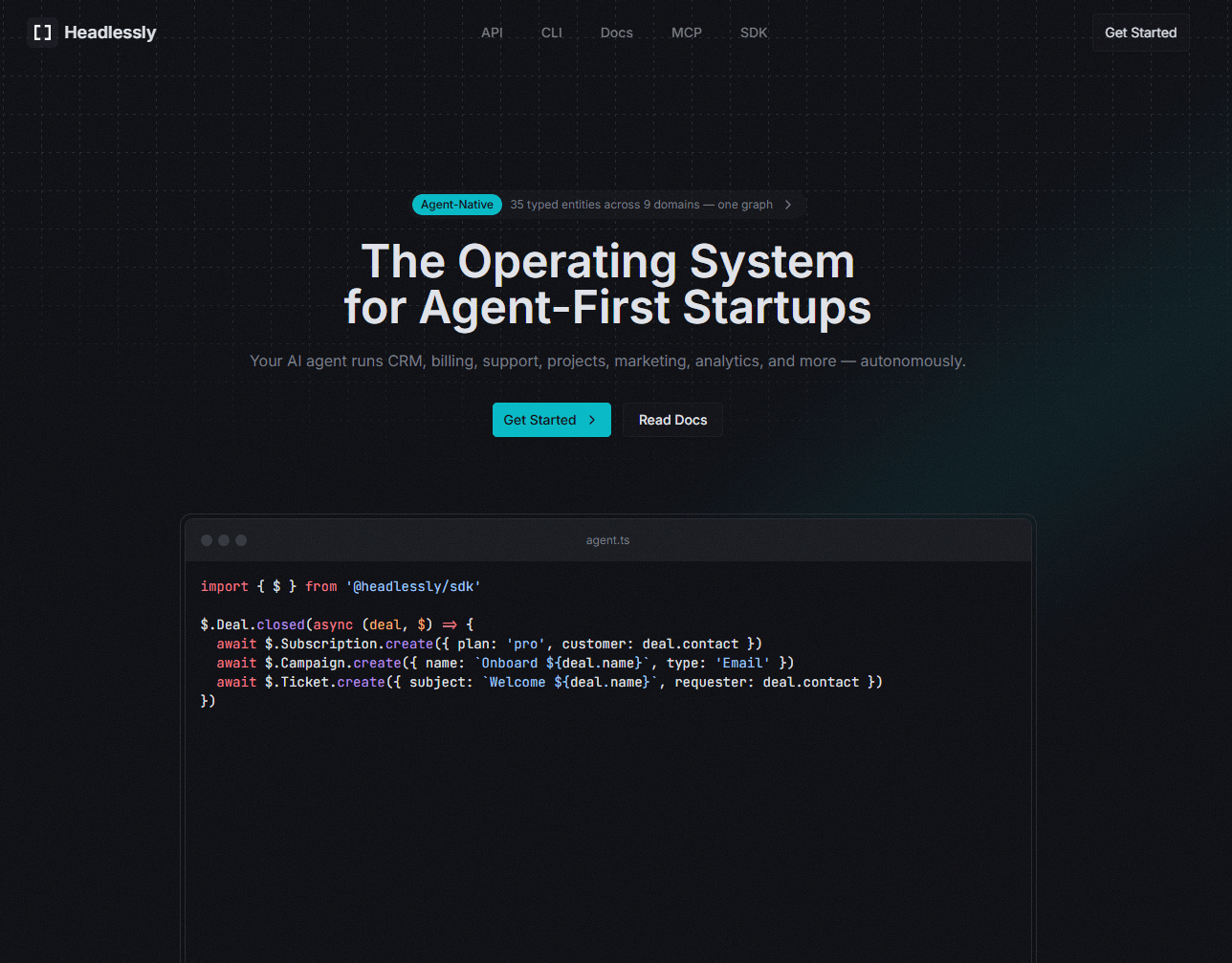
Headless.ly is an API-only operations layer where an SDK drives CRM, billing, support, projects, marketing, analytics, and experiments from one interface. According to vendor documentation, the platform focuses on autonomous agent actions with a unified SDK and eventing.
Best for: Teams that want a single SDK for back-office actions across CRM, billing, support, and marketing without adding new UI surfaces.
Key Features:
- Unified SDK for CRM, billing, support, projects, marketing, analytics, and experiments, per vendor documentation.
- API-first workflows with platform automation and event hooks, per vendor documentation.
- One install model to enable multi-system actions from agents, per vendor documentation.
Why we like it: Consolidates common agent actions behind one SDK, which reduces credential sprawl and repetitive integration code when you move from a pilot to production.
Notable Limitations:
- Public third-party reviews are limited as of April 2026, so buyers should request a live API test and reference accounts before committing.
- Details about data residency, rate limits, and on-prem options are not publicly documented, which can slow security review.
Pricing: Pricing not publicly available. Contact vendor for a custom quote.
HeadlessHQ
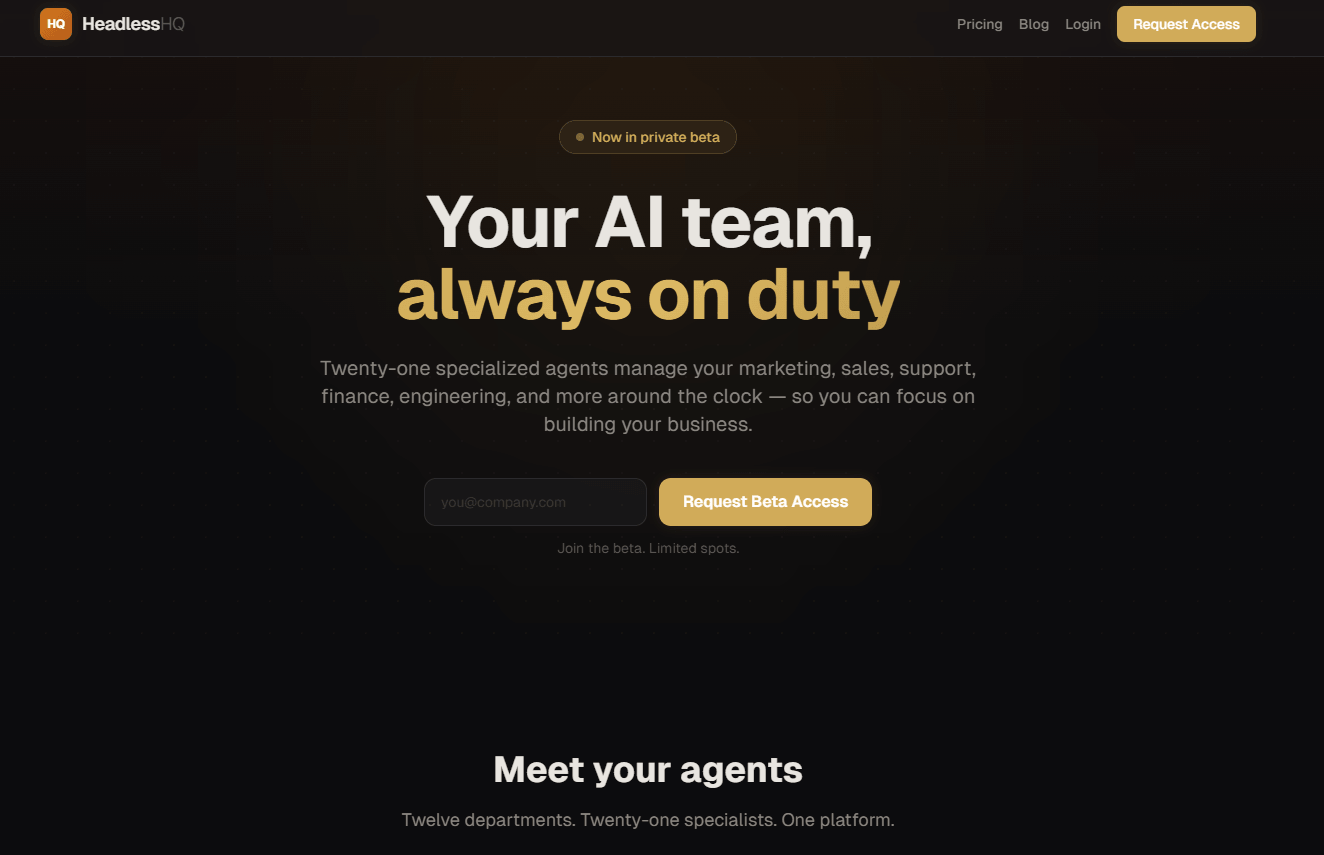
HeadlessHQ positions itself as a headless AI operations platform that runs nine agent departments, including marketing, sales, support, finance, contracts, onboarding, analytics, inbound, and customer success, via APIs. Per vendor documentation, it emphasizes cross-agent intelligence, approval workflows, and signed webhook ingestion.
Best for: Companies that want preconfigured, department-specific agents coordinated through a single API layer with approval controls.
Key Features:
- Nine specialized agent departments with cross-agent context sharing, per vendor documentation.
- 30+ third-party integrations across CRM, ads, ticketing, email, and finance systems, per vendor documentation.
- Signed webhook ingestion and approval workflows before execution, per vendor documentation.
- Private beta status noted by the vendor as of April 2026.
Why we like it: The department model shortcuts design time. Cross-agent context plus approvals helps you ship safely while you gather real performance data.
Notable Limitations:
- Private beta status means limited real-world references and potential feature churn, so expect tighter piloting and rollback plans.
- No independent pricing or peer reviews on major review sites identified as of April 2026, which increases diligence needs.
Pricing: Pricing not publicly available. Contact vendor for a custom quote.
Budibase AI Agents
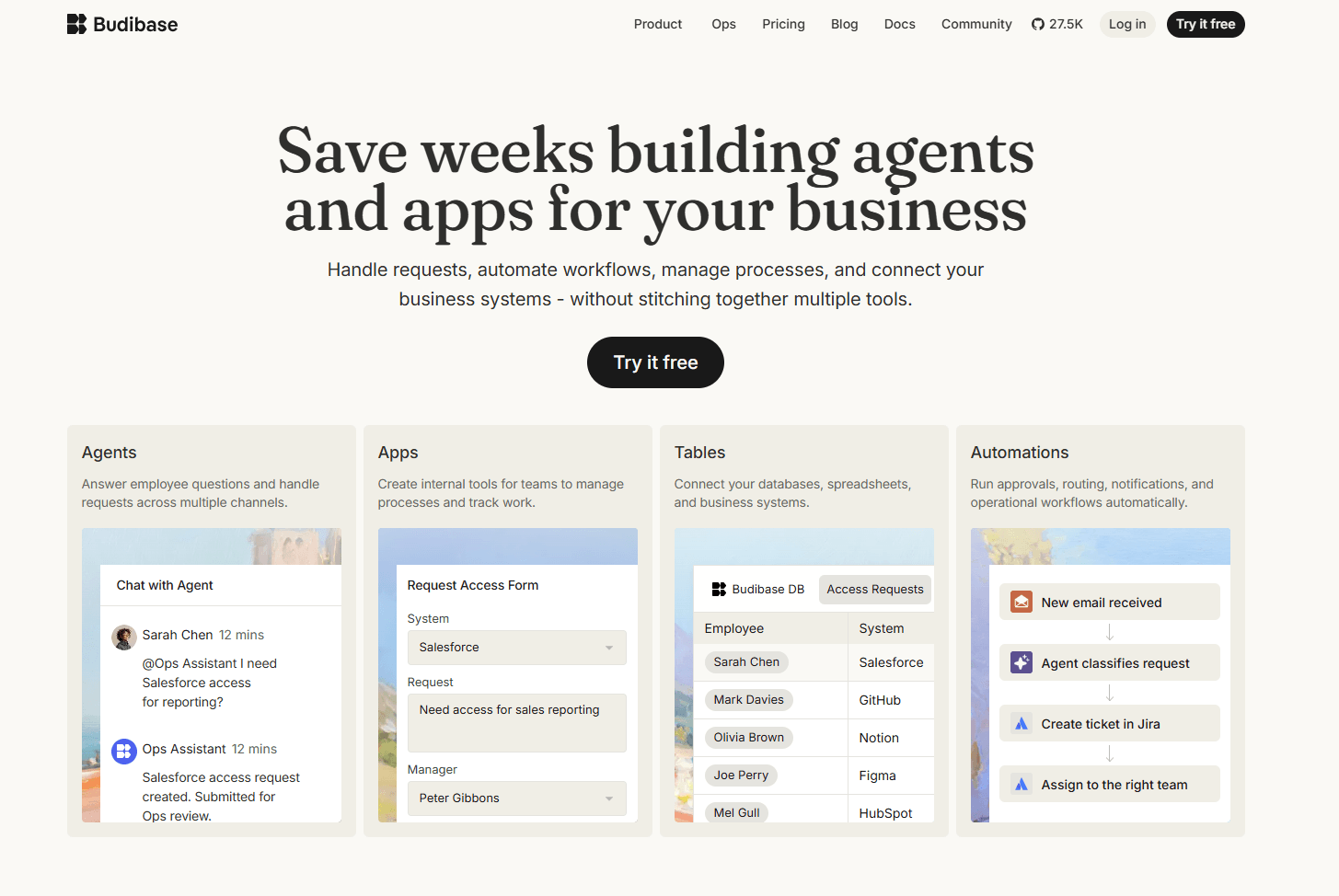
Budibase is an open-source platform where AI agents and automations connect to your data and tools through API triggers, with cloud and self-hosted options. According to vendor documentation, the platform is model-agnostic and integrates with common data sources and REST APIs.
Best for: Ops teams that want a self-host or cloud option with a no-code builder for agent workflows and broad data connectors.
Key Features:
- Visual builder for agent workflows and automations connected to data sources, per vendor documentation.
- Self-hosted and cloud deployment options with Docker and Kubernetes support frequently referenced by users.
- Data connectors for PostgreSQL, REST APIs, and others, frequently cited by third-party reviews.
- Model-agnostic approach that supports OpenAI-compatible endpoints, per vendor documentation.
Why we like it: Open-source plus self-hosting appeals to teams with strict governance or data residency needs, and the connector depth reduces custom code.
Notable Limitations:
- Users on third-party review sites report mobile UX limitations and mixed views on pricing value at higher tiers, which may affect external-facing apps (G2 reviews snapshot, independent overview).
- Community threads highlight concerns about limits for some self-hosted scenarios, so confirm current terms during procurement (Reddit discussion).
Pricing: Public sources indicate an open-source free option, paid Premium, and Enterprise tiers. For dollar figures, see the Pricing Overview section below which cites independent summaries.
Headless SaaS Tools Comparison: Quick Overview
| Tool | Best For | Pricing Model | Highlights |
|---|---|---|---|
| Headless.ly | Unified SDK for CRM, billing, support, marketing | Not publicly available | One API and SDK to drive common back-office actions from agents |
| HeadlessHQ | Cross-department agent operations with approvals | Not publicly available, private beta | Nine agent departments, cross-agent intelligence, signed webhooks |
| Budibase AI Agents | Open-source, self-host or cloud, no-code automations | Open-source plus paid tiers | Visual agent builder, broad data connectors, self-host option |
Headless SaaS Platform Comparison: Key Features at a Glance
| Tool | Unified SDK or Visual Builder | Signed Webhook Support Mentioned | Departmental or Modular Agents |
|---|---|---|---|
| Headless.ly | Unified SDK | Not publicly documented | Modular actions across CRM, billing, support, marketing |
| HeadlessHQ | API layer with prebuilt departments | Yes, per vendor documentation | Nine departments with cross-agent context |
| Budibase AI Agents | Visual builder for agents and automations | Via connectors and triggers, confirm per deployment | Modular flows built from data sources and actions |
Headless SaaS Deployment Options
Estimates based on public documentation and third-party reviews. Validate requirements during security review.
| Tool | Cloud API | On-Premise | Integration Complexity |
|---|---|---|---|
| Headless.ly | Yes | Not publicly documented | Medium |
| HeadlessHQ | Yes | Not publicly documented | Low to Medium |
| Budibase AI Agents | Yes | Yes, self-host via Docker and Kubernetes frequently noted by users | Medium |
Headless SaaS Strategic Decision Framework
| Critical Question | Why It Matters | What to Evaluate |
|---|---|---|
| Do agent actions require approvals by default? | Governance reduces risk as you scale to production | Role based approvals, action logs, dry runs |
| How are webhooks authenticated and retried? | HMAC signatures and idempotency prevent spoofing and duplicates | HMAC verification, replay protection, idempotency keys |
| What deployment models pass security and data residency? | Self-host or private cloud can speed InfoSec sign-off | Self-host guides, network egress controls, secrets management |
| How many systems can the platform coordinate natively? | Fewer custom adapters mean lower maintenance | Official connectors and SDK maturity |
| What evidence exists beyond the vendor site? | Independent signals reduce selection risk | Analyst mentions, third-party reviews, marketplace entries |
Headless SaaS Solutions Comparison: Pricing and Capabilities Overview
The Budibase figures below reflect list prices summarized by independent sources as of April 2026. Always confirm current pricing during procurement.
| Organization Size | Recommended Setup | Estimated Cost |
|---|---|---|
| Startup, fewer than 25 users | Budibase open-source or entry paid tier for agent automations, Headless.ly or HeadlessHQ pilot only | Budibase from roughly $19 per creator per month, per independent recap. About $228 per creator annually (independent pricing summary) |
| Mid-market, 25 to 250 users | Budibase paid tier plus self-host for sensitive data, evaluate Headless.ly or HeadlessHQ for department-level agents | Varies by seat count and workflows. Pilot first given volatility in agent projects (Gartner cancellation risk) |
| Enterprise, 250 plus users | Budibase self-host with SSO and centralized secrets, compare Headless.ly or HeadlessHQ for cross-agent governance | Contact vendors for quotes. Budget with contingency given emerging agent governance patterns in 2026 |
Problems and Solutions
Problem 1, Agent adoption without guardrails leads to rework
Why it happens, Enterprises are racing to embed agents into apps, yet many projects are delayed or canceled due to unclear value and risk controls. Gartner warns that over 40 percent of agentic AI projects will be canceled by the end of 2027 if they lack governance and measurable outcomes.
- Headless.ly, Centralizes common actions like CRM updates, billing, and support with a single SDK, which simplifies audit and rollback, per vendor documentation.
- HeadlessHQ, Bakes in approval workflows and cross-agent intelligence across nine departments, which helps you keep humans in the loop before execution, per vendor documentation.
- Budibase AI Agents, Uses a visual builder and self-hosting option so security teams can review flows and keep data local, with self-host and Kubernetes support frequently cited by users on review sites.
Problem 2, Webhook spoofing and duplicate actions in production
Why it happens, Many teams skip HMAC verification and idempotency when they wire agents to third-party APIs, which can lead to spoofed events and double-charged invoices. Independent guidance stresses verifying HMAC signatures and implementing idempotent mutations to avoid retries causing duplicates (TechTarget explainer, AWS idempotency guidance).
- Headless.ly, Advertises event hooks and SDK-driven actions, so request an idempotency pattern for each mutating call and a signed webhook standard during evaluation, per vendor documentation.
- HeadlessHQ, States support for signed webhook ingestion and approval workflows, which aligns with HMAC and review-before-run patterns that reduce risk, per vendor documentation.
- Budibase AI Agents, Connectors and REST actions let you enforce HMAC verification and idempotency in your flows, with users reporting success integrating standard data sources and APIs.
Problem 3, Data residency and deployment constraints stall InfoSec approval
Why it happens, Cloud-only agent platforms can trigger data egress reviews, while many organizations need private or sovereign deployments. Industry coverage shows growing interest in controlled cloud footprints and sovereign options for regulated buyers in 2026 (TechRadar coverage).
- Headless.ly, No public on-prem details, so include a data flow diagram and DPA early in security review and confirm log retention and regional isolation.
- HeadlessHQ, Private beta means deployment policy may be evolving, so insist on an architecture review and clarify data processing locations.
- Budibase AI Agents, Self-host path can satisfy residency and isolation needs while keeping integration agility, as echoed by third-party reviews and community discussions.
The Bottom Line on Headless, API-Only Agent Platforms
The shift to headless, API-only operations is real, with analysts forecasting that 40 percent of enterprise applications will embed task-specific agents by the end of 2026. If you want consolidation and a single SDK, Headless.ly is compelling, though you should demand clarity on security and deployment details. If you prefer prebuilt departmental agents with approvals, HeadlessHQ's approach is attractive, but private beta status means pilot first. If you need self-host and open-source flexibility with a no-code builder, Budibase stands out, and third-party reviews provide useful signal on its strengths and tradeoffs. Shortlist two, run time-boxed pilots with explicit success metrics, and require signed webhook plus idempotency patterns from day one.