
Most teams discover integration risk during live floor trials, not from glossy demo videos. Working across different tech companies, we have learned to ask for three things up front: duty-cycle estimates under full payload, safety circuit details like CAT1 or FSoE, and a concrete MTBF target for actuators. You think you know a robot's limits until a 10 minute battery swap turns into a 90 minute outage during a hot shift. From our experience in the startup ecosystem, the right platform choice comes down to validated use cases, safety, and serviceability, not hype.
The broader robotics backdrop is expanding fast. Morgan Stanley projects humanoids could reach a $5 trillion market by 2050, with adoption accelerating in the late 2030s, and IFR data shows U.S. manufacturers installed 34,200 new industrial robot units in 2024, with the Americas exceeding 50,000 units for the fourth consecutive year (Morgan Stanley, IFR World Robotics 2025). The four platforms below show credible progress toward commercial outcomes. You will learn where each fits, what to watch in pilots, and how to avoid the most common deployment mistakes.
Apptronik Apollo
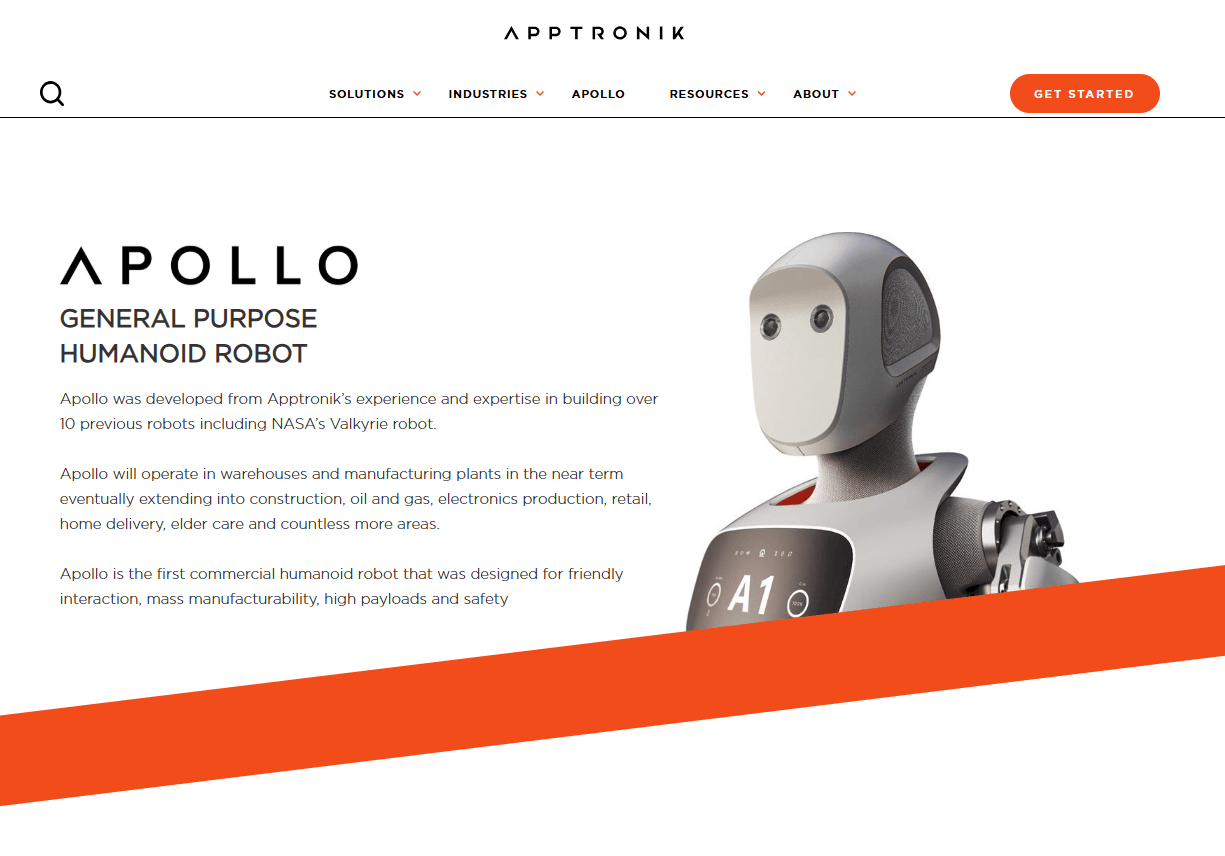
General-purpose humanoid aimed at warehouses and industrial work. Human-scale form factor with a modular approach to end effectors and power.
Best for: Industrial R&D teams and operations groups piloting tote moves, line feeding, and ergonomic relief tasks in brownfield sites.
Key Features:
- Human-scale build, swappable battery, and runtime typically cited around a single shift segment.
- Approx. 25 kg, 55 lb payload and 1.7 m class height per vendor materials.
- Modular end effectors and mounts for different manipulation tasks.
- Safety-focused design with collaborative operation goals.
Why we like it: Clear push to reduce part count and use off-the-shelf components to lower service cost and speed repairs, which matters in early pilots.
Notable Limitations:
- Still early in scaling, with pilots rather than wide production rollouts reported by news outlets.
- Dexterity across unstructured SKUs remains a work in progress in public demos.
- Multi-shift reliability and spares logistics are not yet validated at fleet scale in third-party reporting.
Pricing: Pricing not publicly available. Contact Apptronik for a custom quote.
Agility Robotics Digit

Commercial humanoid focused on logistics and warehouse automation with whole-body mobility and a production roadmap.
Best for: 3PLs and retailers testing tote recycling, induction, buffer moves, and tasks that benefit from human-scale reach without facility rebuilds.
Key Features:
- Purpose-built for tote handling and human-scale environments.
- Fleet management via a cloud platform for deployment, monitoring, and KPI tracking.
- Safety stack that includes E-stop and category-level stops, with emphasis on cooperative operation.
Why we like it: Real pilots in logistics and a dedicated U.S. factory indicate credible intent to scale, which reduces supply risk during expansion. In fall 2025, Digit reached the milestone of 100,000 totes moved at GXO's Flowery Branch facility, and GXO signed an industry-first multi-year RaaS agreement with Agility Robotics.
Notable Limitations:
- Many deployments still run in isolated zones for safety during early stages.
- Current skills tend to be narrow task bundles rather than broad general purpose.
- Throughput parity with human labor depends on SKU mix and upstream workflow tuning.
Pricing: Pricing not publicly available. Contact Agility Robotics for a custom quote.
Figure AI (Figure 03)

Next-generation general-purpose humanoid emphasizing learning from human demonstrations, with new hands, memory, and voice interaction.
Best for: Advanced manufacturing and innovation teams piloting part handling or kitting where perception and manipulation advances can move the needle.
Key Features:
- Redesigned 4th-generation hands with 16 degrees of freedom, tactile finger pads, and palm cameras.
- Lighter joints and improved safety features, with voice and memory functions powered by the Helix AI platform.
- Focus on neural policy training for manipulation and logistics tasks.
Why we like it: Aggressive iteration on perception and manipulation plus a manufacturing scale program offers a fast improvement loop. Figure 02 completed an 11-month deployment at BMW Spartanburg, loading over 90,000 parts and contributing to 30,000 BMW X3 vehicles. The Figure 03 fleet began rolling out at BMW in January 2026.
Notable Limitations:
- Many capabilities are still emerging, with demos showing task variability.
- Domestic, in-home scenarios are aspirational near term, not production ready.
- Real-world reliability data in multi-shift industrial use is limited in third-party reporting.
Pricing: Pricing not publicly available. Contact Figure AI for a custom quote.
Prometheus Robotics Platform
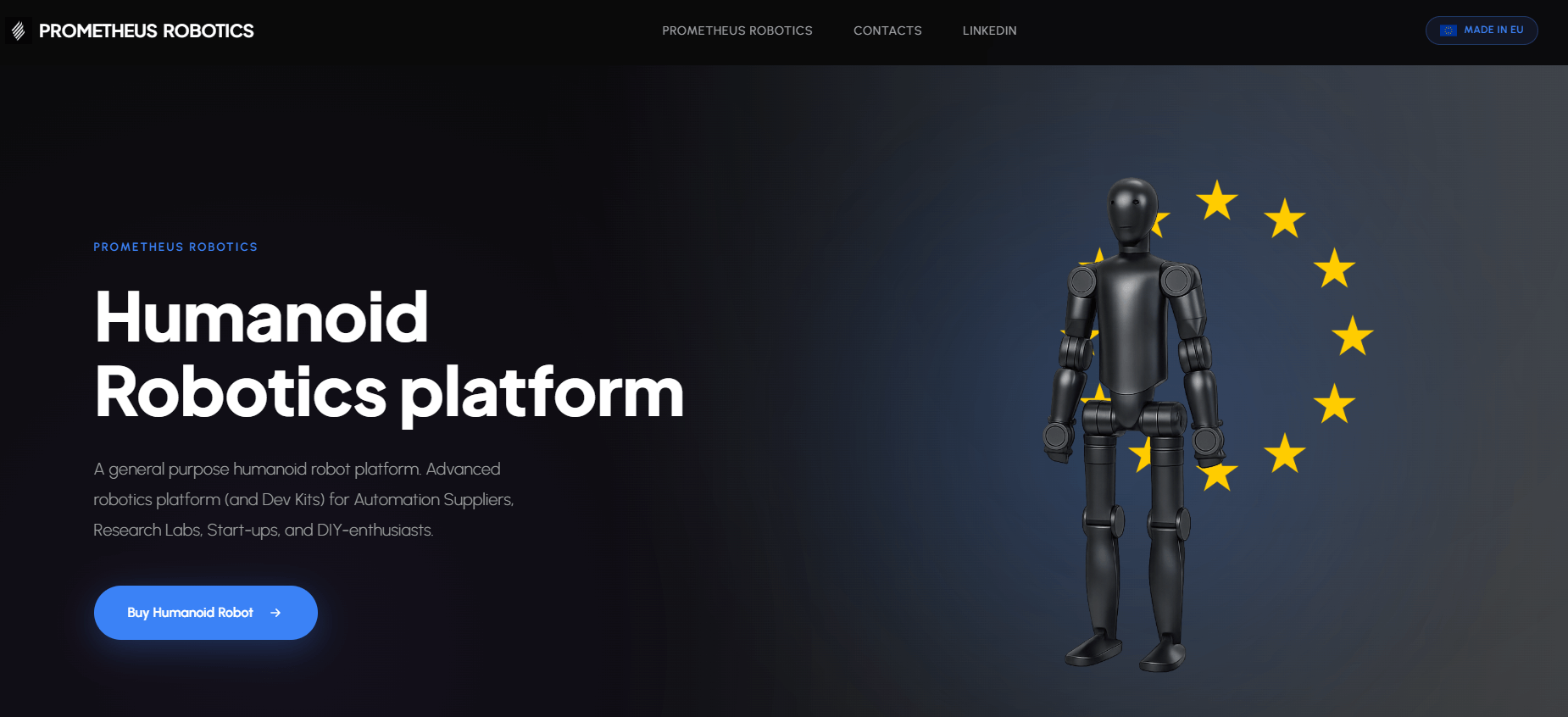
Modular general-purpose humanoid platform and development kit intended for research labs, automation suppliers, and developers.
Best for: Universities, startups, and integrators needing a customizable humanoid kit for rapid prototyping and research.
Key Features:
- Modular architecture with options for legs or wheeled base.
- Open platform orientation with DIY-friendly assembly kits.
- Compute options that include embedded boards appropriate for prototyping.
Why we like it: Flexible entry point to build and test humanoid behaviors without waiting for large vendor lead times.
Notable Limitations:
- Limited third-party validation and few independent reviews as of publication.
- Industrial safety certifications and fleet tooling are minimal compared to larger vendors.
- Unknown long-term parts and service pipeline.
Pricing: Pricing not publicly available. Contact Prometheus Robotics for a custom quote.
Humanoid Robot Platforms Comparison: Quick Overview
| Tool | Best For | Pricing Model | Highlights |
|---|---|---|---|
| Apptronik Apollo | Industrial pilots in automotive and electronics | Custom contract, pilot oriented | Vendor reports modular hardware and swappable batteries; pilots with major manufacturers have been reported by tech media. |
| Agility Robotics Digit | 3PL and retail tote workflows | RaaS and pilot contracts | U.S. RoboFab capacity target of up to 10,000 units per year reported by major outlets, plus live logistics pilots. |
| Figure 03 | Advanced manufacturing pilots | Pilot contracts | New hands, memory, voice features covered by mainstream press, with an active BMW factory program reported. |
| Prometheus Platform | Research and startup prototyping | Custom kit purchase | Modular dev kit focus for labs and early builders; limited independent coverage. |
Context sources: large-scale factory capacity for Agility was covered by CNBC. Figure's BMW program and 03 feature set were profiled by TechCrunch and TIME. Apptronik's pilots with Mercedes, Jabil, and GXO were reported by heise online and TechCrunch.
Humanoid Robot Platforms: Key Features at a Glance
| Tool | Payload Range | Runtime Approach | Noted Pilots |
|---|---|---|---|
| Apptronik Apollo | ~25 kg, 55 lb class per engineering coverage | Swappable battery, shift segment focus | Mercedes, Jabil, GXO pilots reported by third-party outlets |
| Agility Robotics Digit | ~16 kg, 35 lb class in reports | Multi-hour runtime with autonomous docking | Amazon lab testing, GXO multi-year RaaS agreement, 100K+ totes milestone |
| Figure 03 | Not public in third-party reports | Next-gen pack with safety improvements | BMW Spartanburg - Figure 02 completed 11-month deployment; Figure 03 fleet deployed January 2026 |
| Prometheus Platform | Configurable per module | ~4 hours per vendor materials | Research and prototyping focus |
Examples and sources: Digit's weight and tote handling were cited by The Seattle Times. Agility's cloud management launch was detailed via Business Wire. Figure 03 capabilities and BMW work were profiled by TIME. Apollo's size and payload were covered by IEEE Spectrum.
Humanoid Robot Platforms: Deployment Options
| Tool | Cloud API | On-Premise | Integration Complexity |
|---|---|---|---|
| Apptronik Apollo | Vendor APIs available in pilots | Supported in pilots | Medium, depends on workflow and safety review |
| Agility Robotics Digit | Cloud fleet platform available | Yes, with site networking | Medium, WMS or WES integration optional per fleet platform |
| Figure 03 | Internal platform focus, partner access | Supported in pilots | High, due to emerging software and evolving skills |
| Prometheus Platform | Dev SDK focus | Yes, lab-friendly | Medium, research-grade integration |
Note: Agility's cloud fleet platform details are documented in third-party press releases and coverage (Business Wire, The Robot Report).
Humanoid Robot Platforms: Strategic Decision Framework
| Critical Question | Why It Matters | What to Evaluate | Red Flags |
|---|---|---|---|
| What is the validated use case and throughput? | ROI lives or dies on flow rate, not a demo | Cycles per hour, tote mix, failure recovery path | "General purpose" claims without task KPIs |
| How mature is the safety stack? | Determines whether you need cages or can co-work | Stop categories, PLC, FSoE, risk assessment | No published stop categories, vague "safe by design" |
| What is the service model? | Downtime risk and OPEX planning | Spare actuators, swap SLAs, remote support | No spares list, unclear MTBF, no field repair guides |
| How will it integrate? | Avoids creating automation islands | WMS, WES, MES adapters, APIs, fleet tools | Custom scripts only, no roadmap for connectors |
Humanoid Robot Platforms: Pricing & Capabilities Overview
| Organization Size | Recommended Setup | Estimated Investment |
|---|---|---|
| SMB warehouse or lab | Single unit pilot with fenced workcell and KPI tracking | Not publicly available |
| Mid-market 3PL node | 2-4 units, fleet dashboard, basic WMS connector, safety audit | Not publicly available |
| Enterprise plant | 5-10 units, multi-workcell orchestration, spares kit, onsite training | Not publicly available |
Pricing note: None of the featured vendors publish list pricing for production units as of February 2026. Budget planning should include integration, safety validation, and spares.
Problems & Solutions
-
Problem: Tote recycling and buffer moves cause ergonomic strain and line slowdowns.
Solution with Digit: Amazon and others tested Digit to move empty totes and support human workers, which targets a repetitive, ergonomically poor task that often becomes a bottleneck (The Seattle Times). GXO pilots also highlight tote transfers between systems, providing real-world data for throughput tuning, and in fall 2025 Digit surpassed 100,000 totes moved at GXO's Flowery Branch facility. -
Problem: Automotive line feeding and part delivery create staffing gaps across shifts.
Solution with Apollo: Independent coverage reported Apollo pilots with Mercedes, GXO, and a factory partnership with Jabil, focusing on simple, repetitive tasks like part transport and inspection that can free skilled workers for higher value steps (heise online). In February 2026, Apptronik closed over $935 million in Series A funding, with a strategic partnership with Google DeepMind to power Apollo with Gemini Robotics (TechCrunch). -
Problem: Kitting and fixture loading in mixed-model factories require dexterity and rapid retraining.
Solution with Figure 03: BMW's Spartanburg plant engagement and Figure 03's new 4th-generation hands with tactile pads, palm cameras, and memory functions aim to improve manipulation and reduce task engineering time. Figure 02 completed an 11-month deployment at Spartanburg, loading over 90,000 parts across 1,250+ operational hours, and the Figure 03 fleet began deployment in January 2026 (Figure AI). -
Problem: Research teams need a configurable platform without long vendor lead times.
Solution with Prometheus: A modular dev-kit approach plus published specifications makes it practical for labs to prototype behaviors and evaluate locomotion or manipulation modules, although independent validations are limited; the company's presence and positioning are visible on its LinkedIn profile. -
Safety and deployment reality check: Early humanoid deployments often run in isolated zones or fenced cells while safety functions, perception, and fall recovery mature. This staged approach is documented in reporting on current pilots and reviews of real-world constraints (TIME, AP News).
Bottom Line: Picking the Right Humanoid, Right Now
If you are buying outcomes instead of press clips, prioritize validated workflows, safety, and factory capacity. Agility's RoboFab and live tote workflows show a credible push toward scale, with Digit surpassing 100,000 totes at GXO and a multi-year RaaS agreement in place. Figure is iterating fast on manipulation with the 03 fleet now deploying at BMW Spartanburg following a successful 11-month Figure 02 run. Apptronik's manufacturing pilots and fresh $935 million in funding signal runway to harden Apollo for production use, backed by a strategic partnership with Google DeepMind (TechCrunch). The market is early, but the direction is clear, supported by long-term forecasts from large banks and continued industrial robot deployments in the U.S. (Morgan Stanley). Start with a fenced pilot, instrument everything, and expand only when your KPIs hold up under real shift conditions.