

Most teams discover their workflow is the bottleneck during quarter-end crunches, not from a shiny demo. Working across different tech companies, we have watched firms stall because intake rules are not codified, billing checks lack UTBMS validation, and clause libraries are not tied to CRMs or DMSs. The biggest legal workflow automation mistakes happen when routing, document assembly, and invoice review are left to email. From our experience in the startup ecosystem, three fixes consistently pay off fast: matter-intake triage with branching rules, automated billing guideline checks against LEDES or UTBMS codes, and template driven document automation with audit trails.
Gartner forecasts the global legal technology market will reach 50 billion dollars by 2027, a signal that ops and automation are now board-level priorities. You will learn where each platform fits, what implementation tradeoffs to expect, and how pricing actually looks in the market, backed by third-party sources like Gartner, ACC, Capterra, G2, and LawSites (Gartner legal tech outlook, ACC 2024 CLO findings).
Onit
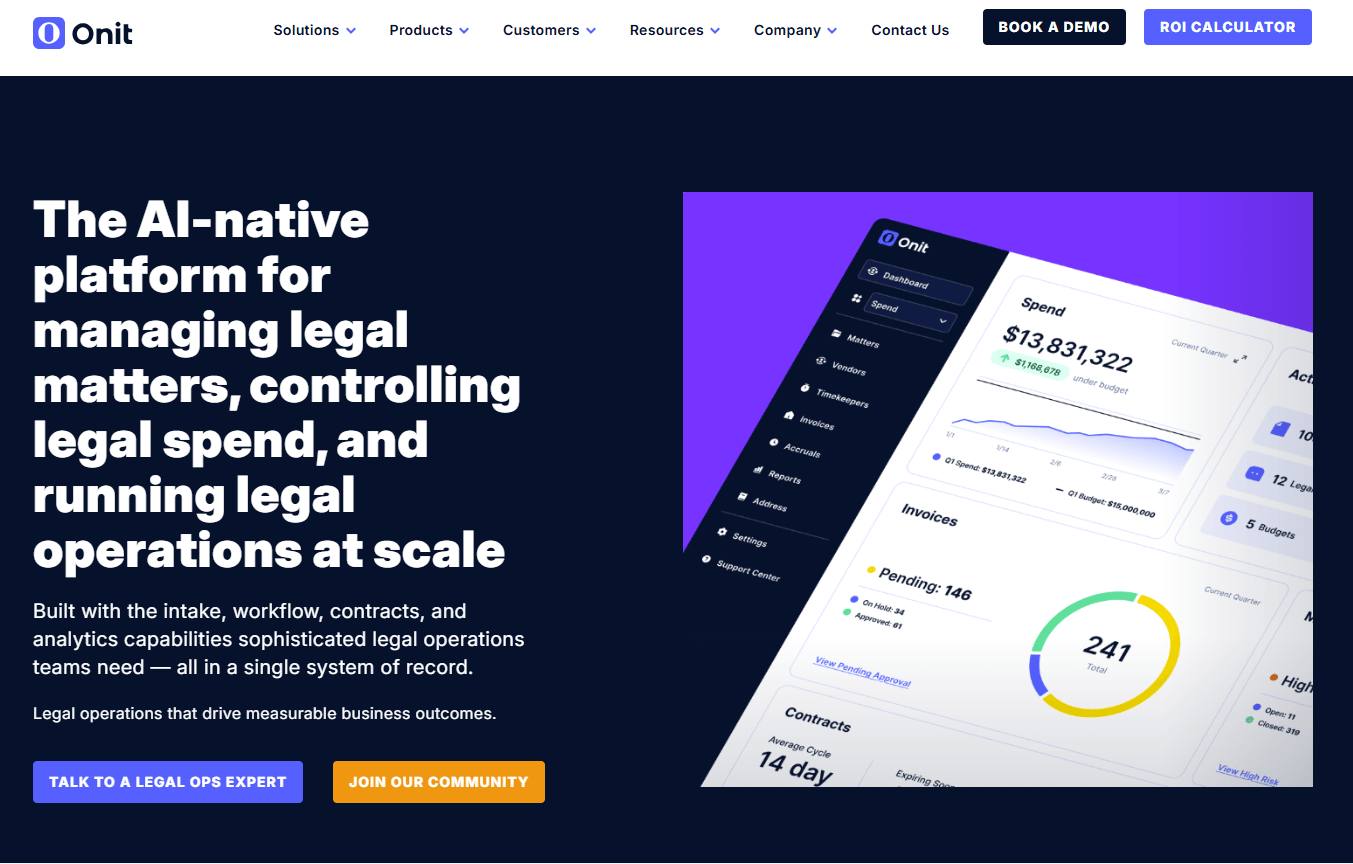
AI-native enterprise legal operations platform that unifies matters, spend, contracts, and approvals in one system. Built for configurable workflows that cross legal, procurement, and the business, per vendor documentation.
Best for: Enterprise legal departments that want end-to-end ELM, CLM, and e-billing with configurable workflow automation at scale. Independent coverage highlights Onit in large legal ops programs and enterprise consolidations (CCBJ LegalTech Review 2026).
Key Features:
- Enterprise Legal Management with e-billing, matter, vendor, and accruals tracking, per vendor documentation.
- Contract Lifecycle Management with clause, review, and approval workflows, per vendor documentation.
- No-code or low-code workflow app studio and AI-assisted review, per vendor documentation.
Why we like it: When you need spend analytics, matter data, and contract metadata in one model, Onit's platform approach reduces swivel-chair work and supports auditability across invoices, matters, and contracts.
Notable Limitations:
- Steep learning curve for admins and power users configuring advanced workflows, repeatedly noted in third-party reviews (G2 OnitX ELM reviews).
- Enterprise implementations can be lengthy and require strong internal process ownership, a common theme in enterprise ELM and CLM rollouts covered by industry outlets.
Pricing: Pricing not publicly available. Contact Onit for a custom quote. Public listings do not show list prices (G2 pricing page, no published rates).
Axiom Legal Workflow
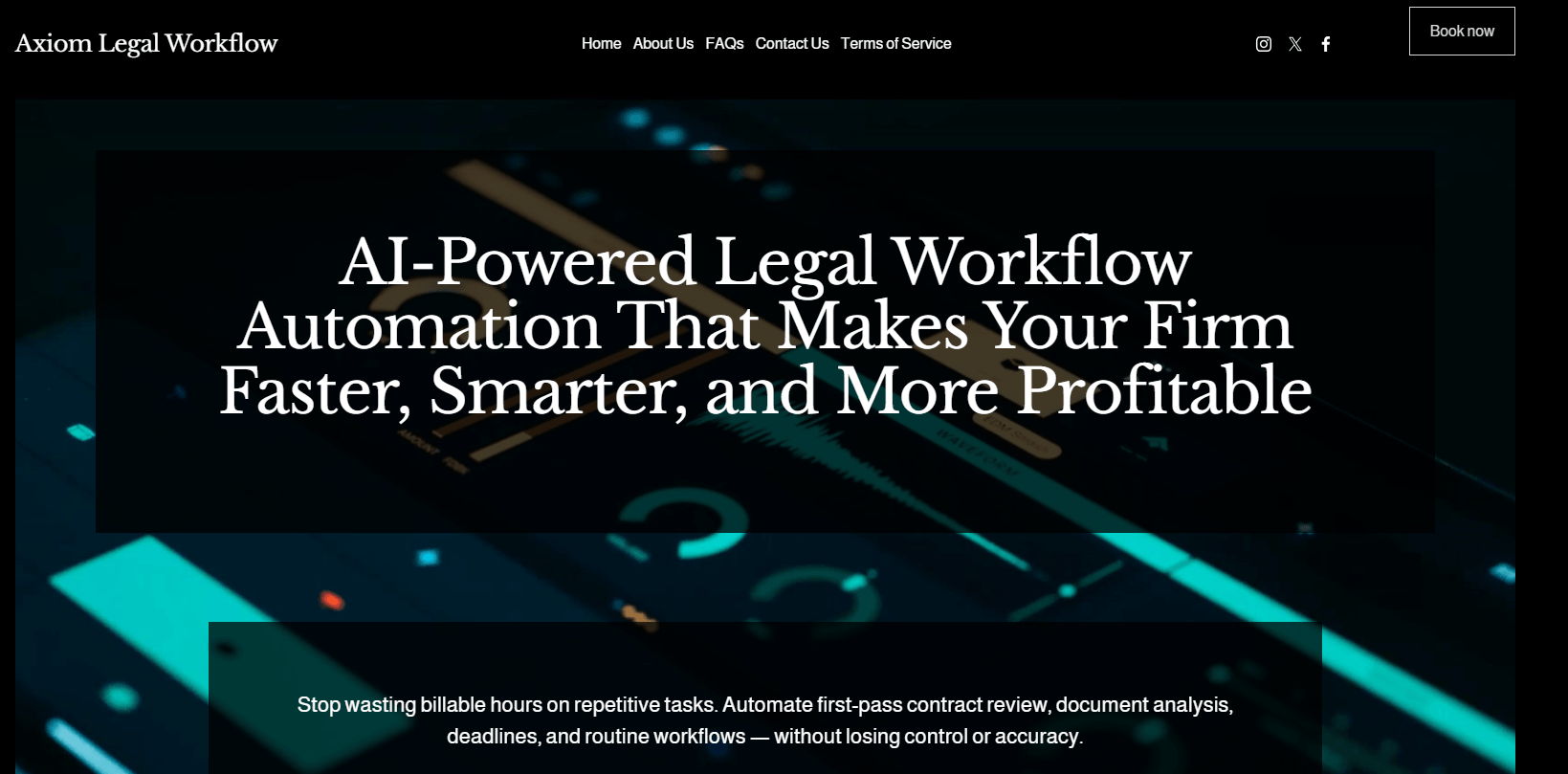
AI-powered legal workflow automation built specifically for California employment law firms. Focuses on first-pass document analysis, routine workflows, and deadline tracking, per vendor documentation.
Best for: California employment firms that want prebuilt workflows for jurisdiction-specific tasks and document analysis rather than generic automation.
Key Features:
- First-pass contract and document review with attorney controls, per vendor documentation.
- Deadline and task automation tailored to California employment matters, per vendor documentation.
- Prompted playbooks and structured workflows to standardize reviews, per vendor documentation.
Why we like it: Niche focus can cut setup time for employment shops that would otherwise customize generic tools to California requirements.
Notable Limitations:
- Limited third-party reviews as of 2026, so buyers should pilot with real matters and verify outputs against local rules.
- Narrow practice focus limits value outside California employment law; firms with broader practices may outgrow it.
Pricing: Pricing not publicly available. Request a quote and insist on a pilot with success criteria. No listings found on major directories like G2 or Capterra as of 2026, which supports treating pricing as custom.
Actionstep
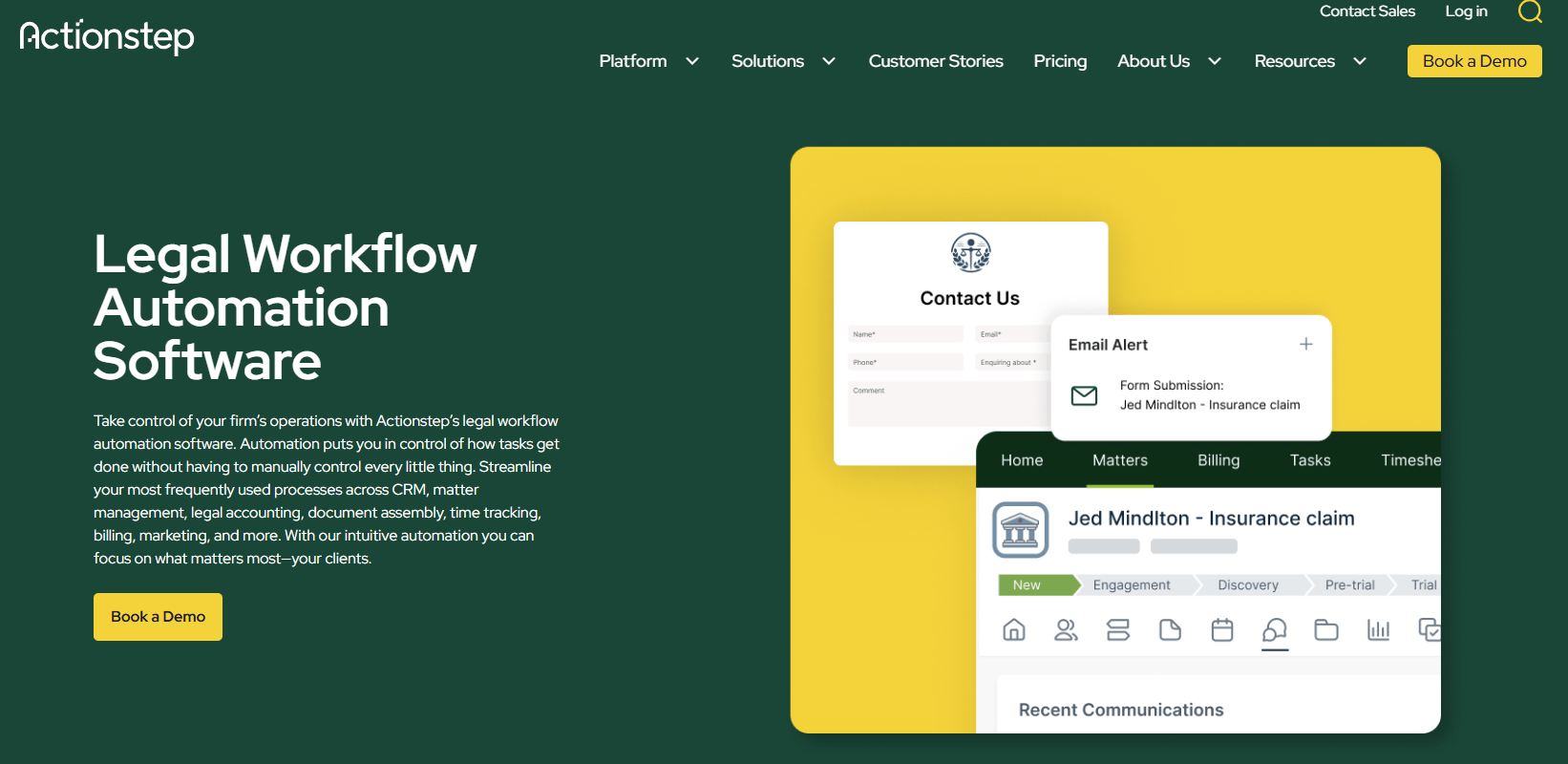
Cloud practice management for midsize firms with robust workflow automation across intake, document assembly, billing, and CRM. Known for configurable matter-type workflows, per vendor documentation and buyer reviews.
Best for: Midsize firms that want an end-to-end system with strong workflow automation and built-in billing or legal accounting. The product is PE-backed yet operates independently since a 2020 investment, which supports ongoing product development (Serent Capital announcement).
Key Features:
- Matter-centric workflow automation with task assignment and stage changes, per vendor documentation.
- Document assembly and template merge, frequently cited by users (Capterra Actionstep reviews).
- Integrated billing, payments, and legal accounting capabilities, expanded via the Soluno acquisition (acquisition news).
Why we like it: Powerful matter-type workflows and document automation help midsize teams standardize playbooks without heavy custom code.
Notable Limitations:
- Initial setup and configuration can be time consuming for firms without a dedicated admin, per multiple buyer reviews.
- Buyers have reported price increases and variability across regions, so confirm total cost of ownership pre-contract (community discussions).
Pricing: Pricing not publicly available. Contact Actionstep for a custom quote. Third-party listings indicate tailored pricing rather than fixed public tiers (G2 pricing summary).
Clio
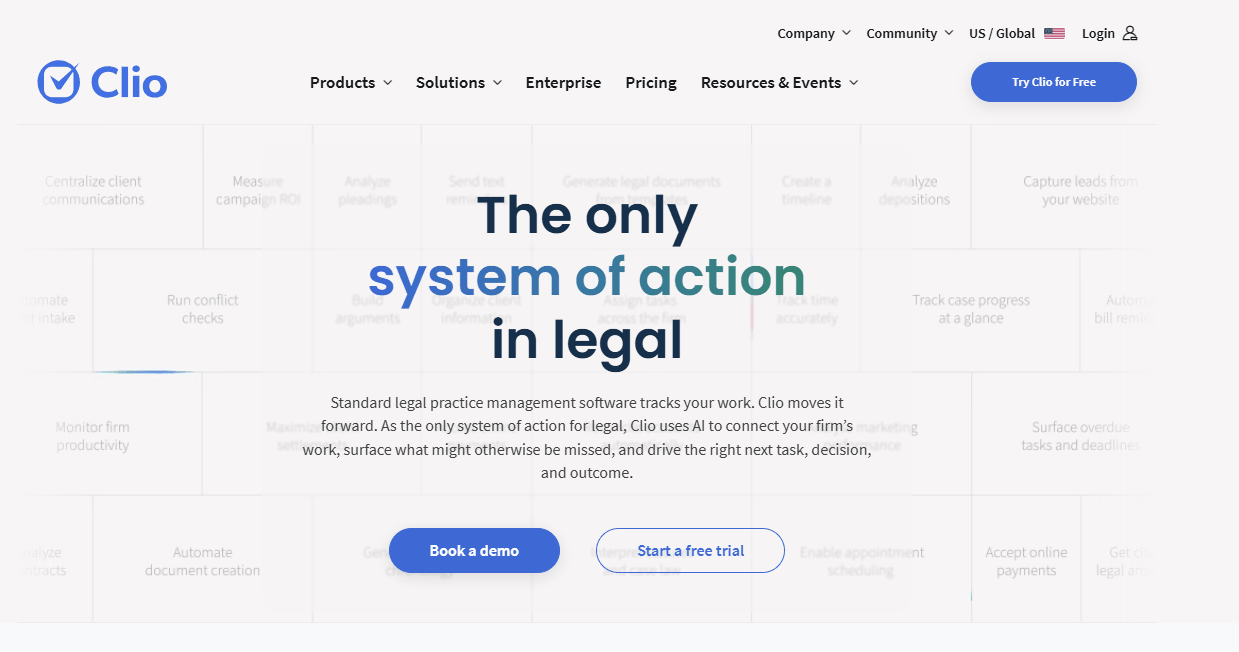
Practice management system of action with automation across intake, calendaring, billing, document workflows, and a growing AI workspace. Increasingly positioned as an intelligent legal work platform in independent coverage.
Best for: Solo to midsize firms seeking fast time-to-value, a large integration ecosystem, and optional AI workspace. LawSites reports that Clio Work, the AI workspace, became available as a standalone product to firms of any size in April 2026 (LawSites coverage).
Key Features:
- Client intake and appointment workflows with CRM capabilities, often bundled via Clio Grow according to third-party overviews (Capterra product page).
- Task and deadline automation, time and billing with trust accounting, and document management, validated in user reviews.
- AI workspace for research and drafting available as a standalone product per April 2026 news.
Why we like it: Speed to deployment, a broad marketplace, and clearer small-firm pricing than typical enterprise tools make Clio a pragmatic automation starting point.
Notable Limitations:
- Advanced features and add-ons can push total cost higher, a common theme in buyer commentary (G2 pricing overview).
- Users report occasional friction with advanced reporting and template limitations, per aggregated reviews.
Pricing: Multiple third-party listings show ranges from 49 to 149 dollars per user per month as of 2026, depending on plan and billing cycle (StackScored pricing tracker). Always confirm current promotions and add-on costs.
Legal Workflow Automation Platforms Comparison: Quick Overview
| Tool | Best For | Pricing Model | Highlights |
|---|---|---|---|
| Onit | Enterprise legal departments consolidating ELM, CLM, and e-billing | Custom quote | Deep configurability, strong spend plus matter plus contract data model |
| Axiom Legal Workflow | California employment law firms | Custom quote | Niche workflows tailored to CA employment matters, per vendor documentation |
| Actionstep | Midsize firms needing end-to-end practice management with automation | Custom quote | Robust matter-type workflows and doc assembly, confirmed in buyer reviews |
| Clio | Solo to midsize firms wanting rapid deployment and integrations, with optional AI workspace | Tiered subscription | Large ecosystem and new standalone AI workspace option |
Legal Workflow Automation Platform Comparison: Key Features at a Glance
| Tool | Workflow Automation | Document Automation | Billing and e-Billing |
|---|---|---|---|
| Onit | Configurable, cross-department workflows, per vendor documentation | CLM with clause and review workflows, per vendor documentation | Enterprise e-billing with LEDES and UTBMS controls, per vendor documentation |
| Axiom Legal Workflow | Prebuilt flows for CA employment tasks, per vendor documentation | First-pass analysis and drafting prompts, per vendor documentation | Not a replacement for enterprise e-billing, evaluate needs during pilot |
| Actionstep | Matter-type workflows with stage changes and task assignment | Template merge for letters and forms, noted by users | Integrated billing and payments, with legal accounting via Soluno acquisition |
| Clio | Intake, tasks, calendaring, and reminders with automations | Document workflows and e-sign, per third-party overviews | Timekeeping and billing with trust accounting, validated in reviews |
Legal Workflow Automation Deployment Options
| Tool | Deployment Notes | Integration Complexity |
|---|---|---|
| Onit | Enterprise cloud deployments with extensive configuration, commonly seen in large legal ops programs | Higher, due to depth of ELM, CLM, e-billing and custom workflows |
| Axiom Legal Workflow | Cloud application focused on CA employment workflows, per vendor documentation | Moderate, verify DMS, calendaring, and email integrations during pilot |
| Actionstep | Cloud practice management used across multiple regions, independent since 2020 investment | Moderate, initial setup effort reported by users |
| Clio | Cloud practice management with large marketplace and recent AI workspace expansion | Lower to moderate, wide third-party app availability per listings |
Legal Workflow Automation Strategic Decision Framework
| Critical Question | Why It Matters | What to Evaluate | Red Flags |
|---|---|---|---|
| Do we need ELM plus CLM plus e-billing in one platform or just practice management automation? | Overbuying adds cost and time to value. | Scope current pain: intake, invoice review, approvals, doc assembly, reporting. | Buying enterprise ELM when you only need intake and billing. |
| How standardized are our playbooks and approval paths? | Automation pays off only when rules are explicit. | Map routing rules, SLAs, exception handling, UTBMS policy. | "We will figure it out in build" without written SOPs. |
| What integrations are must-have on day one? | Missed connectors drive manual work. | DMS, email, calendar, e-sign, accounting, matter taxonomy. | Custom point integrations with no owner or budget. |
| What is our admin model? | Sustainable automation needs owners. | In-house admin vs partner, training plan, change management. | No named admin, no time budgeted for upkeep. |
| How will we measure ROI? | Exec sponsors need evidence. | Baseline cycle times, rejection rates, rework, outside counsel savings. | Only vanity metrics, no baseline. |
Legal Workflow Automation Solutions Comparison: Pricing and Capabilities Overview
| Organization Size | Recommended Setup | Monthly Cost | Annual Investment |
|---|---|---|---|
| Solo or small firm | Clio core plan, add intake if needed, pilot AI workspace separately | From 49 to 149 dollars per user per month based on third-party listings | From 588 to 1,788 dollars per user, verify add-ons and promotions |
| Midsize firm | Actionstep with firm-specific workflows and document assembly | Custom quote | Custom quote, confirm implementation and training scope |
| Enterprise legal department | Onit ELM plus CLM with e-billing and integrations | Custom quote | Custom quote, budget for phased rollout and configuration |
| California employment boutique | Axiom Legal Workflow pilot on a real matter set | Custom quote | Custom quote, require pilot deliverables and success metrics |
Problems & Solutions
-
Problem: Intake chaos and missed SLAs during high volume periods.
- Why it happens: CLOs continue to prioritize technology to improve efficiency, but intake routing and data capture often lag behind, according to industry surveys.
- Solutions:
- Clio, implement intake and appointment workflows with automated tasks and reminders, validated in third-party overviews and user feedback.
- Actionstep, use matter-type workflows to drive stage changes and assignments, as reported by buyers.
- Onit, push legal request intake through configurable workflow apps connected to matter and spend records, highlighted in enterprise coverage.
-
Problem: Invoice review delays and poor visibility into legal spend.
- Why it happens: Legal ops are investing in e-billing and matter management to gain efficiency and control, consistent with market trend coverage.
- Solutions:
- Onit, enterprise e-billing and UTBMS checks tied to matters and vendor records, with analytics used by large departments.
- Clio, time capture and billing automation with trust accounting for smaller firms, supported in user reviews.
-
Problem: Inconsistent documents and missed clause updates.
- Why it happens: Contract workflows are fragmented across tools, a recurring finding in CLM market coverage (Gartner CLM market definition via Nasdaq summary).
- Solutions:
- Onit CLM centralizes review and approvals with clause workflows, per independent market descriptions and buyer references.
- Actionstep automates document assembly with template merge, highlighted by users.
- Clio supports document workflows and e-sign through its ecosystem, cited in third-party listings.
-
Problem: California employment matters require jurisdiction-specific workflows and rapid document analysis.
- Why it happens: State-specific requirements increase variance and review effort for small teams.
- Solutions:
- Axiom Legal Workflow offers CA-focused prompts, deadlines, and document analysis. Because third-party validation is limited as of 2026, require a pilot with defined accuracy targets and attorney signoff.
Choosing With Confidence in 2026
Legal workflow automation is shifting from optional to expected as budgets move toward technology, and market momentum supports platforms that standardize intake, billing checks, and document generation at scale. For enterprise legal ops, Onit's consolidated ELM plus CLM model shines if you can invest in configuration and change management. For midsize firms, Actionstep's matter-type workflows and document assembly are proven, but budget for setup and verify pricing. For small to midsize firms, Clio offers fast time-to-value and a growing AI workspace, with clear third-party pricing ranges. California employment boutiques can consider Axiom Legal Workflow, but should run a measured pilot given the limited public reviews. After helping startups scale, our rule of thumb is simple: write your playbooks first, then let the software automate what you already do well.