
The biggest multi-AI agent mistakes happen when teams try to harden a cool proof-of-concept during quarter-end crunch, not during the vendor demo. Working across different tech companies, we have learned that real wins come from concrete choices, like wiring agents to a Model Context Protocol server so they can call your CRM, constraining browser agents with strict selectors and retry logic, and recording an auditable chain-of-work for compliance. Adoption is rising fast, with Gartner predicting that 40 percent of enterprise apps will embed task-specific agents by 2026, up from less than 5 percent in 2025, and also warning that over 40 percent of agentic projects may be canceled by 2027 due to cost or unclear value. Those two facts frame this guide. Gartner press release, Gartner research update, The Verge on MCP momentum.
From our experience in the startup ecosystem, we shortlisted four platforms that consistently deliver value in production. We focused on verifiable capabilities, deployment paths, and pricing clarity, selecting Manus, Maisa AI, TinyFish, and FuseBase because they represent distinct buyer needs: general-purpose autonomy, auditable enterprise automation, industrial-scale web agents, and workspace-native agents. In the next sections you will learn when to pick each tool, where it fits, and what tradeoffs to expect, with independent sources for pricing and real-world performance. Reuters overview of agentic trials, ITPro on MCP open governance.
Manus
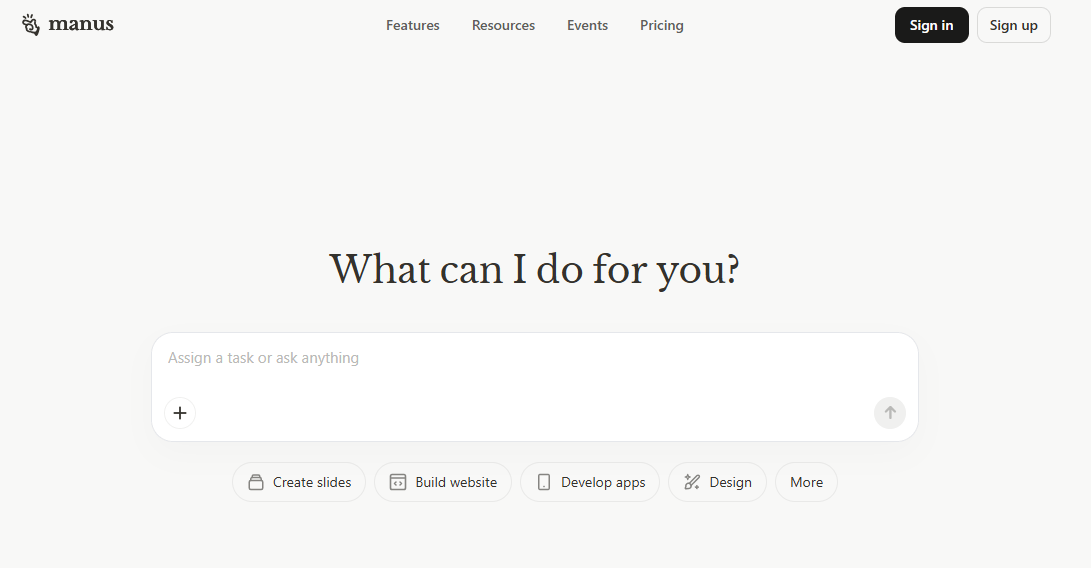
A consumer-friendly autonomous agent that runs multi-step tasks and can handle diverse goals, from quick research to lightweight content and spreadsheet work. Concurrency and credits make it easy to test small projects before scaling.
Strictly: no links here. Claims verified in the sources cited below.
- Best for: Teams that want a flexible general-purpose agent to prototype and ship small end-to-end tasks quickly.
- Key Features:
- Credit-based plans with concurrent task execution, confirmed by independent testing. TechCrunch product update.
- Team plan with pooled credits for small groups. TechCrunch teams announcement.
- Mobile and web access to trigger and monitor runs.
- Why we like it: Easy way to explore autonomous workflows without standing up complex infrastructure, and pricing makes controlled experiments straightforward. Independent reviewers also note it handles simple web-to-doc tasks well.
- Notable Limitations:
- Stability and support concerns have been reported by users. Review threads cite task failures, billing disputes, and poor response times. Treat these as caution flags during vendor evaluation. Reddit user reports, community complaints.
- Media coverage has called out gaps between marketing and practical performance.
- Pricing: Starter $39 per month for 3,900 credits and two concurrent tasks, Pro $199 per month with 19,900 credits and five concurrent tasks, Team $39 per seat per month with a five-seat minimum. Taxes or app-store billing may vary by region.
Maisa AI
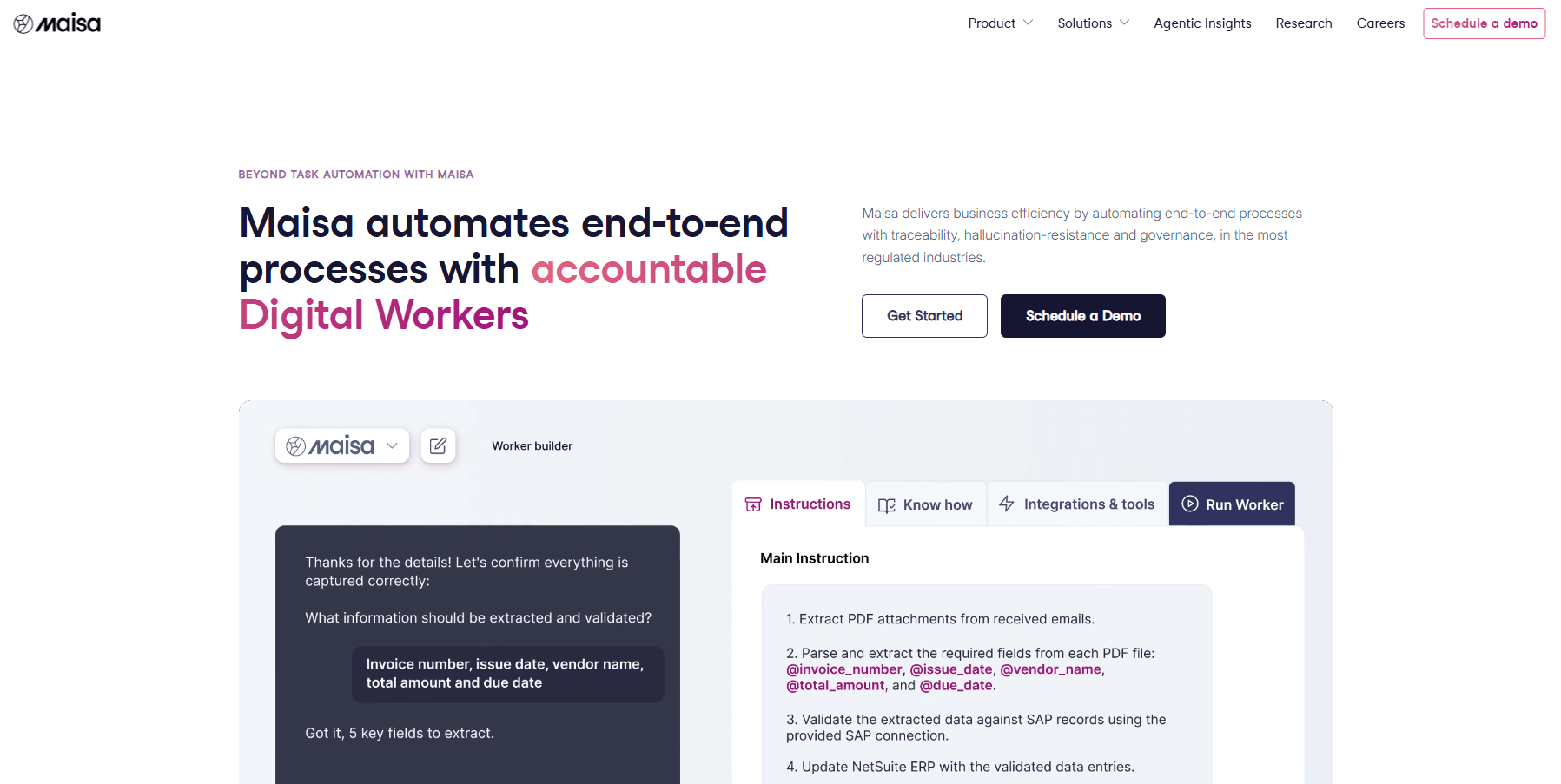
An enterprise agentic process automation platform that lets non-technical teams build auditable "digital workers" for regulated workflows. Designed for traceability, supervision, and deployment in controlled environments.
Strictly: no links here. Claims verified in the sources cited below.
- Best for: Regulated enterprises that need accountable, step-by-step auditable automation in finance, operations, and compliance.
- Key Features:
- No-code "Studio" for building digital workers with Chain-of-Work and human-in-the-loop supervision. TechCrunch funding and launch.
- Determinism controls via a Knowledge Processing Unit concept to reduce hallucinations.
- Cloud or on-prem deployment for enterprise buyers.
- Available through AWS Marketplace procurement. AWS Marketplace listing.
- Why we like it: It is built around auditability and governance from day one, which is what most enterprise pilots miss. The AWS Marketplace route also accelerates procurement.
- Notable Limitations:
- Early stage vendor with limited public reviews, so reference checks and pilots are essential. Invest in Spain summary.
- Feature depth is evolving, which can lengthen rollout if you need complex legacy integrations.
- Pricing: Pricing not publicly available. Available via private offer in AWS Marketplace, contact vendor for a custom quote.
TinyFish
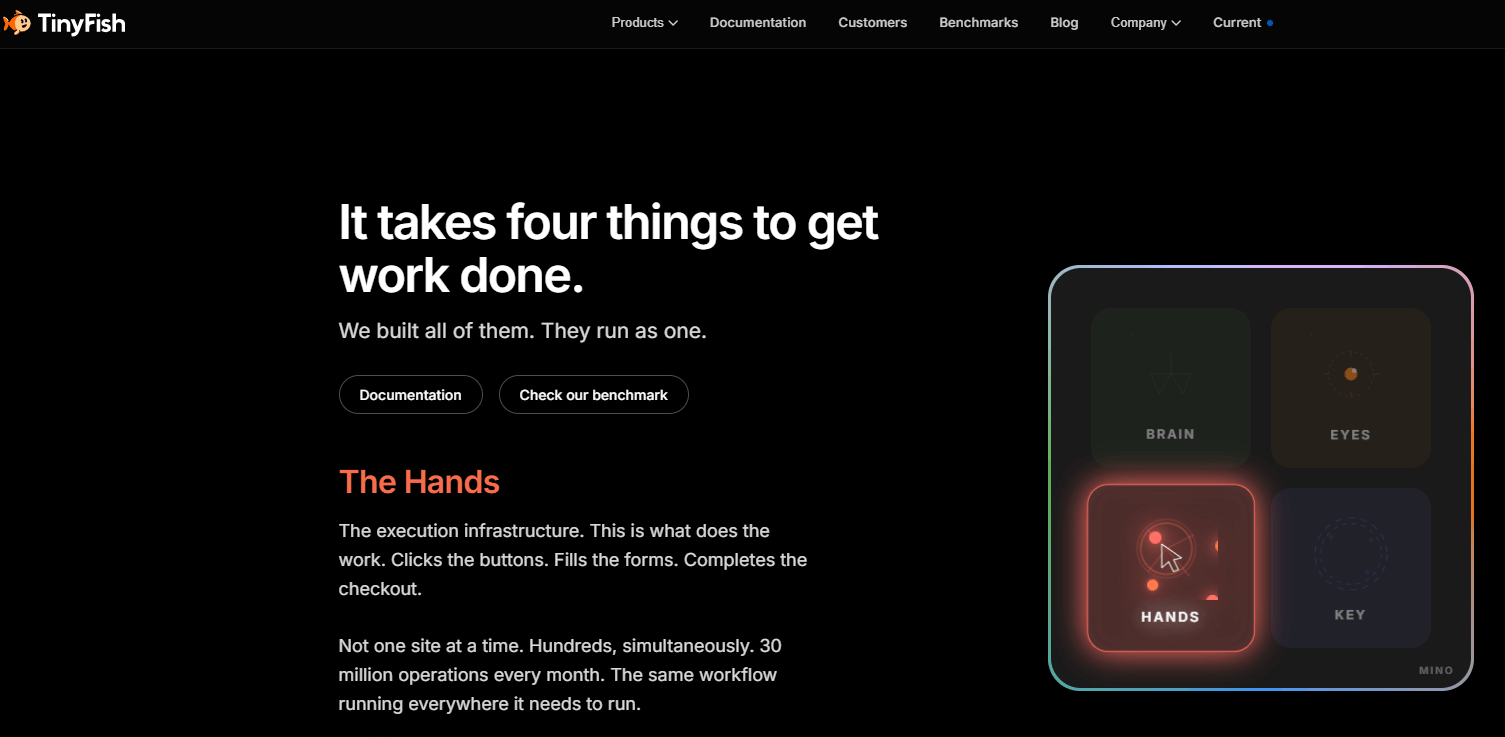
Enterprise web agents that replicate human browsing to automate price surveillance, inventory tracking, and market intelligence at scale. Emphasis on resilience and speed for high-change websites.
Strictly: no links here. Claims verified in the sources cited below.
- Best for: Retail, travel, marketplaces, and any team that needs continuous competitive data from the open web.
- Key Features:
- Human-like browsing agents for dynamic price monitoring and stock tracking. Reuters funding profile.
- Production deployments with large brands and Fortune 500 customers. Business Wire launch.
- Reasoning plus deterministic execution pipeline for repeatable outcomes.
- Why we like it: Purpose-built infrastructure for browsing tasks beats brittle scripts, and third-party reporting shows it running at scale with demanding customers.
- Notable Limitations:
- Legal and policy complexity around web data collection still applies, especially for sites with restrictive terms or sensitive datasets. See recent U.S. cases on scraping and trade secrets. Reuters legal analysis, case law overview.
- Pricing not public and likely enterprise-only, so expect a sales-led cycle. No verified public pricing found as of January 2026.
- Pricing: Pricing not publicly available. Contact TinyFish for a custom quote. Independent reports confirm enterprise focus and recent funding.
FuseBase
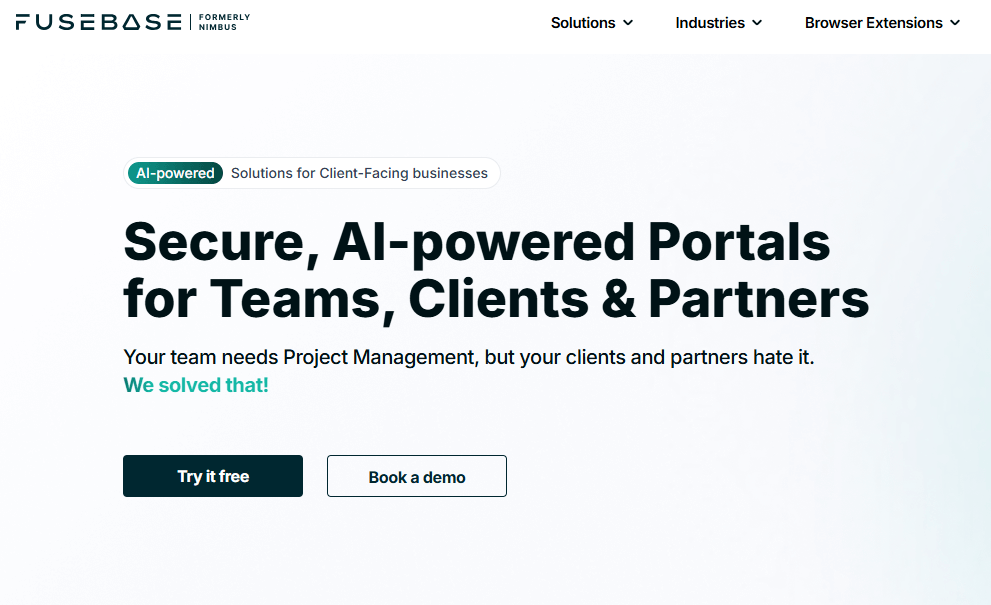
An AI-powered workspace for internal teams and client portals where agents live inside pages, portals, and a browser extension. Strong fit for agencies and service teams.
Strictly: no links here. Claims verified in the sources cited below.
- Best for: Professional services, agencies, and B2B teams that want branded portals and in-workspace agents without writing code.
- Key Features:
- Client portals, internal workspaces, and AI agents praised in third-party reviews. G2 product page, Product Hunt reviews.
- MCP integrations for agents listed on AppSumo's verified offering, helpful if you are standardizing on MCP. AppSumo plan details.
- Browser extensions to run agents while you work on the web.
- Why we like it: It collapses docs, portals, and agent actions into one surface, and there is independent confirmation of MCP integrations for teams adopting open standards.
- Notable Limitations:
- Some users want deeper integrations, better mobile parity, and faster performance under load.
- Lifetime deals change availability, which can complicate standardizing on a specific plan. Reddit AppSumo thread.
- Pricing: Public monthly pricing shows Solo at about $32, Essentials at about $82, and Advanced at about $332 per month via third-party listings. A time-limited lifetime deal has also been offered via AppSumo. Verify current terms before purchase. G2 pricing snapshot.
Multi-AI Agent Tools Comparison: Quick Overview
| Tool | Best For | Pricing Model | Highlights |
|---|---|---|---|
| Manus | General-purpose autonomous tasks for individuals and small teams | Subscription from $39 per month, team plan $39 per seat with 5-seat minimum | Mobile and web, credit and concurrency model |
| Maisa AI | Auditable enterprise automation in regulated workflows | Custom enterprise licensing, AWS Marketplace private offers | No-code digital workers, HALP, Chain-of-Work, on-prem option |
| TinyFish | Large-scale web browsing agents for price and inventory intelligence | Enterprise contracts | Human-like browsing at scale, early customers reported |
| FuseBase | Client portals and workspace-native agents for service teams | Subscriptions from ~$32 per month, occasional lifetime deals | Portals, workspaces, MCP integrations, browser extensions |
Multi-AI Agent Platform Comparison: Key Features at a Glance
| Tool | Auditable Runs | Browser Automation | MCP Support |
|---|---|---|---|
| Manus | Basic run histories reported in reviews, not positioned as audit-grade | Yes, for multi-step tasks like web-to-doc actions per coverage | Not documented by independent sources |
| Maisa AI | Yes, Chain-of-Work with human-in-the-loop supervision | Yes for workflow execution in enterprise contexts | Not publicly claimed, focuses on model-agnostic governance |
| TinyFish | Outcomes reported, built for deterministic execution at scale | Yes, human-like browsing at enterprise scale | Not disclosed |
| FuseBase | Workspace and portal logs, not positioned as regulated audit logs | Yes via agents and browser extensions | Listed as included in plans on AppSumo |
Multi-AI Agent Deployment Options
| Tool | Cloud API | On-Premise | Integration Complexity |
|---|---|---|---|
| Manus | Yes | Not documented | Low to medium, project-level setup |
| Maisa AI | Yes | Yes | Medium to high, enterprise rollout |
| TinyFish | Yes | Not disclosed | Medium, depends on target sites and policies |
| FuseBase | Yes | Not documented | Low to medium for SMB and agencies |
Multi-AI Agent Strategic Decision Framework
| Critical Question | Why It Matters | What to Evaluate |
|---|---|---|
| Do you need verifiable audit trails across long jobs? | Many agent projects fail on risk and accountability, not features | Presence of step-by-step provenance and human-in-the-loop controls |
| Will agents need to act across apps using open standards? | MCP adoption is rising, which reduces vendor lock-in | MCP servers, connectors, marketplace availability |
| Is web browsing at scale a core requirement? | Browsing agents face fragility and security risks | Rate limits, selector strategies, site policy handling, security posture |
| What deployment controls do you require? | Regulated sectors may need on-prem or strict governance | On-prem options, marketplace procurement, SOC policies |
Multi-AI Agent Solutions Comparison: Pricing and Capabilities
| Organization Size | Recommended Setup | Monthly Cost |
|---|---|---|
| Solo maker or consultant | FuseBase Solo for portals and agents or Manus Starter for one-off jobs | ~$32 to $39 |
| Small team, 5 users | Manus Team minimum or FuseBase Essentials | ~$195 for Manus Team minimum, or ~$82 for FuseBase Essentials |
| Mid-market, regulated workflows | Maisa AI pilot via AWS Marketplace | Pricing not publicly available |
| Enterprise, web intelligence | TinyFish proof of value plus staged rollout | Pricing not publicly available |
Problems & Solutions
-
Problem: "We need audit-ready AI for compliance and finance, and our pilots keep stalling."
- Solution with Maisa AI: Use digital workers with Chain-of-Work, HALP supervision, and optional on-prem to get traceable runs. This approach targets the enterprise failure pattern Gartner warns about, with controls built in.
-
Problem: "We must track competitor prices and stock across hundreds of sites daily, and scripts keep breaking."
- Solution with TinyFish: Deploy enterprise web agents that replicate human browsing, designed for dynamic websites and high-volume operations, with reported production use. Also build a policy playbook because scraping can carry legal risk in specific contexts.
-
Problem: "Clients, vendors, and our team are scattered across tools, and information falls through the cracks."
- Solution with FuseBase: Create branded client portals and internal workspaces where agents can file updates, answer questions, and trigger simple workflows, with MCP integrations listed for future-proofing.
-
Problem: "We just want a general-purpose agent to do quick multi-step jobs without heavy setup."
- Solution with Manus: Use credit-based plans for short tasks and basic web-to-doc outcomes, then measure ROI before scaling. Plan for reliability checks due to mixed user reports and set strict acceptance criteria per run.
A Practical Bottom Line for 2026 Planning
If you want auditability first, start with an enterprise pilot on Maisa AI and buy through AWS Marketplace to move procurement faster. If your challenge is competitive web data at scale, run a proof of value with TinyFish and formalize legal, security, and site change playbooks. For client collaboration and fast wins in services, FuseBase gives you portals plus agents with the bonus of MCP integrations. For flexible experiments, Manus is a low-commitment way to test autonomous workflows, but set SLOs and watch reliability. Above all, remember the market's split reality - rapid adoption and high failure risk - and choose based on verifiable controls, not hype.
