
You think you know "low power at the edge" until the battery budget collapses during field tests. Working across different tech companies, I keep seeing the same gap: teams overlook event-driven sensors with microsecond latency, spiking cores that sleep until spikes arrive, and analog ML that filters noise before the ADC. For example, Sony and Prophesee's stacked event sensor achieved sub-millisecond response and 124 dB-class dynamic range, which changes how you architect always-on vision entirely, as detailed in Sony's announcement of the co-developed sensor with Prophesee. (Sony press release)
According to Gartner, revenue from AI semiconductors reached an estimated 71 billion dollars in 2024, up 33 percent year over year, with accelerators in servers alone accounting for 21 billion dollars. (Gartner newsroom)
BrainChip Akida
Ultra-low-power, event-based neuromorphic processor IP aimed at embedded edge inference. Available as synthesizable IP and on small dev boards for rapid prototyping.
Best for: Teams needing on-device learning and SNN-style, event-driven inference in sub-watt products.
Key Features:
- Event-based, fully digital neuromorphic IP delivered for SoC licensing, with on-device learning and CNN-to-SNN conversion workflows. (See coverage in the Edge AI and Vision Alliance and a patent roundup via Business Wire.)
- Emerging "Akida Pico" co-processor variant rated under 1 mW for extreme-edge wake-up and filtering. (TechPowerUp)
- Tooling supports quantization and conversion of Keras/TensorFlow models to Akida-compatible networks. (Akida CNN2SNN docs)
Why we like it: The IP model means you can bring neuromorphic acceleration into your own SoC and pick your process node, which cuts risk for high-volume designs. The small dev boards help de-risk functionality before a silicon spin, and the Pico core is handy for power-gating large hosts.
Notable Limitations:
- Conversion requires quantization and layer-type constraints, so some models need re-architecture to meet hardware-friendly limits. (Akida CNN2SNN docs)
- SNN tools and benchmarks remain less standardized than conventional DL, which adds integration learning curve. (MIT Press, Neural Computation; Sensors review)
- General challenge for SNN accelerators: sensitivity to soft errors in harsh environments requires mitigation in safety-critical designs. (arXiv)
Pricing: IP licensing pricing not publicly available. Dev hardware has been announced broadly, for example the Akida Edge AI Box was introduced for pre-order "starting at 799 dollars" in 2024. (Business Wire; CNX Software) Contact BrainChip for a custom quote.
Innatera Pulsar

Mass-market neuromorphic microcontroller that combines an SNN engine with a RISC-V core and CNN, FFT accelerators for always-on sensor intelligence.
Best for: OEMs building battery-powered modules, wearables, or smart sensors that need sub-milliwatt inferencing and a familiar MCU workflow.
Key Features:
- Hybrid architecture with digital SNN engine, RISC-V MCU, CNN and FFT blocks to mix SNN and conventional flows. (EE Times; XPU.pub deep dive)
- Sub-milliwatt pattern recognition targets and Talamo SDK to build SNN models or port from TensorFlow and PyTorch. (EE Times)
- Backed by fresh funding to scale production in 2024, with continued Series A expansion in mid-2024. (PR Newswire; PR Newswire update)
Why we like it: Pulsar is pragmatic. You get an MCU power envelope, event-driven SNN for idle efficiency, and a small CNN block for the cases SNN alone does not cover, which reduces two-chip designs.
Notable Limitations:
- No on-chip nonvolatile memory, so designs need external flash which adds BOM and board space. (XPU.pub)
- Public pricing is not disclosed, and broad availability only started to scale around 2025 which can affect lead times for large programs. (XPU.pub)
- As with SNN platforms in general, model conversion and tooling standardization lag mainstream DL. (Sensors review)
Pricing: Pricing not publicly available. Contact Innatera for a custom quote.
Aspinity AML100
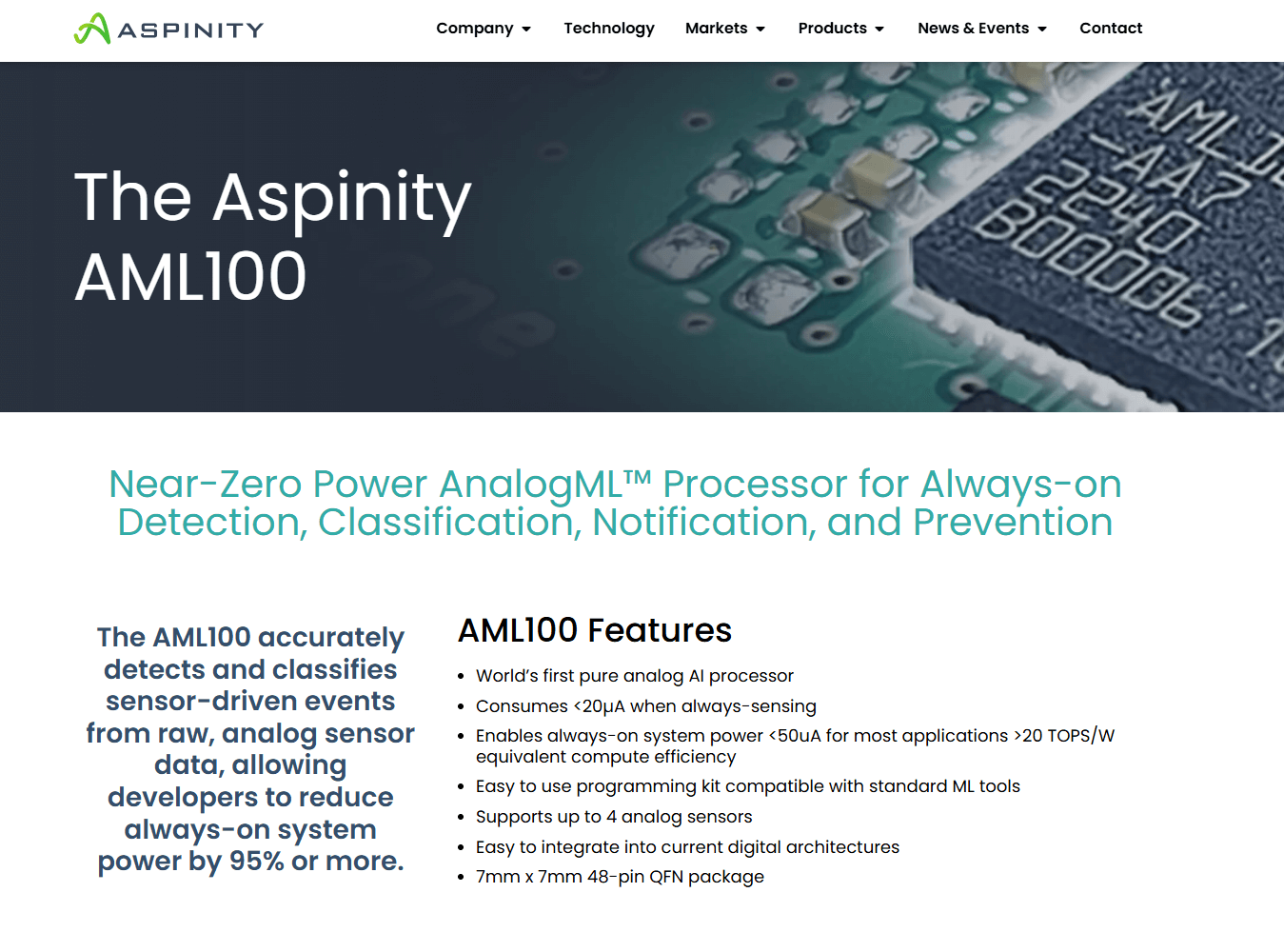
Pure analog machine learning processor for always-on sensing that classifies raw sensor signals before digitization to save system power.
Best for: Battery-powered devices that monitor audio, vibration, or other analog signals continuously and must wake a host only when events occur.
Key Features:
- Analog ML stack that consumes under 20 microamps in always-sensing mode and can drop system idle below 100 microamps. (audioXpress coverage)
- Supports up to four analog sensors, reducing false wakeups by deciding relevance before the ADC. (Aspinity launch coverage)
- Field-programmable analog blocks to retarget models and applications over time. (audioXpress)
Why we like it: If your power budget is measured in microamps, cutting out the ADC and digital pre-processing until it really matters can extend battery life by an order of magnitude.
Notable Limitations:
- Not an SNN or digital NPU, so it does not run arbitrary deep networks and is best for targeted event detection. (EE Times)
- Analog ML requires using the vendor toolchain and model approach, which can limit portability across other accelerators. (EE Times Japan)
- Public, off-the-shelf pricing is scarce; most engagements are solution driven.
Pricing: Pricing not publicly available. Contact Aspinity for a custom quote.
Prophesee Metavision
Event-based neuromorphic vision sensors that output pixel-level changes only, delivering extremely low latency and very high dynamic range for fast, power-efficient vision.
Best for: Vision systems that break under motion blur or extreme lighting, such as robotics, AR, and high-speed industrial monitoring.
Key Features:
- Stacked Sony, Prophesee sensors with sub-millisecond response and industry-leading pixel shrinks. (Sony press release; IEEE Spectrum)
- Fifth-gen GenX320 targets microwatt-level ultra-low power and <150 µs pixel latency for edge devices. (EE Times)
- Growing third-party camera ecosystem and SDK options from IDS and Lucid Vision. (Vision Systems Design)
Why we like it: You get microsecond-scale timing and >110-140 dB dynamic range, which makes previously impossible real-time tasks feasible without massive compute.
Notable Limitations:
- Requires specialized algorithms and data representations, so off-the-shelf CV models often underperform. (Frontiers review)
- Static or low-contrast scenes can produce sparse events that need careful pipeline design. (EmergentMind primer)
- Very high event rates can stress bandwidth or host processing without tailored data paths. (Frontiers neurorobotics)
Pricing: Third-party cameras with IMX636 are publicly listed, for example Lucid Vision's 0.9 MP event camera at about 1,495 dollars. (Lucid Vision listing) Evaluation kits may be listed near 5,000 euros in regional stores. (Example listing: Prophesee store)
Neuromorphic Computing Tools Comparison: Quick Overview
| Tool | Best For | Pricing Model | Highlights |
|---|---|---|---|
| BrainChip Akida | IP in your own SoC or small boards for pilots | IP license, dev boards | Event-driven SNN, on-device learning, sub-watt targets |
| Innatera Pulsar | Always-on sensing MCU class designs | MCU, modules | SNN engine plus RISC-V and CNN, sub-mW inference |
| Aspinity AML100 | Ultra-low-power analog event detection | Chip, solution kits | <20 µA always-sensing, pre-ADC classification |
| Prophesee Metavision | High-speed, HDR event vision | Sensors, EVKs, cameras | µs-scale latency, >110-140 dB HDR, growing camera ecosystem |
Neuromorphic Computing Platform Comparison: Key Features at a Glance
| Tool | Event-Driven Compute | On-Device Learning | Complementary Blocks |
|---|---|---|---|
| BrainChip Akida | Yes, SNN | Yes | CNN2SNN toolflow |
| Innatera Pulsar | Yes, SNN | Yes | RISC-V MCU, CNN, FFT |
| Aspinity AML100 | Analog ML | Yes, field programmable | Sensor front ends |
| Prophesee Metavision | Event vision | N/A | SDKs, partner cameras |
Neuromorphic Computing Deployment Options
| Tool | Cloud API | On-Premise | Air-Gapped | Integration Complexity |
|---|---|---|---|---|
| BrainChip Akida | No | Yes | Yes | Medium, quantization and model constraints |
| Innatera Pulsar | No | Yes | Yes | Medium, SNN plus MCU toolchain |
| Aspinity AML100 | No | Yes | Yes | Low-to-Medium, analog ML workflow |
| Prophesee Metavision | No | Yes | Yes | Medium, event-based CV pipeline |
Neuromorphic Computing Strategic Decision Framework
| Critical Question | Why It Matters | What to Evaluate | Red Flags |
|---|---|---|---|
| Is your bottleneck always-on power or peak inference throughput? | Determines whether analog ML or SNN/CNN hybrid wins | Idle current, wake-up latency, sensor count | Chasing TOPS without measuring idle microamps |
| Do you have motion blur or HDR failures in vision? | Event vision can fix what frame sensors cannot | Latency, HDR in dB, SDK ecosystem | Assuming standard CV models will "just work" on events |
| Can your models meet quantization and layer constraints? | Hardware-friendly models avoid months of rework | Supported layers, bit-widths, toolflow | Treating conversion as an afterthought |
| Will the system be safety-critical or space-grade? | Robustness to soft errors and radiation matters | Fault mitigation, ECC, redundancy | Ignoring soft-error paths on SNN hardware |
Neuromorphic Computing Solutions Comparison: Pricing and Capabilities
| Organization Size | Recommended Setup | Upfront Cost Signals | Notes |
|---|---|---|---|
| Startup prototyping | Prophesee camera + Akida board or Innatera EVK | Cameras with IMX636 start near 1,495 dollars at third-party vendors; EVKs vary | Example pricing via Lucid Vision. Akida dev hardware and Innatera EVKs vary by region and bundle. |
| Mid-size productization | Akida IP in partner SoC or Pulsar MCU, targeted Prophesee sensor | IP licensing and MCU pricing not public | Engage vendors early for NRE, volumes, and toolchain access. |
| Enterprise programs | Mixed stack: Prophesee for vision, Akida/Pulsar for fusion, AML100 for ultra-low-power sentry | Varies by volumes and compliance | Validate safety and long-term supply, plan for algorithm retraining and QA. |
Problems & Solutions
-
Problem: Motion blur and blown-out highlights break vision in fast, high-contrast scenes.
How these tools help: Prophesee's event sensors deliver microsecond-level timing and >110-140 dB dynamic range, which eliminates blur in fast motion and handles lighting extremes that defeat frame cameras. -
Problem: Always-on microphones or vibration sensors drain batteries while doing nothing useful.
How these tools help: Aspinity's AML100 classifies raw analog signals at under 20 microamps and can keep whole systems below 100 microamps until a real event arrives. -
Problem: Tiny batteries cannot support a general-purpose CPU awake for inference.
How these tools help: Innatera's Pulsar combines an SNN engine with an MCU and CNN accelerator to run always-on patterns in sub-milliwatt budgets, waking the host only on true positives. -
Problem: Customers need on-device personalization without cloud retraining.
How these tools help: Akida's event-based architecture supports on-device learning and standard model conversion, enabling privacy-preserving updates at the edge. -
Problem: Teams try to drop event sensors into existing CV stacks and get poor results.
How these tools help: Plan for event-native algorithms or proper frame conversions. Reviews emphasize the need for tailored sparse processing to avoid compute blow-ups and accuracy hits.
The Bottom Line on Neuromorphic Platforms
Low power at the edge is not solved by squeezing another few percent out of a CNN. It is solved by changing when and how compute happens. Neuromorphic platforms win when they eliminate unnecessary work before the digital pipeline wakes up.
If your constraint is idle current, start with analog ML or spiking wake paths like Aspinity or Innatera. If your system fails due to motion blur, latency, or lighting extremes, event-based vision from Prophesee belongs at the front of the pipeline. If you need on-device learning or tight SoC integration at scale, BrainChip’s IP model offers flexibility that discrete accelerators cannot. Across all of them, the real work is not hardware selection but model conversion, algorithm design, and system-level power budgeting.
The market tailwinds are real. AI silicon revenue is growing fast, but the edge rewards architectures that do less, not more. The teams that succeed in 2026 run one focused pilot per sensing modality, measure idle microamps and wake latency in the field, and scale only the designs that prove they can stay asleep until reality demands otherwise.