
Most teams discover that "AI that reads papers" still leaves gaps at the bedside during pre-round huddles and tumor boards, not from glossy vendor decks. From our experience in the startup ecosystem, the biggest wins come when platforms plug directly into the workflow with three things dialed in: FHIR-based EHR hooks for orders and notes, genetics-aware logic that interprets variants into actions, and safety rails like citation traceability for every recommendation. You think you know your CDS stack until a prior auth appeal, a complex drug-gene interaction, or an imaging-genomics discordance forces a reality check. Clinicians need speed and provenance, and the tools below stood out on both.
According to Frost & Sullivan, AI-driven clinical decision support is on track to grow from 10.75 billion dollars in 2024 to 16.67 billion dollars by 2030, a signal that health systems are actively investing in decision intelligence at the point of care (Frost & Sullivan global CDSS outlook).
PrecisionHealth.ai
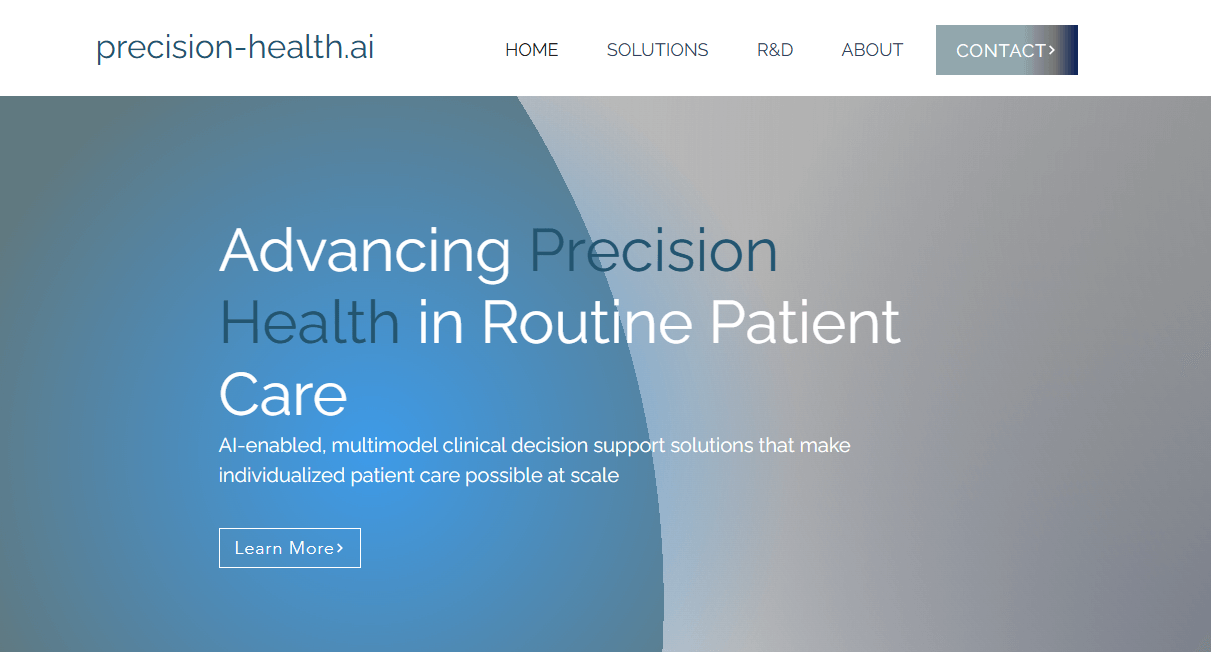
AI-enabled clinical decision support that combines genetics, imaging biomarkers, labs, and EHR data to support individualized care across neurology, oncology, and psychiatry. Active in the Oslo Cancer Cluster ecosystem, with collaborations that point to real-world pilots and research translation.
Best for: Clinical teams exploring multimodal precision medicine use cases like dementia risk stratification, prostate cancer planning, or psychiatry cardiometabolic risk.
Key Features:
- Multimodal ingestion across genomics, imaging biomarkers, labs, and EHR data, with cloud delivery.
- Risk stratification for neurodegeneration and differential diagnosis tools for dementias.
- Oncology workflows focused on earlier detection and treatment planning.
- Precision psychiatry efforts for therapy optimization and adverse effect reduction.
Why we like it: Strong focus on clinically high-value problems where multimodal fusion matters, plus credible community ties that can accelerate pilots.
Notable Limitations: Early-stage public footprint, few independent peer-reviewed deployment studies available, and limited third-party implementation references for large U.S. IDNs.
Pricing: Pricing not publicly available. Contact vendor for a custom quote.
PrecisionLife CDS
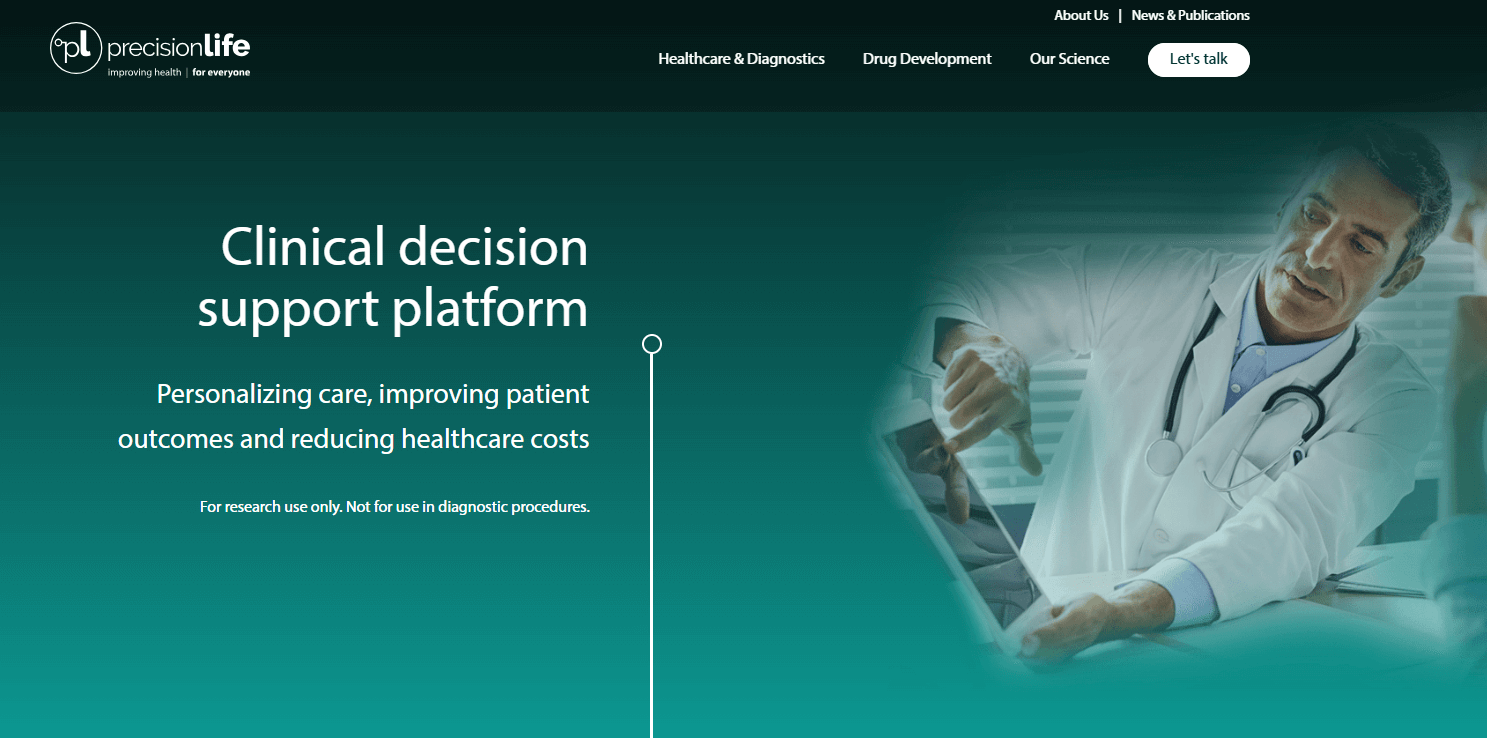
Mechanism-driven clinical decision support that interprets genetic test results into disease risk, likely disease mechanisms, treatment options, and trial matches. Uses combinatorial analytics to identify patient subgroups and support mechanism-based decisions.
Best for: Organizations piloting genetics-forward CDS for chronic, complex conditions where polygenic risk alone is insufficient.
Key Features:
- Mechanism-centric interpretation of genetic variants to explain disease drivers.
- Recommendations spanning risk prediction, triage, treatment selection, and clinical trial matching.
- Non-invasive sample pathways, compatible with standard genotyping arrays.
- Orientation toward payer-relevant biomarkers and drug-response insights.
Why we like it: The mechanistic framing is practical for moving from genetic signal to action, which clinicians and payers both need.
Notable Limitations: Clinical validation and regulatory pathway details are still emerging, limited EHR standards references in public materials, and scarce third-party implementation reviews.
Pricing: Pricing not publicly available. Contact vendor for a custom quote.
OpenEvidence
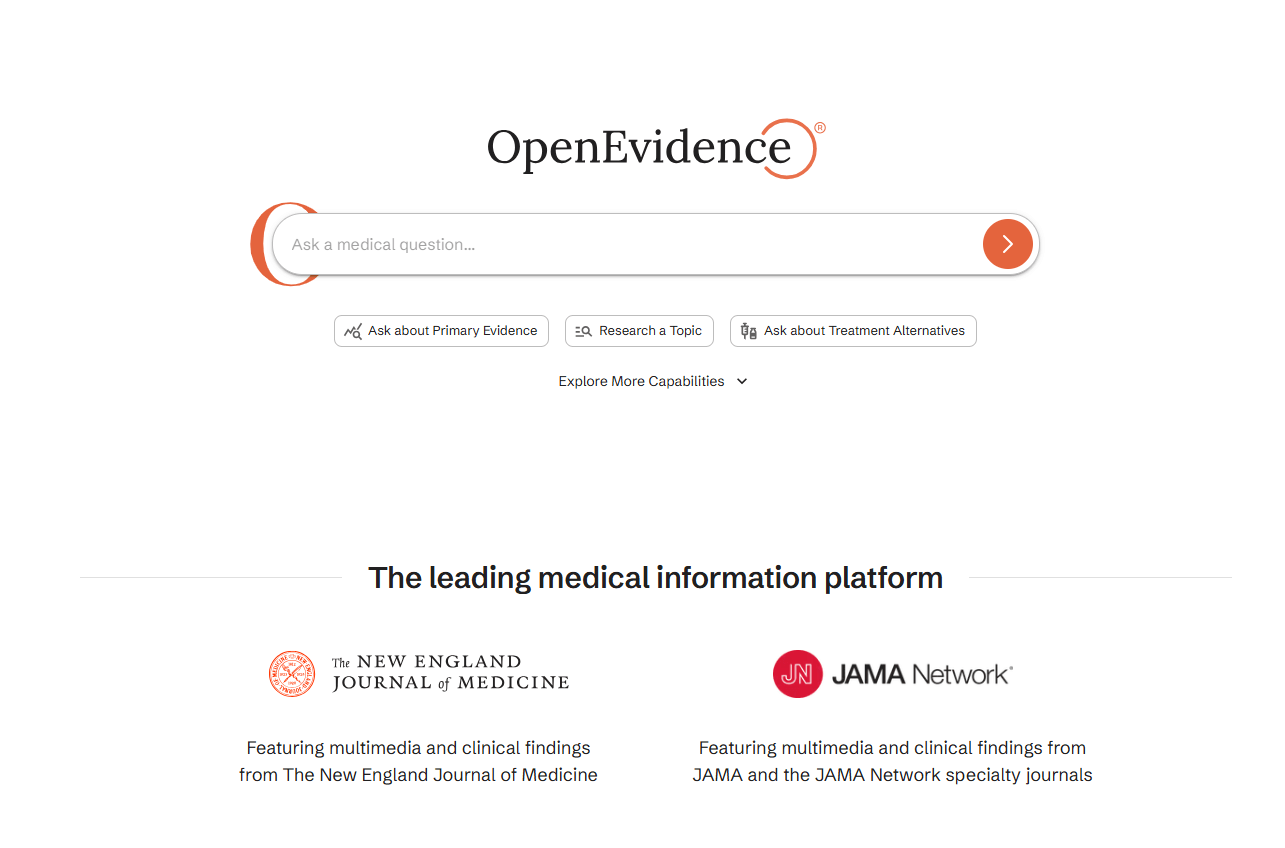
AI-powered medical literature search and clinical assistant for physicians, trained on peer-reviewed sources and clinical guidelines. Built for point-of-care questions with tight citation trails and publisher content partnerships.
Best for: Physicians and care teams who need rapid evidence synthesis, citation-level provenance, and up-to-date publisher content during clinical workflows.
Key Features:
- Evidence answers linked to peer-reviewed literature and guidelines.
- Large-scale physician adoption reported with a rapid growth trajectory.
- Publisher partnerships that expand high-quality source coverage.
- Mobile and web access designed for point-of-care usage.
Why we like it: Speed plus provenance helps clinicians answer time-critical questions without sacrificing evidence quality.
Notable Limitations: Free, advertising-supported model can raise conflict-of-interest questions for some buyers, lawsuits with competitors have created noise around the category, and on-prem deployment is not publicly described.
Pricing: Free for verified clinicians with advertising support, per recent funding coverage that describes the model (TechCrunch on funding and model). Enterprise arrangements not publicly listed.
Precision Medicine & Clinical AI Decision Support Tools Comparison: Quick Overview
| Tool | Best For | Pricing Model | Highlights |
|---|---|---|---|
| PrecisionHealth.ai | Multimodal pilots in neurology, oncology, psychiatry | Not publicly available | Multimodal risk and diagnosis focus, research collaborations |
| PrecisionLife CDS | Genetics-forward risk, mechanism, and therapy guidance | Not publicly available | Mechanism-based interpretation, trial enrichment orientation |
| OpenEvidence | Evidence retrieval and reasoning at the bedside | Ad-supported for clinicians (free) | Publisher content partnerships, fast growth among physicians |
Note: OpenEvidence's free, ad-supported model and rapid funding milestones are covered in independent reporting (TechCrunch, Fierce Healthcare), while its publisher partnerships have been reported by trade media (Medical Economics on NEJM partnership).
Precision Medicine & Clinical AI Decision Support Platform Comparison: Key Features at a Glance
| Tool | Evidence Traceability | Genetics Interpretation | EHR Workflow Hooks |
|---|---|---|---|
| PrecisionHealth.ai | Citations indicated in outputs | Yes, includes imaging biomarkers | Intended EHR integration focus |
| PrecisionLife CDS | Mechanism-linked citations | Strong, limited public detail on imaging | Emerging standards references |
| OpenEvidence | Line-by-line citations | N/A | Browser and mobile workflows, clinical use focus |
Evidence traceability is a pivotal requirement for CDS, and market momentum supports AI-enabled CDS adoption through 2030.
Precision Medicine & Clinical AI Decision Support Deployment Options
| Tool | Cloud API | On-Premise / Air-Gapped | Integration Complexity |
|---|---|---|---|
| PrecisionHealth.ai | Cloud delivery reported | Not public | Moderate to high for multimodal data |
| PrecisionLife CDS | Cloud delivery for CDS outputs | Not public | Genetics and EHR mapping effort expected |
| OpenEvidence | Web and mobile access | Not public | Low for individual clinicians, enterprise SSO not publicly detailed |
Integration complexity estimates reflect known pain points from genetic CDS literature, such as limited standards-based genomic data transfer in many deployments (JAMIA systematic review on genetic CDS).
Precision Medicine & Clinical AI Decision Support Strategic Decision Framework
| Critical Question | Why It Matters | What to Evaluate | Red Flags |
|---|---|---|---|
| Does the platform provide citation-level provenance for every recommendation? | Reduces medico-legal risk and speeds audit trails | Source transparency, ability to open primary literature | Opaque summaries, no primary sources |
| How mature is EHR and genetics integration? | Avoids swivel-chair workflows, reduces errors | SMART on FHIR, orderset hooks, variant interpretation pipeline fit | CSV hand-offs, manual copy-paste |
| Are conflicts of interest managed? | Ads or sponsored content can bias care | Clear labeling, governance policy, independent oversight | Undisclosed sponsorships, mixed editorial lines |
| What is the regulatory posture? | Different CDS features can fall under SaMD | Claimed indications, validation studies, change control | Vague claims, no performance metrics |
Precision Medicine & Clinical AI Decision Support Solutions Comparison: Pricing & Capabilities Overview
| Organization Size | Recommended Setup | Public Pricing | Budget Considerations |
|---|---|---|---|
| Small practice or specialty group | OpenEvidence for quick evidence lookups | Yes, free for clinicians | Training time, optional enterprise features may require contracts |
| Community hospital | PrecisionHealth.ai pilot for a targeted pathway, plus OpenEvidence | No | Implementation services for multimodal data feeds, governance time |
| Academic medical center or IDN | PrecisionLife CDS pilot for a genetics-heavy service line, plus OpenEvidence | No | Genetics pipeline alignment, EHR build, change management workstream |
Public pricing is sparse across precision CDS, and buyers should expect services and integration to dominate total cost of ownership, consistent with broader AI software spend trends in healthcare (Gartner AI software spending in healthcare and life sciences).
Problems & Solutions
-
Problem: Clinicians face evidence overload at the point of care, and need trusted, fast answers with citations.
Solution: OpenEvidence pairs an AI assistant with peer-reviewed sources and has inked content agreements with leading publishers, which reduces literature hunting during visits (Medical Economics on NEJM partnership). Independent coverage highlights rapid physician adoption and a free, ad-supported model that lowers procurement friction for frontline users. -
Problem: Genetic test results are hard to translate into mechanism and treatment action in chronic, complex diseases.
Solution: PrecisionLife has reported replication of long COVID genetic findings in a diverse U.S. cohort with partners, which supports its mechanism-driven approach to subtyping and therapy guidance, pending further clinical validation (BIA summary of replicated findings in long COVID). This aligns with the broader market shift toward AI-enabled CDS cited by analysts. -
Problem: Health systems need multimodal precision, combining imaging, labs, EHR context, and genetics.
Solution: PrecisionHealth.ai publicly positions on multimodal CDSS across neurology, oncology, and psychiatry, and its membership in Oslo Cancer Cluster signals active engagement with clinical partners to move pilots forward (Oslo Cancer Cluster member profile for Precision Health). This community grounding often accelerates access to data and clinical champions. -
Problem: Governance teams worry about CDS vendor risk and market volatility.
Solution: Require transparent provenance, clear policy on advertising and sponsored content, and review external reporting on any legal disputes in the category, such as the 2025 lawsuits between Doximity and OpenEvidence covered by business media (Business Insider report on dueling lawsuits). Use this diligence to set procurement guardrails regardless of which platform you pick.
Bottom Line: Choose Evidence Velocity, Mechanistic Clarity, and Deployment Fit
The CDSS market is growing, but buyers win when they match the job to be done with the platform's strengths. If your clinicians need fast, citable summaries at the bedside, OpenEvidence's growth story and publisher partnerships are well documented in independent coverage. If your program is genetics-forward and needs mechanism-based decisions, PrecisionLife's replication work suggests traction toward clinically useful subtyping, with more validation still needed. If you are standing up multimodal pilots, PrecisionHealth.ai's activity within the Oslo Cancer Cluster points to a pathway for collaborations and real-world projects. Anchor your shortlist with these three, run a time-boxed pilot with clear metrics, and formalize evidence and integration checkpoints up front.