
Most teams discover how fragile their browser security is during a phishing simulation or a red team engagement, not from a quarterly report. Working across different tech companies, teams have had to fix breakages from in-browser JavaScript, lock down risky file uploads with policy, and route uncategorized sites into isolation without killing page performance. Remote browser isolation, RBI, is the pragmatic way to keep web code off devices while preserving productivity. Browser isolation now sits inside larger SSE stacks, which is why it matters that the SSE market reached about 6.26 billion dollars in 2024, with steady double-digit growth ahead, per Grand View Research's SSE study. The five platforms below consistently balanced protection, admin effort, and user experience. You will learn where RBI fits, what to pilot, and where you might overspend.
Proofpoint Isolation

Cloud RBI that isolates risky links and personal browsing, streaming safe renderings to the endpoint. Designed to neutralize malware and data exfiltration from web sessions without changing how users work. According to vendor documentation.
Best for: Security teams that already run Proofpoint email security and want people-centric web controls tied to links and identity, with minimal endpoint change.
Key Features:
- Isolation of risky and uncategorized sites with read-only modes for personal webmail and document apps, per vendor documentation.
- URL filtering and policy controls that can restrict uploads or downloads during isolated sessions, per vendor documentation.
- Integration with Proofpoint threat intel to isolate links from messages, per vendor documentation.
Why we like it: Easy way to extend an existing Proofpoint footprint from email into the browser, especially for personal browsing controls.
Notable Limitations: Reports of site compatibility issues with dynamic JavaScript, mixed feedback on admin UX, and occasional support communication gaps based on public user threads and reviews.
Pricing: Pricing not publicly available. Contact Proofpoint for a custom quote.
Disclosure: Proofpoint has operated as a private company since its 12.3 billion dollar buyout by Thoma Bravo in 2021.
Netskope Remote Browser Isolation
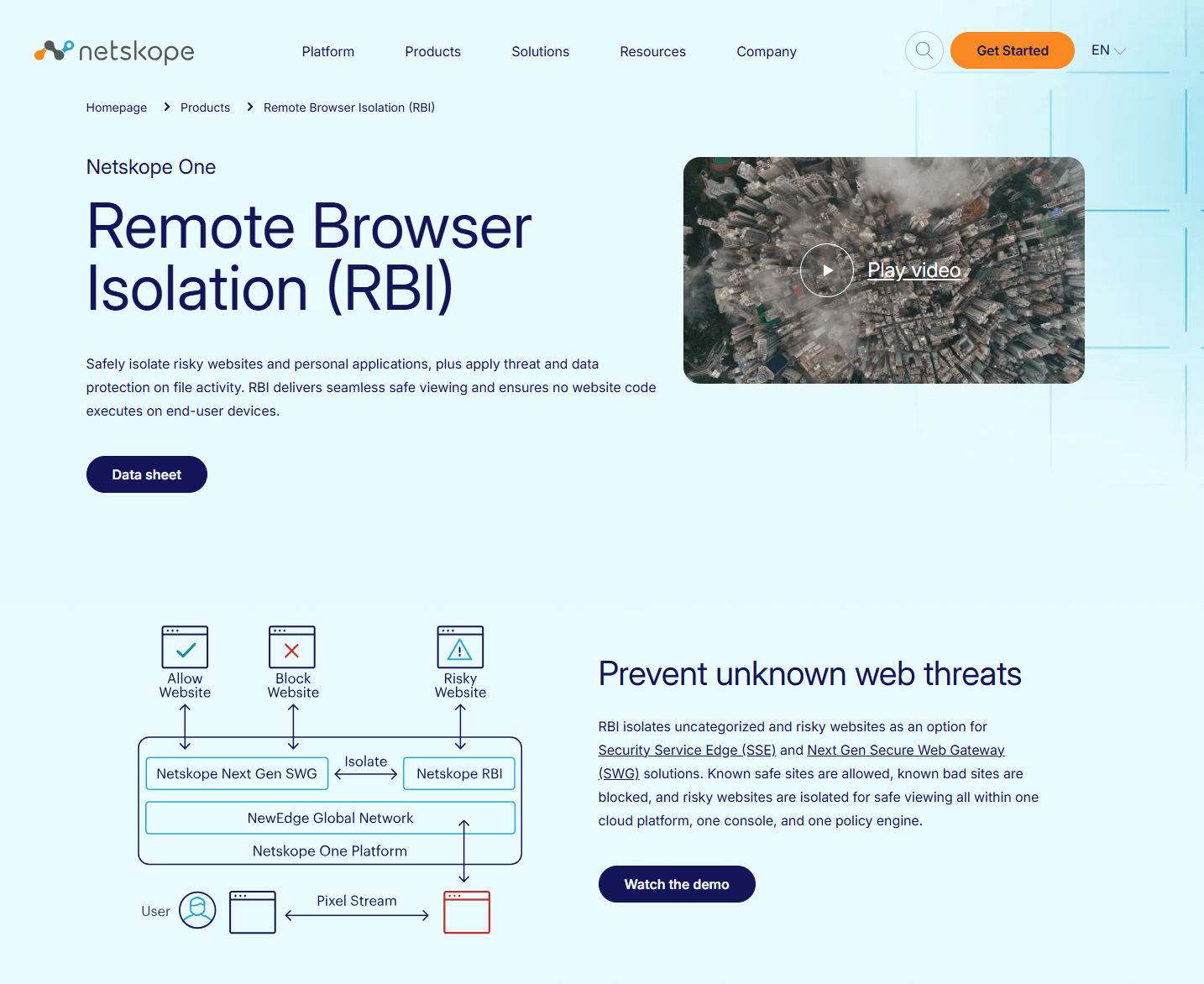
Cloud RBI integrated into the Netskope SSE and Next-Gen SWG platform, rendering risky sites remotely and controlling file actions. According to vendor documentation.
Best for: Organizations standardizing on Netskope SSE that want one policy engine for SWG, CASB, DLP, ZTNA, and RBI.
Key Features:
- Policy to isolate uncategorized or risky sites while blocking known bad and allowing known good, per vendor documentation.
- File activity controls during isolation to limit uploads, downloads, or copy-paste, per vendor documentation.
- Single-console management alongside SWG and DLP policies, per vendor documentation.
Why we like it: Cohesive experience for admins already using Netskope policies and DLP, with RBI as a graduated response for unknown sites.
Notable Limitations: Some admins cite console complexity and intermittent performance issues, and there are community reports of slowdowns in specific environments.
Pricing: Pricing not publicly available. Contact Netskope for a custom quote.
FortiIsolator
Fortinet's RBI delivered as an appliance or virtual instance, rendering web content in a remote container and streaming safe output to users. According to vendor documentation.
Best for: Regulated or sensitive environments that prefer on-prem or VM isolation, including sites that need minimal external dependency.
Key Features:
- Clientless remote rendering to any modern HTML5 browser, per vendor documentation.
- Tight integration points with FortiGate, FortiProxy, and FortiMail for policy-based steering, per vendor documentation.
- Flexible deployment as hardware appliance or VM, with scale profiles, per vendor documentation.
Why we like it: Clear option for teams that need RBI under local control or that want to stitch isolation into existing Fortinet workflows.
Notable Limitations: Smaller review volume than cloud-first peers, and reviewers note occasional app compatibility friction and UI learning curve.
Pricing: Pricing not publicly available. Contact Fortinet for a custom quote.
Palo Alto Networks Remote Browser Isolation
RBI integrated with Prisma SASE, focused on near-native performance and granular policy control to stop zero-day web threats while keeping browsing fluid. According to vendor documentation.
Best for: Prisma SASE customers who want unified policies across SWG, ZTNA, and a fully managed isolation layer.
Key Features:
- Cloud-rendered browsing with controls for downloads, uploads, clipboard, and session behavior, per vendor documentation.
- Centralized policy through Prisma SASE with broad browser support, per vendor documentation.
- Frequent feature updates that expand file handling and user experience options, per vendor documentation.
Why we like it: Strong fit when you already rely on Prisma for access and data security and want isolation governed by the same engine.
Notable Limitations: Reviews mention tuning effort for strict defaults, occasional lag on heavy sites, and an admin learning curve.
Pricing: Pricing not publicly available. Contact Palo Alto Networks for a custom quote.
Menlo Security Remote Browser Isolation
Cloud RBI built on Menlo's isolation core, designed for scale and consistent performance with policy controls and visibility across browsing. According to vendor documentation.
Best for: Enterprises that want dedicated isolation depth with a track record in large-scale cloud isolation, including public sector.
Key Features:
- Cloud-based isolation that executes web code remotely and streams safe output to endpoints, per vendor documentation.
- Policy controls for uploads, downloads, and read-only modes across web and SaaS, per vendor documentation.
- Isolation platform used in government environments, per public announcements.
Why we like it: Mature isolation approach for organizations prioritizing prevention over detect-and-respond in the browser.
Notable Limitations: Reviews cite occasional rendering issues on specific sites and the need for exceptions in some workflows.
Pricing: Pricing not publicly available. Contact Menlo Security for a custom quote.
Remote Browser Isolation Tools Comparison: Quick Overview
| Tool | Best For | Pricing Model | Highlights |
|---|---|---|---|
| Proofpoint Isolation | Proofpoint email customers adding web isolation | Subscription, quote based | People-centric policies that pair links, identity, and web isolation |
| Netskope RBI | Organizations on Netskope SSE | Subscription, quote based | One policy for SWG, DLP, ZTNA, and RBI in the same console |
| FortiIsolator | On-prem or VM RBI in regulated sites | License, quote based | Appliance or VM isolation with Fortinet integrations |
| Palo Alto Networks RBI | Prisma SASE customers | Subscription, quote based | Unified SASE policy with frequent isolation feature updates |
| Menlo Security RBI | Large-scale cloud isolation, including public sector | Subscription, quote based | Isolation-first design built for performance at scale |
Remote Browser Isolation Platform Comparison: Key Features at a Glance
| Tool | Isolation Triggers | File Controls | Admin Model |
|---|---|---|---|
| Proofpoint Isolation | Risky, uncategorized, or personal browsing per policy | Read-only modes, download and upload controls | Cloud service tied to Proofpoint policies |
| Netskope RBI | Risky or unknown categories via SSE policy | Fine-grained file actions in session | Single console with SWG and DLP |
| FortiIsolator | Policy steering from Fortinet stack | Streamed content, configurable exceptions | Appliance or VM under local control |
| Palo Alto Networks RBI | SASE policy with browser coverage | Granular clipboard, download, upload controls | Managed service in Prisma SASE |
| Menlo Security RBI | Isolation-first for web, SaaS, and documents | Policy-based transfers and read-only | Cloud isolation with tenant-level policies |
Remote Browser Isolation Deployment Options
| Tool | Delivery Model | On-Prem/VM Option | Integration Focus |
|---|---|---|---|
| Proofpoint Isolation | Cloud | No | Email threat intel and people-centric controls |
| Netskope RBI | Cloud | No | SSE, SWG, and DLP in one engine |
| FortiIsolator | Appliance or VM | Yes | FortiGate, FortiProxy, FortiMail |
| Palo Alto Networks RBI | Cloud | No | Prisma SASE policy and logging |
| Menlo Security RBI | Cloud | No | Isolation core with policy and logging |
Remote Browser Isolation Strategic Decision Framework
| Critical Question | Why It Matters | What to Evaluate |
|---|---|---|
| Where will isolation live, SSE cloud or on-prem appliance | Decides latency, scale, and control | Proximity of PoPs, peering, or local resources |
| How strict are file and clipboard controls | Stops data loss in browser flows | Per-type download, upload, copy-paste, watermarking |
| How does it handle dynamic sites and JS | Reduces breakage and help-desk load | Rendering method, exceptions, per-site modes |
| What is the admin overhead | Affects ongoing cost and response | One policy engine across SWG, DLP, ZTNA |
| Compliance needs like FedRAMP | Can be a hard requirement | Authorization level and sponsor |
Remote Browser Isolation Solutions Comparison: Pricing and Capabilities Overview
| Organization Size | Recommended Setup | Cost Estimate |
|---|---|---|
| 200-1,000 users | Pilot cloud RBI inside your existing SSE, expand by risk category | Quote based |
| 1,000-10,000 users | Standardize isolation policy in SSE for risky and personal browsing, add file controls | Quote based |
| Regulated or segmented sites | FortiIsolator appliance or VM for sensitive zones, cloud RBI elsewhere | Quote based |
Problems & Solutions
-
Problem: Isolation introduces latency or slows common workflows
Evidence: Admins reported intermittent slowdowns and reliability issues with SSE stacks in public forums and peer reviews, including Netskope customer threads noting pauses and degraded performance in certain conditions and versions, and Gartner Peer Insights comments on console usability and reliability for Netskope Security Cloud (Reddit thread on Netskope slowdowns, Gartner Peer Insights review excerpts for Netskope Security Cloud, and a community note on Google Workspace performance with specific browser flags and decryption policies, April 2025 update).
How tools address it:- Netskope RBI: Keep isolation scoped to risky and uncategorized categories to reduce volume. Pilot from multiple PoPs and verify TLS 1.3 early data interactions against SSL policies when relevant, as discussed in community mitigation notes, then tune exceptions.
- Menlo Security RBI: Isolation-first design and a record of large cloud deployments, including public sector, can help with scale expectations. Menlo's FedRAMP authorization signals operational rigor for federal workloads, see the Business Wire announcement.
- FortiIsolator: Use appliance or VM inside sensitive networks to eliminate internet path variables. G2 reviews highlight the value of clientless rendering and the ability to bypass specific apps when needed (FortiIsolator reviews on G2).
-
Problem: Site breakage inside isolation, blank pages, or JS features failing
Evidence: Practitioners report JS and printing issues behind Proofpoint isolation and mixed experiences with other isolation layers on dynamic sites (Proofpoint JS thread, and discussion of isolation site issues in a Zscaler pilot where users needed exceptions for drag and drop on file hosts, community thread).
How tools address it:- Proofpoint Isolation: Start with read-only modes for personal browsing and incrementally allow functions required by business apps. Steer internal or high-trust app domains out of isolation to prevent DOM and authentication breakage.
- FortiIsolator: Reviewers note that whitelisting or bypassing specific applications is sometimes needed and workable, which can tame edge cases (G2 review excerpt).
- Palo Alto Networks RBI: User reviews of Prisma Access Browser and Palo Alto's browser security indicate strong isolation outcomes with some tuning, and call out that strict defaults may require adjustments to balance usability and protection (G2 Prisma Access Browser reviews).
-
Problem: Admin overhead managing isolation rules across products
Evidence: Buyers often cite multiple consoles and fragmented policies as a productivity drain. Netskope was named a Leader in The Forrester Wave for SSE, which specifically assesses vendors that unify SWG, CASB, and ZTNA under one strategy and offering (PRNewswire coverage of Forrester SSE Wave leadership).
How tools address it:- Netskope RBI: Manage isolation using the same console and policy objects as SWG and DLP so changes propagate consistently.
- Palo Alto Networks RBI: Keep isolation policy aligned with Prisma SASE objects to reduce duplicated rules, and lean on identity integration for conditional access, highlighted in the Okta and Palo Alto partnership note about limiting SSO app access to the secure browser (ITPro coverage).
- Menlo Security RBI: Dedicated isolation platform means fewer moving parts for browser security, and it can sit alongside any SWG where needed.
-
Problem: Compliance requirements or public sector procurement
Evidence: Menlo Security received FedRAMP Authorization for its cloud isolation platform, which is often a prerequisite for US federal workloads.
How tools address it:- Menlo Security RBI: Use the FedRAMP Authorized service path for federal and SLED programs.
- FortiIsolator: Deploy isolation as an on-prem appliance or VM in segmented networks with strict routing and data residency needs.
-
Problem: Proving value to the business amid tight budgets
Evidence: Security products spending stayed strong in 2023 and is forecast to maintain double-digit growth through 2028, driven by board-level focus on cyber risk, according to IDC's tracker summary.
How tools address it:- Start with narrow, high-risk categories and personal browsing in isolation to show a quick drop in malware blocks and risky downloads. Expand to contractor BYOD and unmanaged endpoints where isolation eliminates agents and incident tickets. Review data from peer reviews to anticipate the tuning work and set stakeholder expectations, for example latency or console complexity notes in Gartner Peer Insights for Netskope.
Conclusion, The Bottom Line
RBI is not a silver bullet, it is a pressure valve that keeps risky web code and sketchy file flows away from your devices while users keep working. The broader SSE market is large and growing, and RBI is now a core, not niche, capability, per Grand View Research's SSE figures. If you live in Proofpoint, start with Isolation for personal browsing and link-driven risk. If you are a Netskope or Prisma SASE shop, keep isolation policies next to SWG and DLP to cut admin overhead, and plan a short exception sprint for dynamic apps, a pattern echoed in buyer reviews. If you need local control, FortiIsolator gives you appliance or VM flexibility. Pilot with measurable goals, tune for performance and site compatibility, and you will get the protection gains without the productivity tax.