
Most teams discover their real cyber exposure during insurance renewal modeling, not from their SIEM. Working across different tech companies, we have seen security economics work best when you can move from signals to dollars fast, for example mapping controls to NIST CSF, building Monte Carlo loss curves, and stress testing vendor outages. The stakes are clear: the average breach cost was $4.44M in the latest IBM report, per IBM's Cost of a Data Breach, and global cyber premiums reached an estimated $16B-$16.6B in 2025 with Forrester projecting 15% growth in 2026, according to Munich Re's cyber insurance outlook and coverage by The Insurer. North America remains the largest market, accounting for $10.6B and a 69% share of global premiums in 2024.
From these platforms, we narrowed to four that repeatedly delivered credible, defensible outputs and board-friendly reporting. You will learn when to pick insurer-grade portfolio models, when scenario-driven CRQ wins, when to prioritize active risk monitoring tied to coverage, and, critically, where limitations show up in reviews and industry reports so you avoid costly detours.
Cyence (Guidewire)
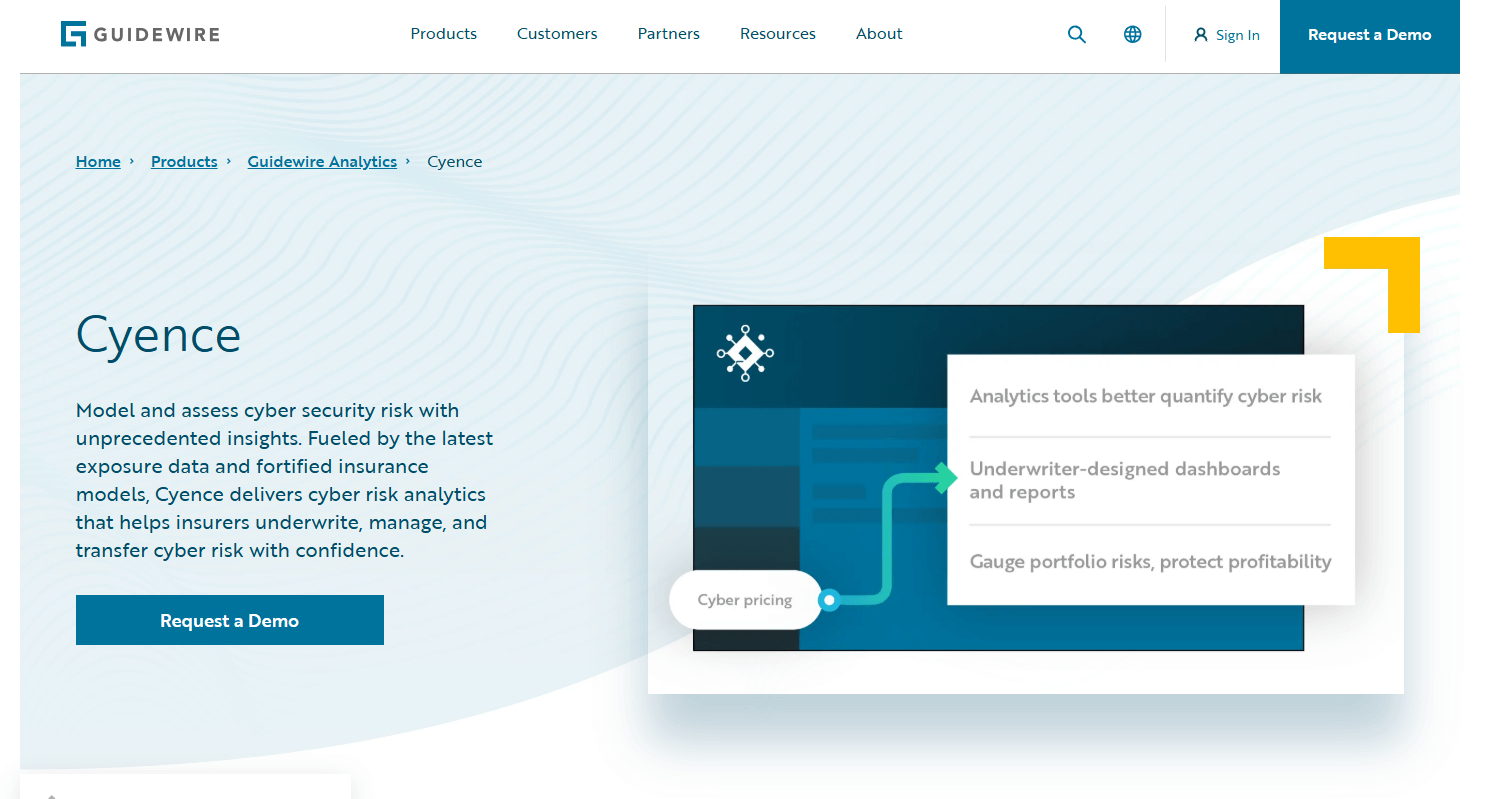
Insurer-grade cyber risk analytics that converts security signals into loss distributions for underwriting, pricing, portfolio management, and accumulation risk. Uses external data collection, machine learning, and econometric modeling to express risk in financial terms, per Guidewire and third-party coverage.
Best for: P&C carriers, reinsurers, MGAs, and brokers that need underwriting support, portfolio aggregation views, and cyber catastrophe scenarios.
Key Features:
- Data listening at web scale with machine learning applied to emerging risks like cyber, reputation, and business interruption, per Forbes coverage of the acquisition.
- Portfolio accumulation and tail risk modeling used by brokers and reinsurers, referenced in a joint paper with Guy Carpenter.
- Loss quantification for individual companies and portfolios to inform selection and pricing, as described in industry articles.
Why we like it:
Built for insurance workflows, it gives consistent views from single risk to portfolio, which reduces model drift between underwriting and ERM.
Notable Limitations:
- Primarily targeted at P&C insurance use cases rather than enterprise IT programs, per industry write-ups.
- Effective use often requires actuarial and accumulation modeling skills, highlighted by reinsurance research discussing cyber catastrophe uncertainty.
- Pricing and configuration details are not public.
Pricing: Pricing not publicly available. Contact Guidewire for a custom quote.
Kovrr
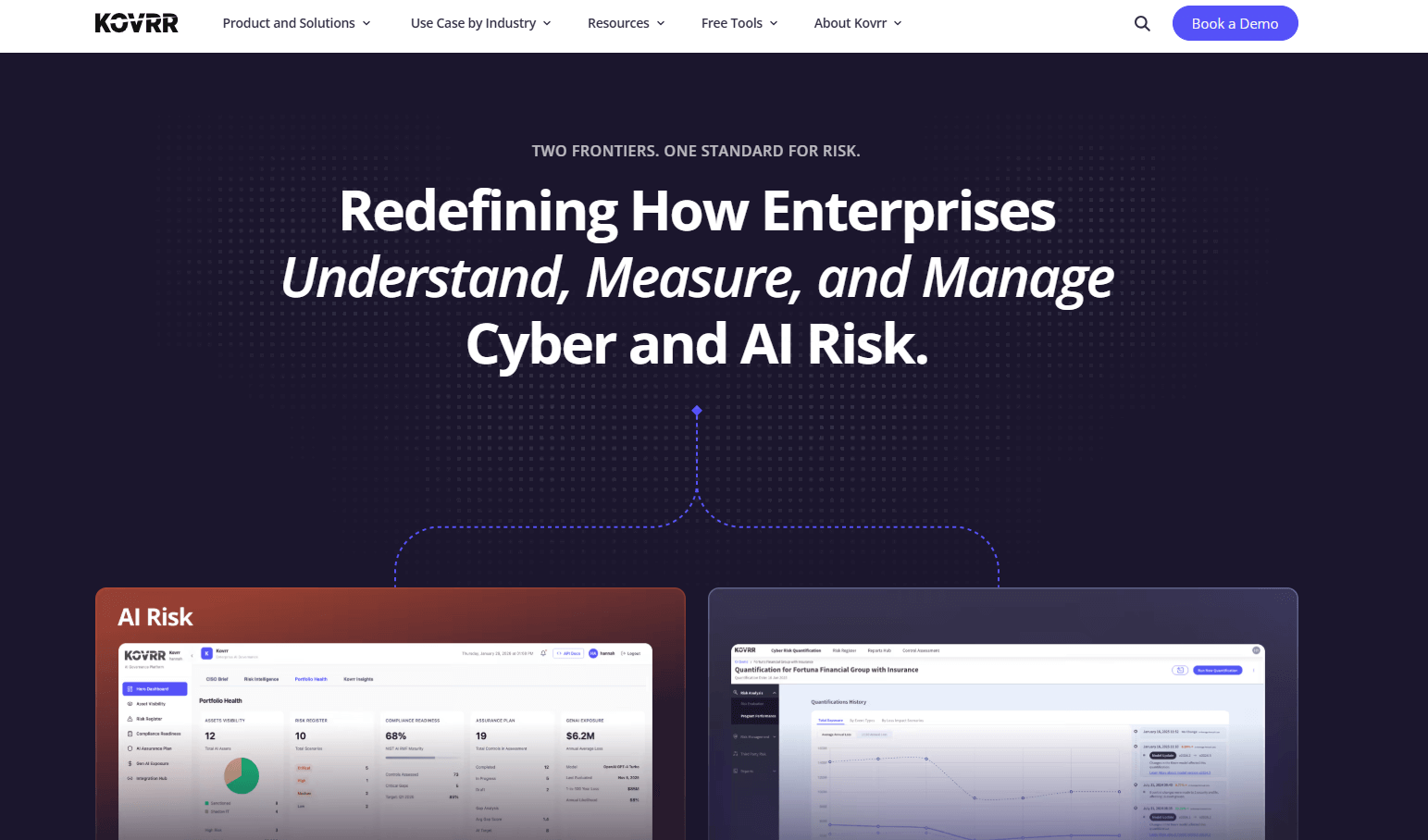
Data-driven cyber risk quantification for enterprises and (re)insurers with support for third-party risk, ROI analysis, and defensible financial metrics. Reviews consistently cite fast time to value and strong onboarding.
Best for: Enterprises and (re)insurers that need defensible CRQ for budgeting, compliance, and vendor risk, plus aggregation views for reinsurance conversations.
Key Features:
- Financial CRQ with loss distributions and exceedance curves for scenarios like ransomware, data theft, and service provider outages, per analyst and news coverage.
- Third-party risk contribution analysis and portfolio views referenced in industry materials.
- Reviewers highlight rapid onboarding, strong integration and support on Gartner Peer Insights.
Why we like it:
Clear AAL and extreme loss outputs make budget tradeoffs and control ROI conversations straightforward.
Notable Limitations:
- Public reviews note CRQ results still depend on internal data quality and stakeholder inputs, a common theme in analyst feedback.
- Smaller public ecosystem of off-the-shelf connectors compared with large GRC suites, per market commentary.
- Pricing not listed publicly.
Pricing: Pricing not publicly available. Contact Kovrr for a custom quote.
Axio
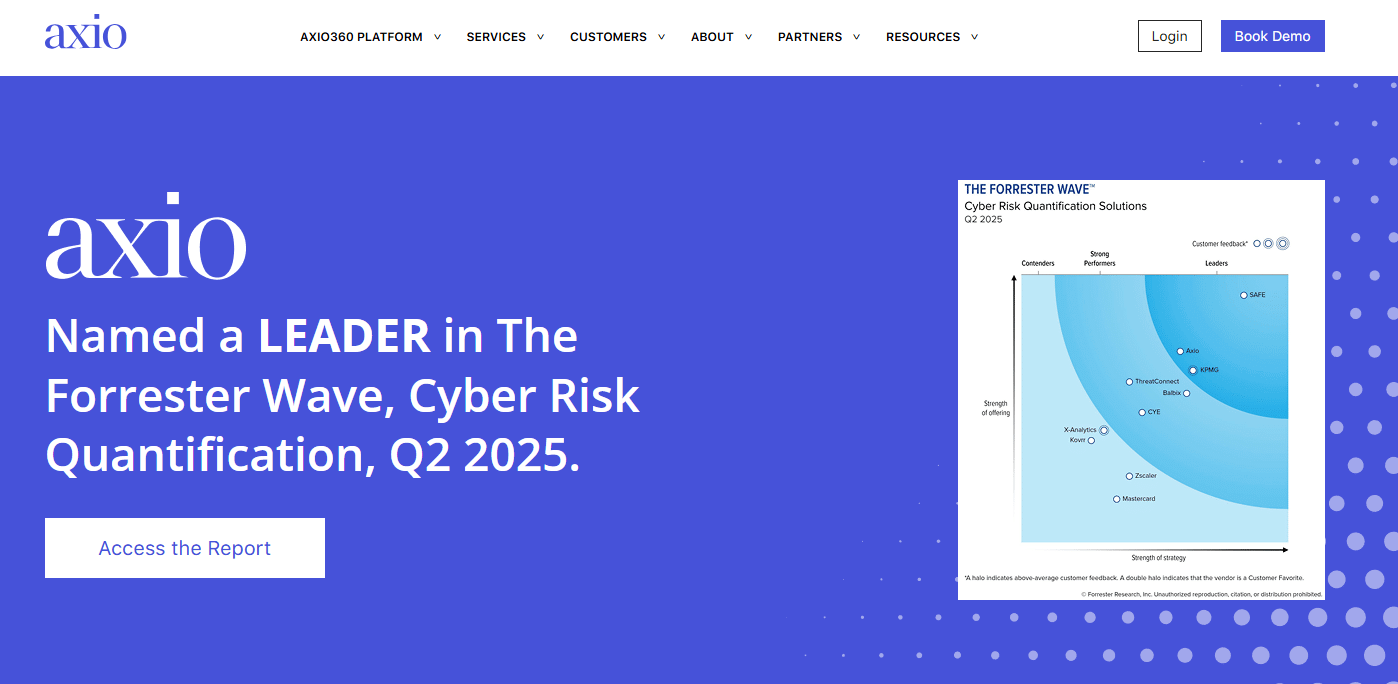
Scenario-based CRQ and cyber program management that maps controls to frameworks like NIST CSF and produces board-ready reports. Recognized by analysts for strong governance and insurance planning support.
Best for: CISOs and risk leaders who need to tie control maturity to quantified loss, prioritize initiatives, and brief boards with defensible scenarios.
Key Features:
- Scenario-driven CRQ with transparent, customizable assumptions and board reporting, highlighted by analyst recognition.
- Framework mapping and program tracking across NIST CSF, ISO 27001, and sector standards, frequently cited by users.
- Strong service and support ratings on Gartner Peer Insights.
Why we like it:
It balances quant with program governance, so security strategy, spend, and risk transfer are discussed in one place.
Notable Limitations:
- We did not find consistent, credible public reviews detailing recurring drawbacks. Teams should run a proof of concept focused on data prep and scenario calibration.
- Requires active stakeholder workshops to get the best outputs, which adds time to first quant.
- Pricing not listed publicly.
Pricing: Pricing not publicly available. Contact Axio for a custom quote.
At-Bay
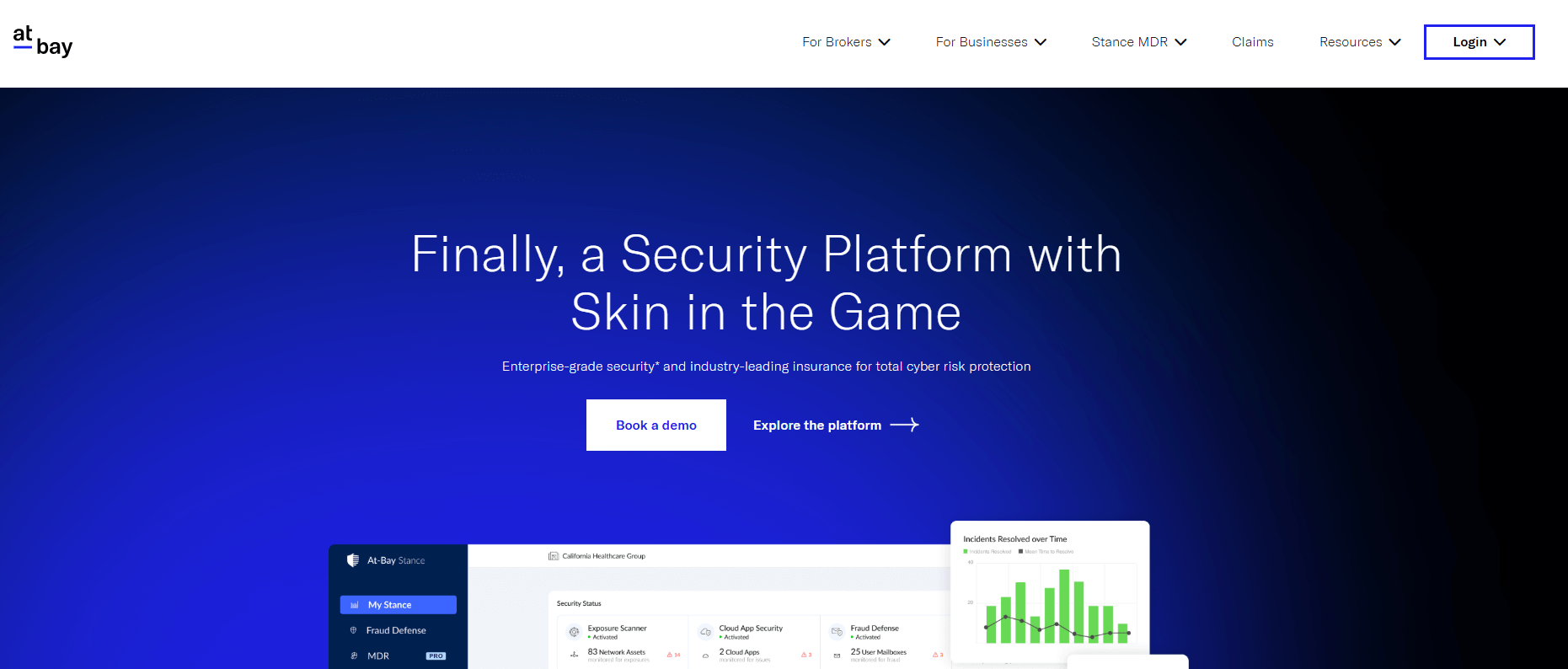
Cyber insurer that pairs active risk monitoring with coverage, scanning insureds and advising on fixes to lower loss frequency. Press and research discuss its technical underwriting and InsurSec model.
Best for: SMB and mid-market buyers that want security guidance tied to policy terms, and brokers who value prebind risk insights.
Key Features:
- Active risk monitoring throughout the policy period with notifications on exposed services and critical vulnerabilities, reported widely in the press.
- Security plus insurance model with incentives and partnerships reported in news coverage.
- Managed detection and response (Stance MDR) offerings targeted at SMB to mid-market, covered by industry news.
Why we like it:
The closed loop of real-world exposure scans, remediation advice, and policy incentives can materially cut claim frequency.
Notable Limitations:
- Strategic shifts, such as refocusing lines of business, have been reported by industry media, which buyers should track.
- Not a standalone CRQ platform for enterprise budgeting needs, so pair it with CRQ if you need defensible board models.
- Premiums and endorsements vary by risk profile, and details are not public.
Pricing: Pricing not publicly available. Contact a broker or At-Bay for a custom quote.
Security Economics Tools Comparison: Quick Overview
| Tool | Best For | Pricing Model | Highlights |
|---|---|---|---|
| Cyence (Guidewire) | Insurers, reinsurers, MGAs | Custom enterprise license | Underwriting, pricing, and portfolio accumulation modeling referenced in industry coverage |
| Kovrr | Enterprises and (re)insurers | Custom subscription | Financial CRQ, vendor risk quant, reviewer-noted fast onboarding |
| Axio | CISOs and risk leaders | Custom subscription | Scenario CRQ, NIST CSF mapping, strong governance focus per analyst recognition |
| At-Bay | SMB to mid-market insureds and brokers | Insurance premiums | Active risk monitoring tied to coverage, widely covered by press |
Security Economics Platform Comparison: Key Features at a Glance
| Tool | Feature 1 | Feature 2 | Feature 3 |
|---|---|---|---|
| Cyence (Guidewire) | Data listening and ML on cyber signals | Company and portfolio loss modeling | Accumulation and tail risk scenarios |
| Kovrr | Loss exceedance curves for enterprise CRQ | Third-party risk contribution analysis | ROI views for control investments |
| Axio | Scenario-based CRQ with board reporting | Framework mapping and benchmarks | Program roadmapping and tracking |
| At-Bay | Continuous external attack surface scans | Security guidance tied to policy incentives | MDR options for SMB and mid-market |
Security Economics Deployment Options
| Tool | Cloud API | On-Premise | Integration Complexity |
|---|---|---|---|
| Cyence (Guidewire) | Yes | Limited, insurer-centric | Medium to High in carrier environments |
| Kovrr | Yes | Limited | Medium, depends on data sources |
| Axio | Yes | Limited | Low to Medium, workshop-driven |
| At-Bay | N/A, insurer platform | N/A | Low for insureds and brokers |
Security Economics Strategic Decision Framework
| Critical Question | Why It Matters | What to Evaluate | Red Flags |
|---|---|---|---|
| Do we need insurer-grade portfolio modeling or enterprise CRQ? | Avoid buying the wrong class of tool | Portfolio accumulation scenarios vs scenario CRQ depth | No clear evidence of validated loss models |
| Can the platform produce defensible board metrics in 30 days? | Budget cycles are short, credibility is key | Reviewer-reported time to value, analyst recognition | Black box outputs without transparent assumptions |
| How are third parties and concentration risks quantified? | Supply chain drives large losses | TPRM quant features, exceedance curves, service provider scenarios | Only point-in-time security scores, no loss math |
| Will outputs align with insurance strategy? | Insurance is a major lever on total cost of risk | Tail risk views, coverage alignment, insurer usage | No ability to discuss cat scenarios or exclusions with brokers |
Security Economics Solutions Comparison: Program Fit Overview
| Organization Size | Recommended Setup | Contract Approach | Notes |
|---|---|---|---|
| SMB to Lower Mid-Market | At-Bay for coverage plus monitoring, add CRQ lite if required | Annual | Monitoring plus incentives can reduce claims, keep CRQ lightweight |
| Upper Mid-Market | Axio or Kovrr for CRQ, pair with At-Bay or carrier of choice | Annual to Multi-year | Prioritize board reporting and third-party loss views |
| Carrier or Reinsurer | Cyence for underwriting and accumulation, optionally benchmark with broker research | Multi-year | Align model governance with actuarial and ERM processes |
Problems & Solutions
-
Problem: "Our carrier asked for portfolio accumulation exposure at 1 in 100 and 1 in 200, and we only have point-in-time scores."
Solution: Cyence is designed for accumulation and tail scenarios used by insurance stakeholders. A joint paper from Guy Carpenter and Guidewire Cyence outlines construction of a US Cyber Industry Exposure Database and loss curve, including a 1 in 100 loss ratio view, which is exactly the language carriers expect (Guy Carpenter and Cyence paper). Industry coverage also explains Cyence's data listening and ML approach that underpins these models (Forbes on Guidewire and Cyence). -
Problem: "The board wants a defensible number for ransomware loss and a prioritized spend plan before the next budget call."
Solution: Axio's scenario-based CRQ with board-ready reporting is cited by analysts, and it was named a Leader in The Forrester Wave for CRQ in Q2 2025, which emphasizes impact-focused modeling and governance features that speed time to value (Business Wire summary of Forrester Wave recognition). Gartner Peer Insights reviews also highlight strong product capabilities and support, helpful when you need to move quickly (Axio on Gartner Peer Insights). -
Problem: "Regulators and finance asked us to quantify third-party risk contribution, not just list vendors."
Solution: Kovrr reviewers cite fast onboarding and actionable CRQ outputs, and the platform is often used to quantify third-party risk contributions and run what-if control improvements that roll into loss distributions, which helps with regulatory discussions (Kovrr on Gartner Peer Insights). Industry news has covered Kovrr's work with (re)insurers to analyze portfolios and event catalogs, signaling credible modeling roots for supply chain scenarios (Business Wire on Kovrr platform updates for (re)insurers). -
Problem: "Ransomware frequency is rising, the CFO wants premiums under control this year."
Solution: At-Bay's model pairs continuous attack surface monitoring with coverage and incentives. Press coverage explains how it differentiates by monitoring insureds' perimeters and alerting on exposures to reduce claims, which can translate into better economics over time (TechCrunch on At-Bay's approach). The company has also publicly expanded mid-market appetite and capacity, important if you need higher limits this renewal season (Business Wire on At-Bay coverage expansion).
Conclusion: How To Pick With Confidence
Security economics is about turning technical risk into financial decisions. If you are an insurer or broker, Cyence's portfolio and accumulation focus maps to the way your capital providers think about tail events, which is reinforced by reinsurance research and industry reporting. If you are a CISO, Axio and Kovrr deliver defensible CRQ and board reporting, backed by analyst and peer reviews that speak to time to value and support. If you want monitoring tied to policy economics, At-Bay's active model has been widely profiled and can reduce frequency, which matters as breach costs remain high. Finally, watch the market cycle. Analysts noted a recent dip in US cyber premiums - admitted direct written premiums fell 2.3% in 2024 to $7.1 billion, the first contraction since dedicated NAIC cyber reporting began - which can affect capacity and pricing strategy, especially for SMBs (Insurance Business coverage of 2024 US premiums). Pick the tool class that matches your decision, then run a proof of concept that reproduces one board scenario, one control ROI case, and, if relevant, one accumulation view.