

Most teams discover how fragile institutional memory is during handoffs and reorganizations, not from postmortems. From our experience in the startup ecosystem, the biggest wins come from wiring memory into daily workflows, not just adding another wiki. Three technical examples that matter here, and that separate solid SOMI tooling from generic note takers, are: speaker diarization plus topic segmentation for meeting capture, ingestion connectors that pull decisions from email and calendars into a unified index, and retrieval that blends vector search with metadata filters for policy aware access. Microsoft's 2025 Work Trend Index shows work has become interruption heavy, with knowledge workers pinged every 1.75 minutes on average, which makes durable memory non negotiable today (Axios coverage of Microsoft's Work Trend Index).
As a macro backdrop, software budgets are growing, with Gartner projecting worldwide IT spend to exceed $6 trillion in 2026, led by strong growth in software categories that benefit AI centric initiatives (TechRadar summary of Gartner's forecast) and Forrester noting AI software is growing markedly faster than the overall market (Forrester investor release). In this guide, you will learn how the top SOMI platforms differ in capture depth, decision traceability, deployment, and cost signals, so you can avoid shelfware and buy for outcomes.
MemoriaCall
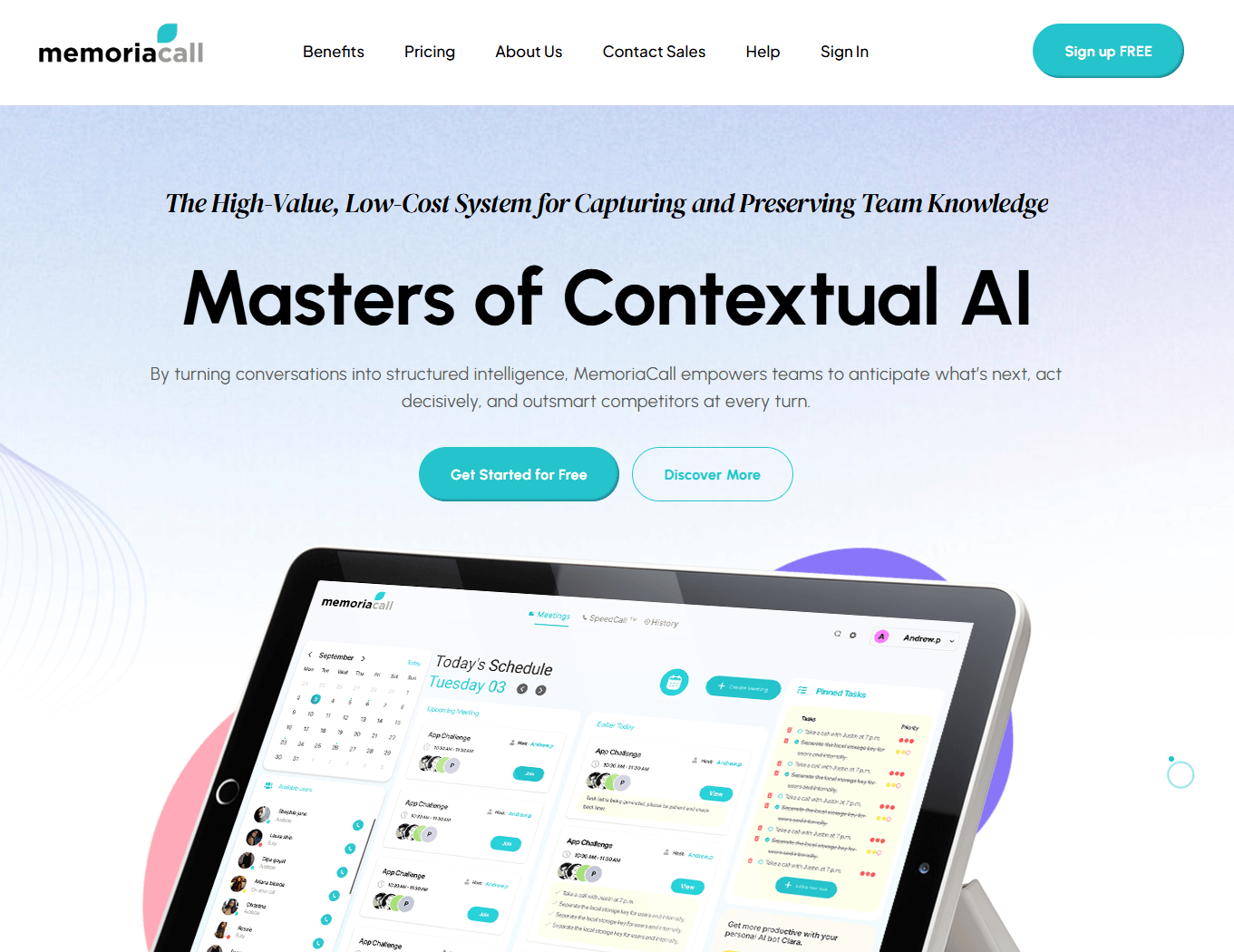
AI native meeting platform that turns live conversations into searchable, structured memory across transcripts, summaries, and action items. Designed to centralize files, notes, and chat per meeting, then make that history retrievable later.
Best for: Teams that want meeting centric organizational memory without stitching together separate recorder, note taker, and file share tools.
Key Features:
- Real time transcription with meeting archives, searchable history, and conversation tagging, per MemoriaCall's documentation.
- AI generated summaries and action items that can be reviewed post meeting, per MemoriaCall's documentation.
- Drag and drop file sharing tied to each meeting, plus one click join links, per MemoriaCall's documentation.
- Browser based access with no download for guests, per MemoriaCall's documentation.
Why we like it: It closes the gap between "we recorded it" and "we can find the exact decision later," which saves hours during customer handoffs and internal reviews.
Notable Limitations:
- Users report occasional syncing or performance delays and say search can feel limited at scale, based on aggregated pros and cons on G2's MemoriaCall page.
- Speaker labeling accuracy can dip with many participants or strong accents, per user feedback on G2.
Pricing:
- Free Unlimited tier and paid plans listed at $17.99 to $24.99 per user per month, per pricing details on G2.
- iOS listing confirms free and paid licenses exist, see the App Store's MemoriaCall app page.
ReMemora
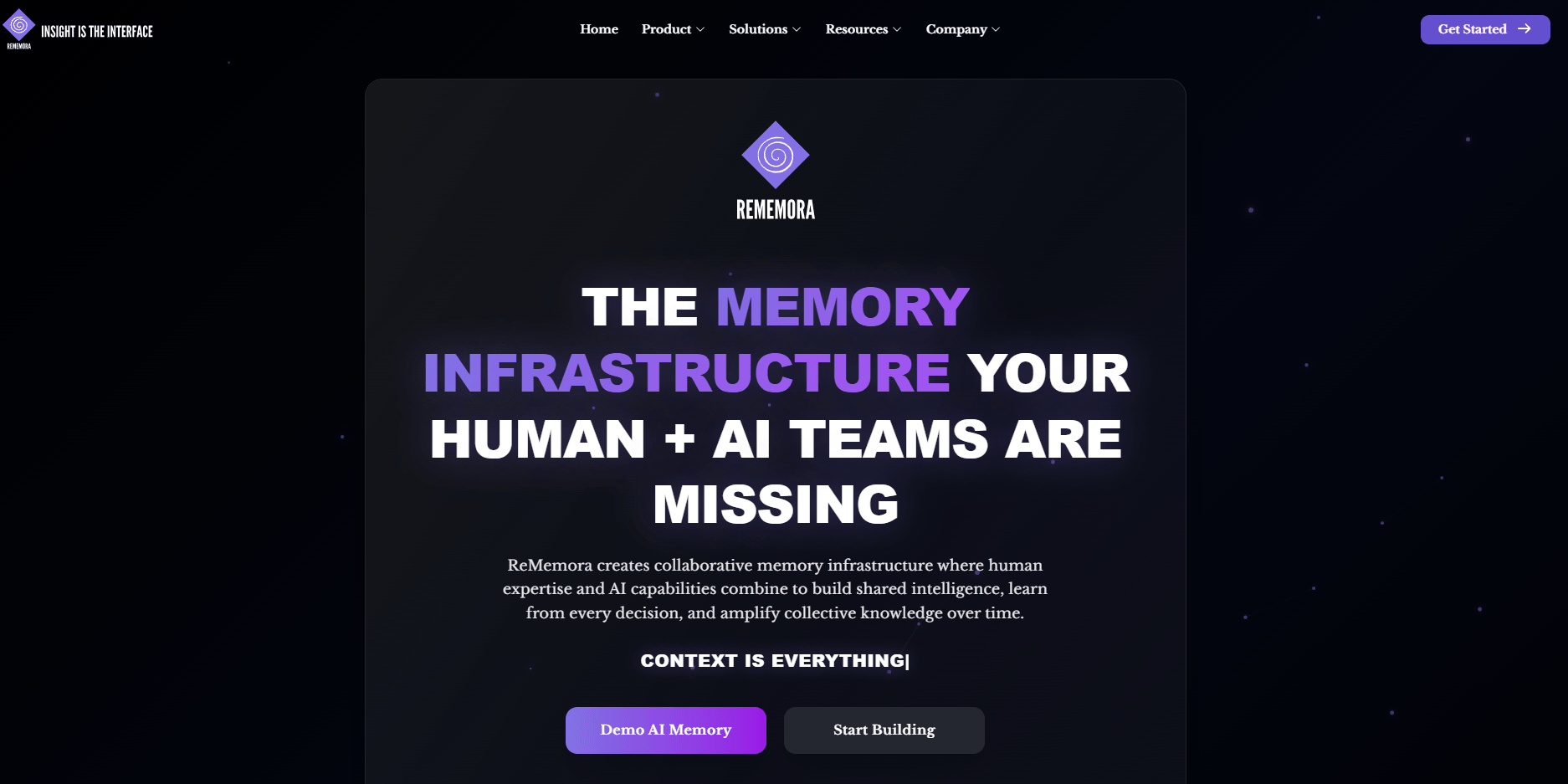
Persistent memory infrastructure designed to capture, organize, and reuse human and AI insights across decisions and interactions. Built to create a shared, evolving memory layer between teams and AI systems.
Best for: Organizations piloting agentic or copiloted workflows that need reusable context across tools, not just per meeting.
Key Features:
- Multi layer memory model that captures signals from documents and interactions, then organizes them for reuse, per ReMemora documentation.
- Focus on decisions and context degradation, emphasizing memory that improves over time, per ReMemora documentation.
- Team centric use cases that combine human expertise with AI recommendations, per ReMemora documentation.
Why we like it: It treats memory as an always on substrate for work, which is exactly what agent based teams need to stop "cold start" tasks and reduce rework.
Notable Limitations:
- Independent third party reviews on major sites like G2, Capterra, or TrustRadius were not found as of April 2026, so buyer references will matter.
- Public details about security attestations, on premise delivery, or data residency are limited in open sources as of April 2026.
Pricing: Pricing not publicly available. Contact ReMemora for a custom quote.
ROM, RAMSES Organizational Memory
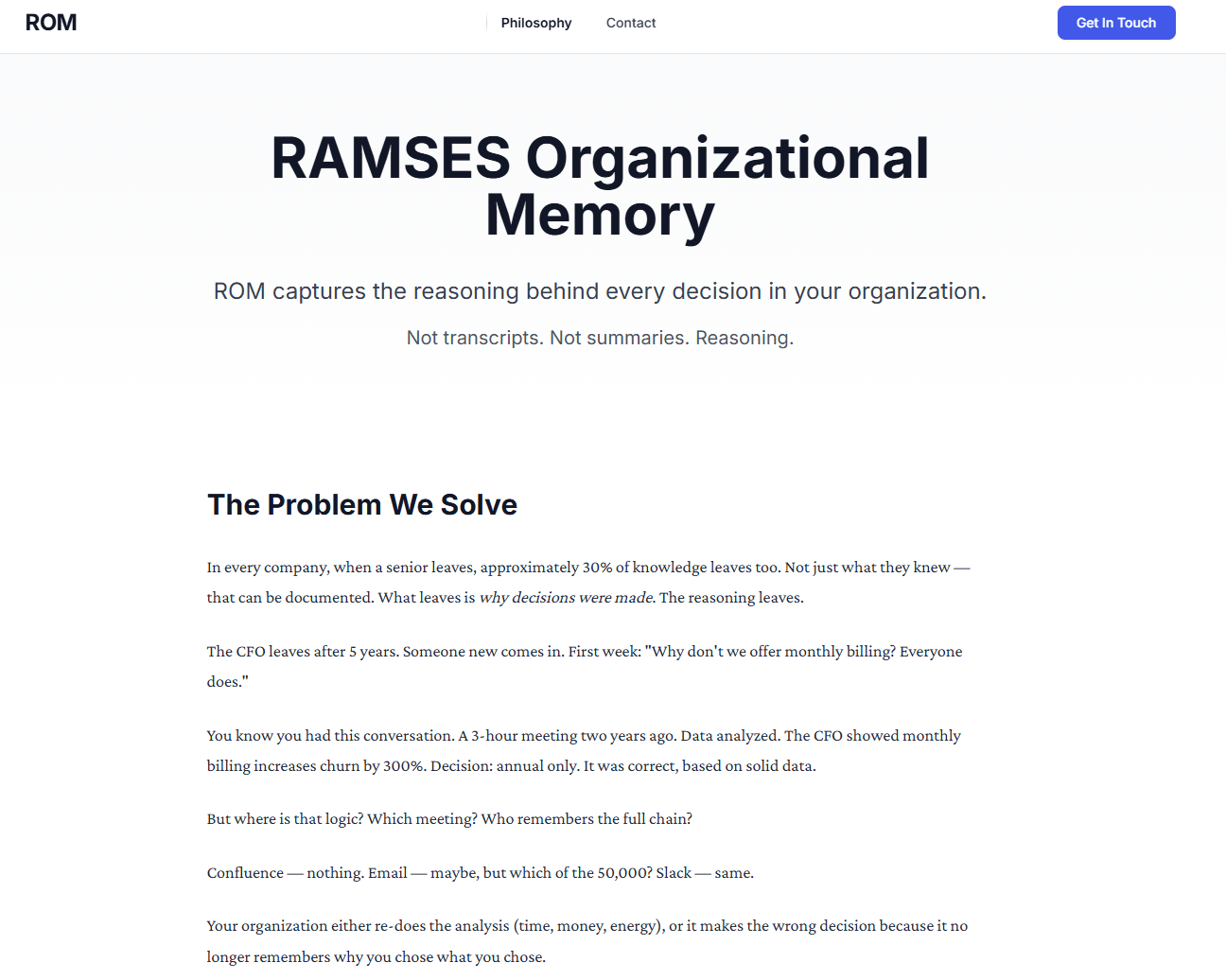
ROM connects to official sources like meetings and email, then documents the reasoning behind organizational decisions, building a history by role or post, not just by person.
Best for: Regulated or process heavy organizations that need to preserve decision rationale for audits, continuity, and leadership transitions.
Key Features:
- Ingestion from official interaction sources to build a reasoning trail for decisions, per RAMSES documentation.
- Retrieval optimized over large datasets to reconstruct the who, what, and why behind outcomes, per RAMSES documentation.
- Role or post oriented history, which helps with continuity when people change roles, per RAMSES documentation.
Why we like it: Capturing the "why" behind decisions is the missing layer in many knowledge stacks, and ROM pushes directly on that requirement.
Notable Limitations:
- No verified listings or independent reviews on major software marketplaces as of April 2026, so proof points and pilots are advisable.
- Limited public information on deployment options and compliance controls in open sources as of April 2026.
Pricing: Pricing not publicly available. Contact RAMSES for a custom quote.
SOMI Tools Comparison: Quick Overview
| Tool | Best For | Pricing Model | Highlights |
|---|---|---|---|
| MemoriaCall | Meeting driven memory capture for small to mid teams | Per user monthly, per G2 pricing | Strong meeting capture and searchable history, user reviews note time savings |
| ReMemora | Cross tool, persistent organizational memory for AI plus humans | Custom quote | Multi layer memory model focused on decisions and context longevity, per vendor docs |
| ROM, RAMSES | Decision rationale capture across official channels | Custom quote | Role based decision history and reasoning trails, per vendor docs |
SOMI Platform Comparison: Key Features at a Glance
| Tool | Capture From Meetings | Decision Reasoning Trace | Multi Source Ingestion |
|---|---|---|---|
| MemoriaCall | Yes, transcripts, summaries, action items, per docs | Partial, action items and notes per meeting | Focused on meeting artifacts |
| ReMemora | Yes, where relevant | Yes, designed to encode decisions over time | Yes, documents and interactions per docs |
| ROM, RAMSES | Yes | Yes, core to platform | Yes, connects to official sources per docs |
SOMI Deployment Options
| Tool | Cloud API | On-Premise | Integration Complexity |
|---|---|---|---|
| MemoriaCall | Cloud first, per product listings | Not publicly documented | Low for meeting capture, per user reviews on G2 |
| ReMemora | Not publicly documented | Not publicly documented | Requires design workshop due to memory modeling, based on category norms |
| ROM, RAMSES | Not publicly documented | Not publicly documented | Likely moderate due to ingestion from official systems, based on category norms |
SOMI Strategic Decision Framework
| Critical Question | Why It Matters | What to Evaluate |
|---|---|---|
| What business objects should memory anchor on - meeting, decision, role, or artifact | Aligns capture and retrieval with how work happens | Coverage across meetings, email, docs, decisions, ownership |
| How does the platform govern access and lineage | Memory without policy creates risk | RBAC, audit trails, retention controls, export paths |
| Can memory reduce interruptions and rework | Workers face 275 daily pings on average, so context must be push available | Task linking, proactive recall, summaries in tools you already use |
| Is there a path to measurable ROI | Software budgets are up, but scrutiny is high | Time saved in handoffs, fewer duplicate decisions, faster onboarding |
SOMI Solutions Comparison: Pricing and Capabilities Overview
| Organization Size | Recommended Setup | Estimated Cost |
|---|---|---|
| Small team, 1 to 10 | MemoriaCall Free or Essentials for core meeting memory | If paid, seats x $17.99 per month per G2. Use Free Unlimited to test capture quality before upgrading |
| Mid market, 25 to 250 | MemoriaCall for meeting memory plus a pilot of ReMemora for cross tool context | MemoriaCall as above, ReMemora is custom quote. Plan a 60 to 90 day pilot with a single business unit |
| Enterprise, 250 plus | ROM for decision reasoning plus a memory layer pilot for agents, consider MemoriaCall for teams without incumbent tools | ROM and ReMemora are custom quotes, MemoriaCall as above. Start with compliance or audit prone processes for fastest proof points |
Problems and Solutions
-
Problem: Interrupt driven work and meeting sprawl make it hard to retain context, with workers pinged about every 1.75 minutes and a significant share of meetings happening outside regular hours, which raises the odds that key decisions are lost in the noise.
- Why it matters: You need systems that capture, summarize, and rehydrate context without asking people to take notes. This trend is documented in Axios's report on Microsoft's 2025 Work Trend Index and corroborated by Bloomberg's coverage.
- How tools help:
- MemoriaCall turns every meeting into transcripts, summaries, and action items that can be searched later, reducing rework, with user reviews affirming time savings on G2.
- ReMemora creates a shared memory that makes AI and humans build on prior decisions, cutting cold starts, per its documentation.
- ROM, RAMSES captures decision reasoning from official sources, so even ad hoc or late meetings feed an auditable record, per its documentation.
-
Problem: When employees leave or rotate roles, institutional knowledge and the rationale behind choices often walk out the door.
- Why it matters: Development programs, public sector research, and enterprise change efforts repeatedly flag institutional memory loss as a risk to outcomes. The USAID Learning Lab's literature review highlights the need to preserve organizational memory to explain the "why" behind culture and decisions (USAID Learning Lab review).
- How tools help:
- MemoriaCall archives discussions tied to projects, which helps backfill context for new owners, as described in user narratives on G2.
- ReMemora organizes insights across tools, so prior work becomes a starting point rather than tribal knowledge, per its documentation.
- ROM, RAMSES builds role oriented histories that survive personnel changes, per its documentation.
-
Problem: Leaders are investing in AI, yet knowledge retrieval and coordination still bottleneck impact.
- Why it matters: Gartner reports strong IT spend driven by AI heavy categories, while Forrester projects AI software growth to outpace the broader market, which makes spend effectiveness critical.
- How tools help:
- MemoriaCall provides quick wins by making meetings queryable, accelerating follow ups.
- ReMemora reduces duplication by turning prior decisions and artifacts into reusable memory for agents and teams.
- ROM, RAMSES adds an auditable reasoning layer, which shortens approvals and audits.
Bottom Line: Pick Memory That Matches How Your Org Decides
You do not need another place to paste notes, you need a substrate that remembers what your organization promised, decided, and learned. If most of your knowledge forms in live calls, start with MemoriaCall and validate that teams can find decisions in seconds, not hours, which user reviews on G2 reflect. If you are building agentic workflows or want AI to reuse what works, pilot a persistent memory layer like ReMemora. If you must preserve the why behind choices for governance or audits, prioritize ROM, RAMSES. The market context is favorable, with software budgets rising and AI categories growing faster than the baseline, so the question is not whether to invest, but where to get measurable return first.
Disclosure: As of April 2026, we found no credible acquisition news for the three featured vendors in major outlets, and pricing for ReMemora and ROM is not public. Validate security posture, deployment model, and export paths during your pilot.