Most teams discover license and vulnerability landmines during a customer audit or due diligence, not from their CI pipeline. Working across different tech companies, I have seen SCA tools save entire release cycles by stopping a GPL-only transitive dependency from entering a microservice, catching a container base image with a critical OpenSSL CVE, or flagging a missing CycloneDX SBOM before a supplier handoff.
Breach economics reinforce why this matters. IBM reported the global average cost of a breach at 4.88 million dollars in 2024, declining to 4.44 million dollars in 2025 as organizations improved detection and response. Heading into 2026, costs in the United States remain the highest globally at just over 10 million dollars per incident, reflecting regulatory penalties, litigation, and supply chain disruption. The trend is clear: fewer breaches are going undetected, but when failures happen, especially in software supply chains, they are still extremely expensive.
You will learn which tools excel at developer workflow integration, which reduce false positives or support binary analysis for closed source components, and how pricing and deployment models compare. Regulatory pressure is also increasing. The EU Cyber Resilience Act will require SBOMs for products with digital elements starting December 11, 2027, and SBOMs are already expected in U.S. federal procurement under NIST guidance tied to Executive Order 14028. By 2026, SBOM readiness is no longer optional for teams shipping commercial software.
Snyk
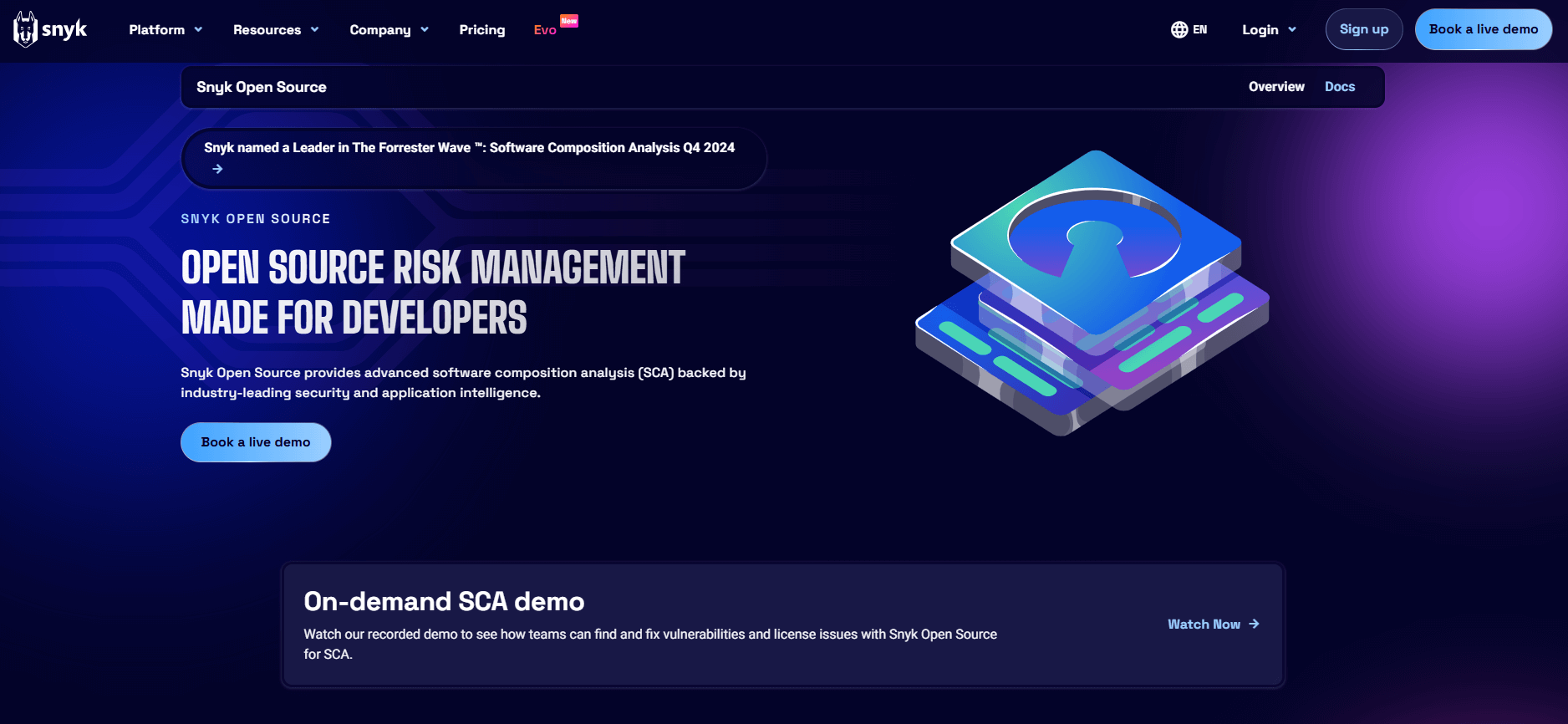
Developer‑first platform for SCA that plugs into repos, IDEs, and CI to find and fix open source risks early. Strong ecosystem coverage and automation help teams ship with fewer surprises.
Strictly no links here. Information verified via reputable third‑party sources and vendor documentation.
- Best for: Engineering teams that want SCA embedded in developer workflows with quick fix PRs and broad language support.
- Key Features:
- IDE, SCM, and CI integrations for dev‑centric SCA and automated fix PRs.
- License compliance policies and reporting.
- SBOM generation in SPDX or CycloneDX formats for code and containers.
- Why we like it: From my experience in the startup ecosystem, Snyk removes friction where it matters, in the PR and IDE, and it scales reasonably well from solo devs to platform teams.
- Notable Limitations: Reviews cite noise and false positives and occasional UI complexity or slower scans on large repos, plus reporting gaps. See aggregated feedback on G2 and PeerSpot.
- Pricing: Free plan available and Team tier starting at $98 per developer per month billed annually, Enterprise by quote, per the G2 pricing page for Snyk. Also available via AWS Marketplace listings, where terms are contract based.
Mend
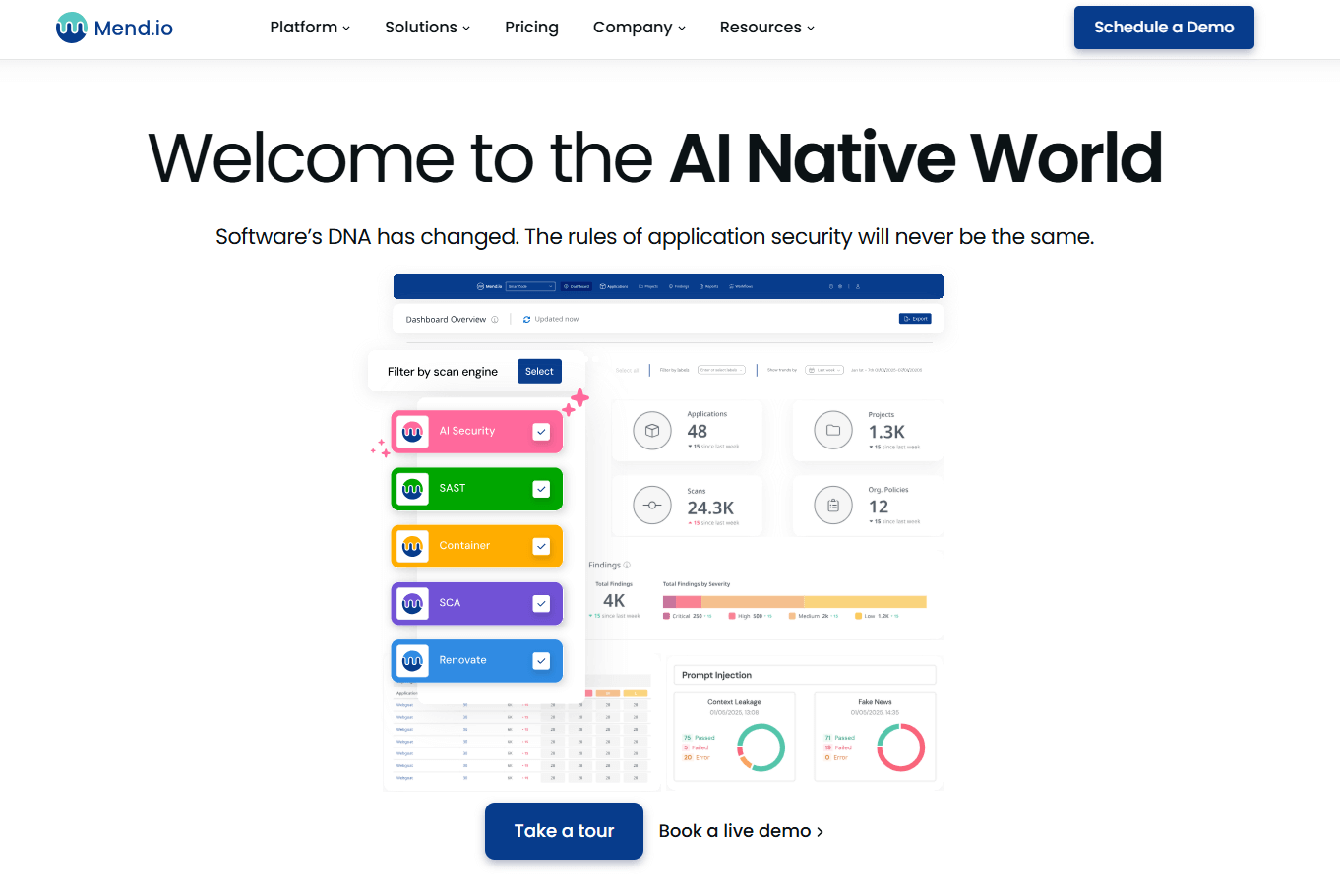
AI‑native SCA focused on automated remediation, license governance, SBOMs, and blocking malicious packages across the SDLC. Formerly known as WhiteSource.
Strictly no links here. Information verified via reputable third‑party sources and vendor documentation.
- Best for: Enterprises that want strong remediation automation across SCA, license compliance, and supply chain protections.
- Key Features:
- Automated remediation for open source issues and policy‑driven governance.
- Reachability analysis to prioritize exploitable findings.
- Malicious package detection and blocking integrated into registries and CI.
- Why we like it: After helping startups scale, I value Mend's emphasis on fix automation and policy gates that reduce mean time to remediate while keeping legal happy.
- Notable Limitations: Users report UI modernization needs, some false positives, and setup or integration learning curve in mid‑market deployments, based on G2 reviews of Mend.io.
- Pricing: Public contract SKUs are visible on AWS Marketplace, for example $20,000 per year for 20 contributing developers, with additional packages and private offers available.
Black Duck Software
Independent SCA platform recognized for deep policy controls, license risk management, and strong binary analysis, now operating as Black Duck Software after the 2024 carve‑out.
Strictly no links here. Information verified via reputable third‑party sources and vendor documentation.
- Best for: Regulated industries and suppliers that need audit‑grade SBOMs, license compliance, and binary analysis when source is not available.
- Key Features:
- Multiple discovery modes including dependency, codeprint, snippet, and binary analysis.
- Robust license governance and notices generation.
- SBOM export and workflows tuned for audits and supplier exchanges.
- Why we like it: Working across different tech companies, Black Duck's binary and snippet analysis consistently helps when scanning firmware, third‑party deliverables, or mixed stacks where source access is limited.
- Notable Limitations: Reviews note resource‑heavy on‑prem deployments, slower scans for some setups, and higher cost perceptions. See G2's Black Duck page and Capterra feedback.
- Pricing: Pricing not publicly available. Contact Black Duck or partners for a custom quote. Disclosure, Synopsys sold its Software Integrity Group to PE firms in 2024 and the business reemerged as Black Duck Software, per Reuters coverage and the PE firms' completion announcement.
FOSSA
Commercial SCA and SBOM platform centered on license compliance, vulnerability management, and governance, with simple packaging for smaller teams.
Strictly no links here. Information verified via reputable third‑party sources and vendor documentation.
- Best for: Teams that prioritize clean licensing, SBOM management, and straightforward rollout with CI integrations.
- Key Features:
- Automated license compliance with policy enforcement and attribution support.
- SBOM creation and import with reporting and quality checks.
- Optional binary and snippet scanning add‑ons for deeper coverage.
- Why we like it: From my experience in the startup ecosystem, FOSSA's focus on compliance plus SBOMs saves real legal review cycles and gives smaller orgs an easy onramp to SCA.
- Notable Limitations: Some reviews flag slow UI at times, unclear license remediation guidance for edge cases, and coverage gaps for unmanaged dependencies, per G2's FOSSA reviews.
- Pricing: Median contract value around $21,896 per year according to the Vendr marketplace listing for FOSSA. Public plan details are advertised by the vendor, but verify directly for the latest.
JFrog Xray

Enterprise‑grade SCA and supply chain scanning integrated into the JFrog Platform, covering artifacts, containers, and builds with policy enforcement and research‑backed intelligence.
Strictly no links here. Information verified via reputable third‑party sources and vendor documentation.
- Best for: Organizations already on JFrog Artifactory that want native SCA, SBOMs, and policy gates across repositories and pipelines.
- Key Features:
- Deep, recursive scanning of artifacts and container layers with policy‑based blocking.
- SBOM generation and license compliance reporting.
- Contextual analysis and threat research to reduce noise and prioritize fixes.
- Why we like it: After helping startups scale, I have seen Xray dramatically simplify rollout when Artifactory is already the artifact backbone and DevOps teams want one control point.
- Notable Limitations: Reviews mention complexity to set up in hybrid environments, a learning curve, and cost concerns for smaller teams, per consolidated G2 feedback on the JFrog Platform.
- Pricing: JFrog Pro starts at $150 per month per the G2 pricing summary. Enterprise tiers and advanced security packages are also listed via AWS Marketplace offers.
Software Composition Analysis (SCA) Tools Comparison: Quick Overview
| Tool | Best For | Pricing Model | Free Option |
|---|---|---|---|
| Snyk | Dev teams wanting dev‑first SCA | Per developer for Team and Enterprise | Yes |
| Mend | Enterprises needing remediation and policy governance | Per contributing developer, contracts | Not advertised as free |
| Black Duck Software | Regulated and supplier risk scenarios | Custom quote | No |
| FOSSA | License compliance and SBOM centric programs | Per project or annual contracts | Vendor advertises free tier |
| JFrog Xray | Teams on JFrog Artifactory | Platform subscriptions, marketplace SKUs | Trial options |
Software Composition Analysis (SCA) Platform Comparison: Key Features
| Tool | Policy Gates | SBOM Export | Binary Analysis |
|---|---|---|---|
| Snyk | Yes | SPDX, CycloneDX | Limited, focused on manifests and images |
| Mend | Yes | SPDX, CycloneDX | Focus on source and dependency, not primary for binaries |
| Black Duck Software | Yes | SPDX, CycloneDX and notices | Yes, strong capability |
| FOSSA | Yes | SPDX, CycloneDX | Available as add‑on |
| JFrog Xray | Yes | SPDX, CycloneDX | Focus on artifacts and image layers |
Software Composition Analysis (SCA) Deployment Options
| Tool | Cloud API | On-Premise | Air-Gapped |
|---|---|---|---|
| Snyk | Yes | No | No |
| Mend | Yes | Yes | Limited, customer‑managed |
| Black Duck Software | Yes | Yes | Yes |
| FOSSA | Yes | Yes | Limited, customer‑managed |
| JFrog Xray | Yes | Yes | Yes |
Note on air‑gapped: JFrog documents Xray deployment patterns for air‑gapped environments, including DMZ and offline database sync, which third‑party outlets also republish, see MarketScreener's summary of JFrog's air‑gap guidance.
Software Composition Analysis (SCA) Strategic Decision Framework
| Critical Question | Why It Matters | What to Evaluate |
|---|---|---|
| Do we need binary analysis? | Suppliers often ship only executables or firmware. | Binary and snippet analysis depth, SBOM import, audit workflows. |
| How noisy are findings? | False positives waste engineering time. | Reachability, contextual analysis, research quality, triage UX. |
| Can we satisfy SBOM mandates? | CRA and federal buyers expect SBOMs. | SPDX, CycloneDX, VEX support, automation in CI/CD. |
| How is license risk handled? | Copyleft and attribution are legal risks. | Policy model, notices generation, legal workflows. |
Software Composition Analysis (SCA) Solutions Comparison: Pricing & Capabilities Overview
| Organization Size | Recommended Setup | Monthly Cost | Annual Investment |
|---|---|---|---|
| Startup, 5–15 devs | Snyk Team or FOSSA business tier, plus SBOM in CI | From low hundreds | From low thousands |
| Mid‑market, 50–200 devs | Mend or Snyk enterprise tier, or Xray if on JFrog | Five figures | Low to mid five figures |
| Enterprise, 500+ devs | Black Duck Software with binary analysis, Mend or Xray platform wide | High five to six figures | Mid to high six figures |
Estimates above are directional. For representative public price points see G2 pricing for Snyk, AWS Marketplace SKUs for Mend, and AWS Marketplace listings for JFrog. For FOSSA, the Vendr marketplace shares typical contract values. Always validate your quote and terms.
Problems & Solutions
-
Problem: We must produce SBOMs for customers and upcoming CRA deadlines, but our tools are manual and inconsistent.
- How Black Duck helps: Known for audit‑grade SBOM workflows and binary analysis for third‑party deliverables, which is useful as CRA mandates SBOMs by December 11, 2027. The CRA was adopted on October 10, 2024 and entered into force on December 10, 2024, with main obligations applying from December 2027, as summarized on Wikipedia's CRA entry and discussed in recent academic analyses of CRA requirements including SBOMs and coordinated disclosure in 2025 research on arXiv. A 2025 press release shows STMicroelectronics automating SBOM generation with Black Duck SCA, highlighting real‑world usage for compliance programs.
- How Snyk and Mend help: Both generate SPDX and CycloneDX SBOMs and integrate SBOM intelligence into pipelines, aligning with NIST's SBOM guidance tied to EO 14028.
- How FOSSA helps: SBOM management and import make supplier SBOMs actionable, which remains a gap for many firms. Industry coverage notes low SBOM readiness ahead of CRA, for example the 2025 IoT and OT report write‑ups indicating lagging adoption, as summarized by 24x7 Magazine.
-
Problem: Too many false positives and CVE noise slow teams down.
- How JFrog Xray helps: Contextual analysis and research enrichment aim to reduce noise and highlight relevant risk, which JFrog publicly described in its Business Wire announcement, aggregated on the company's investor site.
- How Mend helps: Reachability analysis prioritizes exploitable vulnerabilities, a theme reflected in user reviews on G2.
- How Snyk helps: Developer‑first fixes in PRs shorten time to remediation, but reviews still advise tuning policies to manage noise, per G2 reviews.
-
Problem: We ingest closed‑source components, firmware, or vendor blobs with no source access.
- How Black Duck helps: Binary analysis, snippet detection, and codeprint techniques are designed for executables, firmware, and containers, which is repeatedly cited in third‑party summaries and customer feedback on G2 and PeerSpot.
- How FOSSA helps: Binary scanning add‑on extends SCA coverage to compiled artifacts, which is useful for validating supplier SBOMs, as described in product overviews and reinforced by Vendr pricing context.
-
Problem: We operate in air‑gapped or highly restricted networks.
- How JFrog Xray helps: Documented air‑gap patterns with DMZ mirroring and offline update flows exist, and third‑party outlets republish that guidance, for example MarketScreener's coverage.
- How Black Duck helps: Customers report both SaaS and on‑prem models with varying setup effort, including air‑gapped scenarios, per PeerSpot deployment feedback and Capterra reviews.
Bottom Line: Choose What Fits Your Pipelines and Regulators
By 2026, software composition analysis is less about scanning and more about whether risk controls are embedded early enough to prevent downstream failures. Teams that still treat SCA as a late-stage audit step continue to lose time to emergency fixes, customer escalations, and contract delays. Teams that integrate SCA into pull requests, builds, and artifact repositories avoid those surprises entirely.
If you live in Git and want fast fix pull requests with minimal friction, Snyk remains the shortest path for developer-first adoption. If automated remediation, license governance, and policy enforcement are your bottlenecks, Mend is well suited for scaling across larger engineering organizations. If you operate in regulated environments, ship firmware, or consume third-party binaries, Black Duck’s binary and snippet analysis justifies its heavier footprint. If SBOM-centric compliance and clean licensing are the priority, FOSSA offers a pragmatic and accessible approach. If your delivery pipeline already runs on JFrog Artifactory, Xray is the most natural control plane for enforcing supply chain policy.
With breach costs still measured in millions, U.S. exposure remaining the highest globally, and mandatory SBOM timelines approaching, the right SCA tool in 2026 should do one thing above all else: eliminate surprises before release. Choose the platform that aligns with your pipelines, your regulators, and your risk tolerance, not the one with the longest feature list.