Most teams discover their data governance gaps during a model audit right before launch, not from their privacy office. Working across different tech companies, we have seen projects stall because teams lack column-level lineage, cannot tune differential privacy epsilon to meet policy, and have no automated synthetic-to-real drift monitoring. The cost of getting this wrong is real - the global average breach hit 4.44 million dollars in 2025 according to IBM's Cost of a Data Breach Report. Our take - governance is not a checklist, it is an operating model that connects generation, validation, and policy.
A quick market pulse: Gartner has repeatedly signaled that synthetic data will dominate AI training in the coming years, with analysts predicting that by 2030, synthetic structured data will grow at least 3 times as fast as real structured data for AI model training, and that through 2030, synthetic data will constitute more than 95% of data used for training AI models in images and videos (Gartner Hype Cycle for AI 2025). Four suites consistently combine generation, quality validation, and governance. Below you will learn where each shines, the pricing you can actually verify, and how to match tools to real compliance and engineering problems.
MDACA Synthetic Data Engine
Enterprise-oriented synthetic data engine that generates statistically similar datasets from sensitive sources and includes side-by-side utility and privacy comparisons. According to vendor documentation, it supports differential privacy options and visual validation such as histograms and correlation heatmaps.
Best for: Public sector and regulated enterprises that want an AWS-deployable component with built-in validation panels.
Key Features:
- Differential privacy settings and utility-privacy tradeoff controls, per vendor documentation
- Comparative validation, including distribution and correlation checks between real and synthetic, per vendor documentation
- Web console for generation, designed to run as an AMI in your VPC, per vendor documentation
Why we like it: The validation step is not an afterthought. Having side-by-side checks helps teams catch mode collapse or leakage before a compliance review.
Notable Limitations:
- Limited third-party reviews - AWS Marketplace currently lists no customer ratings, which makes external validation harder (AWS Marketplace listing)
- Documentation about DP settings is vendor-supplied - independent benchmarks are scarce
- Feature roadmap and ecosystem references are lighter than larger vendors - most public coverage is a Business Wire marketplace announcement
Pricing: Public hourly rates on AWS Marketplace at approximately 1.49 to 3.00 dollars per hour depending on instance size, see the AWS Marketplace page.
Protegrity Synthetic Data (part of Protegrity Platform)
Enterprise data protection platform with a synthetic data capability that focuses on bias controls, privacy reporting, and policy-driven governance across AI pipelines. According to vendor documentation, it supports on-prem, cloud, and hybrid deployments.
Best for: Security and data teams that already run tokenization or masking and want synthetic data under the same governance umbrella.
Key Features:
- Customizable bias controls and privacy reporting for synthetic outputs, per vendor documentation
- Central policy, discovery, and protection services that extend to AI pipelines, confirmed by trade press coverage of new AI workflow controls (ADTmag)
- Cross-border data protection patterns aligned to complex jurisdictional rules, highlighted in a PR Newswire release
Why we like it: Strong fit for organizations that need one control plane for discovery, protection, and synthetic generation, then need audit-ready reports for risk teams.
Notable Limitations:
- Several G2 reviewers cite cost as a concern and mention a learning curve for advanced setups (G2 reviews)
- Limited public pricing transparency, which slows procurement in smaller teams
- Capabilities are broad, so rollout normally needs cross-function program ownership
Pricing: Pricing not publicly available. Contact Protegrity for a custom quote. A free Developer Edition was announced for experiment and prototyping, see Protegrity News.
K2view Synthetic Data Generation
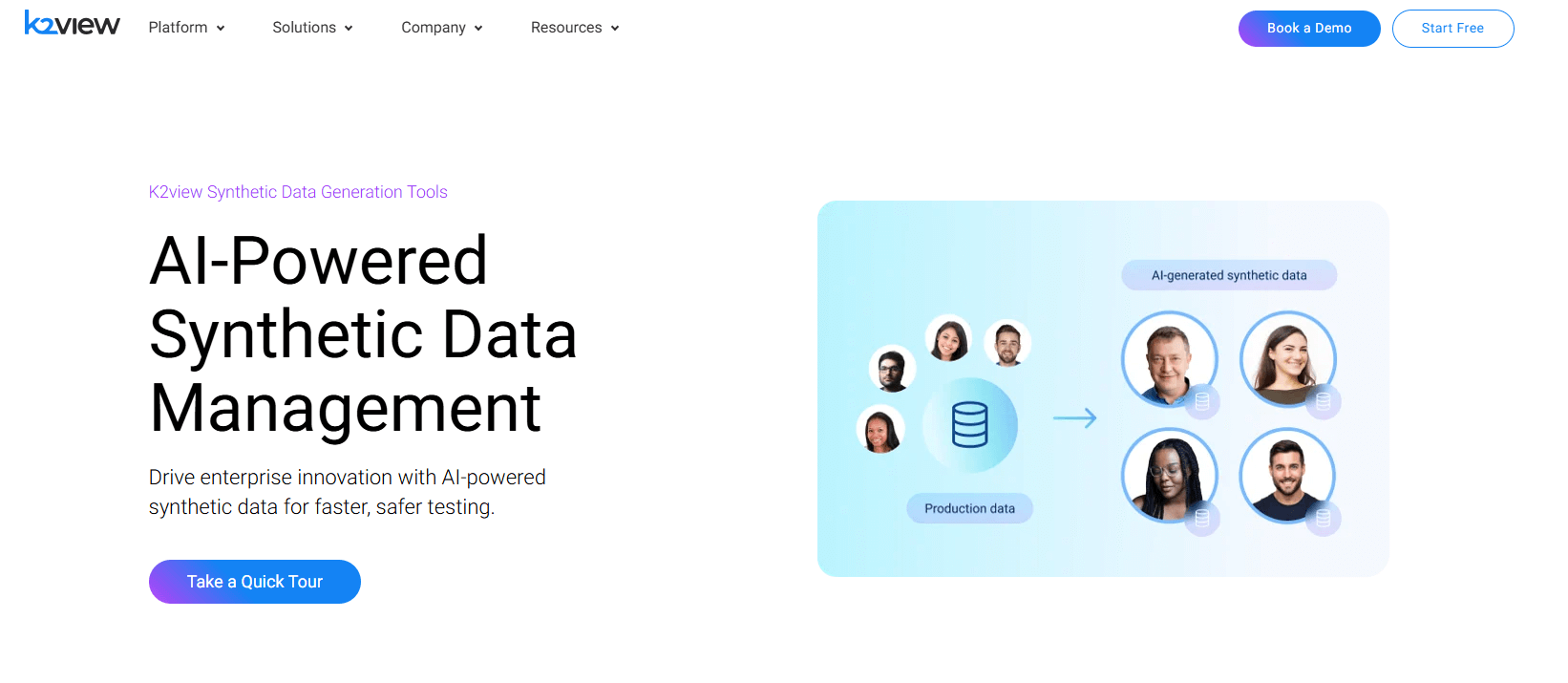
Part of K2view's Test Data Management and Data Product Platform, combining synthetic data generation with masking, cloning, subsetting, versioning, and reservation for CI/CD. According to vendor documentation, it supports self-service and lifecycle controls.
Best for: DevOps and QA teams that need governed, on-demand test data with lineage and rollback across complex application estates.
Key Features:
- Synthetic generation plus masking, subsetting, and cloning under one platform, per vendor documentation
- Versioning, reservation, and rollback to manage test data lifecycles at scale, per vendor documentation
- Recognized presence in Test Data Management and integration markets per analyst reviews, including Gartner Peer Insights market pages and a K2view profile overview on Gartner Peer Insights vendor page
Why we like it: Strong operational focus. If the goal is reliable pre-production environments that mirror production structure without exposing PII, the lifecycle pieces matter as much as synthesis.
Notable Limitations:
- Reviews note a learning curve and request richer documentation in early stages (G2 reviews)
- Pricing can be significant for small teams, according to user comments on G2
- Feature breadth can require dedicated enablement to get full value
Pricing: Public listing on AWS Marketplace shows annual contracts starting at 75,000 dollars plus usage-based fees, see the AWS Marketplace offer.
Syntheticus Suite
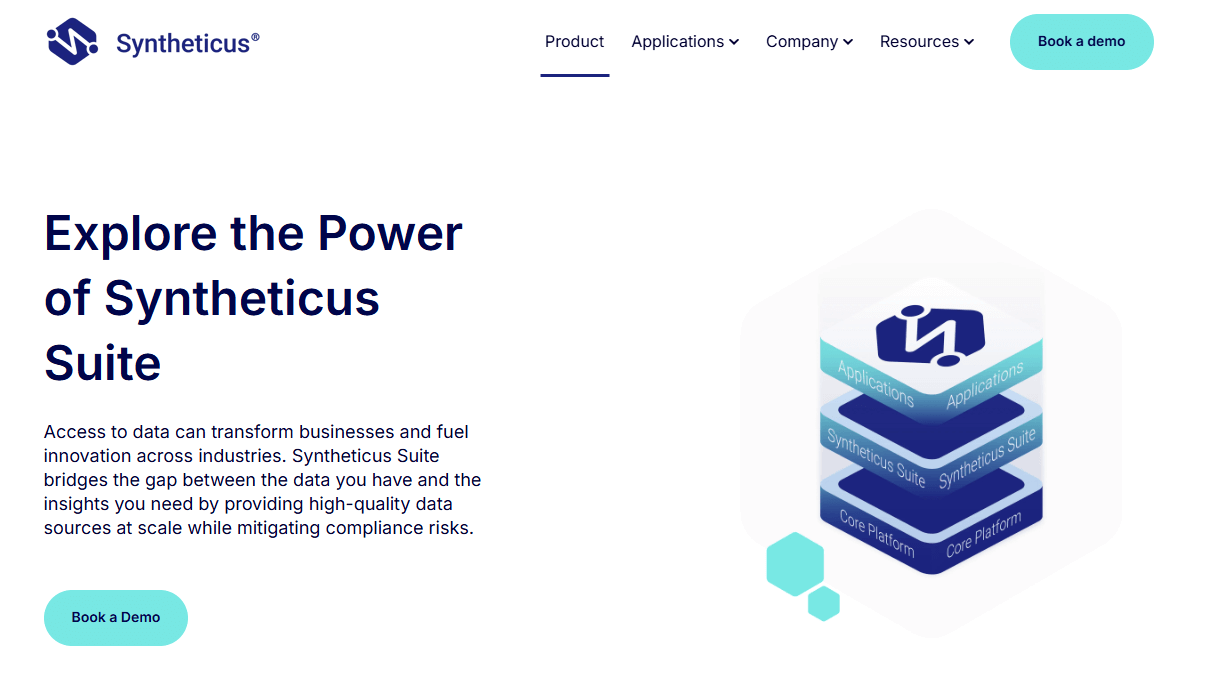
Synthetic data platform from a Swiss startup focused on safe synthetic data with validation and governance across multiple data types and deployment models. According to vendor documentation, it supports multi-environment deployments.
Best for: Teams that want a focused synthetic data stack with an emphasis on privacy tech research and flexible deployment.
Key Features:
- End-to-end flow - ingestion, generation, validation, and quality scoring, per vendor documentation
- Governance workflow designed for regulated data sharing, per vendor documentation
- Active presence in the Swiss startup and research ecosystem, with third-party listings on Venturelab and CB Insights
Why we like it: Good balance of product focus and governance awareness. The company has community traction and references in research-driven circles.
Notable Limitations:
- Limited independent enterprise case studies in English-language press as of December 2025
- G2 reviews are positive but few, and some mention initial complexity or occasional synthetic data repetition (G2 product page)
- Pricing transparency is limited for larger deployments
Pricing: Pricing not publicly available. Contact Syntheticus for a custom quote.
Synthetic Data Governance Tools Comparison: Quick Overview
| Tool | Best For | Pricing Model | Highlights |
|---|---|---|---|
| MDACA Synthetic Data Engine | Regulated teams needing AWS-deployable synthesis with validation panels | Hourly AMI rates | Differential privacy knobs and visual utility/privacy checks, per vendor documentation, with AWS listing as public reference |
| Protegrity Synthetic Data | Enterprises standardizing policy, discovery, protection, and synthesis | Quote-based enterprise licensing | Synthetic data under one governance plane, cross-border data patterns covered in trade press |
| K2view Synthetic Data Generation | DevOps and QA needing governed test data lifecycle | Annual subscription plus usage, AWS Marketplace | Synthesis plus masking, subsetting, cloning, reservation, versioning, reflected in TDM analyst coverage |
| Syntheticus Suite | Teams wanting a focused synthetic data stack with governance workflows | Quote-based | End-to-end generation and validation with governance focus, backed by startup ecosystem listings |
Synthetic Data Governance Platform Comparison: Key Features at a Glance
| Tool | Generation Controls | Validation & Reporting | Governance Hooks |
|---|---|---|---|
| MDACA Synthetic Data Engine | Differential privacy and parameter tuning, per vendor docs | Distribution and correlation comparisons | Runs in VPC, aligns to enterprise access controls |
| Protegrity Synthetic Data | Bias controls and model choice, per vendor docs | Detailed privacy reports and audit trails | Central policies, discovery, and cross-border controls, covered by press |
| K2view Synthetic Data Generation | Rules-based and AI-assisted synthesis | Test data reservation, rollback, and versioning metadata | TDM governance and approval flows |
| Syntheticus Suite | Multi-type synthesis, per vendor docs | Quality scoring and validation steps | Workflow for approvals and data sharing governance |
Synthetic Data Governance Deployment Options
| Tool | Cloud API | On-Premise | Integration Complexity |
|---|---|---|---|
| MDACA Synthetic Data Engine | AWS AMI deployment | Vendor indicates private cloud options | Medium, infrastructure set in AWS |
| Protegrity Synthetic Data | Multi-cloud connectors noted in press | Enterprise deployments commonly on-prem too | Medium to High, programmatic rollout |
| K2view Synthetic Data Generation | Cloud and hybrid supported in analyst profiles | Yes | Medium, with enablement for TDM |
| Syntheticus Suite | Cloud options | Claims multi-environment | Medium, depends on data types |
Synthetic Data Governance Strategic Decision Framework
| Critical Question | Why It Matters | What to Evaluate | Red Flags |
|---|---|---|---|
| How will we prove privacy, not just claim it | Regulators and auditors expect proof, not slogans | Membership inference resistance, privacy reports, epsilon choices, third-party tests | No quantitative privacy metrics, no leakage testing |
| Can we track utility drift over time | Synthetic that drifts hurts model accuracy | Side-by-side stats, downstream performance on hold-out tasks | One-time validation, no monitoring |
| How does this tie to AI governance rules | The EU AI Act timeline brings governance and audit duties | Policy mapping, audit logs, access controls, reporting | No audit trail, no policy engine |
| Who owns test data lifecycle | TDM is a continuous process | Reservation, versioning, rollback, subsetting, PII discovery | Manual cloning, stale data, broken referential integrity |
Synthetic Data Governance Solutions Comparison: Pricing and Capabilities Overview
| Organization Size | Recommended Setup | Monthly Cost | Annual Investment |
|---|---|---|---|
| Small team, cloud-first | MDACA SDE on t3.large in AWS, pilot privacy and utility checks | About 1,460 dollars at 2.00 dollars per hour, 24x7 run, from AWS listing | About 17,520 dollars, excludes AWS infra |
| Mid-size with CI/CD focus | K2view TDM plus synthetic generation for governed test data | Starts at about 6,250 dollars per month before usage, from AWS Marketplace pricing | From 75,000 dollars per year plus usage |
| Enterprise with policy control | Protegrity platform with synthetic data and AI pipeline controls | Pricing not publicly available | Contact vendor for a custom quote, Developer Edition for prototyping per press release |
| Enterprise, research-driven pilots | Syntheticus Suite for focused synthesis and validation | Pricing not publicly available | Contact vendor for a custom quote |
Problems & Solutions
-
Problem: "We need synthetic data that passes a governance audit under the EU AI Act timeline."
The EU AI Act entered into force on August 1, 2024, with key obligations phasing in between February 2025 and August 2027, including governance for general-purpose AI and strict controls for high-risk systems. Prohibited AI practices and AI literacy obligations entered application from February 2, 2025. High-risk AI rules take effect August 2, 2026, with extended transition for certain embedded systems until August 2, 2027 (European Commission overview, European Parliament news).
How tools help:- Protegrity ties synthetic data to central policies, discovery, and protection with audit logs, highlighted in trade coverage of new AI workflow protections
- K2view supports governance processes around test data creation and approval, aligned with analyst descriptions of TDM best practices that include synthesis
- MDACA provides comparative utility and privacy checks, supplying evidence for reviews, with a documented AWS deployment path
- Syntheticus focuses on validation and governance workflows suitable for controlled data sharing, with company references in reputable startup directories
-
Problem: "Could synthetic data leak training records through membership inference attacks, especially with diffusion models for tabular data"
Research in 2025 shows that diffusion-based and other generators can be vulnerable to membership inference, and that synthetic data can confound evaluations if not handled carefully. The MIDST Challenge at SaTML 2025 demonstrated that even state-of-the-art tabular diffusion models like TabDDPM and TabSyn can be successfully attacked (MIA-EPT for tabular diffusion, Membership inference on diffusion tabular models).
How tools help:- MDACA's privacy controls and validation panels provide measurable privacy and utility signals teams can document
- Protegrity's privacy reports are designed to quantify re-identification risks and produce audit-ready evidence, reinforced by the platform's broader governance stack in press coverage
- K2view lets teams combine synthesis with masking and subsetting, so high-risk fields can be masked even when synthesis is used
- Syntheticus emphasizes validation loops that can be paired with external privacy tests before release
-
Problem: "We must keep pre-production in sync with production structure without exposing PII, and we need rollback and reservation for parallel test runs."
TDM best practice is to combine synthetic data with masking and subsetting and to govern provisioning end-to-end (Gartner Peer Insights explainer).
How tools help:- K2view stands out for reservation, versioning, and rollback plus synthesis - a strong fit for CI/CD
- Protegrity brings policy consistency when test data paths cross borders
- MDACA offers quick AWS-based pilots with validation
- Syntheticus supports controlled sharing flows for multi-party tests
-
Problem: "We need a business case that speaks to the board."
Breach costs remain substantial - IBM reported a 4.44 million dollar global average in 2025, with U.S. breaches averaging a record 10.22 million dollars, driven by regulatory fines and operational disruption (IBM Cost of Data Breach 2025).
How tools help:- Protegrity, K2view, MDACA, and Syntheticus can frame quantifiable risk reduction with audit logs, controlled access, and privacy reports, giving CFO-friendly artifacts
Bottom Line: Pick Governance You Can Prove
Synthetic data is becoming central to AI programs, and analysts expect synthetic structured data to grow at least 3 times as fast as real structured data for AI model training through 2030 (Gartner predictions). The compliance bar is rising as the EU AI Act phases in through 2027, with high-risk AI rules taking effect in August 2026 and adding explicit governance and audit demands (European Commission timeline). If you need fast validation and an AWS-native pilot, MDACA is pragmatic. If you want one policy plane for protection plus synthesis, Protegrity is compelling. For CI/CD-grade test data with lifecycle control, K2view leads. For research-focused pilots with governance workflows, Syntheticus is a solid bet. Start with measurable privacy and utility checks, then wire results into your audit story. If a tool cannot give you numbers you can defend, keep looking.