

Most teams discover gaps in "trust" during procurement fire drills, not from their compliance dashboards. From our experience in the startup ecosystem, the biggest misses happen when AI features ship faster than governance, when third party risk is tracked in spreadsheets, and when SOC 2 evidence is scattered across Drive, Jira, and Slack. With regulations tightening and breach costs still high, the urgency is real. The EU AI Act entered into force on August 1, 2024 and is phasing in obligations through 2027, which is already changing buyer checklists and audit scopes, according to the European Commission and legal analyses from the Commission and DLA Piper.
Gartner projects worldwide AI spending to reach $2.52 trillion in 2026, a 44% year over year jump that is flowing into governance and risk tools as models move to production, per Gartner's January 2026 forecast. In this guide, you will see where each product fits, what is actually available today, what limitations buyers report, and how to match a tool to your regulatory timeline.
TrustLaunchAI
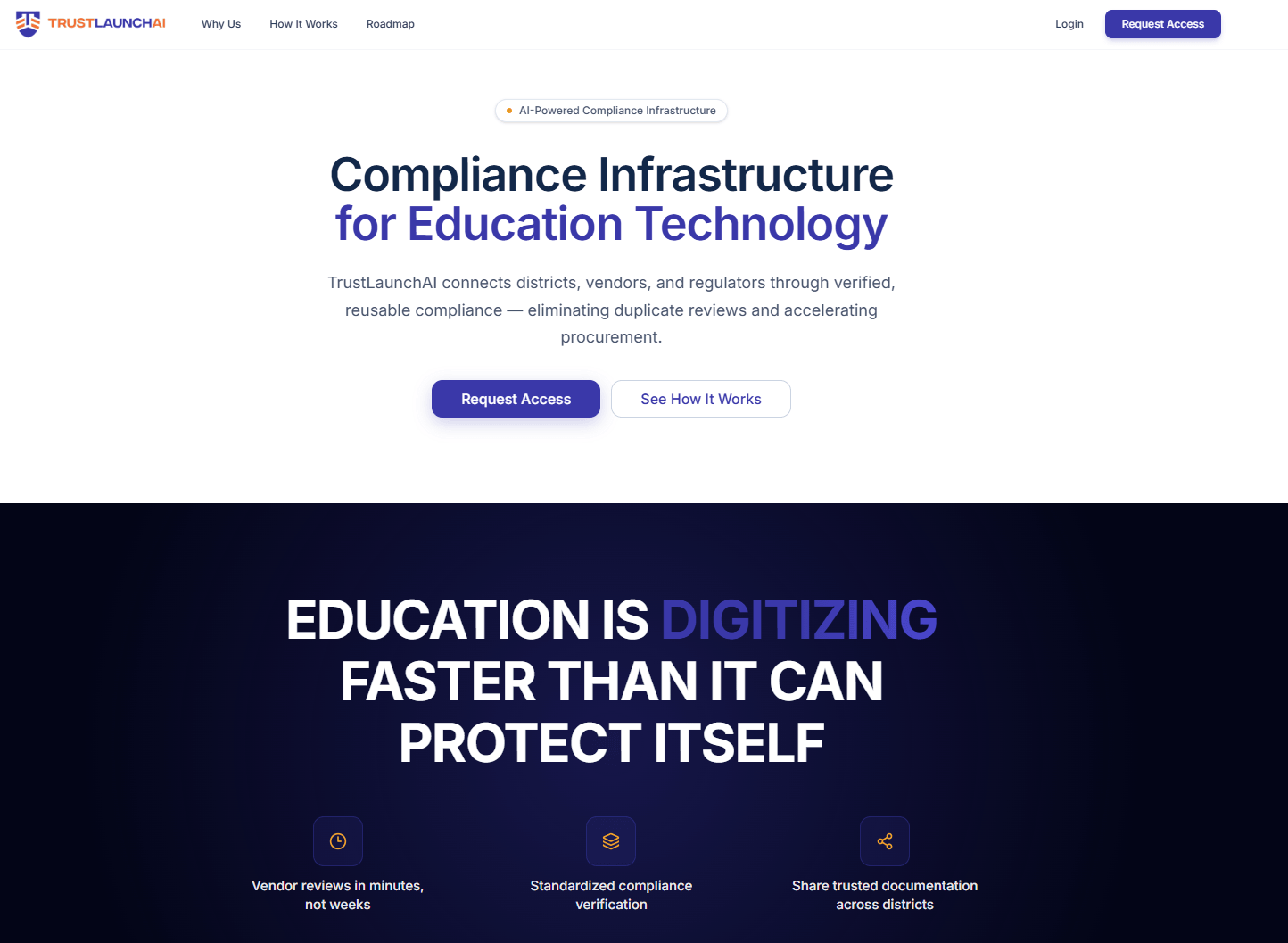
Shared compliance infrastructure for K‑12, focused on reusable "trust profiles" and AI assisted verification across districts and vendors, per vendor documentation.
Best for: K‑12 districts and EdTech vendors that want to reuse privacy reviews across multiple procurements.
Key Features:
- Shared vendor trust profiles with policies, certifications, and privacy artifacts in one place, per vendor documentation.
- AI analysis against FERPA, COPPA, and state requirements to reduce manual review time, per vendor documentation.
- Network model for reusing verified findings across districts, per vendor documentation.
Why we like it: After helping startups scale into K‑12, duplicate privacy reviews are the hidden tax on both districts and vendors. A shared verification layer targets that waste directly.
Notable Limitations:
- Early stage product with limited third party reviews as of April 2026.
- K‑12 privacy expectations are rising quickly after high profile incidents, which may drive scope changes mid rollout, as coverage of the PowerSchool breach shows in Axios reporting and broader analysis from TechPolicy.Press.
Pricing: Pricing not publicly available. Contact vendor for a custom quote.
LucidTrust
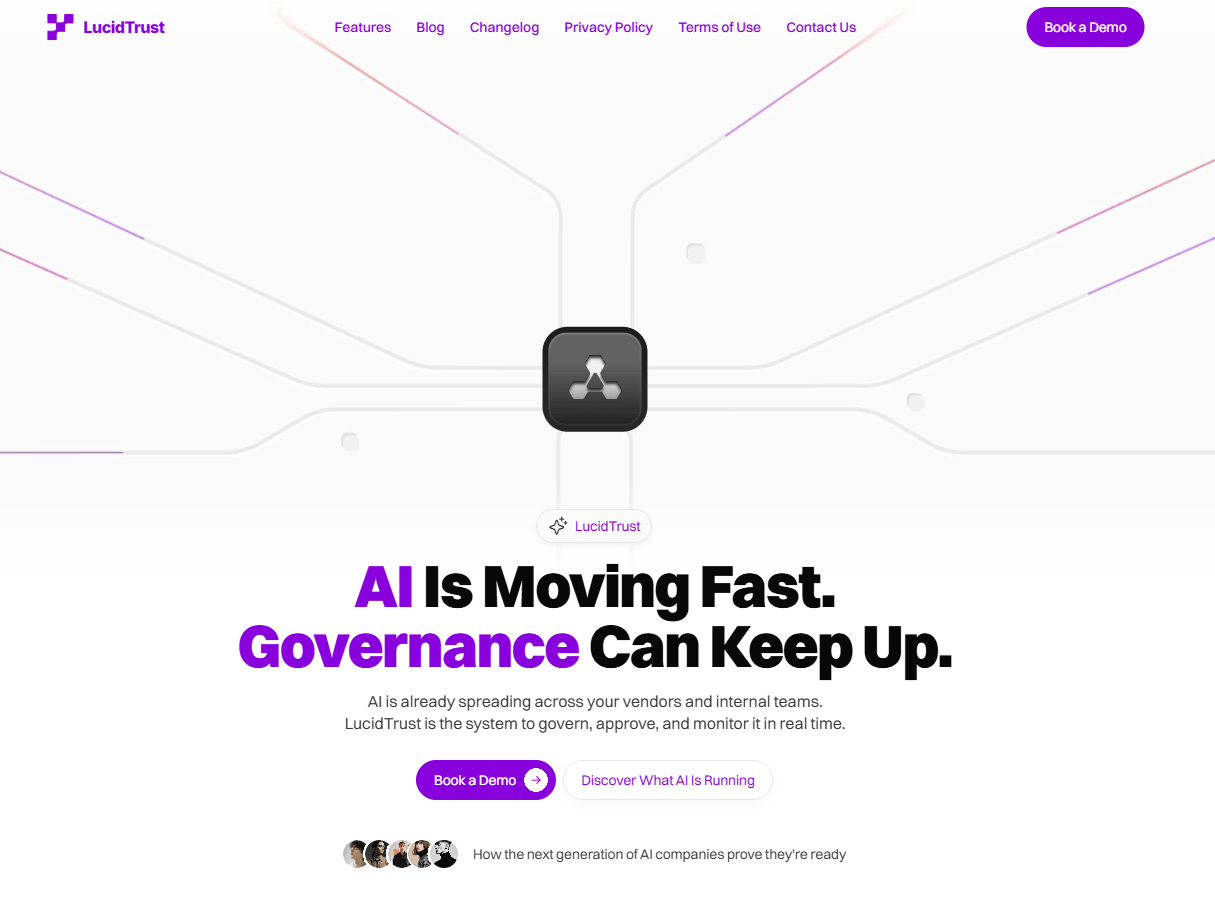
AI governance and compliance platform for regulated industries that maps inventory and risks to the EU AI Act and other frameworks, per vendor documentation.
Best for: Financial services, healthcare, and other regulated teams that need AI system inventories, risk classification, and audit ready evidence across jurisdictions.
Key Features:
- AI system inventory with automatic high risk classification aligned to the EU AI Act and ISO 42001, per vendor documentation.
- Vendor AI assessment workflows that address model lineage, testing for bias, and training data provenance, per vendor documentation.
- Policy guidance and full audit trail that links approvals and assessments to reports for regulators or boards, per vendor documentation.
Why we like it: Working across different tech companies, the toughest gap is a living AI register tied to decisions and evidence. An inventory that auto maps to obligations is the first lever for scale.
Notable Limitations:
- Limited independent coverage and buyer reviews as of April 2026, so proofs of value may require pilots.
- Timing pressures will intensify as EU AI Act milestones hit through 2027.
Pricing: Pricing not publicly available. Contact vendor for a custom quote.
TrustCloud
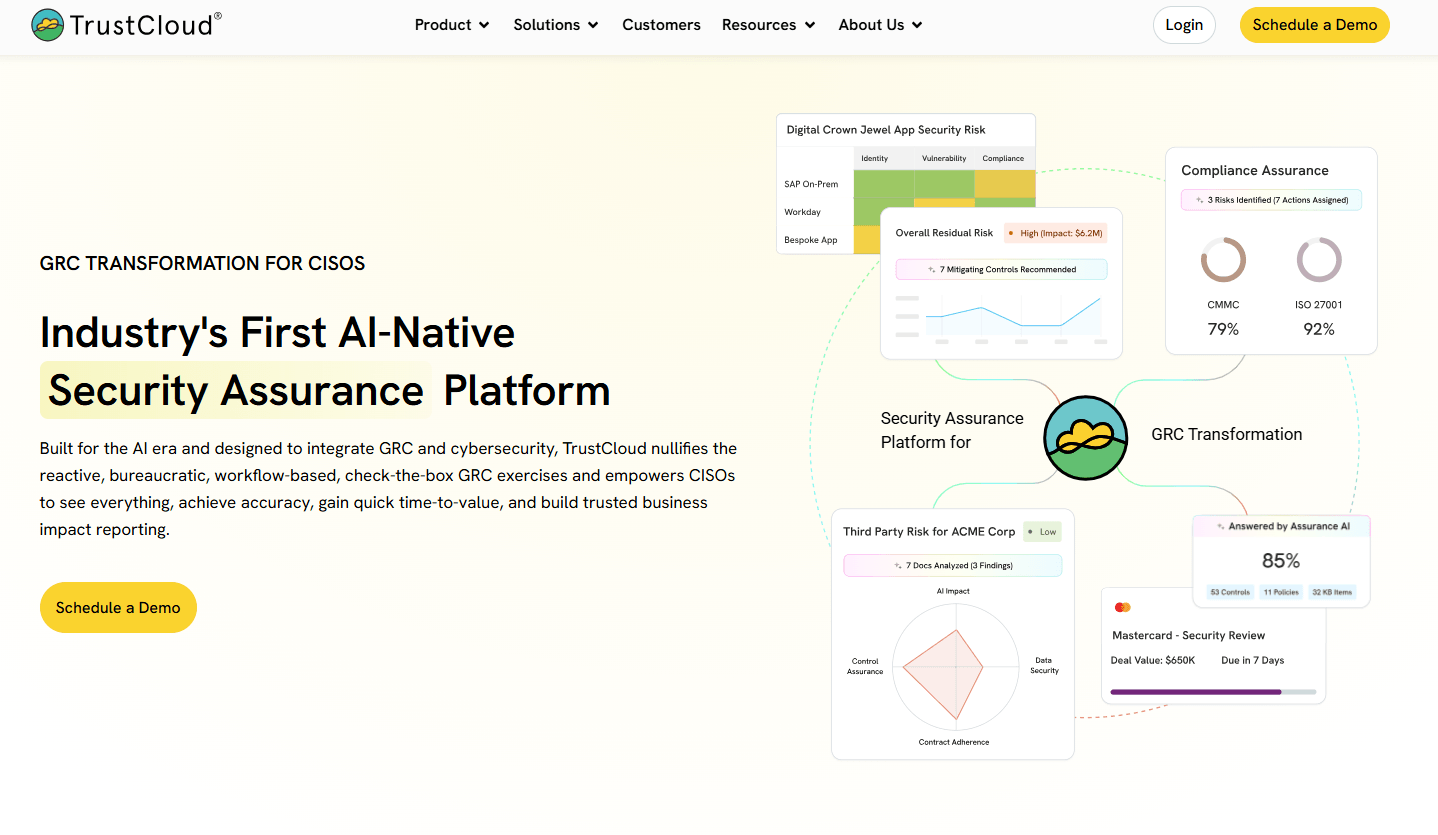
AI native security assurance platform that combines GRC, questionnaire automation, and continuous control monitoring.
Best for: Growth and mid‑market companies that want combined SOC 2, ISO 27001, HIPAA evidence collection, faster security questionnaires, and a trust portal.
Key Features:
- Security questionnaire automation, trust portal, risk register, third party risk, and vendor reviews.
- Automated evidence collection with continuous control monitoring and auditor oriented templates.
- Cloud integrations, including identity providers and major clouds.
(Features verified on the AWS Marketplace listing.)
Why we like it: After helping startups scale, the win is consolidating audits, risk, and sales side proof in one place, then pushing evidence into customer workflows.
Notable Limitations:
- Reviewers note API sync or integration friction and UI navigation learning curves, plus cost concerns for some teams, as summarized on G2's TrustCloud page.
- Enterprise on prem or air gapped deployment is not publicly documented.
Pricing: Available through the AWS Marketplace, including some entry level contract dimensions such as questionnaire automation and a risk register. Pricing on that page uses contract terms, for example certain startup SKUs listed at $0, and mid‑market modules with listed annual prices. For broader deployments, contact TrustCloud for a custom quote.
Trust Infrastructure & AI Compliance Proof Tools Comparison: Quick Overview
| Tool | Best For | Pricing Model | Highlights |
|---|---|---|---|
| TrustLaunchAI | K‑12 districts and EdTech vendors | Custom quote, free tier not verified | Shared, reusable trust profiles and AI privacy checks, per vendor documentation |
| LucidTrust | Regulated enterprises running or buying AI | Custom quote, free tier not verified | AI system register, EU AI Act classification, vendor AI assessments, per vendor documentation |
| TrustCloud | Growth to mid‑market teams needing GRC plus proof | Contract via marketplace or direct, limited free SKUs shown on marketplace | Questionnaire automation, trust portal, CCM, and risk register |
Trust Infrastructure & AI Compliance Proof Platform Comparison: Key Features at a Glance
| Tool | AI Risk Classification | Evidence Automation | Vendor AI Assessments | Audit Trail |
|---|---|---|---|---|
| TrustLaunchAI | Maps to FERPA, COPPA, state laws, per vendor documentation | AI assisted review of privacy docs, per vendor documentation | District grade privacy checks, per vendor documentation | Yes, per vendor documentation |
| LucidTrust | EU AI Act and ISO 42001 logic, per vendor documentation | Links controls and approvals to reports, per vendor documentation | Focus on model lineage, bias testing, and provenance, per vendor documentation | Yes, per vendor documentation |
| TrustCloud | Multi framework support reported, per marketplace listing | Automated evidence and continuous testing, per marketplace listing | Third party risk and vendor reviews, per marketplace listing | Yes, via trust portal and reports |
Trust Infrastructure & AI Compliance Proof Deployment Options
| Tool | Cloud API | On‑Premise | Integration Complexity |
|---|---|---|---|
| TrustLaunchAI | Yes, per vendor documentation | Not publicly documented | Moderate, depends on district stack and vendor artifacts |
| LucidTrust | Yes, per vendor documentation | Not publicly documented | Moderate, driven by inventory and policy integrations |
| TrustCloud | Yes, per the AWS Marketplace listing | Not publicly documented | Moderate, reviewers cite some API sync friction on G2 |
Trust Infrastructure & AI Compliance Proof Strategic Decision Framework
| Critical Question | Why It Matters | What to Evaluate | Red Flags |
|---|---|---|---|
| Which AI systems are in scope through 2027 under the EU AI Act? | Obligations phase in on Feb 2, 2025, Aug 2, 2025, Aug 2, 2026, and Aug 2, 2027. | High risk classification logic, conformity assessment artifacts, and reporting. | No inventory, static spreadsheets, or generic GRC labels for AI. |
| Can we prove continuous control performance to reduce breach impact? | Breach costs averaged $4.44M globally in 2025, per IBM's report. | Automated evidence capture, CCM coverage, mapped frameworks. | Manual screenshots, quarterly sampling, auditor surprises. |
| How will vendor AI features be governed pre and post deployment? | Vendors ship AI features fast, your risk posture can drift. | Vendor AI assessments, approvals workflow, runtime change alerts. | Relying only on SOC 2 and unvetted feature toggles. |
| For K‑12, can we reuse district trust signals after breaches? | PowerSchool's late 2024 incident shows the blast radius of vendor failures, per Axios. | Shared trust profiles, standardized privacy checks, verifiable reuse. | One off questionnaires, no cross district reuse, opaque artifacts. |
Trust Infrastructure & AI Compliance Proof Solutions Comparison: Pricing & Capabilities Overview
| Organization Size | Recommended Setup | Monthly Cost | Annual Investment |
|---|---|---|---|
| Startup or small team | TrustCloud's marketplace SKUs for targeted needs, such as single questionnaire automation or startup risk register, then expand if value is proven. | From roughly $12.50 for a single questionnaire SKU when annualized, based on listed $150 per year. | From $150 per year for certain modules, other startup SKUs may be listed at $0. |
| Mid‑market | TrustCloud multi module contract via marketplace plus pilots for LucidTrust or TrustLaunchAI if AI governance or K‑12 reuse is required. | Varies by mix; example module at $5,000 per year for a mid‑market risk register, about $416.67 monthly. | Contract dependent. Confirm totals through procurement or marketplace private offers. |
| Enterprise or public sector | Parallel pilots, AI governance program design, and data protection uplift. Formalize EU AI Act workstreams. | Pricing not publicly available for LucidTrust and TrustLaunchAI. | Contact vendors for custom quotes and co term with renewal cycles. |
Problems & Solutions
-
Problem: District privacy teams scramble after vendor breaches, and duplicate reviews stall instruction and contracts.
Evidence: The December 2024 PowerSchool incident triggered broad notifications in early 2025, ransom payment, and extortion threats to districts, with additional context on scale from TechPolicy.Press.
How each tool helps:- TrustLaunchAI, per vendor documentation, structures vendor trust profiles once, adds AI privacy checks for FERPA and COPPA, and enables reuse across districts to cut duplicate reviews.
- LucidTrust focuses less on K‑12 procurement and more on regulated AI inventories, so it is a fit if a district central office is standing up an AI register and risk scoring, per vendor documentation.
- TrustCloud brings continuous control monitoring and a trust portal that can accelerate district vendor security reviews when audits broaden after an incident.
-
Problem: EU AI Act deadlines require mapping AI use cases to high risk obligations, with conformity assessment evidence.
Evidence: The Act entered into force on Aug 1, 2024, with phased applicability through 2027, per the European Commission.
How each tool helps:- LucidTrust, per vendor documentation, provides high risk classification logic, policy scaffolding, and audit trails mapped to the EU AI Act and ISO 42001.
- TrustCloud can centralize policy, controls, and evidence across multiple frameworks to support conformity documentation.
- TrustLaunchAI is oriented to K‑12 privacy laws and procurement trust, so consider it where district AI usage intersects FERPA, COPPA, and emerging state AI guides.
-
Problem: Rising breach impact demands real time control assurance rather than quarterly sampling.
Evidence: The global average cost of a data breach was $4.44M in 2025, with U.S. averages reaching a record $10.22M, according to IBM's Cost of a Data Breach Report.
How each tool helps:- TrustCloud features automated evidence collection and continuous control monitoring with integrations across cloud services, which shortens audit cycles and tightens posture.
- LucidTrust captures approvals and assessment decisions in a full audit trail for AI systems, supporting faster regulator or board responses, per vendor documentation.
- TrustLaunchAI's reusable trust signals reduce repetitive manual work, so staff can shift attention to control improvements, per vendor documentation.
Bottom Line: Picking the Right Trust Layer for 2026
If you need K‑12 vendor vetting that compounds across districts, start with a pilot of TrustLaunchAI and pressure test reuse claims against real RFPs. If your board wants a defensible AI program with EU AI Act mapping, trial LucidTrust with a narrow inventory slice timed to the milestones running through 2027. If audit readiness, continuous testing, and buyer security questionnaires are blocking sales, TrustCloud's marketplace path and CCM focus can pay for itself fastest. Across all three, anchor your business case to breach economics and 2026 AI spending priorities now reshaping enterprise budgets.