

Most teams discover age gates break conversion during A/B rollouts, not from the compliance memo. From our experience in the startup ecosystem, the biggest mistakes happen when teams ship selfie checks without liveness, skip device risk signals, or hard-code a single vendor method. Ask any trust and safety lead about their worst launch, and they will describe a support queue full of “unable to verify” tickets.
Regulators are also turning up the heat, with the UK Online Safety Act allowing fines up to 10 percent of global revenue or 18 million pounds, whichever is higher, according to Ofcom guidance. Age assurance is the gate in front of the product, so it is a different purchase from checking a company with a KYB platform or screening faces with deepfake detection.
We picked 7 platforms in this space. Five consistently delivered deployable methods across document checks, facial age estimation, and privacy-preserving signals, with two close contenders worth a look. You will learn which methods map to your risk model, what to watch for in real-world accuracy (per NIST's 2024 evaluation), and where buyer feedback flags integration or support gaps.
Age Assurance and Verification Platforms at a Glance
| Platform | Best for | Pricing | Highlights |
|---|---|---|---|
| Yoti | UK/EU facial estimation plus reusable Digital ID and Yoti Keys | Quote for businesses. App is free for individuals | One integration for many methods. ACCS and ISO/IEC 27566-1 on AVS 2026. Keys reuse an age result on-device |
| VerifyMy | Email-based estimation plus ID checks for adult, alcohol, and e-commerce flows | Quote. Volume-based | Email OTP estimation. ID scan and face match as step-up. ACCS 1:2025 and ISO/IEC 27566-1:2025 (May 2026) |
| Persona | Configurable selfie estimation and ID fallback at consumer-platform scale | Public Essential floor. Growth and Enterprise by quote | Thresholds, buffers, and step-up in one workflow. Self-serve Essential. Immediate redaction |
| Incode | Enterprise age assurance with on-device estimation and injection defense | Quote | On-device option so the face stays on the phone. First-party 40+ jurisdictions. Deepfake and injection detection |
| k-ID | Jurisdiction-aware age rules and parental consent for games and kids' apps | AgeKit API free. Platform is a usage quote | 200+ jurisdictions, including US states. Family Connect verifiable parental consent. CDK feature flags |
| Veriff | Selfie age estimation inside a wider IDV/KYC stack | Public IDV self-serve. Age Estimation is a listed service | Document-free selfie estimate with liveness. ID verification as the high-certainty path. Age is one use case, not the whole platform |
| iDenfy | A printed per-check IDV price when age is one check inside KYC | Public per-check with a PAYG monthly floor | Age verification on the ID flow. Separate selfie age estimation. Optional approved-only billing. Age is one use case inside broader IDV |
Yoti
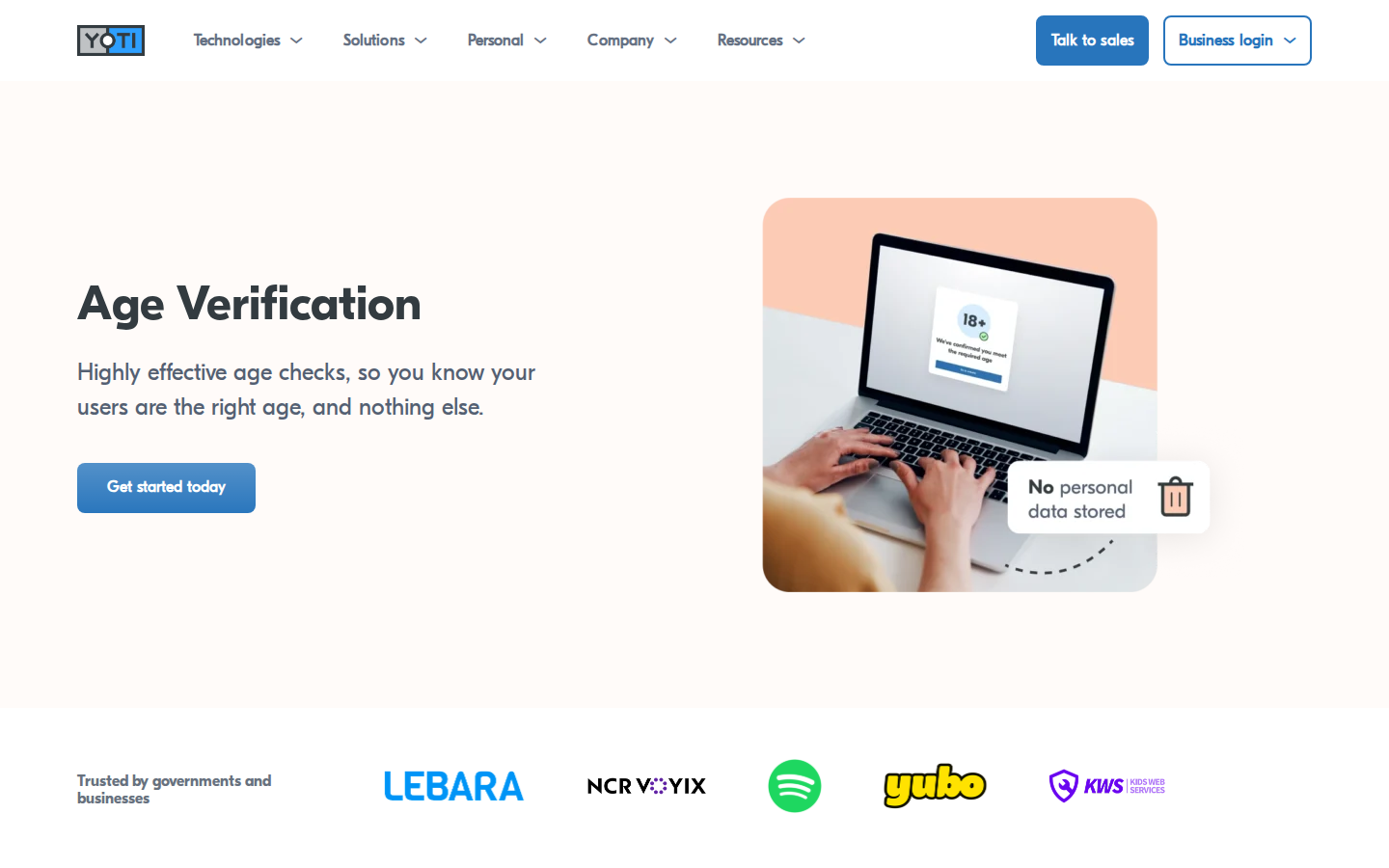
Yoti is the default UK and EU pick on this shortlist when the job is facial age estimation plus a reusable credential. The age-verification product offers more than ten methods through one integration: facial age estimation (a selfie, with liveness and anti-spoofing), Digital ID wallet reuse, identity document plus selfie match, Yoti Keys, credit card, mobile, electronic ID, SSN, database, and email age estimation. Facial estimation returns an estimated age or an over/under threshold. Yoti states a one-second check time, and that facial data is deleted after the check. As of September 2024, Yoti published a 99.3% true positive rate for 13 to 17 year olds correctly estimated as under 21. Treat that as a dated first-party figure.
Yoti Keys store the encrypted result of an age check on the user's device (plus how and when it was done). No name or document goes into the Key. Returning users can reuse that result on sites that accept Keys, including in private browsing. Digital ID is the other reuse path: verify once in the wallet, then share an age attribute. Business pricing is quote. The Digital ID app, facial age estimation, and related consumer checks are free for individuals. Yoti's Age Verification Service (AVS) Version 2026-2.1 is listed on the Age Check Certification Scheme registry against ACCS 1:2025 and ISO/IEC 27566-1:2025, with certification validity to 6 September 2029. The Aug24 facial model still shows a separate ACCS 1:2020 Level 2 estimation certificate valid to 21 October 2026. Confirm which certificate covers the SKU you are buying.
Best for: UK and EU services that want facial estimation with a reusable Digital ID or Yoti Key, and a documented ACCS / ISO 27566 path.
Key features:
- Facial age estimation with liveness, plus Digital ID wallet reuse and on-device Yoti Keys
- Document, credit card, mobile, eID, SSN, database, and email methods on the same integration
- Hosted no-code portal, APIs and SDKs, and country-level method routing
Why we like it: Keys and Digital ID let an adult who already passed a check skip the selfie the next time, which is the difference between a gate people complete and a gate they bounce.
Notable limitations:
- Business rates are quote. There is no public per-check price
- Yoti's site says its methods are recognised by Ofcom as highly effective. Ofcom publishes method criteria, not a named-vendor endorsement. Ask which method and which evidence pack you actually get
- Email estimation and SSN/database paths are not the same assurance level as a document or Digital ID. Match the method to the statute
Pricing: Individuals use the Digital ID app and consumer age checks at no charge. Business age assurance is quote. Confirm method mix, volume, and which ACCS schedule applies on the order form.
VerifyMy
VerifyMy is the email-first age assurance platform on this list. The distinctive method is email-address age estimation: the user proves they own the inbox with a time-limited OTP, and VerifyMy estimates whether they are 18+ from prior uses of that address across sites and apps. VerifyMy states it does not read the mailbox, does not market to the address, and deletes the email when the check finishes. If email cannot return a result, the same suite steps up to facial age estimation, government-issued ID, ID plus face match, credit card, name and address, or mobile. That mix is why adult, alcohol, and e-commerce checkouts show up in client stories on the homepage (Gamma Entertainment, Toolstation).
The Age Check Certification Scheme lists Verifymy Limited's Age Assurance Platform v1.0.1026 against ACCS 1:2025 and ISO/IEC 27566-1:2025. Certificate ACCS/2026/004 was issued 21 May 2026 and is valid until 20 May 2029 (read with the schedule of certification). Scope is online only. A separate ACCS registry entry also covers VerifyMy Age Estimation API 1.0.0 against IEEE 2089.1-2024. Public pages do not print list prices. Treat commercial terms as a volume quote. Confirm the schedule still covers the methods you will actually turn on (email vs ID vs face).
Best for: Adult, alcohol, and e-commerce flows that want an email estimate first and an ID scan only when the inbox cannot carry the check.
Key features:
- Email-address age estimation with OTP ownership proof
- Facial estimation, government ID, ID plus face match, credit card, name/address, and mobile as alternatives
- ACCS 1:2025 and ISO/IEC 27566-1:2025 on the Age Assurance Platform (May 2026 certificate)
Why we like it: An adult at checkout can pass with an inbox they already have, instead of hunting for a passport in a parking lot, and the same API can still demand an ID when the email is too new to score.
Notable limitations:
- New, privacy, or work-only inboxes will fail estimation and force a heavier method. Model that step-up rate before launch
- No public list rate. You will quote volume and method mix
- The ISO 27566 certificate is scoped online-only and tied to a named platform version. Do not assume every add-on on the marketing site sits inside that schedule
Pricing: Quote. VerifyMy describes tailored, volume-based deployments. Public product pages do not print a per-check figure.
Persona
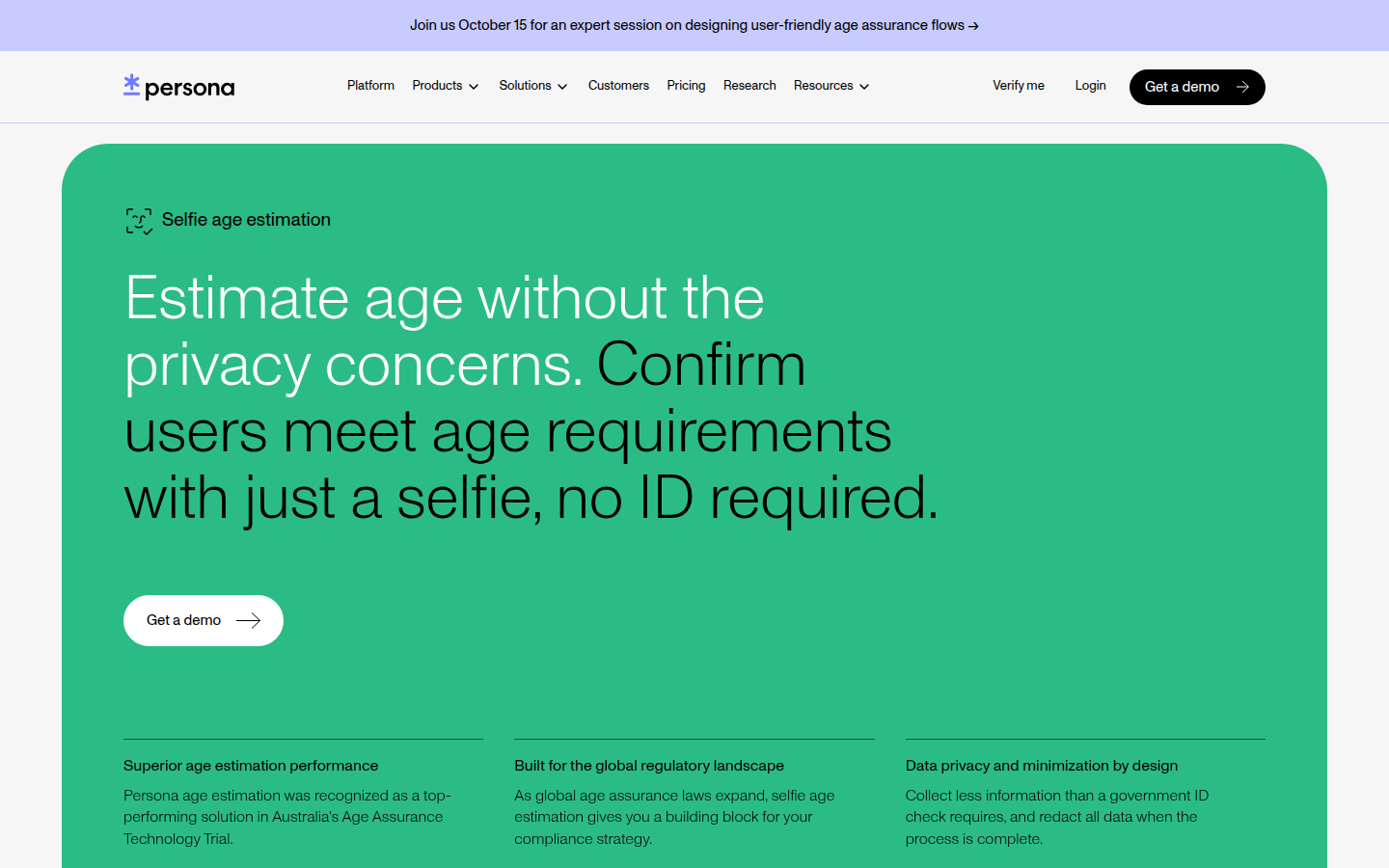
Persona is the configurable, self-serve entry on this shortlist. Selfie age estimation captures a live selfie, estimates age, runs presentation and deepfake checks, compares the result to your cutoffs and buffers, and can route borderline users to a stronger method. Persona states models trained on more than a million ethically sourced images, a mean absolute error under 2 years, multi-frame analysis, auto-capture, and automatic redaction when the check is done. Persona documents cloud-based estimation plus policy-driven orchestration that can vary by geography. Age 18+ verified claims and KYC-plus-age flows also exist on the identity platform. This is a consumer-identity stack that happens to do age well.
Essential is the public self-guided plan. Pricing starts at a printed monthly floor with a 12-month minimum term. Growth and Enterprise are sales-quoted. A Startup Program exists for eligible SMBs (monthly allotment of free services on a limited set of products). Confirm whether selfie age estimation sits in the Essential template you actually enable, or whether it is a usage line on top. Persona states it was a top-performing solution in Australia's Age Assurance Technology Trial. That line is Persona's own summary of a government trial.
Best for: Consumer platforms that want self-serve configuration of estimation thresholds, buffers, and ID fallback, and will live on Persona's identity plans.
Key features:
- Selfie age estimation with liveness, spoof detection, custom cutoffs, and buffers
- Automatic step-up to stronger methods, plus immediate redaction
- Self-serve Essential plan with hosted workflows, and a broader KYC/KYB platform around it
Why we like it: You can set the buffer so a 17-year-old near an 18+ line is sent to a document, while a clear adult clears on a selfie, without building that router yourself.
Notable limitations:
- Age is one verification type inside a larger identity platform. Budget for the platform plan, with age as one line on it
- We could not find Persona on the public ACCS registry for ISO/IEC 27566. Do not carry the Yoti or VerifyMy certificates over to this platform
- Essential has a 12-month minimum. Growth and Enterprise are quote
Pricing: Essential starts at $250 per month with a 12-month minimum. Growth and Enterprise are quote. Startup Program eligibility is application-based. Confirm age-estimation usage on the plan you sign.
Incode
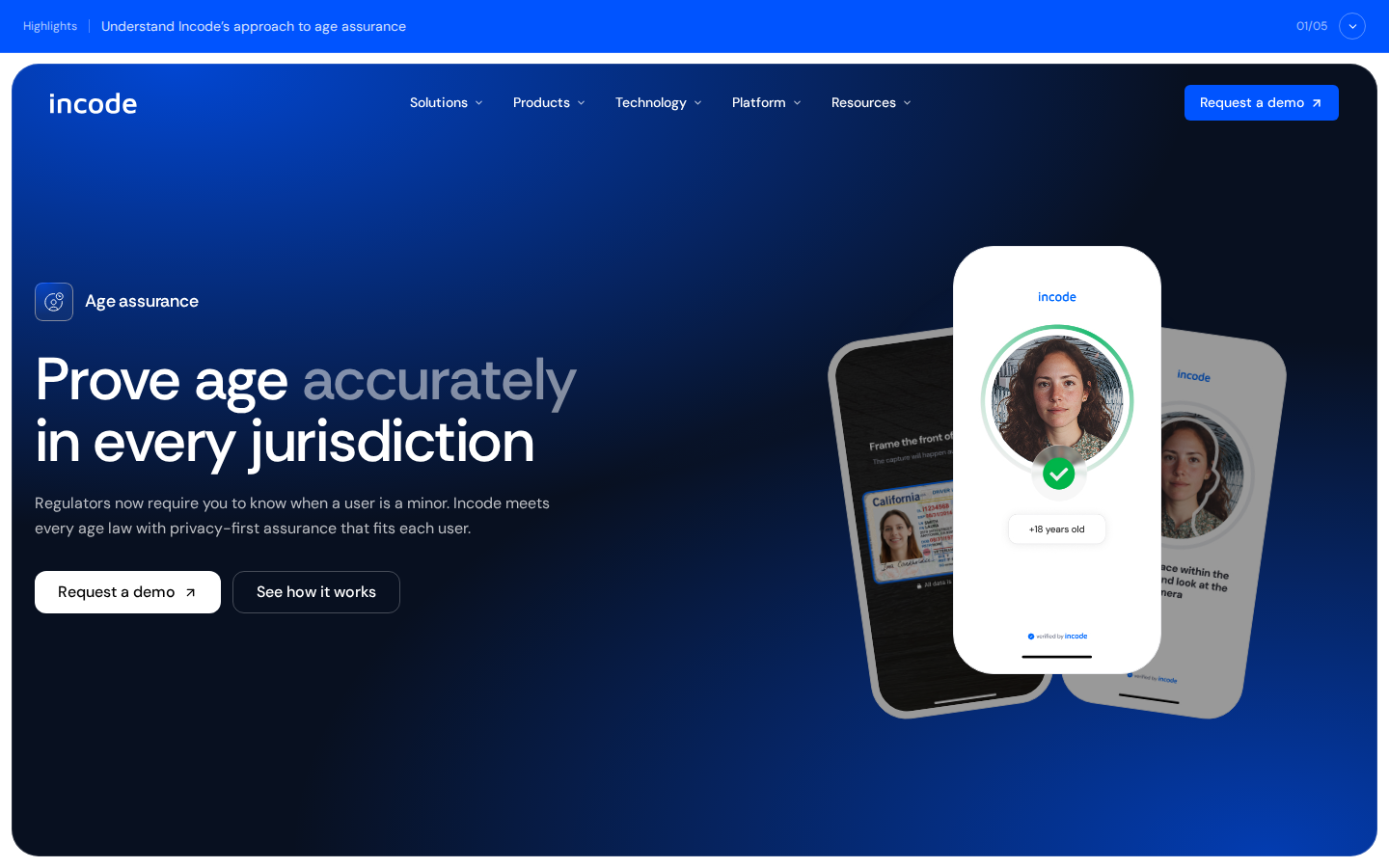
Incode is the enterprise age-assurance platform on this list: facial estimation (including an on-device option), document and government-record step-up, and phone/data/network signals, orchestrated to the jurisdiction. On-device age estimation runs face analysis on the user's phone. Incode states that no biometric image, facial template, or PII is transmitted, with a server-side integrity check on non-PII metadata to catch spoofing or tampering. The same stack is positioned against deepfakes, injection, replay, virtual cameras, and physical masks. Developer docs describe Android on-device processing (Welcome SDK 5.47.0+, STANDARD mode, E2EE required) that submits structured results and keeps the selfie on the device.
The age-assurance page prints "40+ jurisdictions ready to comply and deploy" and lists UK OSA / Ofcom HEAA, EU DSA, US COPPA and state laws, KOSA, Brazil Digital ECA, and Australia OSA as examples. That is Incode's own count. No public schedule lists every statute behind it. Public pricing is quote. iBeta Level 3 PAD (ISO/IEC 30107-3) on iOS and Android is claimed on the same page. No ACCS or ISO/IEC 27566 certificate for Incode appears on the public registry. Ask for the evidence pack that matches the on-device product you are buying.
Best for: Large consumer platforms that need on-device estimation, injection and deepfake defense, and a vendor that already sells multi-jurisdiction orchestration.
Key features:
- On-device facial age estimation with local liveness, plus cloud estimation where you still want it
- Document, digital ID, and government-record step-up (CPF, CURP, DMV and similar)
- Deepfake, injection, replay, and mask detection, with a server-side metadata integrity check
Why we like it: The face can stay on the phone while the platform still gets a pass/fail against a threshold, which is the architecture privacy teams ask for after they read the DPIA.
Notable limitations:
- Quote only. There is no public per-check price
- 40+ jurisdictions is Incode's count. Confirm the named laws on your contract, especially US state bills that are still in flux
- On-device has SDK and E2EE constraints. It is not a drop-in web redirect
Pricing: Quote. Confirm on-device versus cloud estimation, jurisdiction packs, and whether document step-up is in the same order line.
k-ID
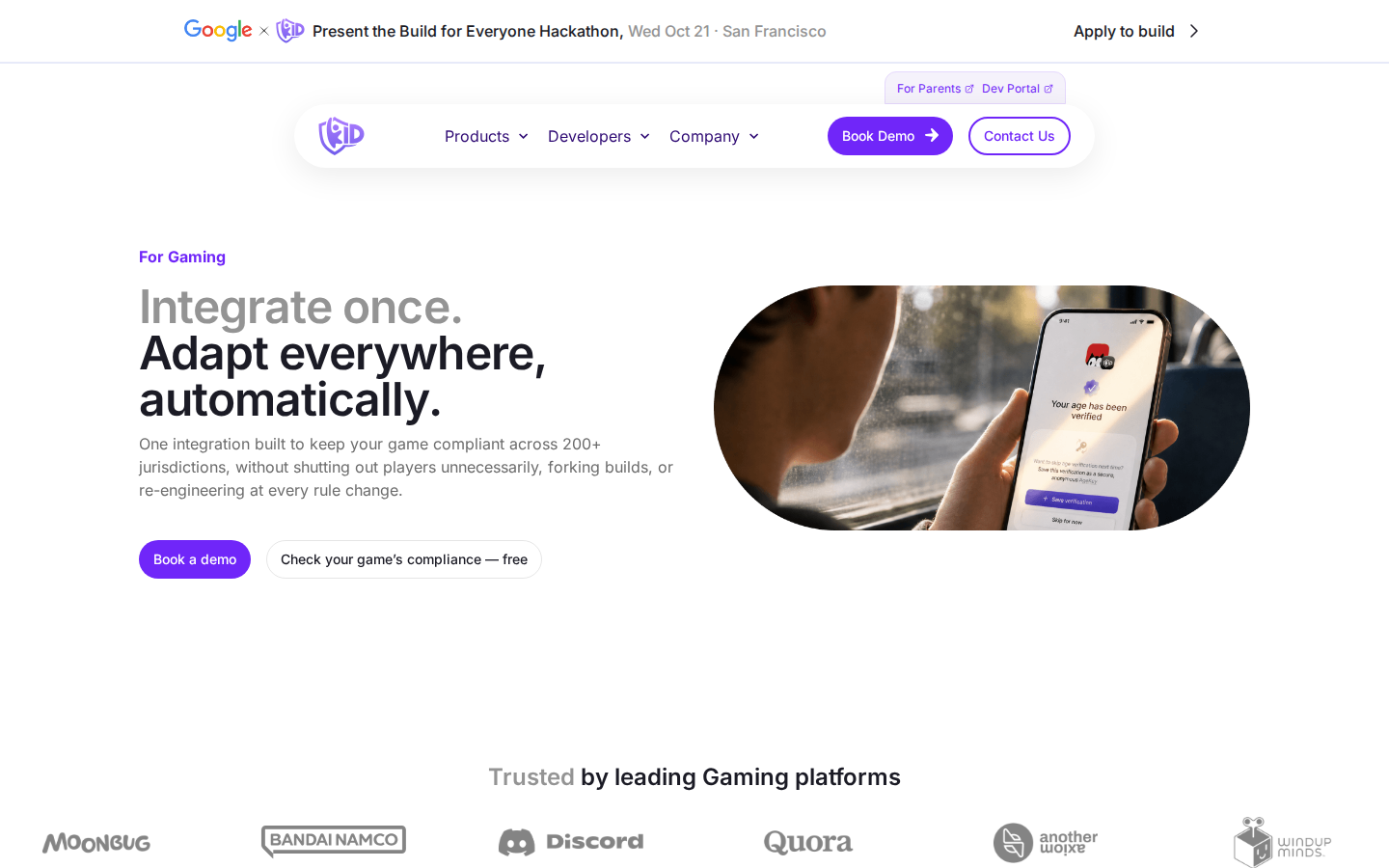
k-ID is age-aware product infrastructure for games and kids' apps. AgeKit is a free API that returns thresholds, approved collection methods, and classification logic for a jurisdiction code (including US-CA and US-TX). It classifies users as digital minor, digital youth, or digital adult without collecting an exact age as PII. AgeKit+ adds multi-method assurance. The Compliance Development Kit (CDK) turns 50-plus features on or off by age and country. Family Connect is the parent portal for verifiable parental consent (VPC): credit card, ID document, SSN (US), email, QR, or OTP for the trusted adult. Consent can sit up front at registration or deferred until a restricted feature is touched.
k-ID states 200+ jurisdictions, monthly regulatory updates, and a subscription scaled to MAU and title count rather than a per-check tax on every player. AgeKit itself is free to start. The full stack (assurance, enforcement, consent, regulatory intelligence) is quote. This is the platform when the failure mode is a hardcoded age-13 gate in a country that uses 15 or 16. An adult site that needs an 18+ document is better served elsewhere on this list. SOC 2 Type 2 and ESRB certification are claimed on the AgeKit product page. Confirm those on the pack you sign.
Best for: Game and kids'-app teams that need jurisdiction-aware thresholds and parental consent inside the product.
Key features:
- AgeKit jurisdiction API (thresholds, approved methods, digital minor/youth/adult)
- Family Connect verifiable parental consent, upfront or deferred
- CDK feature-level controls across 200+ jurisdictions, updated monthly
Why we like it: The game can disable voice chat for a digital minor in one state and leave it on for an adult in another, from the same API response, instead of shipping a new binary every time a legislature moves the line.
Notable limitations:
- AgeKit alone is rules, not a face check. You still add AgeKit+ or another assurance method when the jurisdiction demands it
- Built for games, kids' apps, and similar consumer products. It is a poor fit as your only adult-content verifier
- Platform pricing is a usage quote. AgeKit free does not mean Family Connect is free
Pricing: AgeKit is free. The full platform is a subscription scaled to MAU and titles. Contact sales for a portfolio quote. There is no public per-check age-scan price.
Veriff
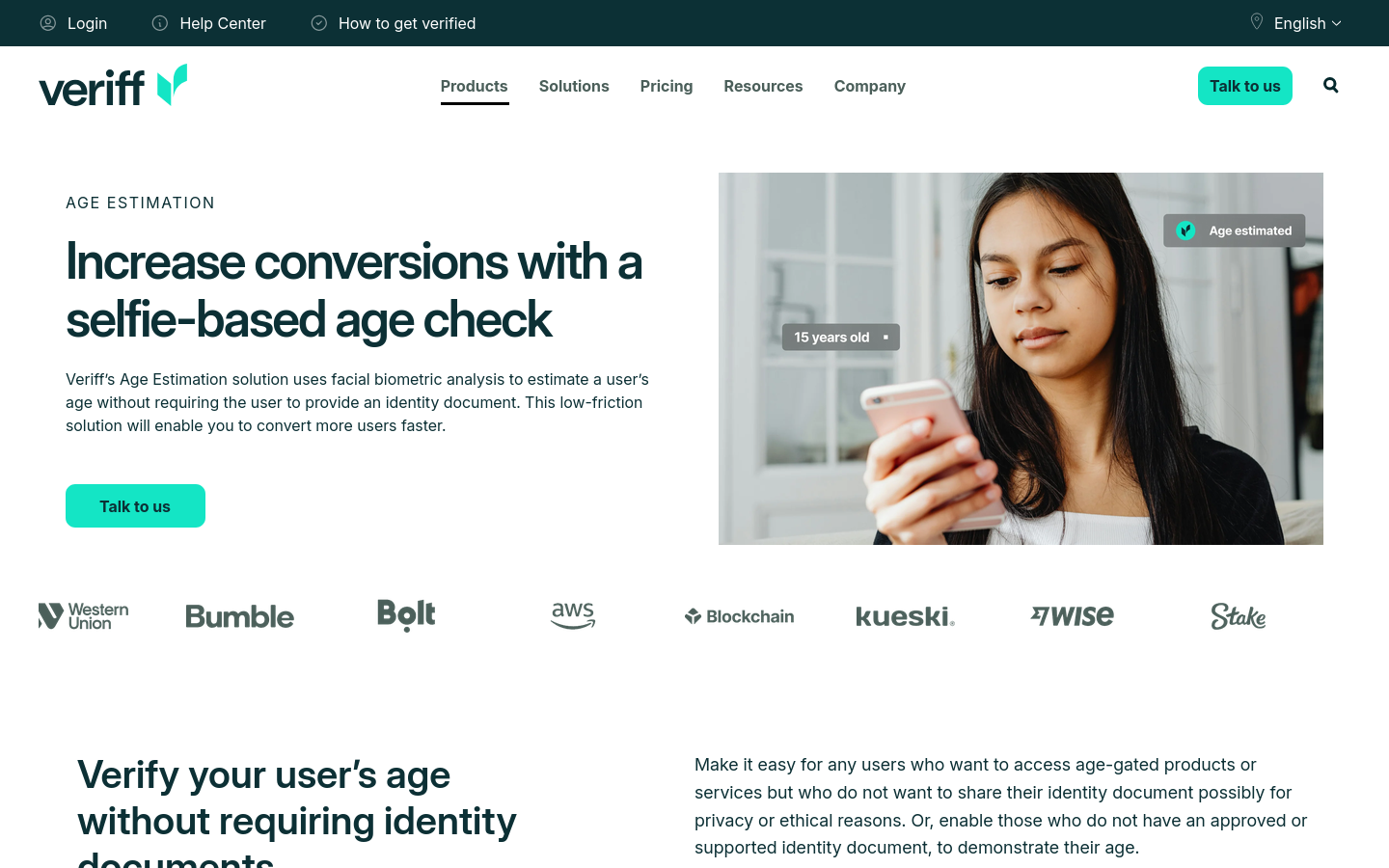
Veriff puts age estimation inside a wider identity-verification and KYC stack. Age is one use case inside that stack. Age Estimation is a selfie-only flow. The user takes a photo, Veriff estimates age, and liveness plus fraud checks run in the same session. The platform returns an estimated age so you can allow, deny, or step up to document verification. Assisted image capture, device and network analytics, and 50-language localisation sit around that selfie. The broader identity product verifies government IDs (Veriff cites 12,500-plus document types) with face match when you need a date of birth rather than a band.
Self-serve plans on Veriff's pricing page are published for identity verification sessions (Essential, Plus, Premium, with monthly minima). Age Estimation is listed as a named service in Veriff's service description. It does not have its own public rate on that self-serve pricing page. Do not treat the IDV per-verification price as the age-estimation price unless your order form says so. Certifications printed on the Age Estimation page include SOC 2 Type II, ISO/IEC 27001:2022, ISO/IEC 30107-3 Levels 1 and 2, UK Cyber Essentials, and UKDIATF. That is IDV-grade security labelling. None of it is an ACCS or ISO/IEC 27566 age-assurance certificate.
Best for: Teams already buying Veriff for IDV/KYC that want a document-free selfie estimate, with a government-ID fallback in the same vendor.
Key features:
- Selfie age estimation with liveness and fraud checks, no identity document required
- Step-up to full document verification and face match in the same stack
- Assisted capture, device/network analytics, and a large document library for the ID path
Why we like it: A user who will not (or cannot) show a passport still gets a selfie decision, and the same vendor can demand the document when the estimate lands in the buffer, without a second integration.
Notable limitations:
- Age is one service inside IDV. You are buying Veriff's identity platform, with age as a flow
- Age Estimation has no separate public rate on the self-serve IDV pricing
- No ACCS or ISO/IEC 27566 certificate for Age Estimation appears on the public registry. Ask for the evidence pack that covers estimation as well as document IDV
Pricing: Identity-verification self-serve plans are public (Essential from $0.80 per verification with a $49 monthly minimum). Age Estimation is a listed service without a dedicated public rate on that pricing page. Quote the estimation SKU separately.
iDenfy
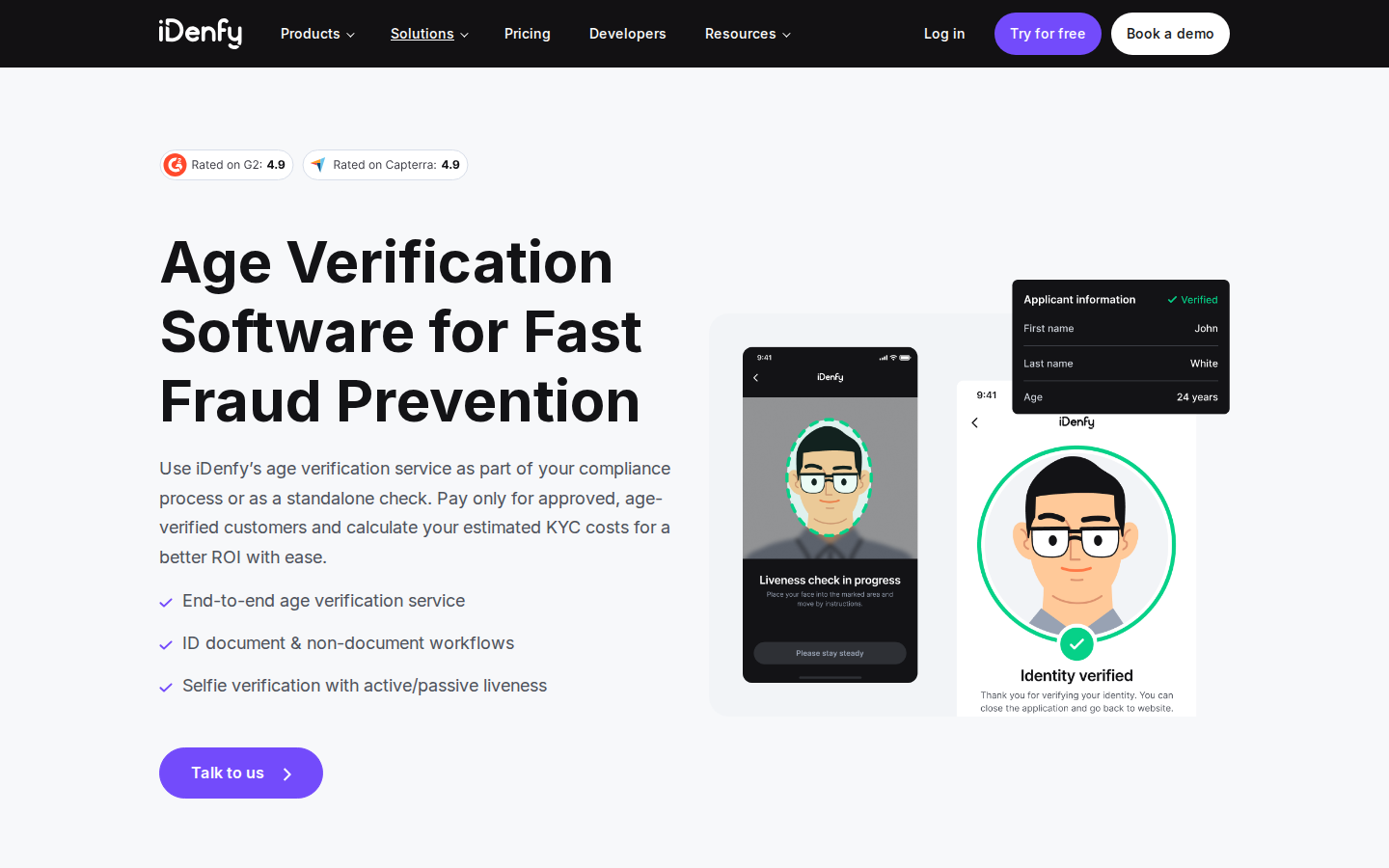
iDenfy is the startup-budget IDV pick on this shortlist, with a printed per-check price. Age is one use case inside a broader identity-verification platform (KYC, optional KYB and AML). Age verification here is a min/max rule on a government-ID flow, tagging UNDER_AGE or OVER_AGE from the date of birth on the document. Age estimation is a separate selfie-first session, with its own token, billing, and webhook, a configurable limit and buffer, and an optional step-up to an ID when the estimate is uncertain. iDenfy states you can change age limits in the dashboard or API, including for Shopify and other plugins.
The pay-as-you-go plan lists a per-verification rate and a monthly minimum on Basic, with a higher Premium floor. So the per-check price is not the whole bill. Optional approved-only billing (failed, fraud, and abandoned sessions unbilled) is an add-on on the comparison table. A short trial with a small number of identity checks is offered. Enterprise is volume quote. Use this platform when you need a public IDV price to start, and age is a rule on that IDV (or a selfie estimate you enable next). Do not use it as a substitute for Yoti Keys, VerifyMy email, or k-ID parental consent.
Best for: Early-stage teams that want published IDV pricing, an age rule on the document flow, and an optional selfie estimate, and will accept a monthly PAYG floor.
Key features:
- Age verification as min/max limits on the KYC document flow
- Standalone selfie age estimation with buffer and ID step-up
- Public pay-as-you-go IDV pricing, API/SDK/no-code, optional approved-only billing
Why we like it: You can turn on an 18+ document rule this week from a dashboard, with a price you can put in a spreadsheet, without waiting for an enterprise age-assurance RFP to come back.
Notable limitations:
- Age sits inside IDV. Parental consent, reusable Digital ID, and email estimation are not this product
- PAYG is not unlimited. The plan carries a monthly minimum
- Age estimation accuracy is described as a roughly three-year range in iDenfy's own explainer. Confirm buffers before you treat a selfie as an 18+ wall
Pricing: Pay-as-you-go lists $1.35 per verification with a $135 monthly minimum on Basic. Approved-only billing and extras are separate lines. Enterprise is quote.
Age methods compared
| Platform | Facial estimation | Email estimation | ID document and reusable ID |
|---|---|---|---|
| Yoti | Yes. Selfie, liveness, anti-spoofing | Yes, as one of the listed methods | Document plus selfie. Digital ID wallet. Yoti Keys on-device |
| VerifyMy | Yes, as a step-up from email | Yes. Signature method, OTP ownership | ID scan, and ID plus face match. No Yoti-style Keys product |
| Persona | Yes. Selfie estimation with buffers | Not the headline method | Document plus selfie, including Age 18+ verified claims. mDL on higher plans |
| Incode | Yes, including on-device | Email listed among phone/data signals, not as the core product | Documents, digital IDs, government records. No consumer Keys wallet |
| k-ID | Via AgeKit+ multi-method assurance, not AgeKit alone | Not the product story. Parent email is a VPC channel | Parent ID/card/SSN for consent. Player reusable consent across titles |
| Veriff | Yes. Dedicated Age Estimation selfie | Not listed as an estimation method on the Age Estimation page | Full IDV plus face match as the certainty path |
| iDenfy | Yes. Separate age-estimation session | Email OTP exists as an extra, not as age estimation | KYC document flow with age limits. Digital IDs listed on the IDV plans |
Certification, regions, and data handling
| Platform | Certification on the public record | Regions and fit | Data handling |
|---|---|---|---|
| Yoti | ACCS 1:2025 and ISO/IEC 27566-1:2025 on AVS 2026-2.1 (to 6 Sep 2029). Aug24 facial ACCS 1:2020 Level 2 (to 21 Oct 2026) | UK/EU default. 200-plus countries claimed for scale | Facial data deleted after estimation. Keys hold an encrypted result, not personal details |
| VerifyMy | ACCS/2026/004, ACCS 1:2025 and ISO/IEC 27566-1:2025, issued 21 May 2026, valid to 20 May 2029. IEEE 2089.1 entry for the estimation API | Global methods. Strong adult, alcohol, e-commerce references | Email deleted after the check. No mailbox access, no marketing use, per product copy |
| Persona | SOC 2 Type 2. Australia Age Assurance Technology Trial cited by Persona. No ACCS ISO 27566 certificate on the public registry | Consumer platforms, self-serve. Geography-aware policies in the orchestrator | Immediate redaction after estimation. Pay per successful verification on contracts |
| Incode | iBeta Level 3 PAD (ISO/IEC 30107-3) claimed. 40-plus jurisdictions claimed. No ACCS ISO 27566 certificate on the public registry for this SKU | USA, UK, EU, Brazil, Australia named. Enterprise social and marketplace | On-device: face stays on phone. Automated redaction and deletion claimed on the cloud path |
| k-ID | SOC 2 Type 2 and ESRB certified, claimed on AgeKit. Not an adult-content ACCS pack | 200-plus jurisdictions, including US states and EU members. Games and kids' apps | AgeKit returns categories, not exact ages. VPC stores parent consent, not a player selfie by default |
| Veriff | SOC 2 Type II, ISO 27001:2022, ISO/IEC 30107-3 L1/L2, UKDIATF, printed on Age Estimation. No ACCS ISO 27566 certificate on the public registry for this SKU | Global IDV. Age as one flow inside that stack | Selfie for estimation. Document path collects ID images. Retention is a plan/add-on topic |
| iDenfy | ISO 27001 and SOC 2 commitments appear on Enterprise copy. No ACCS ISO 27566 certificate on the public registry for this SKU | Global document coverage claimed. Startup and mid-market IDV | PAYG retention listed at 12 months. Enterprise up to 8 years. Deletion API listed |
Strategic Decision Framework
Four questions before you sign.
| Critical question | Why it matters | What to evaluate | Red flag |
|---|---|---|---|
| Does the statute want estimation, or a verified age? | Ofcom's highly effective test, DSA Article 28, Australia's under-16 social rule, and US state adult-content bills do not ask for the same evidence. | Name the market and the threshold (16 vs 18 vs parental consent). Ask which method on the order form maps to that duty. | A single global selfie estimate sold as "compliant everywhere," with no step-up for the markets that want an ID or a parent. |
| What certification actually covers the SKU? | ACCS and ISO/IEC 27566 certificates are scoped to a named system version. An ISO 27001 logo on the IDV platform is not the same paper. | Read the schedule: methods in scope, online-only limits, expiry. Match Yoti AVS, VerifyMy platform, or whoever you picked, not a sibling product. | The sales deck cites a certificate for a model or API you are not buying, or the date is already inside the expiry window of the facial model. |
| What is retained, and what happens if you leave? | Age checks create biometrics, documents, or parent records. Retention and export terms decide whether you can switch vendors without stranding users. | Deletion after estimation, Keys/wallet reuse that you do not own, PAYG retention windows, and whether reusable tokens die on churn. | Indefinite selfie storage with no deletion SLA, or a reusable credential that only works inside one vendor's walled garden after you cancel. |
| Are Apple or Google age signals enough for a mobile-only app? | Apple's Declared Age Range API and Google Play Age Signals can return a band, a source tier, and parental-control state. They are store APIs, not a UK/EU age-assurance platform. | Whether your duty is a store age band for an iOS/Android app, or highly effective assurance for web, adult, or social access in named countries. | Shipping only the free store signal for a web service, an adult site, or a jurisdiction that expects ACCS-grade methods and an evidence pack. |
What usually goes wrong when buying an age assurance platform
Most mismatches happen because a full KYC file is bought for a soft age band, because one global gate is hardcoded for every country, because store age APIs are treated as Ofcom-grade assurance, or because an IDV vendor is assumed to be an age-assurance specialist.
| Problem | Solution |
|---|---|
| You run full KYC (document, selfie, AML) where estimation would have cleared the adult | Start with facial or email estimation, keep a buffer, and step up to ID only for uncertain ages or high-risk markets. Yoti, VerifyMy, Persona, Incode, and Veriff all have that pattern if you configure it |
| One global age-13 or age-18 gate for every country | Thresholds and approved methods differ by jurisdiction (COPPA 13, GDPR 13 to 16, Australia social 16). Use k-ID AgeKit or another jurisdiction pack, then attach the assurance method that market actually requires |
| Apple Declared Age Range or Play Age Signals is the entire web compliance plan | Use store APIs for in-app, store-distributed experiences. For UK OSA, EU DSA, Australian social, or US adult-content duties on the open web, buy a method you can evidence |
| You hire an IDV vendor and assume parental consent and reusable Digital ID are included | Veriff and iDenfy are IDV stacks with an age flow. Parental consent is k-ID. Reusable Digital ID and Keys are Yoti. Email-first adult checkout is VerifyMy. Do not flatten those jobs |
Bottom line
If the service is UK or EU social, adult, or UGC and you want facial estimation plus a reusable Digital ID or Key, start with Yoti and confirm which ACCS schedule covers the methods on the order form. If the job is adult, alcohol, or e-commerce conversion and an inbox is enough for most users, start with VerifyMy and budget the ID step-up for unscored emails. If you want self-serve thresholds, buffers, and ID fallback on a consumer platform, start with Persona Essential and confirm age estimation is in that plan. If you are an enterprise platform that needs on-device estimation and injection defense across many laws, start with Incode and demand the 40-plus list in writing.
If you ship games or kids' apps, start with k-ID AgeKit for the rules and Family Connect for parents. Do not use it as your only adult-content verifier. If you already run (or want) a full IDV/KYC vendor and age is one more flow, start with Veriff for a selfie estimate next to documents, or iDenfy when you need a printed per-check IDV price and will live with the PAYG monthly floor.