

KYB is not KYC with a company name field. KYC proves a person. AML screens a name against lists. KYB proves the legal entity: registry lineage, filing owner versus tax-ID owner, and who actually controls the account. Buy the person stack for the person. Buy the entity stack for the entity.
Mixing them is how a $1.35 user-verification rate ends up in a KYB model. The homepage will call both “verification.” The invoice will not.
We compared four platforms on that split: whether a KYB check has a public price, which countries are actually in the payload, and what happens when the register is empty. If you need a printed per-check rate and registry lineage, start with The KYB. If the same applicant is a person and a company in one session, Sumsub is the hybrid queue. If the footprint is many countries and the register runs out, Trulioo is selling the step after the record. If the entities are U.S., Middesk is Secretary of State plus TIN.
What usually goes wrong when buying KYB
Most quotes in this category fail for the same few reasons. The fix is operational, not a new acronym.
| Problem | Solution |
|---|---|
| A KYC user rate is sitting in a KYB model | Separate person verification from the entity check |
| The payload cannot say what happened when the register was empty | Ask what record they store when the filing is missing |
| The published rate is Basic KYC, not KYB | Use the public KYB rate when one exists. Otherwise treat business verification as custom-priced |
| Country-count slides hide which registers are actually in the payload | Write the geography the check covers before you buy |
How we evaluated KYB platforms
Four facts, all readable before a call: whether the check traces to a registry, what happens when that register is empty, whether any KYB price is public, and which geography the payload actually covers. Country-count slides did not move a ranking. Person-only KYC stacks and regional scrapers sit in What we left out because they sit outside the four questions this page asks.
TL;DR: The Four Compared
| Service | Best for | What to check |
|---|---|---|
| The KYB | Registry-first checks and a printed per-check price |
When emptyIn-house MLRO review and paid EDD reports
PricePlus: $3 per basic KYB check, 100-check minimum. Enterprise custom
Watch-outThe grid does not say whether Plus walks past the first legal entity. Confirm it before buying
|
| Sumsub | Person and company in one flow, plus a human queue |
When emptyIn-house review of corporate documents the registry will not resolve
PriceBasic $1.35 and Compliance $1.85 are user verification. KYB is Enterprise, quote-only
Watch-outDo not drop the $1.35 line into a KYB model
|
| Trulioo | Multi-country onboarding when the official register is thin |
When emptyUBO Discovery Agent reconstructs ownership and reports gaps
PriceQuote only. Volume, country mix, and datasource groups move it
Watch-outNot every source is a direct registry pull. Ask for per-country source lineage if auditors will review the evidence
|
| Middesk | U.S. entities at volume: SOS, TIN, and monitoring |
When emptyIt will not invent a foreign UBO
PriceCustom
Watch-outU.S. only. Policy changes at a secretary of state office become your outage
|
The KYB
The KYB is a registry-first verification platform: pull the official record, map directors and UBOs, screen the people, keep watching the entity. After FinCEN no longer required U.S. companies to file beneficial ownership reports, a vendor that can show you the registry source matters more than a country-count slide. The registry is the product. The scan is the receipt.
It is also the only name here that prints dollars for a basic KYB check. That is why it is on this shortlist: you can put a number in a budget before the first sales call.
Best for: Compliance teams that want data lineage back to government registries and a printed per-check price.
What you get:
- Real-time official registry search, document retrieval, and UBO identification from the registry record.
- AML, adverse media, enforcement, licensing, and bankruptcy or liquidation screening on the same file.
- In-house MLRO review when the file is ugly, plus paid enhanced due diligence reports.
- Perpetual KYB change alerts on company status, officers, and addresses.
Why we like it: A $3 line you can defend in a spreadsheet, tied to a registry pull, is rarer than a 250-country homepage.
Limits:
- Plus lists 204 countries and states. Enterprise lists 250-plus. Read the quote line.
- Smaller public review footprint than Sumsub or Trulioo. Pilot with your actual jurisdictions.
- Registry quality still varies by country. A coverage headline is not a per-market match rate.
Price: On the pricing page, Plus is $3 per basic KYB check, minimum 100 verifications, one back-office user. AML screening is another $3. Business document verification $2. Business info questionnaire $2. Analyst-led due diligence $50 per report. Official documents at registry cost plus 25%. Perpetual monitoring +$0.50 per verification. Enterprise is custom volume pricing, with 25 free verifications at activation.
Sumsub
Sumsub Business Verification is KYB on the same platform as KYC: registry check, UBO and director verification, questionnaires, AML, and a human queue when the registry is empty. When the record is a PDF in a language nobody on the team reads, you need a named reviewer - that review path is what the hybrid product is actually selling.
The pricing page is easy to misread. Basic at $1.35 and Compliance at $1.85 are end-user KYC. Business Verification sits on Enterprise, which is quote-only. A $1.35 user-verification rate is a tempting line to drop into a KYB model. It is a different product.
Best for: Teams that already need person verification and want business verification in the same workflow, with a manual escalation path for layered ownership.
What you get:
- Registry checks, then UBO and director KYC in the same flow.
- In-house compliance review for documents registries will not resolve.
- AML with hit analysis against a large list set.
- Company-level risk scoring, periodic rechecks, and document expiry tracking.
Why we like it: One session can be a person and a company. Most KYB APIs make you glue that together yourself.
Limits:
- The published Basic and Compliance rates are person verification. Budget Enterprise for business verification.
- Reviewers still rate the KYC side as more mature. Pressure-test KYB on your own entity mix.
- Custom workflows have a learning curve. Integration time is real.
Price: User verification from $1.35 (Basic) or $1.85 (Compliance), with monthly minimums. KYB is Enterprise, custom. A 14-day trial includes 50 free checks. AWS Marketplace is a procurement path.
Trulioo Business Verification
Trulioo is the enterprise KYB API for teams that onboard in many countries and do not want a vendor per region. Person and business verification sit on one contract. Most KYB tools fetch a record. Trulioo is now selling the step after the record runs out.
The UBO Discovery Agent sits inside the existing KYB transaction. When the registry stops at the next company in the chain, or there is no central register - including much of the U.S. - the agent reconstructs ownership from filings, disclosures, legal records, OSINT, and Trulioo’s business graph. Gaps are reported rather than guessed.
Best for: Multi-region enterprises that need one API for registry, watchlist, and reconstructed UBO, especially in markets where the official register is thin.
What you get:
- Global KYB with a normalized payload.
- Watchlist, PEP, and sanctions screening on the same transaction.
- UBO Discovery as a flag on the existing API, once the datasource group is on the package.
- Person and business verification on one orchestration layer.
Why we like it: After FinCEN no longer required U.S. companies to file beneficial ownership reports, “the register is empty” is a product feature, not an edge case.
Limits:
- Not every source is a direct registry pull. Ask for per-country source lineage if auditors will review the evidence.
- Setup and country-specific tuning show up in every public review set.
- No public list price.
Price: Quote. Credit-pack and per-record structures are common; none of them are printed.
Middesk
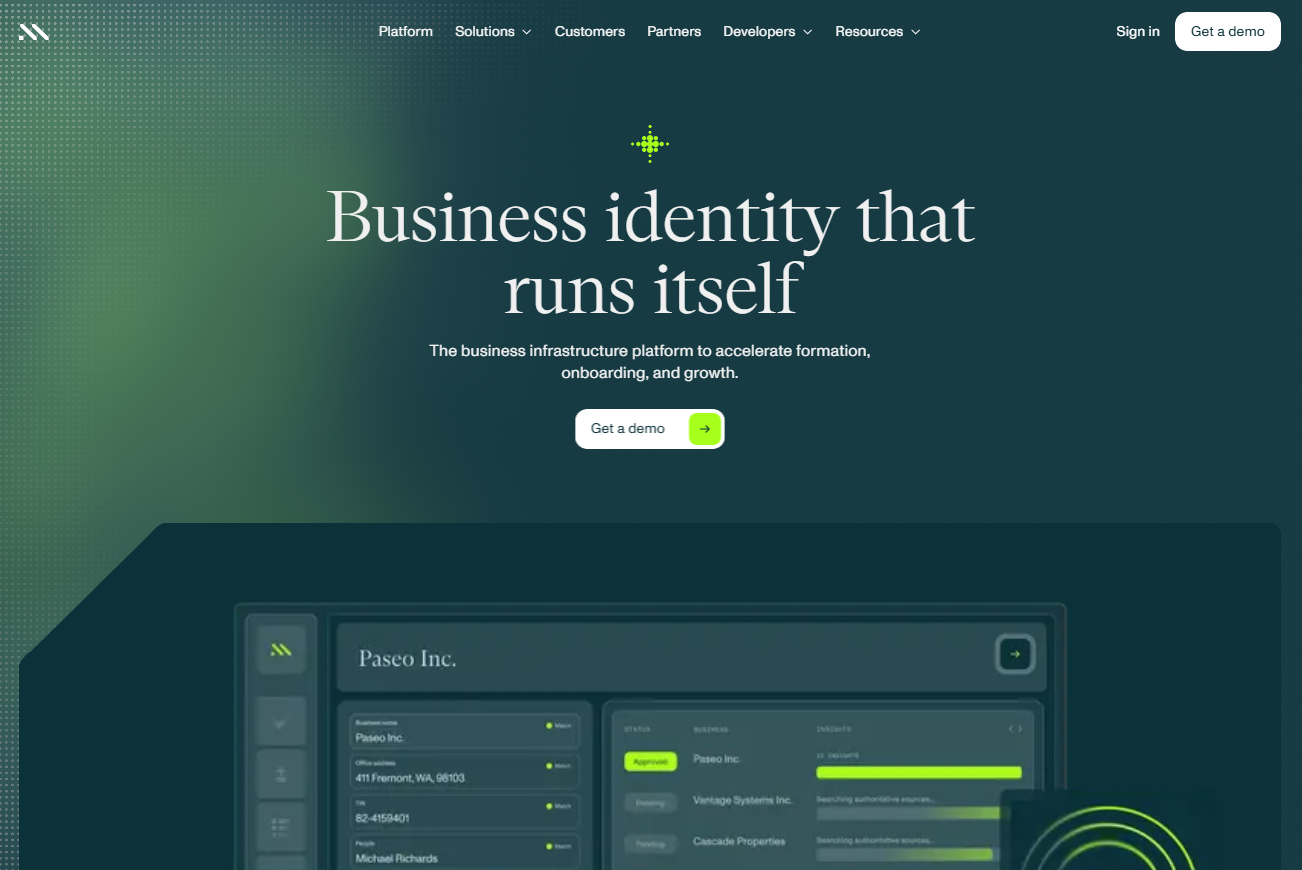
Middesk is U.S. business identity: Secretary of State records, IRS TIN and name checks, formation documents, and ongoing monitoring. That U.S. focus is the point. With FinCEN no longer requiring U.S. companies to file beneficial ownership reports, primary state filings and TIN matching are the record you can still defend.
If most of your legal entities are Delaware, Wyoming, and California LLCs, a global KYB suite is extra connectors you will not tune. Middesk will not invent a foreign UBO, and you should buy it for that limit, not despite it.
Best for: Fintechs, lenders, and B2B platforms that onboard U.S. entities at volume and want SOS plus TIN in one API.
What you get:
- Secretary of State coverage in all 50 states and D.C., registration documents, good standing.
- IRS TIN and legal-name matching on the onboarding payload.
- Continuous monitoring for standing, officers, and adverse signals after the account is live.
- Officer KYC via integrated providers when you need the people as well as the entity.
Why we like it: It does one geography well, and it does not pretend the empty foreign register is a feature it has.
Limits:
- U.S. only. Non-U.S. entities need a second vendor.
- Depends on government data access. Policy changes at the IRS or a secretary of state office become your outage.
- Quote-only. No public per-check rate.
Price: Custom, usually volume plus product mix (verification, monitoring, documents, UBO). Pricing is custom.
Public pricing and country coverage
This grid compares whether KYB pricing is public or custom, and whether the provider covers only the U.S. or multiple countries.
Placement follows published pricing and coverage claims: a public KYB check versus quote-only, and U.S. filings versus multi-country. We placed products. We did not rank logos. Sumsub’s published $1.35 is KYC, so it sits on the quote-only side for KYB.
Pricing and usage costs compared
| Service | Public KYB price | The catch |
|---|---|---|
| The KYB Plus | $3 per basic KYB check | 100-check minimum. AML is another $3. Plus vs Enterprise coverage is not the same list |
| Sumsub | None. KYB is Enterprise | $1.35 / $1.85 are person verification. Successful checks only on the trial math |
| Trulioo | None | Country mix and datasource groups move the quote. Discovery is a flag on the package |
| Middesk | None | U.S. only. Monitoring and documents are separate lines |
What we left out
Real products, different KYB job: a KYB price you can read as KYB, a registry you can defend, or a geography that matches the job.
- Onfido, Jumio, and Persona - person-first KYC. Useful for the people. They fail the entity check the moment a user-verification rate is pasted into a KYB model.
- OpenCorporates - company data, not a KYB review workflow. Fine for looking up a filing. It is not the check, the reviewer, or the queue.
- ComplyAdvantage - AML and name screening. It tells you if a name hits a list. It does not prove registry lineage.
Questions before you pick a KYB API
A quote that cannot answer these three is still a scan.
- U.S. only, or U.S. plus everywhere else? Middesk if the entities are domestic. The KYB or Trulioo if counterparties sit in markets with a thin register. Sumsub if the same applicant is a person and a company in one session.
- Do you need a printed KYB price to start? The KYB Plus is the only printed KYB check on this page. Everyone else’s public dollars are KYC, or there are no public dollars.
- What happens when the registry is empty? Sumsub has a named review queue. Trulioo has the Discovery Agent. The KYB has MLRO review and paid EDD. Middesk will not invent a foreign UBO.
How to pick from this shortlist
Registry lineage and a number you can budget: The KYB. Person and company in one flow: Sumsub, and do not use the $1.35 line. Multi-country after the register runs out: Trulioo. U.S. SOS plus TIN: Middesk. Then put the pricing page next to a sample payload from your real jurisdictions.
Frequently asked questions
Is KYB the same purchase as KYC?
No. KYC proves a person. KYB proves the legal entity. A $1.35 user-verification rate is person verification. Dropping it into a KYB model is how the invoice and the auditor tell different stories.
Did the end of U.S. federal BOI make KYB optional?
No. FinCEN no longer requires U.S. companies to file beneficial ownership reports. That is the 11 August 2026 notice on FinCEN’s BOI FAQs. The 21 March 2025 interim final rule started the rollback. Covered financial institutions still have customer due diligence obligations, while some marketplaces have separate business-verification requirements depending on their activity. The work moved onto state filings, TIN match, and whatever graph the vendor can defend.
Which platform has a public KYB price?
The KYB Plus prints $3 per basic KYB check, with a 100-check minimum. Sumsub’s public dollars are KYC. Trulioo and Middesk are quote-only.