

An AI agent integration platform gives an agent a controlled way to discover and call external tools. The important distinction is whether the platform is built for runtime tool use, or for workflows a person designs in advance. Buyers should also separate products for internal agents from products that manage OAuth and connections for customer-facing agents. A Zapier canvas and an AI gateway that only routes tokens are different products. Neither logs into Salesforce for a customer org.
Start by deciding who owns the connection. If your own employees are running internal agents, you need runtime authorization and tool discovery. If your product connects to each customer’s SaaS accounts, tenant OAuth and connection management become the bigger requirement. Gateway and OEM are not the same quote, even when the catalog looks identical. Connected Users are not seats.
If the agent is the caller and you want Search & Execute or A2A, start with StackOne. If Connected Users already hold the OAuth, Paragon is the reuse. If the team will write TypeScript and wants a $0 cloud plan or a self-hosted runtime, Nango is the code path. If you want a session MCP URL, meta-tools, and a public tool-call price, Composio publishes that rate. The method is on How we review tools.
Problems and Solutions
Most quotes in this category fail for the same few reasons. The fix is operational, not a new acronym.
| Problem | Solution |
|---|---|
| The quote treats a Zap canvas as agent integration | Buy a per-tenant OAuth plus a tool the model can find at runtime, not a design-time canvas |
| The contract is for the wrong product line | Confirm whether the product is designed for your internal agents or for customer-facing tenant connections before signing |
| Catalog counts look like capacity | Budget from the published billing unit: credits, connections, or tool calls |
| Retries and failed tool calls are missing from the model | Read how a repeated call is billed before you sign |
How we evaluated agent integration platforms
We evaluated the platforms on who the OAuth is issued for, whether the product is a team gateway or a tenant embed, whether any price is public, and how a failed or repeated tool call is billed. Catalog counts did not move a ranking. Neighbor products sit under What we left out.
TL;DR: The 7 Compared
| Service | Best for | What to check |
|---|---|---|
| StackOne | The agent is the caller, and you want Search & Execute or A2A - or the same catalog white-labeled for tenants |
OAuthGateway seats for your team, or OEM for your customers. Mixing them is the wrong product line
PriceGateway Starter $0 with 1,000 credits / seat / month. Team $600/mo with 5,000 credits / seat. Extra credits $60 or $20 per 20k. OEM Core $0
Watch-outSearch plus execute can be two credits. Browser use, premium defense, and data sync cost more than 1
|
| Paragon | A B2B product that already thinks in Connected Users and needs the agent to reuse that OAuth |
OAuthManaged OAuth and API keys per Connected User. JWT in; magic-link when the tenant is not connected yet
PriceQuote-only. Billing is Connected Users. Pro vs Enterprise, no dollars on the page
Watch-outCompetitor teardowns and a G2 trial badge are not a price list
|
| Nango | A team that will write the actions in TypeScript and wants a $0 cloud plan or a self-hosted runtime |
OAuthPer-connection OAuth, API keys, and refresh. White-label Connect UI. You write the functions
PriceFree $0. Starter from $50/mo. Growth from $500/mo. Then $1 / connection after the included bundle
Watch-outProxy requests, function runs, sync records, and webhooks each print at $0.0001. Compute is $0.0000002 / ms
|
| Composio | A per-user MCP URL and meta-tools, with a public tool-call price you can put in a model |
OAuthSession-scoped.
composio.create(user_id) returns a managed MCP URL plus search / authenticate / executePriceFree $0, hard-capped. Pro $29/mo includes a $29 usage credit, then $0.0003 / tool call and $0.003 / trigger
Watch-outAWS still prints Starter $29 and Growth $229. Prefer composio.dev/pricing from 15 Aug 2026. Premium tools bill everyone from 1 Sep 2026
|
| Arcade.dev | Product teams shipping agents that must call SaaS as the signed-in user. |
OAuthRuntime holds user OAuth
PriceFree $0. Team $25 + usage
Watch-outNot iPaaS
|
| Merge Agent Handler | AI products that need a maintained tool catalog plus tenant OAuth, with a printed $0 and $1,000 Product tier. |
OAuthTenant OAuth for product agents
PriceFree $0. Pro $1,000 / month
Watch-outNot Unified API
|
| Pipedream Connect / MCP | Agent builders who want a wide MCP catalog and per-user OAuth without writing each connector. |
OAuthConnect holds tenant OAuth
Price$99 / month annual Connect (confirm)
Watch-outNot Workflows iPaaS
|
The cells pick the product line. The write-ups below are the same seven tools, in the same order, with the billing detail that will not fit in a cell.
StackOne
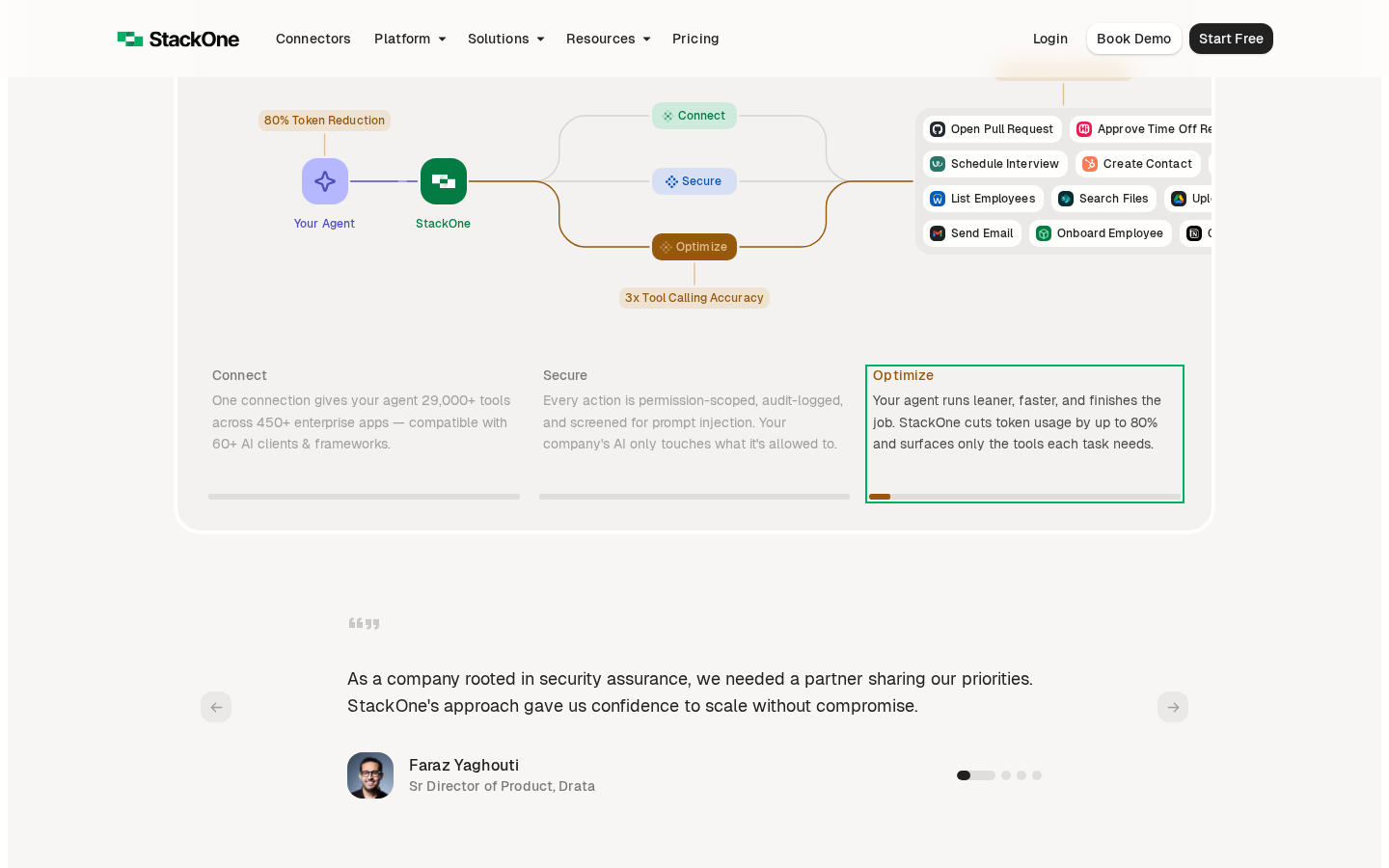
StackOne is the agent-native pole of this list: one MCP, A2A, or REST front door over a SaaS action catalog, plus tool search, human-in-the-loop Agent Auth, and StackOne Defender. Two motions sit on that catalog. Gateway is for a team running its own agents. OEM is white-label for a SaaS product embedding integrations for its tenants. Auth is a basic API key plus x-account-id, or a per-account token URL.
Search & Execute is the product answer to stuffing a Drive transcript through the model twice on the way to a Salesforce lead. The model looks up a tool instead of loading the whole catalog into context. Treat the published connector and action counts as catalog marketing. Unified HRIS/ATS APIs are still in the docs - some buyers will read this as a Merge-class sync and miss the agent surface.
Best for: An internal agent team that needs runtime tool search and A2A, or a SaaS product that wants the same catalog white-labeled, and that will read the credit math before the POC.
What you get:
- A single MCP at
https://api.stackone.com/mcp, or a per-connector/rpc/{connector}/mcp, plus A2A - the only listing here with A2A docs. - Search & Execute so the model looks up a tool instead of loading the catalog into context.
- Agent Auth for human consent on writes; Defender Core on every plan, Defender Premium on Team and above.
- Falcon as an MCP client, an AI Connector Builder on Team and OEM Enterprise, and the older unified HRIS/ATS APIs still in the docs.
Why we like it: You buy it when the agent is the caller. Gateway versus OEM is printed as two motions. The credit FAQ is dated and specific: one tool call is 1 credit; browser use, premium defense, and data sync cost more.
Limits:
- Credit math is easy to undercount. Search plus execute can be two calls.
- The $600/mo Gateway Team plan prints a monthly fee and a seat stepper. It does not print a seat floor we can defend.
- Unified-API heritage is still on the site. Some buyers will buy a sync and miss the agent surface.
- No AWS Marketplace listing.
Price: Published on stackone.com/pricing. Gateway Starter is $0 with 1,000 credits per seat per month; extra credits $60 per 20k. Gateway Team is $600/mo with 5,000 credits per seat per month; extra credits $20 per 20k. OEM Core is $0, with unlimited connected customers and a monthly credit slider. Enterprise and OEM Enterprise are sales calls.
Paragon
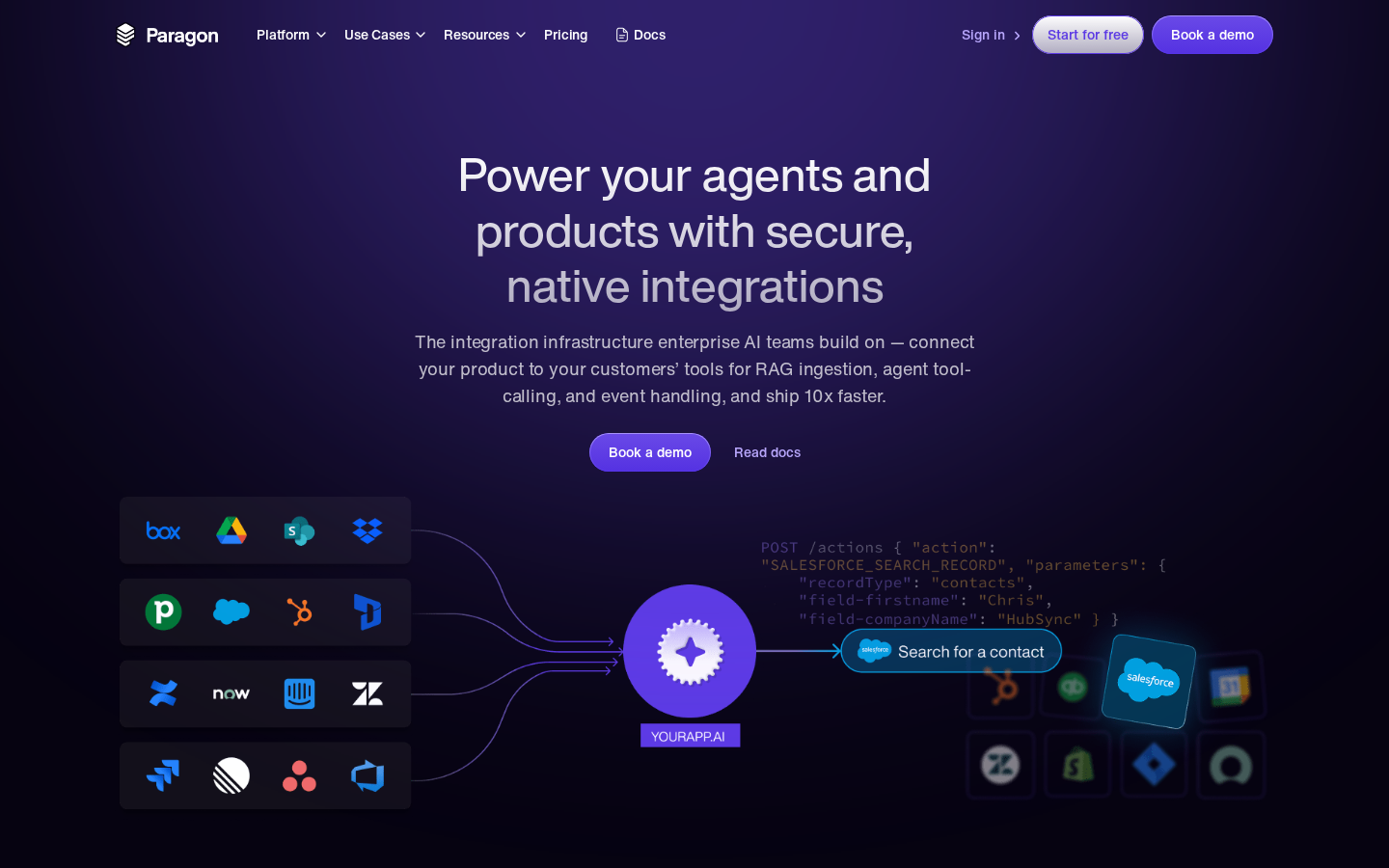
Paragon is embedded integration infrastructure that grew an agent surface on top of a mature Connect Portal. Workflows is the old embedded iPaaS. ActionKit is the agent layer: an API and an MCP for tools, plus triggers. ActionKit lists 130+ integrations and 1,000+ actions. Treat that as catalog marketing. No A2A.
Auth is managed OAuth 2.0 and API keys per Connected User - a customer org. The Connect Portal can be embedded or headless. A JWT user token (RS256) goes from the product to Paragon; a magic-link fires when the end user is not connected yet. Custom actions come from OpenAPI. Enterprise can self-host or forward-deploy. ActionKit Triggers shipped 14 Aug 2026: an agent can subscribe to Slack, HubSpot, or Salesforce events instead of only firing writes.
Best for: A B2B or AI SaaS product that already thinks in Connected Users and wants agents to share the same per-tenant OAuth as the existing embedded integrations.
What you get:
- Hosted ActionKit MCP, and an MIT MCP adapter over the same API. The platform behind it is closed.
- ActionKit Triggers, so an agent can subscribe to events instead of only firing writes.
- Connect Portal for per-tenant OAuth, including multi-account auth and bring-your-own client on some apps.
- Managed Sync and Workflows still ship on the same auth layer. Do not pretend the iPaaS surface is gone.
Why we like it: The agent features sit on an auth runtime that was already built for other people’s customers. If the buyer is “our SaaS embeds Salesforce for our tenants, and now the agent has to use that connection,” this is the motion.
Limits:
- Pricing is quote-only. The pricing page has Pro vs Enterprise and a trial CTA. No dollars. No public free plan.
- No AWS Marketplace listing for ActionKit. Unrelated “Paragon Cloud Services” listings are a different company.
- Closed platform except the thin MIT adapter. No A2A.
- Count providers and the ActionKit catalog is smaller than Nango or Composio.
Price: Quote-only on useparagon.com/pricing. Billing is Connected Users. Enterprise adds self-host, SAML SSO, HIPAA, and SLAs. A G2 product page showing Pro as a $0 free trial is a trial badge, not a list rate.
Nango
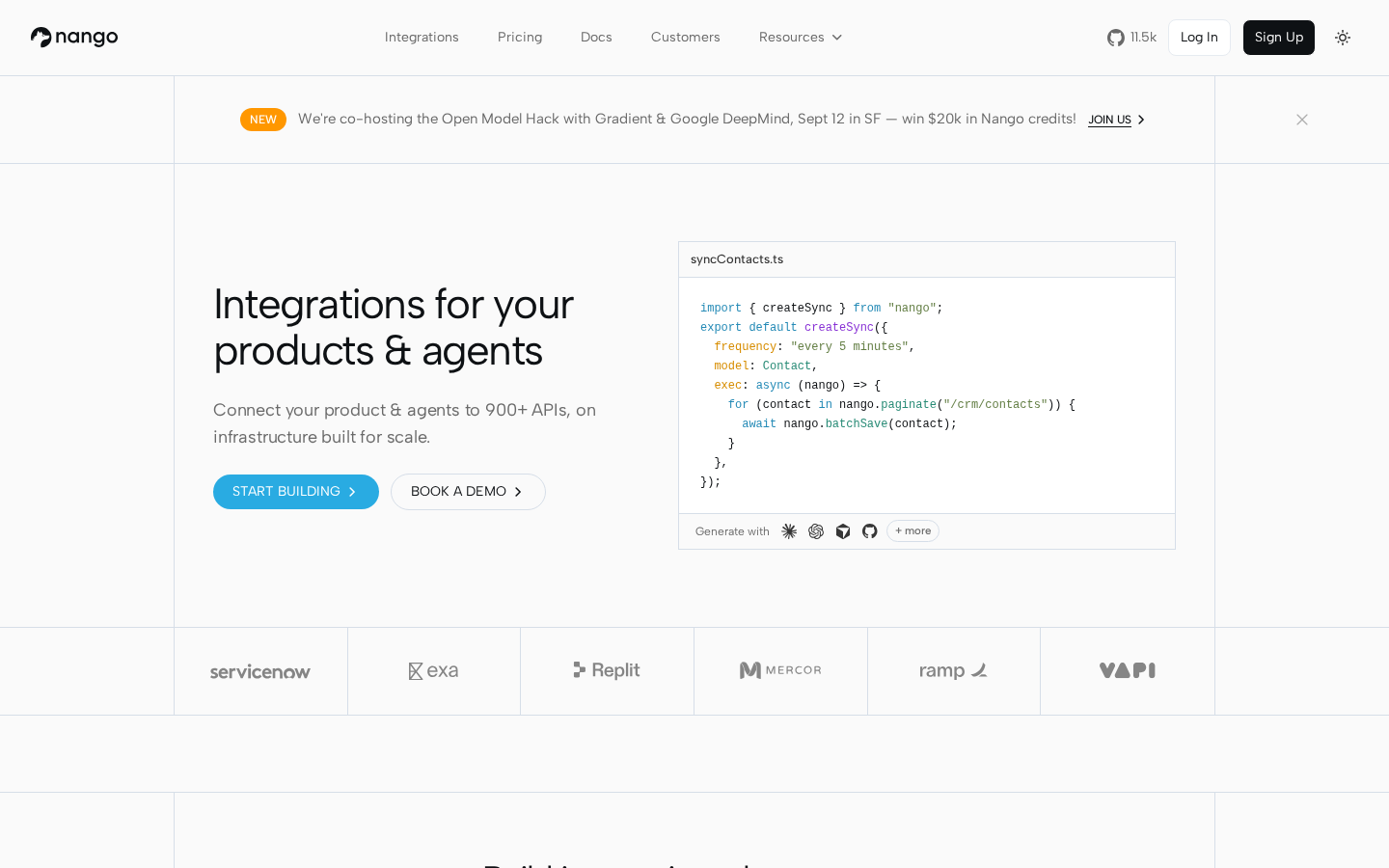
Nango is the code-first pole. You, or a coding agent, write TypeScript functions. Nango runs auth, execution, syncs, and webhooks, then exposes those actions over REST or a hosted MCP. It publishes 900+ APIs and 6,000+ templates. Treat that as catalog marketing. The product is APIs you auth plus functions you write. Nango argues that is the point.
Hosted MCP lives at https://api.nango.dev/mcp (Streamable HTTP; Authorization, connection-id, provider-config-key). A Management MCP (beta) at https://mcp.nango.dev/mcp covers logs, plus CIMD and dynamic client registration for connecting users to other MCP servers. Self-host is under Elastic License 2.0 - source-available, not OSI Apache. No A2A. No AWS Marketplace listing.
Best for: Engineering teams that will write the actions in TypeScript, want a $0 cloud plan or a self-hosted runtime, and do not need a visual Zap builder.
What you get:
- Hosted MCP plus runtime discovery via
GET /scripts/config. - A Management MCP (beta) for logs, CIMD, and dynamic client registration.
- White-label Connect UI, per-connection OAuth / API keys / refresh, and a Function Builder skill for Claude, Cursor, and Codex.
- Self-host under Elastic License 2.0.
Why we like it: It is the only listing here you can start at $0 and read as code. The overage table is public and mechanical: connections, proxy requests, function runs, sync records, webhooks, compute milliseconds, custom logs.
Limits:
- You write the actions. A catalog-only team will feel this as empty.
- Syncs are migrating to Lambda with a 10-minute cap. The note is in the 2026 changelog.
- No A2A. No AWS Marketplace listing. ELv2 is not Apache if you embed the code in a closed product.
Price: Published on nango.dev/pricing. Free $0. Paid plans start at $50 per month. Growth starts at $500 per month and adds larger included usage. Enterprise is custom. Extra connections are $1 each after the included bundle. Usage beyond the included allowance is billed separately.
Composio
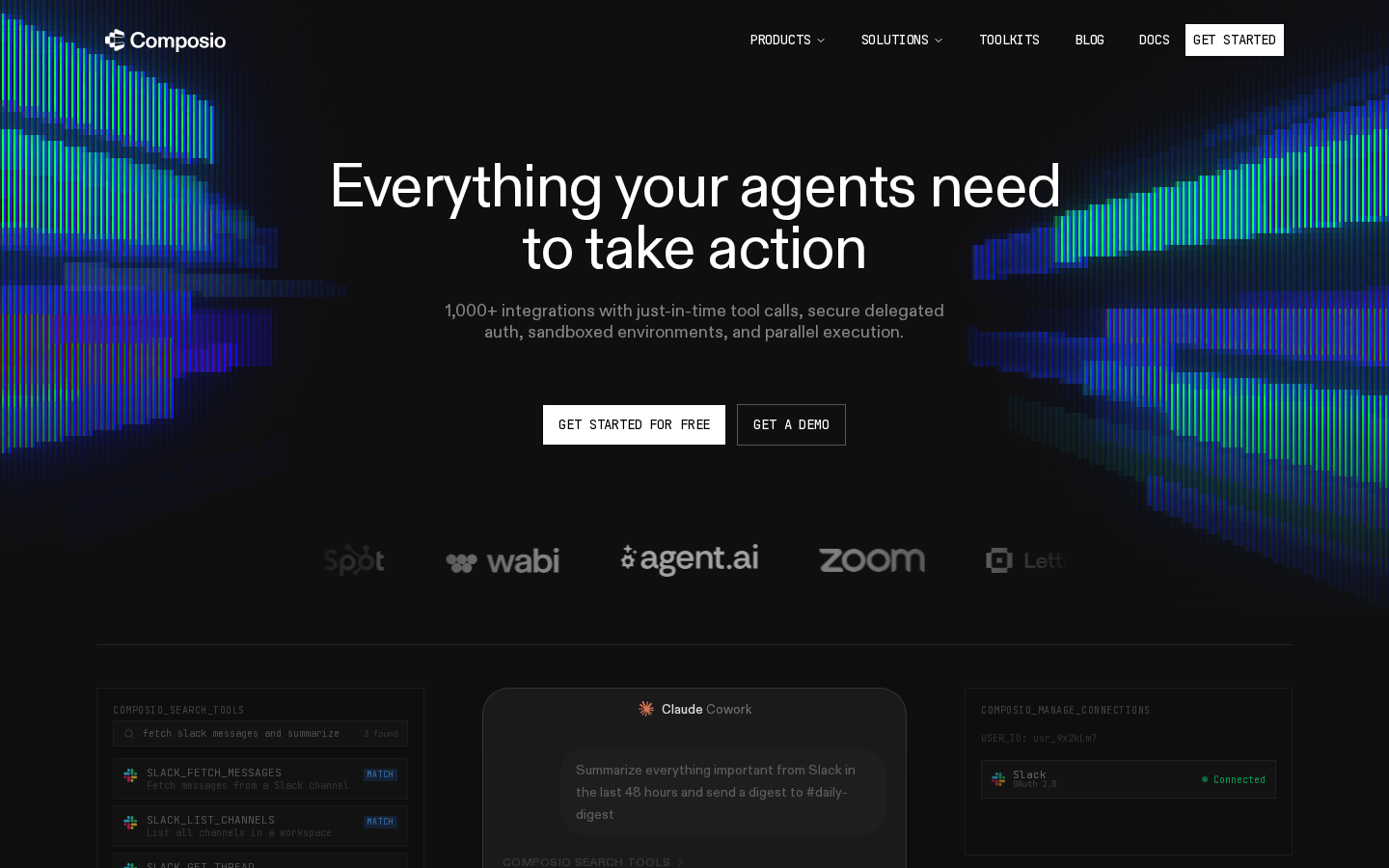
Composio is a session-scoped tool catalog. You create a session for a user, get a managed MCP URL plus meta-tools (search, authenticate, execute), and run tools with Composio-managed OAuth. The how-it-works doc is the cleanest picture of that session model. The site says 1,000+ toolkits. The AWS Marketplace listing still says 250+ tools. Prefer the site. No A2A.
New signups on or after 15 Aug 2026 sit on the current list. Grandfathered customers keep the old list through 31 Dec 2026. Premium tools start billing everyone on 1 Sep 2026, including pre-15 Aug accounts. composio.dev/pricing now prints approximate pass-through prices for a few of those tools. The AWS Marketplace listing still shows Starter and Growth. Those plan names do not match the site.
Best for: Teams that want a per-user MCP URL and meta-tools, a public tool-call price, and are willing to ignore the stale AWS Marketplace listing.
What you get:
composio.create(user_id)returnssession.mcp.url.- Meta-tools for search, auth, and execute. The docs say meta-tools like tool search are free and never billed.
- Composio-managed OAuth apps, or bring-your-own. Self-managed credentials are listed as Included.
- A sandbox for untrusted tool code. SDKs are public; the platform is closed.
Why we like it: It is the only listing here with both a public reprice (15 Aug 2026) and an AWS listing. You can put $0.0003 per tool call in a spreadsheet. You still have to ignore the marketplace plan names.
Limits:
- Catalog (1,000+ vs 250+) disagrees across the product site and AWS copy.
- AWS prices and usage units look older than the 15 Aug site. Prefer the site.
- Hard cap on the Free plan: 100k tool calls, 50k triggers, 3 members.
- No A2A. Composio-managed apps use a smaller free slice (up to 20k of the 100k tool calls), then a higher rate.
Price: For signups on or after 15 Aug 2026, on composio.dev/pricing. Free $0, hard-capped at 100k tool calls and 50k triggers. Pro $29/mo includes a $29 usage credit that resets monthly, then $0.0003 per tool call and $0.003 per trigger. Grandfathered customers keep the old list through 31 Dec 2026. Premium tools start billing everyone on 1 Sep 2026. AWS still shows Starter $29/mo (500 users, 100k API calls) and Growth $229/mo (3,000 users, 600k API calls).
Arcade.dev
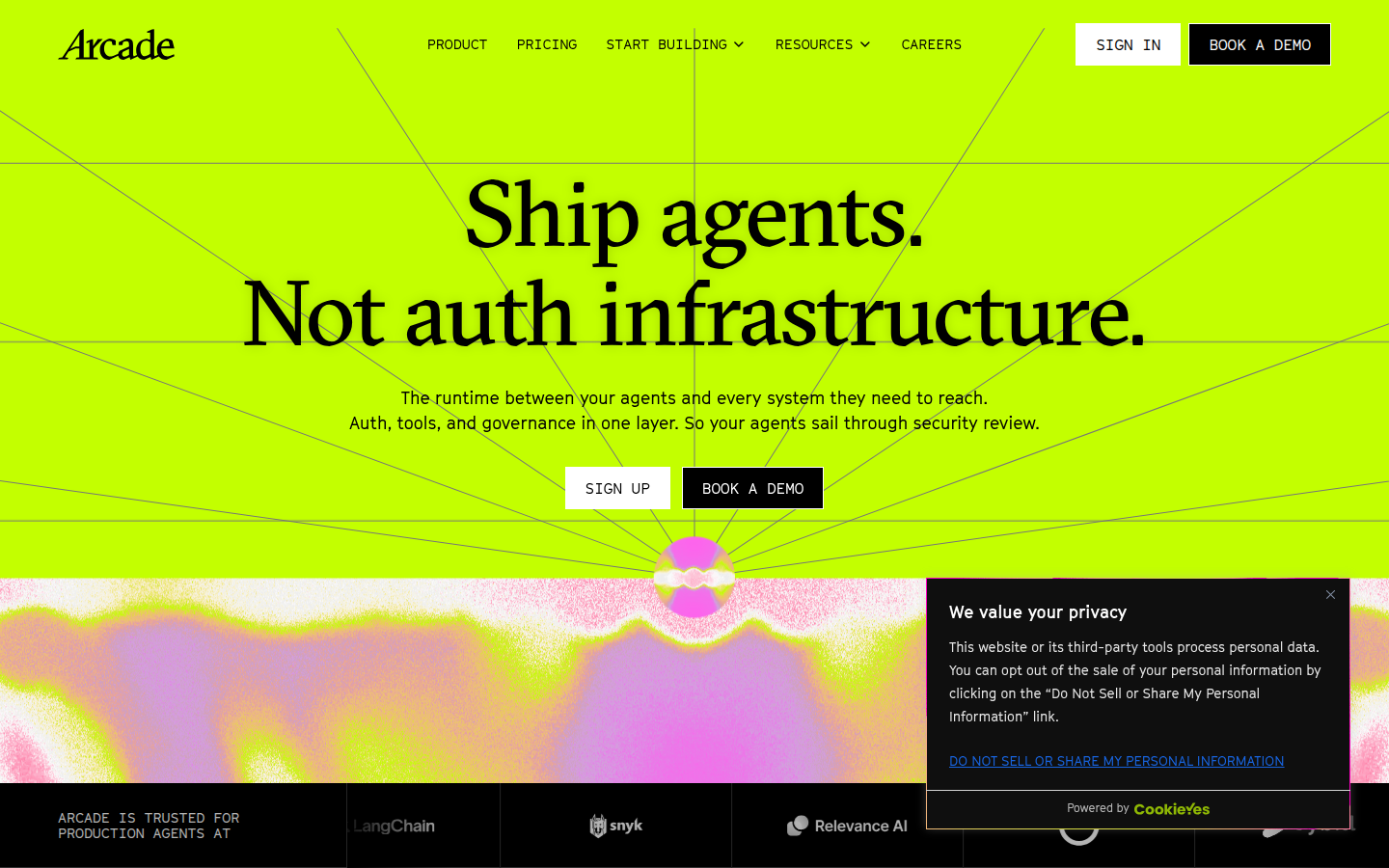
Arcade.dev is an MCP runtime between agents and SaaS. User-level OAuth. Credentials stay in the runtime. Free is $0 / month (2,000 auth events and 2,000 tool calls). Team is $25 / month plus usage: auth events $0.10, tool calls $0.01. Enterprise is custom. Published on arcade.dev/pricing.
Arcade.dev is a stronger fit when user-level authorization and controlled access matter more than having the largest connector catalog.
Best for: Product teams shipping agents that must call SaaS as the signed-in user.
What you get:
- MCP runtime with user-level OAuth
- Free $0 and Team $25 + usage
- Cloud, VPC, or air-gapped on Enterprise
Why we like it: The pitch is MCP authorization, not iPaaS and not an LLM gateway.
Limits:
- Free and Team are Arcade Cloud only
- Billing is auth events and tool calls, not seats
Price: Free $0 / month. Team $25 / month plus $0.10 per auth event and $0.01 per tool call. arcade.dev/pricing.
Merge Agent Handler
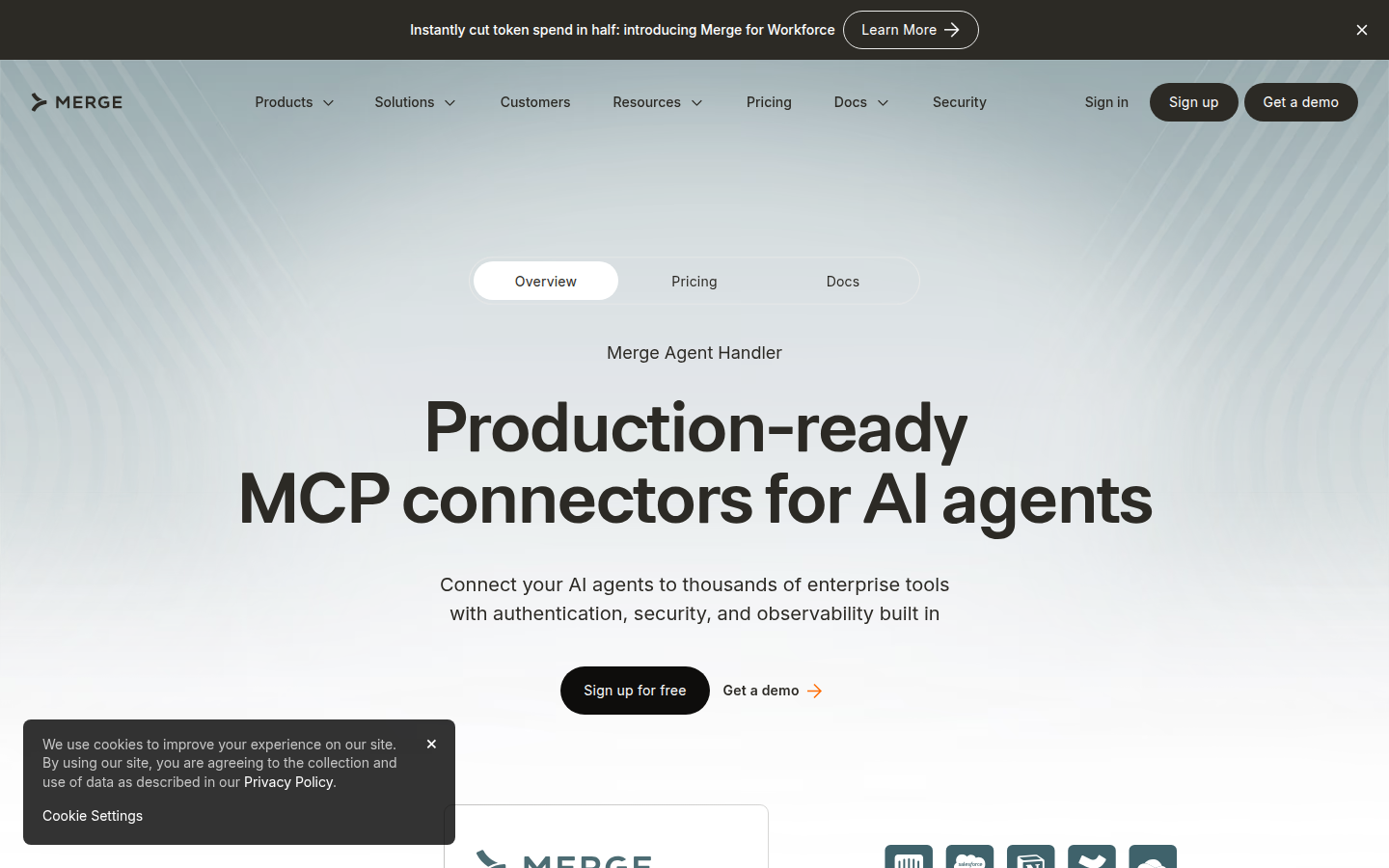
Merge Agent Handler is Merge’s agent tool layer, not Merge Unified API. Product: Free $0 / month with 2,000 credits. Pro $1,000 / month with 25,000 credits. Workforce Pro is $10 per user / month. Unified API bills linked accounts, which is a different product. Do not mix them. Published on merge.dev/pricing/agent-handler.
Merge Unified API is for teams that want normalized HR, CRM, accounting, and other business data behind one API. Agent Handler is the separate path for AI agents that need managed tools and tenant authentication.
Best for: AI products that need a maintained tool catalog plus tenant OAuth, with a printed $0 and $1,000 Product tier.
What you get:
- Production MCP connectors with managed auth
- Free $0 / 2,000 credits. Product Pro $1,000 / 25,000 credits
- Workforce plan at $10 / user / month
Why we like it: You want Agent Handler because the agent calls the tools. Unified API is the older linked-account product.
Limits:
- Product Pro does not print the overage per-credit rate
- Do not buy Unified API for this job
Price: Product Free $0. Product Pro $1,000 / month. Workforce Pro $10 / user / month. Agent Handler pricing.
Pipedream Connect / MCP
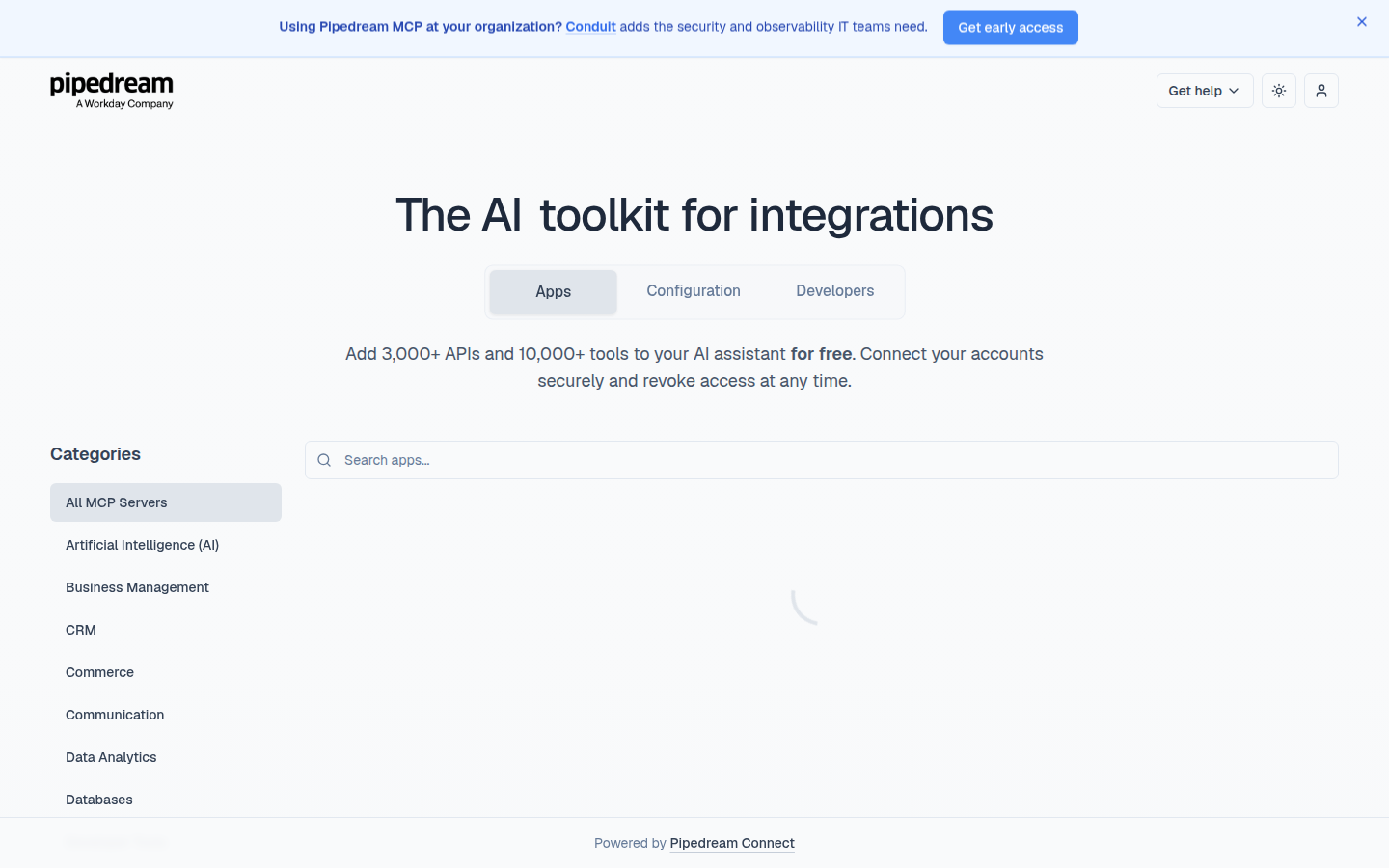
Pipedream Connect / MCP is Pipedream’s MCP catalog plus Connect tenant OAuth. Hosted MCP for your own accounts is free. Production Connect has listed at $99 / month billed annually (10,000 credits, auth for 100 external users). Confirm the Connect tab on pipedream.com/pricing. This is not Pipedream Workflows.
This is not Pipedream Workflows. Zapier and Workato belong with iPaaS, because a person draws the flow at design time rather than giving an agent a runtime catalog of tools.
Best for: Agent builders who want a wide MCP catalog and per-user OAuth without writing each connector.
What you get:
- MCP servers for a large app catalog
- Connect tenant OAuth
- Production Connect plan (confirm $99 annual)
Why we like it: The docs match the bar: multi-app MCP tools plus tenant OAuth.
Limits:
- Development mode is not for real customers
- Workflows is billed separately
Price: Hosted MCP for your own accounts is free. Production Connect has listed at $99 / month annual. Confirm on pipedream.com/pricing.
Who holds the OAuth, and who writes the action
This grid plots two questions. Across is who the connection is for: your team’s agents on the left, your tenants on the right. Up is the product type: a catalog the model can search at the top, functions you write at the bottom.


 Connected Users or a session MCP
Placement follows product language: Gateway vs OEM vs Connected Users vs a session MCP vs functions you write. StackOne sits on the team side because Gateway is the public seat-and-credit price; OEM is the same catalog on a different quote. The grid is a map, not a leaderboard.
How pricing actually bills
| Service | Published rate | What a retry costs |
|---|---|---|
| StackOne | Credits on Gateway seats. Starter $0 / 1,000 credits. Team $600/mo / 5,000 credits. Extra $60 or $20 per 20k | 1 credit ≈ 1 tool call. Search plus execute can be two. Browser use, premium defense, and data sync cost more. Failed calls are not billed, per the FAQ |
| Paragon | Quote-only on Connected Users | The page does not print an execution fee. Confirm whether a failed ActionKit call still counts a Connected User |
| Nango | Plan fee plus $1 / connection after the bundle. Most usage units $0.0001; compute $0.0000002 / ms | A replayed function run, proxy request, or webhook is another unit. The connection stays on the bill while it exists |
| Composio | Free hard-capped. Pro $29/mo includes a $29 usage credit, then $0.0003 / tool call and $0.003 / trigger | Each tool run is a tool call. Meta-tools like search are free. Direct execution, proxy, and sandbox add small extras on the same page |
| Arcade.dev | Free $0. Team $25 + $0.10 auth / $0.01 tool call | Air-gap is Enterprise |
| Merge Agent Handler | Product Free $0. Pro $1,000 / month | Workforce is $10 / user / month. Unified API uses a different billing unit |
| Pipedream Connect / MCP | Connect $99 / month annual (confirm) | Dev mode is capped. Production is the paid Connect plan |
What we left out
Neighbor products that solve a different job: runtime auth for a customer org, a tool the model can find, or a billing unit that belongs to this category.
- Zapier, Workato, Tray, Boomi, MuleSoft - iPaaS. A person draws the flow at design time. They already live on our iPaaS tools page. None of the seven above are on it.
- Portkey, Helicone, LiteLLM, TrueFoundry - AI gateways. They route and observe model traffic. They do not hold Salesforce OAuth for a tenant.
- Merge Unified API - Still the right product if you are normalizing HR/CRM reads for a B2B product. It is not Agent Handler. Agent Handler is on this list.
- Vendor Salesforce / Slack / HubSpot MCPs - Vendor-specific. They are not a multi-app layer.
Questions before you sign an agent-integration contract
Ask for these three on paper. If they stay verbal, you are still buying a canvas that says MCP.
- Who is the OAuth for? A seat on your team and a Connected User at a customer org are different incident-response stories. Gateway and OEM are different quotes on the same catalog.
- Does the model find the tool at runtime? Search & Execute, meta-tools, and a function you wrote are three answers. Dumping the catalog into the system prompt is not one of them.
- How does a retry bill? Credits, connections, tool calls, and triggers all charge the second attempt unless the page says otherwise. Ask for a trace of your three real tools, not a catalog slide.
Which agent integration platform should you pick
Agent is the caller, and you want Search & Execute or A2A: StackOne, and read Gateway versus OEM before the POC. Connected Users already hold the OAuth: Paragon. TypeScript you will write, at $0 or self-hosted: Nango. A session MCP URL and a public tool-call price: Composio, from the 15 Aug 2026 composio.dev page, not the AWS Marketplace listing. User-level MCP auth: Arcade.dev, Free $0 or Team $25 plus usage. Product agents with a printed $1,000 tier: Merge Agent Handler, not Unified API. Widest MCP catalog plus Connect OAuth: Pipedream Connect, $99 / month annual on the Connect tab (confirm). Then put that page next to a trace of the real tools.
Frequently asked questions
Is an agent integration platform the same purchase as iPaaS or an AI gateway?
No. iPaaS is a person configuring a workflow before anything runs. An AI gateway is a proxy in front of model traffic. This category is the other direction: the agent discovers a tool schema at runtime, the platform holds OAuth for a customer org or a connected user, and production retries sit on that call. If the demo opens on a canvas, you are in iPaaS. If it opens on a model picker and a latency graph, you are in a gateway.
Can I start on Composio Free and turn premium tools on in September?
Premium tools start billing everyone on 1 Sep 2026, including accounts that signed up before 15 Aug. Free is hard-capped and will not produce a surprise bill on the base usage. composio.dev/pricing lists approximate pass-through prices for a few premium tools. Get the toolkit list for your build in writing.
Why can’t I average the four catalog counts into one shortlist score?
The billing units are not the same. StackOne bills credits and seats on Gateway, with OEM as a different quote. Paragon stays quote-only on Connected Users. Nango bills connections plus usage. Composio bills tool calls and triggers on the 15 Aug list. A homepage connector count is not a third option.