

An AI legal operating system has to do more than answer questions in a chat window. It has to hold matters, documents, review tables, and approvals in one governed place. Teams that bolt a general-purpose assistant onto email and shared drives usually lose the audit trail, the matter context, or both.
The spending behind these systems is growing fast. Gartner predicts legal technology budgets will double by 2028, naming specialized platforms such as Harvey and Legora as drivers of the productivity gains. Pricing is shifting at the same time, and Gartner forecasts that consumption-based pricing will account for over 35% of net new corporate legal tech spend by 2028.
This guide compares seven AI legal operating systems for law firms, in-house teams, and cross-border practices, with pricing checked against vendor pages in November 2026.
AI Legal Operating Systems at a Glance
| Tool | Best For | Pricing Model | Standout |
|---|---|---|---|
| Harvey | Am Law and global firms standardizing diligence and litigation work | Enterprise quote | Vault review tables plus Workflow agents inside Word and Microsoft 365 Copilot |
| Legora | Firms and legal departments that want one agentic workspace | Enterprise quote, consumption-based for Agent Pro | Agent, Tabular Review, Monitors, and Intake under one aOS |
| Clio | Small to midsize firms, plus large firms on Clio Operate | Published entry tier, quotes above it | Practice management, billing, and vLex-powered research from one vendor |
| LawVu LegalOS | Corporate legal teams running intake to resolution | Quote, modular | Intake, matters, contracts, spend, and AI agents on one record |
| LegalOn | Lean in-house teams that need fast redlines without a full CLM | Quote | 135+ attorney-built playbooks applied inside Word |
| MatterSuite | Legal departments and larger firms that want one operations vendor | Per user, from $89 per month | Matters, LEDES billing, conflicts, and an AI module in one system |
| Gotham | India-headquartered and cross-border legal teams | Low-cost Junior tier, quoted Pro tier | India-first research with India-resident data for Indian customers |
How We Evaluated These Tools
We assessed each platform against published vendor documentation, release notes, pricing pages, and official marketplace listings, using these criteria:
- Workflow coverage: whether the platform connects intake, matters, documents, and review, or only adds a chat layer on top of them.
- Human-in-the-loop controls: approval checkpoints, audit logs, and reviewer assignment before agent output leaves the team.
- Microsoft 365 fit: Word and Outlook add-ins and Copilot integrations, since adoption drops when lawyers have to switch systems.
- Pricing transparency: published prices, how AI usage is metered, and whether spend controls exist for consumption-based tiers.
- Data governance: model training policies, data residency options, and contract terms that compliance teams will review.
- Market validation: recent funding, named enterprise customers, and a shipping cadence visible in public changelogs.
1. Harvey
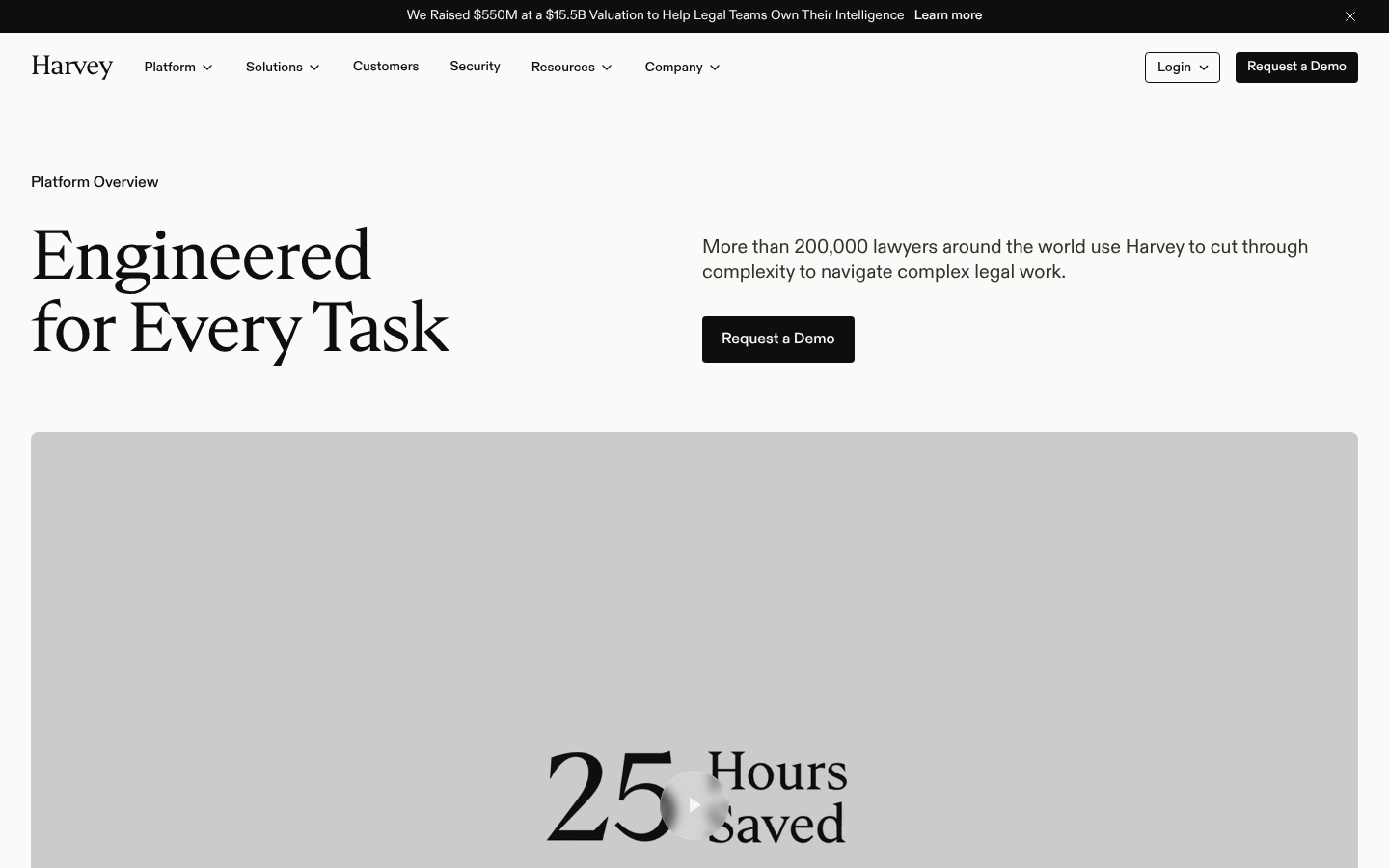
AI legal workspace with Assistant, Vault for bulk review, Knowledge for research, and Workflow agents. It is built for research, drafting, and large-scale tabular reviews inside Microsoft 365, and raised $550 million at a $15.5 billion valuation in September 2026.
Best for: Am Law and global firms standardizing due diligence, litigation chronologies, and policy monitoring across practice groups.
Key Features:
- Vault review tables for bulk extraction across large document sets, with 2026 additions such as table-level instructions, manual input columns, and cell comments, per Harvey's release notes.
- Workflow agents and Agent Builder, which let firms describe a workflow in plain language and embed knowledge sources or review tables into it. Harvey reports more than 25,000 custom agents running on the platform.
- Harvey for Word, with full-document edits, playbooks, writing styles, and a model selector inside the add-in.
- Harvey for Microsoft 365 Copilot, released in June 2026, which lets users query @Harvey in Copilot chat and pull Vault content without leaving Microsoft 365.
- Document management integrations with iManage and NetDocuments.
Why we like it: Review tables and agent workflows cut hours from diligence and regulatory policy checks without forcing lawyers out of Word and Outlook. Harvey also ships at a visible pace, with monthly product briefs and dated release notes.
Notable Limitations:
- Custom agents are built with Harvey's embedded legal engineering teams, so a full rollout is a services-led project rather than a self-serve setup.
- The Copilot integration must be enabled in both Harvey and the Microsoft 365 admin center, which brings IT into the deployment.
- There is no self-serve tier or public price, which keeps smaller firms out of easy evaluation.
Pricing: Not publicly listed. Harvey sells through sales-led enterprise agreements. Contact Harvey for a custom quote.
2. Legora

Agentic operating system with multi-jurisdiction research, tabular review, monitors, and workflow builders. Formerly known as Leya, Legora raised a $550 million Series E at an $8.8 billion valuation in October 2026.
Best for: Firms and legal departments that want an agent-first workspace spanning research, workflow automation, and intake in one pane.
Key Features:
- Legora aOS with Agent, which plans, executes, reviews, and delivers multi-step legal work, per vendor documentation.
- Tabular Review, Workflows, Lists, and Legal Research for structured document analysis and repeatable processes.
- Monitors for tracking regulatory change across jurisdictions.
- Intake and Portal modules for in-house requests and client collaboration.
- Word and Outlook add-ins plus a mobile app.
Why we like it: The aOS approach makes Legora a strong candidate for teams replacing a patchwork of point tools with one governed workflow layer. It also ships usage dashboards and spending controls alongside its consumption-based tier, which addresses the budget risk buyers worry about most.
Notable Limitations:
- Agent Pro moved to consumption-based pricing in June 2026, so costs rise and fall with usage and need active monitoring.
- Agentic intake, horizon scanning, and expanded legal research are named as investment areas for the October 2026 round, so confirm which modules are generally available before you sign.
- Legora's site names no specific document management integrations, so verify DMS connectivity during evaluation.
Pricing: Not publicly listed. Core seats are quote-based, and Agent Pro is billed on consumption with usage dashboards and spending controls, per Legora's June 2026 pricing announcement. Contact Legora for a custom quote.
3. Clio

Unified legal work platform combining Clio Manage, Grow, Draft, Payments, and Work, with agentic workflows from intake through drafting and billing. Clio completed its $1 billion acquisition of vLex in November 2025 and launched Clio for Enterprise alongside it.
Best for: Small to midsize firms that want one vendor from intake and calendaring to billing and AI-assisted legal work, plus larger firms evaluating Clio Operate.
Key Features:
- Clio Work for research, document analysis, and drafting, powered by vLex's Vincent AI and a legal library of more than one billion documents across 110 jurisdictions.
- Clio Operate, built from the 2025 ShareDo acquisition, for workflow configuration and matter management in large firms and corporate legal departments.
- Practice management, client intake, billing, and payments in the same platform.
- Clio Draft for document automation.
Why we like it: Clio pairs mature practice operations with expanding AI workflows, reducing vendor sprawl for firms that prefer one accountable platform.
Notable Limitations:
- Published pricing covers only the EasyStart tier. Essentials, Advanced, and Expand all require a sales conversation.
- Clio Operate was used mainly by UK firms before its North American rollout, so US enterprise references are still building.
- The small-firm stack (Manage) and the enterprise stack (Operate) are different products, so confirm which one a proposal actually covers.
Pricing: EasyStart starts at $49 per user, per Clio's pricing page as checked in November 2026. Essentials, Advanced, Expand, and Clio for Enterprise are quote-based.
4. LawVu LegalOS
In-house legal operating system for intake, matters, contracts, spend, knowledge, and AI agents in one platform. LawVu launched LegalOS in June 2026, layering agents on top of ten years of structured in-house workflow data.
Best for: Corporate legal teams that want intake to resolution in one record system, with portfolio analytics and AI-assisted drafting or review.
Key Features:
- AI agents that pick up inbound requests, create matters, generate tasks, and draft responses, with sign-off steps and on-demand actions, per vendor documentation.
- Connected intake, matter management, contract lifecycle management, spend management, and e-billing.
- LawVu Draft, the contract drafting engine from the December 2025 ClauseBase acquisition, embedded in Microsoft Word.
- An MCP server that connects LegalOS to ChatGPT, Claude, and Microsoft Copilot, plus public APIs and Power Platform and Workato connectors.
Why we like it: Intake, matters, and contracting live in one governed platform that legal ops can run without stitching five tools together. LawVu also lets teams buy only the modules they need and scale later.
Notable Limitations:
- LegalOS is built exclusively for in-house teams, so law firms looking for timekeeping and client billing are outside its scope.
- The agentic layer launched in June 2026, so agent features have a short track record compared with the core workspace.
- Pricing is modular and quote-based, which makes early budgeting harder.
Pricing: Not publicly listed. LawVu sells modular editions. Contact LawVu for a custom quote.
5. LegalOn
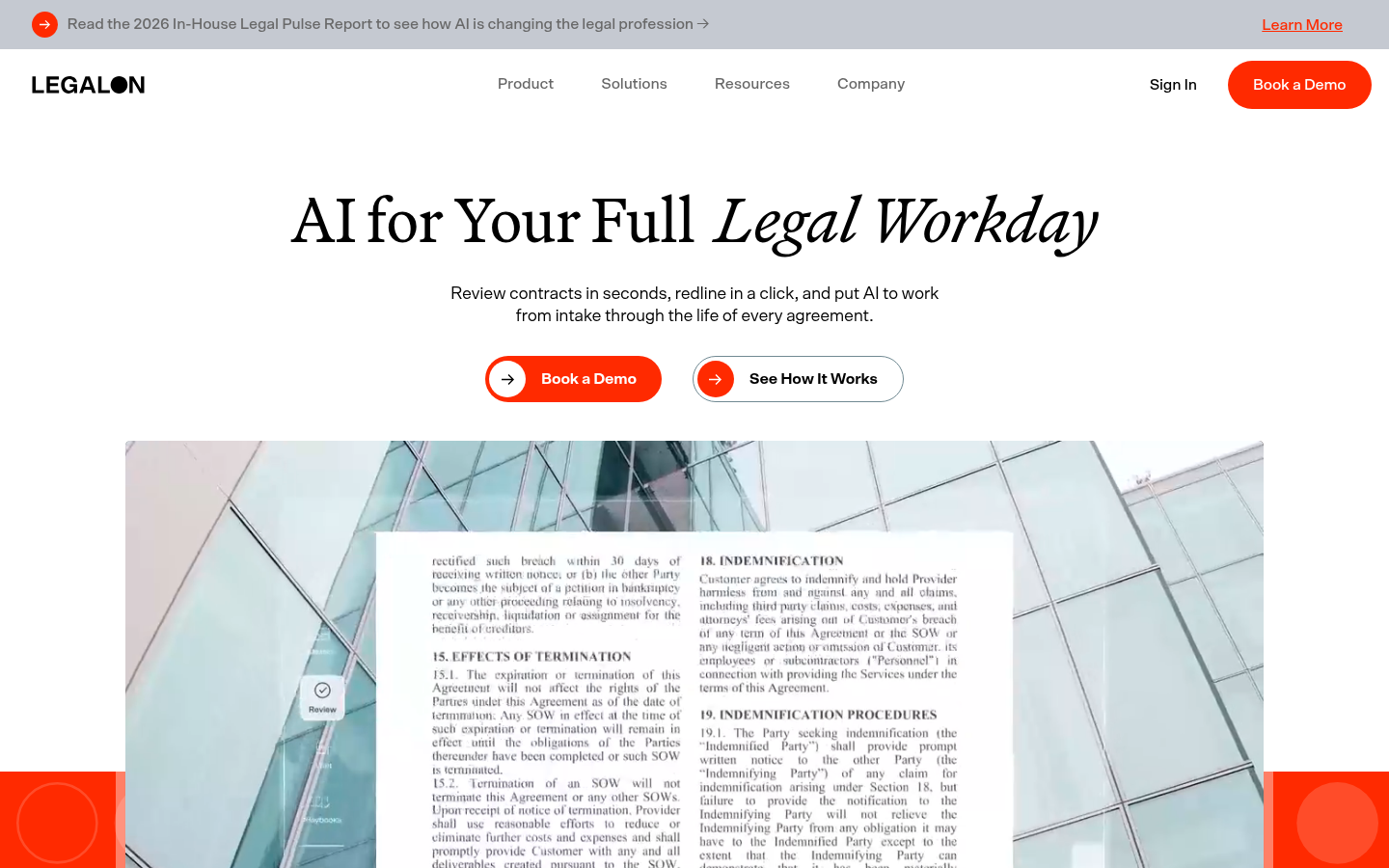
Contract review and redlining with attorney-built playbooks, matter management, an AI Assistant, and a Word add-in. It is a lighter alternative to full CLM for lean in-house teams.
Best for: Lean in-house teams that need fast redlines against company standards without standing up a full CLM.
Key Features:
- 135+ attorney-built playbooks covering 50+ contract types, plus more than 100 attorney-built prompt workflows, per vendor documentation.
- Playbook Agent, which converts existing templates and redlines into custom playbooks.
- AI-suggested edits applied as tracked changes inside Word.
- Contract translation inside Word for the web and the Word add-in, added in July 2026.
- Matter management and an AI Assistant on the same engine.
Why we like it: Deep playbook coverage and practical redlines make LegalOn a good first step when budgets will not support full CLM.
Notable Limitations:
- The platform centers on contract review, so teams that also need spend management or outside counsel billing will need another system.
- Non-standard or bespoke agreements fall outside the built-in playbooks and need custom playbooks before review is reliable.
- Access requires a demo, with no self-serve trial.
Pricing: Not publicly listed. Contact LegalOn for a custom quote.
6. MatterSuite
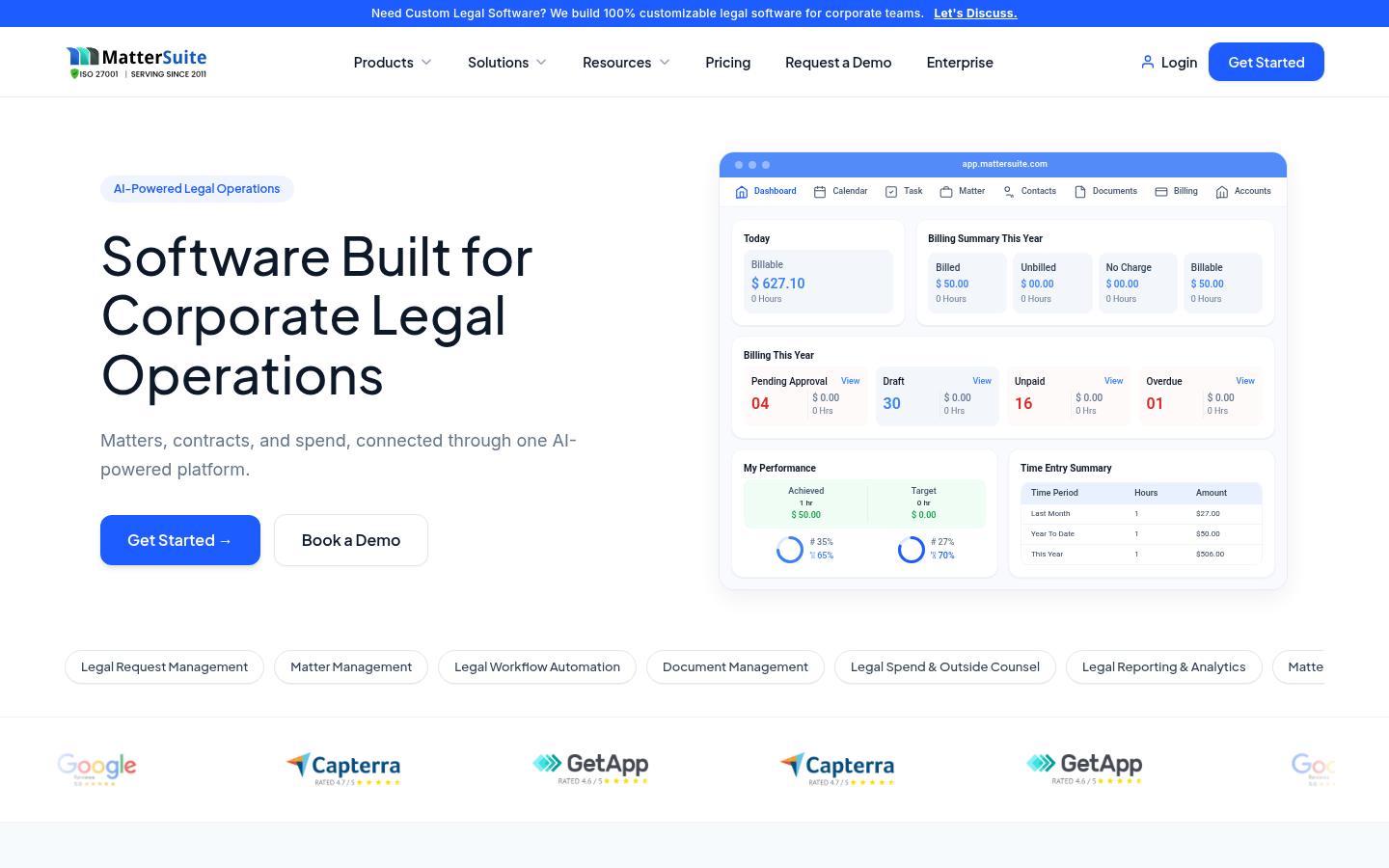
All-in-one legal operations system from CaseFox with matters, contacts, documents, billing, conflict checks, and AI drafting or research. It targets corporate legal departments and larger law firms.
Best for: Legal departments and larger firms seeking one vendor for operations, with AI features tied to intake and document workflows.
Key Features:
- Matter management, client and matter intake, document and contract management, and a secure client portal, per vendor documentation.
- MatterBilling add-on with time and expense tracking, UTBMS and LEDES compliance, and matter budgets.
- MS Ask AI module for legal research, document drafting, contract and risk analysis, and summarization.
- LawSuite add-on for litigation, evidence, and eDiscovery management.
- Microsoft and Google integrations with multi-location and multilingual support.
Why we like it: MatterSuite is a pragmatic option when you want one system of record and practical AI without assembling a suite from parts. A published starting price and a free trial also make it easy to evaluate.
Notable Limitations:
- Capterra and Software Advice listings showed no user reviews as of November 2026, so independent validation is thin.
- AI research, billing, and litigation tools sit in add-on modules, so the entry price does not reflect a full deployment.
Pricing: Plans start at $89 per user per month with a 14-day free trial, per MatterSuite's pricing page as checked in November 2026. Add-on modules are priced through sales.
7. Gotham
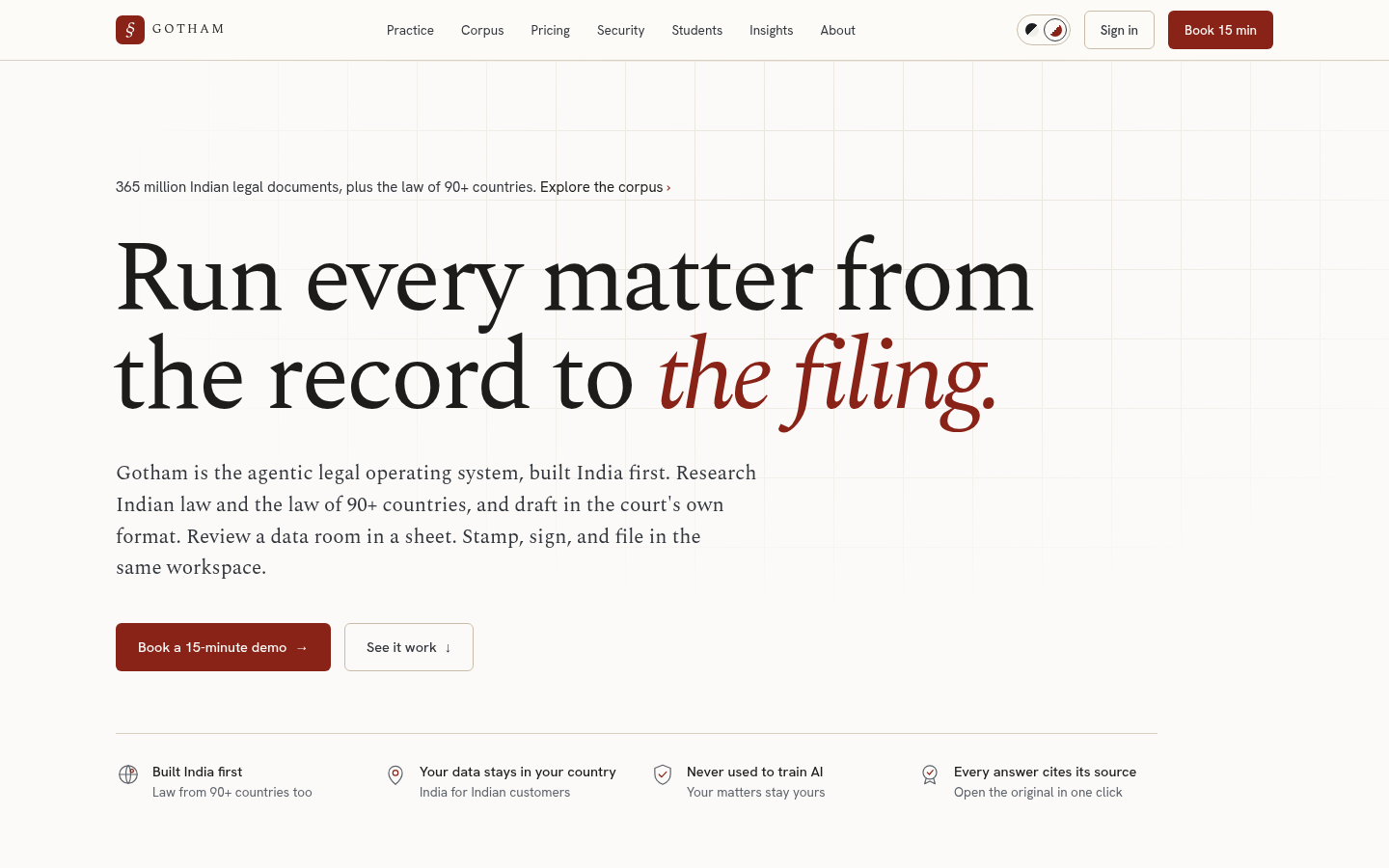
Agentic legal workspace with Assistant, Workflows, Tabular Review, and an India-first legal corpus, plus official sources from more than 90 countries. It also serves US and UK teams on their own law.
Best for: India-headquartered firms or cross-border teams that need India-first research plus US and UK coverage in one workspace.
Key Features:
- Research across the Supreme Court of India, all 25 High Courts, tribunals such as NCLT and ITAT, and regulators such as SEBI and RBI, per vendor documentation.
- Tabular Review, Workflows, and Playbooks for contract and diligence work.
- Court-format drafting, state-wise stamp duty, e-stamping, and eSign inside the matter lifecycle.
- Security commitments that include no model training on customer data, zero data retention for AI subprocessors, and India-only storage for Indian customers.
Why we like it: Focused India coverage and data residency options make Gotham valuable for cross-border matters that touch Indian courts and regulators. A low-cost Junior tier also lets individual lawyers test it before a firm commits.
Notable Limitations:
- Gotham was founded in 2025, so references outside India are limited for North American and European buyers.
- The Terms of Service are governed by Indian law with exclusive jurisdiction in Gurugram courts, subject to any arbitration clause in the MSA, which US and EU buyers will route through legal review.
- The Word pane is limited to Gotham Pro.
Pricing: Gotham Junior is listed at $9 per month or $79 per year (INR 499 per month plus GST in India), with 300 AI credits and up to 10 active matters, currently via waitlist. Gotham Pro is priced per firm by seats and credits. Contact Gotham for a quote.
Feature Comparison
| Tool | Core Workflow | AI Capability | Microsoft 365 Fit |
|---|---|---|---|
| Harvey | Bulk review and research | Workflow agents and Agent Builder | Word add-in and Copilot agent |
| Legora | Agentic legal work across practices | Agent, Agent Pro, and Monitors | Word and Outlook add-ins |
| Clio | Practice management and billing | vLex Vincent AI research and drafting | Web and mobile apps |
| LawVu LegalOS | In-house intake to resolution | Request-handling agents and LawVu Draft | Word drafting plus Copilot via MCP |
| LegalOn | Contract review and redlining | Playbook Agent and AI Assistant | Word add-in with tracked changes |
| MatterSuite | Matter, billing, and conflicts | MS Ask research and drafting module | Microsoft and Google integrations |
| Gotham | India-first research and matters | Assistant, Workflows, and Tabular Review | Word pane on Pro |
Deployment Options
| Tool | Data Residency | Integration Path | Setup Effort |
|---|---|---|---|
| Harvey | US, EU, and Australia regional workspaces | iManage, NetDocuments, SharePoint, Copilot | High, with embedded legal engineering |
| Legora | Not publicly detailed | Vendor integrations directory | Medium to high |
| Clio | Confirm hosting region with vendor | Public API and app ecosystem | Low for Manage, higher for Operate |
| LawVu LegalOS | Confirm hosting region with vendor | Public APIs, MCP server, Power Platform, Workato | Medium |
| LegalOn | Not publicly detailed | Word add-in and web app | Low |
| MatterSuite | Multi-location support | Microsoft and Google integrations | Medium |
| Gotham | India-only storage for Indian customers | Chrome extension and court filing connectors | Low on Junior, scoped on Pro |
Strategic Decision Framework
| Critical Question | Why It Matters | What to Evaluate | Red Flags |
|---|---|---|---|
| Will we face consumption-based AI pricing? | Uncapped token or action-based pricing can blow budgets | Rate cards, usage dashboards, throttles, and monthly hard caps | No visibility into usage or per-action rates |
| Do agents enforce human-in-the-loop review? | Compliance and malpractice risk demands approvals | Native checkpoints, audit logs, and assignment to licensed reviewers | Agents that can send emails or edit documents without approval |
| Can it live where lawyers already work? | Adoption dies if people must switch systems | Word and Outlook add-ins, Copilot integration, email-to-matter | Chat-only tools with weak Office integration |
| Is it a true operating system, not point AI? | Legal ops needs intake-to-resolution and portfolio views | Intake, matters, contracts, knowledge, and spend in one record | Siloed assistants that cannot link to matters, obligations, or spend |
Problems & Solutions
- Problem: Firmwide pilots stall because chat assistants do not survive locked-down desktops or do not map to real workflows. Solution: Harvey runs review tables, agents, and playbooks inside Word and Microsoft 365 Copilot, so lawyers work in tools IT already supports. Pilot it against an alternative on real matters before a firmwide commitment.
- Problem: In-house teams drown in intake emails, fragmented contract status, and missing portfolio signals. Solution: LawVu LegalOS unifies intake, matters, contracts, and spend, and its agents can pick up requests, create matters, and draft responses with sign-off steps built in.
- Problem: Lean teams need reliable redlines without the weight of CLM. Solution: LegalOn applies attorney-built playbooks inside Word and returns edits as tracked changes, giving small teams a consistent first pass on standard agreements.
- Problem: Small firms want one accountable platform that spans intake, work, research, and billing. Solution: Clio combines practice management and payments with vLex-powered research in Clio Work, which gives a single-vendor path from client intake to AI-assisted legal work.
- Problem: Cross-border matters need India-first legal intelligence plus US and UK coverage. Solution: Gotham covers Indian courts, tribunals, and regulators with India-resident data for Indian customers, and its published terms let compliance teams review jurisdiction up front.
- Problem: Ops teams want one vendor for matters, billing, conflicts, and AI drafting or research. Solution: MatterSuite bundles matter management, LEDES billing, conflict checks, and an AI module, which helps buyers shrink a multi-vendor stack once they validate references directly.
The Bottom Line
Most legal teams will get better results from an operating system that runs where work already happens, with agentic AI applied to specific, governed workflows. Harvey and Legora lead for large firms, LawVu LegalOS and LegalOn fit in-house teams, and Clio and MatterSuite cover one-vendor operations. Gotham is the pick for India-first, cross-border work.
With Gartner expecting consumption-based pricing to take a growing share of legal tech spend, negotiate usage caps and dashboards before you scale. Shortlist two candidates that fit your size and data posture, then run a four-week proof on real documents.