

A content drop or a live event can multiply player tickets overnight, and the support stack has to absorb that spike while players are still in the game. Three details usually decide whether it holds: the in-game SDK, the way the AI agent is billed, and how fast the team can change routing rules across channels.
AI agents are now a real budget line for support teams. A Gartner survey published in August 2026 found AI spending by customer service leaders rose 38 percent while overall service budgets grew 2 percent. Players still want a person on the other end: in a separate Gartner customer survey, 87 percent said companies using GenAI for service must offer access to a human agent.
General helpdesks cover part of this, and our customer service software category lists the wider market. The seven player support platforms below run from gaming-native SDK vendors to one iGaming specialist.
How We Evaluated Player Support Platforms
We compared each platform against published vendor documentation, pricing pages and official announcements, all checked in November 2026. We did not run hands-on tests. The criteria:
- In-game reach: SDK coverage for Unity, Unreal, mobile, PC, web and console.
- AI agent and billing unit: what the AI can resolve on its own, and whether it is charged per resolution, per outcome, per session or through a plan allowance.
- Human escalation: routing, VIP handling and a clear path to a person.
- Live-ops fit: multilingual coverage, Discord and community channels, and how fast rules can change during an event.
- Compliance and data handling: security certifications, PII controls and support for regulated flows.
- Pricing transparency: published prices versus quote-only contracts.
Player Support Platforms at a Glance
Here is how the seven platforms compare on fit, pricing model and the one feature that sets each apart.
| Platform | Best For | Pricing Model | Highlights |
|---|---|---|---|
| Helpshift | Mid-size to AAA live-service games | Custom quote | In-game SDKs for mobile, PC and web, console QR handoff, Keywords Studios agents |
| Zendesk | Publishers standardizing on one CX suite | Per agent plus per automated resolution | Zendesk SDK for Unity, mature reporting and roles |
| Intercom | Live-ops teams that want fast chat automation | Per seat plus USD 0.99 per Fin outcome | Fin AI agent, which can also run on another helpdesk |
| Freshdesk | Cost-conscious small to mid-size studios | Per agent plus AI session packs | Low entry price, iOS and Android chat SDK |
| Theymes | Mobile and free-to-play studios leaving a general helpdesk | Quote-based plans with AI answer allowance | Native SDKs for Unity, iOS, Android and WebGL, Discord bot |
| Inngame | Indie studios on Unity, Steam and web portals | Flat monthly plans from EUR 29 | AI replies, two-way translation, bug grouping |
| Cevro AI | Regulated iGaming operators | Custom quote | AI agents for payments, bonuses, KYC and responsible gaming |
Pricing is the clearest split in the table, since four platforms publish prices and three sell on quotes. SDK coverage is the other: Helpshift, Zendesk, Theymes and Inngame support Unity, and Intercom and Freshdesk reach players through iOS and Android SDKs.
The 7 Best Player Support Platforms
These seven range from a full player engagement suite to a EUR 29 indie tool. Helpshift leads as the most complete gaming-native option, followed by three general CX suites, two lighter gaming tools and the iGaming specialist.
1. Helpshift
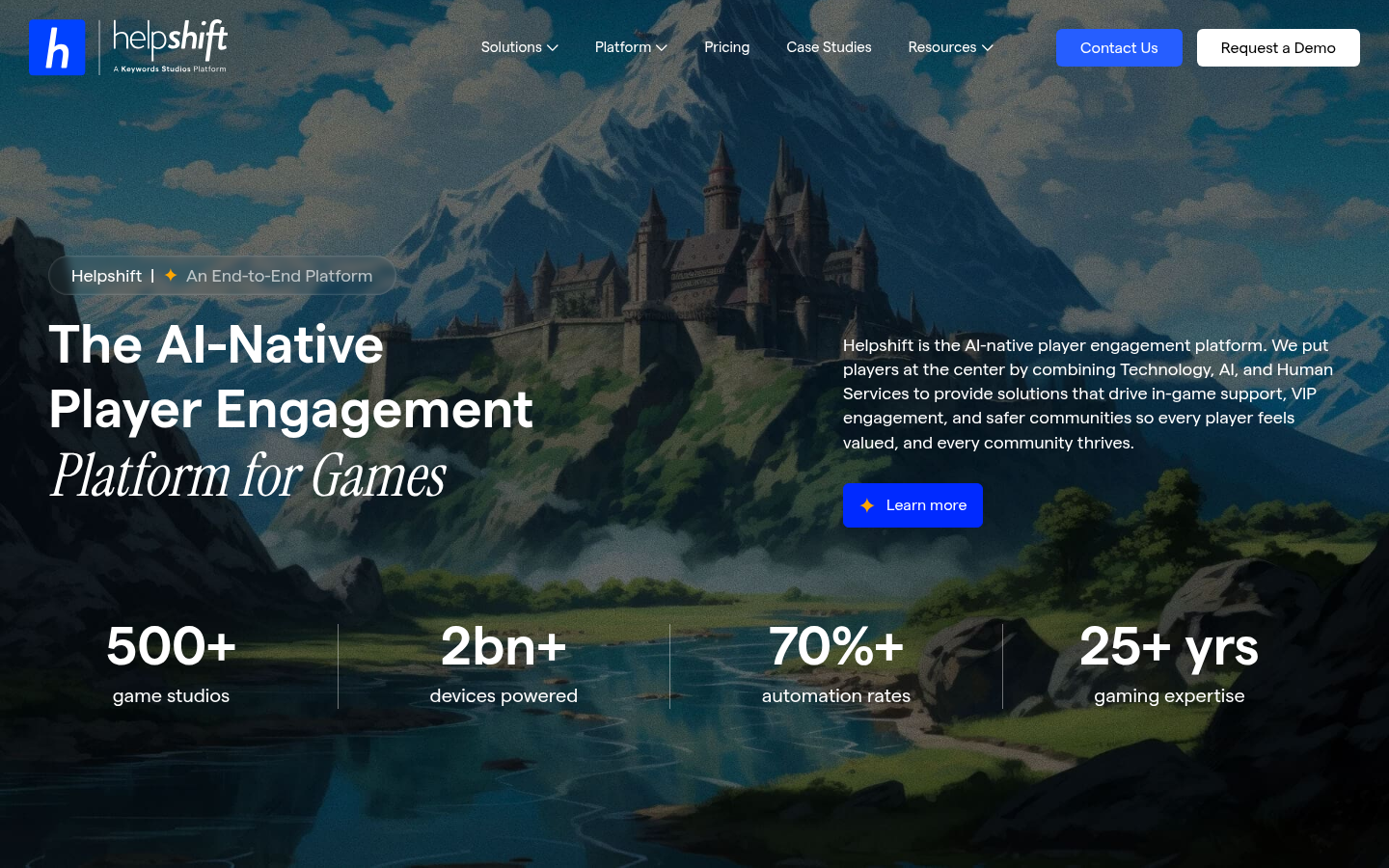
Helpshift is an AI-native player engagement platform for games, owned by Keywords Studios since the acquisition closed in December 2022.
Best for: Mid-size to AAA studios running live-service games across mobile, PC and console that want support inside the game client.
Key Features:
- In-game support SDKs for iOS, Android, PC and web, with integrations for Unity, Unreal Engine, Cocos and React Native, per Helpshift's platform page.
- Console handoff through a patented QR code or link that moves the conversation to the player's phone with context intact.
- Care AI agent for automated resolution, plus Smart Intents routing that puts VIP, payment and event-blocker tickets first.
- Discord support bot with automation, guided flows and handoff to human agents.
- Language AI with built-in machine translation, and optional Keywords Studios human agents for overflow and 24/7 coverage.
Why we like it: Helpshift covers the SDK, the AI and the human agents under one contract, which reduces vendor juggling on launch week. The console QR handoff is a practical answer to typing support messages on a controller.
Notable Limitations:
- Pricing is quote-only, and the pricing page lists no figures.
- Console players finish the conversation on a second device, since the console flow is a handoff to the phone.
- The platform is built for games only, so publishers that also support non-game apps or web stores may need a second tool.
Pricing: Not publicly listed. Contact Helpshift for a quote.
2. Zendesk
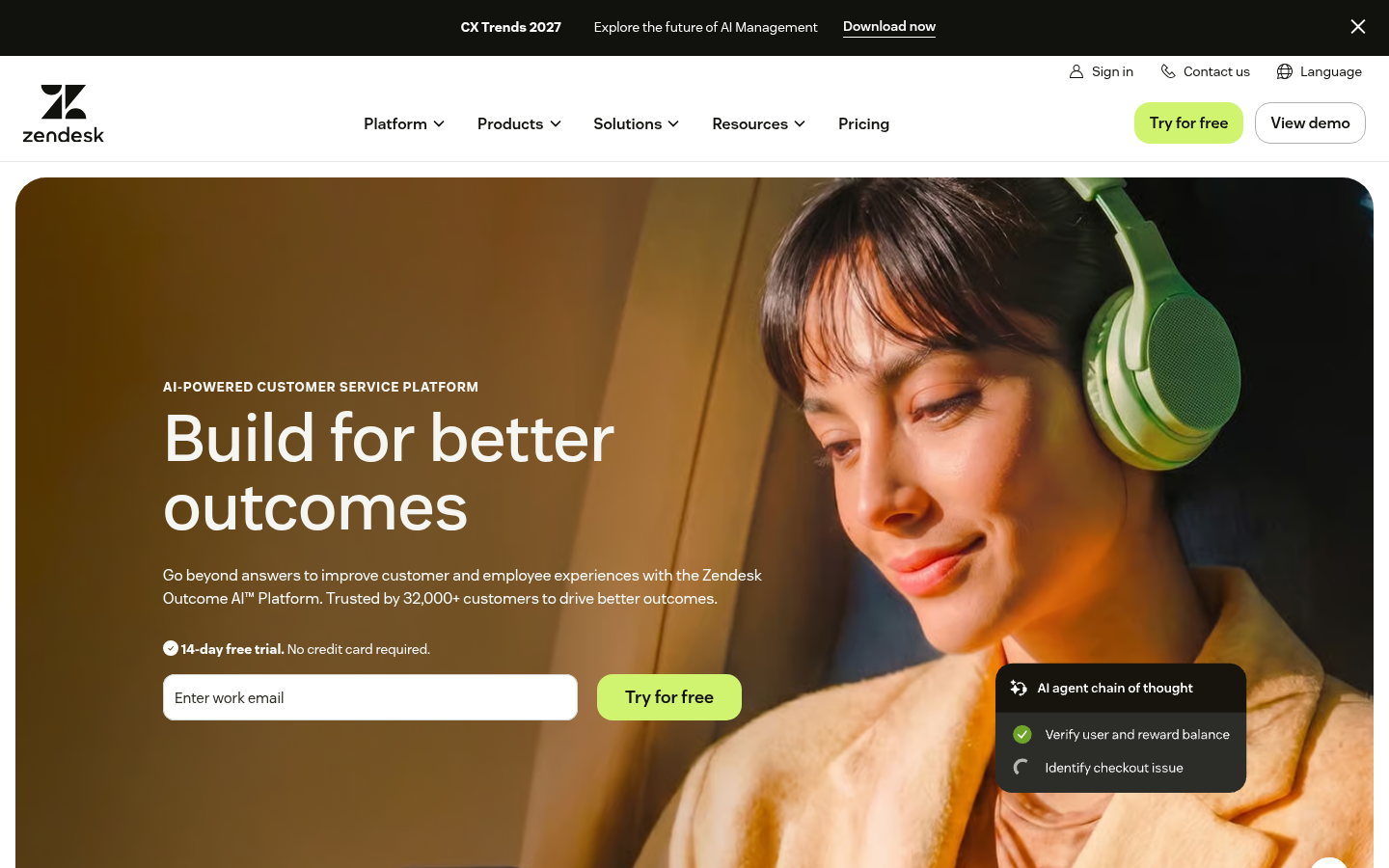
Zendesk is an enterprise customer service suite with AI agents included in every plan and an official SDK for Unity games.
Best for: Publishers that already run Zendesk for web stores, accounts or corporate support and want games on the same platform, with established roles, reporting and governance.
Key Features:
- Zendesk SDK for Unity with messaging, generally available since February 2024, plus SDKs for iOS, Android and web.
- AI agents included in Suite plans and billed by automated resolution. Since May 18, 2026, only verified resolutions count toward billing.
- Optional Copilot add-on for human agents, listed at USD 50 per agent per month.
- A large app marketplace for adding third-party tools to the workspace.
Why we like it: One platform can cover the game, the web shop and the account team under one set of roles and reports. The Unity SDK gives Unity studios in-game messaging without adding a second vendor.
Notable Limitations:
- Zendesk's Unity SDK supports images only for attachments and has no typing indicator, per its developer docs.
- Zendesk's SDK documentation covers Unity, iOS, Android and web, so Unreal and console titles need a web or custom approach.
- Seats and AI resolutions are two separate meters, and resolutions above the plan allowance are billed on top.
Pricing: Per Zendesk's pricing page as captured in October 2026, Suite Team is USD 55 and Suite Professional USD 115 per agent per month on annual billing, with Suite Enterprise sold through sales. Each agent includes 5 automated resolutions a month on Suite Team and 10 on Suite Professional. Additional resolutions are listed at USD 1.50 on a committed volume or USD 2.00 pay as you go.
3. Intercom
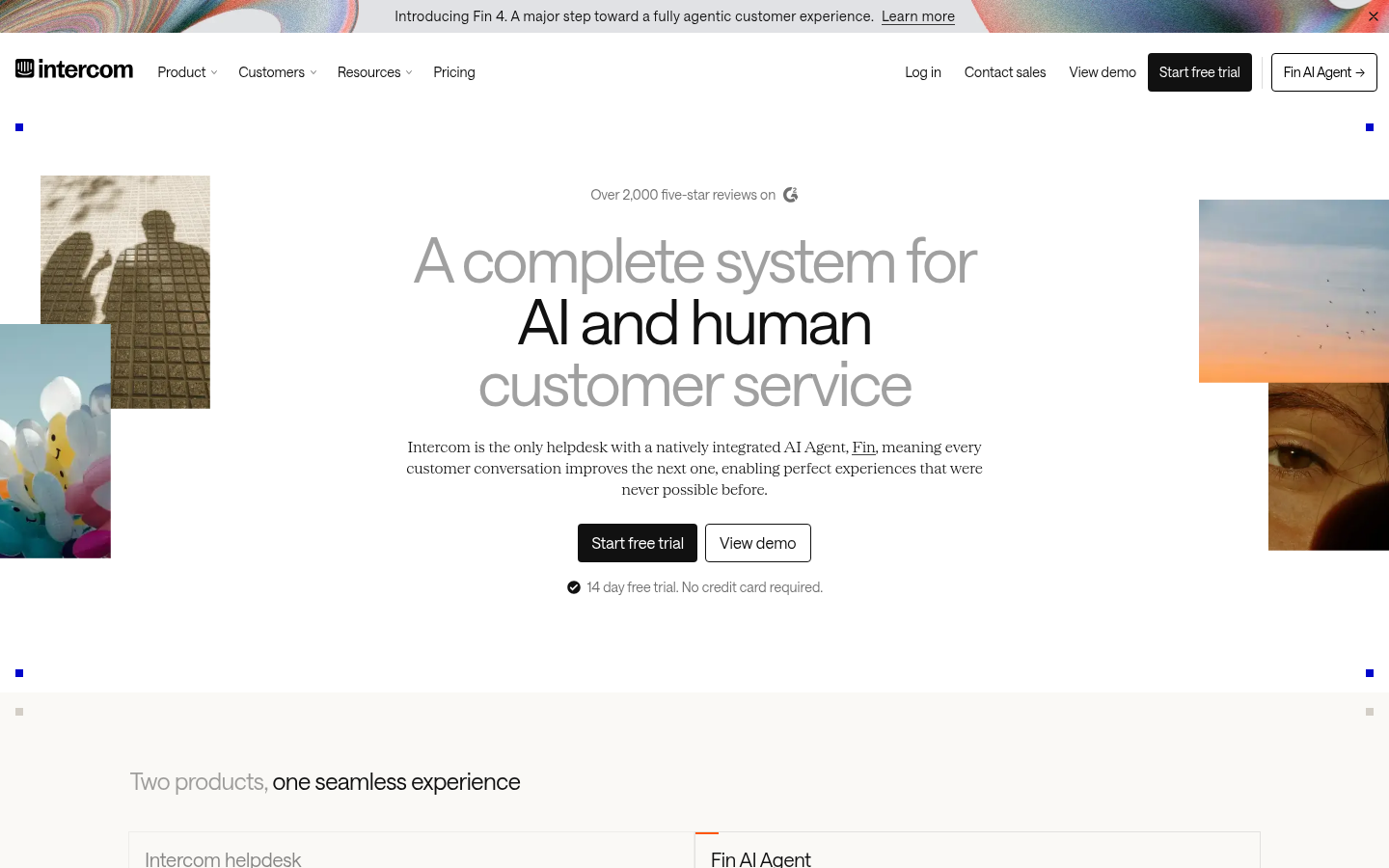
Intercom is a customer service helpdesk paired with the Fin AI agent, sold by the company formerly called Intercom, which renamed itself Fin in May 2026.
Best for: Live-ops teams with web, launcher or mobile app traffic that want fast chat automation and a simple per-outcome price for AI.
Key Features:
- Fin AI agent on every plan, billed per successful outcome, and also available on top of another helpdesk such as Zendesk or Salesforce.
- Messenger SDKs for iOS, Android and React Native for in-app chat.
- Copilot for human agents, listed at USD 29 per agent per month on annual billing.
- Workflow automation, multiple team inboxes and a multilingual help center on the Advanced plan.
Why we like it: Per-outcome billing ties AI spend to results, which makes cost per deflected ticket easy to model. Studios can also trial Fin on their current helpdesk before moving the whole team.
Notable Limitations:
- Salesforce signed an agreement on June 15, 2026 to acquire Fin for about USD 3.6 billion, with closing expected in Salesforce's fiscal Q4 2027, so roadmap and contract terms may change.
- Intercom's Messenger supports iOS, Android and React Native, with no Unity or Unreal package.
- AI cost scales with outcome volume, so a launch spike raises the bill in the same week.
Pricing: Intercom's pricing page lists Essential at USD 29, Advanced at USD 85 and Expert at USD 132 per seat per month on annual billing (USD 39, USD 99 and USD 139 monthly), as captured in September 2026. Fin costs USD 0.99 per outcome on every plan. Fin on another helpdesk carries a 50-outcome monthly minimum.
4. Freshdesk
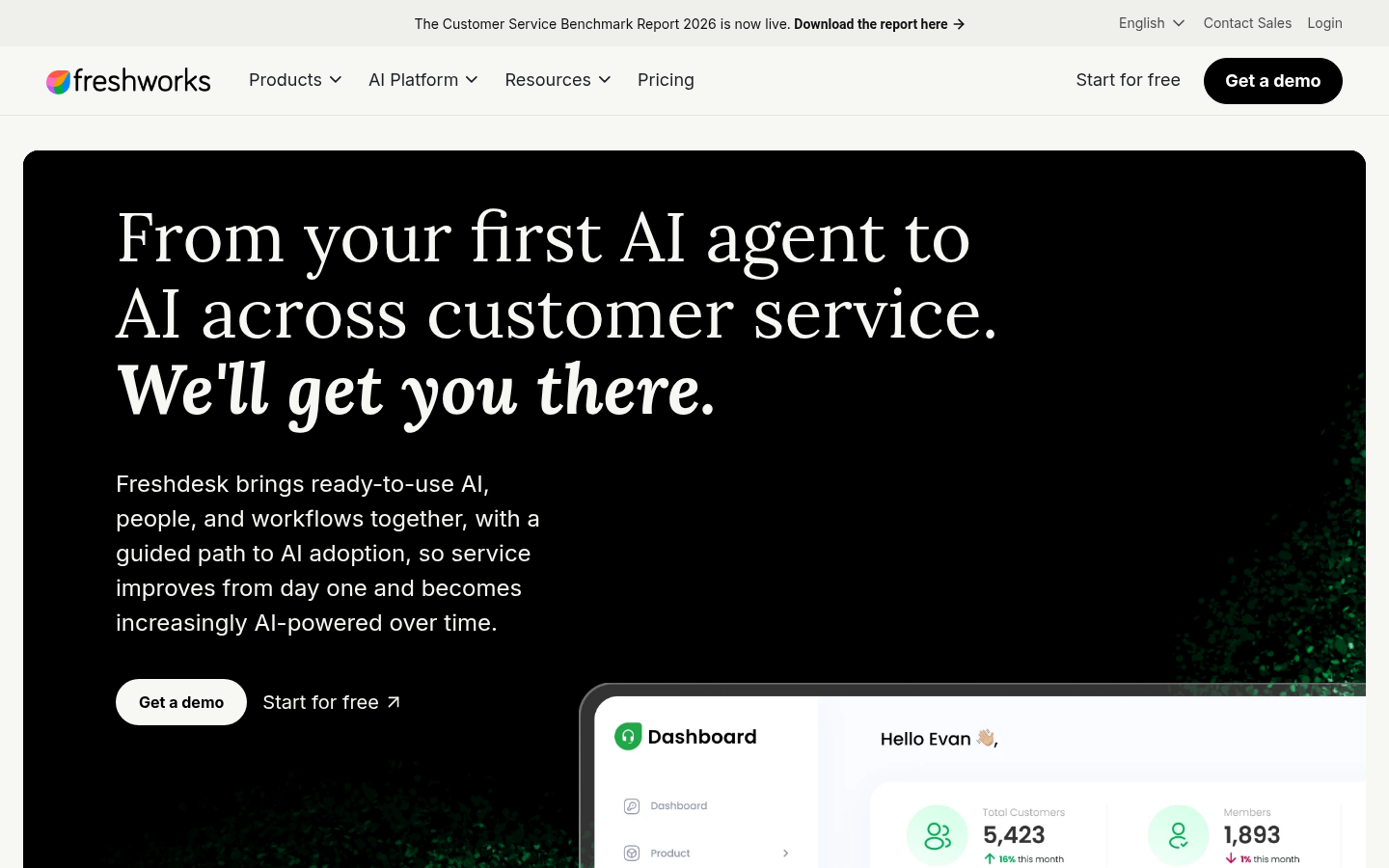
Freshdesk is Freshworks' helpdesk, with in-app chat through the Freshdesk Messaging mobile SDK (formerly Freshchat) and Freddy AI for automation.
Best for: Small to mid-size studios that want a familiar helpdesk with a low entry price and are comfortable with mobile-only in-app chat.
Key Features:
- Ticketing, shared inbox, knowledge base and customer portal on every paid plan.
- Mobile Chat SDK for iOS and Android, plus a React Native SDK on the Freshchat side.
- Freddy AI Agent for automated answers, with 500 free sessions included once per account.
- Freddy AI Copilot for human agents on the Pro and Enterprise plans.
- Freshworks Marketplace apps for app store reviews, analytics and other gaming-adjacent workflows.
Why we like it: It is easy to start, the price is published, and most game teams already know how it works. For a small team, that keeps setup time low.
Notable Limitations:
- Freshdesk's Mobile Chat SDK supports only iOS and Android, per its own documentation, so there is no Unity or Unreal package.
- Copilot is limited to Pro and Enterprise, and AI session packs expire with the billing cycle.
- Chat-based AI agents sit in the Freshdesk Omni bundle, which costs more per agent than classic Freshdesk.
Pricing: As of October 2026, Freshdesk's pricing page lists Growth at USD 19, Pro at USD 55 and Enterprise at USD 89 per agent per month on annual billing (USD 23, USD 66 and USD 107 monthly), up from USD 15, USD 49 and USD 79 before the 2026 increase. Freshdesk Omni runs USD 29 to USD 119. Extra Freddy AI Agent sessions cost USD 49 per 100, Copilot is USD 29 per agent per month, and a 14-day free trial is available.
5. Theymes
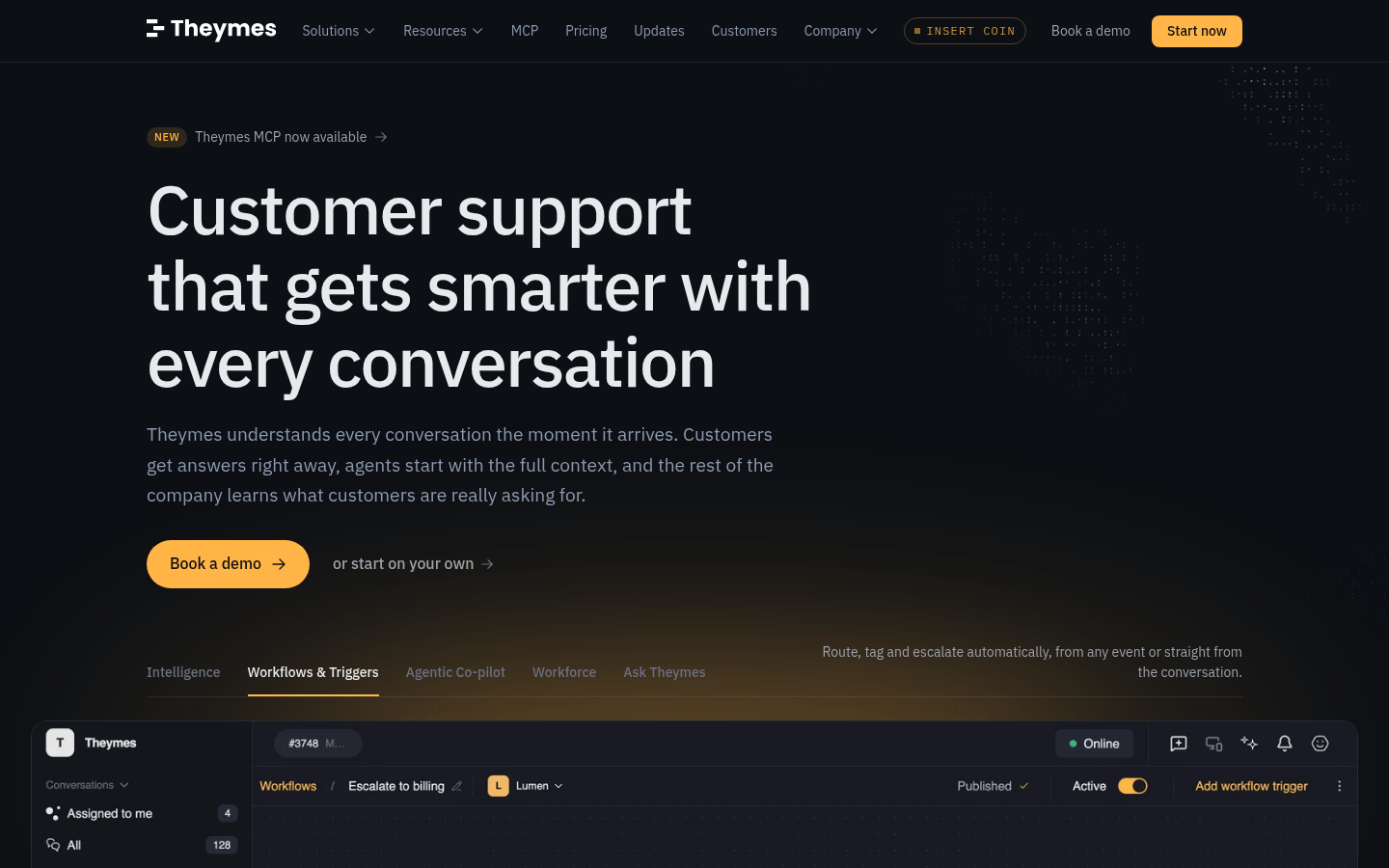
Theymes is a player support platform from Theymes Oy, with native SDKs for Unity, iOS, Android and WebGL and a Discord bot in the same workspace.
Best for: Mobile and free-to-play studios moving off a general helpdesk that want in-game AI answers and Discord support handled together.
Key Features:
- Native SDKs for Unity, iOS, Android and WebGL, plus a web widget.
- AI answers from the studio's knowledge base in 50+ languages, with player ID, platform, build and level attached to each question.
- Native Discord bot that routes tickets to the same workspace as in-game support.
- ISO 27001 certification, PII stripped before data reaches a language model, and zero data retention with LLM providers.
- Named customers include Metacore, Saber Interactive, Wooga and Pixel Federation.
Why we like it: Theymes is built for games only, and the plans include a monthly AI answer allowance, so the bill tracks the plan more than ticket volume. Player context arrives with the first message, which cuts the back-and-forth that slows first replies.
Notable Limitations:
- Theymes lists no Unreal or console SDK.
- Every plan is priced on request, and the AI Agents add-on is sold in monthly conversation packages with no published prices.
- Theymes positions itself as a replacement for Zendesk, Freshdesk or Helpshift, so adopting it usually means a migration.
Pricing: Theymes' pricing page, checked in November 2026, prices every plan on request. Starter includes 5 seats and 5,000 AI answers a month, Engagement includes 10 seats and 10,000 AI answers, and Enterprise is tailored with an SLA. Annual billing carries a discount.
6. Inngame
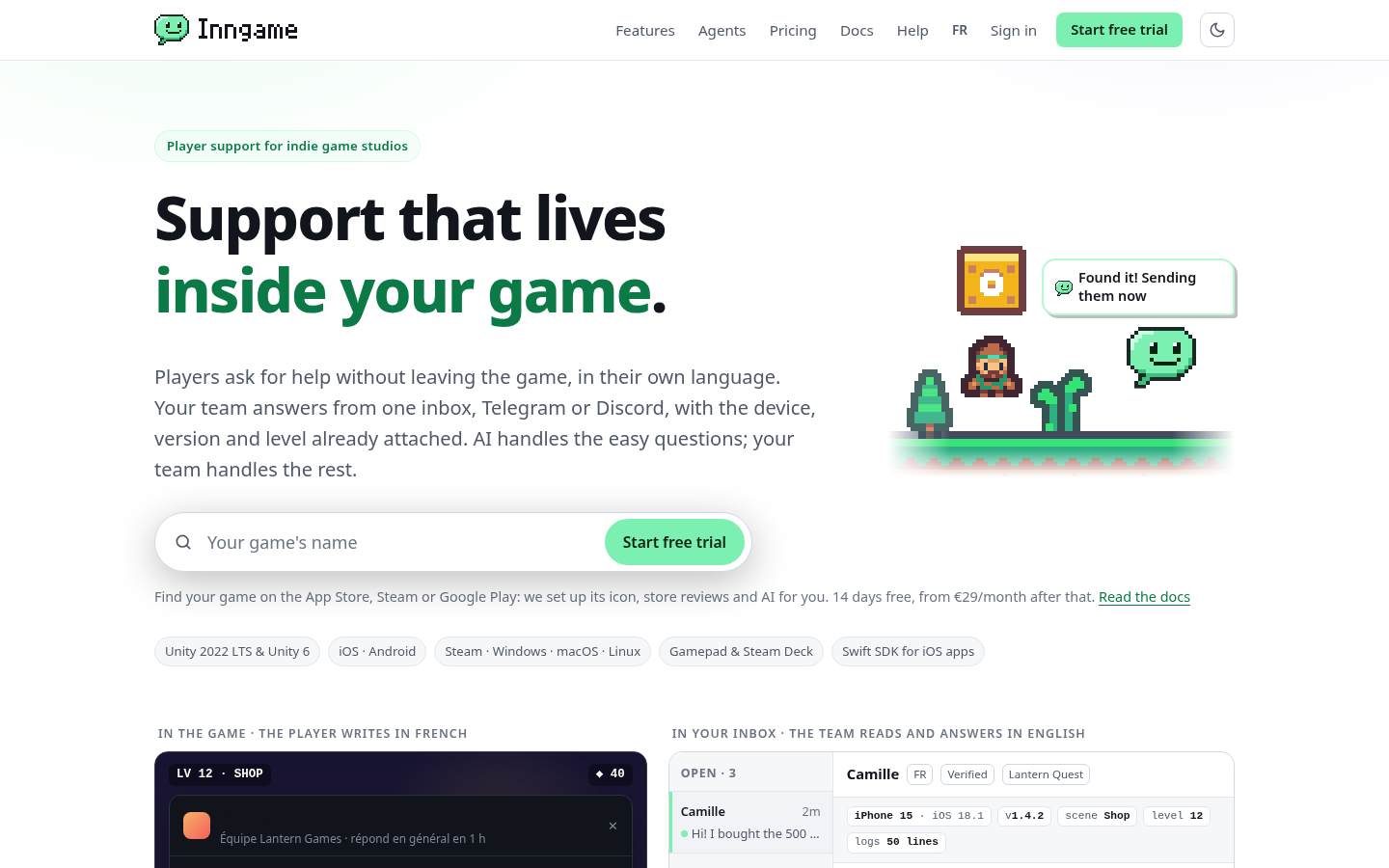
Inngame is a lightweight in-game support chat for small studios, with SDKs for Unity, native iOS and HTML5 games.
Best for: Indie and small studios shipping on Unity, Steam or web portals such as itch.io, CrazyGames and Poki that want in-game chat and bug intake for under EUR 100 a month.
Key Features:
- Unity SDK for Unity 2022 LTS and Unity 6, covering iOS, Android, Steam, Windows, macOS and Linux, with gamepad and Steam Deck support.
- Swift SDK for native iOS apps, an HTML5 script tag for browser games, and a REST API for everything else.
- AI modes per game: Auto answers from the FAQ, Draft writes replies for approval, and Off keeps it human-only. Refunds always need a person.
- Two-way machine translation with the original message visible.
- Bug grouping from player reports, spike alerts to the inbox, Telegram and Discord, and GitHub issue creation.
Why we like it: The pricing is public and flat, and teams can plug in their own Anthropic or OpenAI key to remove AI caps. Bug grouping turns scattered player reports into something a developer can act on.
Notable Limitations:
- The site does not name the company behind the product or list security certifications, so procurement teams will need to ask directly.
- Native Android apps and Unreal projects fall back to the REST API.
- Email is not listed as a support channel.
Pricing: Inngame's pricing page, checked in November 2026, lists Indie at EUR 29 a month (2 apps, 3 seats, 1,000 AI messages, 20,000 translations) and Studio at EUR 99 a month (20 apps, 15 seats, 10,000 AI messages, 200,000 translations), billed monthly. Bringing your own AI key removes the monthly caps at no extra charge. A 14-day free trial includes 200 AI replies and 2,000 translations.
7. Cevro AI
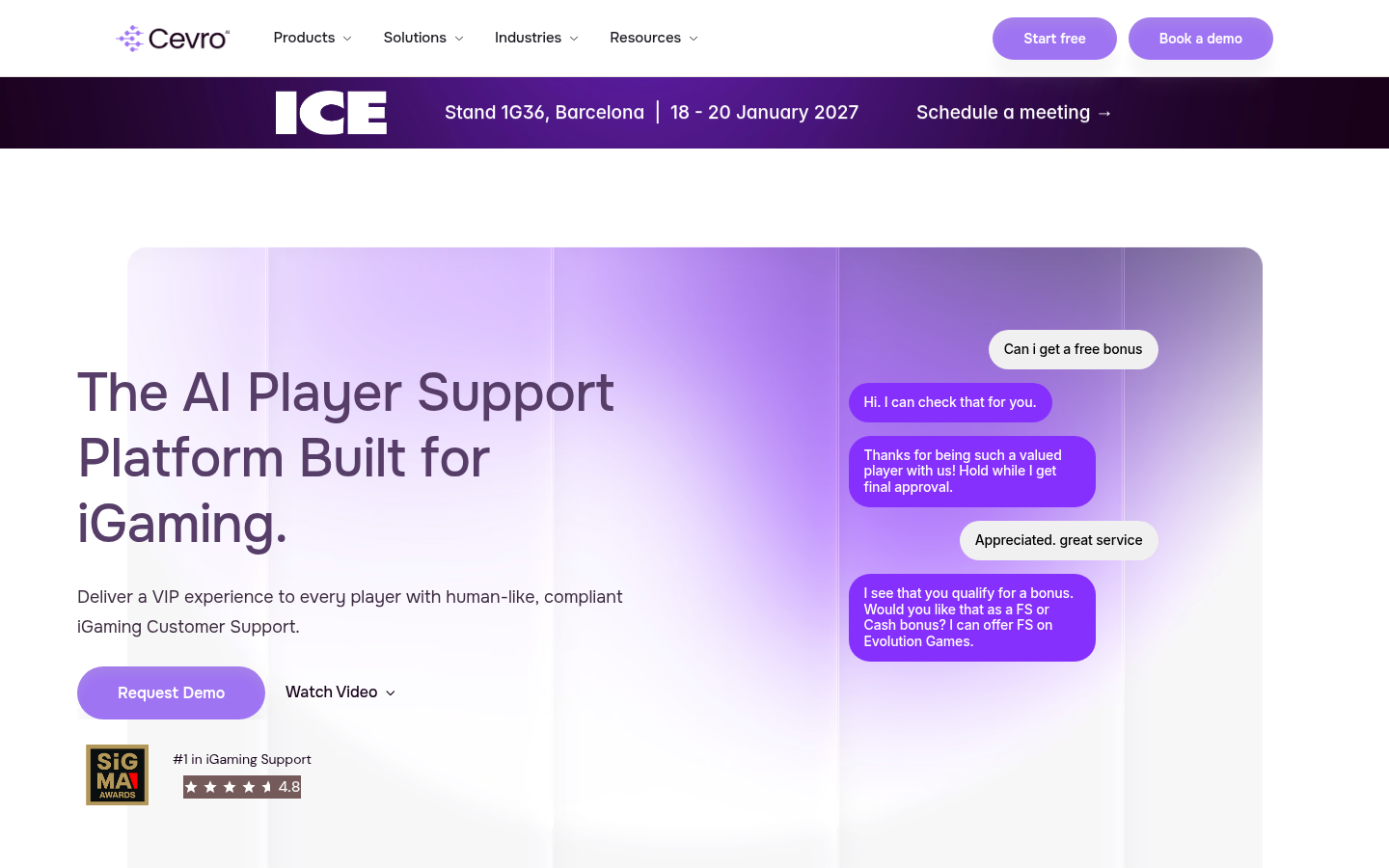
Cevro AI builds AI support agents only for regulated iGaming, and rebranded from ChatForm AI in November 2025.
Best for: Online casino and sportsbook operators, and the platforms behind them, that need AI to take action inside player account management (PAM) and payment systems.
Key Features:
- Connection to PAM and back-office systems to process withdrawals, deposit issues, bonus requests and account tickets, as announced in its December 2025 EveryMatrix partnership.
- KYC and anti-money laundering (AML) checks handled inside the support chat through a partnership with Shufti, announced in June 2026.
- Built-in responsible gaming and compliance safeguards, with handoff to live agents when needed.
- Bonus Engine for personalized offers in chat, and CevroScribe, a copilot that lets support managers edit procedures and escalation logic.
- Platform integrations with EveryMatrix and Vegangster, and support in 100+ languages.
Why we like it: It targets the payment, bonus and KYC tickets that general helpdesks handle poorly in regulated markets. Resolving those inside the chat keeps them out of a separate compliance queue.
Notable Limitations:
- It serves iGaming only and offers no SDK for video games.
- The Bonus Engine lets the AI issue offers in chat, which each operator must check against local bonus and responsible gambling rules.
- Pricing is not published.
Pricing: Not publicly listed. Contact Cevro AI for a quote.
Beyond gaming-specific tools, our AI customer support collection covers AI agents built for other industries.
Capability Comparison
In-game reach and the systems each platform connects to are where the seven differ most.
| Platform | In-Game SDK | AI Agent | Integration Focus |
|---|---|---|---|
| Helpshift | iOS, Android, PC, web; Unity, Unreal, Cocos; console via QR | Care AI | Discord bot, Keywords Studios agents |
| Zendesk | Unity, iOS, Android, web | AI agents per automated resolution | Large app marketplace |
| Intercom | iOS, Android, React Native | Fin per outcome | Fin also runs on other helpdesks |
| Freshdesk | iOS, Android | Freddy AI Agent per session | Freshworks Marketplace |
| Theymes | Unity, iOS, Android, WebGL | AI answers within plan allowance | Discord bot, Slack alerts |
| Inngame | Unity, Swift iOS, HTML5 | Auto or Draft modes, or your own AI key | Discord, Telegram, GitHub |
| Cevro AI | None | iGaming AI agents | PAM, payments, Shufti KYC and AML |
Pricing Comparison
Seat or plan prices set the floor, and AI billing is the line that moves during a launch. Quote-only vendors also need time for a sales cycle.
| Platform | Entry Price | AI Billing |
|---|---|---|
| Helpshift | Custom quote | Contract terms |
| Zendesk | USD 55 per agent per month (Suite Team, annual) | 5 resolutions per agent included, then USD 1.50 to USD 2.00 each |
| Intercom | USD 29 per seat per month (Essential, annual) | USD 0.99 per Fin outcome |
| Freshdesk | USD 19 per agent per month (Growth, annual) | 500 free sessions once, then USD 49 per 100 |
| Theymes | On request | AI answers included in plan |
| Inngame | EUR 29 per month (Indie) | 1,000 AI messages included, or uncapped with your own key |
| Cevro AI | Custom quote | Not published |
Strategic Decision Framework
Use these questions to narrow the shortlist before you book demos.
| Critical Question | Why It Matters | What to Evaluate | Red Flags |
|---|---|---|---|
| Do we need true in-game support? | Leaving the game to get help hurts satisfaction mid-session | SDK size, Unity and Unreal coverage, console handling, offline behavior | A web widget presented as an in-game SDK |
| How is AI billed? | Per-resolution and per-outcome meters change the cost curve during launches | Definition of a billed unit, plan allowances, dispute process | No usage dashboard or audit trail for billed resolutions |
| Can players reach a human? | Gartner found 87 percent of customers expect a human option when GenAI handles service | Escalation routing, VIP flows, agent assist | AI flows with no visible handoff to a person |
| Are we regulated? | Licensing rules decide what AI may do with payments and identity | KYC, AML, responsible gaming controls, audit logs | Generic chatbots with no compliance guardrails |
| How fast can we adapt during an event? | Live ops changes weekly, sometimes hourly | No-code rule changes, versioning, rollback | Every change needs a developer and an app store release |
Problems & Solutions
These are the four problems that come up most when studios replace or add a player support platform.
Problem: Players quit or leave a review when a crash or stuck quest forces them out of the game to get help.
Solution: An in-game SDK keeps help, search and tickets inside the client. Helpshift covers mobile, PC and web and hands console players off by QR code. Theymes and Inngame cover Unity, and Zendesk's Unity SDK works for studios already on Zendesk.
Problem: AI bills spike during launches, and finance cannot forecast them.
Solution: Find the billed unit before signing, then model it with ticket volume from a past launch. Zendesk bills automated resolutions above a per-agent allowance, and Intercom charges USD 0.99 per Fin outcome. Theymes and Inngame include an AI allowance in the plan, and Inngame lets you bring your own model key.
Problem: Bug reports arrive scattered across channels and languages, and engineering sees them late.
Solution: Inngame groups player messages into bugs, sends spike alerts to Discord or Telegram and opens GitHub issues. Theymes attaches the player's build, platform and level to each question, and Helpshift's Language AI translates conversations in real time.
Problem: Regulated operators cannot let a generic chatbot touch KYC or payments.
Solution: Cevro AI reads status from PAM and payment systems, runs KYC and AML checks in the chat through Shufti and routes responsible gaming cases to live agents.
The Bottom Line
The right player support platform depends on where your players are and how your AI bill is counted. Studios that need help inside the game client, console included, should start with Helpshift. Smaller Unity teams can get similar in-game reach from Theymes, or from Inngame on a tight budget.
Publishers already running Zendesk or Intercom can keep one platform if the Unity SDK or mobile Messenger covers their titles. Before signing any contract, model AI fees with ticket data from a past launch and keep a visible route to a human agent. Regulated iGaming operators are a separate case, and Cevro AI is built for their payment, bonus and KYC flows.