

Every sanctions hit, transaction monitoring alert and adverse-media match in an L1 queue needs a disposition, and every disposition needs a rationale an examiner can follow. Agentic financial crime platforms take on that first pass. They gather evidence, apply your written policy, draft the case narrative and hand the decision to a human reviewer with the reasoning attached.
Doing this work by hand is expensive. LexisNexis Risk Solutions put global financial crime compliance costs at $206.1 billion in its 2023 study. Governance pressure has grown since then, and Gartner reported in October 2026 that AI risk is rising faster than AI value, with only 25% of CIOs aligning technology and business risk in a Q3 2026 survey.
This guide compares seven agentic financial crime platforms for banks and fintechs, with vendor claims and pricing checked against first-party pages and official marketplace listings in November 2026.
Agentic Financial Crime Platforms at a Glance
All seven vendors sell on custom quotes, so the pricing column shows how each one is bought: direct license, managed service or a cloud marketplace.
| Platform | Best For | Pricing Model | Highlights |
|---|---|---|---|
| Bretton AI | Banks and fintechs that want agents to run L1 and L2 investigations inside existing tools | Custom quote, platform license or Managed Services | $75M Series B in February 2026, SOC 2 Type II, VPC deployment |
| WorkFusion AI Agents | Large sanctions and adverse-media alert queues | Custom quote, now sold by UiPath | Pre-built agents for sanctions, PEP, adverse-media and KYC review |
| Unit21 | Fraud and AML teams that want detection, investigation and SAR drafting in one system | Custom quote, SaaS | Investigation and SAR agents with a four-level autonomy ladder and a remote MCP server |
| Hawk AML Investigative Agent | Banks that want an agent overlay on their current AML stack | Custom quote, with AWS Marketplace private offers for Hawk modules | Confidence scores, citations and action logs on every agent step |
| Lucinity | Teams that want AML case management with an agent built in | Custom quote, also purchasable on Azure Marketplace | Luci agent framework, also offered inside Oracle's financial crime platform |
| Silent Eight Iris 7 | High-volume global banks screening names and payments | Custom quote, multi-year enterprise contracts | Policy-bound decisioning with managed, customer cloud or on-prem deployment |
| Hummingbird | Institutions standardizing investigations and SAR filing across teams | Custom quote, agents also available over API | Observe, recommend and automate modes with one shared audit trail |
How We Evaluated These Platforms
We assessed each platform against vendor documentation, dated product announcements, official marketplace listings and analyst recognition, using these criteria:
- Agent scope: which parts of the alert-to-filing workflow the agents actually execute, from triage and evidence gathering to narrative drafting.
- Explainability: whether each decision carries citations, confidence scores, a policy reference and a replayable log.
- Human oversight: configurable autonomy levels, escalation paths and QA sampling of agent output.
- Deployment and data control: SaaS, VPC, customer cloud and on-prem options, plus security attestations.
- Integration effort: how the agents connect to existing screening, monitoring and case management systems.
- Market validation: funding, named customers, analyst awards and a visible 2026 release cadence.
None of the seven vendors publishes list pricing, and independent precision and recall benchmarks are scarce across the category. Plan a pilot on your own historical alerts for any platform you shortlist.
The 7 Best Agentic Financial Crime Platforms
The seven platforms fall into three groups. Bretton AI and WorkFusion sell agents that work inside your existing tools, Hawk adds an agent overlay to current stacks, and Unit21, Lucinity, Silent Eight and Hummingbird pair agents with their own case or decisioning platforms.
1. Bretton AI
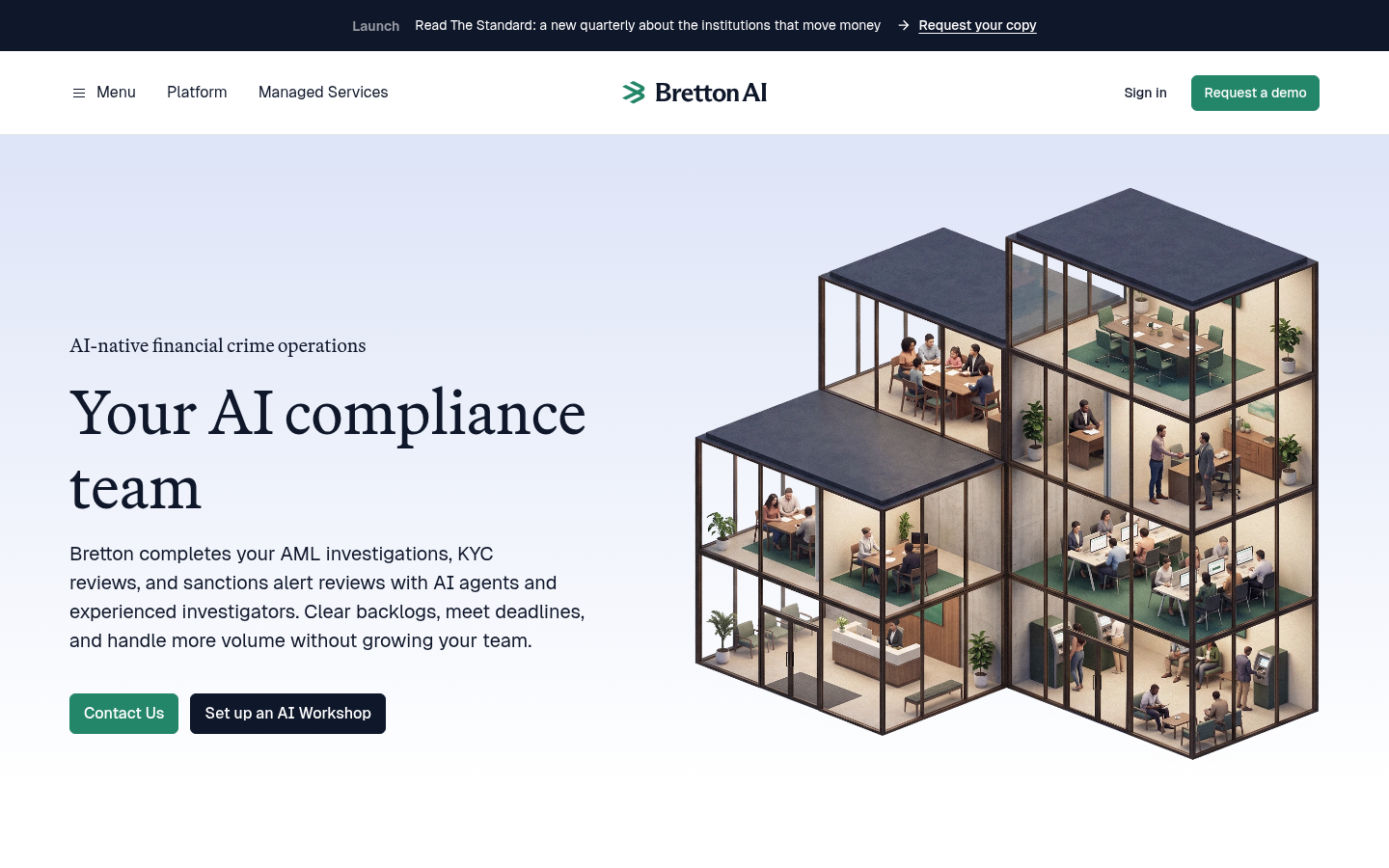
Bretton AI, formerly Greenlite AI, builds AI agents for AML, sanctions, KYC and KYB, and enhanced due diligence work at regulated banks and fintechs. It raised a $75 million Series B led by Sapphire Ventures in February 2026, with Greylock, Thomson Reuters Ventures and Citi Ventures participating.
Best for: Banks and fintechs that want agents to work L1 alerts and L2 investigations inside their current case management and compliance tools.
Key Features:
- AML investigation agents that triage L1 alerts and complete L2 cases, gathering evidence across systems and producing cited, audit-ready narratives for human sign-off.
- Trust Infrastructure that bundles independent model validation, continuous evaluations, regression testing, drift management and audit traceability.
- The Bretton AI Platform, with Builder for custom agents, Workbench for case teams and Templates for pre-built workflows.
- A Managed Services option, where a dedicated Bretton team runs the program end to end on the same platform.
- SOC 2 Type II, GDPR compliance, zero data retention and virtual private cloud deployment, per Bretton's trust center.
Why we like it: Bretton leads with model validation and audit traceability, which are the first things a model risk team asks about. CEO Will Lawrence told PYMNTS the platform has supported 1.2 million investigations, and Bretton reports that a $15B+ institution cut BPO spend by $5.35 million in its first year.
Notable Limitations:
- Since the Series B, Bretton has expanded into lending, fraud and onboarding workflows, so confirm which financial crime agents are generally available for your use case.
- Custom agents are built with Bretton's forward-deployed engineers, which makes a broad rollout a services-led project.
- The BPO savings and investigation counts are vendor-reported, with no independent benchmark published.
Pricing: Not publicly listed as of November 2026. Bretton sells platform licenses and Managed Services. Contact Bretton AI for a custom quote.
2. WorkFusion AI Agents
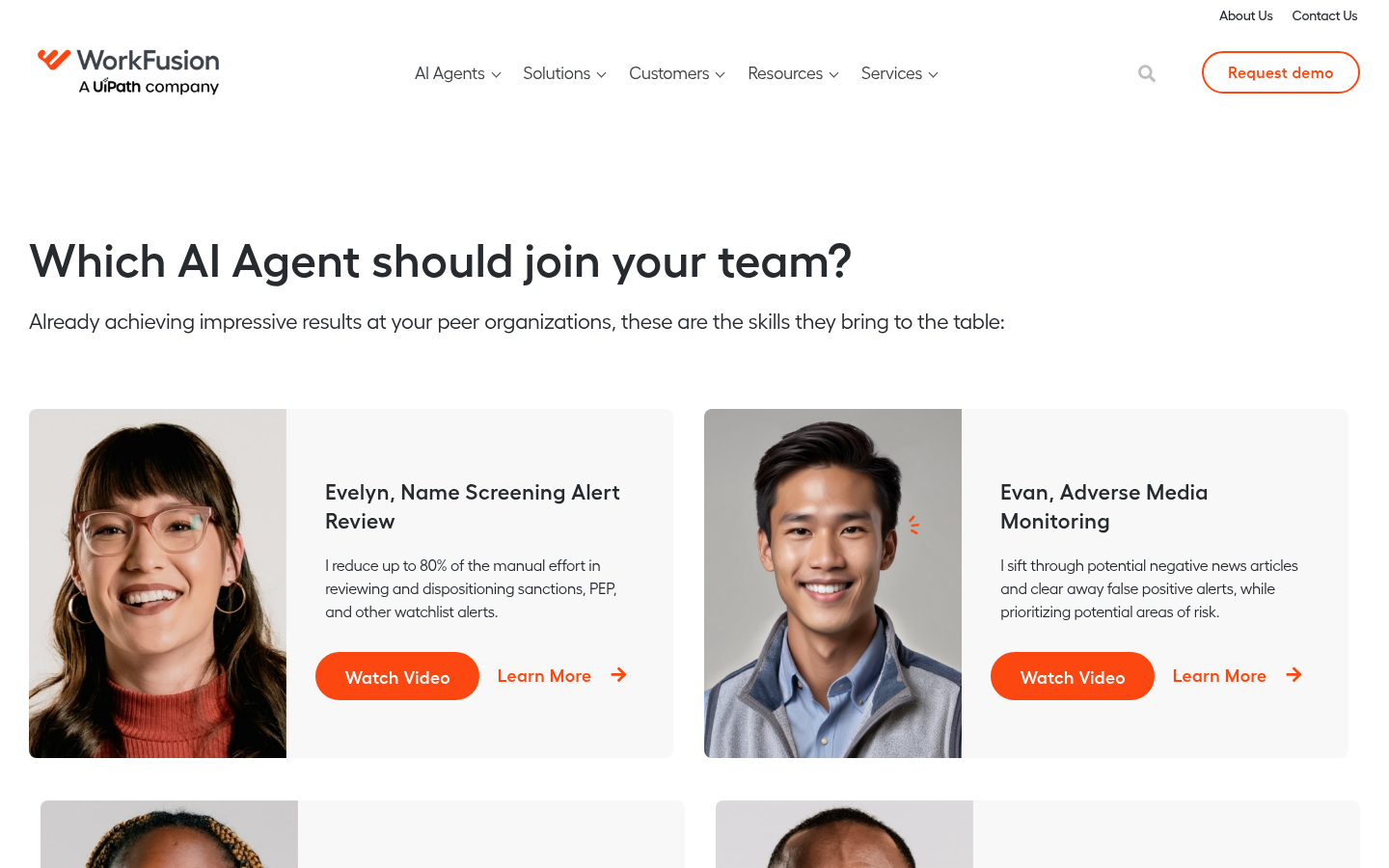
WorkFusion sells pre-built AI agents that review sanctions, adverse-media, transaction monitoring and KYC alerts and document each disposition. UiPath acquired WorkFusion in February 2026 and is bringing the agents into its agentic automation platform for banks.
Best for: Institutions with large sanctions and adverse-media queues that want pre-trained L1 agents on top of their current screening software.
Key Features:
- Named agents for specific queues, including Tara for payment sanctions screening, Evelyn for sanctions and PEP alert review, and Evan for adverse media.
- Alert disposition for output from name, PEP, list and payment screening systems, with every decision documented and explainable.
- L2 coverage for enhanced due diligence, KYC and transaction monitoring investigations.
- Human-in-the-loop escalation, with high-risk alerts routed to analysts.
Why we like it: WorkFusion has published concrete volume figures. In March 2025 it reported that its agents were processing one million sanctions and adverse-media alerts a day, and it earned a 2025 Datos Insights silver medal for sanctions and watchlist screening innovation.
Notable Limitations:
- UiPath has not published a full integration timeline or confirmed the future of the WorkFusion brand, so ask about roadmap and contract continuity before you sign.
- The agents focus on alert review and investigation support, so you will still need a separate case management system.
- The one-million-alerts figure dates from March 2025 and predates the acquisition.
Pricing: Not publicly listed as of November 2026. WorkFusion agents are now sold through UiPath. Contact UiPath or WorkFusion for a quote.
3. Unit21
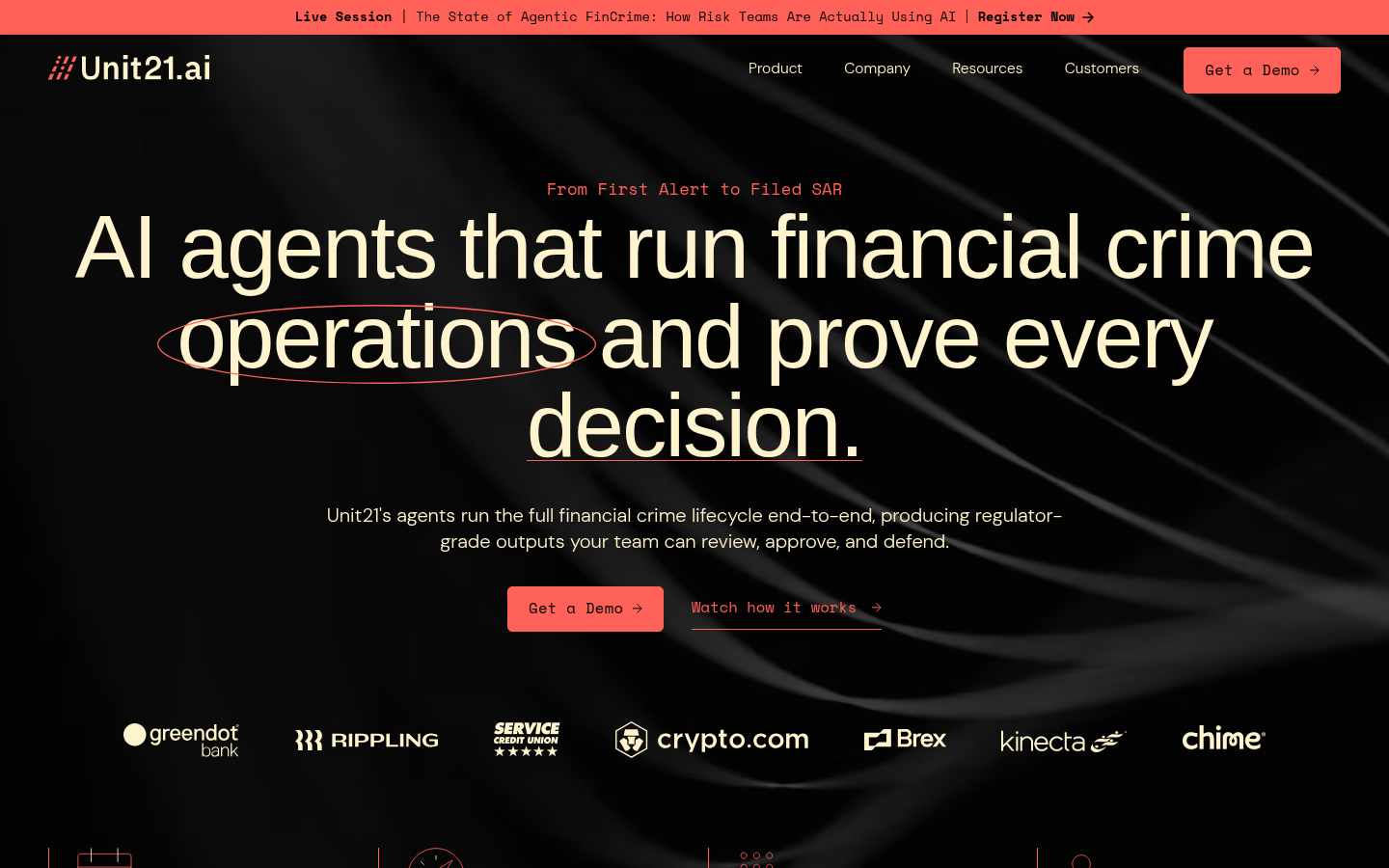
Unit21 is a fraud and AML platform that relaunched in March 2026 around AI agents for detection and investigation. Its agents triage alerts, investigate cases and draft SAR narratives inside the same system that holds rules, cases and filings.
Best for: Risk and compliance teams that want one environment for fraud and AML detection, agent-led investigation and SAR preparation.
Key Features:
- An AI investigation agent that runs validated tasks against each alert, including event analysis, online research, adverse media, network analysis and prior activity.
- A SAR Agent, generally available since July 2026, that drafts narratives across multiple cases and extracts filing fields for the analyst who signs and files.
- Autonomy set on a four-level ladder per queue, use case and risk tier, with QA sampling applied to agent output.
- An Agentic Task Builder (July 2026) for plain-English custom tasks tested against historical alerts, plus a remote MCP server (August 2026) that follows existing Unit21 roles and permissions.
Why we like it: Unit21 feeds investigation outcomes back into detection tuning, so cleaner alerts reach the queue over time. Unit21 reports that Nexo reduced false positives by 57% and Underdog cut alert volume by 72% with its AI agent, and it won a 2026 Datos Insights Impact Award for AI-driven innovation across fraud and AML.
Notable Limitations:
- Unit21 does not ship traditional machine learning risk-scoring models or support bring-your-own models, so teams with in-house scores need a plan for feeding them in.
- Most agent capabilities shipped between March and September 2026, so production track records are short. Confirm general availability for each module.
- Customer results are vendor-reported, so measure lift on your own labeled alerts.
Pricing: Not publicly listed as of November 2026. Unit21 sells quote-based SaaS contracts. Contact Unit21 for a custom quote.
4. Hawk AML Investigative Agent
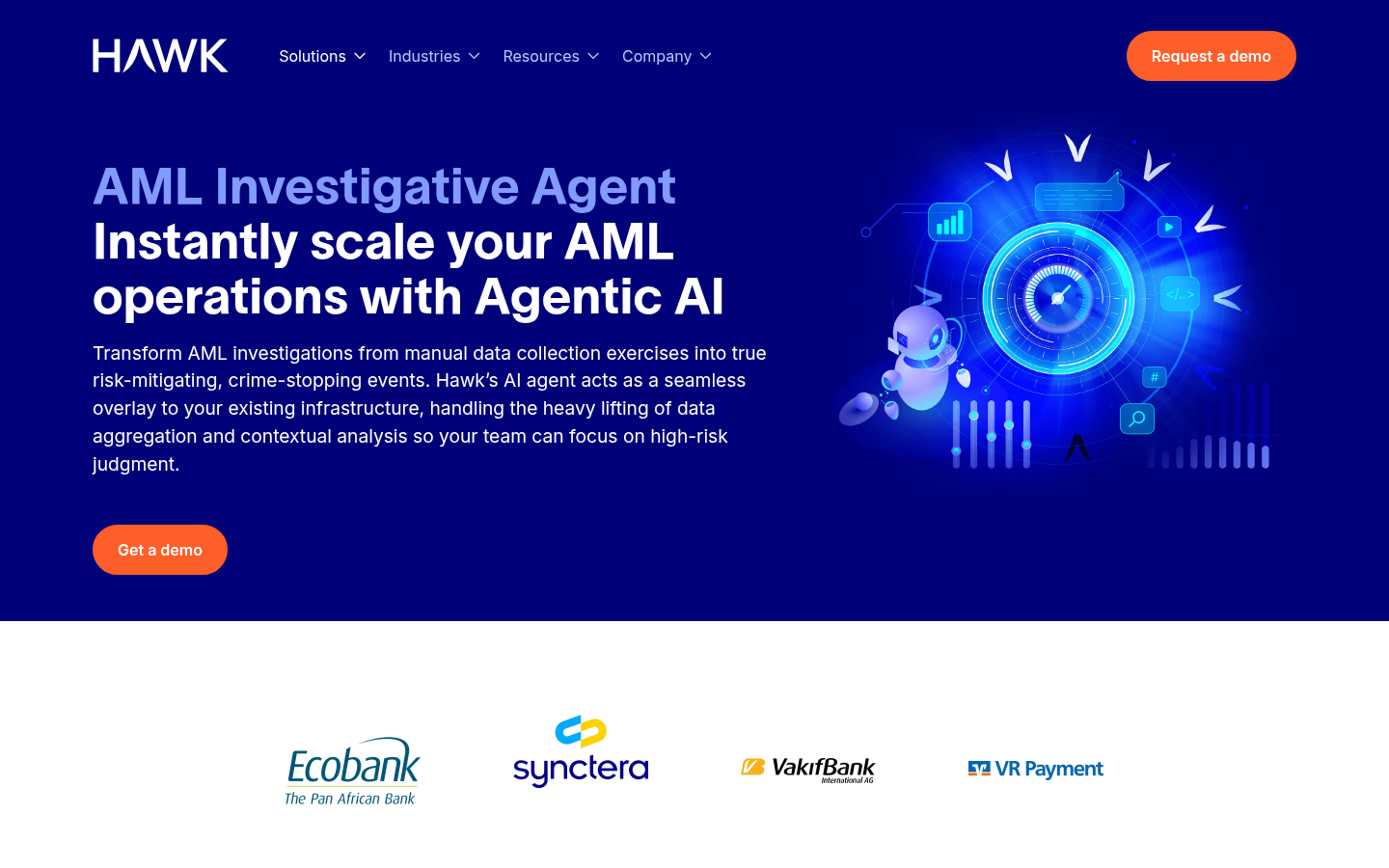
Hawk launched its AML Investigative Agent in March 2026 as a model-agnostic, modular overlay for existing AML stacks and case managers. The agent gathers data, summarizes cases, identifies typologies and drafts SAR narratives for analyst review.
Best for: Banks that want an explainable agent layer over their current screening and monitoring systems, with SAR drafting and typology detection.
Key Features:
- Automated data gathering, case summaries and typology identification, backed by continually updated AML typology knowledge.
- SAR narrative drafting for analyst review and approval.
- Explainability through chain-of-thought visualization, confidence scores, citations and detailed action logs, with built-in human-in-the-loop controls.
- Companion agents across the Hawk suite, including a Screening Review Agent and a Fraud Review Agent, per Hawk's AWS Marketplace listings.
Why we like it: The overlay design lets you add agentic investigation without replacing a case manager or monitoring engine. Hawk's AML AI Overlay earned a 2025 Datos Insights silver medal for transaction monitoring innovation, and Hawk offers SaaS, VPC and on-prem deployment.
Notable Limitations:
- The Investigative Agent launched in March 2026, so production references are newer than those for Hawk's core monitoring product.
- Agent quality depends on connectivity to source systems. Hawk describes connectors ranging from APIs to UI scraping and MCP servers, and scraping-based connectors need ongoing maintenance.
- Typology labels come from Hawk's own continually updated knowledge base, so check them against the typologies your program files on.
Pricing: Not publicly listed as of November 2026. Hawk's AWS Marketplace listings for fraud prevention and payment screening run as private offers priced by transaction volume, use case and contract length. Contact Hawk for a scoped quote.
5. Lucinity
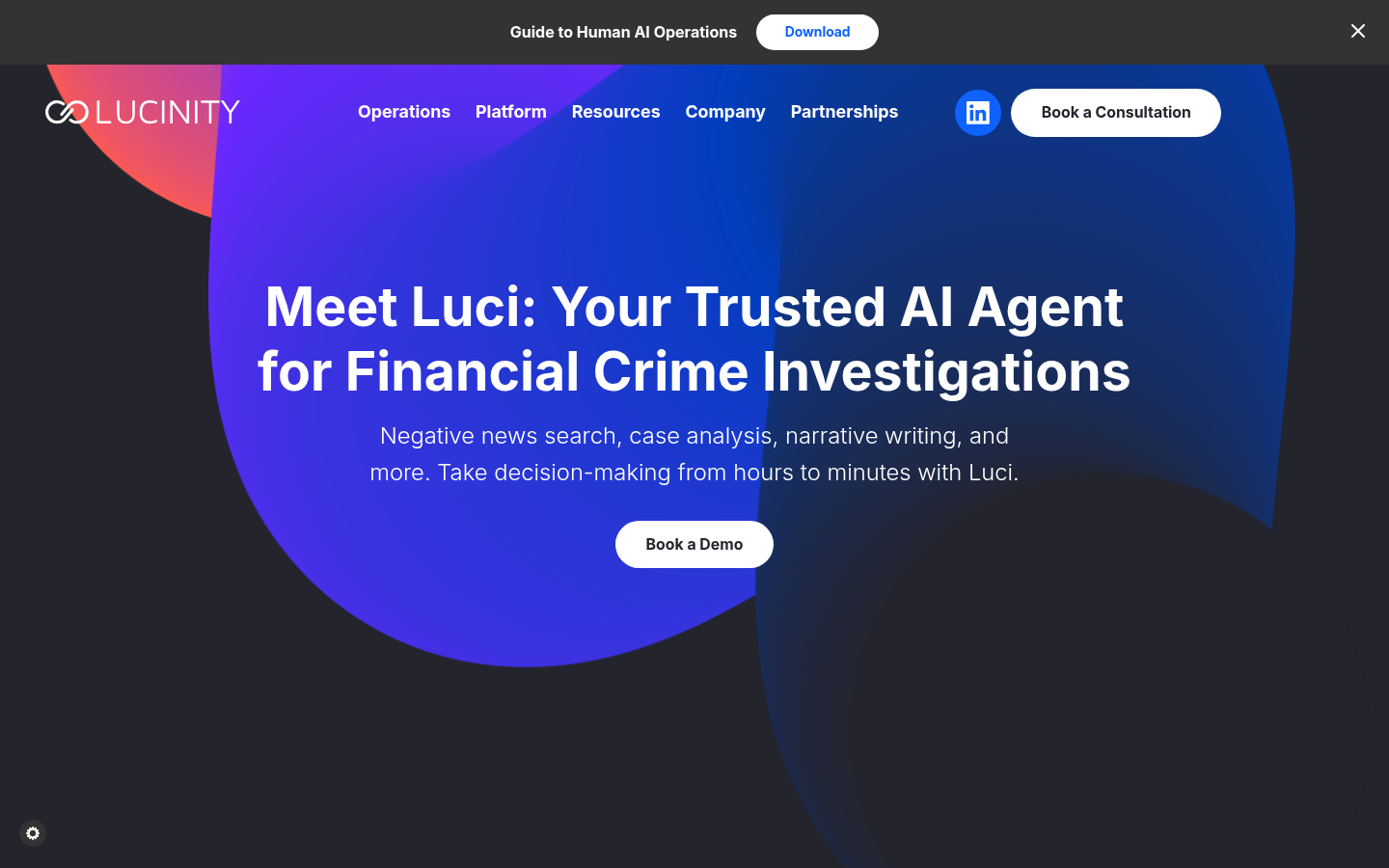
Lucinity pairs AML case management with Luci, an agent framework that assembles evidence, summarizes cases and drafts narratives inside structured workflows. In April 2026, Oracle integrated Lucinity's agent-driven investigation technology into its financial crime and compliance platform.
Best for: Teams that want modern AML case management plus an agent that prepares evidence and narratives for analysts.
Key Features:
- Luci case summaries and narrative drafting, built on Lucinity's copilot technology and Microsoft Azure OpenAI, with multi-LLM support.
- A Customer 360 view re-architected around Luci, in production at a Tier 1 financial institution.
- Case Manager with configurable queues, routing and audit trails.
- Retrieval-augmented generation and validation steps that keep Luci's output grounded in case data.
Why we like it: Lucinity puts the agent inside the case manager analysts already work in. The Oracle integration and an Azure Marketplace listing also give buyers two familiar procurement routes, and Lucinity earned a 2025 Datos Insights silver medal for transaction monitoring innovation.
Notable Limitations:
- Oracle customers can access Lucinity's agent capabilities through Oracle's platform, so confirm which features each route includes before you choose one.
- Luci started on Azure OpenAI, so confirm which models are approved for your deployment during model risk review.
- Most public customer references are anonymized, which makes peer reference checks harder.
Pricing: Not publicly listed as of November 2026. Lucinity is available through Microsoft Azure Marketplace, where buyers can apply committed Azure spend. Contact Lucinity for a custom quote.
6. Silent Eight Iris 7
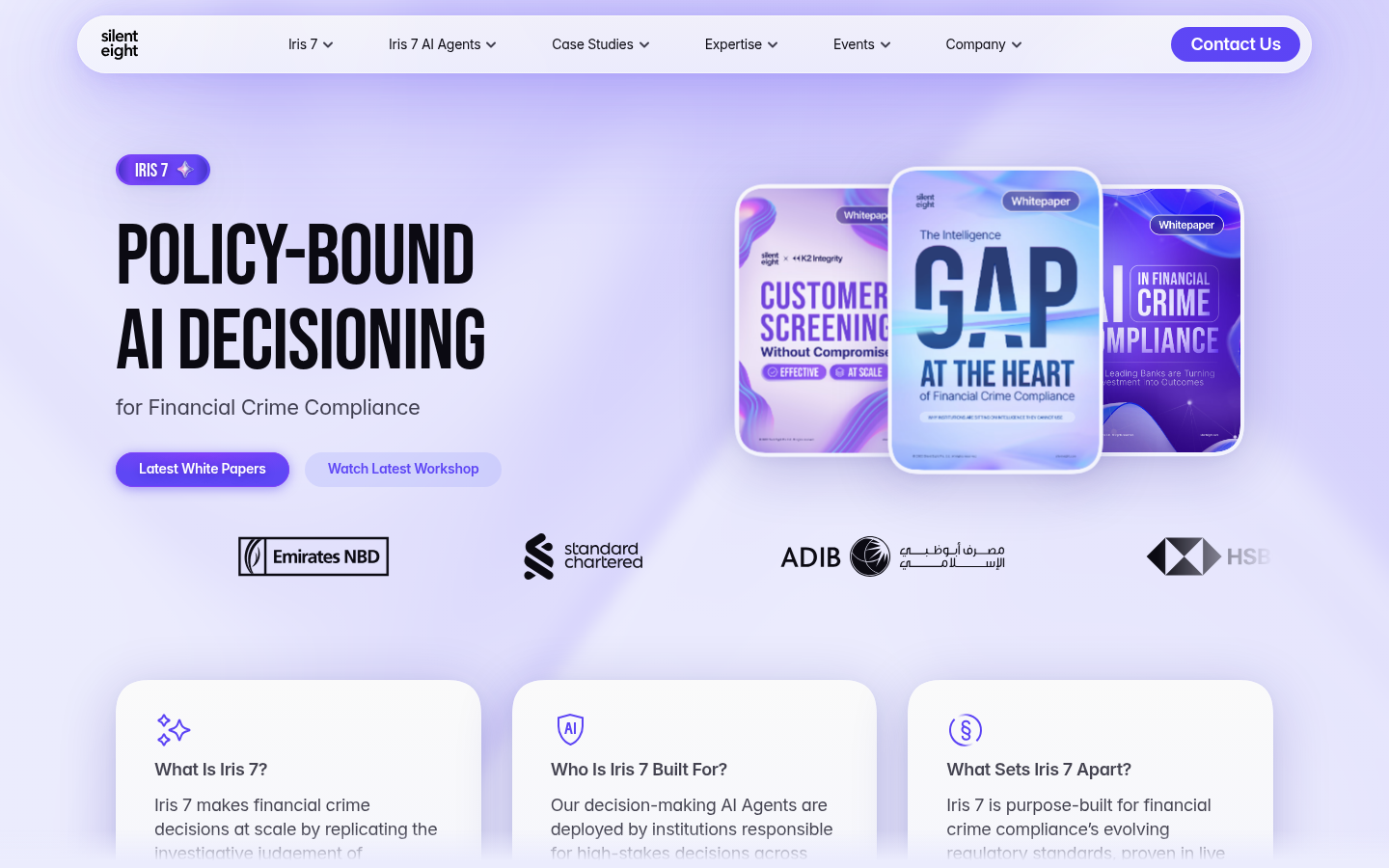
Silent Eight builds Iris 7, a policy-bound decisioning platform whose AI agents adjudicate name screening, transaction screening and transaction monitoring alerts. Its publicly named customers include HSBC, Standard Chartered and Emirates NBD.
Best for: High-volume global institutions that need explainable, policy-mapped screening and investigation decisions at scale.
Key Features:
- Policy-bound agents that replicate analyst judgement and record a written, auditable narrative for each decision.
- A Customer Screening Suite that runs name screening end to end, from detection to investigation to decisioning.
- The ability to run on top of incumbent screening systems while operations migrate.
- Three deployment models: managed service, customer cloud and on-prem.
Why we like it: Silent Eight has run agents in live Tier 1 bank environments since 2018, and Iris 7 is built around policy alignment and decision traceability. A Forrester Total Economic Impact study commissioned by Silent Eight documents the Customer Screening Suite replacing proprietary screening tools in a new market.
Notable Limitations:
- Policy-bound decisioning depends on detailed upfront policy modeling and data lineage work before agents can decide alerts.
- Silent Eight advertises "100% precision" in its ACAMS sponsor listing, a claim to validate on your own alert history during a pilot.
- The Forrester study is vendor-commissioned and based on a single interviewee organization.
Pricing: Not publicly listed as of November 2026. In the Forrester study, the interviewee organization paid over $800,000 in platform, license and advanced support fees over three years. Contact Silent Eight for a custom quote.
7. Hummingbird
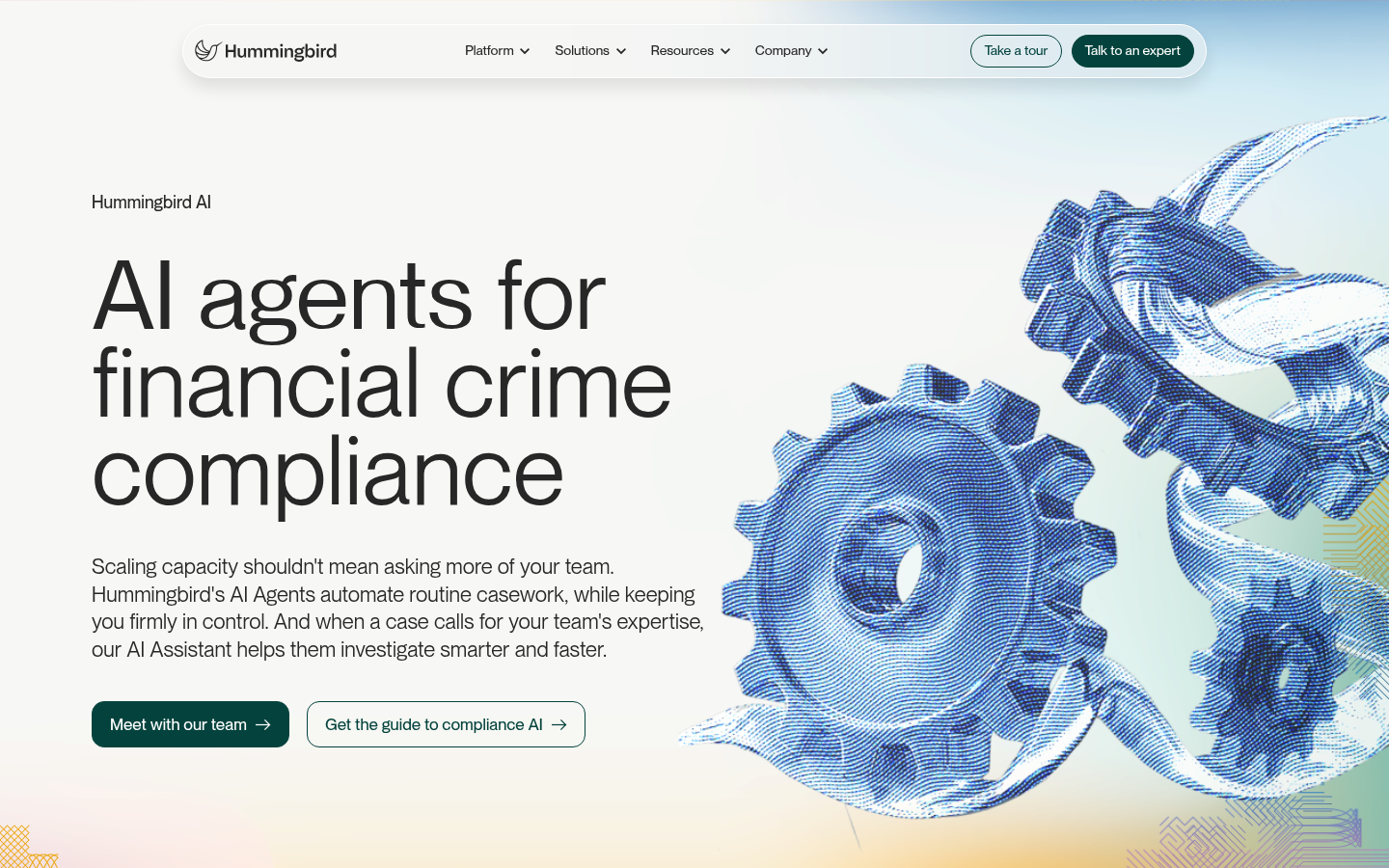
Hummingbird is a case management and regulatory filing platform that orchestrates AI agents and human analysts in one workflow. In June 2026 it added a Research Agent and a Review Agent, available inside Hummingbird and over API.
Best for: Institutions standardizing investigations, SAR filing and QA across teams, with staged autonomy and governance controls.
Key Features:
- AI agents for entity research, narrative writing and SAR filing, with every recommendation shown in context for analyst approval.
- Observe, recommend and automate modes, so agent accuracy is measured against analyst decisions before any automation.
- Orchestration across Hummingbird's agents, your own agents and specialist third-party agents, with one shared audit trail.
- SAR, STR and CTR preparation and filing workflows.
Why we like it: Hummingbird pairs mature case and filing workflows with agents that start in oversight mode and scale toward automation as controls prove out. It won the 2026 Datos Insights Impact Award for Best Financial Crime RegTech Innovation.
Notable Limitations:
- Hummingbird recommends automate mode only for lower-risk scenarios or where observed data supports it, so expect a long observe and recommend phase for high-risk queues.
- Detection comes from upstream monitoring and screening providers, which adds integration work.
- API access to the agents launched in June 2026, so integrations outside the Hummingbird interface have a short track record.
Pricing: Not publicly listed as of November 2026. Contact Hummingbird for a custom quote.
Key Features Compared
Agent scope runs from specific alert queues at WorkFusion to full triage-to-SAR workflows at Unit21 and Hummingbird, and each vendor records a different kind of evidence for every decision.
| Platform | Agent Scope | Human Oversight | Audit Evidence |
|---|---|---|---|
| Bretton AI | L1 triage and L2 AML, sanctions, KYC and EDD investigations | Human sign-off on every narrative, with Managed Services option | Cited narratives, model validation and drift tracking |
| WorkFusion AI Agents | Sanctions, PEP, adverse-media, KYC and TM alert review | Escalation of high-risk alerts to analysts | Documented, explainable disposition per alert |
| Unit21 | Triage, investigation and SAR drafting in one system | Four-level autonomy ladder per queue and risk tier | Full audit trail plus QA sampling of agent output |
| Hawk AML Investigative Agent | Data gathering, typology detection and SAR drafting | Built-in human-in-the-loop controls | Chain-of-thought view, confidence scores and action logs |
| Lucinity | Case summaries, Customer 360 and narrative drafting | Analyst review inside Case Manager | Case audit trails with RAG-grounded output |
| Silent Eight Iris 7 | Name screening, transaction screening and TM decisions | Policy-bound agents with human oversight | Written narrative for every decision |
| Hummingbird | Entity research, case review and SAR filing | Observe, recommend and automate modes | One audit trail shared by agents and analysts |
Deployment Options
Silent Eight and Hawk publish on-prem options, Bretton AI and Hawk offer private cloud deployment, and the remaining vendors run as SaaS or vendor-hosted cloud.
| Platform | Deployment Models | Integration Approach | Plan For |
|---|---|---|---|
| Bretton AI | SaaS with virtual private cloud options | Agents work inside existing case and compliance tools | Forward-deployed engineering time for custom agents |
| WorkFusion AI Agents | Vendor-hosted cloud | Sits on existing screening and monitoring software | Roadmap changes under UiPath ownership |
| Unit21 | SaaS | Native platform, plus agents over API and a remote MCP server | Data mapping into Unit21 rules and cases |
| Hawk AML Investigative Agent | SaaS, VPC or on-prem | Model-agnostic overlay on current stacks | Connector maintenance for each source system |
| Lucinity | Cloud, via direct contract, Azure Marketplace or Oracle | Pulls external detection sources into case flows | Choosing between the direct and Oracle routes |
| Silent Eight Iris 7 | Managed service, customer cloud or on-prem | Runs on top of incumbent screening during migration | Upfront policy modeling and data lineage |
| Hummingbird | SaaS, with agents over API | Ties into upstream detection and screening providers | Integration with monitoring vendors |
Strategic Decision Framework
Ask these five questions before a pilot, and treat any answer that matches a red flag as a reason to stop the deal.
| Critical Question | Why It Matters | What to Evaluate | Red Flags |
|---|---|---|---|
| What level of autonomy is acceptable for each workflow? | Examiners expect oversight and reversibility in high-risk processes | Autonomy modes, escalation paths, replay and rollback | Agents that auto-close alerts without replayable evidence or policy versioning |
| Can the platform produce explainable, policy-bound decisions? | Examiners may ask for the rationale and evidence chain behind any disposition | Decision rationale, citations, evidence retention and policy mapping | Outputs with no decision trace or policy reference |
| How will we validate performance on our own data? | Public benchmarks are scarce and error costs are high | A pilot on labeled historical alerts, precision and recall tracking, QA sampling | Claims of dramatic lift with no controlled test |
| Does agent access fit our identity and access controls? | Axios reported in October 2026 that major US banks were blocking unvetted third-party AI agents | Per-agent credentials, least privilege, logs tied to identities | Shared service accounts and weak or missing logs |
| What will the platform cost over 12 to 36 months? | Integration, model usage and QA effort can exceed license fees | Pricing drivers, reprocessing costs, services dependence | Unclear usage drivers and surprise overage fees |
Problems & Solutions
Four problems come up in most agentic FCC evaluations, and each one has two or three platforms with a direct fit.
Problem: Sanctions and PEP false positives overwhelm L1 teams. WorkFusion's pre-built agents disposition alerts from name, PEP, list and payment screening systems and escalate high-risk cases to analysts. Silent Eight's Customer Screening Suite runs name screening end to end with a written rationale for each decision, which suits Tier 1 volumes.
Problem: SAR narratives consume hours per case. Unit21's SAR Agent drafts narratives across multiple cases and extracts filing fields for the analyst who files. Hawk's AML Investigative Agent drafts SAR narratives from its own evidence gathering, and Lucinity's Luci drafts narratives inside Case Manager.
Problem: Examiners want to see why an agent closed an alert. Bretton AI attaches citations and model validation records to each narrative, and Hawk logs chain-of-thought reasoning, confidence scores and actions. Hummingbird keeps agents and analysts on one audit trail, which gives an examiner a single record to review.
Problem: Budgets will not cover a platform replacement. Hawk's overlay and WorkFusion's agents sit on top of existing systems, and Bretton AI's agents work inside current tools. Start in observe or recommend mode, measure the drop in manual steps and QA rework, then expand autonomy queue by queue.
The Bottom Line
Weigh explainability and replayable evidence first when you compare autonomy claims. Silent Eight and WorkFusion fit high-volume screening, Unit21 and Hummingbird fit teams that want detection or filing in one system, and Bretton AI, Hawk and Lucinity fit teams adding agents to the stack they already run.
Whichever you shortlist, run a time-boxed pilot on your own labeled alerts and sample every early agent decision. Scale only after the platform shows fewer manual steps, consistent policy-mapped reasoning and audit evidence your examiners accept.