Claims teams lose time when first notice of loss (FNOL) details are scattered across phone calls, messages, and core systems. Underwriters face a similar problem when submissions arrive as lengthy emails and attachments that still need manual review.
McKinsey's February 2026 analysis estimates that generative AI could unlock $50 billion to $70 billion in insurance industry revenue. However, Gartner warned in January 2026 that AI customer-service resolutions could cost more than $3 each by 2030, making efficiency measurement essential.
We compare six insurance-focused AI assistants for claims, underwriting, policy servicing, and distribution.
AI Insurance Assistants at a Glance
| Tool | Best For | Pricing Model | Standout Feature |
|---|---|---|---|
| Bevaya (Roots Automation) | Insurance document automation across claims, underwriting, and servicing | Published per-agent and usage-credit model; confirm quote | InsurGPT, prebuilt agents, human review |
| Sixfold | High-volume underwriting and submission triage | Custom quote | Appetite scoring and source-cited risk narratives |
| Hi Marley | FNOL intake and claims communications | Custom quote | Voice-story capture, SMS follow-up, claims coordination |
| Liberate | Automated voice calls, FNOL, and policy servicing | Custom quote | Conversational AI agents with core-system actions |
| Federato | Portfolio-aware underwriting and broader core modernization | Custom quote | RiskOps triage, portfolio controls, integrated claims |
| Zelros (Earnix) | Insurance advisor recommendations and customer engagement | Custom quote | Contextual recommendations and guided conversations |
How We Evaluated These Tools
We assessed publicly documented capabilities, insurance-specific implementations, customer references, and pricing information available in 2026. This is a research-based comparison, not a hands-on product benchmark.
Our evaluation focused on five criteria:
- Insurance workflow coverage: Whether the platform supports specific tasks such as FNOL, underwriting triage, policy servicing, or advisor recommendations rather than general-purpose chat.
- Governance and explainability: Availability of evidence references, decision histories, exception handling, and human review for sensitive insurance workflows.
- Integration capabilities: Documented connections to core insurance platforms, CRMs, underwriting workbenches, and communication channels.
- Customer evidence: Named insurer deployments, public case studies, official marketplace listings, and product-specific implementation references.
- Pricing and deployment transparency: Published commercial terms, usage-based charges, deployment requirements, and implementation dependencies.
Where independent evidence or technical documentation was insufficient, we have identified what buyers should confirm during procurement.
1. Bevaya (Roots Automation)
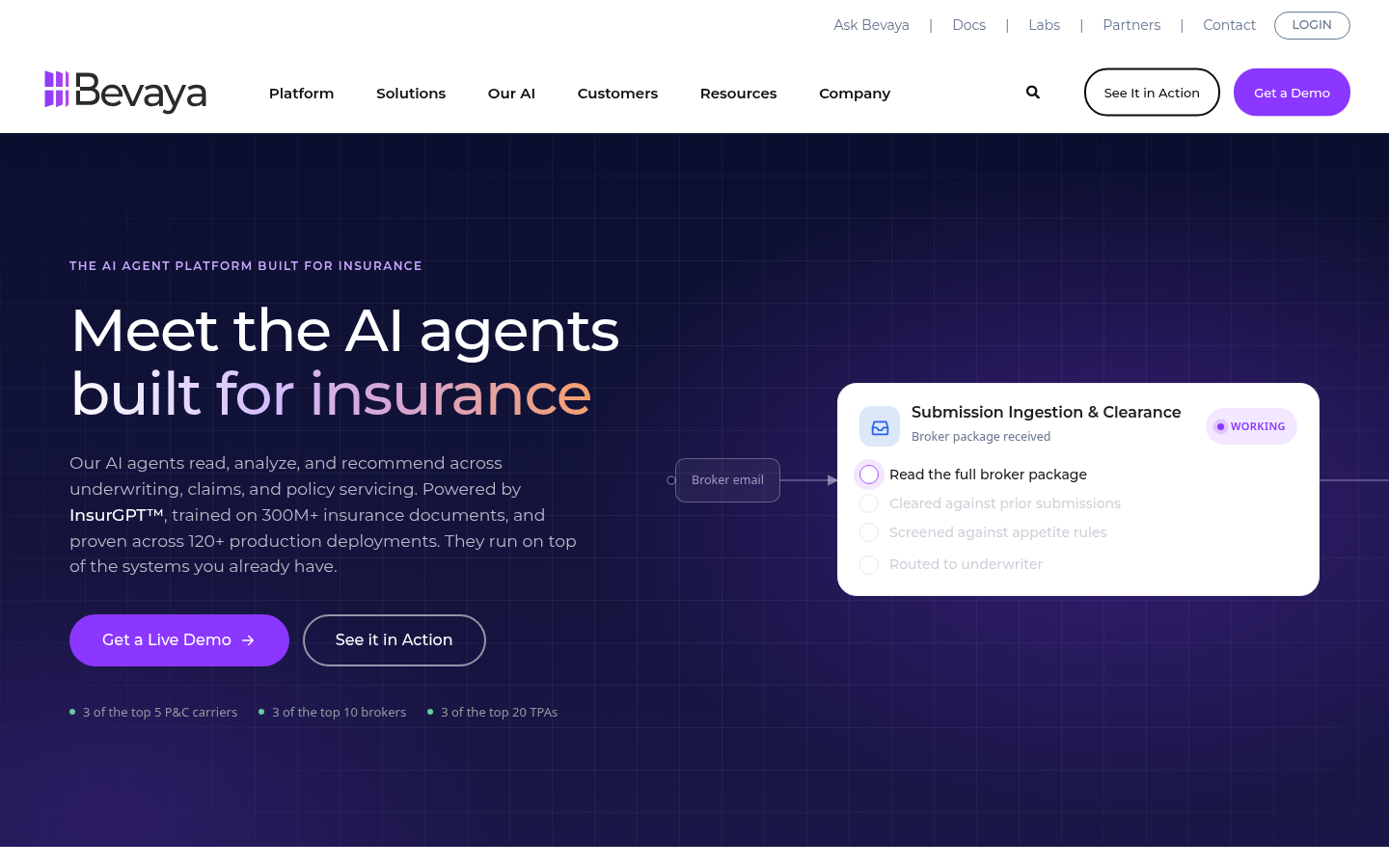
Bevaya is an insurance-focused AI agent platform introduced by Roots Automation on May 28, 2026, replacing its previous platform and becoming the company's go-forward brand.
Powered by InsurGPT, it automates document-intensive workflows across underwriting, claims, and policy servicing while maintaining configurable human oversight.
Best for:
P&C carriers, brokers, and third-party administrators that need insurance-specific document processing, claims administration, and underwriting automation with human review.
Key Features:
- InsurGPT insurance models: An ensemble of specialized AI models designed to interpret insurance terminology, documents, and workflows across different lines of business.
- Prebuilt insurance agents: Support for submission intake, ACORD extraction, loss-run processing, claim indexing, FNOL setup, endorsements, and policy comparisons.
- Human-in-the-loop review: Configurable review queues, confidence thresholds, source highlighting, and audit histories that help teams inspect extracted information before downstream actions.
- Core-system connectivity: API-based workflows and documented integrations involving Guidewire, Salesforce, Outlook, SFTP, and other insurance systems.
Why we like it:
Bevaya addresses the document-heavy work that often delays claims and underwriting without requiring every exception to become a fully automated decision. Its review environment gives operations teams a practical way to verify outputs while gradually increasing automation.
The combination of reusable insurance agents and shared usage credits is useful for organizations deploying several workflows. The vendor also publishes a per-agent pricing and capability breakdown, making it easier to begin a commercial evaluation than with entirely undisclosed pricing.
Notable Limitations:
- Bevaya's public pricing page contains inconsistent displayed figures, including a $0 starting-price indicator alongside higher subscription examples and differing credit allocations. Buyers should obtain a reconciled proposal before budgeting.
- Although prebuilt agents reduce development work, organizations still need to configure source mappings, exception thresholds, approvals, and write-backs for their specific insurance systems.
- Bevaya is principally a workflow and document automation platform, so carriers seeking a dedicated, conversational voice-service experience should compare its phone-related capabilities with voice-first alternatives.
Pricing:
Bevaya publishes a per-AI-agent subscription model with pooled usage credits and volume discounts. Its pricing calculator illustrates a base subscription of $4,000 per agent per month, billed annually, but the inconsistent figures elsewhere on the page mean that this should not be treated as a confirmed contractual price.
Request a written quote covering the number of agents, included credits, overage rates, integration work, and support.
2. Sixfold
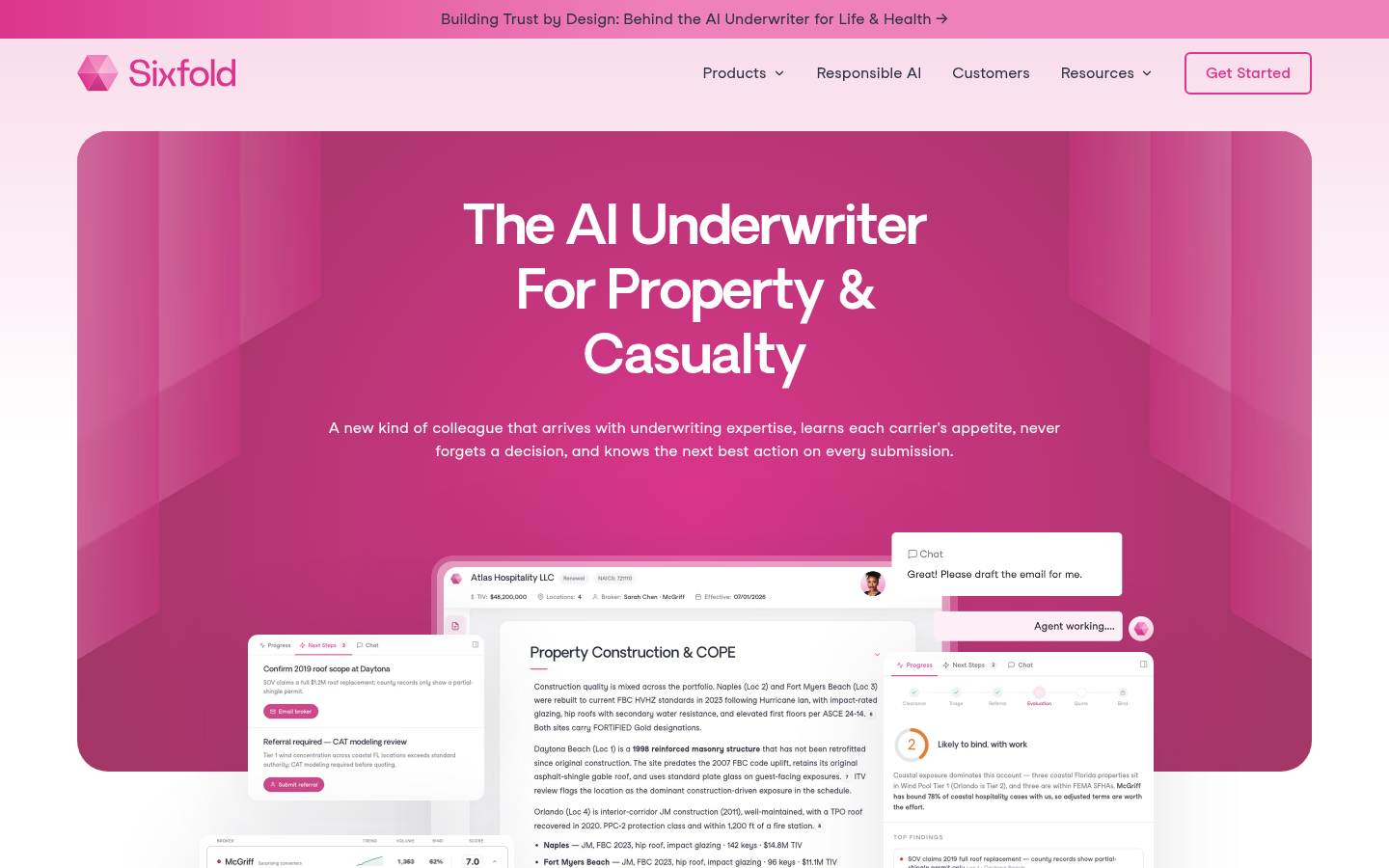
Sixfold is an AI underwriting platform designed to evaluate submissions against insurer-specific guidelines and convert fragmented risk information into structured narratives.
Its public customer references include Zurich North America, which reported deploying the platform across its U.S. Middle Market underwriting operations.
Best for:
Commercial, specialty, P&C, and life insurance underwriting teams that process large submission volumes and need consistent appetite assessments with verifiable evidence.
Key Features:
- Appetite scoring: Evaluates submissions against carrier guidelines and highlights individual risk signals, helping underwriters prioritize suitable business.
- Automated submission analysis: Processes information from applications, loss runs, exposure reports, and other supporting documents to reduce manual review.
- Source-cited narratives: Generates underwriting summaries and risk assessments with references to the underlying information for verification.
- Workflow integration: Supports API connections to underwriting workbenches, CRMs, and policy administration environments, with agent-based assistance for selected follow-up tasks.
Why we like it:
Sixfold brings evidence and appetite evaluation into the same workflow, rather than asking underwriters to switch between extracted documents and separate scoring tools.
Its official Microsoft Marketplace listing documents appetite scoring, cited narratives, and integration capabilities. Zurich North America also reported in July 2025 that its initial rollout helped 16 underwriters save an estimated average of 60 minutes per submission, providing a useful customer-reported productivity reference.
Notable Limitations:
- Sixfold focuses on underwriting workflows rather than claims communications or conversational FNOL, so it is not a replacement for a customer-facing insurance service platform.
- The quality of appetite recommendations depends on accurate, maintained underwriting guidelines and the quality of incoming submissions.
- Zurich's deployment began with lower-risk narrative generation before expanding. Carriers expecting immediate automated decisioning should account for a phased validation and governance process.
Pricing:
Sixfold does not publish standard subscription rates or enterprise package prices.
Contact the company for a custom quote based on business lines, submission volumes, integrations, and deployment requirements. Ask whether implementation, source integrations, and ongoing model evaluation are included.
3. Hi Marley
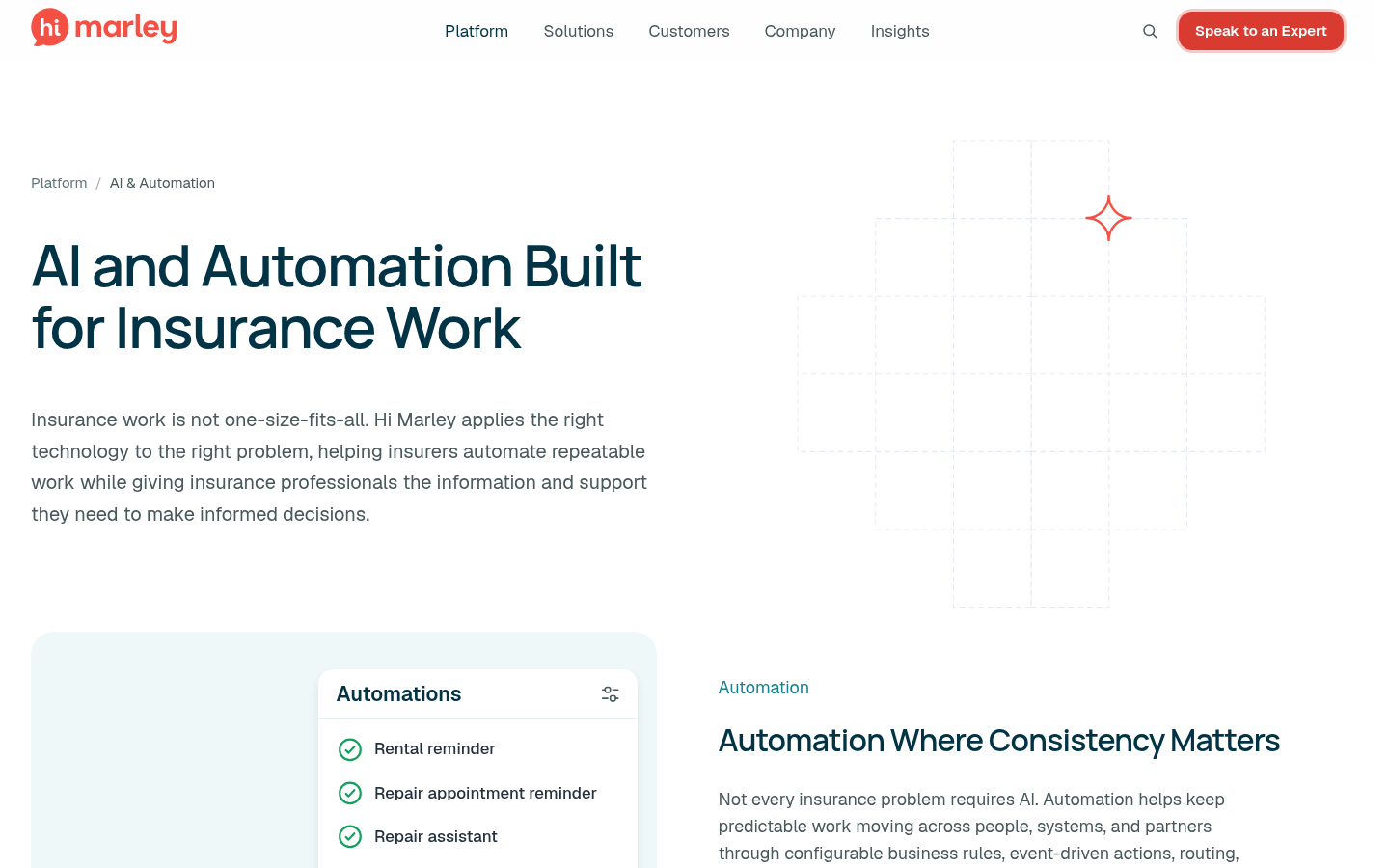
Hi Marley is a claims communication and automation platform for P&C insurers, combining voice-based loss reporting with SMS conversations, document collection, and adjuster coordination.
Its Conversational FNOL solution lets policyholders describe a loss verbally and then continue providing supporting information through text.
Best for:
Claims organizations that want to simplify FNOL, reduce repeated information requests, and keep policyholders, adjusters, and service providers connected throughout the claim lifecycle.
Key Features:
- Conversational FNOL: Records and transcribes a policyholder's description of an incident, then extracts information required to start a claim.
- Call-to-text continuation: Collects photos, videos, supporting details, and missing information through subsequent SMS messages.
- AI-assisted communication: Provides message summaries, suggested responses, and contextual information to help adjusters manage ongoing claims conversations.
- Insurance ecosystem integrations: Supports workflows involving Guidewire ClaimCenter, Duck Creek Claims, and other claims systems, including case creation and information sharing.
Why we like it:
Hi Marley connects the initial loss report with the conversations that follow, so policyholders do not have to repeat the same details at every handoff.
The approach is particularly useful when photos, repair updates, and vendor coordination are central to the claim. Hi Marley's Conversational FNOL documentation explains how spoken loss descriptions become structured claim information and continue through an established text conversation.
Notable Limitations:
- Conversational FNOL uses an initial spoken narrative followed by text-based follow-up. It should not be confused with an AI voice agent that conducts an extended, interactive telephone conversation from beginning to end.
- The SMS-centered workflow may be less suitable for carriers prioritizing email-first or app-only customer service experiences.
- Successful adoption depends on integrating claims communication into existing processes, including message consent, escalation ownership, and record retention.
Pricing:
Hi Marley does not publish standard enterprise pricing for its Conversational FNOL and claims communication offerings.
Contact the company for a quote covering claim volumes, messaging usage, FNOL capabilities, core-system integrations, and implementation services.
4. Liberate
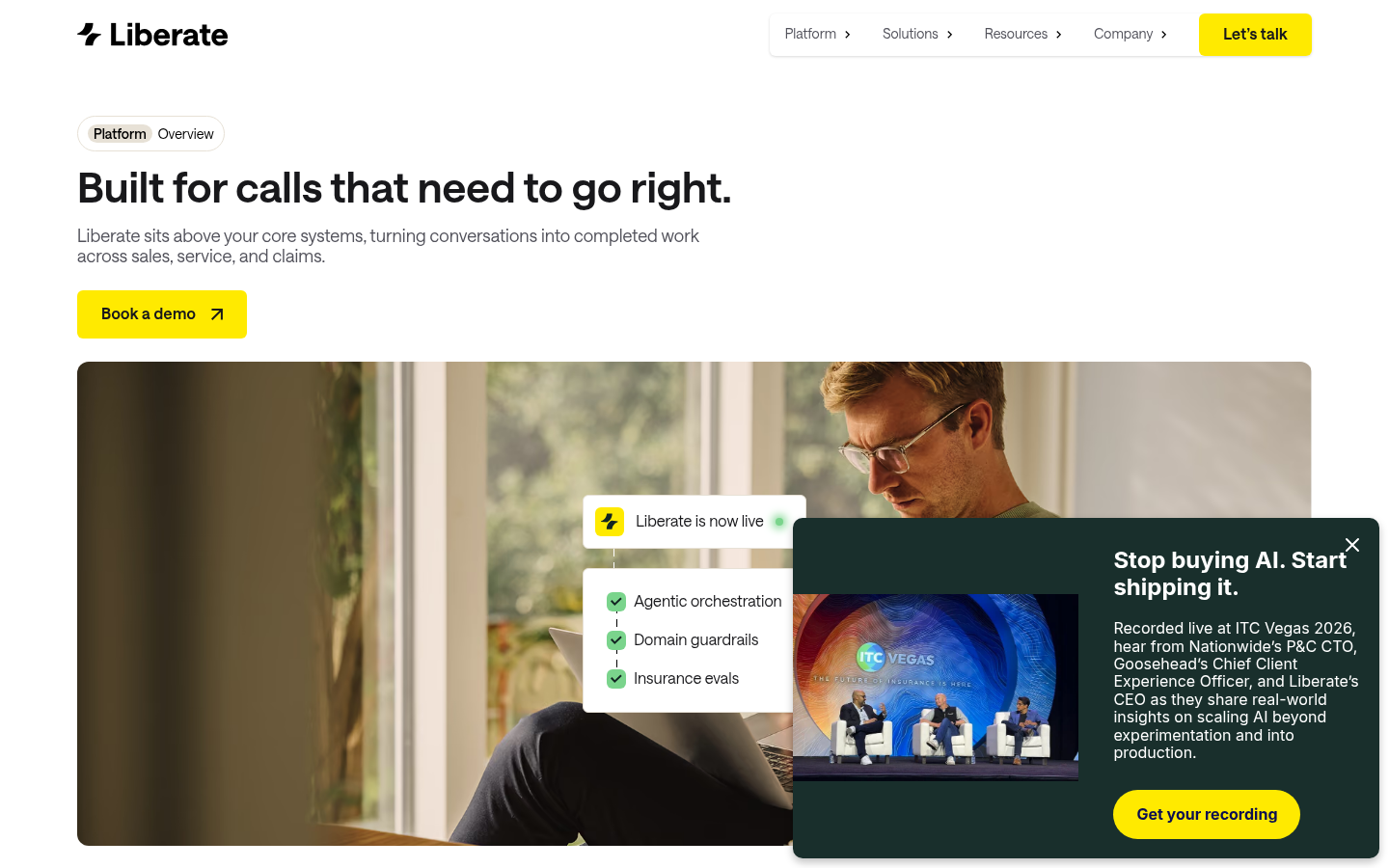
Liberate offers insurance-native AI agents that handle customer conversations and perform operational tasks across claims, policy servicing, and sales.
The platform emphasizes conversational voice automation, identity verification, workflow orchestration, and direct actions in connected insurance systems.
Best for:
Carriers, brokers, and insurance service teams that need around-the-clock call handling, automated FNOL, routine policy assistance, and structured escalation to human representatives.
Key Features:
- AI voice agents: Manage FNOL calls, claims status inquiries, billing questions, and other insurance service conversations.
- Core-system actions: Retrieve policy information, validate identities, create claim records, and update connected systems where integrations are configured.
- Multichannel orchestration: Supports customer interactions through voice, SMS, email, and digital channels.
- Operational guardrails: Includes workflow controls, release evaluations, conversation analytics, and escalation paths for situations requiring human intervention.
Why we like it:
Liberate is designed to complete operational work during an insurance conversation rather than simply capture a transcript for later processing.
That distinction is valuable for carriers dealing with after-hours calls or sudden spikes in claim volume. Its July 2026 Guidewire FNOL accelerator announcement describes policy validation through PolicyCenter, claim submission into ClaimCenter, and live transfers when intervention is needed.
Notable Limitations:
- Straight-through resolution requires reliable integrations for identity verification, policy retrieval, and permitted transactions. The level of automation depends on the carrier's existing systems and configured workflows.
- Carriers must define when the AI agent should transfer a conversation, especially when coverage disputes, exceptions, or sensitive decisions arise.
- Liberate advertises an implementation timeline of approximately six to eight weeks, but actual deployment scope should be confirmed for each core system, business line, and integration requirement.
Pricing:
Liberate does not publish standard subscription pricing.
Request an enterprise quote covering voice usage, call volumes, supported channels, core integrations, implementation services, and escalation requirements. Ask for expected cost per completed service interaction rather than call-volume pricing alone.
5. Federato
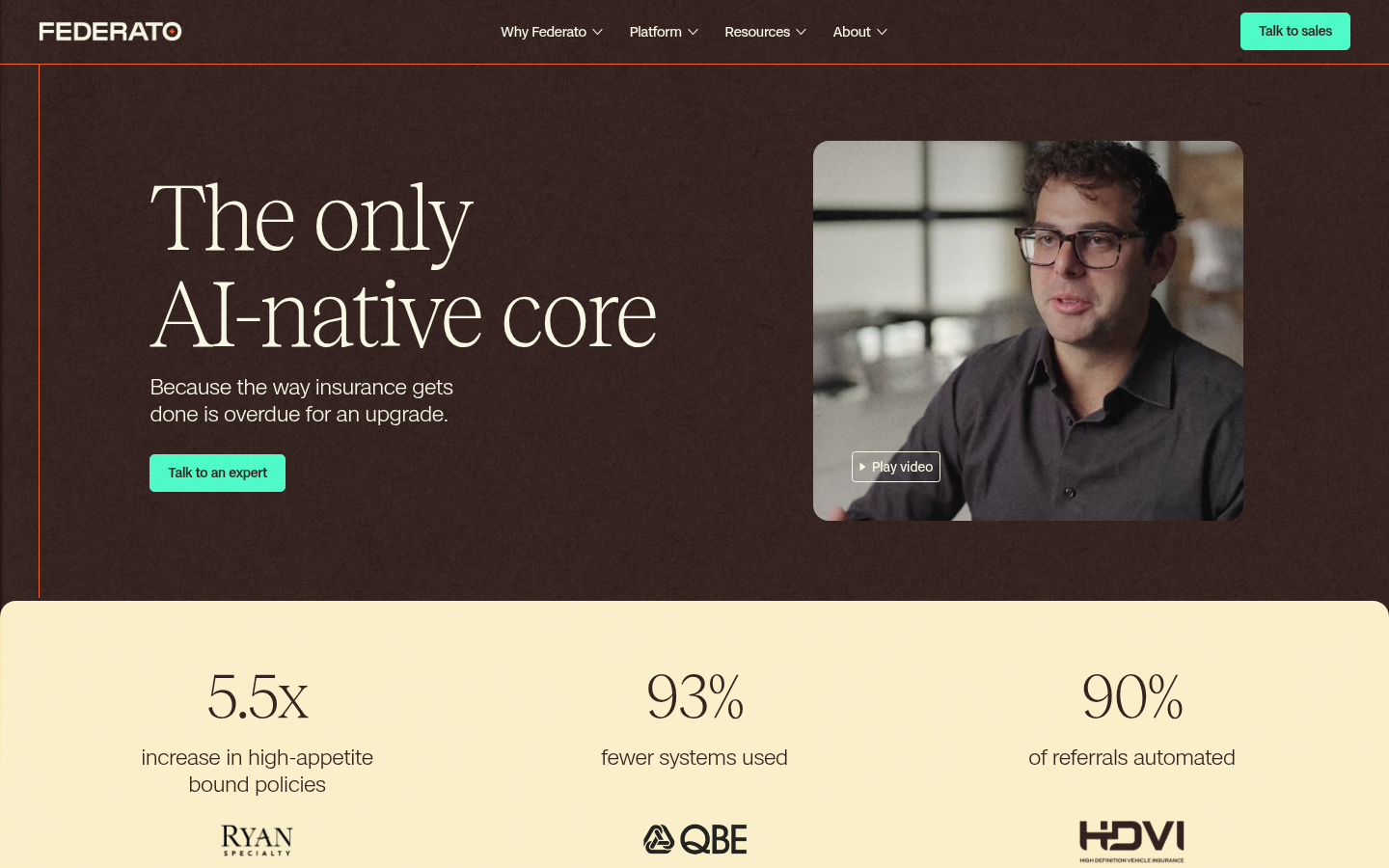
Federato began with portfolio-aware underwriting and RiskOps workflows but expanded substantially during 2026.
Its AI-native insurance core now covers underwriting, policy administration, billing, and claims. Federato Claims launched in August 2026, extending its portfolio intelligence approach into the claims lifecycle.
Best for:
P&C and specialty insurers, carriers, and MGAs that want underwriting decisions tied to portfolio objectives and are evaluating broader modernization of insurance operations.
Key Features:
- Submission triage: Analyzes emails, applications, and attachments to evaluate appetite, eligibility, and the likelihood of winning suitable business.
- Portfolio-aware decisioning: Uses portfolio composition, underwriting guidelines, and business strategy to help prioritize submissions.
- Integrated policy workflows: Connects underwriting with policy administration, billing, product configuration, and operational records within its broader platform.
- Federato Claims: Supports claims intake, management, coverage analysis, and structured feedback from claims decisions into underwriting and portfolio strategy.
Why we like it:
Federato connects decisions made on individual risks to the insurer's wider portfolio strategy. That gives underwriting leaders a way to make appetite and mix objectives part of daily work instead of relying only on retrospective reports.
Its 2026 platform overview also reflects an important shift in positioning: Federato is now offering a broader AI-native core rather than only an underwriting workbench.
Notable Limitations:
- Adopting Federato's broader core platform can be a substantially larger modernization project than purchasing a focused underwriting assistant, particularly where existing policy or claims systems must be replaced.
- Buyers seeking only lightweight submission scoring should clarify which workflows can be implemented independently and which require additional modules.
- The platform's claims capability is comparatively newer, having launched in August 2026, so insurers should request references specific to the claims workflows and scale they intend to deploy.
Pricing:
Federato does not publish standardized subscription pricing for its underwriting and core-platform capabilities.
Contact Federato for a custom quote. Pricing should be evaluated against the modules purchased, lines of business, integration and migration scope, and ongoing operational requirements.
6. Zelros (Earnix)
Zelros developed an insurance-focused AI copilot for personalized recommendations and advisor assistance. Following its 2025 acquisition by Earnix, these capabilities now sit within the broader Earnix customer engagement and decisioning portfolio.
The offering focuses on helping insurance advisors deliver relevant explanations and product recommendations within existing customer workflows.
Best for:
Insurance distribution teams, brokers, advisors, and customer service organizations that want contextual recommendations and guided conversations to improve customer engagement.
Key Features:
- Personalized recommendations: Uses customer information and interaction context to suggest relevant insurance products, coverage opportunities, and next actions.
- Contextual explanations: Helps translate complex business rules, product information, and documents into explanations that advisors can use during customer interactions.
- Configurable recommendation logic: Allows business teams to manage recommendation content, rules, and customer engagement workflows.
- Workflow embedding: Supports integration with existing customer engagement and distribution environments rather than requiring replacement of core systems.
Why we like it:
Zelros addresses a different part of the insurance lifecycle from claims and underwriting automation: helping advisors identify relevant products and provide more useful guidance during conversations.
The current Earnix Customer Engagement offering combines explanation, recommendations, and decisioning within distribution and service workflows. Its advisor-focused approach is a useful option for organizations prioritizing customer engagement over back-office automation.
Notable Limitations:
- The publicly available 2026 product documentation does not clearly establish page-level policy citations or automated call summaries as standard features. Buyers needing these capabilities should request a demonstration using their own policy documents.
- Zelros is now part of Earnix, so procurement teams should confirm product packaging, support ownership, integration responsibilities, and the current roadmap.
- The offering is primarily oriented toward recommendations and customer engagement, not automated FNOL or comprehensive underwriting submission triage.
Pricing:
Standalone Zelros pricing is not publicly listed.
Contact Earnix for a custom quote covering the relevant customer engagement capabilities, user volumes, integration requirements, and support arrangements. Confirm which formerly Zelros-branded functions are included in the proposed package.
Key Features Compared
| Tool | Claims and FNOL | Underwriting and Distribution | Evidence and Control Features |
|---|---|---|---|
| Bevaya | FNOL setup, claim indexing, document processing | Submission intake, loss runs, policy servicing | Source traceability, human review queues |
| Sixfold | Not a primary focus | Appetite scoring, submission analysis, risk narratives | Source citations and underwriter verification |
| Hi Marley | Voice-story FNOL, SMS, claims communication | Not a primary focus | Conversation records and adjuster handoff |
| Liberate | Conversational voice FNOL, status and service requests | Quote and sales-related workflows | Workflow guardrails, evaluations, human escalation |
| Federato | Claims management and FNOL within its broader core | Portfolio-aware triage, underwriting and policy workflows | Decision context, audit histories, portfolio feedback |
| Zelros | Customer servicing guidance rather than FNOL automation | Personalized offers and advisor recommendations | Configured recommendation logic and contextual explanations |
These differences matter because the platforms do not all automate the same type of decision. A system that prepares an underwriting narrative, for example, should not automatically be treated as equivalent to one that completes a customer service transaction.
Deployment Options
| Tool | Documented Delivery Model | Integration Approach | What Buyers Should Confirm |
|---|---|---|---|
| Bevaya | Vendor describes deployment in customer cloud environments | APIs and connectors for Guidewire, Salesforce, email, and files | Cloud architecture, data residency, credit usage, and review configuration |
| Sixfold | Cloud platform with Microsoft Azure Marketplace availability | APIs for underwriting workbenches, CRM, and policy systems | Data isolation, write-back scope, and appetite validation |
| Hi Marley | Cloud-based communication platform | Guidewire, Duck Creek, APIs, and messaging integrations | SMS consent, retention controls, and claim creation workflows |
| Liberate | Cloud-delivered AI agent platform | Guidewire accelerator and integrations with other insurance systems | Voice infrastructure, permitted actions, and escalation design |
| Federato | AI-native insurance core platform | Connected policy, underwriting, billing, and claims modules | Standalone versus core deployment, migration scope, and residency |
| Zelros | Enterprise customer engagement offering through Earnix | Embedding into existing advisor and customer workflows | Product packaging, hosting, CRM compatibility, and support ownership |
Public documentation does not establish a standard air-gapped or on-premises package for every vendor. Organizations with strict residency or infrastructure requirements should request architecture diagrams and written deployment commitments before signing.
Strategic Decision Framework
| Critical Question | Why It Matters | What to Evaluate | Red Flags |
|---|---|---|---|
| Can AI outputs be verified? | Claims and underwriting decisions require reliable supporting information | Source references, decision logs, audit retention, reviewer controls | Unsupported recommendations or an inability to reconstruct decisions |
| Does the platform complete work in our core systems? | Automation loses value when employees must manually re-enter results | API actions, supported transactions, test environments, exception handling | Demonstrations that stop at transcripts or summaries |
| Is the workflow narrow or part of a core replacement? | Implementation effort varies greatly between point solutions and system modernization | Module scope, data migration, operational dependencies, rollout phases | An extensive transformation requirement for a small initial use case |
| Where should humans retain control? | Coverage decisions, disputes, and high-risk exceptions require accountable oversight | Escalation triggers, approval thresholds, manual overrides, accountability | Unclear responsibility for errors or inappropriate automated decisions |
| Are AI operating costs measurable? | Conversation, inference, implementation, and support costs affect ROI | Cost per completed workflow, usage limits, accuracy, exception rates | No usage telemetry or clear model for recurring costs |
For voice-based FNOL, carriers should also assess consent requirements, recording retention, and audit trails. Our voice agent compliance platforms guide examines these controls in more detail.
Problems & Solutions
- Problem: Underwriters receive more submissions than they can evaluate consistently. Solution: Sixfold prepares source-cited risk narratives and evaluates appetite fit so underwriters can spend more time on viable opportunities. Federato is better suited when prioritization also needs to reflect real-time portfolio strategy, product rules, and broader underwriting operations.
- Problem: Policyholders repeat their loss details, and supporting evidence arrives through disconnected channels. Solution: Hi Marley captures an initial spoken FNOL account and continues through SMS to collect supporting photos and details. Liberate is the stronger option when the objective is an interactive AI voice agent that can verify information, complete connected system actions, and transfer difficult conversations to staff.
- Problem: Claims and underwriting teams spend too much time classifying documents and handling exceptions. Solution: Bevaya combines insurance-specific document processing with configurable AI agents and human review queues. This is useful for organizations seeking automation without removing human verification from sensitive or ambiguous cases.
- Problem: Insurance advisors struggle to match customer needs with suitable coverage and explain recommendations consistently. Solution: Zelros capabilities within Earnix Customer Engagement provide contextual explanations and personalized recommendations during customer interactions. Buyers should validate the recommendation logic, approved content, and available evidence features before deployment.
The Bottom Line
Sixfold is a strong starting point for underwriting triage, while Federato fits organizations that also need portfolio controls and broader core modernization. Hi Marley is better suited to FNOL and claims messaging, whereas Liberate focuses on interactive voice automation and completing transactions. Bevaya is a practical option for insurance document workflows with human review, and Zelros addresses advisor recommendations. Start with a narrow use case, measure its results, and expand only when the operational value justifies the cost.