

Most teams discover their voice stack is noncompliant during a regulator inquiry or litigation hold, not from an internal audit. Working across different tech companies, we have seen voice agents stall because they lacked three basics: granular retention policies mapped to record types, immutable audit logs with signer identity and timestamps, and consent plus disclosure flows that match jurisdictional rules. A steady drumbeat of enforcement keeps the pressure high, with the SEC and CFTC assessing nearly $3.6 billion in off-channel communications penalties since 2021, according to a recent roundup by Compliance Week. You will learn where each tool fits, what it costs, and concrete risks to watch.
The compliance backdrop is not theoretical. IBM's 2025 breach study pegs the average incident at $4.44 million globally - down from $4.88 million the prior year thanks to faster AI-driven containment - which explains why buyers still demand controls and evidence trails from day one, per IBM's Cost of a Data Breach Report. At the same time, regulators tightened phone rules, with the FCC confirming on February 8, 2024 that AI-generated or cloned voices are treated as "artificial or prerecorded voice" under the TCPA, which requires consent for such calls, per the FCC's declaratory ruling (FCC 24-17). That ruling remains in force in 2026, and a July 2024 NPRM proposes mandatory in-call AI disclosure, though the rule has not yet been finalized under the current Commission. Against that landscape, the featured platforms stood out for governed voice workflows, audit-ready evidence, and support for regulated intake channels.
BKB Voice
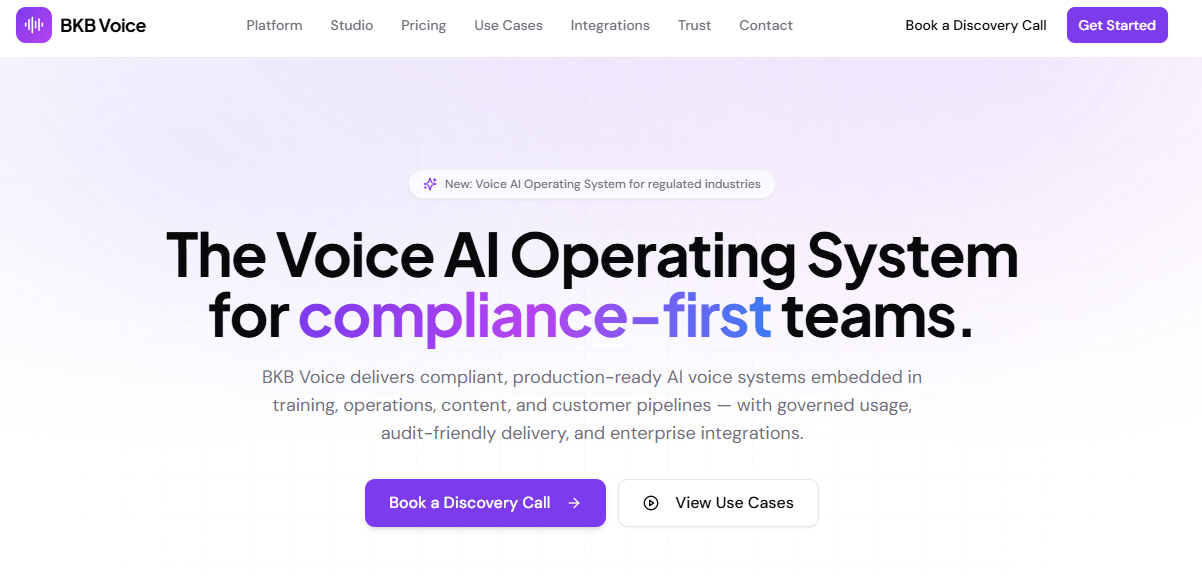
A compliance-first voice operating system that embeds voice generation into governed workflows with approvals and immutable audit logs. According to vendor documentation, it focuses on enterprise integrations and audit-friendly delivery rather than one-off clips.
Best for: Regulated teams that need governed, auditable voice workflows tied to LMS, CRM, or content pipelines rather than a standalone TTS tool.
Key Features:
- Governed voice workflows with approvals and audit logs, per vendor documentation.
- Enterprise integrations via APIs and webhooks to LMS, CRM, helpdesk, and storage, per vendor documentation.
- Versioned, traceable narration for policies, onboarding, and accessibility content, per vendor documentation.
- Usage rights and voice-model licensing tracked at render time, per vendor documentation.
Why we like it: It treats voice as a production step inside existing systems, which reduces shadow tools and centralizes approval evidence when auditors ask for it.
Notable Limitations:
- No independent third-party reviews located as of June 15, 2026. Treat claims as unverified and request reference architectures.
- Categorywide complaints about AI agent platforms often cite opaque pricing and learning curves, so vet SOWs carefully, per G2's analysis of AI agent builders.
- Limited public case studies. Ask for audited controls mapped to SEC 17a-4's audit-trail alternative, which the SEC explains in its rule amendments summary.
Pricing: Per vendor documentation viewed in June 2026: Creator one-time license, Business Workflow monthly subscription, and Enterprise custom contracts. Verify in writing during procurement. If your compliance program relies on WORM or audit-trail alternatives, require contractual attestations referencing SEC Rule 17a-4 updates.
Bevoiceai
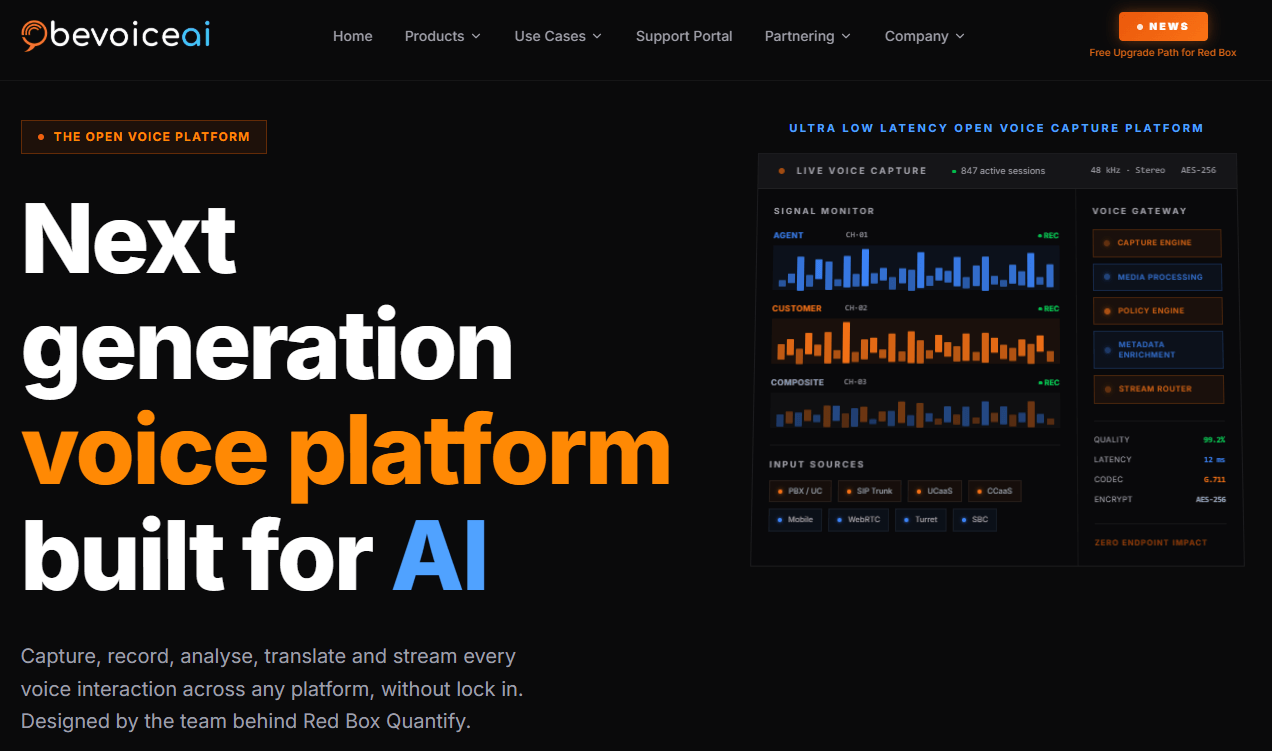
A vendor-neutral voice capture and compliance layer for regulated environments, offering recording, real-time AI orchestration, multilingual translation, and analytics. According to vendor documentation, it connects to SIP, WebRTC, legacy UC, trading systems, and contact centers without endpoint changes.
Best for: Financial services, trading floors, emergency and command environments, or large enterprises consolidating multi-vendor telephony recording and analytics.
Key Features:
- Compliance voice recording with investigation tools and unified capture across legacy, hybrid, and cloud estates, per vendor documentation.
- Real-time AI orchestration to multiple analytics or ASR vendors in parallel, per vendor documentation.
- On-premises or private-cloud analytics layer with transcription, summaries, sentiment, QA, and multilingual translation, per vendor documentation.
- Policy-driven routing that assigns vendors per user, call, language, or scenario, per vendor documentation.
Why we like it: The "capture once, route many" architecture helps avoid lock-in and centralizes compliance posture across mixed telephony estates.
Notable Limitations:
- No independent third-party reviews located as of June 15, 2026. Treat technical claims as unverified until you pilot.
- Expect integration work for complex estates, and confirm codec handling and recording controls for regulated desks.
- Broader buyer feedback on AI agent platforms flags pricing complexity and learning curves, which you should pressure-test in POCs, per G2's buyer data.
Pricing: Pricing not publicly available. Contact Bevoiceai for a custom quote, and require a data-flow diagram plus retention and redaction controls mapped to MiFID II call recording obligations, which ESMA describes in its Q&A on Article 16(7).
Sonotheia
An explainable voice governance platform that pairs forensic detection with audit-ready evidence and decision rationale for regulated voice channels. According to vendor documentation, each verdict is backed by reconstructable artifacts for review.
Best for: Teams that must detect deepfakes or synthetic speech and provide defendable evidence to compliance, risk, or legal.
Key Features:
- Real-time forensic risk detection for synthetic or manipulated audio with configurable thresholds, per company profile data and vendor documentation.
- Explainable outputs with evidence artifacts designed for audits and investigations, per vendor documentation.
- Decision governance so verdicts can be reconstructed, challenged, and defended, per vendor documentation.
Why we like it: It treats detection as the start of an evidence workflow, which matters when you need more than a "confidence score" to act.
Notable Limitations:
- No independent third-party reviews located as of June 15, 2026. Request codec-level benchmarks and false-positive data for your telephony environment.
- Emerging category, so validate performance and chain-of-custody documentation against your admissibility standards.
- Integration patterns are not widely documented. Pilot in your call paths and document controls that align with the FCC's 2024 AI voice ruling for outbound use cases.
Pricing: Pricing not publicly available. Contact Sonotheia for a custom quote and request an evidence pack that maps outputs to your legal hold and audit requirements.
Whispli Voice AI
A secure AI-powered voice intake channel that turns verbal disclosures into structured cases with speech-to-text and anonymity protections. Product pages describe guided voice reporting that converts disclosures directly into Whispli's case management.
Best for: Ethics, whistleblowing, and incident intake programs that need anonymous voice reporting and structured case workflows.
Key Features:
- Voice intake that guides reporters and auto-creates cases, per product pages.
- Speech-to-text transcription with structured fields and workflows, per product pages.
- Anonymous two-way communication and case handling aligned to whistleblowing programs, per product pages.
Why we like it: For regulated disclosures, a single system that handles voice intake and structured case management reduces handoffs and evidence sprawl.
Notable Limitations:
- Reviews note feature gaps and workarounds, such as missing productivity hooks and some features still maturing, per selected user feedback on G2.
- Limited clarity on advanced telephony controls, so confirm consent prompts and jurisdictional disclosures if you accept hotline traffic subject to TCPA rules, which the FCC clarified for AI voices in its 2024 ruling.
Pricing: Pricing not publicly available on trusted third-party marketplaces. Gartner Peer Insights describes a subscription model with pricing upon request at Gartner Peer Insights.
Voice Agent Compliance Tools Comparison: Quick Overview
| Tool | Best For | Pricing Model | Highlights |
|---|---|---|---|
| BKB Voice | Governed voice workflows in regulated orgs | Tiered, per vendor documentation | Immutable audit logs, approvals, enterprise integrations |
| Bevoiceai | Vendor-neutral capture for regulated telephony | Custom quote | Unified recording, real-time AI routing, on-prem analytics |
| Sonotheia | Explainable deepfake detection with evidence | Custom quote | Forensic artifacts and decision governance |
| Whispli Voice AI | Anonymous voice intake and case handling | Subscription, pricing on request | Voice reporting funnels directly into case workflows |
Voice Agent Compliance Platform Comparison: Key Features at a Glance
| Tool | Evidence-grade Audit Logs | On-prem or Private Deployment | Case Management |
|---|---|---|---|
| BKB Voice | Yes, per vendor docs | Not publicly stated | Integrates to LMS, CRM, content stacks |
| Bevoiceai | Yes, per vendor docs | Yes, analytics layer supports on-prem/private cloud | Exports to archives and compliance systems |
| Sonotheia | Yes, explainable artifacts | Not publicly stated | Feeds investigations with evidence |
| Whispli Voice AI | Case-level audit trails | Not publicly stated | Native case management |
Voice Agent Compliance Deployment Options
| Tool | Cloud API | On-Premise | Integration Complexity |
|---|---|---|---|
| BKB Voice | Yes, per vendor docs | Not publicly stated | Requires solution design and approvals mapping |
| Bevoiceai | Yes | Yes, for analytics and capture components | Medium to high in mixed telephony estates |
| Sonotheia | Not publicly stated | Not publicly stated | Validate in telephony path, request codec benchmarks |
| Whispli Voice AI | Yes | Not publicly stated | Low to medium within compliance programs |
Voice Agent Compliance Strategic Decision Framework
| Critical Question | Why It Matters | What to Evaluate | Red Flags |
|---|---|---|---|
| Do retention and audit logs meet SEC 17a-4's audit-trail alternative or WORM? | Broker-dealers must preserve records either in WORM or with complete, time-stamped audit trails, per the SEC's amendments | Signed attestations, exportable evidence packs, third-party audit capability | "Immutable" logs without signer identity or timestamp detail, or no re-creation of original records |
| Is AI voice used outbound, and is consent captured? | The FCC confirmed AI voices are treated as artificial or prerecorded voice under TCPA, which requires consent | Consent capture, disclosures at call start, opt-out mechanisms | No jurisdiction-specific scripts, or lack of call-level consent evidence |
| Can you capture all business voice on approved channels? | Off-channel fines have reached nearly $3.6B since 2021 across SEC and CFTC sweeps, though the SEC slowed new enforcement actions in early 2025; FINRA has since picked up individual-level accountability | Vendor-neutral capture, routing to approved archives | Endpoint-only recording, or unsupported desk types in finance |
| Do intake channels preserve anonymity and auditability? | Whistleblowing programs need anonymous two-way reporting and evidence | Case-level audit trails, role-based access, tamper-evident logs | Ad hoc inboxes without audit trails or disclosure workflows |
Voice Agent Compliance Solutions Comparison: Pricing and Capabilities Overview
| Organization Size | Recommended Setup | Monthly Cost | Annual Investment |
|---|---|---|---|
| 200-1,000 employees, non-broker-dealer | Bevoiceai for unified recording plus Whispli Voice AI for intake | Pricing not publicly available | Pricing not publicly available |
| 1,000-5,000 employees, multi-region | Bevoiceai recording and analytics, BKB Voice for governed narration workflows, Whispli Voice AI for intake | Mix of subscriptions and custom quotes | Custom quotes, include audit-trail attestations |
| Broker-dealer or trading floor | Bevoiceai capture across trading and UC, Sonotheia for deepfake detection on inbound fraud vectors, BKB Voice for governed internal comms | Pricing not publicly available | Pricing not publicly available |
Problems & Solutions
Problem: Off-channel communications penalties. Since 2021, SEC and CFTC actions have reached nearly $3.6B in combined fines, though the SEC paused new off-channel enforcement in the first half of 2025. FINRA has since stepped in, holding individuals personally accountable for off-channel use, including barring a registrant in early 2026. FY2024 alone saw more than $600M in recordkeeping penalties, per law-firm summaries and enforcement trackers from BCLP.
Solution: Bevoiceai centralizes capture across SIP, WebRTC, legacy UC, and trading systems so calls do not escape approved recording, per vendor documentation. BKB Voice builds governed voice processes with approvals and audit logs around internal comms or training so evidence is retrievable, per vendor documentation. Sonotheia adds explainable detection on suspicious voice inputs in hotlines or customer flows to flag synthetic activity with evidence, per vendor documentation. Whispli Voice AI channels sensitive voice disclosures into structured cases with audit trails that compliance can review.
Problem: Outbound AI voice and consent. The FCC clarified that AI-generated or cloned voices fall under TCPA's artificial or prerecorded voice rules, requiring prior express consent for most calls. A pending NPRM proposes mandatory in-call AI disclosure, though the rule has not been finalized as of mid-2026.
Solution: BKB Voice's approval workflows lock final scripts and disclosures by jurisdiction, storing signer identity and timestamps, per vendor documentation. Bevoiceai routes outbound traffic through policy rules that apply consent gating and disclosure prompts before connecting, per vendor documentation. Whispli Voice AI keeps voice intake inbound only, with clear identity disclosures and records of consent where relevant, as aligned to hotline best practices referenced in product materials.
Problem: Retention and auditability. SEC Rule 17a-4 allows either WORM or a full audit-trail alternative with detailed, time-stamped change logs and identity data.
Solution: Bevoiceai exports to archives and compliance systems and supports on-prem analytics for data-residency and control, per vendor documentation. BKB Voice captures immutable logs per render and ties usage rights to outputs, supporting audit-friendly re-creation, per vendor documentation. Whispli Voice AI maintains case-level audit trails and role-based access that can be reviewed during exams.
Problem: MiFID II call recording. Investment firms must record telephone conversations and electronic communications that lead to or intend to lead to a transaction, with retention and supervisory access, as described in ESMA's Q&A.
Solution: Bevoiceai provides compliance recording across heterogeneous estates and supports multilingual analytics on-prem, per vendor documentation. Sonotheia supplies explainable artifacts when fraud or manipulation is suspected, strengthening investigations aligned to supervisory reviews, per vendor documentation.
Bottom Line For Regulated Voice AI Buyers
Most failures are governance failures, not model failures. That means you want platforms that can evidence every step, handle retention lawfully, and respect consent rules for AI voice. Enforcement remains active - while the SEC paused new off-channel cases in early 2025 under the current administration, FINRA has picked up the baton with individual-level enforcement, and the underlying recordkeeping obligations remain unchanged. The multiyear SEC and CFTC total stands near $3.6 billion, per legal analyses and enforcement trackers from Troutman. If you take one action this week, require vendors to demo exportable evidence packs that map to the SEC's audit-trail alternative and to the FCC's TCPA ruling for any outbound AI voice. That single requirement filters most marketing from production-ready platforms.